
Dare to Differentiate Animal School Understanding by Design
Dare to Differentiate
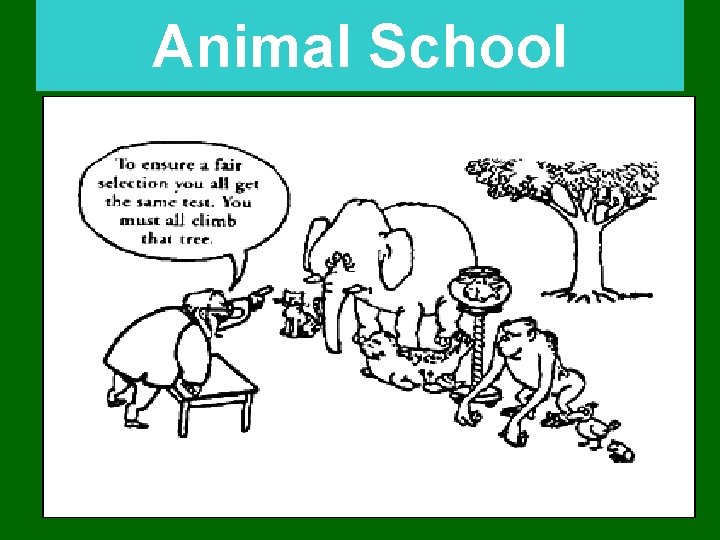
Animal School

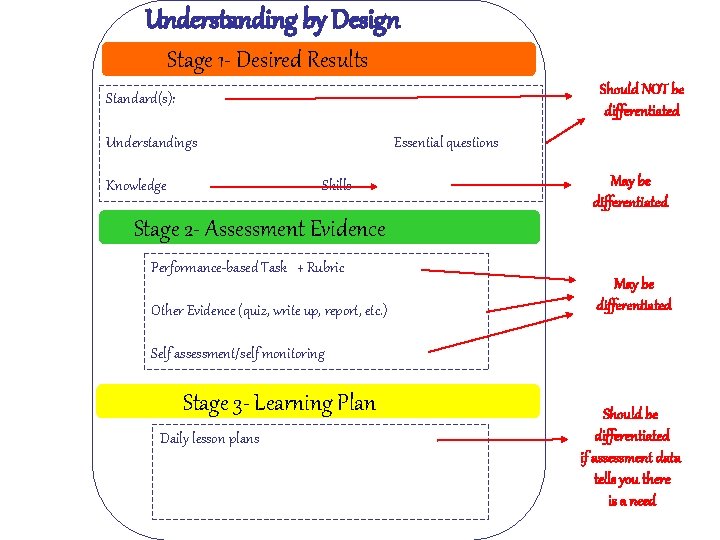
Understanding by Design Stage 1 - Desired Results Should NOT be differentiated Standard(s): Understandings Knowledge Essential questions Skills May be differentiated Stage 2 - Assessment Evidence Performance-based Task + Rubric Other Evidence (quiz, write up, report, etc. ) May be differentiated Self assessment/self monitoring Stage 3 - Learning Plan Daily lesson plans Should be differentiated if assessment data tells you there is a need
Parkway Look-Fors
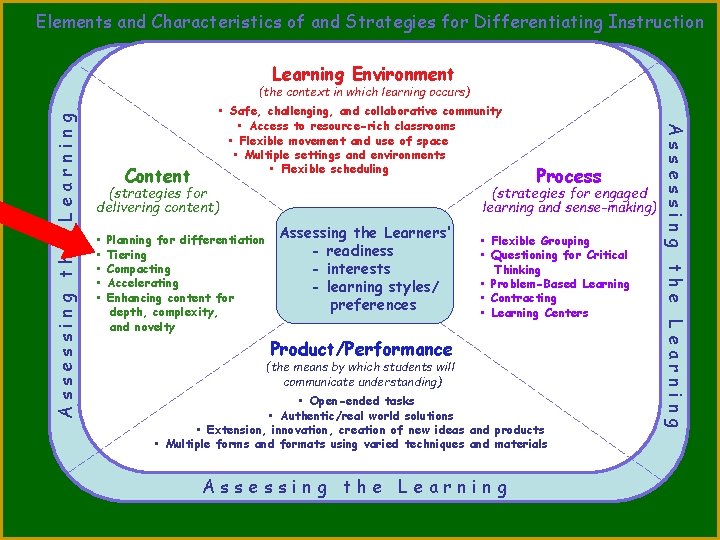
Elements and Characteristics of and Strategies for Differentiating Instruction Learning Environment Content • Safe, challenging, and collaborative community • Access to resource-rich classrooms • Flexible movement and use of space • Multiple settings and environments • Flexible scheduling (strategies for delivering content) • • • Planning for differentiation Tiering Compacting Accelerating Enhancing content for depth, complexity, and novelty Assessing the Learners’ - readiness - interests - learning styles/ preferences Process (strategies for engaged learning and sense-making) • Flexible Grouping • Questioning for Critical Thinking • Problem-Based Learning • Contracting • Learning Centers Product/Performance (the means by which students will communicate understanding) • Open-ended tasks • Authentic/real world solutions • Extension, innovation, creation of new ideas and products • Multiple forms and formats using varied techniques and materials Assessing the Learning (the context in which learning occurs)
Why Pre-Assess? • To make instructional decisions about student strengths and needs. • To determine flexible grouping patterns. • To determine which students are ready for advance instruction
What does Pre-Assessment look like? • Running records • Entrance cards • KWL Charts and other graphic organizers • Standardized test information • Portfolio analysis • Teacher prepared/text prepared pre-tests • Traditional tests • Teacher observation/checklist • Most difficult first • Writing prompts/samples/prewriting activity
In Your Toolbox Pre-Assessment Ideas
A Sample from Our Amazing 2 nd Grade Team… Letter to Parents Contract for Students Unit 7 Objectives and GLES Pre-Assessment Data Analysis
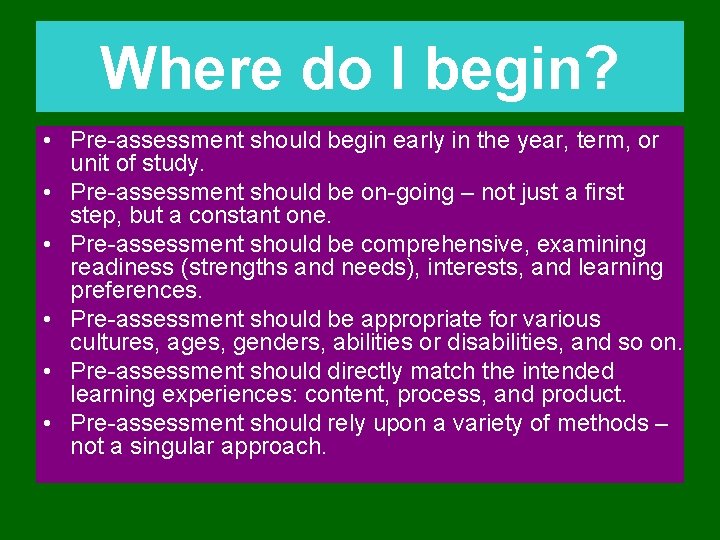
Where do I begin? • Pre-assessment should begin early in the year, term, or unit of study. • Pre-assessment should be on-going – not just a first step, but a constant one. • Pre-assessment should be comprehensive, examining readiness (strengths and needs), interests, and learning preferences. • Pre-assessment should be appropriate for various cultures, ages, genders, abilities or disabilities, and so on. • Pre-assessment should directly match the intended learning experiences: content, process, and product. • Pre-assessment should rely upon a variety of methods – not a singular approach.
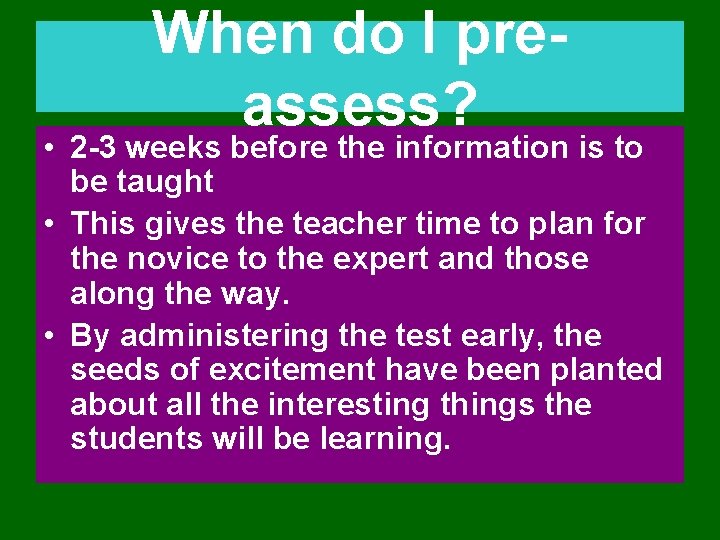
When do I preassess? • 2 -3 weeks before the information is to be taught • This gives the teacher time to plan for the novice to the expert and those along the way. • By administering the test early, the seeds of excitement have been planted about all the interesting things the students will be learning.
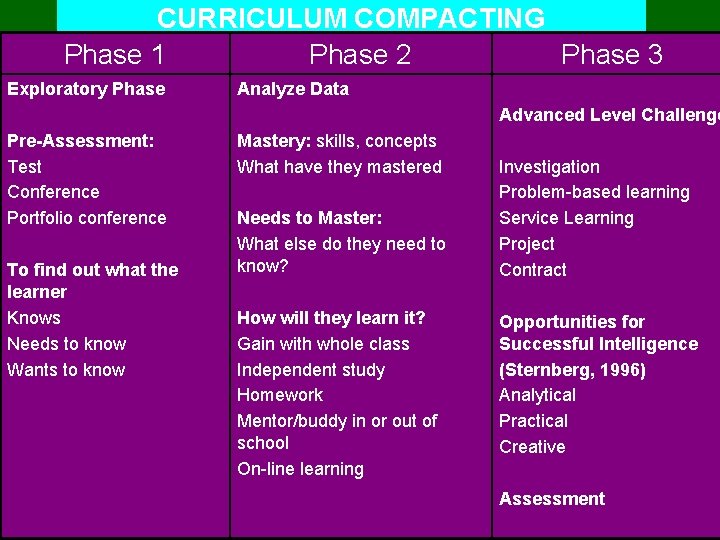
CURRICULUM COMPACTING Phase 1 Phase 2 Phase 3 Exploratory Phase Analyze Data Advanced Level Challenge Pre-Assessment: Test Conference Portfolio conference To find out what the learner Knows Needs to know Wants to know Mastery: skills, concepts What have they mastered Needs to Master: What else do they need to know? How will they learn it? Gain with whole class Independent study Homework Mentor/buddy in or out of school On-line learning Investigation Problem-based learning Service Learning Project Contract Opportunities for Successful Intelligence (Sternberg, 1996) Analytical Practical Creative Assessment
PACING: Curriculum Compacting Modify and/or streamline regular curriculum to: • eliminate repetition of previously mastered material • upgrade the challenge level of the regular curriculum • determine student “readiness” • provide time for enrichment and/or acceleration activities
Curriculum Compacting 1) What’s important? 2) What do students already know or are able to do? 3) What will they grasp at a faster rate? 4) What skill or task can be accomplished quickly?
Tools for Compacting Curriculum • Assessments (Pre, Ongoing, Formative, Summative) • Menus of Challenging Activities • Product Choices Chart • Tiered Lessons • Working Agreements or Learning Contracts • Anchor Activities
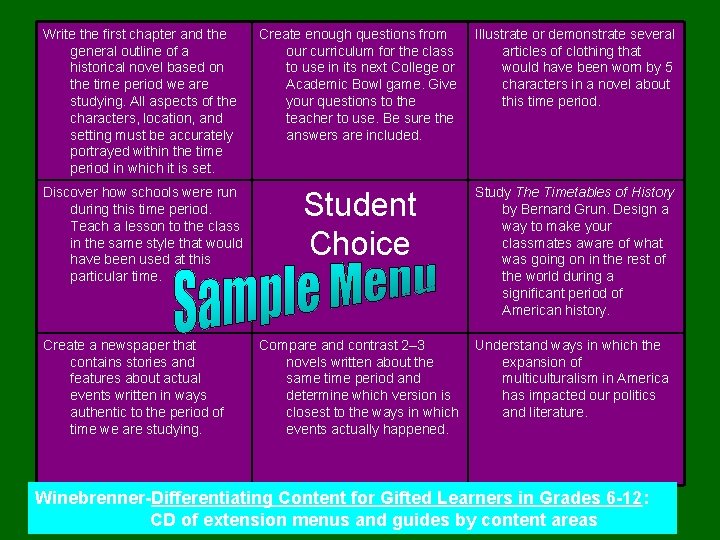
Write the first chapter and the general outline of a historical novel based on the time period we are studying. All aspects of the characters, location, and setting must be accurately portrayed within the time period in which it is set. Discover how schools were run during this time period. Teach a lesson to the class in the same style that would have been used at this particular time. Create a newspaper that contains stories and features about actual events written in ways authentic to the period of time we are studying. Create enough questions from our curriculum for the class to use in its next College or Academic Bowl game. Give your questions to the teacher to use. Be sure the answers are included. Illustrate or demonstrate several articles of clothing that would have been worn by 5 characters in a novel about this time period. Student Choice Study The Timetables of History by Bernard Grun. Design a way to make your classmates aware of what was going on in the rest of the world during a significant period of American history. Compare and contrast 2– 3 novels written about the same time period and determine which version is closest to the ways in which events actually happened. Understand ways in which the expansion of multiculturalism in America has impacted our politics and literature. Winebrenner-Differentiating Content for Gifted Learners in Grades 6 -12: CD of extension menus and guides by content areas
Examples of Choice Boards Dare to Differentiate 2 nd Grade’s Menu
Learning Contracts • A written agreement between the student and the teacher which includes opportunities for the student to work relatively independently on primarily teacherdirected material. The student has: – Some freedom in acquiring skills and understandings – Responsibility for learning independently – Guidelines for completing work – Guidelines for appropriate behavior – Expectations tailored to readiness level
Anchoring Activities • Self-paced, purposeful, content-driven activities that students can work on independently throughout a unit, a grading period, or longer • Meaningful ongoing activities related to the curriculum – A list of activities that a student can do at any time – A long-term project – An activity center/learning station located in the room • These activities must be worthy of a student’s time and appropriate to their learning needs
Tiered Activities Tiered Instruction features: ü Whole group introduction and initial instruction ü Identification of developmental differences ü Ladder Analogy (bottom – up; challenge/complexity) ü Increase or Decrease the: ü Abstraction/Challenge Levels (ie. application, analysis & synthesis) ü Extent of Support Sample ü Complexity of: ü outcomes ü resources (reading levels, types of text [on-line, magazine, etc…], based on prior-knowledge levels) ü processes (way in which students obtain information) ü products (M. I. products)
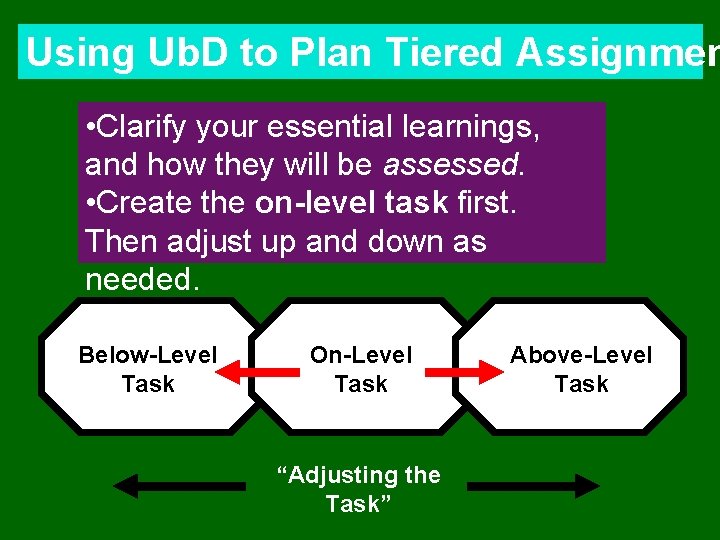
Using Ub. D to Plan Tiered Assignmen • Clarify your essential learnings, and how they will be assessed. • Create the on-level task first. Then adjust up and down as needed. Below-Level Task On-Level Task “Adjusting the Task” Above-Level Task
- Slides: 22