
DARE Disability Access Route to Education School Presentation
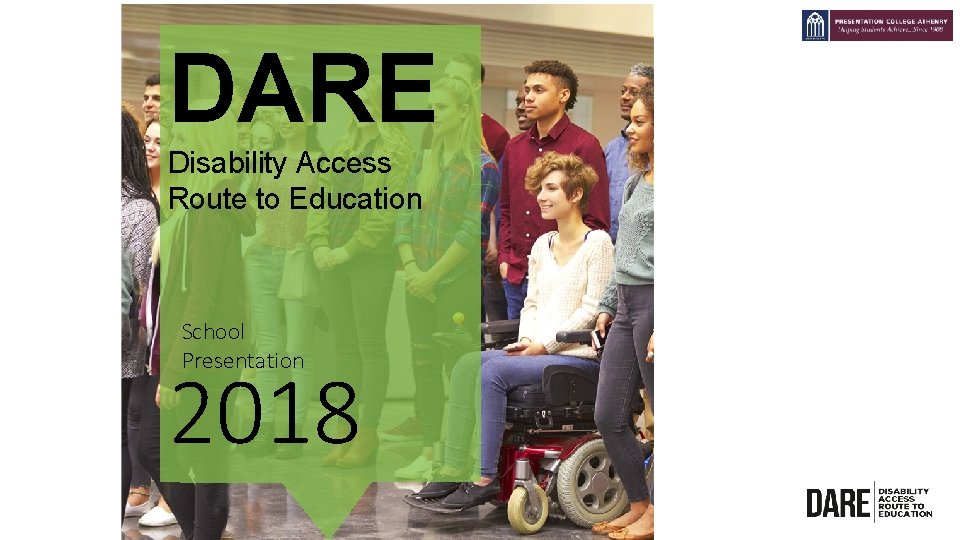
DARE Disability Access Route to Education School Presentation 2018
Watch!! Double click on video image and arrow below to play: https: //www. youtube. com/watch? v=YU 1 Mt. Cjb. Zt. A

Where can I go to College? • St. Angela’s College, Sligo. • IT Sligo • Maynooth University • Pontifical University • AIT • Dublin Institute of Technology • Dublin City University • Institute of Art, Design & Technology, Dún Laoghaire • RCSI • Trinity College, Dublin • University College, Dublin • Marino Institute of Education • National College of Ireland • NUI Galway • University of Limerick • Limerick Institute of Technology • Mary Immaculate College • University College Cork • CIT • Institute of Technology, Carlow
What is DARE? The Disability Access Route to Education (DARE) is a third level alternative admissions scheme for school-leavers whose disabilities have had a negative impact on their second level education. DARE offers reduced points places to school leavers who as a result of having a disability have experienced additional educational challenges in second level education.
Should I Apply? • If your disability has had a negative impact on your educational performance in school. • You may not be able to meet the points for your preferred course due to the impact of disability. • You are under 23 years as at 1 January 2018.

Disabilities eligible for consideration • • • Autistic Spectrum Disorders (including Asperger’s Syndrome) ADD / ADHD Blind / Vision Impaired Deaf / Hard of Hearing DCD – Dyspraxia/Dysgraphia Mental Health Condition Neurological Condition (Incl. Brain Injury & Epilepsy, ) Speech & Language Communication Disorder Significant Ongoing Illness Physical Disability Specific Learning Difficulty (Dyslexia & Dyscalculia)
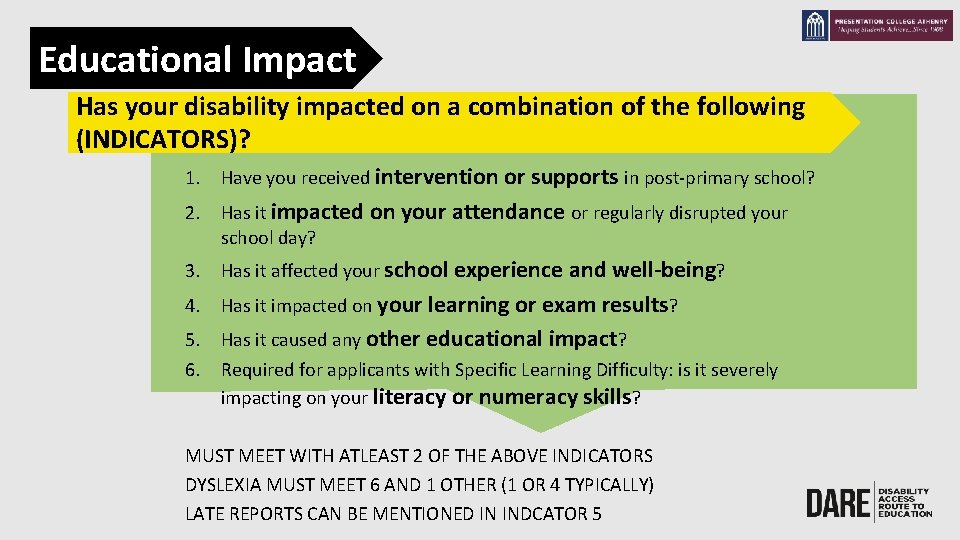
Educational Impact Has your disability impacted on a combination of the following (INDICATORS)? 1. Have you received intervention or supports in post-primary school? 2. Has it impacted on your attendance or regularly disrupted your school day? 3. Has it affected your school experience and well-being? 4. Has it impacted on your learning or exam results? 5. Has it caused any other educational impact? 6. Required for applicants with Specific Learning Difficulty: is it severely impacting on your literacy or numeracy skills? MUST MEET WITH ATLEAST 2 OF THE ABOVE INDICATORS DYSLEXIA MUST MEET 6 AND 1 OTHER (1 OR 4 TYPICALLY) LATE REPORTS CAN BE MENTIONED IN INDCATOR 5
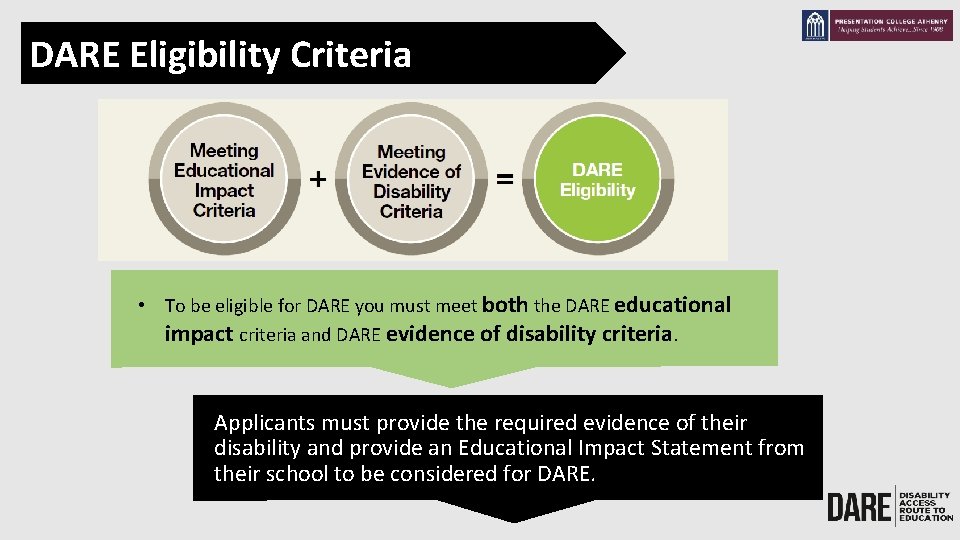
DARE Eligibility Criteria • To be eligible for DARE you must meet both the DARE educational impact criteria and DARE evidence of disability criteria. Applicants must provide the required evidence of their disability and provide an Educational Impact Statement from their school to be considered for DARE.

Benefits of DARE Reduced Points • An example: If the Leaving Certificate points for a course is 366 points, an eligible DARE applicant could be offered a place with a lower points score e. g. 356 points. • Applicants need to meet entry and programme requirements to be considered for a DARE reduced points offer. • The amount of points a particular course is reduced by is dependent on: • The overall number of places on the course • The number of reserved DARE places on the course • The number of DARE eligible applicants competing for these reserved places. • The reduction in points for DARE places can vary every year.

Benefits of DARE • • Orientation Programmes Learning Support Assistive Technology Library Support • Exam Accommodations • Educational Support Worker • Academic Tuition • You don’t have to be eligible for DARE to get support in college. • A needs assessment is conducted to identify your specific support requirements.
How do I apply? Tell your guidance Counsellor that you wish to apply and why. Your guidance Counsellor will help you with your application with discretion.

How do I apply? 1. Apply to CAO at www. cao. ie by 1 February 2018. 2. Review your DARE Handbook with parents or guardians. 3. Complete all elements of the online DARE application form by 1 March 2018. 4. You should start gathering your documentation in a timely fashion, i. e. before 1 March. 5. Submit clear copies of supporting documents requested on your checklist to CAO by 1 April 2018.
Helpful Tips • Your counsellor will help you fill in the forms on and offline. • Will advise you re the necessary evidence paperwork. • Will help you fill in your Educational Impact Statement by discussing the Indicators with you. . • • • Request Evidence of Disability documents early. Send good quality copies of all pages of the correct documents completed by appropriate professionals. Submit all Evidence of Disability documents requested. • Keep proof of postage. • Deadlines!
Applying for a grant DARE is NOT a SUSI grant. . If you apply to DARE, you should also apply to SUSI if you think you may be eligible.
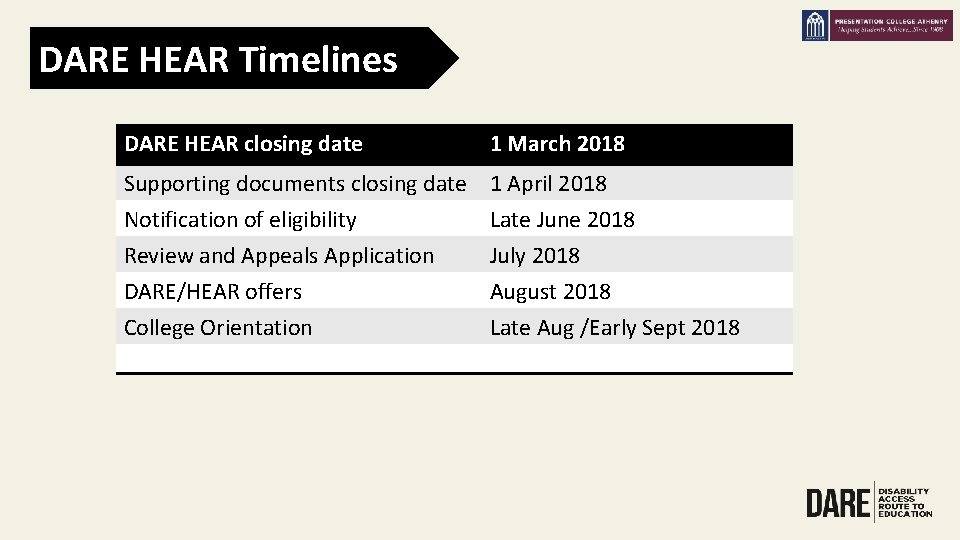
DARE HEAR Timelines DARE HEAR closing date 1 March 2018 Supporting documents closing date Notification of eligibility Review and Appeals Application DARE/HEAR offers College Orientation 1 April 2018 Late June 2018 July 2018 August 2018 Late Aug /Early Sept 2018

HEAR Higher Education Access Route School Presentation 2018
What is HEAR? The Higher Education Access Route is an admissions route for school leavers who for social, financial or cultural reasons are under-represented at third level education. It was set up to ensure that all Leaving Certificate students have a fair and equal opportunity to progress to third level education.
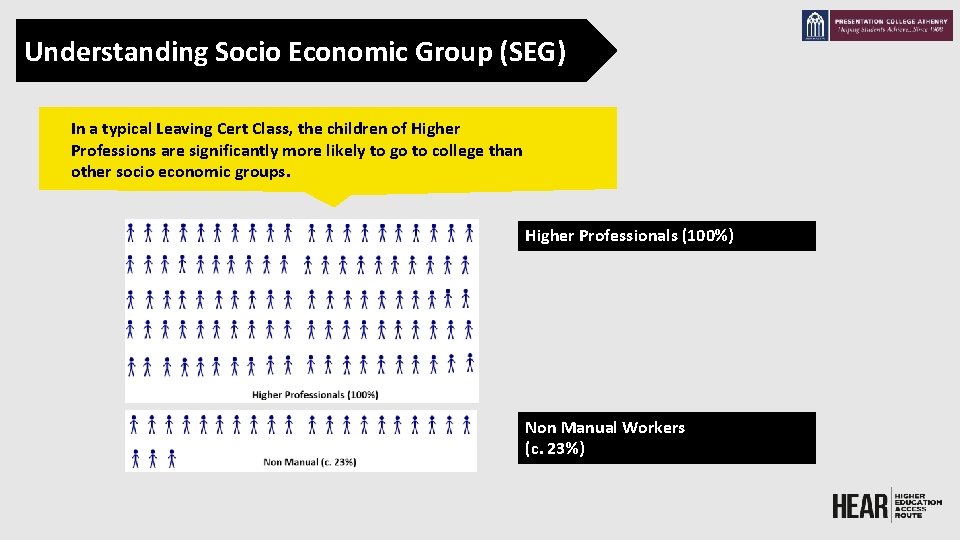
Understanding Socio Economic Group (SEG) In a typical Leaving Cert Class, the children of Higher Professions are significantly more likely to go to college than other socio economic groups. Higher Professionals (100%) Non Manual Workers (c. 23%)
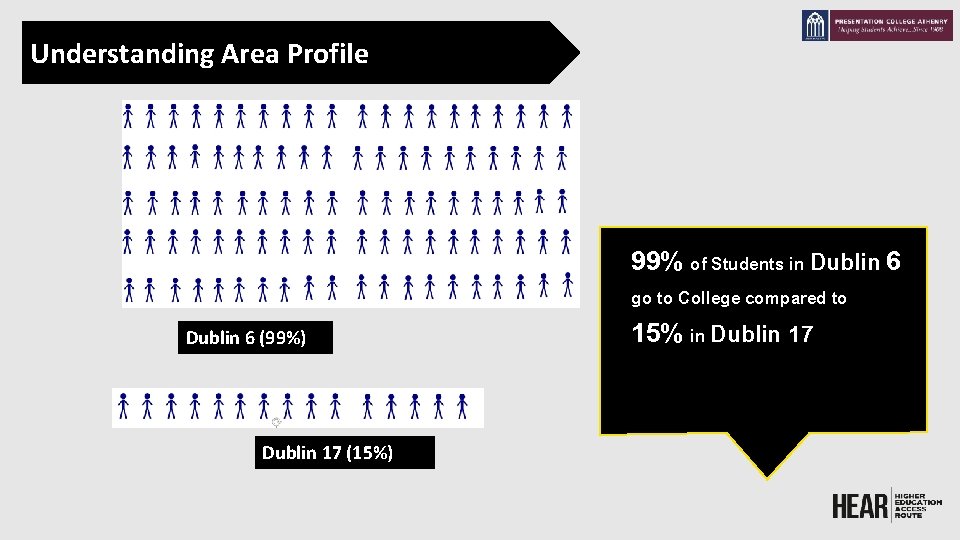
Understanding Area Profile 99% of Students in Dublin 6 go to College compared to Dublin 6 (99%) Dublin 17 (15%) 15% in Dublin 17

Where can I go to College? • St. Angela’s College, Sligo. • IT Sligo • Maynooth University • Pontifical University • Dublin Institute of Technology • Dublin City University • Institute of Art, Design & Technology, Dún Laoghaire • RCSI • Trinity College, Dublin • University College, Dublin • Marino Institute of Education • National College of Ireland • NUI Galway • University of Limerick • Mary Immaculate College • University College Cork
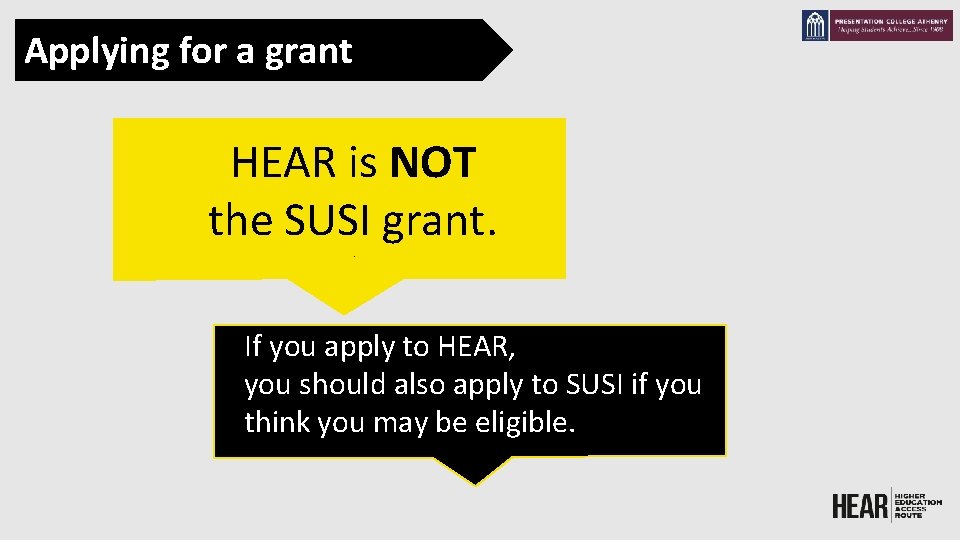
Applying for a grant HEAR is NOT the SUSI grant. . If you apply to HEAR, you should also apply to SUSI if you think you may be eligible.
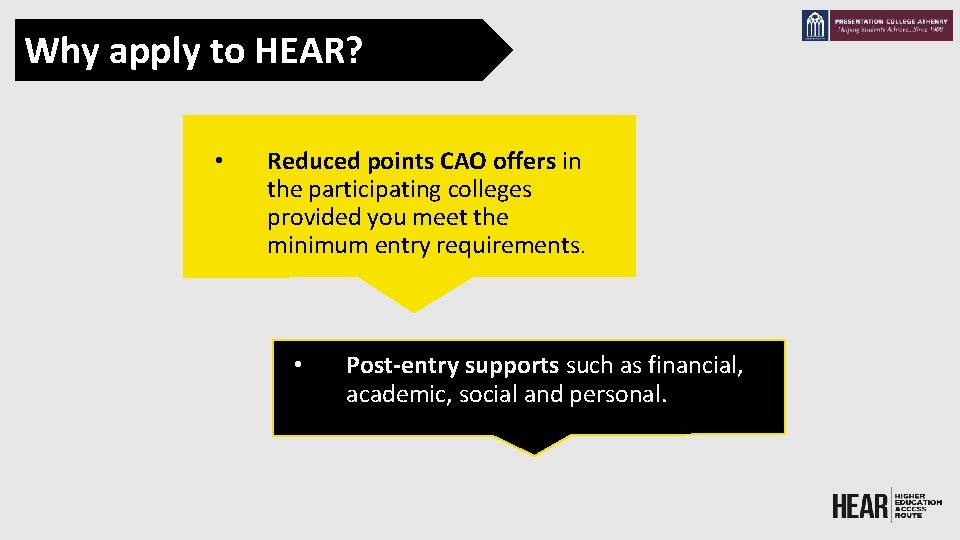
Why apply to HEAR? • Reduced points CAO offers in the participating colleges provided you meet the minimum entry requirements. • Post-entry supports such as financial, academic, social and personal.
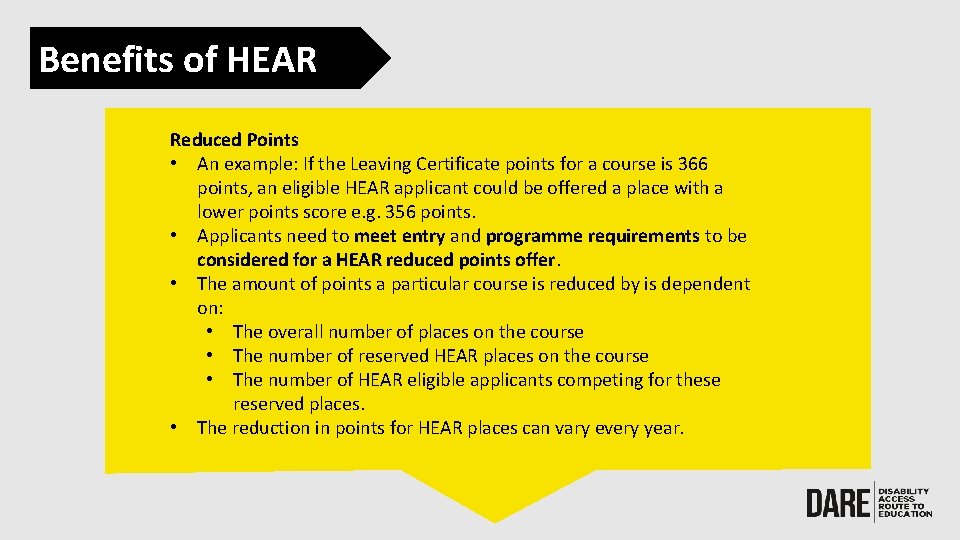
Benefits of HEAR Reduced Points • An example: If the Leaving Certificate points for a course is 366 points, an eligible HEAR applicant could be offered a place with a lower points score e. g. 356 points. • Applicants need to meet entry and programme requirements to be considered for a HEAR reduced points offer. • The amount of points a particular course is reduced by is dependent on: • The overall number of places on the course • The number of reserved HEAR places on the course • The number of HEAR eligible applicants competing for these reserved places. • The reduction in points for HEAR places can vary every year.
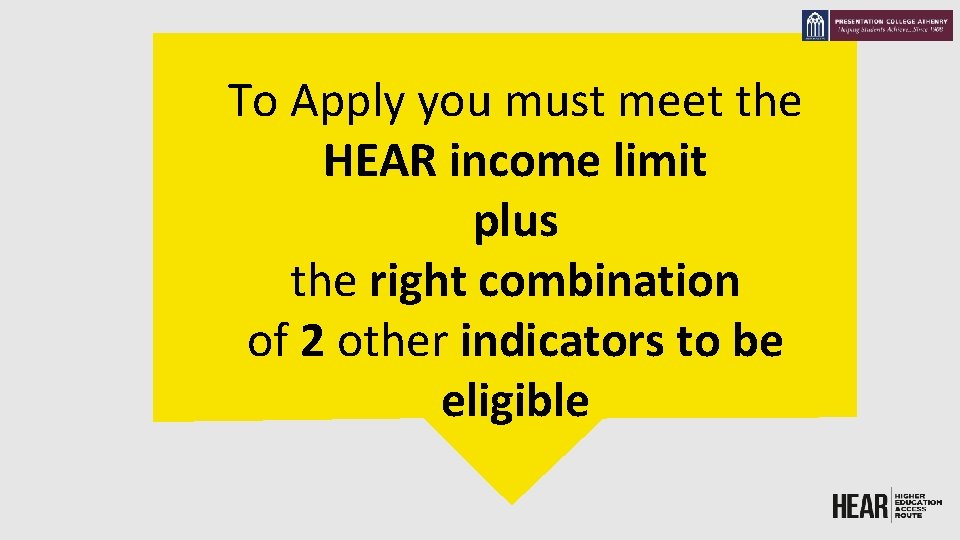
To Apply you must meet the HEAR income limit plus the right combination of 2 other indicators to be eligible
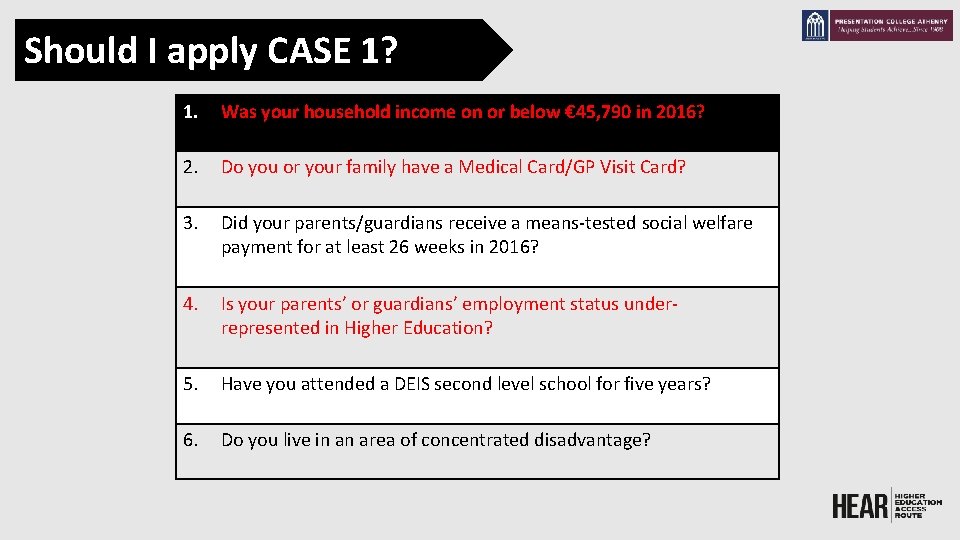
Should I apply CASE 1? 1. Was your household income on or below € 45, 790 in 2016? 2. Do you or your family have a Medical Card/GP Visit Card? 3. Did your parents/guardians receive a means-tested social welfare payment for at least 26 weeks in 2016? 4. Is your parents’ or guardians’ employment status underrepresented in Higher Education? 5. Have you attended a DEIS second level school for five years? 6. Do you live in an area of concentrated disadvantage?
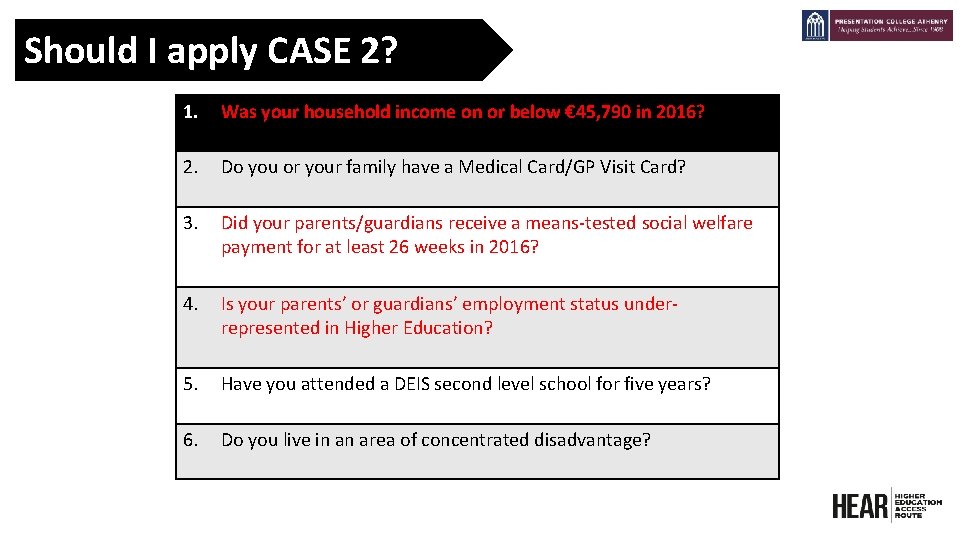
Should I apply CASE 2? 1. Was your household income on or below € 45, 790 in 2016? 2. Do you or your family have a Medical Card/GP Visit Card? 3. Did your parents/guardians receive a means-tested social welfare payment for at least 26 weeks in 2016? 4. Is your parents’ or guardians’ employment status underrepresented in Higher Education? 5. Have you attended a DEIS second level school for five years? 6. Do you live in an area of concentrated disadvantage?
Talk to your parent / Guardian and then tell your Guidance Counsellor. ?

How do I apply? Tell your Guidance Counsellor that you wish to apply to HEAR.

How do I apply? The plan. 1. Apply to CAO at www. cao. ie by 1 February 2018. 2. Review your HEAR Handbook with parents or guardians. 3. Complete all elements of the online HEAR application form by 1 March 2018. 4. Submit clear copies of supporting documents requested on your checklist to CAO by 1 April 2018.
How do I know what documents I need? You can start your application as soon as the CAO opens on 6 November 2017. Do not leave it too late to start looking for the documents you need for your application – you should start gathering the documents you need before 1 March 2018
Helpful Tips • Your counsellor will help you • …. with the application. • Complete the online application accurately. • With an Accurate description of Parental Occupation. • Request the required supporting documentation early. • Send good quality copies of all pages of the correct documents. • Submit all supporting documents requested. • Keep proof of postage. • Deadlines!

Application Advice Clinics
Further Information cao. ie susi. ie qualifax. ie
Follow us on…. . www. accesscollege. ie facebook. com/accesscollege
Remember þ Submit it! þ Check it! þ Send it!
Remember You can apply to both DARE & HEAR Applicants who are both DARE and HEAR eligible will be prioritised by colleges when allocating reduced points places.
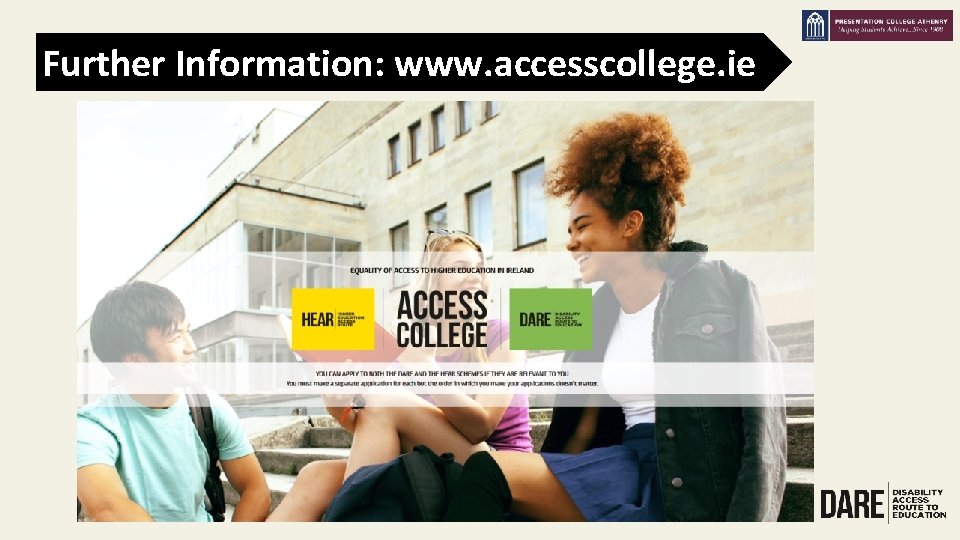
Further Information: www. accesscollege. ie
- Slides: 37