
Dante Alighieri La Commedia The Inferno Dantes Background
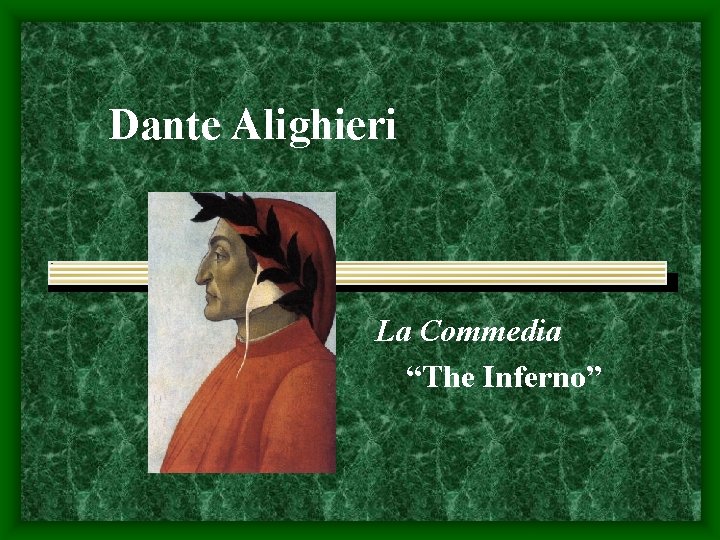
Dante Alighieri La Commedia “The Inferno”

Dante’s Background • • Italian Catholic Born in Florence 1265 Exiled to Ravenna in 1302 Died of malaria in 1321 in Ravenna where he is buried • Florence has an empty tomb for him – supplies oil for his Ravenna lamp • Not much is known about his life and background
What about his family? • Middle class background of some nobility • Father was notary who owned a bit of property – not wealthy; poor family connections • Mother died when he was young • Student, soldier, author, draftsman • He was a Guelph – in mid-1300 was a short-time “political leader” of Florence
Who were the Guelphs and Ghibellines? • • Guelphs (Welfs – princely German family) Ghibellines (Waiblingen – German Castle) What did German families have to do with Italy? Due to warring – two centers of defense and stability emerged: the Papacy and a dominant continental power • Guelphs often aligned with papacy; Ghibellines against local forces • Dante is accused of corruption, fined five thousand florins, has goods confiscated and is sentenced to burning alive. • Exiled from beloved Florence for twenty years –he never sees Florence again.
What’s Dante to do? • Claims to be an undeserving exile • Wanders about Italy, searching for patrons who appreciated his literary talents, lectures, writes “The Comedy” • Describes himself as “wandering as a stranger through almost every region to which our language reaches…a ship without sails or rudder, driven to various harbors and shores by the parching wind that blows from pinching poverty. ”
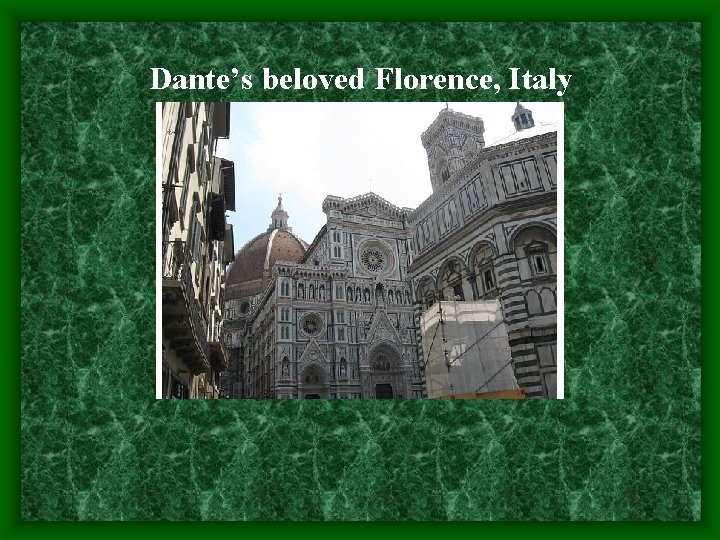
Dante’s beloved Florence, Italy
Who is Beatrice? • • • Beatrice Portinari (Dante’s other beloved) The heroine of his poem Dante first saw her when he was nine Permanently smitten by her Her death plunged him into grief
What is his masterpiece called? La Comedia/La Commedia • A comedy? The main character (himself) attains a happy • • ending – a healing vision of God- and receives a divine message to deliver. A common man writing for the common man and woman, he uses the vernacular Italian and not the Latin of scholars Early commentators who were impressed began to refer to the work as “divine” Some even applied the term to Dante himself Dante declares it a “sacred” poem – composed during the last ten or eleven years of his life

The Poem • Contains 14, 233 lines (The Odyssey contains 12, 100) • Divided into three major canzoni (song collections) • • -THE INFERNO -THE PURGATORIAO -THE PARADISIO Each major section contains 33 cantos – with the Introduction, this equals the perfect 100. Dante’s basic unit is the tercet – terzine, a three-line stanza of which the first and third lines rhyme i. e. cat/green/bat The rhyme of the middle line becomes the rhyme of the first and third lines of the next tercet i. e. seen/glow/keen - - flow/red/snow “terza rima” – a third rhyme Many threes in the poem -
The essence of The Divine Comedy… • Think allegory, allegory • An enlightening and purifying journey taken by a sinful poet to the next world • Spheres of endless punishment • Story of how a good woman’s love can save a man • It is a journey, a travelogue (of sorts), an adventure tale, a parable of political realities, moral realities, and mystical realities
Why did he write it? • Several reasons: – To liberate people from their state of misery –people still alive in the world – To lead these people to happiness – To praise Beatrice – To show the state of souls after death – To “vent” both his anger and his disappointment: he condemned the interference of the church and the pope in political affairs, though he was still devoted to his religion, Catholicism.
If the work is taken allegorically, the subject is: man becoming liable to the justice which rewards and punishes, inasmuch by the exercise of his own free will –his freedom of choice which merits good or evil.
It’s Hell Here… • In the middle of life, losing one’s bearings, sense of meaning – engulfed in darkness and confusion – it’s hell. • Dante has to “hit bottom” to witness the full maturation of fruits of evil so that he can rise up from this condition. • Virgil, the wise man who represents Reason, and Beatrice, the beautiful woman who represents goodness, assist him on this journey.

Eternal punishment – the contrapasso – divine retribution – punishment fits the crime • The punishments that exist in Hell are the flowering of the sin itself. • A vengeful God does not send sinners here – the sinners send themselves here.

Dante’s Inferno • In the Inferno, the poet Virgil has been sent by Beatrice to lead Dante through Hell, a series of downward spiraling circles, organized according to the gravity of the sin committed. • Takes place during Easter season. • Midway through life, Dante realizes he has strayed from the True Way into the Dark Wood of Error (worldliness). As he realizes his loss, he sees the first light of sunrise (divine illumination) lighting the Mount of Joy.

Dante’s Inferno (continued) • He tries to climb the hill, but is blocked by three beasts: the Leopard of Malice and Fraud, the Lion of Violence and Ambition, and the She-wolf of Incontinence. These beasts drive him back into the dark wood of error. • When it appears all hope is lost, Virgil appears as his guide; he symbolizes human reason. He’s there to lead Dante from error. They have to go through Hell to get around the beasts.
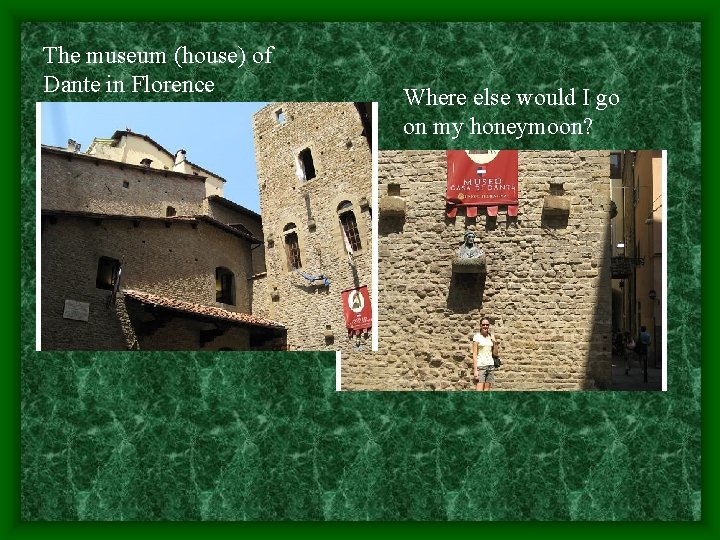
The museum (house) of Dante in Florence Where else would I go on my honeymoon?
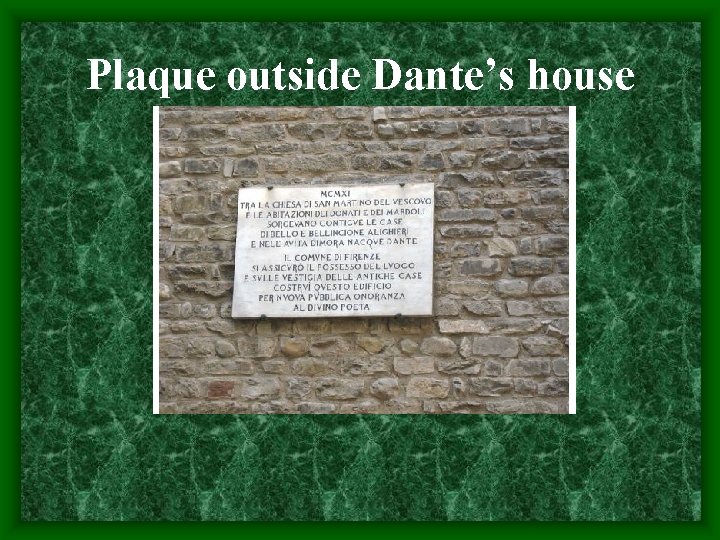
Plaque outside Dante’s house
The end (and the beginning of your journey through Hell…) Slide show adapted from Eileen Radetich, 2010
- Slides: 19