
Daniel Eusebio Roque 0543278 CMD 4 A Pragmatics
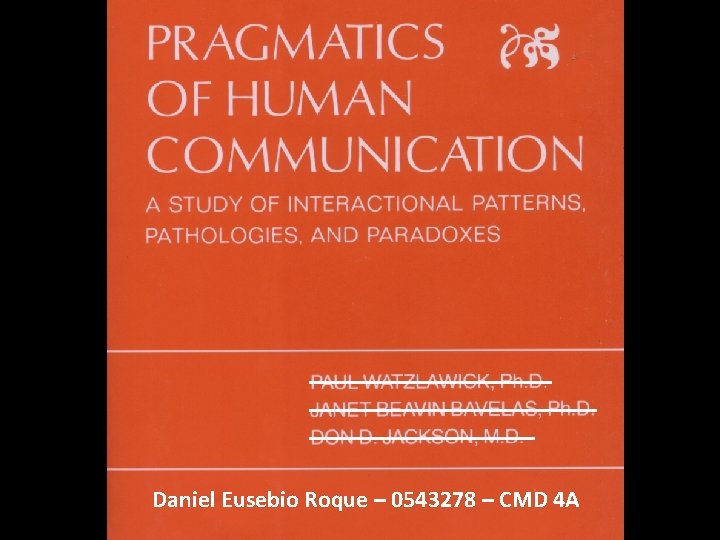
Daniel Eusebio Roque – 0543278 – CMD 4 A
Pragmatics of Human Communication • Summary in chapters – 1 through 8 • Conclusion
Pragmatics of Human Communication Chapter 1 – Frame of reference – Phenomena of human communication • Syntactical • Semantics • Pragmatic – All behavior is communication, all communication affects behavior
Pragmatics of Human Communication Chapter 2 – Some tentative axioms of communication – Individual does not communicate; he engages in or becomes part of communication. – Mathematical concept of function – variables with infinity of possible values (not absolute) emerges only in relation to each other.
Pragmatics of Human Communication Chapter 3 – Pathological communication – Erroneous judgment was based on content rather than on the interaction. (example: sarcasm) – The functions of communication are the relation between 2 or more responses, not the nature of the statements as individual entities.
Pragmatics of Human Communication Chapter 4 – Pragmatics of human communication – Human interaction = communication system • Variables • Relations – The principle that in open systems a given end state can be reached by many potential means.
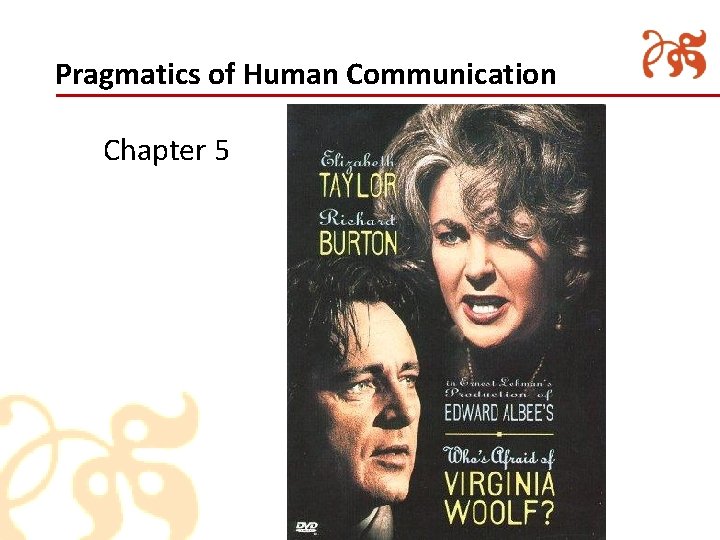
Pragmatics of Human Communication Chapter 5
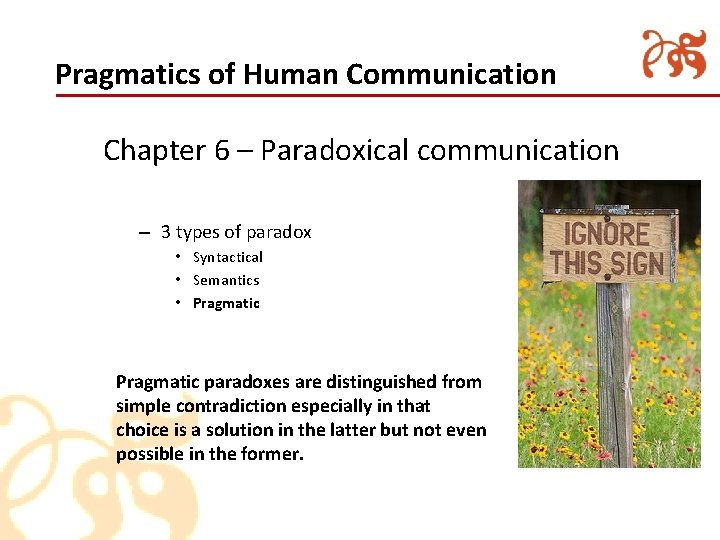
Pragmatics of Human Communication Chapter 6 – Paradoxical communication – 3 types of paradox • Syntactical • Semantics • Pragmatic paradoxes are distinguished from simple contradiction especially in that choice is a solution in the latter but not even possible in the former.
Pragmatics of Human Communication Chapter 7 – Paradox in psychotherapy – Positive – many of the noblest pursuit and achievements of the human mind are linked with the ability to experience paradox. • Fantasy –humor – love – symbolism – creativity • Two young monkeys playing (example) – Creativity = unstable equilibrium, balance disturbed between emotion and thought
Pragmatics of Human Communication Chapter 8 – Epilogue • ‘It is not the things themselves which troubles us, but the opinions which we have about these things. ’ – Epictetus (1 st century AD) • Is the mind a formalized system? Unanswerable. • …nothing inside a frame can state, or even ask, anything about that frame.
Pragmatics of Human Communication Conclusion
Pragmatics of Human Communication End presentation Questions, remarks?
- Slides: 12