
Daniel Defoe Robinson Crusoe 1719 Daniel Defoe 1650
Daniel Defoe Robinson Crusoe 1719
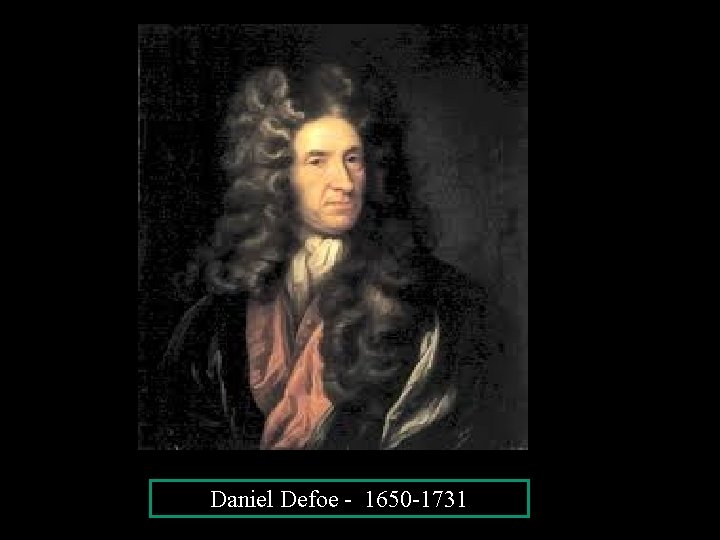
Daniel Defoe - 1650 -1731
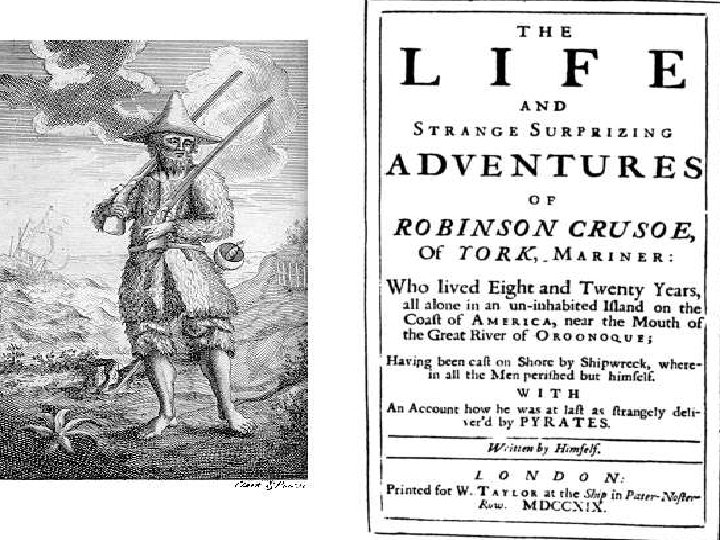
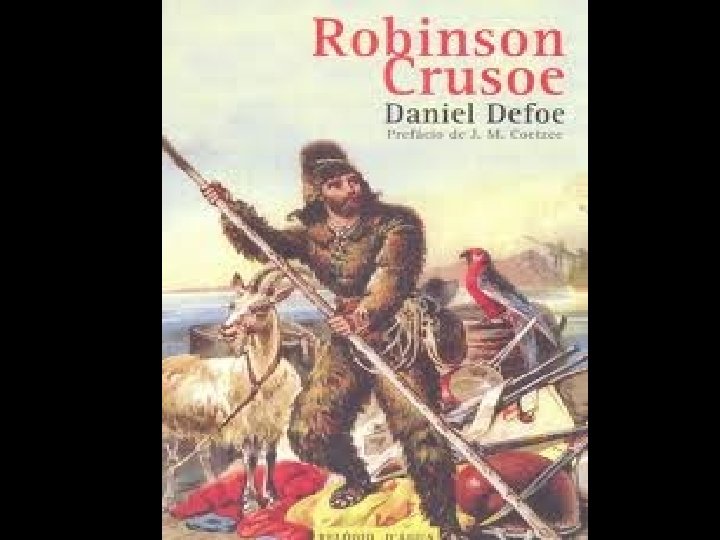
Ø Robinson Crusoe, Individualism and the Novel Ø Ian Watt: The Rise of the Novel (1956) Ø The novel’s serious concern with the daily lives of ordinary people seems to depend upon two important general conditions: Ø a) the society must value every individual highly enough to consider him[her] the proper subject of its serious literature;
Ø Robinson Crusoe, Individualism and the Novel Ø b) and there must be enough variety of belief and action among ordinary people for a detailed account of them to be of interest to other ordinary people, the readers of novels. Ø Defoe's first work of fiction sheds on the nature of the connexions between economic and religious individualism and the rise of the novel.
Ø Robinson Crusoe, Individualism and the Novel Ø But since the primary reason for the interest in Robinson Crusoe has been its literary greatness, the relation between that greatness and the way it reflects the deepest aspirations and dilemmas of individualism also requires brief consideration.
Ø Robinson Crusoe, Individualism and the Novel Ø Robinson Crusoe falls most naturally into place, not with other novels, but with the great myths of Western civilization, with Faust, Don Juan, and Don Quixote. Ø All these have as their basic plots, their enduring images, a single-minded pursuit by the protagonist of one of the characteristic desires of Western man.
Ø Robinson Crusoe, Individualism and the Novel Ø Each of their heroes embodies an internal split and an arrogance, an exceptional prowess and a vitiating excess, in spheres of action that are particularly important in Western culture. Ø Don Quixote, the impetuous generosity and the limiting blindness of chivalric idealism; (Miguel de Cervantes)
Ø Robinson Crusoe, Individualism and the Novel Ø Don Juan, pursuing and at the same time tormented by the idea of boundless experience of women; (Tirso de Molina) Ø Faust, the great knower, his curiosity always unsatisfied, and therefore damned. (Johann Wolfgang von Goethe)
Ø Robinson Crusoe, Individualism and the Novel Ø Crusoe, of course, seems to insist that he is not of their company; Ø they are very exceptional people, whereas anyone would do what he did, in the circumstances.
Ø Robinson Crusoe, Individualism and the Novel Ø Yet he too has an exceptional prowess; he can manage quite on his own. Ø And he has an excess: his inordinate egocentricity condemns him to isolation wherever he is. Ø The egocentricity, one might say, is forced on him, because he is cast away on an island.
Ø Robinson Crusoe, Individualism and the Novel Ø But it is also true that his character is throughout courting its fate and it merely happens that the island offers the fullest opportunity for him to realize three associated tendencies of modern civilization: Ø -absolute economic, social, and intellectual freedom for the individual.
Ø Robinson Crusoe, Individualism and the Novel Ø It was Crusoe’s realization of intellectual freedom which made Rousseau propose the book as “the one book that teaches all that books can teach” for the education of Emile;
Ø Robinson Crusoe, Individualism and the Novel Ø He argued that “the surest way to raise oneself above prejudices, and order one’s judgement on the real relationship between things, is to put oneself in the place of an isolated man, and to judge of everything as that man would judge of them according to their actual usefulness”. Ø On his island Crusoe also enjoys the absolute freedom from social restrictionsthere are no family ties or civil authorities to interfere with his individual autonomy.
Ø Robinson Crusoe, Individualism and the Novel Ø Even when he is no longer alone his personal autarchy remains -indeed it is increased: the parrot cries out his master’s name; unprompted, Ø Friday swears to be his slave forever; Ø Crusoe toys with the fancy that he is an absolute man. Ø Lastly, Crusoe's island gives him the complete laisse-faire which economic man needs to realize his aims.
Ø Robinson Crusoe, Individualism and the Novel Ø At home, market conditions, taxation, and problems of the labour supply make it impossible for the individual to control every aspect of production, distribution, and exchange.
Ø Robinson Crusoe, Individualism and the Novel Ø The conclusion is obvious. Ø Follow the call of the wide open places, discover an island that is desert only because it is barren of owners or competitors, and there build your personal Empire with the help of a Man Friday who needs no wages and makes it much easier to support the white man's burden.
Ø Robinson Crusoe, Individualism and the Novel Ø Such is the positive and prophetic side of Defoe's story, the side which makes Crusoe an inspiration to economists and educators, and a symbol both for the displaced persons of urban capitalism, such as Rousseau, and for its more practical heroes, the empire builders. Ø Crusoe realizes all these ideal freedoms, and in doing so he is undoubtedly a distinctively modern culture-hero.
Ø Robinson Crusoe, Individualism and the Novel Ø Aristotle, for example, who thought that the man 'who is unable to live in society, or who has no need because he is sufficient for himself, must be either a beast or a god. Ø Perhaps with reason; for it is surely true that the ideal freedoms he achieves are both quite impracticable in the real world and, in so far as they can be applied, disastrous for human happiness.
Ø Robinson Crusoe, Individualism and the Novel Ø It may be objected that Robinson Crusoe's achievements are credible and wholly convincing. Ø This is so, but only because in his narrative -perhaps as an unconscious victim of what Karl Mannheim has called the 'Utopian mentality' which is dominated by its will to action and consequently 'turns its back on everything which would shake its belief' -Defoe disregarded two important facts:
Ø Robinson Crusoe, Individualism and the Novel Ø A) the social nature of all human economies, and the actual psychological effects of solitude. Ø The basis for Robinson Crusoe's prosperity, of course, is the original stock of tools which he loots from the shipwreck; they comprise, we are told, 'the biggest magazine of all kinds. . . that was ever laid up for one man'.
Ø Robinson Crusoe, Individualism and the Novel Ø So Defoe's hero is not really a primitive nor a proletarian but a capitalist. Ø In the island he owns the freehold of a rich though unimproved estate. Ø Its possession, combined with the stock from the ship, are the miracles which fortify the faith of the supporters of the new economic creed.
Ø Robinson Crusoe, Individualism and the Novel Ø But only that of the true believers: to the sceptic the classic idyll of free enterprise does not in fact sustain the view that anyone has ever attained comfort and security only by his own efforts. Ø Crusoe is in fact the lucky heir to the labours of countless other individuals; Ø his solitude is the measure, and the price, of his luck, since it involves the fortunate decease of all the other potential stockholders;
Ø Robinson Crusoe, Individualism and the Novel Ø And the shipwreck, far from being a tragic peripety, is the deus ex machina which makes it possible for Defoe to present solitary labour, not as an alternative to a death sentence, but as a solution to the perplexities of economic and social reality. Ø B) The psychological objection to Robinson Crusoe as a pattern of action is also obvious.
Ø Robinson Crusoe, Individualism and the Novel Ø Just as society had made every individual what he is, the prolonged lack of society actually tends to make the individual relapse into a straitened primitivism of thought and feeling. Ø In Defoe's sources for Robinson Crusoe what actually happened to the castaways was at best uninspiring.
Ø Robinson Crusoe, Individualism and the Novel Ø At worst, harassed by fear and dogged by ecological degradation, they sank more and more to the level of animals, lost the use of speech, went mad, or died of inanition. Ø One book which Defoe had almost certainly read, The Voyages and Travels of Albert de Mandelslo, tells of two such cases;
Ø Robinson Crusoe, Individualism and the Novel Ø A Frenchman who, after only two years of solitude on Mauritius, tore his clothing to pieces in a fit of madness brought on by a diet of raw tortoise; Ø And of a Dutch seaman on St Helena who disinterred the body of a buried comrade and set out to sea in the coffin.
Ø Robinson Crusoe, Individualism and the Novel Ø These realities of absolute solitude were in keeping with the traditional view of its effects, as expressed in various studies: Ø the 'solitary mortal‘ was 'certainly luxurious, probably superstitious, and possibly mad: Ø the mind stagnates for want of employment; grows morbid, and is extinguished like a candle in foul air.
Ø Robinson Crusoe, Individualism and the Novel Ø In the story just the opposite happens: Crusoe turns his forsaken estate into a triumph. Ø Defoe departs from psychological probability in order to redeem his picture of man's inexorable solitariness, and it is for this reason that he appeals very strongly to all who feel isolated -and who at times does not?
Ø Robinson Crusoe, Individualism and the Novel Ø An inner voice continually suggests to us that the human isolation which individualism has fostered is painful and tends ultimately to a life of apathetic animality and mental derangement;
Ø Robinson Crusoe, Individualism and the Novel Ø The terms of the problem of the novel and of modern thought alike were established when the old order of moral and social relationships was shipwrecked, with Robinson Crusoe, by the rising tide of individualism. Ø END
Ø Robinson Crusoe, Individualism and the Novel Ø Defoe answers confidently that it can be made the arduous prelude to the fuller realization of every individual's potentialities; Ø And the solitary readers of two centuries of individualism cannot but applaud so convincing an example of making a virtue out of a necessity, so cheering a colouring to that universal image of individualist experience, solitude.
Ø Robinson Crusoe, Individualism and the Novel Ø That it is universal -the word that is always to be found inscribed on the other side of the coin of individualism -can hardly be doubted. Ø We have already seen how, although Defoe himself was an optimistic spokesman of the new economic and social order, the unreflecting veracity of his vision as a novelist led him to report many of the less inspiring phenomena associated with economic individualism which tended to isolate man from his family and his country.
Ø Robinson Crusoe, Individualism and the Novel Ø Modern sociologists have attributed very similar consequences to the other two major trends which are reflected in Robison Crusoe.
Ø Robinson Crusoe, Individualism and the Novel Ø Max Weber, for example, has shown how the religious individualism of Calvin created among its adherents a historically unprecedented 'inner isolation', while Emile Durkheim derived from the division of labour and its associated changes many of the endless conflicts and complexities of the norms of modern society, the anomie (lack of social and ethical standards) which sets the individual on his own and, incidentally, provides the novelists with a rich mine of individual and social problems when he portrays the life of his time.
Ø Robinson Crusoe, Individualism and the Novel Ø Defoe himself seems to have been much more aware of the larger representativeness of his epic of solitude than is commonly assumed. Ø Not wholly aware, since, as we have seen, he departed from its actual economic and psychological effects to make his hero's struggles more cheering than they might otherwise have been;
Ø Robinson Crusoe, Individualism and the Novel Ø Nevertheless, Crusoe's most eloquent utterances are concerned with solitude as the universal state of man. Ø The Serious Rejection of Robinson Crusoe (1720) are actually a miscellaneous compilation of religious, moral, and thaumaturgic (magic by an individual) material, and cannot, as a whole, be taken seriously as a part of the story:
Ø Robinson Crusoe, Individualism and the Novel Ø The volume was primarily put together to cash in on the great success of the first part of the trilogy, The Life and Strange Surprising Adventures, and the smaller one of the Farther Adventures. Ø There are, however, in the prefaces, and the first essay, 'On Solitude', a number of valuable clues as to what, on second thoughts at least, Defoe saw as the meaning of his hero's experiences.
Ø Robinson Crusoe, Individualism and the Novel Ø In 'Robinson Crusoe's Preface' he suggests that the story 'though allegorical, is also historical': it is based on the life of' a man alive, and well-known too, the actions of whose life are the just subject of these volumes, and to whom all or most part of the story most directly alludes'; Ø And Defoe hints that he is himself the 'original' of which Robinson Crusoe is the 'emblem'; that it is his own life which he is portraying allegorically.
Ø Robinson Crusoe, Individualism and the Novel Ø Many critics have denied, and even derided, the claim. Ø Robinson Crusoe had apparently been attacked as fictitious, and it is argued that Defoe was merely using the allegorical argument very largely to controvert this criticism, and also to alleviate the popular Puritan aversion to fiction which he largely shared. Still, the claim to some autobiographical relevance cannot be wholly rejected:
Ø Robinson Crusoe, Individualism and the Novel Ø Robinson Crusoe is the only book for which he made the claim; and it fits in very well with much of what we know of Defoe's outlook and aspirations. Ø Defoe was himself an isolated and solitary figure in his time; witness the summary of his own life which he wrote in the preface to a 1706 pamphlet, A Reply to a Pamphlet, Entitled' The Lord Haversham's Vindication of His Speech. . . ' where he complains:
![Ø Robinson Crusoe, Individualism and the Novel Ø “[…] how I stand alone in](http://slidetodoc.com/presentation_image_h/30387b659dd4f6cb48d8ca70fba5614b/image-43.jpg "Ø Robinson Crusoe, Individualism and the Novel Ø “[…] how I stand alone in")
Ø Robinson Crusoe, Individualism and the Novel Ø “[…] how I stand alone in the world, abandoned by those very people that own I have done them service; . . . how, with. . . no helps but my own industry, I have forced misfortune, and reduced them, exclusive of composition, from seventeen to less than five thousand pounds; how, in gaols, in retreats, in all manner of extremities, I have supported myself without the assistance of friends or relations”.
Ø Robinson Crusoe, Individualism and the Novel Ø 'Forcing his way with undiscouraged diligence' is surely the heroism which Crusoe shares with his creator: and in 'Robinson Crusoe's Preface' it is this quality which he mentions as the inspring theme of his book: Ø 'Here is invincible patience recommended under the worst of misery, indefatigable application and undaunted resolution under the greatest and most discouraging circumstances. '
Ø Robinson Crusoe, Individualism and the Novel Ø Having asserted an autobiographical meaning for his story, Defoe goes on to consider the problem of solitude. Ø His discussion is an interesting illustration of Weber's view of the effects of Calvinism.
Ø Robinson Crusoe, Individualism and the Novel Ø Most of the argument is concerned with the Puritan insistence on the need for the individual to overcome the world in his own soul, to achieve a spiritual solitude without recourse to monasticism. Ø 'The business is to get a retired soul, ' he says, and goes on:
Ø Robinson Crusoe, Individualism and the Novel Ø 'All the parts of a complete solitude are to be as effectually enjoyed, if we please, and sufficient grace assisting, even in the most populous cities, among the hurries of conversation and gallantry of a court, or the noise and business of a camp, as in the deserts of Arabia and Lybia, or in the desolate life of an uninhabited island. ' Ø This note, however, occasionally relapses into a more general statement of solitude as an enduring psychological fact:
Ø Robinson Crusoe, Individualism and the Novel Ø 'All reflection is carried home, and our dear self is, in one respect, the end of living. Ø Hence man may be properly said to be alone in the midst of crowds and the hurry of men and business. Ø All the reflections which he makes are to himself; all that is pleasant he embraces for himself; all that is irksome and grievous is tasted but by his own palate. ‘
Ø Robinson Crusoe, Individualism and the Novel Ø Here the Puritan insistence on possessing one's soul intact from a sinful world is couched in terms which suggest a more absolute, secular, and personal alienation from society.
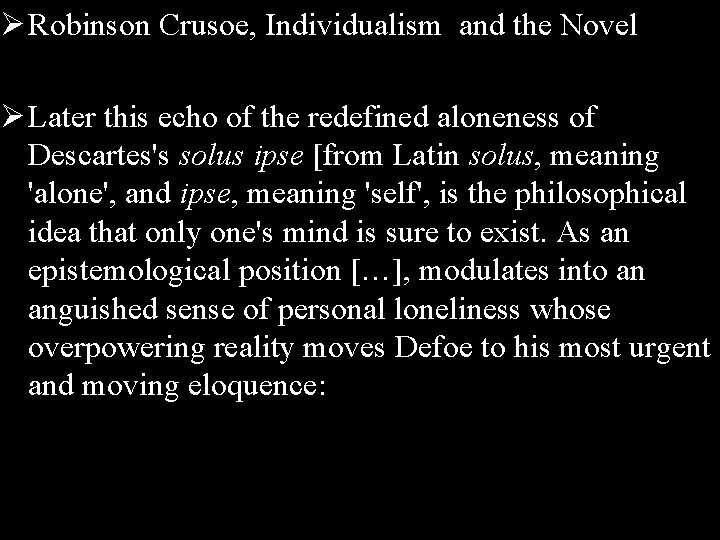
Ø Robinson Crusoe, Individualism and the Novel Ø Later this echo of the redefined aloneness of Descartes's solus ipse [from Latin solus, meaning 'alone', and ipse, meaning 'self', is the philosophical idea that only one's mind is sure to exist. As an epistemological position […], modulates into an anguished sense of personal loneliness whose overpowering reality moves Defoe to his most urgent and moving eloquence:
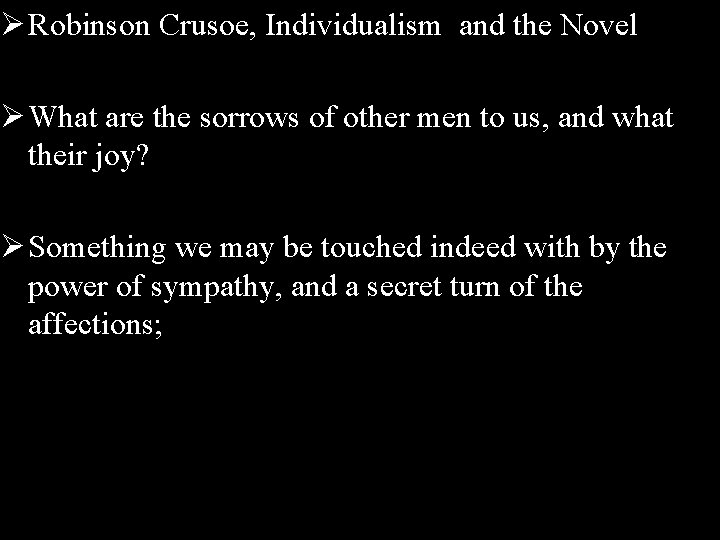
Ø Robinson Crusoe, Individualism and the Novel Ø What are the sorrows of other men to us, and what their joy? Ø Something we may be touched indeed with by the power of sympathy, and a secret turn of the affections;
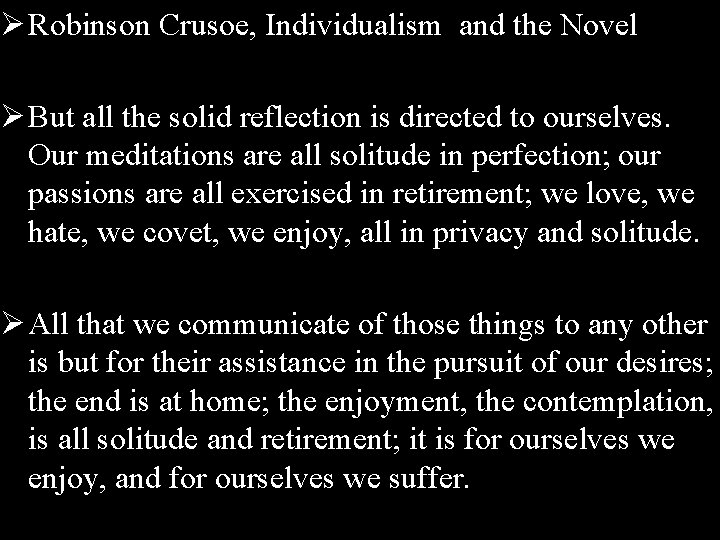
Ø Robinson Crusoe, Individualism and the Novel Ø But all the solid reflection is directed to ourselves. Our meditations are all solitude in perfection; our passions are all exercised in retirement; we love, we hate, we covet, we enjoy, all in privacy and solitude. Ø All that we communicate of those things to any other is but for their assistance in the pursuit of our desires; the end is at home; the enjoyment, the contemplation, is all solitude and retirement; it is for ourselves we enjoy, and for ourselves we suffer.
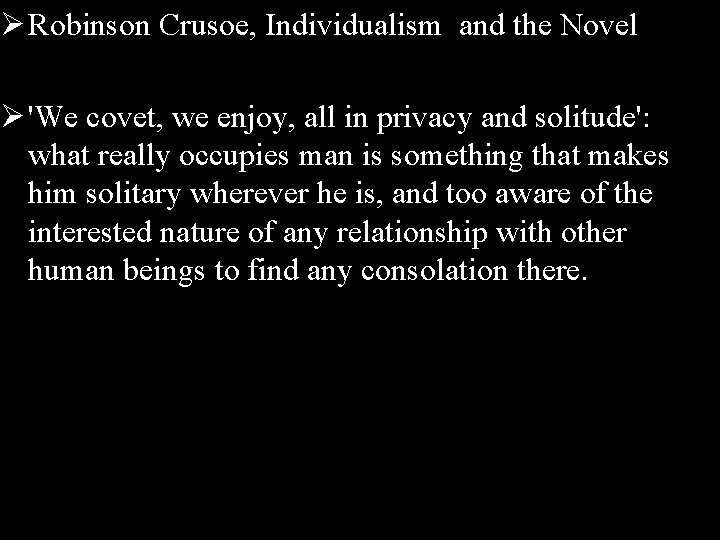
Ø Robinson Crusoe, Individualism and the Novel Ø 'We covet, we enjoy, all in privacy and solitude': what really occupies man is something that makes him solitary wherever he is, and too aware of the interested nature of any relationship with other human beings to find any consolation there.
Ø Robinson Crusoe, Individualism and the Novel Ø 'All that we communicate. . . to any other is but for their assistance in the pursuit of our desires': a rationally conceived self-interest makes a mockery of speech; and the scene of Crusoe's silent life is not least a Utopia because its functional silence, broken only by an occasional 'Poor Robinson Crusoe' from the parrot, does not impose upon man's ontological egocentricity the need to assume a false fa<; ade of social intercourse, or to indulge in the mockery of communication with his fellows.
Ø Robinson Crusoe, Individualism and the Novel Ø Robinson Crusoe, then, presents a monitory image of the ultimate consequences of absolute individualism. Ø But this tendency, like all extreme tendencies, soon provoked a reaction.
Ø Robinson Crusoe, Individualism and the Novel Ø As soon as man's aloneness was forced on the attention of mankind, the close and complex nature of the individual's dependence on society, which had been taken for granted until it was challenged by individualism, began to receive much more detailed analysis.
Ø Robinson Crusoe, Individualism and the Novel Ø Man's essentially social nature, for instance, became one of the main topics of the eighteenth-century philosophers; and the greatest of them, David Hume, wrote in the Treatise of Human Nature ( 1739) a passage which might almost have been a refutation of Robinson Crusoe:
Ø Robinson Crusoe, Individualism and the Novel Ø “We can form no wish which has not a reference to society. . Let all the powers and elements of nature conspire to serve and obey one man; let the sun rise and set at his command; the sea and rivers roll as he pleases, and the earth still furnish spontaneously whatever may be useful or agreeable to him; he will still be miserable, till you give him one person at least with whom he may share his happiness, and whose esteem and friendship he may enjoy. ”
Ø Robinson Crusoe, Individualism and the Novel Ø Just as the modern study of society only began once individualism had focused attention on man's apparent disjunctions from his fellows, so the novel could only begin its study of personal relationships once Robinson Crusoe had revealed a solitude that cried aloud for them. Ø Defoe's story is perhaps not a novel in the usual sense since it deals so little with personal relations.
Ø Robinson Crusoe, Individualism and the Novel Ø But it is appropriate that the tradition of the novel should begin with a work that annihilated the relationships of the traditional social order, and thus drew attention to the opportunity and the need of building up a network of personal relationships on a new and conscious pattern.
Ø Robinson Crusoe, Individualism and the Novel Ø The terms of the problem of the novel and of modern thought alike were established when the old order of moral and social relationships was shipwrecked, with Robinson Crusoe, by the rising tide of individualism. Ø END
- Slides: 61