
Dangerous Goods A rail safety perspective Peter Cumming
- Slides: 8
Dangerous Goods – A rail safety perspective Peter Cumming Branch Director (Western Australia) 17 October 2017
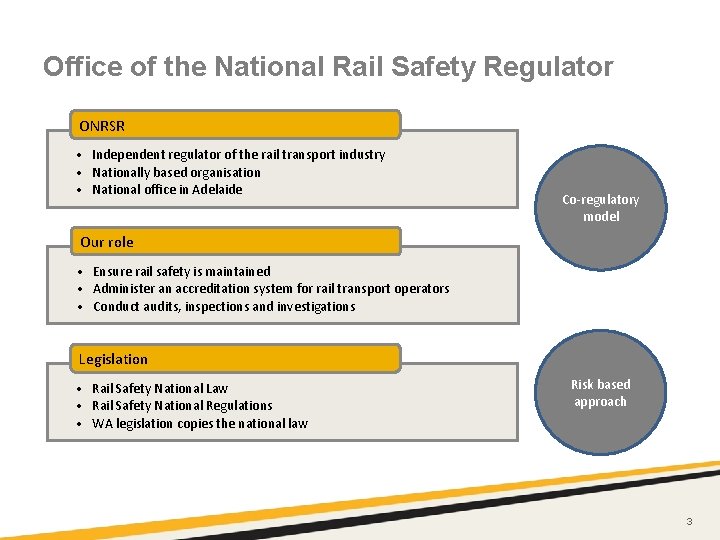
Office of the National Rail Safety Regulator ONRSR • Independent regulator of the rail transport industry • Nationally based organisation • National office in Adelaide Co-regulatory model Our role • Ensure rail safety is maintained • Administer an accreditation system for rail transport operators • Conduct audits, inspections and investigations Legislation • Rail Safety National Law • Rail Safety National Regulations • WA legislation copies the national law Risk based approach 3
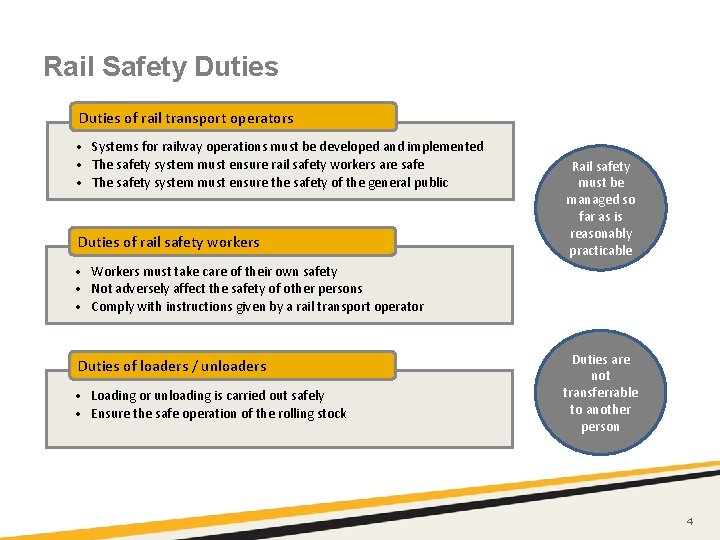
Rail Safety Duties of rail transport operators • Systems for railway operations must be developed and implemented • The safety system must ensure rail safety workers are safe • The safety system must ensure the safety of the general public Duties of rail safety workers Rail safety must be managed so far as is reasonably practicable • Workers must take care of their own safety • Not adversely affect the safety of other persons • Comply with instructions given by a rail transport operator Duties of loaders / unloaders • Loading or unloading is carried out safely • Ensure the safe operation of the rolling stock Duties are not transferrable to another person 4
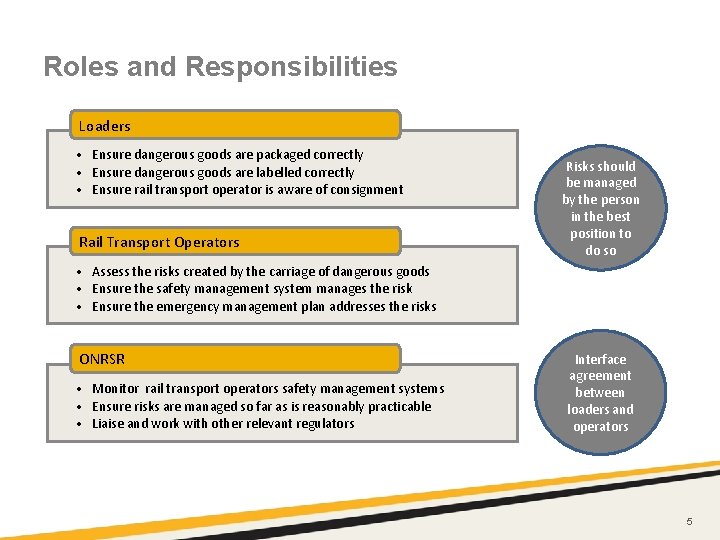
Roles and Responsibilities Loaders • Ensure dangerous goods are packaged correctly • Ensure dangerous goods are labelled correctly • Ensure rail transport operator is aware of consignment Rail Transport Operators Risks should be managed by the person in the best position to do so • Assess the risks created by the carriage of dangerous goods • Ensure the safety management system manages the risk • Ensure the emergency management plan addresses the risks ONRSR • Monitor rail transport operators safety management systems • Ensure risks are managed so far as is reasonably practicable • Liaise and work with other relevant regulators Interface agreement between loaders and operators 5
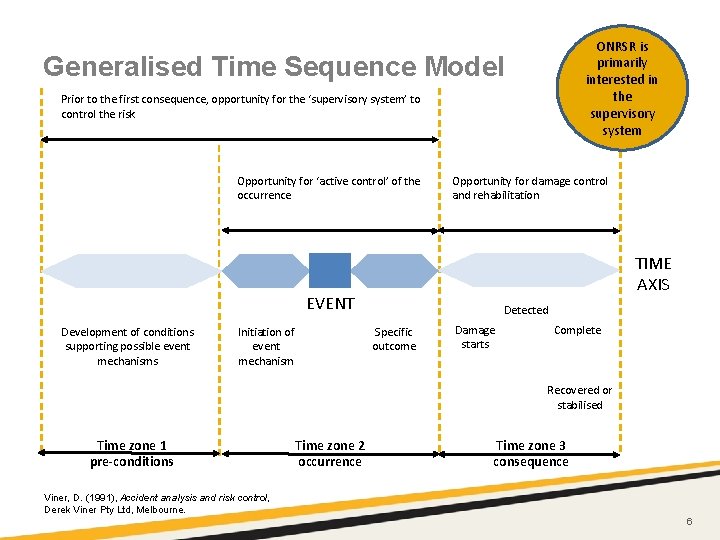
ONRSR is primarily interested in the supervisory system Generalised Time Sequence Model Prior to the first consequence, opportunity for the ‘supervisory system’ to control the risk Opportunity for ‘active control’ of the occurrence Opportunity for damage control and rehabilitation TIME AXIS EVENT Development of conditions supporting possible event mechanisms Detected Specific outcome Initiation of event mechanism Damage starts Complete Recovered or stabilised Time zone 1 pre-conditions Time zone 2 occurrence Time zone 3 consequence Viner, D. (1991), Accident analysis and risk control, Derek Viner Pty Ltd, Melbourne. 6
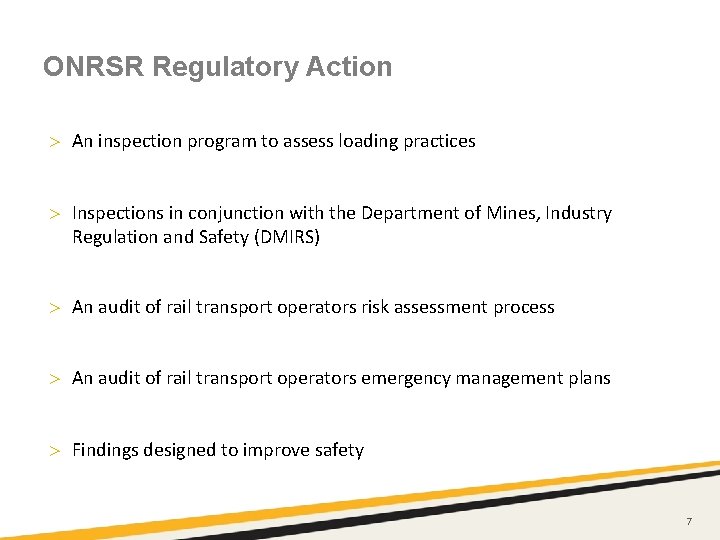
ONRSR Regulatory Action An inspection program to assess loading practices Inspections in conjunction with the Department of Mines, Industry Regulation and Safety (DMIRS) An audit of rail transport operators risk assessment process An audit of rail transport operators emergency management plans Findings designed to improve safety 7
Thank you