
DANCING THROUGH LIFE MENARCHE TO MENOPAUSE Trisha Pachiano


- Slides: 39
DANCING THROUGH LIFE MENARCHE TO MENOPAUSE Trisha Pachiano, D. O.
PUBERTY MENARCHE PERIMENOPAUSE
PUBERTY
PUBERTY DEFINITION: The process of physical changes by which a child’s body matures into adulthood and is capable of sexual reproduction
STAGES OF PUBERTY Puberty is proceeded by adrenarche Adrenarche is an increase in adrenal androgen production between the ages of 6 -10 Onset of puberty is associated with high Gn. RH pulsing. Rise in Gn. RH proceeds the rise in FSH and LH Puberty is completed following menarche.
PHYSICAL CHANGES Average time from start of puberty to finish of puberty is 4. 5 years First physical sign of puberty is breast bud * Breast bud is firm, tender lump under the center of the areoloa * Average of breast bud is 9. 8 years * Development of breast bud is referred to as thelarche Second physical sign of puberty of pubic hair * Usually first visible along the labia * Average of pubic hair development is 10. 5 years * Development of pubic hair referred to as pubarche.
PHYSICAL CHANGES Final sign of puberty is menstruation * First menstrual bleeding is referred to as menarche * Average of menarche is 12. 8 years. * Menses typically occurs 2 years following thelarche Ovulation and menstruation * 80% of cycles anovulatory in the first year after menarche * 50% of cycles anovulatory in the third year after menarche * 10% of cycles anovulatory in the sixth year after menarche Ovulation if necessary for fertility, but may not occur with earliest menses
SUMMARY OF HORMONE CHANGES IN PUBERTY 1. Hypothalamus releases pulses of Gn. RH 2. In response to Gn. RH, anterior pituitary secretes FSH and LH 3. Ovaries respond to FSH and LH and produce estra. Increase in pulsitile secretions of Gn. RH from the hypothalamus 4. Rising levels of estradiol produce physical changes of puberty
DELAYED PUBERTY No sexual characteristics by age 13 OR No menarche 3 years after breast development
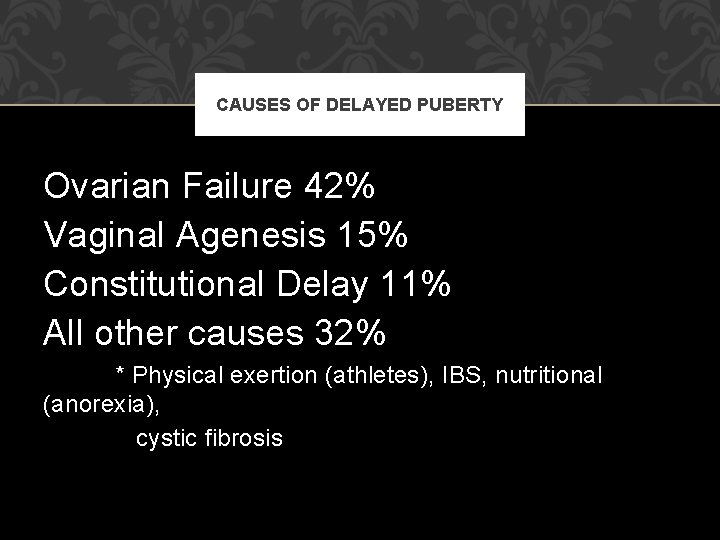
CAUSES OF DELAYED PUBERTY Ovarian Failure 42% Vaginal Agenesis 15% Constitutional Delay 11% All other causes 32% * Physical exertion (athletes), IBS, nutritional (anorexia), cystic fibrosis
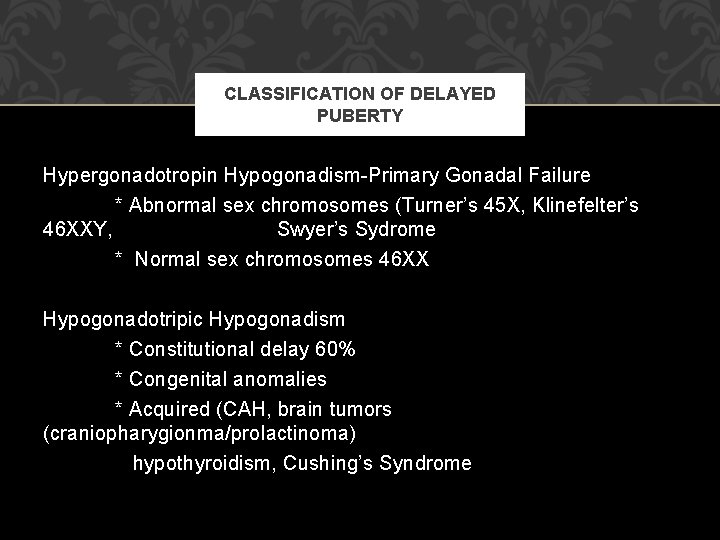
CLASSIFICATION OF DELAYED PUBERTY Hypergonadotropin Hypogonadism-Primary Gonadal Failure * Abnormal sex chromosomes (Turner’s 45 X, Klinefelter’s 46 XXY, Swyer’s Sydrome * Normal sex chromosomes 46 XX Hypogonadotripic Hypogonadism * Constitutional delay 60% * Congenital anomalies * Acquired (CAH, brain tumors (craniopharygionma/prolactinoma) hypothyroidism, Cushing’s Syndrome
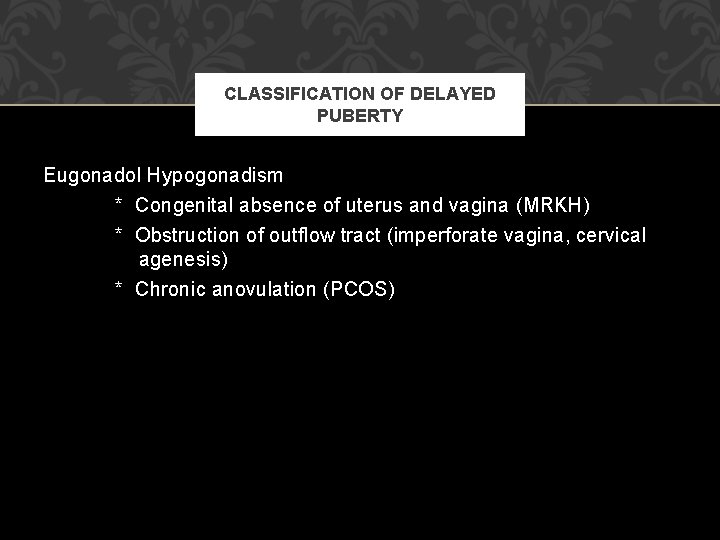
CLASSIFICATION OF DELAYED PUBERTY Eugonadol Hypogonadism * Congenital absence of uterus and vagina (MRKH) * Obstruction of outflow tract (imperforate vagina, cervical agenesis) * Chronic anovulation (PCOS)
PERIMENOPAUSE
PERIMENOPAUSE DEFINITION: Time period leading up to menopause during which some of the symptoms associated with menopause may be experienced
SIGNS OF PERIMENOPAUSE Hallmark of the perimenopausal period is menstrual irregularity * Average is 46 * Average duration 2 -8 years Normal menstrual cycle * Menstrual cycle length is 28 days (+/- 7 days) * 70% of blood loss in first 2 days * Average blood loss 40 cc * Average iron loss 13 mg Menopausal signs/symptoms
IRREGULAR MENSES Important Definitions * Oligomenorrhea: Irregularly timed episodes of bleeding at intervals >35 days (ICD 10 91. 5) * Menorrhagia: regular episodes of bleeding >80 ml and >5 days (ICD 10 92. 0) * Menometrorrhagia: excessive, prolonged bleeding occurring at irregularly times, frequent episodes (ICD 10 N 92. 1) * Intermenstrual bleeding (Polymenorrhea/Metrorrhagia: bleeding between cycles or frequent regular episodes at intervals <21 days * Dysfunctional Uterine Bleeding: Abnormal genital tract bleeding in the absence of structural or organic pathology (ICD 10 N 93. 8)
DIFFERENTIAL DIAGNOSIS OF DUB Pregnancy Cervical Cancer Endometrial Polyps Uterine/Cervical Fibroids Hypothyroidism Coagulation Deleft Infection Foreign Body
ETIOLOGY OF DYSFUNCTIONAL UTERINE BLEEDING DUB has no organic etiology and is usually anovatory, especially in the perimenopausal period. DUB can also be anovulatory in the very young
LABS PT PTT Platelet Count Bleeding Time CBC BHCG Prolactin TSH Cervical Cultures
CAUSES OF DYSFUNCTIONAL UTERINE BLEEDING Systemic Causes * Blood dyscrasias * Lupus * Idiopathic Thrombocytopenic Purpura * Leukemia * Von Willebrand’s Disease *Hypothroidism
CAUSES OF DYSFUNCTIONAL UTERINE BLEEDING Anatomic Causes * * * * Uterine Fibroids Endometrial Polyps Endometrial Hyperplasia Trophoblastic Disease Neoplasms (uterine, cervical, or vaginal) IUD Infection
EVALUATION OF DUB Labs Ultrasound Endometrial Biopsy
TREATMENT OF DUB Pharmocologic * Estrogen * Progesterone
TREATMENT OF DUB Surgical * Hysteroscopy/D&C * Endometrial Thermal Ablation * Hysterectomy
MENOPAUSAL SYMPTOMS Vasomotor Symptoms (Hot Flashes) Breast Tenderness Decreased Libido Vaginal Dryness (due to Vaginal Atrophy) Mood Swings Insomia (Trouble Sleeping) Fatigue Urinary Incontinence
VAGINAL ATROPHY Direct consequence of hypoestrogenic state associated with menopause and occurs in perimenopausal period as estrogen production decreases
SYMPTOMS OF VAGINAL ATROPHY Vaginal Dryness Vulvar Dryness Vaginal Discharge Vaginal Itching Dysparunia
TREATMENT OF PERIMENOPAUSAL SYMTPOMS Estrogen/Progestin Combinations *Oral Contraceptive Pills/Patches/Rings *Hormone Replacement Patches
VASOMOTOR SYMPTOMS Definition: Sudden sensation of extreme heat in upper body, particularly in the face, neck and chest, referred to as hot flash Hot flashes usually last 1 -5 min Hot flashes can be characterized by perspiration, flushing, chills, clamminess, anxiety, and occasionally, heart palpations Vasomotor symptoms may interfere with sleep and cause chronic sleep disruption
TREATMENT Prescription Hormone Therapy * Oral Contraceptive Pills * Cyclic Estrogen/Progesterone (Premphase) * Depo-provera * IUD * Bio-identical Compounded Hormone Replacement
MENOPAUSE
DEFINITION Menopause is the phase in a woman’s life when ovarian production of estrogen ceases, and menstruation stops * Shortly after menopause, there are no remaining ovarian follicles * 10 -20 fold increase in FSH, 3 fold increase in LH * Average of menopause, 51 * Premature menopause is menopause before age 40 * Absence of menses for 12 months
LABS FSH LH TSH
POST-MENOPAUSAL BLEEDING Trans-vaginal Ultrasound * Measure endometrial thickness * If endometrium <5 mm, no need to biopsy * If endometrium 5 -12 mm, neoplastic process unlikely, but biopsy recommended * If endometrium >12 mm, endometrial biopsy necessary * Biopsy performed to rule out endometrial hyperplasia or cancer
ENDOMETRIAL HYPERPLASIA Classification of Endometrial Hyperplasia * Simple Hyperplasia with/without Atypia * Complex Hyperplasia with/without Atypia Diagnosis of Endometrial Hyperplasia *Office Endometrial Biopsy or Surgical D&C Treatment * Oral progestin (10 mg Provera) days 1 -14 of month for 3 months * Progestin treatment only if no atypia * Consider only if patient has not completed menopause
ENDOMETRIAL CANCER Types *Adenocarcinoma *Sarcoma Classification * Stage 1 Tumor confined to the uterus * Stage 2 Tumor involves the uterus and cervical stroma * Stage 3 Vaginal/Parametrial involvement, involvement of lymph nodes *Stage 4 Tumor invasion of bladder or bowel, distant metatasis Treatment * Hysterectomy with BSO, peritoneal cytology, lymphadenectomy
MENOPAUSAL SYMPTOMS Menopausal symptoms similar to symptoms experienced during perimenopause * * * Vasomotor Symptoms Vaginal Atrophy Bone loss Insomnia Memory Loss Decreased Libido
TREATMENT Hormone Replacement * If uterus present, Estrogen/Progesterone Therapy to alleviate symptoms and prevent bone loss * If changing from OCP to post-menopausal HRT, measure FSH on day 5 -6 of pill free week. Once FSH >20, change to HRT * If uterus absent, only need estrogen * If decreased libido, consider addition of testosterone
HORMONE REPLACEMENT REGIMENS Oral Hormone Replacement *Premarin (Premarin/Premphase/Prempro), Estrace, Estradiol *Estrogen/Testosterone Combinations (Estratest) *Patches (Estraderm, Climera, Vivelle) *Transdermal gels or sprays *Bio-identical Hormone Replacement (Biest or Triest)