
DANCE PROGRESSION ROUTES A presentation by Samuel Murray
DANCE PROGRESSION ROUTES A presentation by Samuel Murray

Dance Teacher This career can lead to a range of opportunities: - Dance teacher at a school or college. - A community dance teacher. - For example a Zumba dance teacher. Job skills and requirements: dancing ability excellent communication skills patience knowledge of dance notation - the written system for recording dance movement ability to control groups of pupils business skills (if self-employed) Entry requirements vary depending on the type of teaching you want to do, but you’ll usually need: qualified teacher status (QTS) to teach in a state school at least a Level 3 qualification in dance, and a relevant teaching qualification, to be a lecturer in a further education college a postgraduate qualification or a recognised profile as a professional performer, and teaching experience to be a lecturer in a university To be a private dance teacher, you’ll usually need an approved qualification in the subject you want to teach from the Council for Dance and Education Training

CHEERLEADERS - Dance at the start of a sports game, ‘cheering’ on the team and entertaining the fans pre-match - Famous in America, although is becoming a growing trend in the UK. - Most commonly associated with American Football and Basketball. - Will need to know the basics; rolls, walkovers, cartwheels, round-offs. - Make sure you have a good gymnastics coach. If you're not in all-star cheer yet, look for the best team in your area. - You need to have an extremely hyper-extended toe touch, a high pike, a strong herkie, around the world, tuck, double hook, hurdler, and spread eagle

Commonly seen on the streets of large cities such as London, Manchester and Edinburgh. Could be anyone who has practiced dance and needs the money. Can be extremely good or poor depending on the busker. The aim is to engage the public, usually tourists, and then ask for a donation into your pocket at the end of the performance.
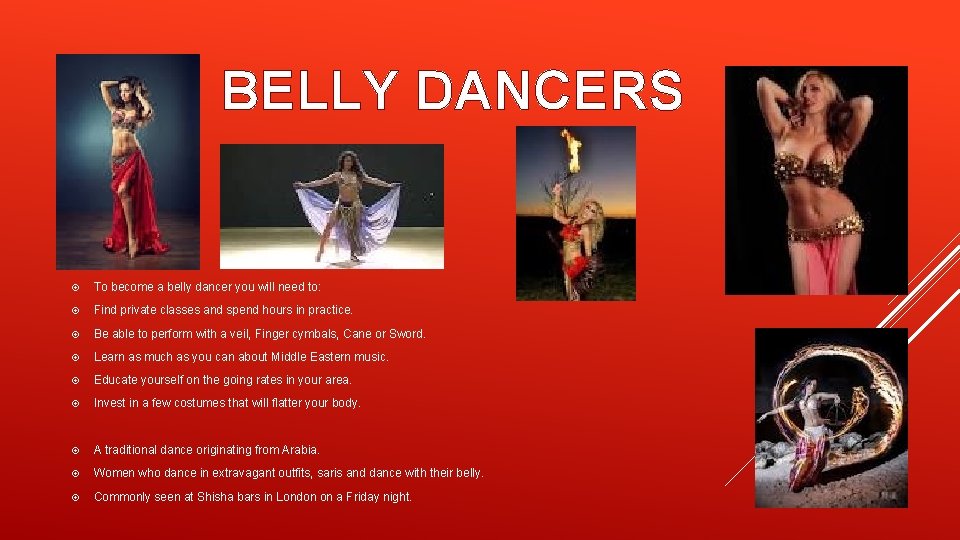
BELLY DANCERS To become a belly dancer you will need to: Find private classes and spend hours in practice. Be able to perform with a veil, Finger cymbals, Cane or Sword. Learn as much as you can about Middle Eastern music. Educate yourself on the going rates in your area. Invest in a few costumes that will flatter your body. A traditional dance originating from Arabia. Women who dance in extravagant outfits, saris and dance with their belly. Commonly seen at Shisha bars in London on a Friday night.
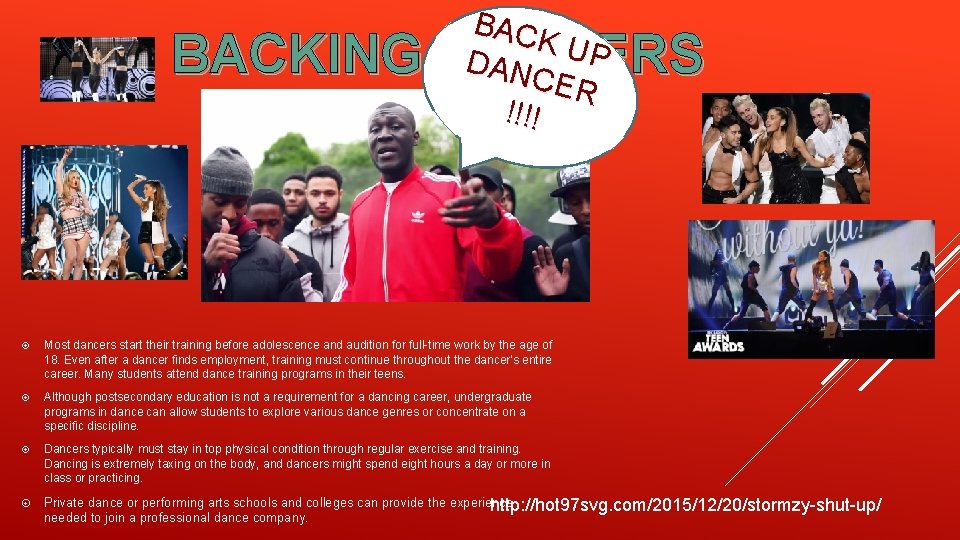
BAC K UP DAN CER !!!! BACKING DANCERS Most dancers start their training before adolescence and audition for full-time work by the age of 18. Even after a dancer finds employment, training must continue throughout the dancer's entire career. Many students attend dance training programs in their teens. Although postsecondary education is not a requirement for a dancing career, undergraduate programs in dance can allow students to explore various dance genres or concentrate on a specific discipline. Dancers typically must stay in top physical condition through regular exercise and training. Dancing is extremely taxing on the body, and dancers might spend eight hours a day or more in class or practicing. Private dance or performing arts schools and colleges can provide the experience http: //hot 97 svg. com/2015/12/20/stormzy-shut-up/ needed to join a professional dance company.
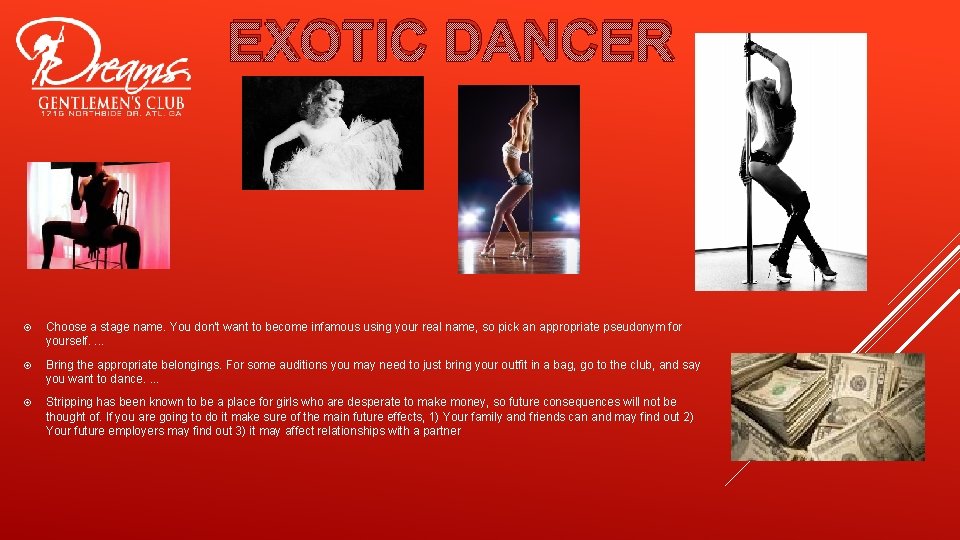
EXOTIC DANCER Choose a stage name. You don't want to become infamous using your real name, so pick an appropriate pseudonym for yourself. . Bring the appropriate belongings. For some auditions you may need to just bring your outfit in a bag, go to the club, and say you want to dance. . Stripping has been known to be a place for girls who are desperate to make money, so future consequences will not be thought of. If you are going to do it make sure of the main future effects, 1) Your family and friends can and may find out 2) Your future employers may find out 3) it may affect relationships with a partner
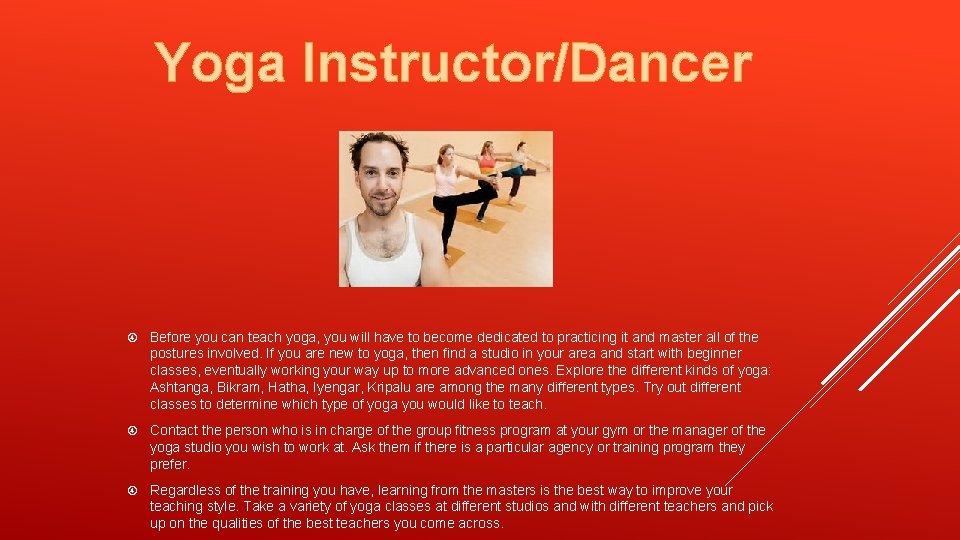
Yoga Instructor/Dancer Before you can teach yoga, you will have to become dedicated to practicing it and master all of the postures involved. If you are new to yoga, then find a studio in your area and start with beginner classes, eventually working your way up to more advanced ones. Explore the different kinds of yoga: Ashtanga, Bikram, Hatha, Iyengar, Kripalu are among the many different types. Try out different classes to determine which type of yoga you would like to teach. Contact the person who is in charge of the group fitness program at your gym or the manager of the yoga studio you wish to work at. Ask them if there is a particular agency or training program they prefer. Regardless of the training you have, learning from the masters is the best way to improve your teaching style. Take a variety of yoga classes at different studios and with different teachers and pick up on the qualities of the best teachers you come across.
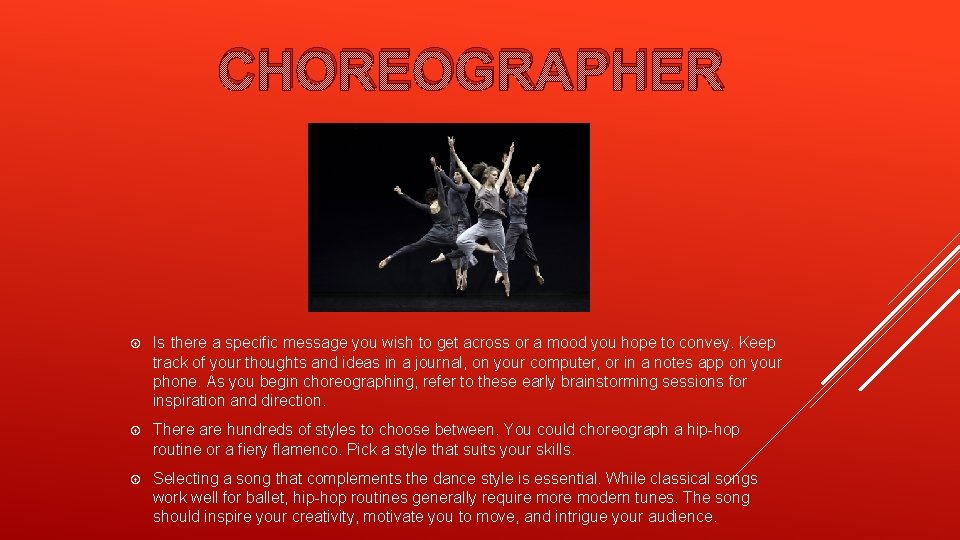
CHOREOGRAPHER Is there a specific message you wish to get across or a mood you hope to convey. Keep track of your thoughts and ideas in a journal, on your computer, or in a notes app on your phone. As you begin choreographing, refer to these early brainstorming sessions for inspiration and direction. There are hundreds of styles to choose between. You could choreograph a hip-hop routine or a fiery flamenco. Pick a style that suits your skills. Selecting a song that complements the dance style is essential. While classical songs work well for ballet, hip-hop routines generally require modern tunes. The song should inspire your creativity, motivate you to move, and intrigue your audience.

DANCE THERAPIST How can I become a dance/movement therapist? There are two routes one can pursue to become a dance/movement therapist. View the R-DMT Applicant Handbook for an in-depth guide of requirements. #1: ADTA Approved Graduate Program Graduates of approved programs meet all professional requirements for the Registered Dance/Movement Therapist (R-DMT) credential. Please contact the school directly for application process, requirements, etc. #2: Alternate Route The Alternate Route is defined as a Master’s degree with dance/movement therapy training from qualified teachers. Other requirements include general training coursework, fieldwork, internship and dance experience.
- Slides: 10