
Damped random walks and the spectrum of the

![P(λ) = T(G’) = Σ| t | sign(t) = P(| λ |) E[sign(t)] Where,](https://slidetodoc.com/presentation_image_h2/caecb355f681677f27df914d70f2bdc3/image-7.jpg "P(λ) = T(G’) = Σ| t | sign(t) = P(| λ |) E[sign(t)] Where,")
![p=λ/(λ-1) [λ is negative] n The degree of 0 in a random tree of](https://slidetodoc.com/presentation_image_h2/caecb355f681677f27df914d70f2bdc3/image-18.jpg "p=λ/(λ-1) [λ is negative] n The degree of 0 in a random tree of")
- Slides: 18
Damped random walks and the spectrum of the normalized laplacian on a graph
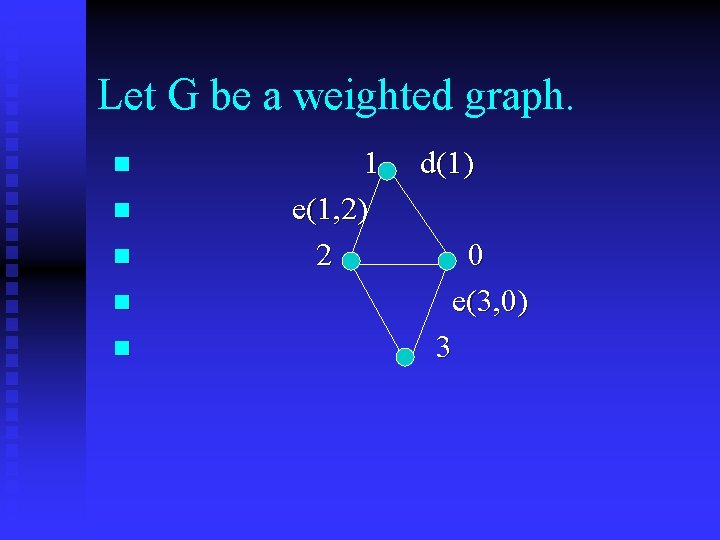
Let G be a weighted graph. n n n 1 e(1, 2) 2 d(1) 0 e(3, 0) 3
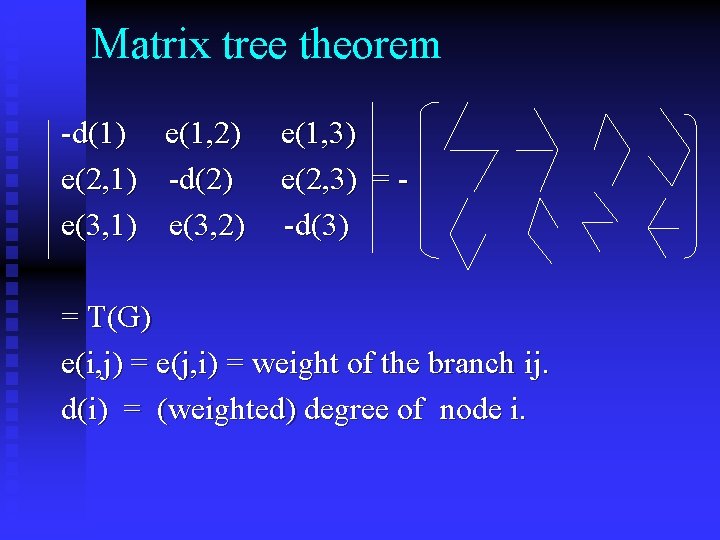
Matrix tree theorem -d(1) e(1, 2) e(2, 1) -d(2) e(3, 1) e(3, 2) e(1, 3) e(2, 3) = -d(3) = T(G) e(i, j) = e(j, i) = weight of the branch ij. d(i) = (weighted) degree of node i.
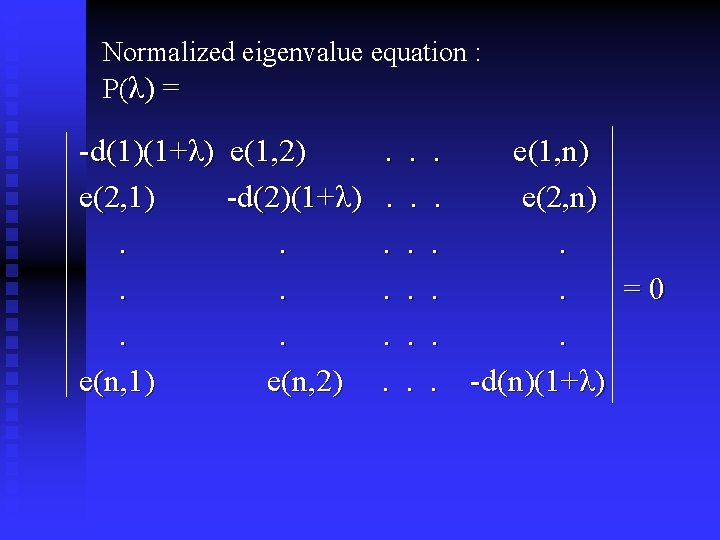
Normalized eigenvalue equation : P(λ) = -d(1)(1+λ) e(1, 2). . . e(1, n) e(2, 1) -d(2)(1+λ). . . e(2, n). . . =0. . . e(n, 1) e(n, 2). . . -d(n)(1+λ)
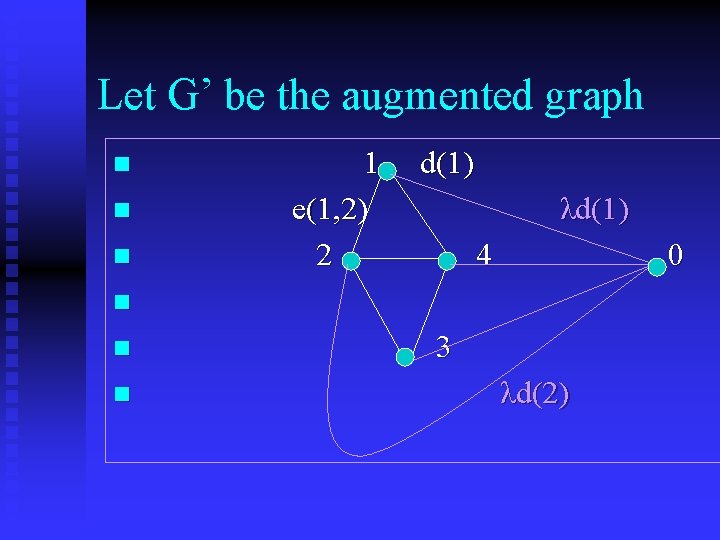
Let G’ be the augmented graph n n n 1 e(1, 2) 2 d(1) λd(1) 4 0 n n n 3 λd(2)
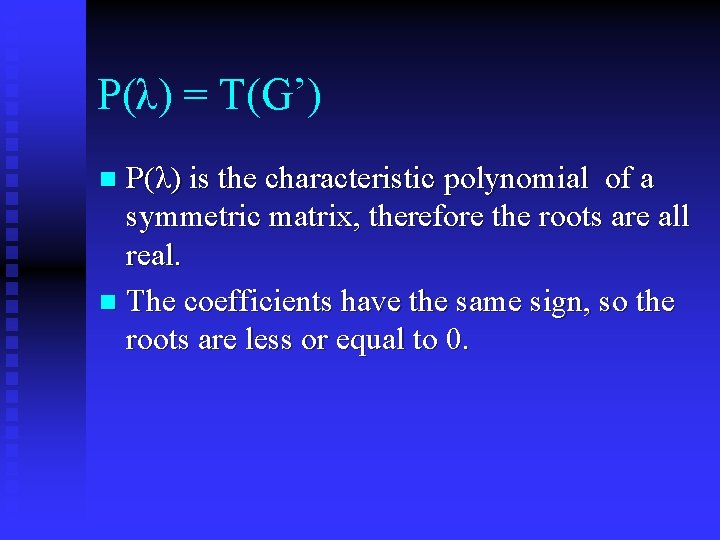
P(λ) = T(G’) P(λ) is the characteristic polynomial of a symmetric matrix, therefore the roots are all real. n The coefficients have the same sign, so the roots are less or equal to 0. n
P(λ) = T(G’) = Σ| t | sign(t) = P(| λ |) E[sign(t)] Where, in the above expectation, the probability of getting tree t is equal to | t |/P(| λ |) The sign of t is (-1)^{# of branches incident on 0}. n
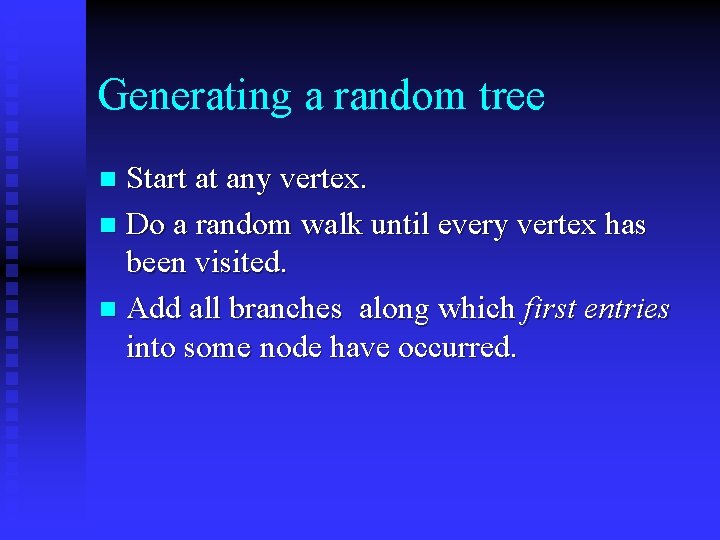
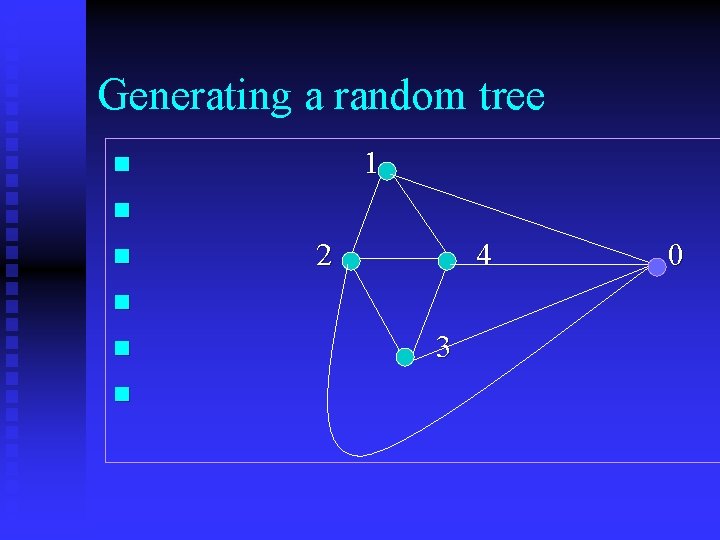
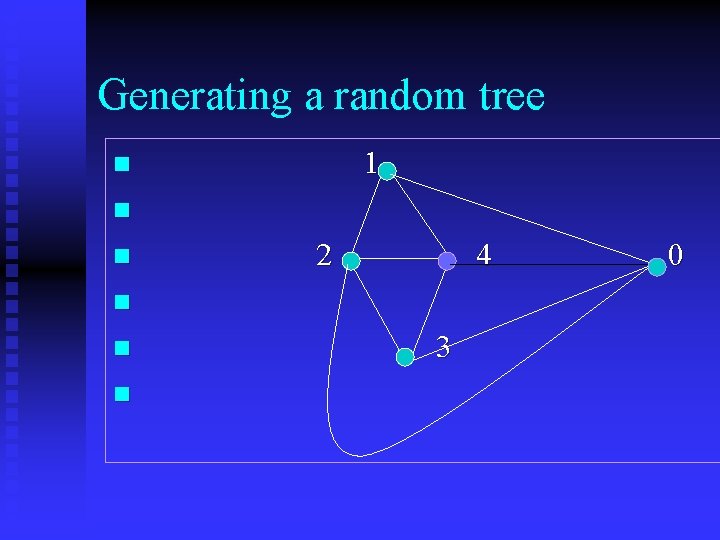
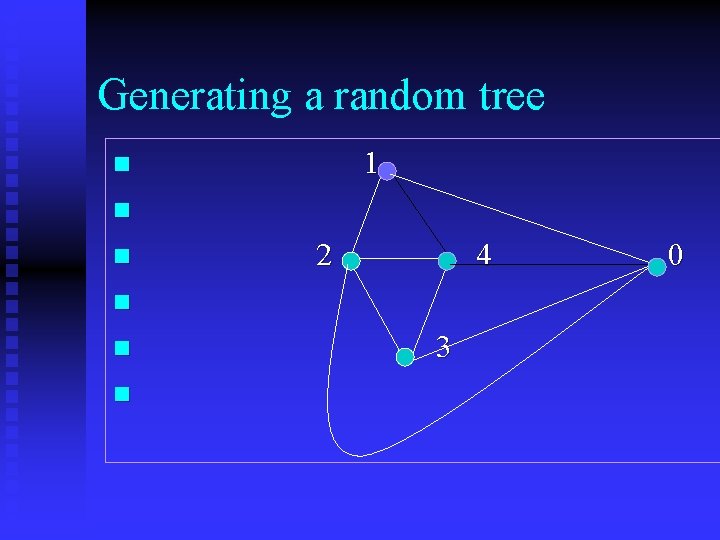
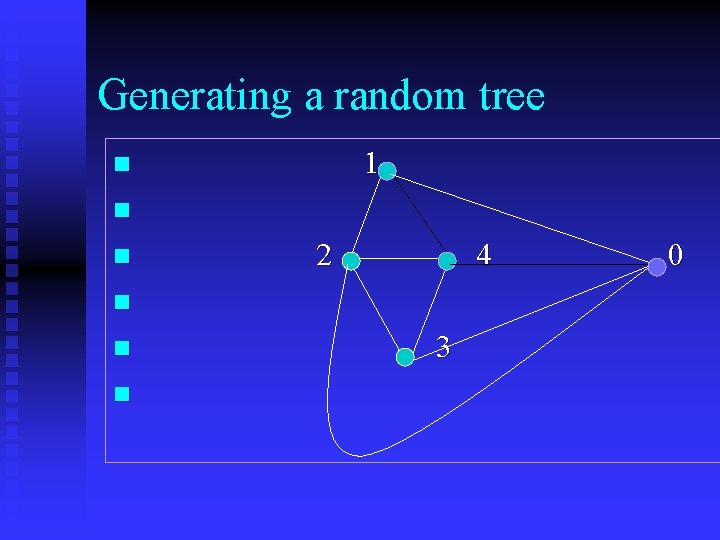
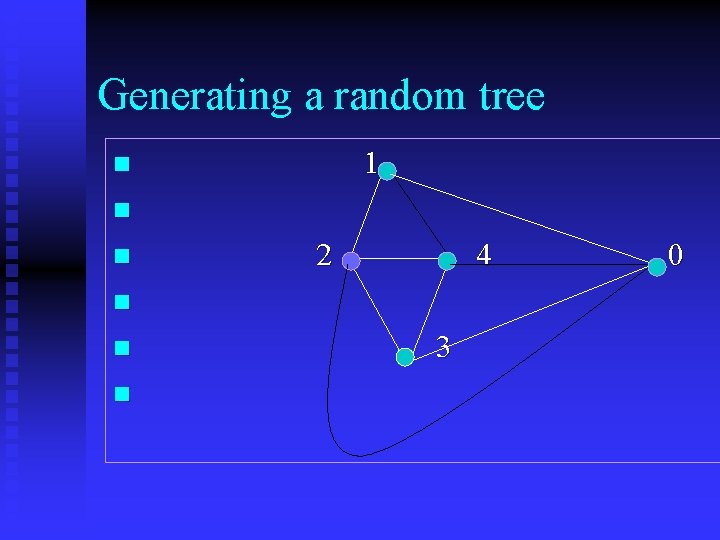
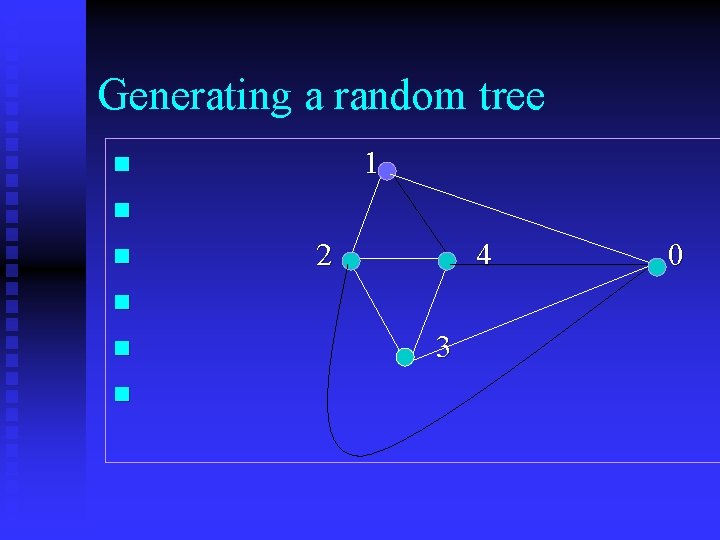
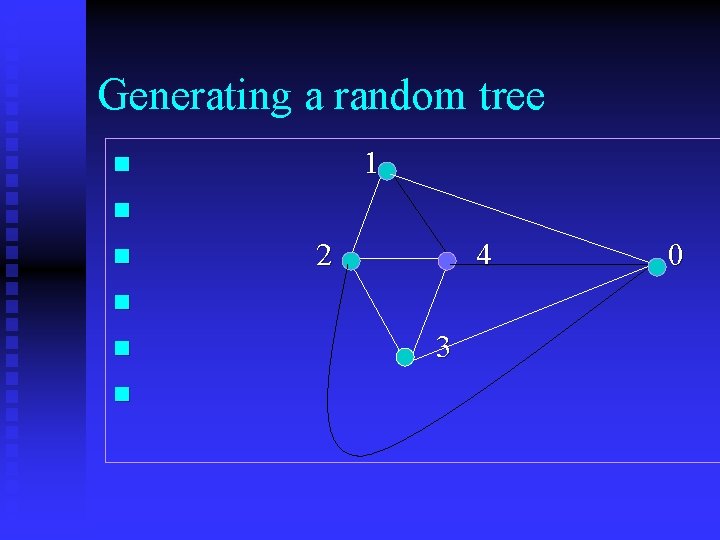
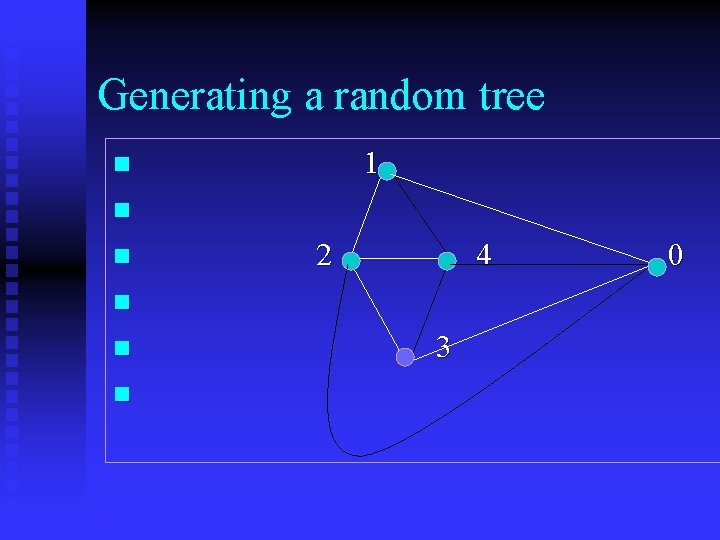
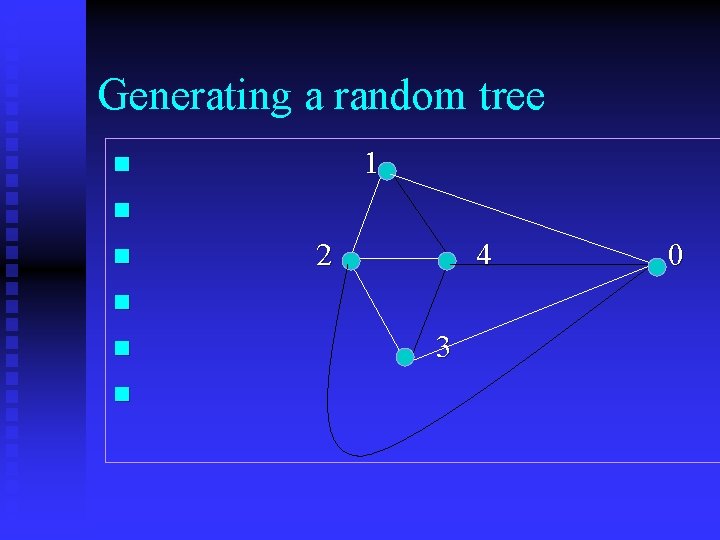
Generating a random tree Start at any vertex. n Do a random walk until every vertex has been visited. n Add all branches along which first entries into some node have occurred. n
Generating a random tree 1 n n n 2 4 n n n 3 0
Generating a random tree 1 n n n 2 4 n n n 3 0
Generating a random tree 1 n n n 2 4 n n n 3 0
Generating a random tree 1 n n n 2 4 n n n 3 0
Generating a random tree 1 n n n 2 4 n n n 3 0
Generating a random tree 1 n n n 2 4 n n n 3 0
Generating a random tree 1 n n n 2 4 n n n 3 0
Generating a random tree 1 n n n 2 4 n n n 3 0
Generating a random tree 1 n n n 2 4 n n n 3 0
p=λ/(λ-1) [λ is negative] n The degree of 0 in a random tree of G’ = The number of times a “p-damped” random walk starts on an unvisited node. Hence λ is a negative eigenvalue if and only if this number is equally likely to be even or odd.