
DAML PI Meeting Status Briefing Dynamics Research Corporation
DAML PI Meeting Status Briefing Dynamics Research Corporation Marti Hall Lee Lacy February 12 -14, 2002 1
Agenda n Overview of DRC’s DAML Work l DAML Military Ontologies l Light Weight Reusable Ontologies l Military Knowledge Representation Methodology l Lessons Learned l Quality Assurance Process (Mist) n DRC’s Upcoming Work n Deliverables n Metrics 2
Overview of DRC’s DAML Work n Focused on Military Applications n Developed Methodology to Solve Complex Military Problems by Building Ontologies/Artifacts from Light Weight (Primitive/Basic) Ontologies n Developed Methodology for Our Quality Assurance Process for Ontologies and Artifacts n Investigated utility of DAML to provide information to the explosive ordnance disposal (EOD) specialist n Investigated utility of DAML to solve USAF Air Mobility Command problem (Foreign Clearance Guide) 3
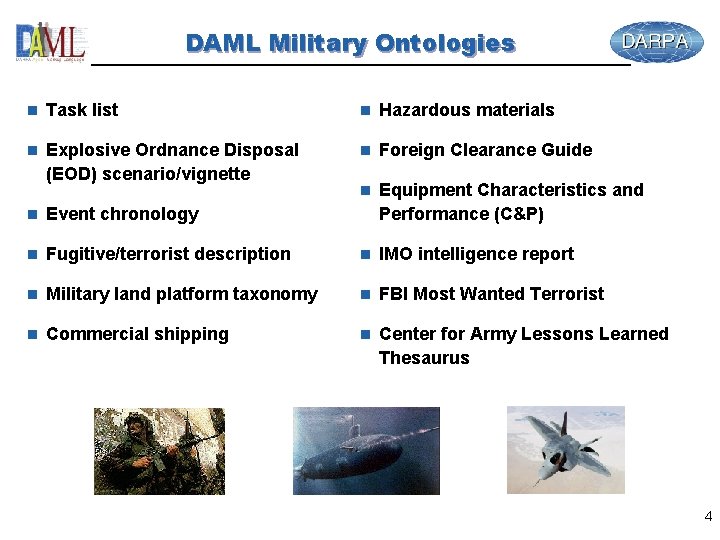
DAML Military Ontologies n Task list n Hazardous materials n Explosive Ordnance Disposal n Foreign Clearance Guide (EOD) scenario/vignette n Event chronology n Equipment Characteristics and Performance (C&P) n Fugitive/terrorist description n IMO intelligence report n Military land platform taxonomy n FBI Most Wanted Terrorist n Commercial shipping n Center for Army Lessons Learned Thesaurus 4

Task List Ontology n Supports representation of military task lists (e. g. , UJTL, NTL, AUTL) n Populating sample instance file with Universal Joint Task List (UJTL) Accomplish Objectives of SN 1 CONDUCT STRATEGIC DEPLOYMENT & REDEPLOYMENT SN 2 DEVELOP STRATEGIC INTELLIGENCE, SURVEILLANCE, AND RECONNAISSANCE SN 3 EMPLOY FORCES Accomplish Objectives of ST 1 DEPLOY, CONCENTRATE, AND MANEUVER THEATER FORCES ST 2 DEVELOP THEATER STRATEGIC INTELLIGENCE, SURVEILLANCE, AND RECONNAISSANCE ST 3 EMPLOY THEATER STRATEGIC FIREPOWER STRATEGIC NATIONAL SN 4 PROVIDE SUSTAINMENT Accomplish Objectives of OP 1 CONDUCT OPERATIONAL MOVEMENT & MANEUVER TA 1 DEPLOY/CONDUCT MANEUVER SN 5 PROVIDE STRATEGIC DIRECTION & INTEGRATION STRATEGIC THEATER ST 4 SUSTAIN THEATER FORCES OP 2 DEVELOP OPERATIONAL INTELLIGENCE, SURVEILLANCE, AND RECONNAISSANCE National Military Strategy ST 5 PROVIDE THEATER STRATEGIC COMMAND CONTROL OPERATIONAL OP 3 EMPLOY OPERATIONAL FIREPOWER SN 6 CONDUCT MOBILIZATION SN 8 FOSTER MULTINATIONAL AND INTERAGENCY RELATIONS Theater and Campaign Strategy ST 6 PROVIDE THEATER PROTECTION ST 7 ESTABLISH THEATER FORCE REQUIREMENTS AND READINESS ST 8 DEVELOP AND MAINTAIN ALLIANCE AND REGIONAL RELATIONS Subordinate Campaigns and Major Operations OP 4 PROVIDE OPERATIONAL SUPPORT Accomplish Objectives of TACTICAL TA 2 DEVELOP INTELLIGENCE TA 4 PERFORM LOGISTICS AND COMBAT SERVICE SUPPORT TA 3 EMPLOY FIREPOWER SN 7 CONDUCT FORCE DEVELOPMENT OP 5 EXERCISE OPERATIONAL COMMAND & CONTROL OP 6 PROVIDE OPERATIONAL PROTECTION Battles and Engagements TA 5 EXERCISE COMMAND & CONTROL TA 6 PROTECT THE FORCE 5
EOD Scenario/Vignette n Developed specific task list for scenario of providing EOD support to clear mines from Straits of Hormuz and open lanes from Saudi Arabia to the oilfields n References tasks from UJTL instance file (shown on previous slide) n Potential applications include support for doctrine development, training, and operations (e. g. , Joint EOD Mission Support Center and Decision Support Tools) 6
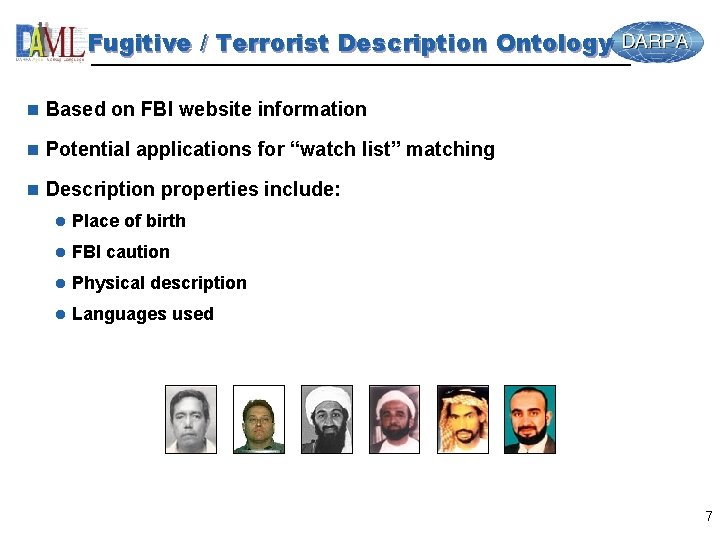
Fugitive / Terrorist Description Ontology n Based on FBI website information n Potential applications for “watch list” matching n Description properties include: l Place of birth l FBI caution l Physical description l Languages used 7
Light Weight Reusable Ontologies n Locator n Point of contact n Versioning Element Set (VES) n Dublin Core (DC) n Person n Bibliographic information n Thesaurus – ANSI NISO Z 39. 19 8
Military Knowledge Representation Methodology n Solving complex military problems requires knowledge representations of tasks, conditions, behaviors, units, and equipment n Our knowledge representation methodology: l Develop a limited but realistic scenario l Build up knowledge representations by combining lightweight, reusable, inter-connectable ontologies (e. g. , bibliographic references, military equipment) l Develop sample instance data l Develop prototypes of applications that employ the representations 9
Lessons Learned n Common repository of instance data (artifacts) needed. n Problems with sites changing content without changing version number and problems with sites changing URIs or dropping out of existence. n Improved tools such as mark-up tools, ontology development tools, validation, complete set of test cases n Problems representing procedural concepts n Needed quality assurance process for test environment (answered it with a methodology we call, “The Mist”) 10
Quality Assurance Process (Mist) n The Mist is an implementation of a quality assurance methodology. n It consists of a testing environment for newly developed or new versions of both ontologies and artifacts. n It was developed to take advantage of the DAML Validator and the RDF Validator web-based tools. n The solution is a testing directory on DRC DAML website in which Ontologists have read/write privileges. The directory was dubbed the “Mist. ” n The Mist also serves as the inbox for publish-ready ontologies and artifacts. n The Mist preserves the integrity of published DAML files, while empowering Ontologists to validate new/revised DAML files via web-based tools. 11
DRC’s Upcoming Work n Continue EOD Work l Support Joint EOD technology demonstration by providing ontologies, DAML artifacts l Support IPT meetings n Participate in the DAML Experiment l Provide linkage from Afghanistan scenario to UJTL l Represent the national goals and objectives l Provide various supporting ontologies (e. g. , weather ontology) 12
Deliverables n EOD l Requirements analysis documents for EOD knowledge representation for EOD DSS (Word document) l Data model diagrams (IDEF 1 X or UML tool files) l DAML ontologies and sample artifacts (DAML files) n DAML Experiment l Artifact tying Afghanistan scenario back to UJTL (DAML file) l Related ontologies, e. g. , weather ontology and UJTL conditions (DAML files) l Artifact representing the national goals and objectives (DAML files) 13
Metrics n Developed 26 ontologies n Developed 26+ artifacts n Supported 4 military customers (NWDC, CALL, EOD, AMC) n Transitioning 2 programs to other funding sources (EOD, FCG) 14
Questions? http: //orlando. drc. com/DAML/ 15
BACKUP MATERIALS 16
What is the Mist? n The Mist is an implementation of a quality assurance methodology. n It consists of a testing environment for newly developed or new versions of both ontologies and artifacts. n It was developed to take advantage of the DAML Validator and the RDF Validator web-based tools. l The web tools require the file under test to have a valid URL. l However, for a variety of reasons, a webmaster should be the only one allowed make changes to website content. l While under test, a DAML file is likely to change too frequently to be officially published by a webmaster. l This conflict created a need for a location wherein an Ontologist can “publish” developing DAML files for testing purposes. 17
The Mist Solution n The solution is a testing directory on DRC DAML website in which Ontologists have read/write privileges. The directory was dubbed the “Mist. ” l One constraint on use of the Mist is that the resulting URI for a DAML file under test, must be virtually identical to the URI it should have once officially published. l Thus the only difference between the a Mist URI and an officially published URI is the inclusion of the. . . /mist/… directory, i. e. : u http: //orlando. drc. com/daml/ontology/Locator/G 3/Locator-ont-g 3 r 1. daml u http: //orlando. drc. com/daml/mist/ontology/Locator/G 3/Locator-ont-g 3 r 1. daml 18
Publishing from the Mist n The Mist also serves as the inbox for publish-ready ontologies and artifacts. l The Ontologist simply needs to inform the Webmaster that a particular DAML file in the Mist is ready for publication. l The Webmaster can then remove references to the Mist directory from the validated DAML file and move it to its official location. n The Mist preserves the integrity of published DAML files, while empowering Ontologists to validate new/revised DAML files via web-based tools. 19
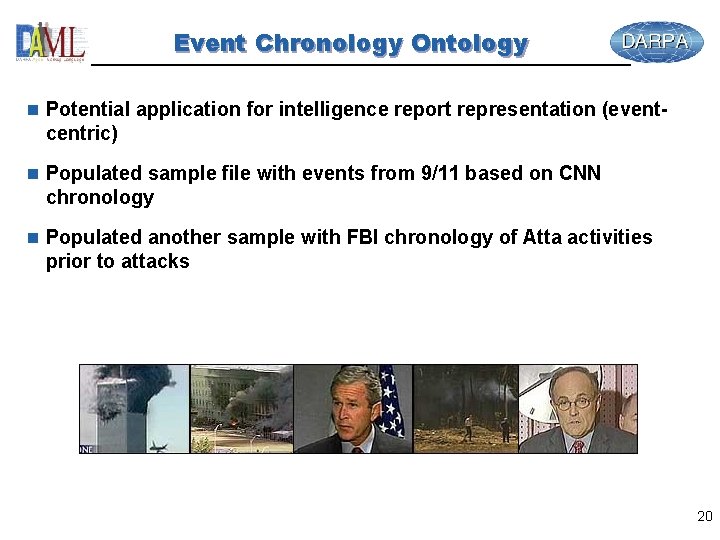
Event Chronology Ontology n Potential application for intelligence report representation (event- centric) n Populated sample file with events from 9/11 based on CNN chronology n Populated another sample with FBI chronology of Atta activities prior to attacks 20
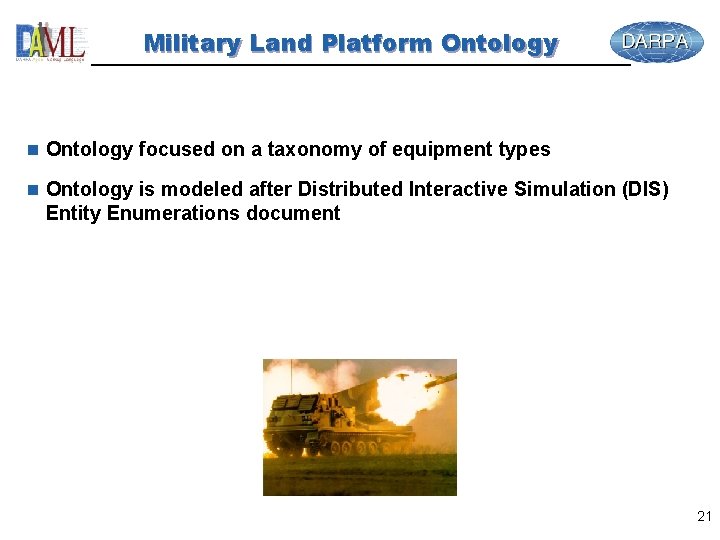
Military Land Platform Ontology n Ontology focused on a taxonomy of equipment types n Ontology is modeled after Distributed Interactive Simulation (DIS) Entity Enumerations document 21
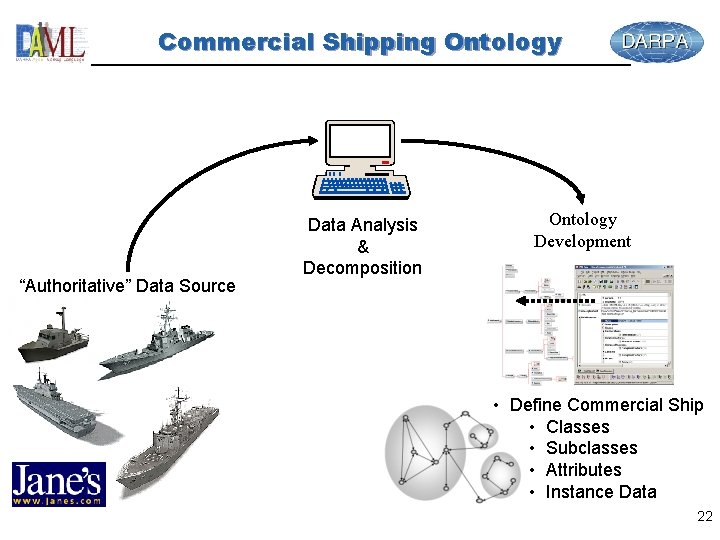
Commercial Shipping Ontology “Authoritative” Data Source Data Analysis & Decomposition Ontology Development • Define Commercial Ship • Classes • Subclasses • Attributes • Instance Data 22
Foreign Clearance Guide n AFRL conducting research to reduce cost and time required to obtain clearances from foreign governments n Focused on lead times associated with diplomatic (DIP) clearances n Migrated IDEF 1 X data model to DAML+OIL ontology n Knowledge acquisition at Scott AFB in joint project with BBN 23
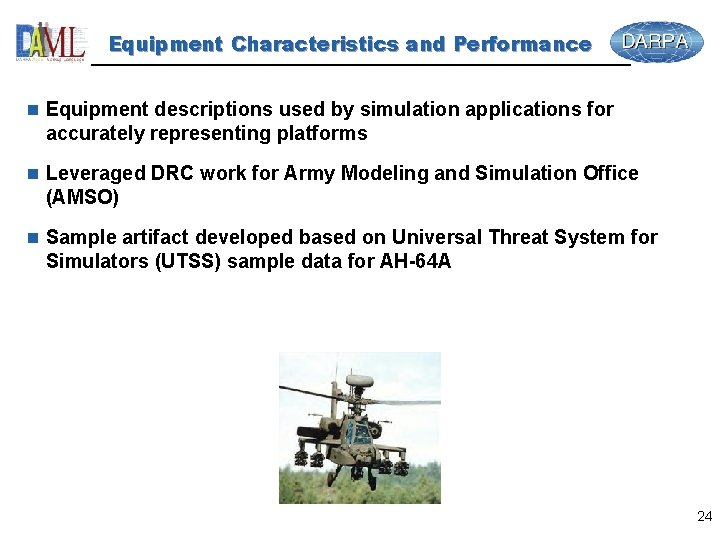
Equipment Characteristics and Performance n Equipment descriptions used by simulation applications for accurately representing platforms n Leveraged DRC work for Army Modeling and Simulation Office (AMSO) n Sample artifact developed based on Universal Threat System for Simulators (UTSS) sample data for AH-64 A 24
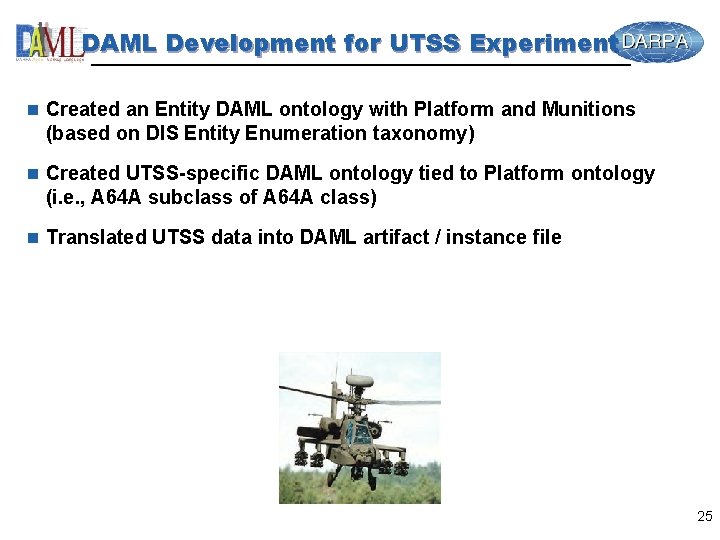
DAML Development for UTSS Experiment n Created an Entity DAML ontology with Platform and Munitions (based on DIS Entity Enumeration taxonomy) n Created UTSS-specific DAML ontology tied to Platform ontology (i. e. , A 64 A subclass of A 64 A class) n Translated UTSS data into DAML artifact / instance file 25
- Slides: 25