
DAMIETTA UNIVERSITY CHEM323 Polynuclear Aromatic Hydrocarbon LECTURE 1
DAMIETTA UNIVERSITY CHEM-323: Polynuclear Aromatic Hydrocarbon LECTURE 1 Dr Ali El-Agamey 1
LEARNING OUTCOMES LECTURES 1 -2 Ø Understand the principles of biphenyl nomenclature and the different methods used in its synthesis. Ø Understand the various methods involved in the synthesis of the different isolated polynuclear aromatic compounds. Ø Appreciate the effect of phenyl group on the stability of various intermediates. Ø Appreciate the steric effect of phenyl and benzyl groups. Ø Understand the role of phenyl and benzyl groups in electrophilic substitution reactions. 2
Ø Lecture 1 -2: -Nomeclature, synthesis and reactions of biphenyl. -Synthesis and reactions of diphenylmethane, triphenylmethyl chloride, triphenylmethanol, transstilbene and benzoin. -Nomenclature of fused systems. Ø Lecture 3 -6: -Aromatic character of fused systems. -Structure elucidation of naphthalene -Reactions of naphthalene. Ø Lecture 7 -11: - Synthesis of naphthalene. - Synthesis and reactions of anthracene and phenanthrene. Ø Lecture 12: -General revision for the whole course. Reading RT Morrison and RN Boyd, Organic Chemistry, Allyn and Bacon, Inc. , 1987. Mundy, BP et al, Name reactions and reagents in organic synthesis, Wiley, 2005 H Meislich et al, Organic Chemistry, Mc. Graw-Hill Book Company, 1980. IL Finar, Organic Chemistry, Volume 1 (1985) and Volume 2 (1977). 3

Polynuclear Aromatic Hydrocarbons Isolated rings (1) Biphenyl Nomenclature 4
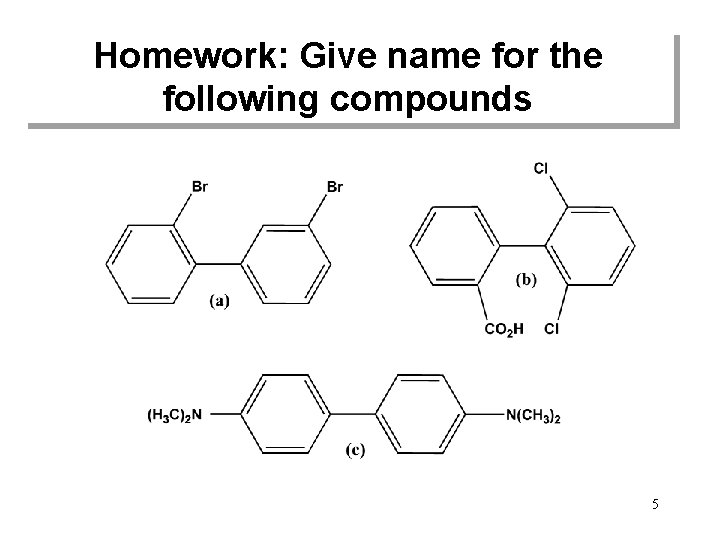
Homework: Give name for the following compounds 5

(1) Biphenyl Synthesis (a) Fittig’s reaction (b) Gattermann reaction (c) Gomberg reaction More examples 6

(d) Ullmann coupling reaction More examples (e) Benzidine rearrangement 7

(1) Biphenyl Reactions Although –NO 2 is m-directing group, p-O 2 NC 6 H 4 is p-directing!! According to the charge distribution approach, a p-nitro group would have been expected to direct to the m-position in the other ring. 8
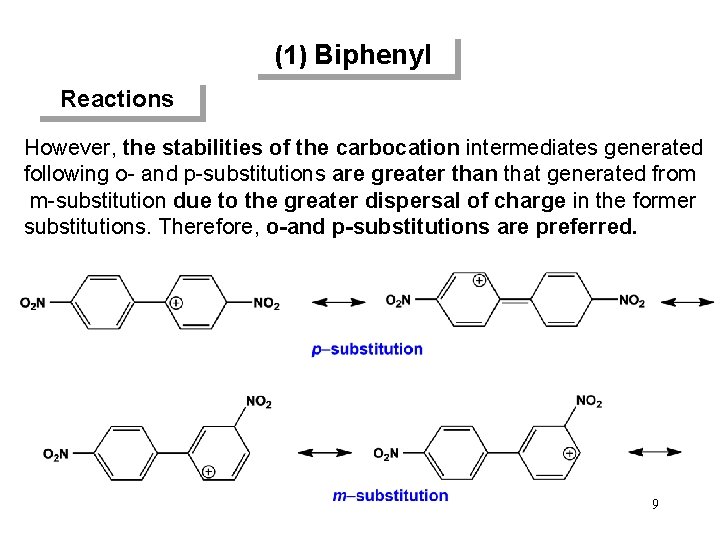
(1) Biphenyl Reactions However, the stabilities of the carbocation intermediates generated following o- and p-substitutions are greater than that generated from m-substitution due to the greater dispersal of charge in the former substitutions. Therefore, o-and p-substitutions are preferred. 9
(2) Diphenylmethane Synthesis and reactions (3) Triphenylmethane (Tritane) Synthesis and reactions 10

Homework: write the product of the following reaction 11
DAMIETTA UNIVERSITY CHEM-323: Polynuclear Aromatic Hydrocarbon LECTURE 2 Dr Ali El-Agamey 12

(3) Triphenylmethyl chloride (Trityl chloride) 13
(4) Triphenylmethanol (Triphenylcarbinol) Synthesis and reactions (5) trans-Stilbene (trans-1, 2 -Diphenylethene) Synthesis and reactions (6) Benzoin Synthesis and reactions 14
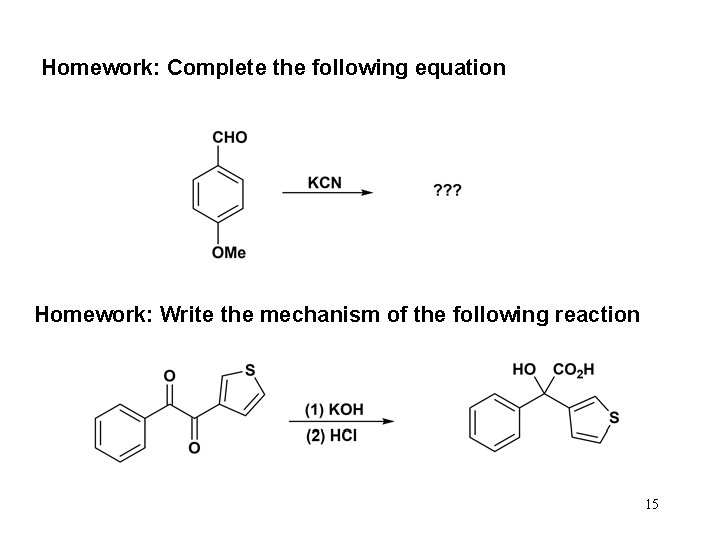
Homework: Complete the following equation Homework: Write the mechanism of the following reaction 15
Fused rings Naphthalene Ø Naphthalene, anthracene and phenanthrene are obtained from coal tar, naphthalene being the most abundant (5%) of all constituents of coal tar. Ø Uses: moth balls, which contain naphthalene, are used as insect repellants (naphthalene is very volatile). Ø Many synthetic dyes contain naphthalene moiety. 16

Fused rings Nomenclature of naphthalene, anthracene and phenanthrene Ø How many isomers for monosubstitution of naphthalene (C 8 H 7 X)? Ø How many isomers for monosubstitution of anthracene (C 14 H 9 X)? Ø How many isomers for monosubstitution of phenanthrene (C 14 H 9 X)? 17
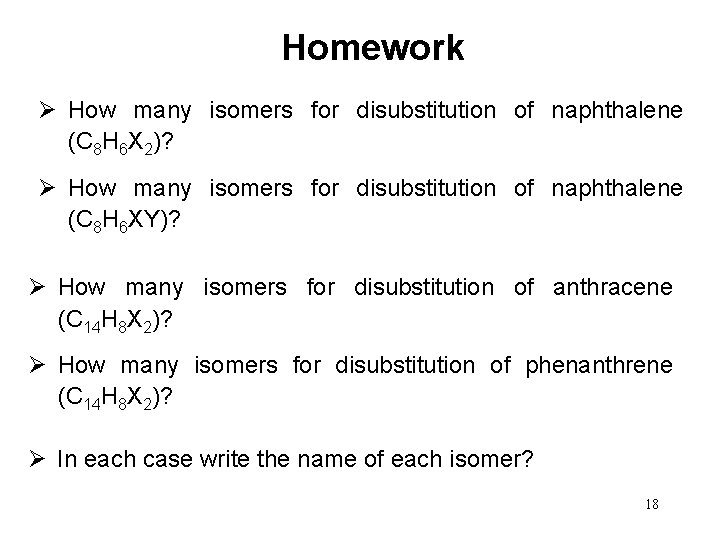
Homework Ø How many isomers for disubstitution of naphthalene (C 8 H 6 X 2)? Ø How many isomers for disubstitution of naphthalene (C 8 H 6 XY)? Ø How many isomers for disubstitution of anthracene (C 14 H 8 X 2)? Ø How many isomers for disubstitution of phenanthrene (C 14 H 8 X 2)? Ø In each case write the name of each isomer? 18

Nomenclature of naphthalene, anthracene and phenanthrene 19
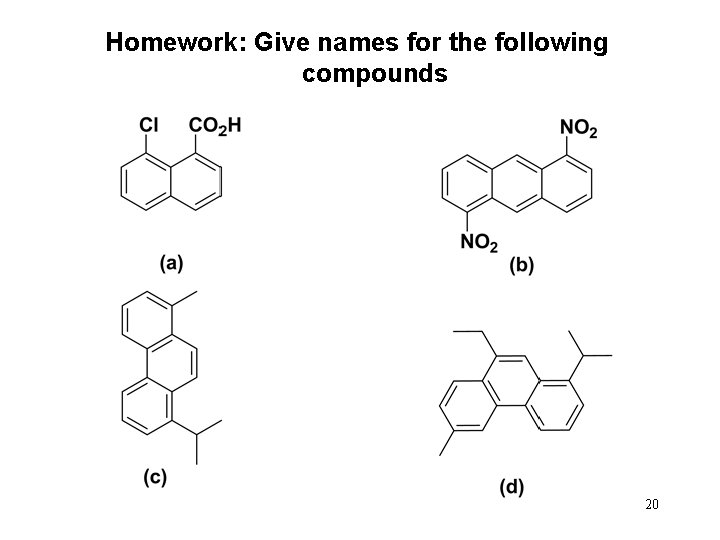
Homework: Give names for the following compounds 20
DAMIETTA UNIVERSITY CHEM-323: Polynuclear Aromatic Hydrocarbon LECTURE 3 Dr Ali El-Agamey 21

Aromatic character of naphthalene, anthracene and phenanthrene Naphthalene, anthracene and phenanthrene are classified as aromatic because of their properties, which resemble those of benzene. (i) Experimental point of view Ø Undergo electrophilic substitution reactions. Ø Like benzene, they are unusually stable as indicated from their low heats of hydrogenation and combustion. 22
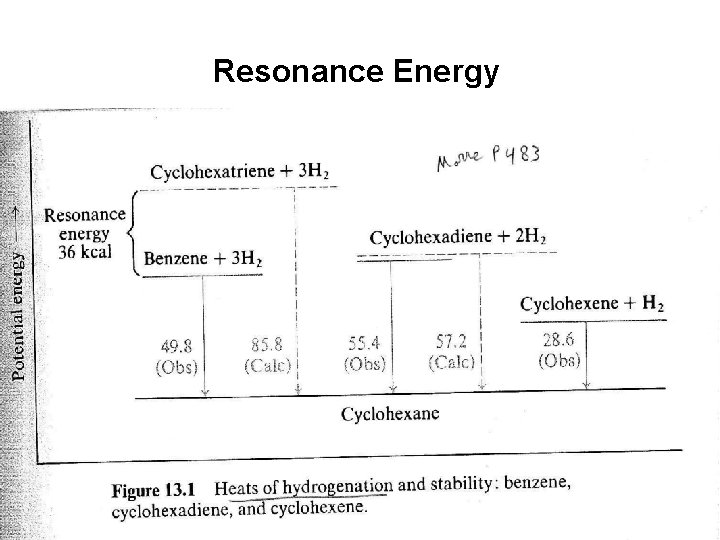
Resonance Energy 23
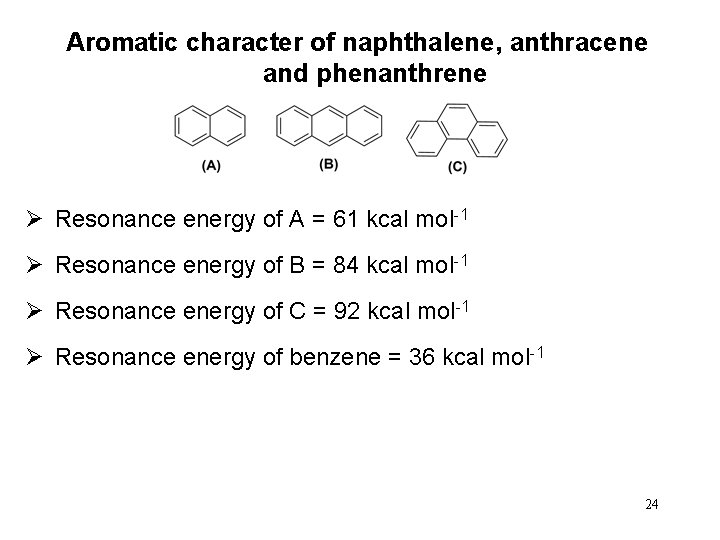
Aromatic character of naphthalene, anthracene and phenanthrene Ø Resonance energy of A = 61 kcal mol-1 Ø Resonance energy of B = 84 kcal mol-1 Ø Resonance energy of C = 92 kcal mol-1 Ø Resonance energy of benzene = 36 kcal mol-1 24
Aromatic character of naphthalene, anthracene and phenanthrene (ii) Theoretical point of view: they have the structure required for aromatic compounds Ø Flat (sp 2 -hybidized); cyclic Ø p-cloud above and below the plane due to ? ? ? Ø HÜckel`s rule ? ? ? 25
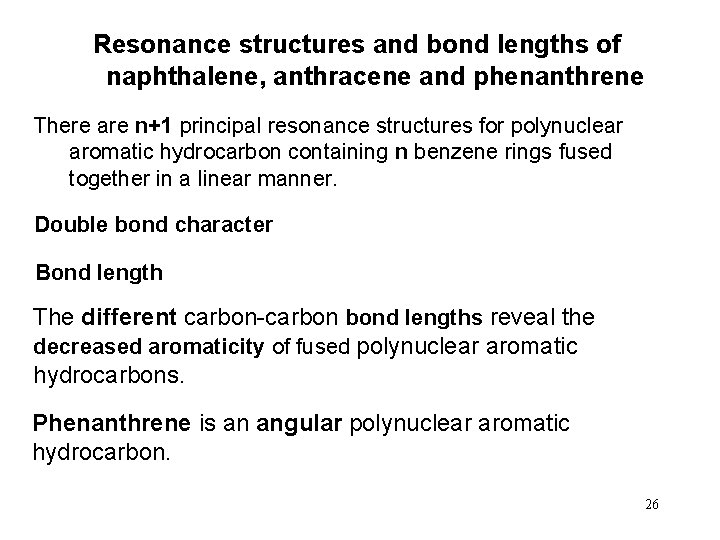
Resonance structures and bond lengths of naphthalene, anthracene and phenanthrene There are n+1 principal resonance structures for polynuclear aromatic hydrocarbon containing n benzene rings fused together in a linear manner. Double bond character Bond length The different carbon-carbon bond lengths reveal the decreased aromaticity of fused polynuclear aromatic hydrocarbons. Phenanthrene is an angular polynuclear aromatic hydrocarbon. 26
Fused rings (1) Naphthalene (C 10 H 8) Naphthalene, anthracene and phenanthrene are obtained from coal tar. Naphthalene being the most abundent (5%) of all constituents of coal tar. (a) Uses Ø In moth balls as insect repellants. Ø Many synthetic dyes contain naphthalene moiety. (b) Structure Elucidation 27
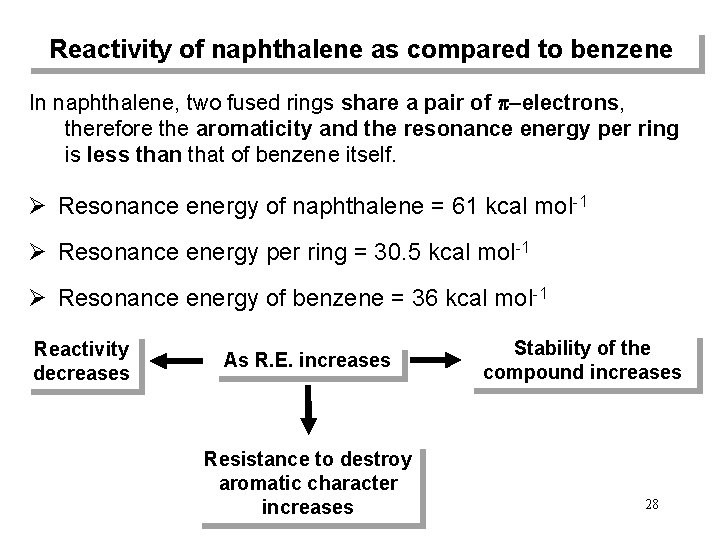
Reactivity of naphthalene as compared to benzene In naphthalene, two fused rings share a pair of p–electrons, therefore the aromaticity and the resonance energy per ring is less than that of benzene itself. Ø Resonance energy of naphthalene = 61 kcal mol-1 Ø Resonance energy per ring = 30. 5 kcal mol-1 Ø Resonance energy of benzene = 36 kcal mol-1 Reactivity decreases As R. E. increases Resistance to destroy aromatic character increases Stability of the compound increases 28
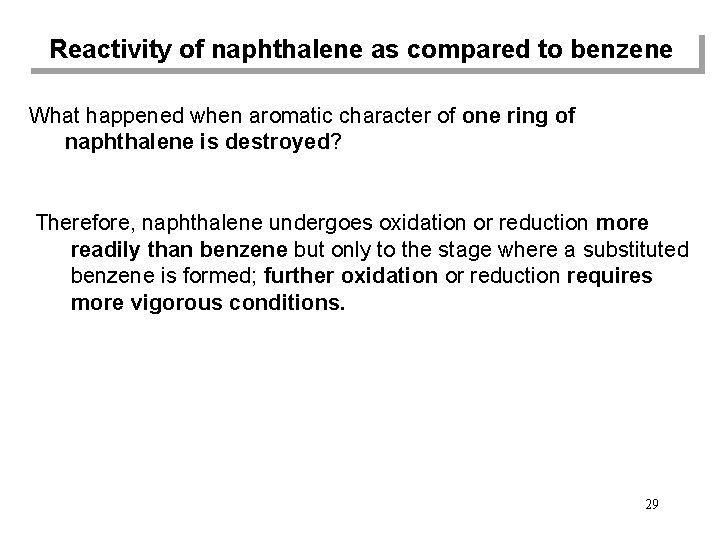
Reactivity of naphthalene as compared to benzene What happened when aromatic character of one ring of naphthalene is destroyed? Therefore, naphthalene undergoes oxidation or reduction more readily than benzene but only to the stage where a substituted benzene is formed; further oxidation or reduction requires more vigorous conditions. 29
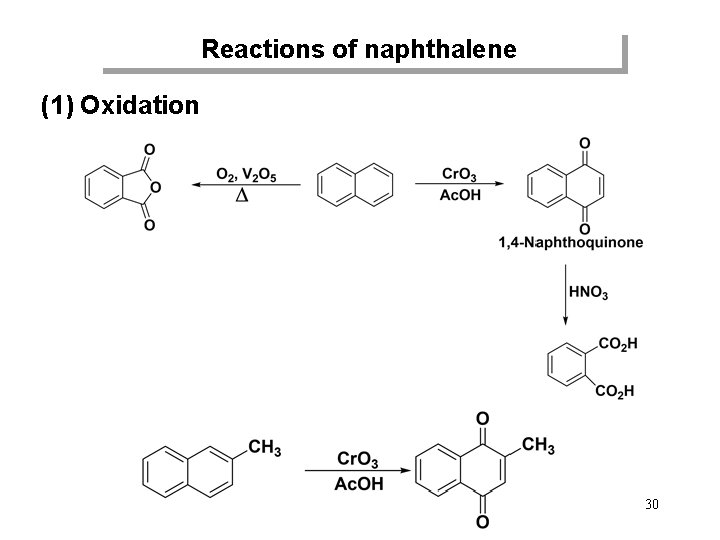
Reactions of naphthalene (1) Oxidation 30
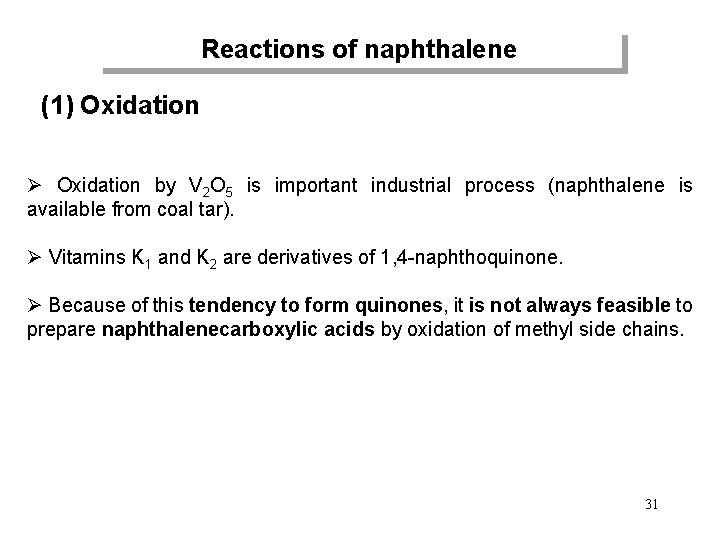
Reactions of naphthalene (1) Oxidation Ø Oxidation by V 2 O 5 is important industrial process (naphthalene is available from coal tar). Ø Vitamins K 1 and K 2 are derivatives of 1, 4 -naphthoquinone. Ø Because of this tendency to form quinones, it is not always feasible to prepare naphthalenecarboxylic acids by oxidation of methyl side chains. 31
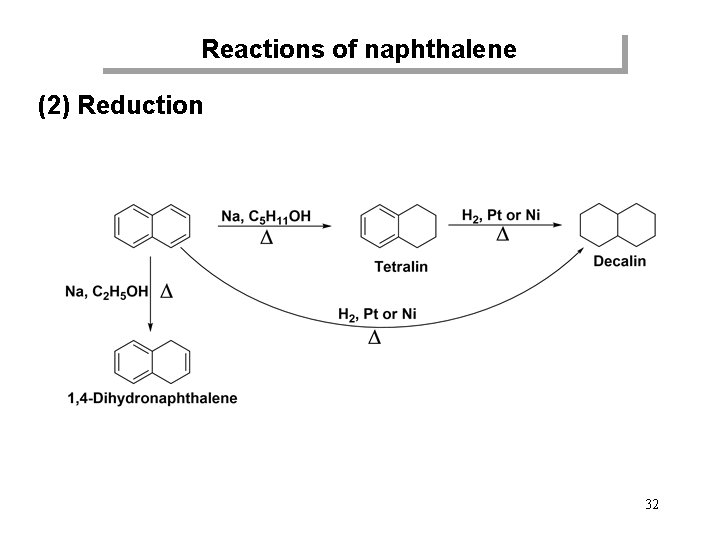
Reactions of naphthalene (2) Reduction 32
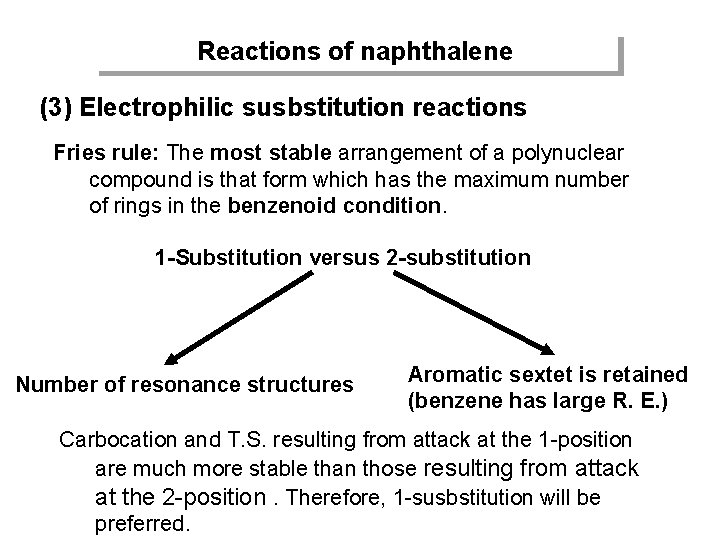
Reactions of naphthalene (3) Electrophilic susbstitution reactions Fries rule: The most stable arrangement of a polynuclear compound is that form which has the maximum number of rings in the benzenoid condition. 1 -Substitution versus 2 -substitution Number of resonance structures Aromatic sextet is retained (benzene has large R. E. ) Carbocation and T. S. resulting from attack at the 1 -position are much more stable than those resulting from attack at the 2 -position. Therefore, 1 -susbstitution will be 33 preferred.

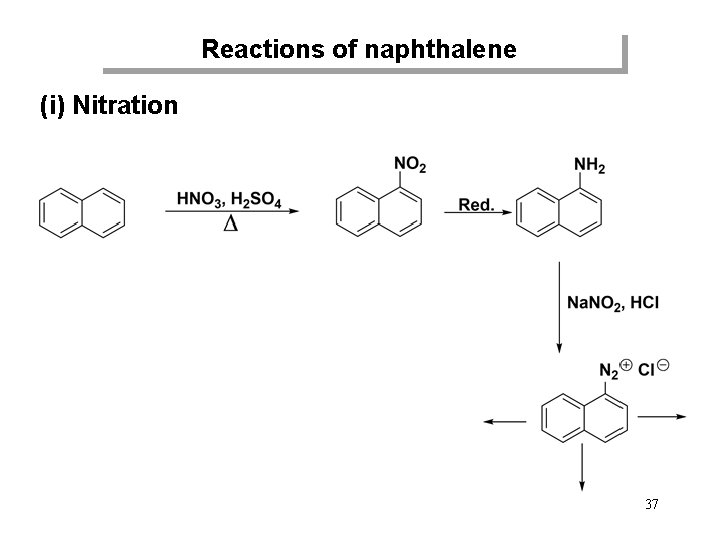
Reactions of naphthalene (i) Nitration 34
DAMIETTA UNIVERSITY CHEM-323: Polynuclear Aromatic Hydrocarbon LECTURE 4 Dr Ali El-Agamey 35
LEARNING OUTCOMES LECTURE 4 Ø Reactions of naphthalene: Nitration; Halogenation; Chloromethylation; Friedel-Crafts reactions (alkylation and acylation). Ø Sulfonation. Ø Naphthols and naphthylamines. Ø Synthesis of 1 -substituted naphthalenes. Ø Synthesis of 2 -substituted naphthalenes. Ø Summary of naphthalene reactions. 36
Reactions of naphthalene (i) Nitration 37
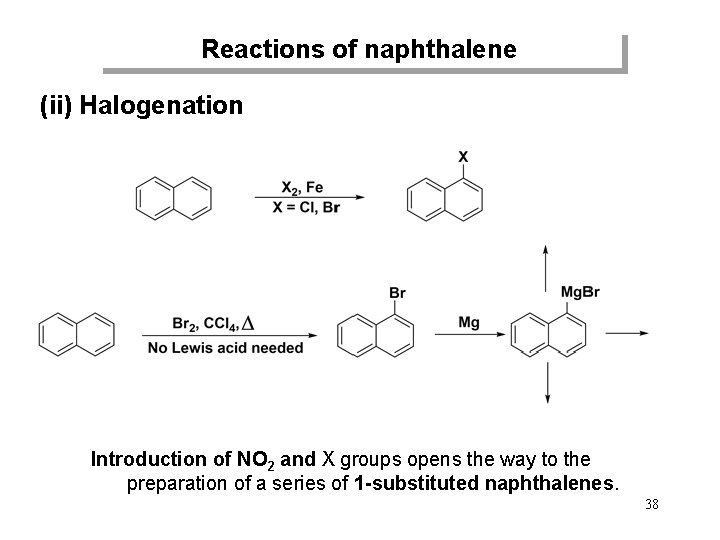
Reactions of naphthalene (ii) Halogenation Introduction of NO 2 and X groups opens the way to the preparation of a series of 1 -substituted naphthalenes. 38

Reactions of naphthalene (iii) Chloromethylation (iv) Friedel-Crafts reactions is carried out under mild conditions. Friedel-Crafts alkylation is of little use because (1) polyalkylation and (2) side reactions. Alkylnaphthalenes can be prepared via acylation or ring closure. 39
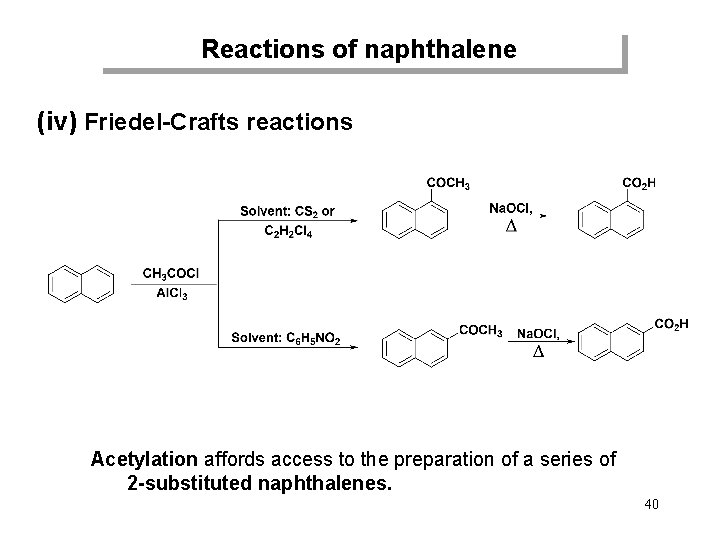
Reactions of naphthalene (iv) Friedel-Crafts reactions Acetylation affords access to the preparation of a series of 2 -substituted naphthalenes. 40
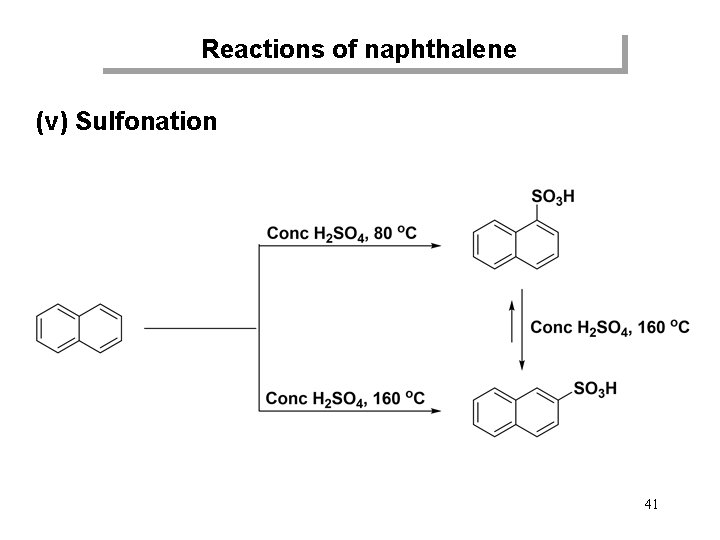
Reactions of naphthalene (v) Sulfonation 41
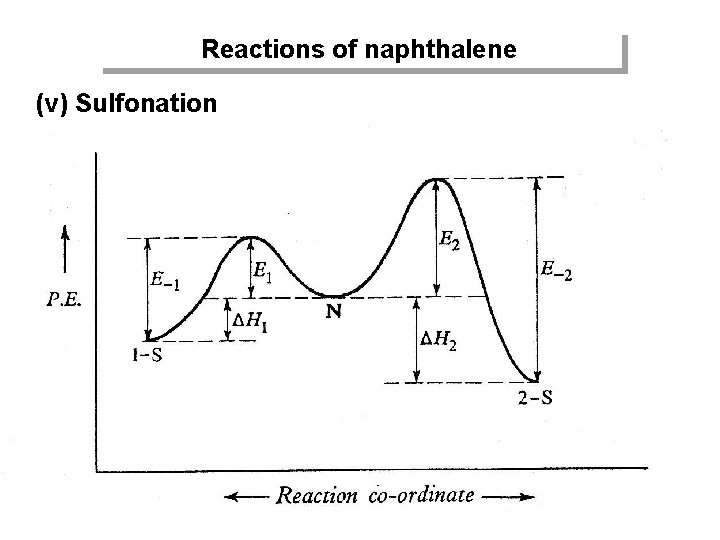
Reactions of naphthalene (v) Sulfonation 42
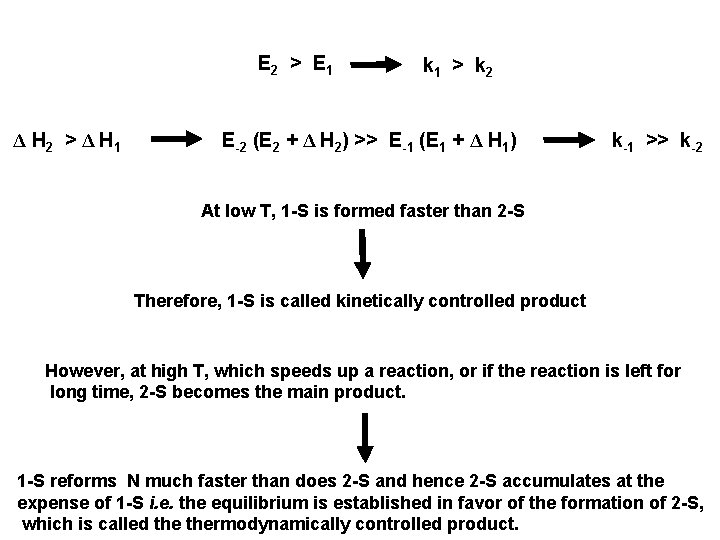
E 2 > E 1 Δ H 2 > Δ H 1 k 1 > k 2 E-2 (E 2 + Δ H 2) >> E-1 (E 1 + Δ H 1) k-1 >> k-2 At low T, 1 -S is formed faster than 2 -S Therefore, 1 -S is called kinetically controlled product However, at high T, which speeds up a reaction, or if the reaction is left for long time, 2 -S becomes the main product. 1 -S reforms N much faster than does 2 -S and hence 2 -S accumulates at the expense of 1 -S i. e. the equilibrium is established in favor of the formation 43 of 2 -S, which is called thermodynamically controlled product.
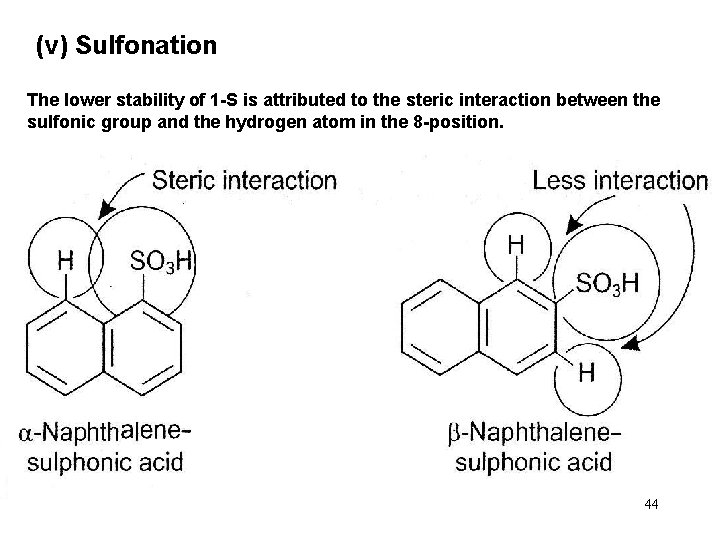
(v) Sulfonation The lower stability of 1 -S is attributed to the steric interaction between the sulfonic group and the hydrogen atom in the 8 -position. 44
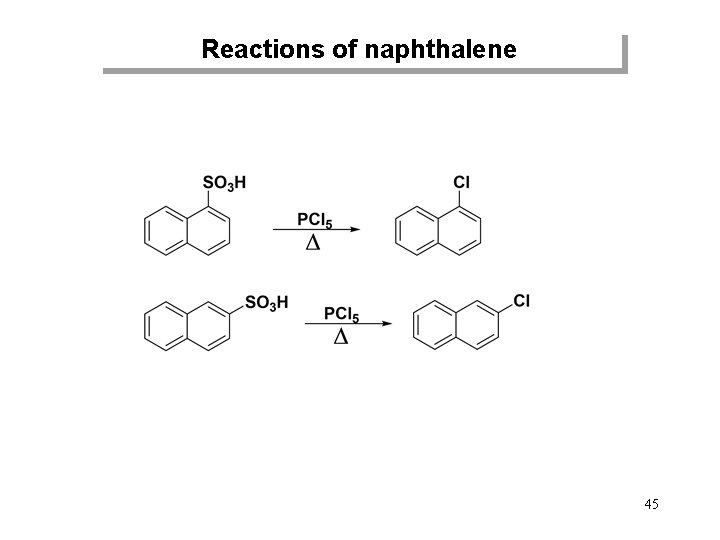
Reactions of naphthalene 45

Reactions of naphthalene Naphthols and naphthylamines Bucherer reaction 46
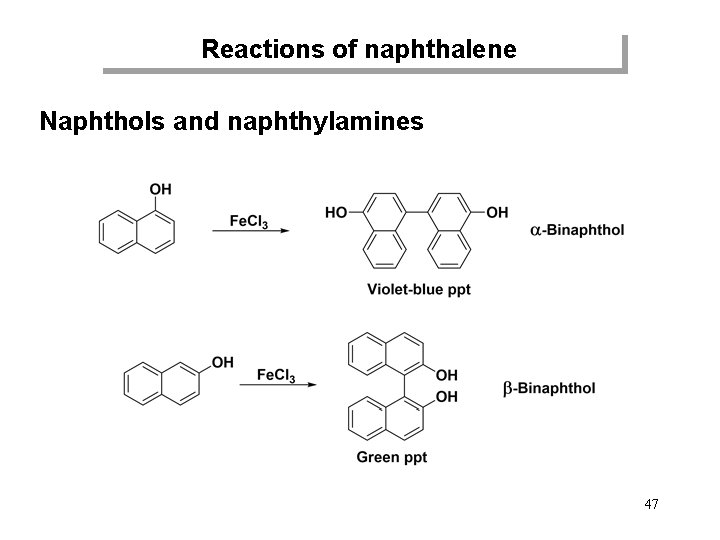
Reactions of naphthalene Naphthols and naphthylamines 47

Synthesis of 1 -substituted naphthalenes 48

Synthesis of 2 -substituted naphthalenes Acetylation and sulfonation affords access to the preparation of a series of 2 -substituted naphthalenes.

Summary of naphthalene reactions 50
- Slides: 50