
Dam Safety Periodic Inspections Robert Taylor P E
Dam Safety Periodic Inspections Robert Taylor, P. E. Regional Dam Safety Program Manager U. S. Army Corps of Engineers Great Lakes & Ohio River Division Robert. E. Taylor@usace. army. mil Dam Safety Workshop Brasília, Brazil 20 -24 May 2013 Corps of Engineers BUILDING STRONG®

Overview § Inspection Purpose § Inspection Policy § Inspection Types § Inspection Procedures § Best Practices § Periodic Assessments 2
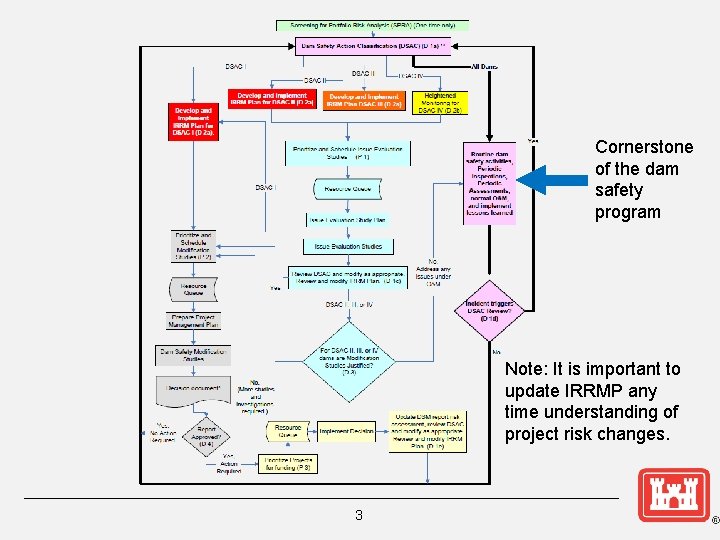
Cornerstone of the dam safety program Note: It is important to update IRRMP any time understanding of project risk changes. 3

Purpose of Inspections § Verify structural integrity of dam and appurtenant structures § Assure protection of human life and property § Disclose conditions which might disrupt operation or threaten dam safety in time to be corrected 4
Civil works structures whose failure or partial failure would endanger the lives of the public, cause substantial damage to property, transportation facilities, or utilities will be continuously evaluated to insure structural safety and stability, and operational adequacy. 5
Policy § Shall not be contracted § Licensed Professional Engineers § Hazard Potential reviewed/revised § Comply with PCA requirements § Inspect portions of non-Fed dams § Evaluate safety of U/S and D/S dams § Military installations § Inspections for others 6
Ancillary Benefits § Maintains institutional knowledge of project § Maintains technical expertise in dam safety § Provides lessons learned for other projects 7
INSPECTION TYPES Operations Routine– During ordinary operations for unusual changes Annual – In preparation for raising pool levels. High Water – In accordance with O&M Manual. Periodic – 5 year detailed Engineering Inspection. Periodic Assessment – 10 year Risk Analysis of Project design and current parameters. Special or Emergency– After major or unusual events or after report of distress. Hydraulic Steel Structures—See ER 1110 -2 -8157 8
OPERATIONS ROUTINE INSPECTIONS § During normal operations of project, personnel should always be aware of Dam Safety items § Frequency is per O&M manual—could be daily, weekly, monthly, etc. § Conducted by Operations Personnel such as field engineers, maintenance workers, park rangers, etc. 9

ANNUAL INSPECTIONS § Once a year except during the same year as the Periodic Inspection (PI) § Conducted by Operations Personnel such as field engineers, maintenance workers, park rangers, etc. , with appropriate Dam Safety engineers 10

HIGH WATER INSPECTIONS § When pools approach record levels or historical levels of concern § As pool approaches record level, project personnel inspect more frequently § If pool is expected to reach new record, Engineers are dispatched to project. § Frequency is case-by-case depending on project’s past performance, consequences, pool level, etc. Could be hourly, every 12 hours, or daily. § Prepare performance report after event 11
PERIODIC INSPECTIONS § Periodic Inspections ► In addition to the visual inspection of the dam, should include the following: • • • Structural inspection of gates Gate operability and capability inspection Stilling basin inspection Powerhouse inspection Instrumentation inspection and evaluation including piezometers, relief wells, toe drains, settlement plates, structural instrumentation, etc. ► Should include engineers from all appropriate disciplines • Geotechnical, structural, H&H, electrical, mechanical 12

PERIODIC ASSESSMENTS § Includes: ► Comprehensive review of records, design, performance, etc. ► Periodic Inspection ► Potential Failure Mode Analysis ► Semi-Quantitative Risk Assessment § Every 10 years 13
OTHER INSPECTIONS § § Dewaterings Installation of new equipment Dam Modifications Emergency Inspections ► Report of significant distress ► Report of accident § Special Inspections ► After earthquakes, extreme floods, large releases and/or spillway discharges 14
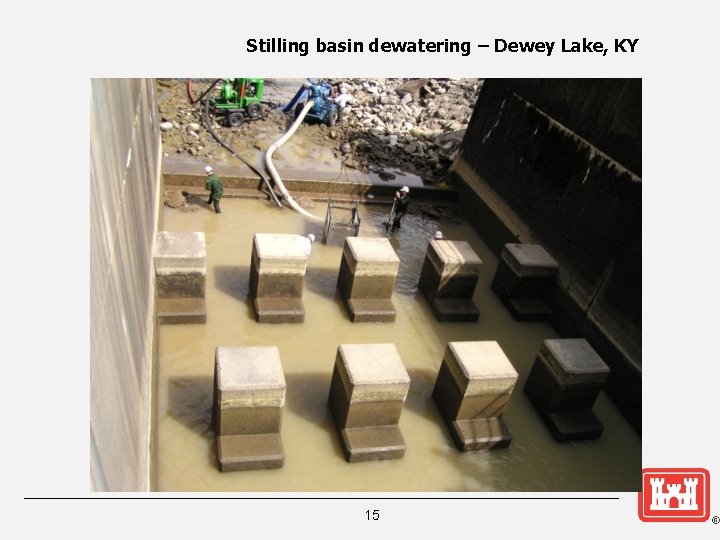
Stilling basin dewatering – Dewey Lake, KY 15

Greenup Locks and Dam – lock chamber dewatering Lock dewatering – Greenup Locks and Dam, Ohio River - 2003 16

Special Post-Earthquake Inspections Table 11. 1 – Criteria for Post-Earthquake Inspections of USACE Dams Earthquake Magnitude Epicenter Distance From the Dam (Kilometers) (Inspect dam if epicenter is within this distance to the dam. ) 4. 5 5. 0 6. 0 7. 0 8. 0 16 80 120 200 320 17
FREQUENCY OF PERIODIC INSPECTIONS § New structures require more frequent inspections ► Initial PI – After structure is complete but prior to impoundment ► Second PI – No later than one year after impoundment is initiated ► Subsequent Inspections • One year interval for next two inspections • Two year interval for next two inspections • Five years for all subsequent PI’s ► Periodic Assessment every 10 years (PI with Risk Assessment) Slide 18 of 101
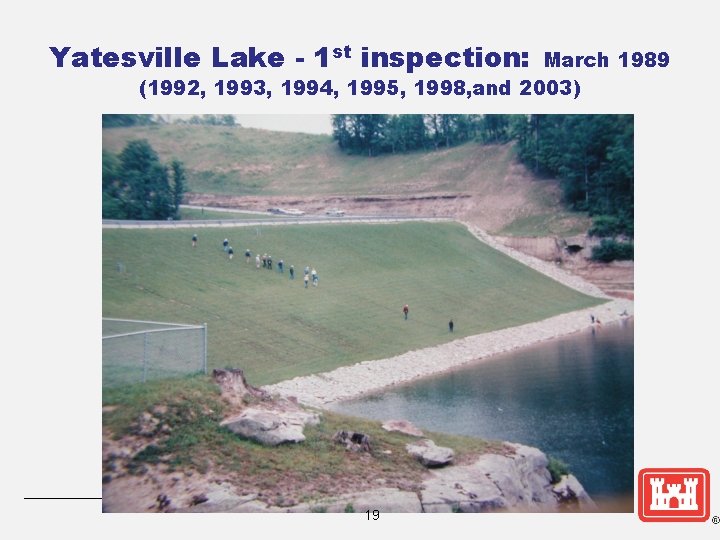
Yatesville Lake - 1 st inspection: March 1989 (1992, 1993, 1994, 1995, 1998, and 2003) 19
Pre-PI Procedures § Schedule and Funding ►Coordinate with Ops and Programs § Notify sponsor, state, agencies § Evaluate instrumentation and monitoring data § Identify PI team and DQC team § Prepare “boiler plate” § Prepare Pre-Inspection Packet 20
Team Composition and Qualifications § Various disciplines as required ► Minimum: Geotech, Structural, H&H, Ops ► Others: Mechanical, Electrical § Experience and training ► 5 years recommended ► OJT (3 previous PI), TADS, Confined Space § Team leaders must be registered PE or geologists w/ DS experience § Clerical/Admin assistance 21
Training Aids for Dam Safety § http: //usasearch. fema. gov/search? query=609 dvd&affiliate=fema § Preparing to Conduct a Dam Safety Inspection. § Documenting and Reporting Findings from a Dam Safety Inspection. § Inspection of Embankment Dams. § Inspection of Concrete and Masonry Dams. § Inspection of the Foundation, Abutments, and Reservoir Rim. 22

Training Aids for Dam Safety (cont’d) § Inspection of Spillways and Outlet Works. § Inspection and Testing of Gates, Valves, and Other Mechanical Systems. § Instrumentation for Embankment and Concrete Dams. § Identification of Material Deficiencies § Evaluation of Facility Emergency Preparedness. 23
Pre-Inspection Packet § Project access map, include GPS info § History of deficiencies and remedial measures § Technical summaries § Reservoir operations procedures § Written evaluation and plots of instrumentation data § Project data, layout and typical drawings § OMRR&R responsibilities § Subsurface soil profiles plots § Typical boring logs 24
Pre-Inspection Packet (cont’d) § List of project documents/engineering data § Checklists § Findings of annual inspections and status of recommended action items § Need for updating design parameters, e. g. , hydraulic, seismic, structural, HSS § Summary of past performance § Summary of Bridge inspections § Status of seismic re-evaluations § Status of Hydrologic re-evaluations 25
Inspection Plan § Risk informed § Incorporate OCA § Include technical skills required, items of equipment to be operated, areas to be inspected, required support equipment ► HSS ► Concrete structures ► Water passages ► Embankments ► Spillways ► Instrumentation ► Reservoir Rim 26
Pre-Inspection Briefing § § § § § Construction history and photos Performance history PFMA results RA results Interim Risk Reduction Measures Results of any pre-inspections Inspection plan Checklists and ratings Project staff input Safety briefing and AHA 27
Inspection Procedures § Inspect/operate features related to safety and stability of structure and operational adequacy of project § Verify engineering data stored on site, EAP up to date and accessible, all personnel with DS training § Certain features may be inspected prior to PI, e. g. , stilling basins, HSS 28
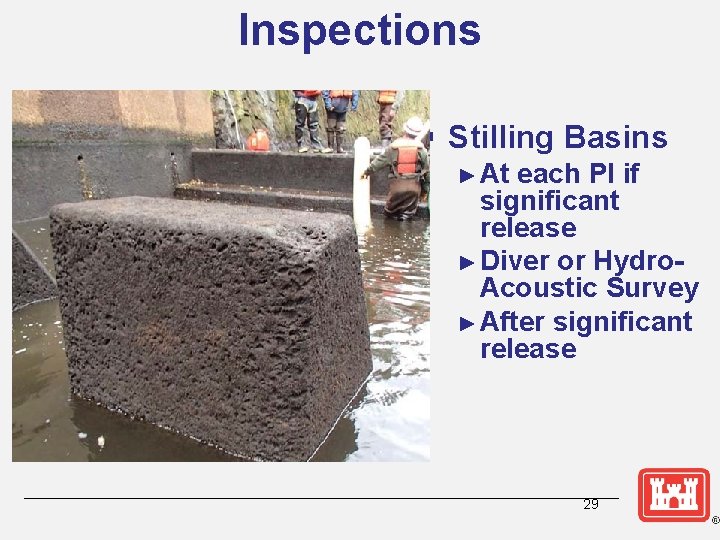
Inspections § Stilling Basins ► At each PI if significant release ► Diver or Hydro. Acoustic Survey ► After significant release 29
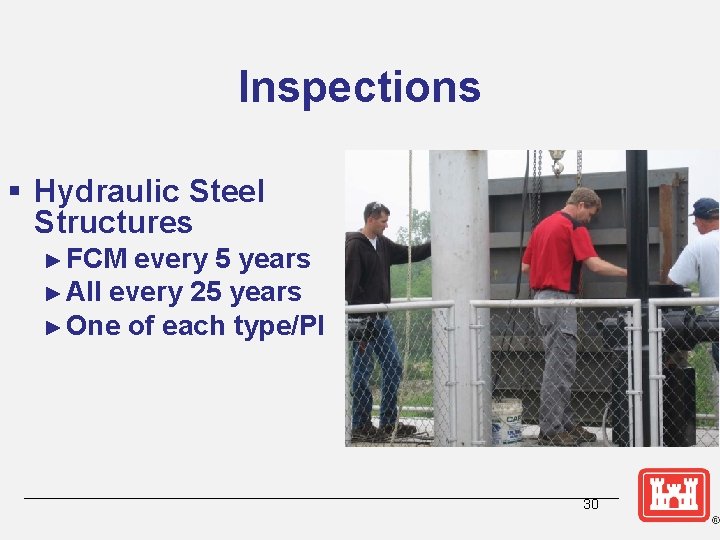
Inspections § Hydraulic Steel Structures ► FCM every 5 years ► All every 25 years ► One of each type/PI 30
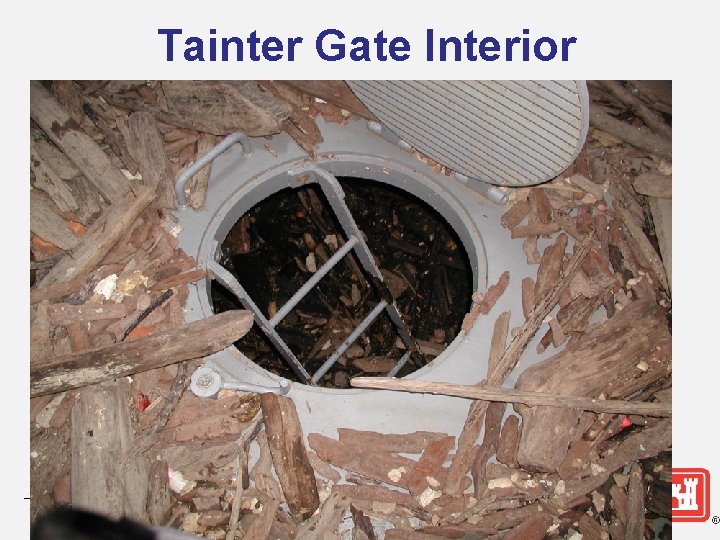
Tainter Gate Interior 31
Reservoir Dams § Concrete dam or earthen embankments—All areas such as toes, abutments, crest, upstream and downstream face, etc. § Outlet Works—Intake Structure, all concrete, all gates, bulkheads, tunnel/conduit/sluices, transition area, stilling basin, outlet channel; Operate all mechanical and electrical equipment, all hydraulic equipment; Run emergency generator under load. § Spillway—All rock cuts / benches, concrete floor or sill, and walls. If a concrete chute – check all walls, chute, and stilling basin. Inspect the approach and the outlet area. § Other—Levees, pump stations, reservoir rim, etc. § Dams upstream—Assess affect and condition of upstream dam 32
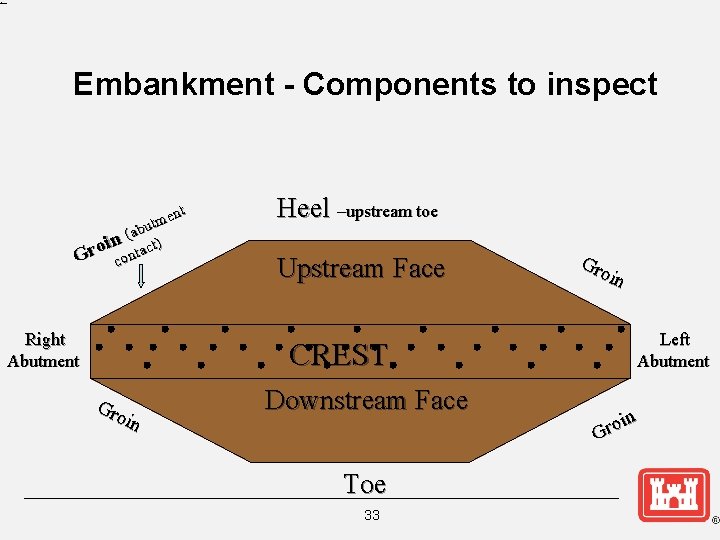
Embankment - Components to inspect nt e m t abu ( in tact) o r G con Right Abutment Heel –upstream toe Upstream Face CREST Gro in Downstream Face Toe 33 Gro in Left Abutment in o r G
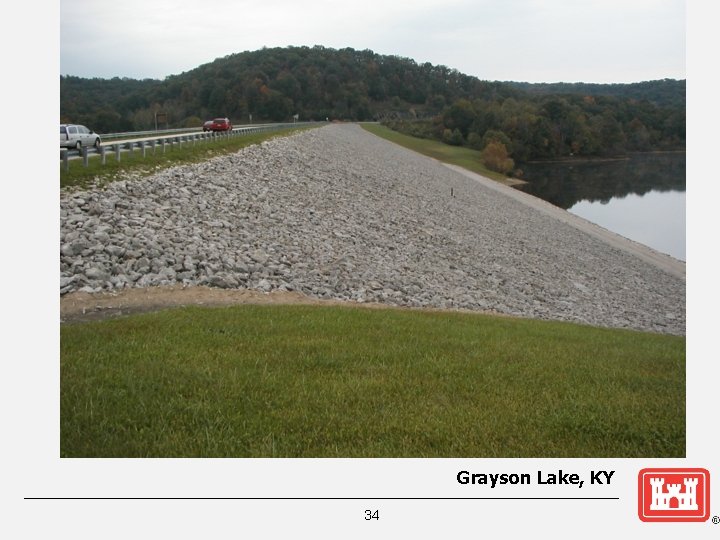
Grayson Lake, KY 34
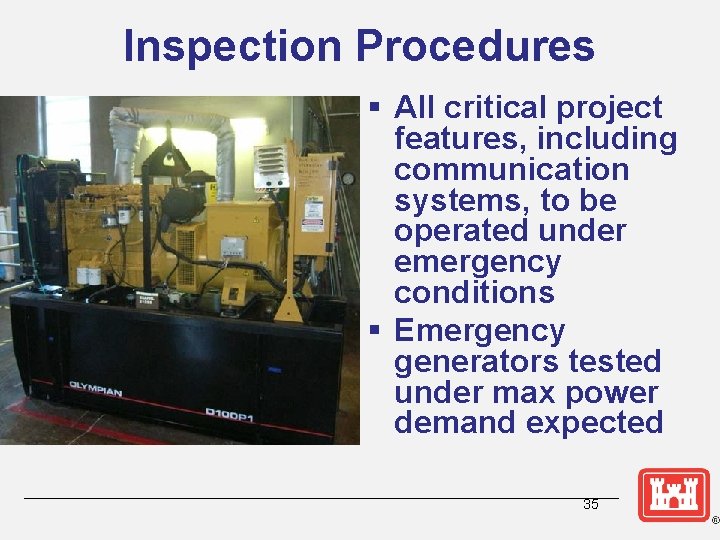
Inspection Procedures § All critical project features, including communication systems, to be operated under emergency conditions § Emergency generators tested under max power demand expected 35
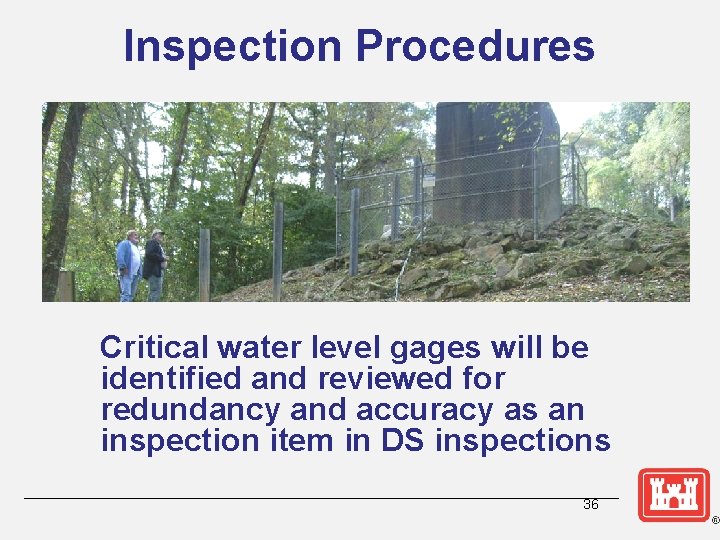
Inspection Procedures Critical water level gages will be identified and reviewed for redundancy and accuracy as an inspection item in DS inspections 36
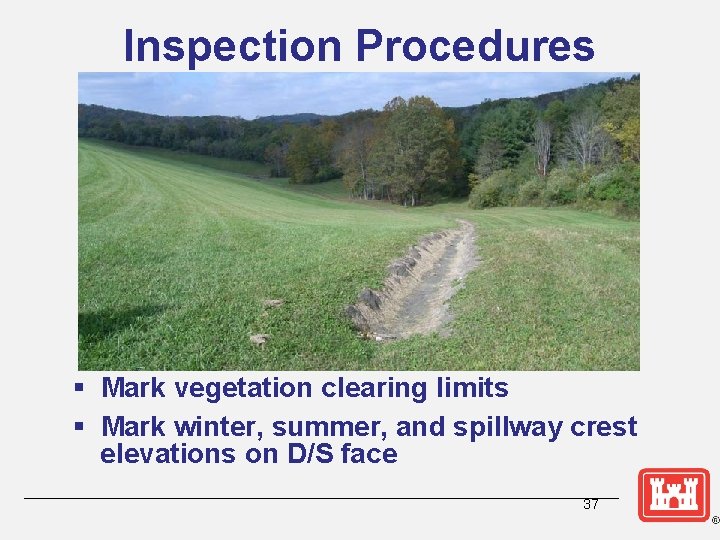
Inspection Procedures § Mark vegetation clearing limits § Mark winter, summer, and spillway crest elevations on D/S face 37
Reservoir Rim • Ascertain if rim is still functioning as intended • Particular concern is slides • Inspect: • By boat • From adjacent areas • By air • By walking around (if reservoir is small) 38
Locks and Dams All concrete portions of locks and dam lock walls (both pool levels), galleries, crossovers, control houses, piers, bridge, etc. All gates - tainter, roller, miter, any accessible bulkheads Operate all equipment - cranes, start motors to all gates, run one tainter / roller gate to full open / closed, document that all dam gates will raise to full extent, filling and emptying system, miter gates, raise emergency gate in lock, set bulkhead in one gate bay of dam, run emergency generator under load Other – riverbanks, dikes, etc. 39
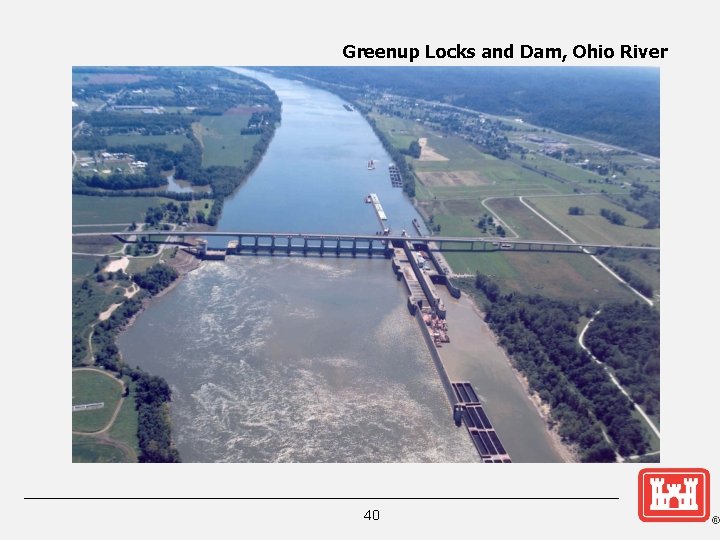
Greenup Locks and Dam, Ohio River 40
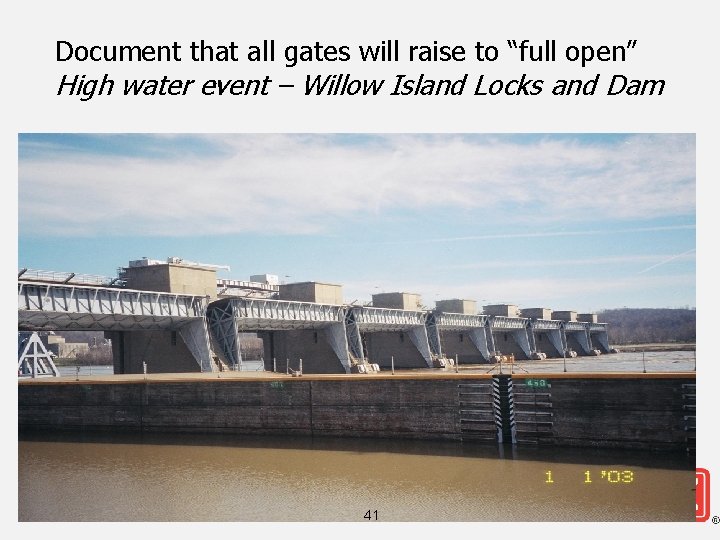
Document that all gates will raise to “full open” High water event – Willow Island Locks and Dam 41
Post-Inspection Briefing § Project and Ops Staff present § Findings and Recommendations ► Noted for record ► Action items ► OCA: A-F ► DSPMT funding: 1 -6 § Evidence of distress to be reported immediately 42
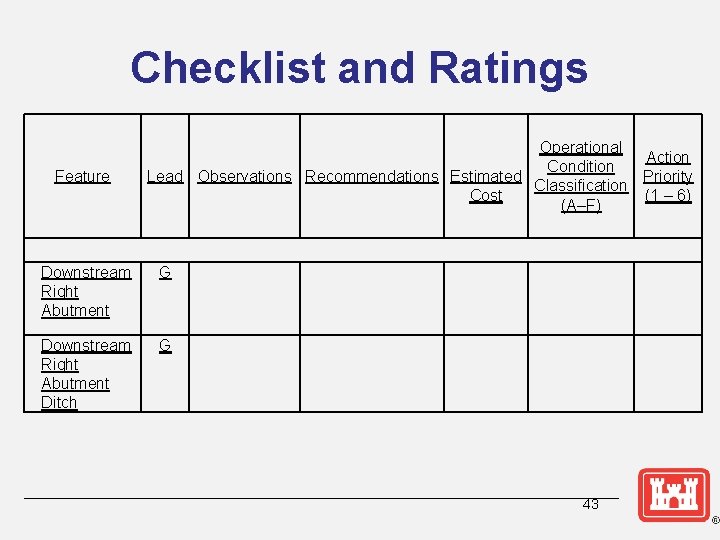
Checklist and Ratings Feature Operational Action Condition Priority Lead Observations Recommendations Estimated Classification Cost (1 – 6) (A–F) Downstream Right Abutment G Downstream Right Abutment Ditch G 43
Distress Signals § Evidence of Distress to Be Reported ► Sloughs, settlement, or slides in embankments such as earth or rockfill dams, urban levees, and bridge abutments or slopes of spillway, channels, and dam abutments ► Evidence of piping, muddy water boils in the areas of a structure such as embankments, abutments, or embankment-abutment contacts ► Abnormal increase or decrease of flow from foundation drains, structural joints or relief wells 44
Distress Signals § Evidence of Distress to Be Reported ► Any increase in seepage quantities through or under embankments or in abutments ► Any significant change in pore-water pressure in either embankments or their foundations or abutments ► Any significant change in uplift pressures under concrete structures ► Unusual vertical or horizontal movement or cracking of embankments or abutments 45
Distress Signals § Evidence of Distress to Be Reported ► Significant cracking of mass concrete structures, either during construction or after completion ► Sinkholes or localized subsidence in the foundation of or adjacent to embankments or other pertinent structures critical to the safe operation of the project ► Excessive deflection, displacement, or vibration of concrete structures (e. g. , tilting or sliding of intake towers, bridge piers, training walls, or floodwalls) 46
Distress Signals § Evidence of Distress to Be Reported ► Erratic movement, binding, excessive deflection, or vibration of outlet and spillway gates and large flow control valves ► Significant damage to any structure (e. g. , barge damage to bridge piers or lock walls or ice flow damage to intake towers and access bridge piers) 47
Distress Signals § Evidence of Distress to Be Reported ► Significant damage to, or changes in, structures, foundations, reservoir levels, groundwater conditions, and adjacent terrain as a result of seismic events. Special inspections for damages should be made immediately following the seismic events. ► Any other indications of distress or potential failure that could inhibit the operation of a project 48
PI Report § Uniform PI/PA report format § Omit PA sections until PA is performed § Review and reuse or revise previous PA sections § If DSAC I-III, can’t say, “Dam is in good or acceptable condition. ” § Perform District Quality Control Review § Submit Executive Summary within 90 days § Submit report to MSC within 90 days § Submit searchable. pdf to ERDC library 49

Be Vigilant! Be Safe! Essayons! 50
- Slides: 50