
Dallas Urban Land Bank Demonstration Program A Briefing
Dallas Urban Land Bank Demonstration Program A Briefing to the Dallas County Commissioners Court October 22, 2013
Purpose n n To provide historic information on the Dallas Urban Land Bank Demonstration Program To provide status of the Land Bank 2
Goal n The goal of the Dallas Urban Land Bank Demonstration Program is to develop a significant quantity of affordable single-family homes on vacant, tax-delinquent properties within Dallas neighborhoods. Putting these properties to this productive use will: 1. 2. 3. 4. 5. Address the shortage of affordable workforce housing in Dallas; Eliminate blight in target neighborhoods; Stabilize “at risk” communities and enhance quality of life; Stimulate community investment and economic growth; and Increase local government property tax, sales tax and fee revenues. 3
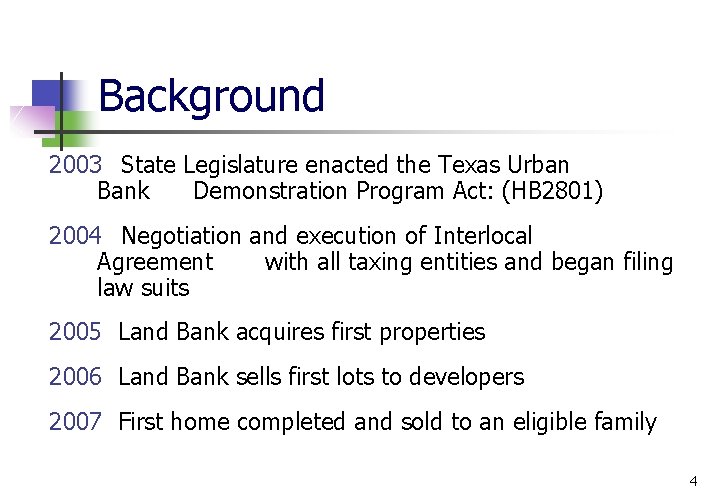
Background 2003 State Legislature enacted the Texas Urban Bank Demonstration Program Act: (HB 2801) 2004 Negotiation and execution of Interlocal Agreement with all taxing entities and began filing law suits 2005 Land Bank acquires first properties 2006 Land Bank sells first lots to developers 2007 First home completed and sold to an eligible family 4
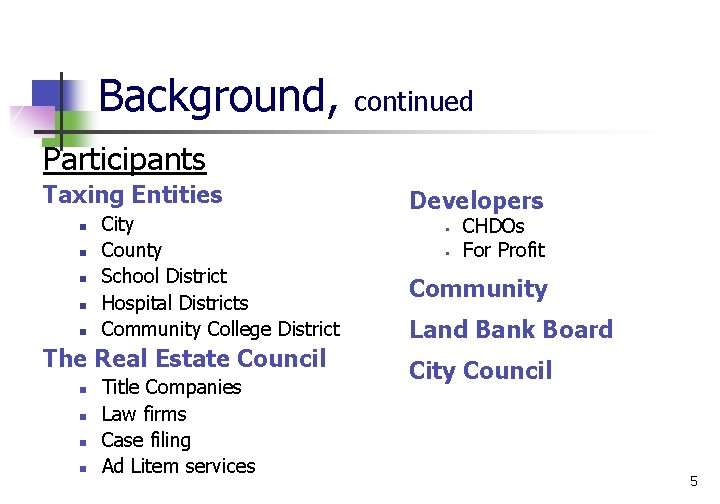
Background, continued Participants Taxing Entities n n n City County School District Hospital Districts Community College District The Real Estate Council n n Title Companies Law firms Case filing Ad Litem services Developers § § CHDOs For Profit Community Land Bank Board City Council 5
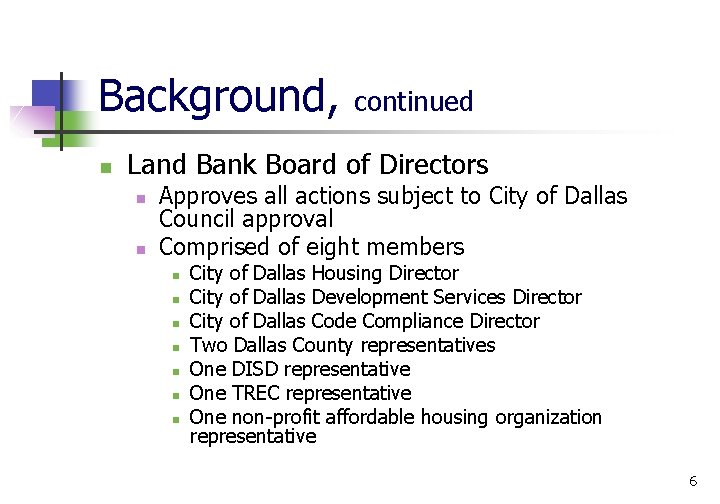
Background, n continued Land Bank Board of Directors n n Approves all actions subject to City of Dallas Council approval Comprised of eight members n n n n City of Dallas Housing Director City of Dallas Development Services Director City of Dallas Code Compliance Director Two Dallas County representatives One DISD representative One TREC representative One non-profit affordable housing organization representative 6
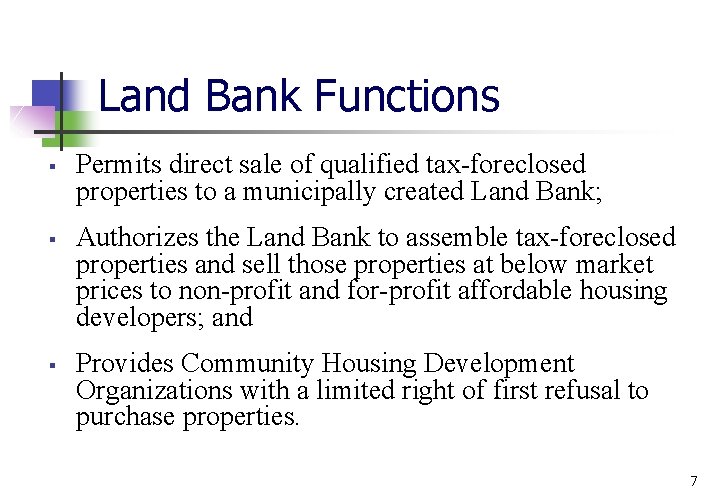
Land Bank Functions § § § Permits direct sale of qualified tax-foreclosed properties to a municipally created Land Bank; Authorizes the Land Bank to assemble tax-foreclosed properties and sell those properties at below market prices to non-profit and for-profit affordable housing developers; and Provides Community Housing Development Organizations with a limited right of first refusal to purchase properties. 7

Six Basic Steps * Land Bank assembles list of potential vacant lots and forwards to Law Firm and Title Company (both perform work on a pro bono basis) Title Company Abstracts Title, forwards opinion to Law Firm and to City Attorney’s Office After approval by City Attorney’s Office, lawsuit is prepared and filed with County Court adjudicates law suit and Sherriff conducts private sale to Land Bank * Land Bank assembles properties to be sold to Developers and solicits Requests for Proposals unless qualified CHDO is developer Obtains Land Bank Board approval, holds community meeting, obtains City Council approval and conveys lots to developer Ad Litem attorneys are required on about 70% of the cases and are furnished through TREC member law firms on a pro bono basis 8
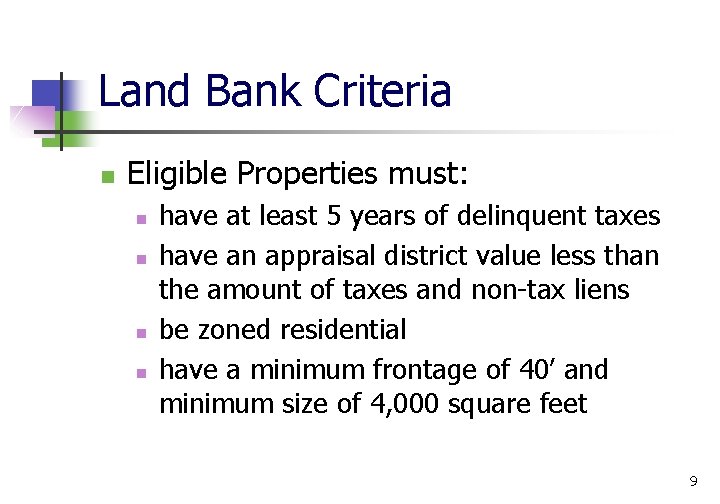
Land Bank Criteria n Eligible Properties must: n n have at least 5 years of delinquent taxes have an appraisal district value less than the amount of taxes and non-tax liens be zoned residential have a minimum frontage of 40’ and minimum size of 4, 000 square feet 9
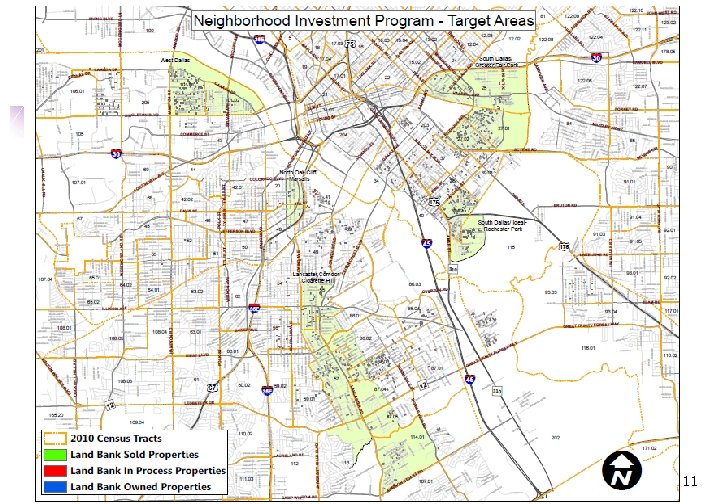
Focus Selection Process 1. 2. 3. Lots in Neighborhood Investment Program (NIP) Areas Lots 1 mile on either side of DART rail lines Selected lots for CHDOs 10
11
Production n n (as of 9/30/2013) 1, 633 lawsuits filed 993 properties sold to the Land Bank including 112 lots acquired using NSP funds 462 lots sold to CHDOs and Developers with 7 lots pending sale 256 homes completed and sold Goal is to add to the pipeline each year: n Up to 150 additional lawsuits brought to the Sheriff’s sale 12
Challenges n n n Maintaining our lot inventory Finding enough qualified home buyers given the current and projected market conditions Ensuring there is sufficient developer capacity 13
- Slides: 13