
Dallas County SAFPF ReEntry Courts Outcome Study Teresa
- Slides: 13
Dallas County SAFPF Re-Entry Courts Outcome Study Teresa May-Williams, Ph. D. Southern Methodist University
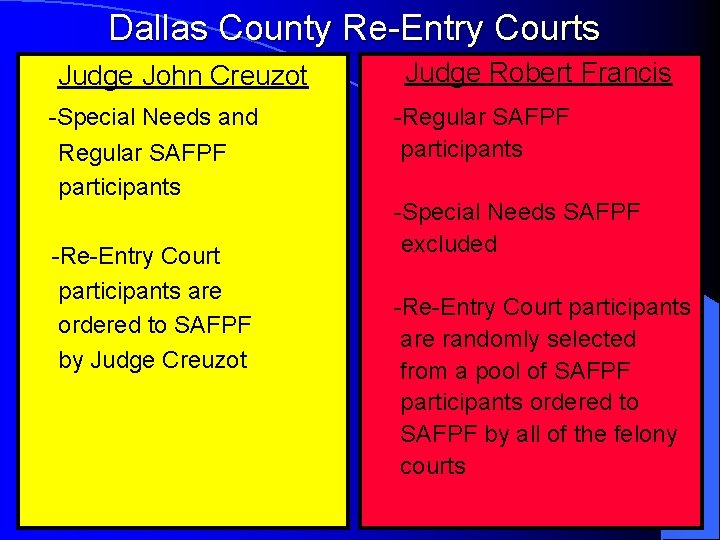
Dallas County Re-Entry Courts Judge John Creuzot -Special Needs and Regular SAFPF participants -Re-Entry Court participants are ordered to SAFPF by Judge Creuzot Judge Robert Francis -Regular SAFPF participants -Special Needs SAFPF excluded -Re-Entry Court participants are randomly selected from a pool of SAFPF participants ordered to SAFPF by all of the felony courts
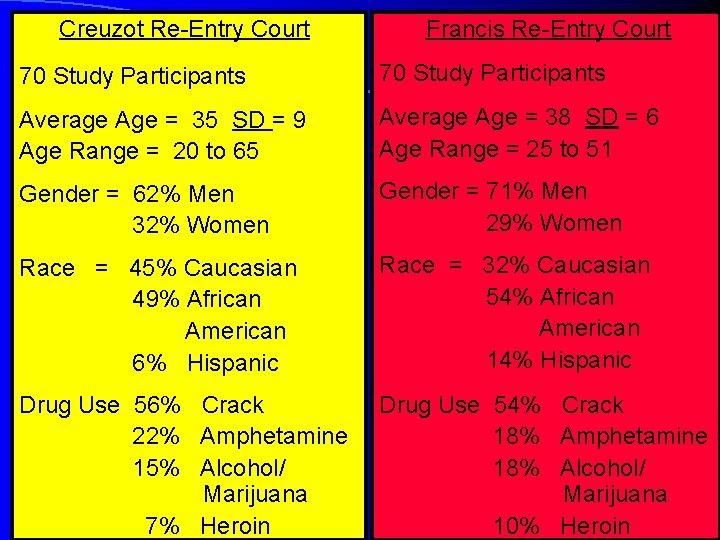
Creuzot Re-Entry Court Francis Re-Entry Court 70 Study Participants Average Age = 35 SD = 9 Age Range = 20 to 65 Average Age = 38 SD = 6 Age Range = 25 to 51 Gender = 62% Men 32% Women Gender = 71% Men 29% Women Race = 45% Caucasian 49% African American 6% Hispanic Race = 32% Caucasian 54% African American 14% Hispanic Drug Use 56% Crack 22% Amphetamine 15% Alcohol/ Marijuana 7% Heroin Drug Use 54% Crack 18% Amphetamine 18% Alcohol/ Marijuana 10% Heroin
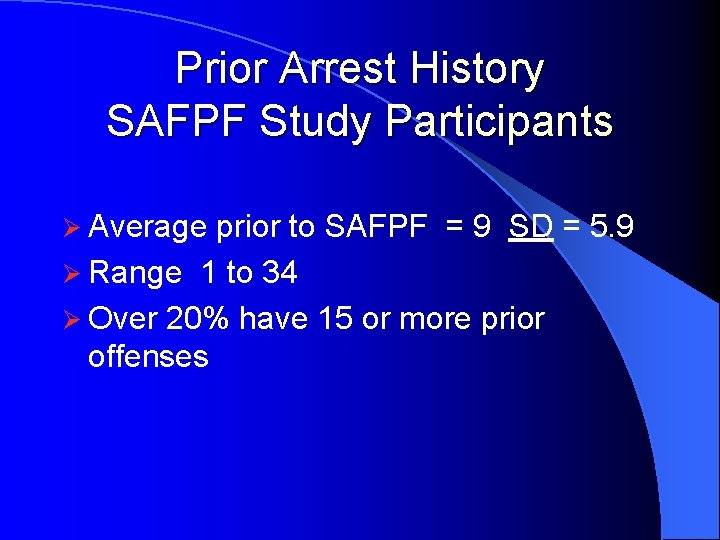
Prior Arrest History SAFPF Study Participants Ø Average prior to SAFPF = 9 SD = 5. 9 Ø Range 1 to 34 Ø Over 20% have 15 or more prior offenses
Control Groups ØControl Groups include SAFPF program participants (70 per group) from the other 13 felony courts. ØControl participants were matched to Re-Entry Court participants for each group by Age, Gender, Ethnicity, Education, and Drug Use.
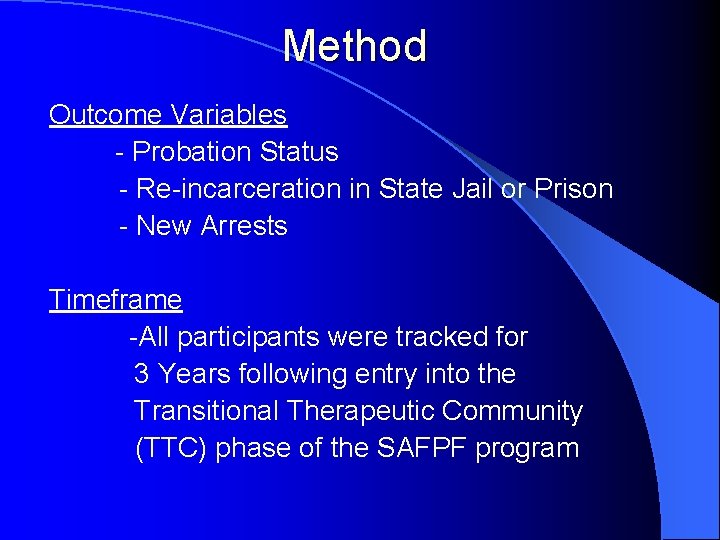
Method Outcome Variables - Probation Status - Re-incarceration in State Jail or Prison - New Arrests Timeframe -All participants were tracked for 3 Years following entry into the Transitional Therapeutic Community (TTC) phase of the SAFPF program
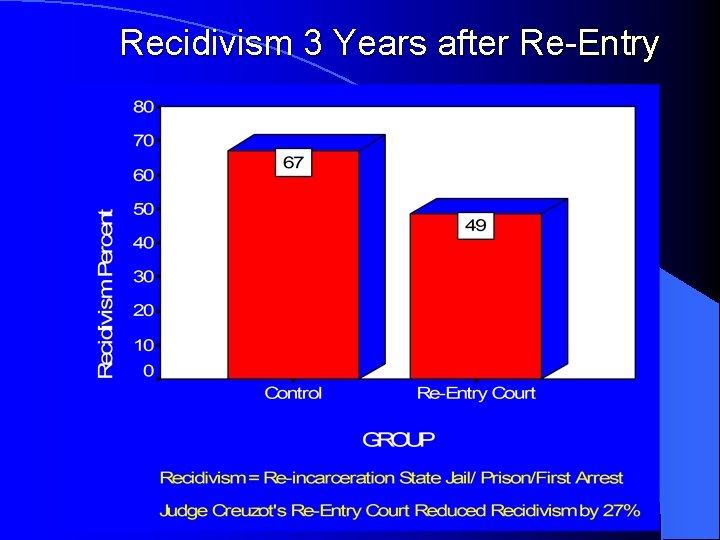
Recidivism 3 Years after Re-Entry
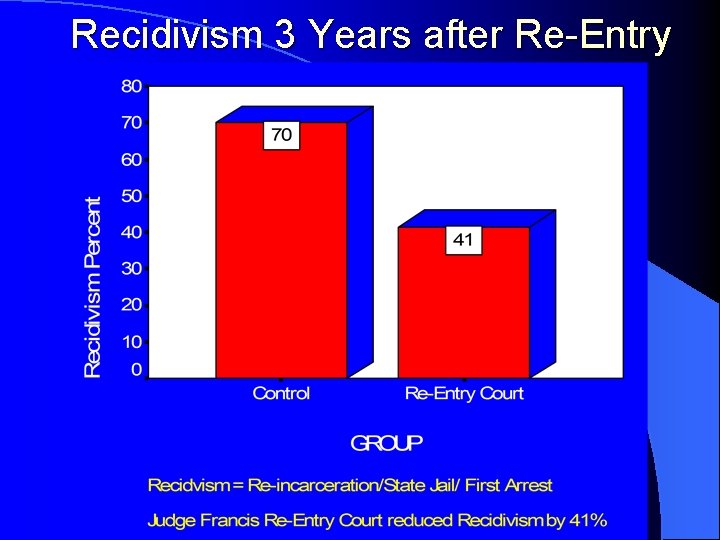
Recidivism 3 Years after Re-Entry
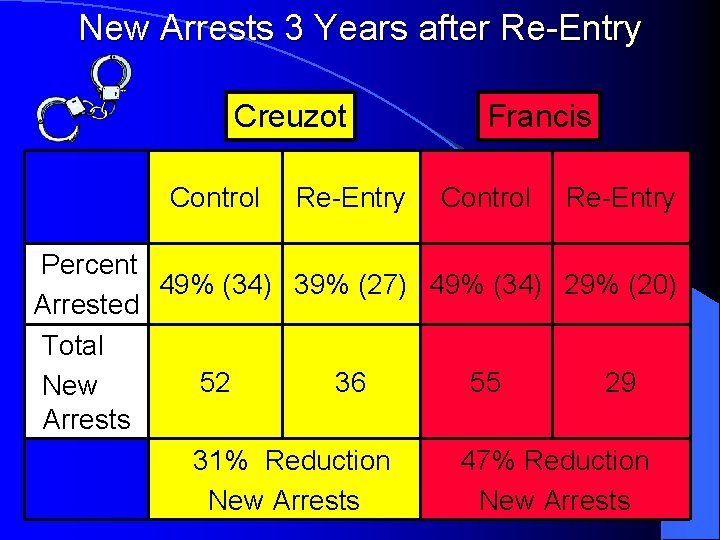
New Arrests 3 Years after Re-Entry Creuzot Control Re-Entry Francis Control Re-Entry Percent 49% (34) 39% (27) 49% (34) 29% (20) Arrested Total 52 36 55 29 New Arrests 31% Reduction 47% Reduction New Arrests
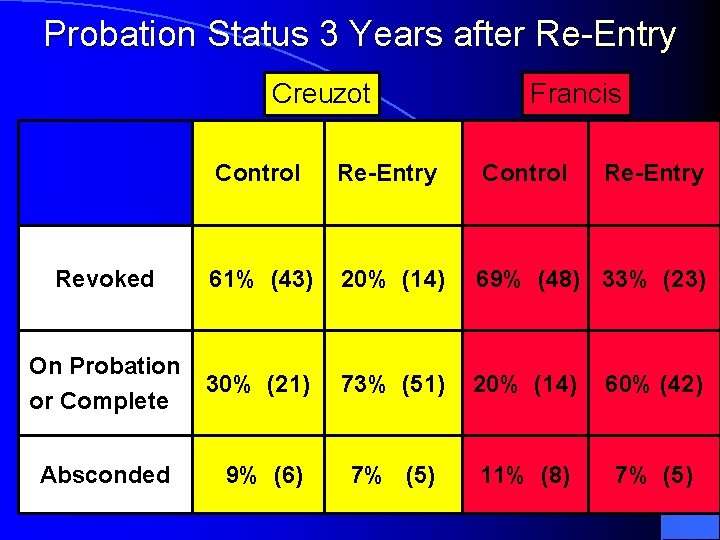
Probation Status 3 Years after Re-Entry Creuzot Francis Control Re-Entry Revoked 61% (43) 20% (14) 69% (48) 33% (23) On Probation or Complete 30% (21) 73% (51) 20% (14) 60% (42) Absconded 9% (6) 7% (5) 11% (8) 7% (5)
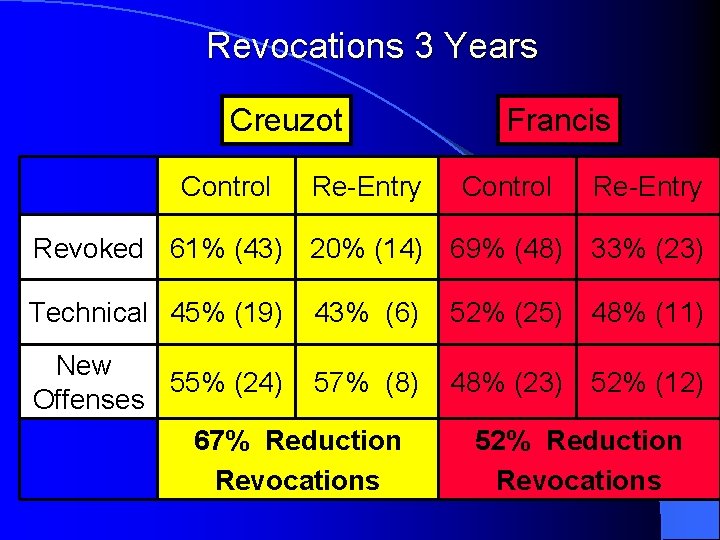
Revocations 3 Years Creuzot Control Re-Entry Francis Control Re-Entry Revoked 61% (43) 20% (14) 69% (48) 33% (23) Technical 45% (19) 43% (6) New 55% (24) 57% (8) Offenses 67% Reduction Revocations 52% (25) 48% (11) 48% (23) 52% (12) 52% Reduction Revocations
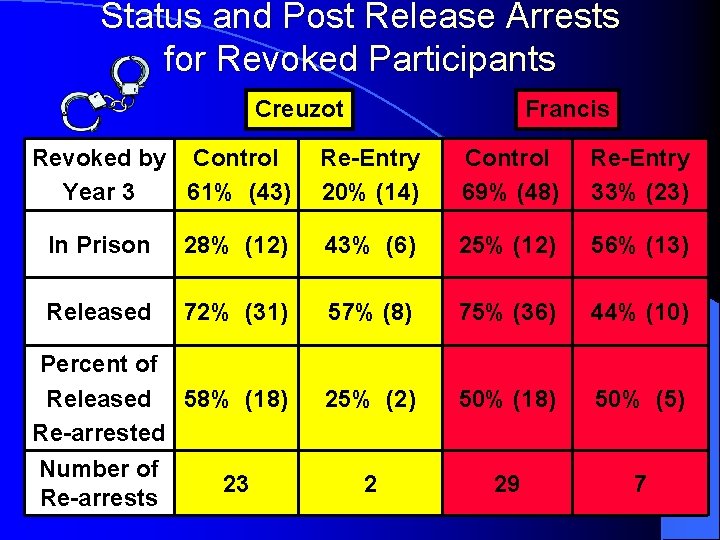
Status and Post Release Arrests for Revoked Participants Creuzot Revoked by Control Year 3 61% (43) Francis Re-Entry 20% (14) Control 69% (48) Re-Entry 33% (23) In Prison 28% (12) 43% (6) 25% (12) 56% (13) Released 72% (31) 57% (8) 75% (36) 44% (10) Percent of Released 58% (18) Re-arrested 25% (2) 50% (18) 50% (5) 2 29 7 Number of Re-arrests 23
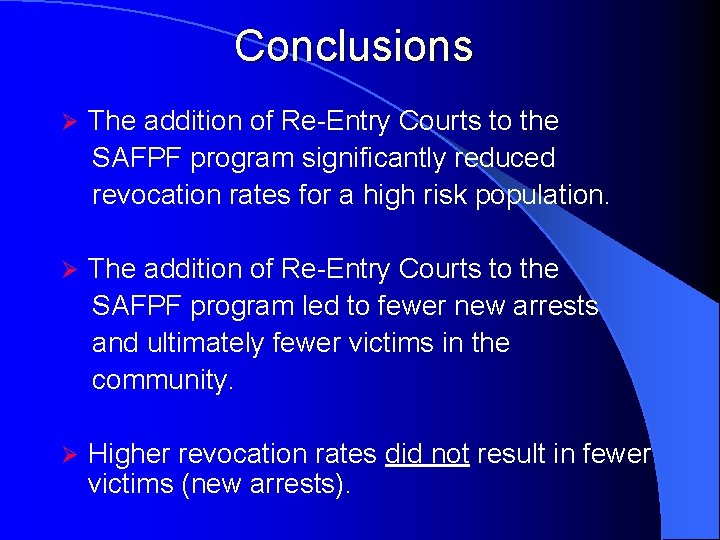
Conclusions Ø The addition of Re-Entry Courts to the SAFPF program significantly reduced revocation rates for a high risk population. Ø The addition of Re-Entry Courts to the SAFPF program led to fewer new arrests and ultimately fewer victims in the community. Ø Higher revocation rates did not result in fewer victims (new arrests).