
Dales Shoes A Structured Interview Process In Dales
- Slides: 15
Dale’s Shoes A Structured Interview Process
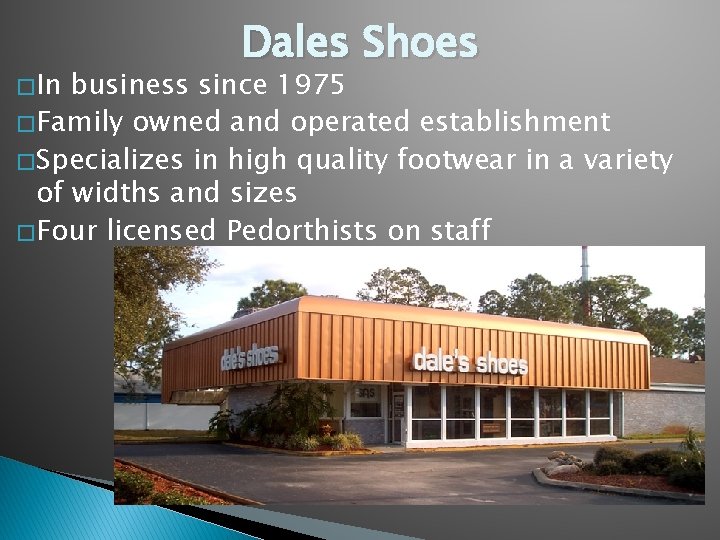
� In Dales Shoes business since 1975 � Family owned and operated establishment � Specializes in high quality footwear in a variety of widths and sizes � Four licensed Pedorthists on staff
Objectives � Develop a job description for Dale’s Shoes sales associates � Conduct an interview with staff to determine the most desirable attributes � Improve upon Dale’s Shoes employee selection process through creation of a structured interview and a scoring system � Reduce employee turnover
Benefits of A Structured Interview Questions are predetermined to be relevant to job criteria � Each applicant is asked the same questions � Allows for detailed notes on each candidate, disregards irrelevant information � Predetermined basis for evaluation of interviewee responses � Unstructured interviews allow for questions that are not necessarily relevant to job criteria � Each applicant in unstructured interviews may be asked different questions, making evaluations inconsistent. � Irrelevant or extraneous information may affect the interview process and final decision. � (Public Service Commission of Canada)
Preparing For the Interview Review the Job Description ◦ nonexistent job ◦ up-to-date � Review Applicant’s Resume ◦ Minimum qualification ◦ List of talking points (background and experiences) � Create A List of Questions ◦ Questions to avoid � Short response and yes/no questions �Questions that imply an answer or hostility �Broad questions that are time consuming ◦ Make sure questions relate to job �KSAOs (Knowledge, Skills, Abilities, and Other Characteristics) (Mc. Connell, 2007) �
Preparing For the Interview � � � Review Company Information ◦ Be prepared to answer questions regarding the company and potential benefits Choose A Quiet Location ◦ Room set up Schedule the Interview ◦ a date and time when you’re available ◦ Contact and send the applicant a reminder (Mc. Connell, 2007)
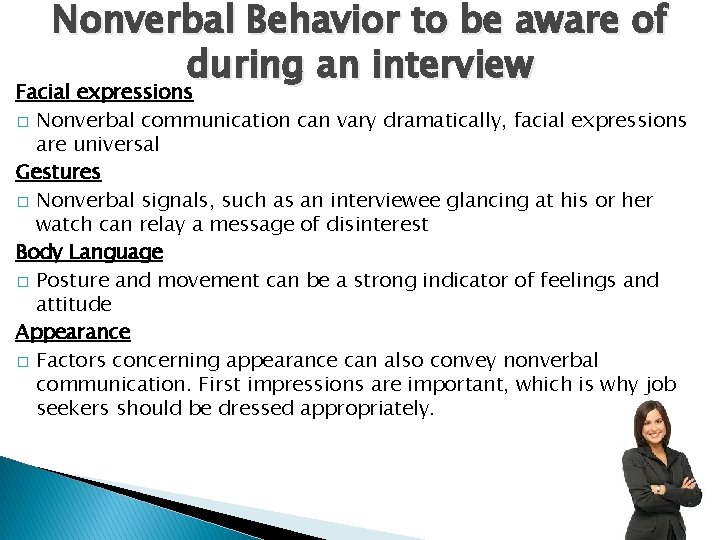
Nonverbal Behavior to be aware of during an interview Facial expressions � Nonverbal communication can vary dramatically, facial expressions are universal Gestures � Nonverbal signals, such as an interviewee glancing at his or her watch can relay a message of disinterest Body Language � Posture and movement can be a strong indicator of feelings and attitude Appearance � Factors concerning appearance can also convey nonverbal communication. First impressions are important, which is why job seekers should be dressed appropriately.
Conducting the Interview � Greet The Applicant � Introduce Yourself � Break The Ice � Talk About The Job And The Organization
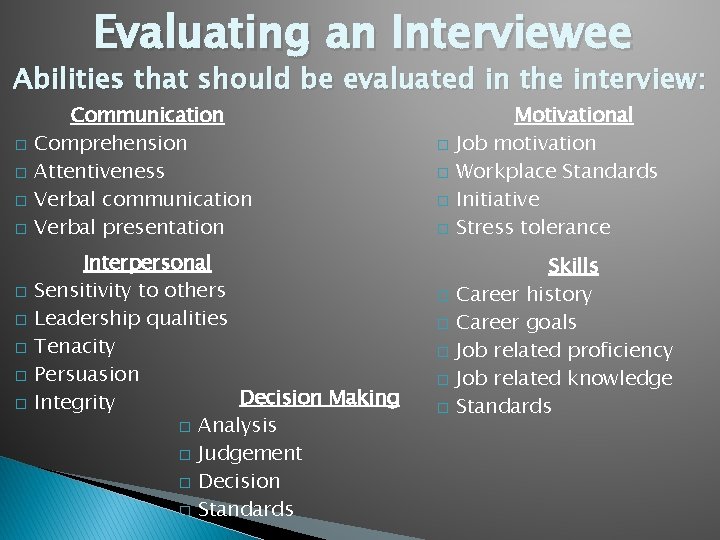
Evaluating an Interviewee Abilities that should be evaluated in the interview: � � � � � Communication Comprehension Attentiveness Verbal communication Verbal presentation Interpersonal Sensitivity to others Leadership qualities Tenacity Persuasion Decision Making Integrity � Analysis � Judgement � Decision � Standards � � � � � Motivational Job motivation Workplace Standards Initiative Stress tolerance Skills Career history Career goals Job related proficiency Job related knowledge Standards
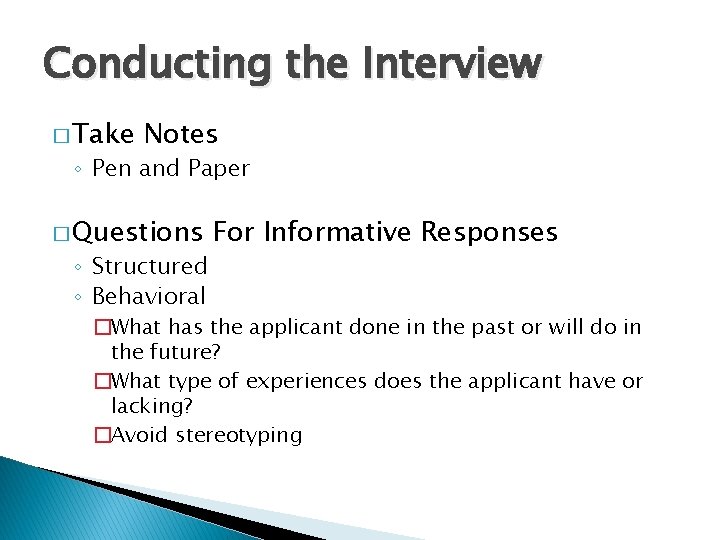
Conducting the Interview � Take Notes ◦ Pen and Paper � Questions ◦ Structured ◦ Behavioral For Informative Responses �What has the applicant done in the past or will do in the future? �What type of experiences does the applicant have or lacking? �Avoid stereotyping
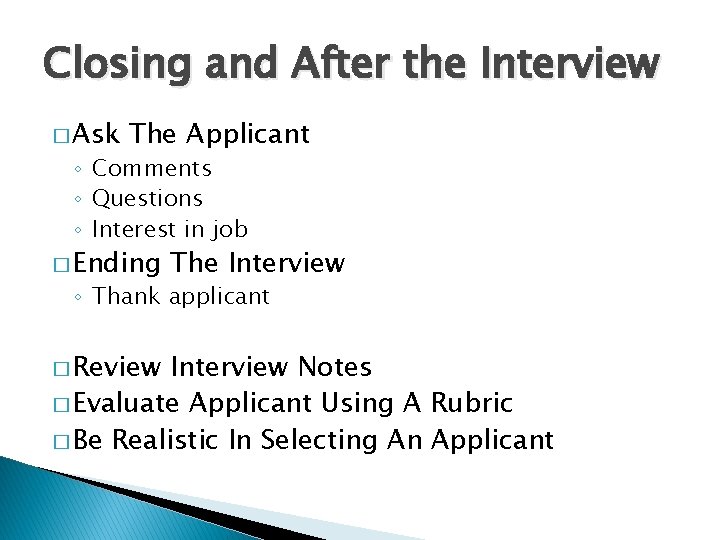
Closing and After the Interview � Ask The Applicant ◦ Comments ◦ Questions ◦ Interest in job � Ending The Interview ◦ Thank applicant � Review Interview Notes � Evaluate Applicant Using A Rubric � Be Realistic In Selecting An Applicant
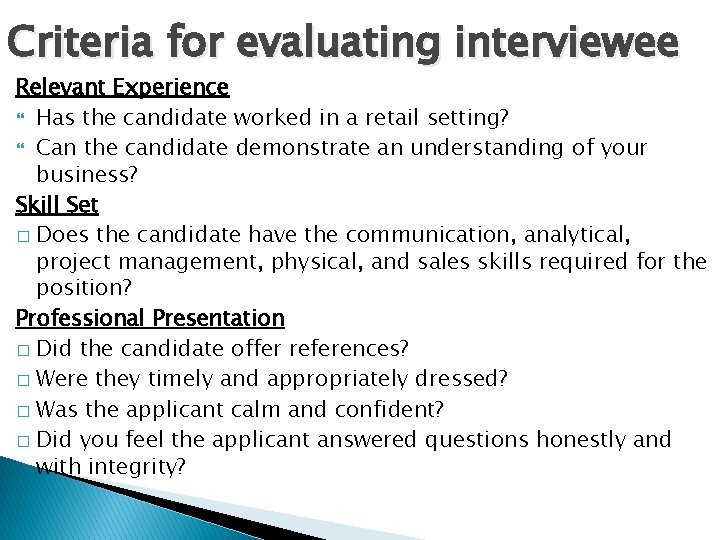
Criteria for evaluating interviewee Relevant Experience Has the candidate worked in a retail setting? Can the candidate demonstrate an understanding of your business? Skill Set � Does the candidate have the communication, analytical, project management, physical, and sales skills required for the position? Professional Presentation � Did the candidate offer references? � Were they timely and appropriately dressed? � Was the applicant calm and confident? � Did you feel the applicant answered questions honestly and with integrity?
Criteria for evaluating interviewee continued Knowledge of Position � Do you feel the candidate fully understands what it take to be successful with this job? � Do you feel that the candidate is willing and able to learn workplace related criteria (new products, technology, etc. )? Personality and Fit � Is the candidate a good fit for your company culture? � How will the candidate be received by the current staff? � Is the applicant motivated and enthusiastic about working for this business?
Evaluating the Interviewee � Provide a method of rating or scoring the applicant responses � To interpret the applicant responses objectively, it is important to develop some scoring system (Graves & Karren, 1996) � One approach is to develop a rubric for rating the quality of the responses � It is important to have both a structured interview and structured criteria for evaluation applicants
Reference Barclay, J. M. (2001). Improving selection interviews with structure: Organisations’ use of“behavioural” interviews. Personnel Review, 30(1), 81 -101. doi: http: //dx. doi. org/10. 1108/00483480110380154 � Blackman, M. C. , & Funder, D. C. (2002). Effective interview practices for accurately assessing counterproductive traits. International Journal of Selection and Assessment, 10(1/2), 109 -116. � Camp, R. R. , Schulz, E. , Vielhaber, M. E. , & Wagner-Marsh, F. (2011). Human resource professionals' perceptions of interviewer training. Journal of Managerial Issues, 23(3), 250 -268. � Carson, K. D. , Carson, P. P. , Fontenot, G. , & Burdin, J. J. (2005). Structured interview questions for selecting productive, emotionally mature, and helpful employees. The Health Care Manager, 24(3), 209 -215. � Conducting effective structured interviews: Resource guide for hiring managers and supervisors. (2005) United States Department of State Bureau of Human Resources. Retrieved March 27, 2015, from http: //www. state. gov/documents/organization/107843. pdf � Graves, L. M. , & Karren, R. J. (1996). The employee selection interview: A fresh look at an ol 35, 163 -180 � problem. Human Resource Management, Mc. Connell, C. R. (2007). Conducting the employee selection interview: How to do it effectively while avoiding legal obstacles. The Health Care Manager, 26(2), 164 -174. doi: 10. 1097/01. HCM. 0000268622. 63985. a 4 � Moy, J. W. (2006). Are employers assessing the right traits in hiring? Evidence from Hong Kong companies. International Journal of Human Resource Management, 17(4), 734 -754. doi: 10. 1080/09585190600581717 � Structured interviewing: How to design and conduct structured interviews for an appointment process. (2009). Public Service Commission of Canada. Retrieved March 27, 2015, from http: //www. psc-cfp. gc. ca/plcy-pltq/guides/structured-structuree/index-eng. htm �