
Dairy Products Dairy Products Dairy products include milk

- Slides: 20
Dairy Products
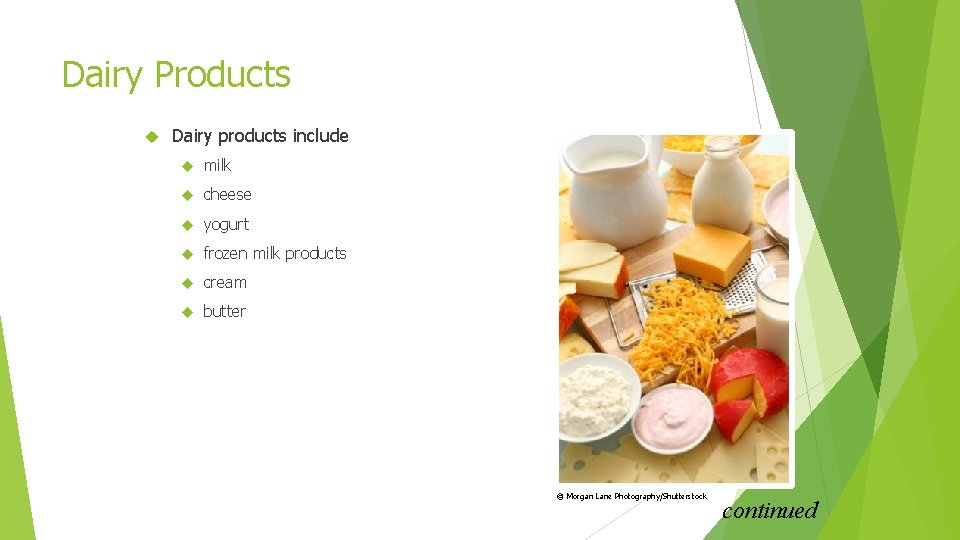
Dairy Products Dairy products include milk cheese yogurt frozen milk products cream butter © Morgan Lane Photography/Shutterstock continued
Dairy Products All dairy products shipped across state lines for retail sale in the U. S. are pasteurized Pasteurization is a heating process that destroys harmful bacteria Helps milk products stay fresh Prevents illness Louis Pasteur invented the process
Milk The higher the fat content, the more the milk costs Most milk and milk products are homogenized and fortified with nutrients Homogenized– is the process by which milkfat is broken into tiny particles that stay evenly suspended in the milk. Fortified – nutrients such as vitamin A and D have been added to the milk.
Forms of Milk comes in 4 forms Fresh Fluid Milk Canned Milk Dry Milk Cultured Milk
Fresh Fluid Milk Whole Milk – 3. 25% fat Reduced-fat Milk – 2% fat Low-fat Milk – 1% fat Fat-free Milk aka Skim Milk aka Nonfat Milk – contains less than 0. 5% fat
Canned Milk Evaporated Milk – about 50% of water is removed from whole milk and canned Evaporated Fat-Free Milk – about 50% water is removed from fat-free milk and canned Sweetened Condensed Milk - about 50% water is removed from whole milk and about 42% sugar is added
Dry Milk Nonfat Dry Milk – 100% water and fat is removed from whole milk Dry Whole Milk – 100% water is removed from whole milk
Cultured Milk Buttermilk – special bacteria culture is added to milk
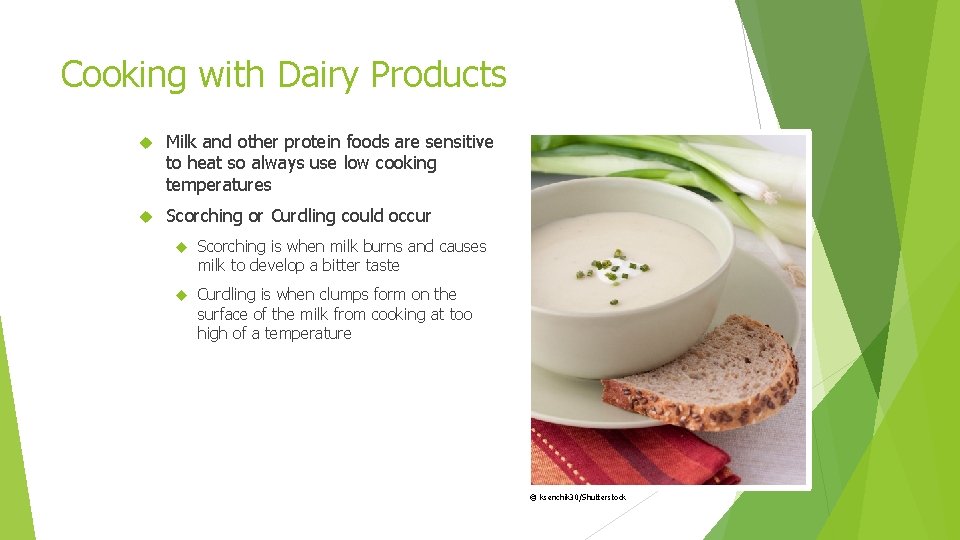
Cooking with Dairy Products Milk and other protein foods are sensitive to heat so always use low cooking temperatures Scorching or Curdling could occur Scorching is when milk burns and causes milk to develop a bitter taste Curdling is when clumps form on the surface of the milk from cooking at too high of a temperature © ksenchik 30/Shutterstock
Cooking with Milk To prevent scorching and curdling cook slowly over a low heat use a double boiler use fresh milk continued
Cooking with Milk Skin is a film that sometimes forms on the surface of milk To keep skin from forming, beat milk to produce a foam layer on top cover milk during heating Remove skin because it creates lumps
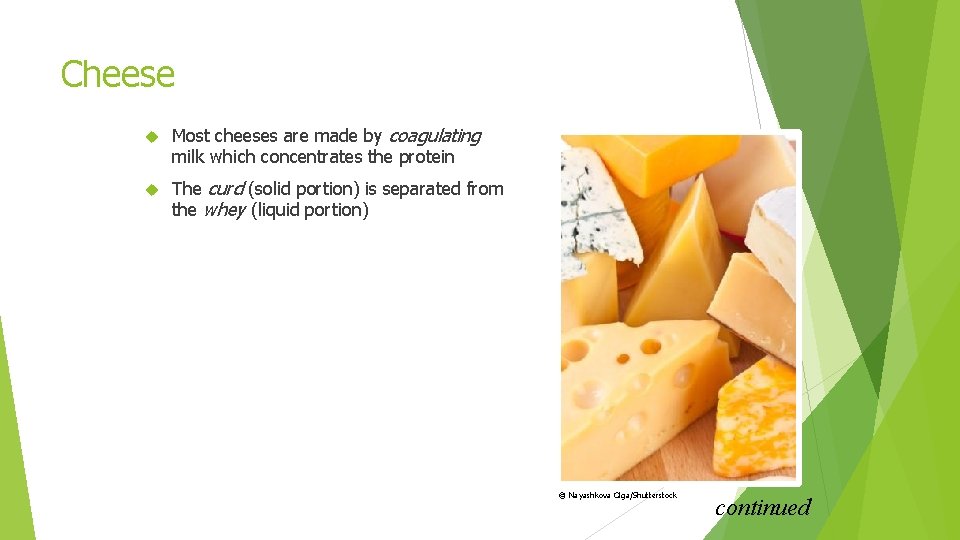
Cheese Most cheeses are made by coagulating milk which concentrates the protein The curd (solid portion) is separated from the whey (liquid portion) © Nayashkova Olga/Shutterstock continued
Cheese Cheeses vary in food values aroma body flavor color texture cost
Two Classes of Cheese Natural Cheese Made from milk, whey or cream Processed Cheese A blending of two or more natural cheeses
Natural Cheese Type of cheese produced depends on the Source of milk Seasonings used Method of preparation Ripening or curing process
Natural Cheese Two categories for natural cheeses: Unripened and Ripened Cheeses Unripened cheeses have soft textures and milk flavors Examples: Cream cheese and cottage cheese Ripened cheeses are stored for certain lengths of time at specific temperatures Examples: Cheddar and Swiss
Process Cheese Natural cheeses are grated and shredded then heated to combine Two types of processed cheese: Process Cheese Food and Process Cheese Spread Process Cheese Food - higher moisture content than natural cheese but lower fat content Process Cheese Spread – higher moisture content and lower fat content than process cheese food Sold as slices, in blocks, or in jars
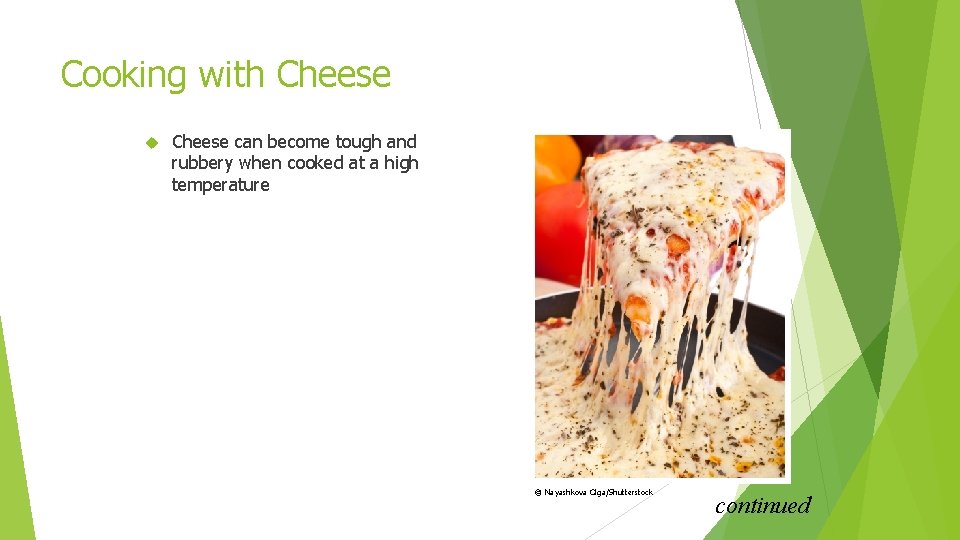
Cooking with Cheese can become tough and rubbery when cooked at a high temperature © Nayashkova Olga/Shutterstock continued
Cooking with Cheese To prevent overcooking, add cubed or shredded cheese to sauces and casseroles at the end of cooking time sprinkle cheese on casseroles after they are baked use medium to medium-high power setting in the microwave oven