
DailyScale Planetary Wave Patterns and the Modulation of
- Slides: 1
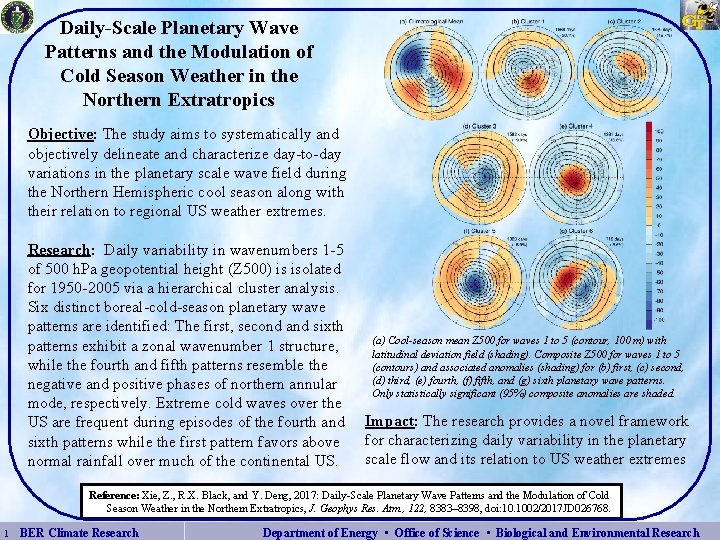
Daily-Scale Planetary Wave Patterns and the Modulation of Cold Season Weather in the Northern Extratropics Objective: The study aims to systematically and objectively delineate and characterize day-to-day variations in the planetary scale wave field during the Northern Hemispheric cool season along with their relation to regional US weather extremes. Research: Daily variability in wavenumbers 1 -5 of 500 h. Pa geopotential height (Z 500) is isolated for 1950 -2005 via a hierarchical cluster analysis. Six distinct boreal-cold-season planetary wave patterns are identified: The first, second and sixth patterns exhibit a zonal wavenumber 1 structure, while the fourth and fifth patterns resemble the negative and positive phases of northern annular mode, respectively. Extreme cold waves over the US are frequent during episodes of the fourth and sixth patterns while the first pattern favors above normal rainfall over much of the continental US. (a) Cool-season mean Z 500 for waves 1 to 5 (contour, 100 m) with latitudinal deviation field (shading). Composite Z 500 for waves 1 to 5 (contours) and associated anomalies (shading) for (b) first, (c) second, (d) third, (e) fourth, (f) fifth, and (g) sixth planetary wave patterns. Only statistically significant (95%) composite anomalies are shaded. Impact: The research provides a novel framework for characterizing daily variability in the planetary scale flow and its relation to US weather extremes Reference: Xie, Z. , R. X. Black, and Y. Deng, 2017: Daily-Scale Planetary Wave Patterns and the Modulation of Cold Season Weather in the Northern Extratropics, J. Geophys Res. Atm. , 122, 8383– 8398, doi: 10. 1002/2017 JD 026768. 1 BER Climate Research Department of Energy • Office of Science • Biological and Environmental Research