
Daily Warmup What are the 8 classification categories

- Slides: 22
Daily Warm-up • What are the 8 classification categories in order starting with Domain ? Pg. 46
Daily Warm-up • What is the first characteristic scientists look for when they classify an animal?
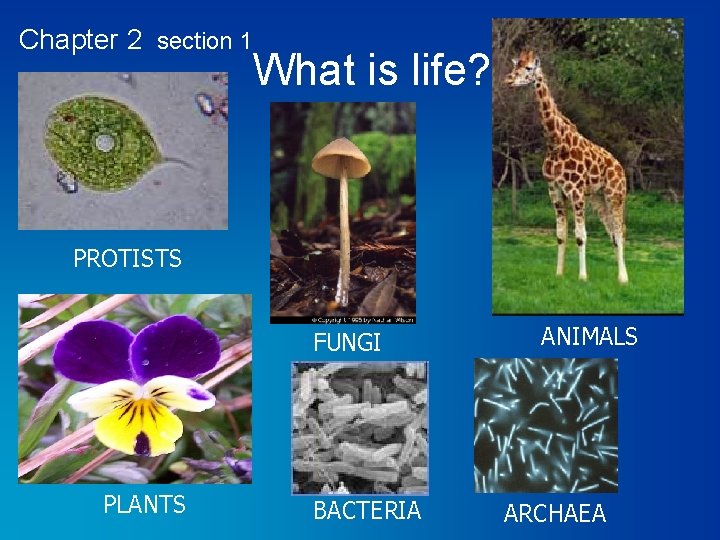
Chapter 2 section 1 What is life? PROTISTS FUNGI PLANTS BACTERIA ANIMALS ARCHAEA
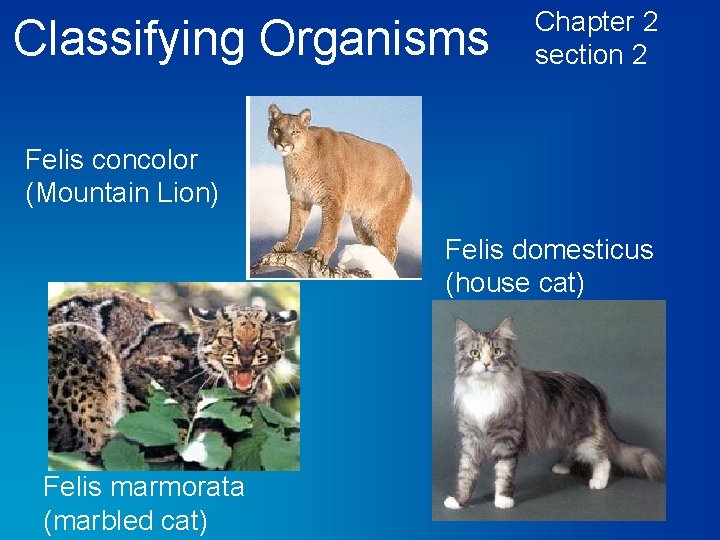
Classifying Organisms Chapter 2 section 2 Felis concolor (Mountain Lion) Felis domesticus (house cat) Felis marmorata (marbled cat)
Vocabulary • Classification- process of grouping things based on their similarities • Taxonomy- scientific study of how things are classified • Binomial nomenclature-two name naming system • Genus-classification grouping that contains similar, closely related organisms • Species-group of similar organisms that can mate with each other and produce offspring • Prokaryotes-cell that lacks a nucleus (Bacteria/Archaea) • Nucleus-a dense area in the cell that contains nucleic aciddirect cell activities. • Eukaryotes-cell that contains nucleus (Protist, Fungi, Plant, Animal)
Scientific Name • An organisms scientific name is made up of two parts. Genus is the first part and it is always capitalized. Species is the second part and it is not capitalized. • Example Canis lupus
Chapter 2 Section 2 Daily Warm-up What classification category would two very similar species be in?
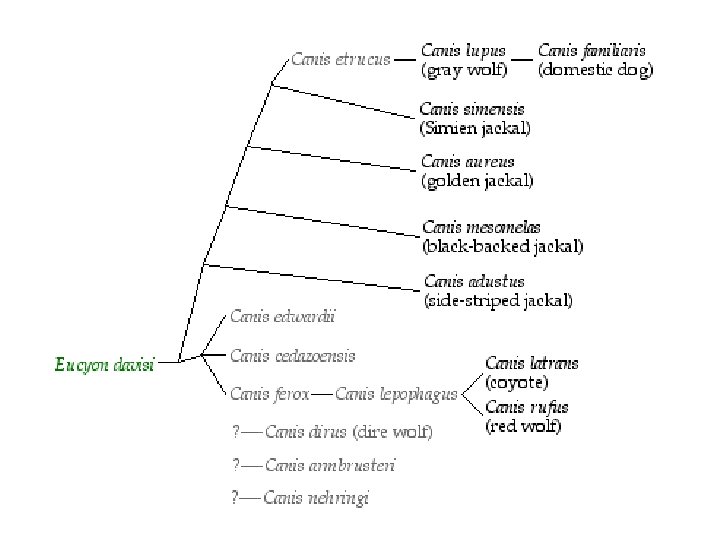
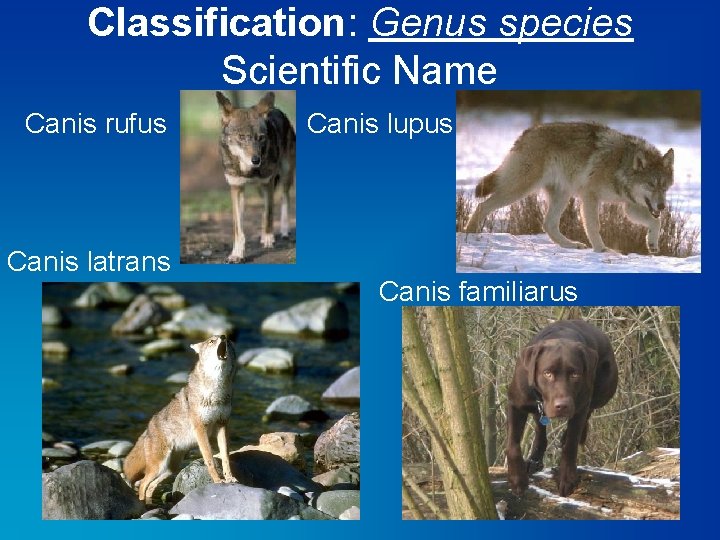
Classification: Genus species Scientific Name Canis rufus Canis latrans Canis lupus Canis familiarus
Why do Scientists Classify? Biologists use classification to organize living things into groups so that the organisms are easier to study.
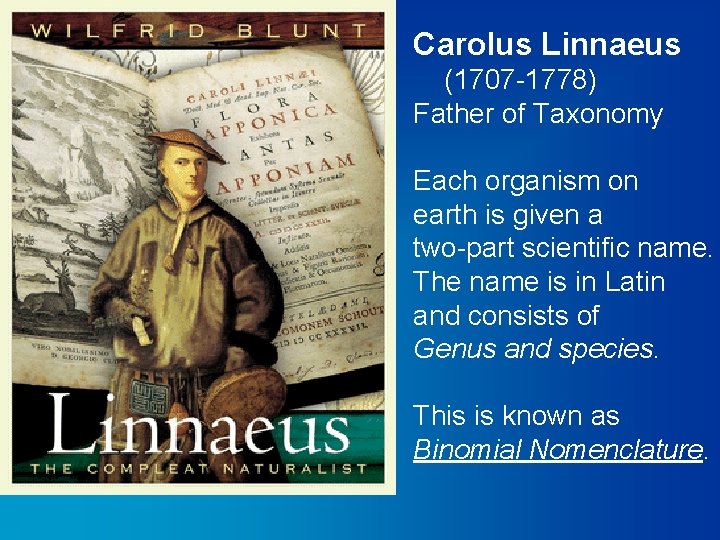
Carolus Linnaeus (1707 -1778) Father of Taxonomy Each organism on earth is given a two-part scientific name. The name is in Latin and consists of Genus and species. This is known as Binomial Nomenclature.
Domains and Kingdoms Organisms are placed into domains and kingdoms based on their cell type, their ability to make food, and the number of cells in their bodies. Open to page 47
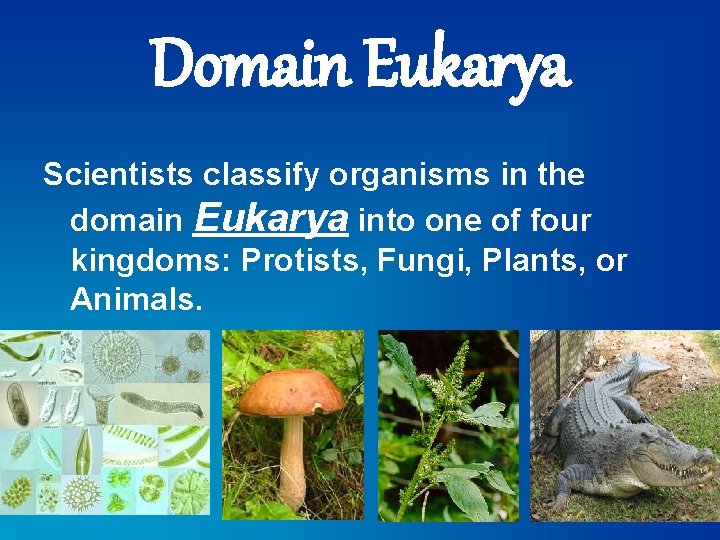
Domain Eukarya Scientists classify organisms in the domain Eukarya into one of four kingdoms: Protists, Fungi, Plants, or Animals.
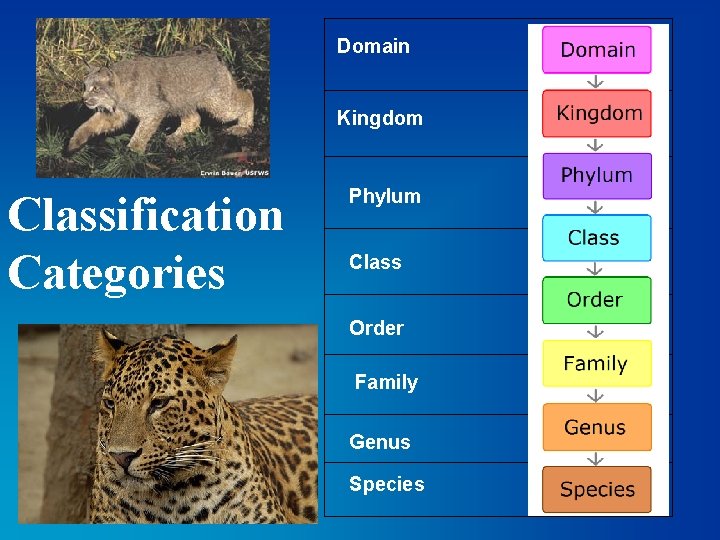
Domain Kingdom Classification Categories Phylum Class Order Family Genus Species
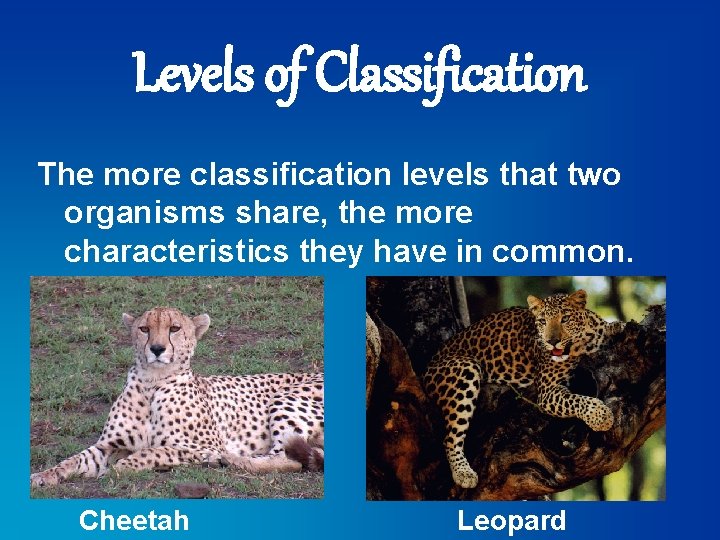
Levels of Classification The more classification levels that two organisms share, the more characteristics they have in common. Cheetah Leopard
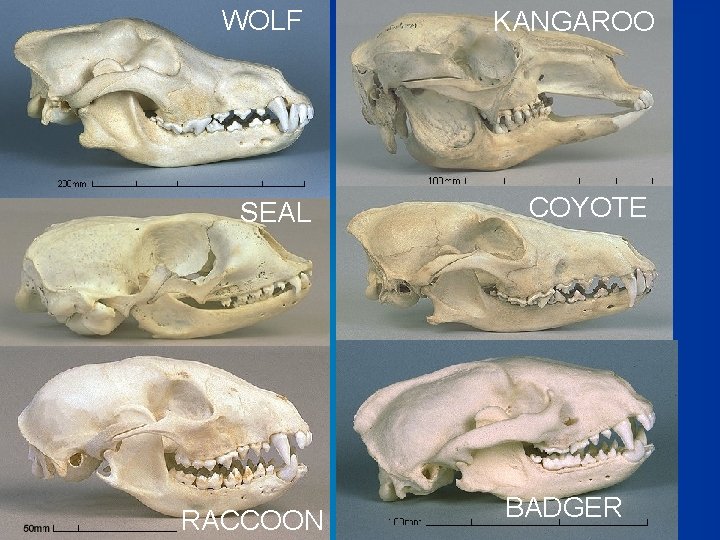
WOLF SEAL RACCOON KANGAROO COYOTE BADGER
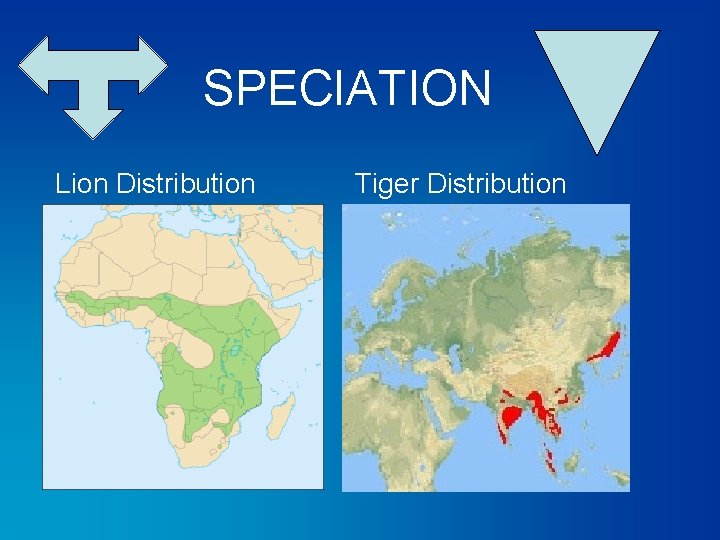
SPECIATION Lion Distribution Tiger Distribution
Assessment Questions • 1. Why do Biologists classify? • 2. Suppose someone tells you that a jaguarundi is classified in the same genus as a housecat. What characteristics do you think a jaguarundi might have? (3) • 3. What genus name would you expect a jaguarundi to have? • 4. List the (8) levels of classification, beginning with domain. • 5. Woodchucks are classified in the same family as squirrels, but in a different family than mice. Do woodchucks have more characteristics in common with squirrels or mice? • 6. What are three domains in which organisms are classified? • 7. Which two domains include only organisms that are prokaryotes? • 8. List the 4 Kindoms in the Domain Eukarya? • 9. What two–parts make up an organisms scientific name?
Assessment Questions Continued • 3 a. What are three domains in which organisms are classified? • 3 b. Which two domains include only organisms that are prokaryotes? •
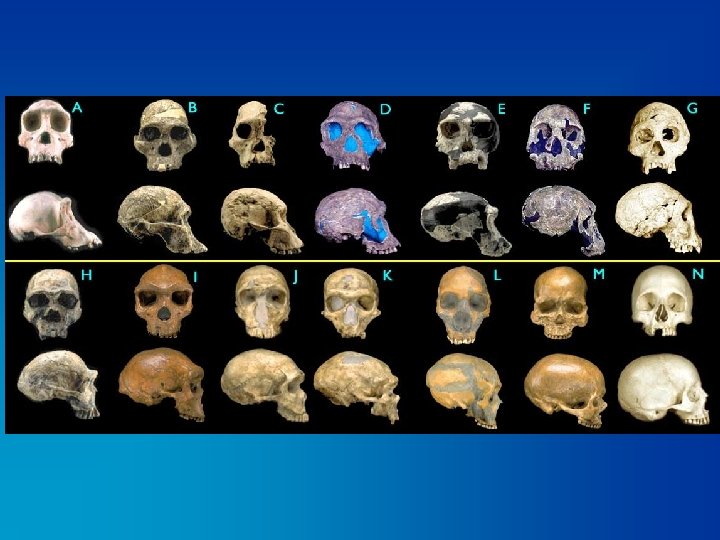
(A) Pan troglodytes, chimpanzee, modern (B) Australopithecus africanus, 2. 6 My (C) Australopithecus africanus, 2. 5 My (D) Homo habilis, 1. 9 My (E) Homo habilis, 1. 8 My (F) Homo rudolfensis, 1. 8 My (G) Homo erectus, 1. 75 My (H) Homo ergaster (early H. erectus), 1. 75 My (I) Homo heidelbergensis, 300, 000 - 125, 000 y (J) Homo sapiens neanderthalensis, 70, 000 y (K) Homo sapiens neanderthalensis, 60, 000 y (L) Homo sapiens neanderthalensis, 45, 000 y (M) Homo sapiens, Cro-Magnon I, 30, 000 y (N) Homo sapiens, modern