
Daily Routine Sit in your appropriate seat quietly
- Slides: 23
Daily Routine • • Sit in your appropriate seat quietly Have all necessary materials out All back packs on the floor All cell phones on silent and away in backpacks • All music devices off and headphones out of your ears • No food or drink except for water
Bell Work • What are the four factors that affect climate for an area? • Choose one of the four factors and explain how it impacts climate?
Earth Science Announcements District Common Assessment Dec 15 Course Final Dec 18 th -19 th
Climate Is climate change real?
Finish Yesterday’s Climate Graph Lab • Complete the graphs • Answer all questions • Make sure to answer the last question…question 9…in three thorough sentences on another sheet of paper
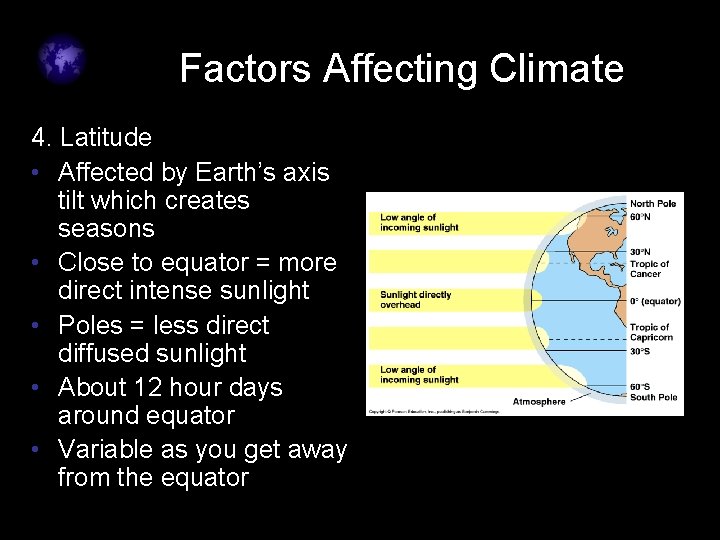
Factors Affecting Climate 4. Latitude • Affected by Earth’s axis tilt which creates seasons • Close to equator = more direct intense sunlight • Poles = less direct diffused sunlight • About 12 hour days around equator • Variable as you get away from the equator
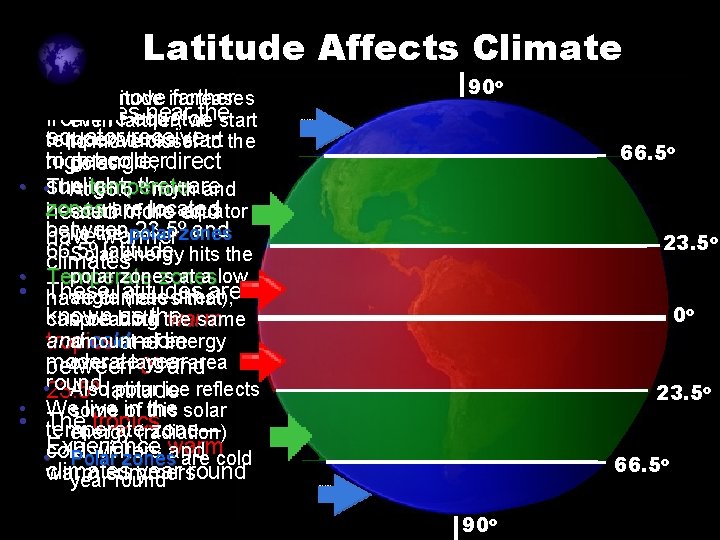
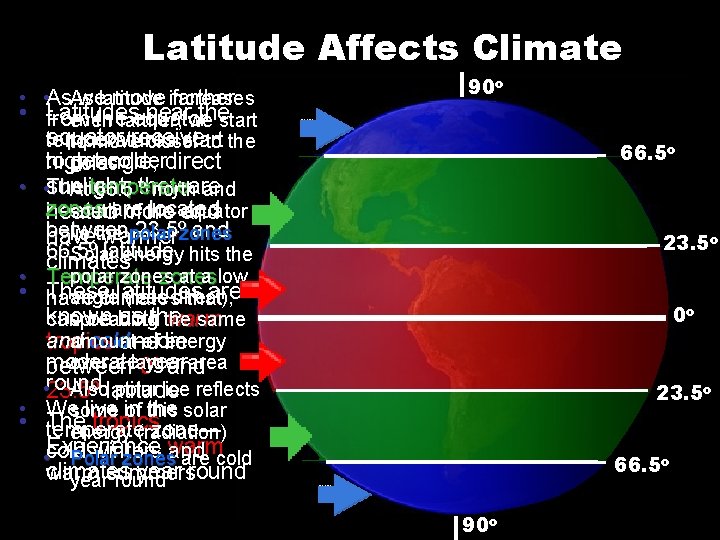
Latitude Affects Climate • • As. As welatitude move increases farther • Latitudes near thestart from thefarther, equator even we equator receive temperatures start to move closer to the to getangle, colderdirect high poles sunlight, • • The At temperate 66. 5 they º northare and zones located southare of the equator heated more and between 23. 5ºzones and lie the polar have warmer 66. 5 º latitude Solar energy hits the climates polar zones at a low • Temperate zones • These latitudes are angle (less direct), have climates that known as the spreading the same can be both warm amount of energy and coldand —or tropics lie moderate year over a larger area between 0º and • round Alsolatitude polar ice reflects 23. 5º • Wesome live in the solar of this • The tropics temperate zone— energy (radiation) Experience warm winters • cold Polar zonesand are cold climates year warm summers year round 90 o 66. 5 o 23. 5 o 0 o 23. 5 o 66. 5 o 90 o
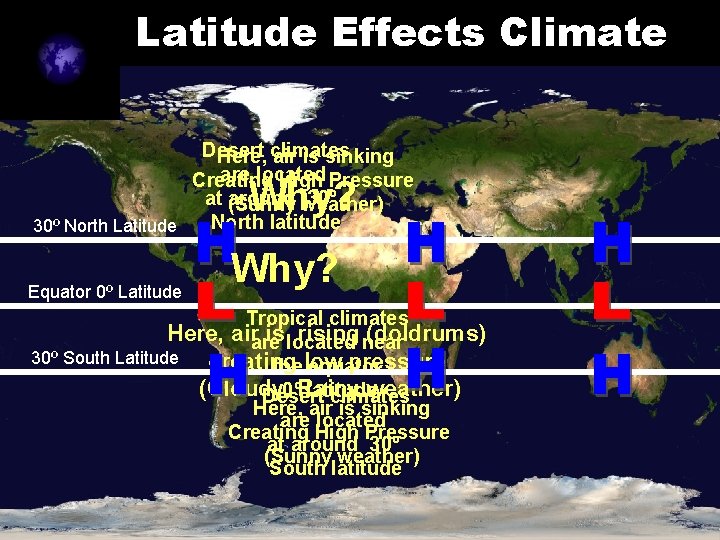
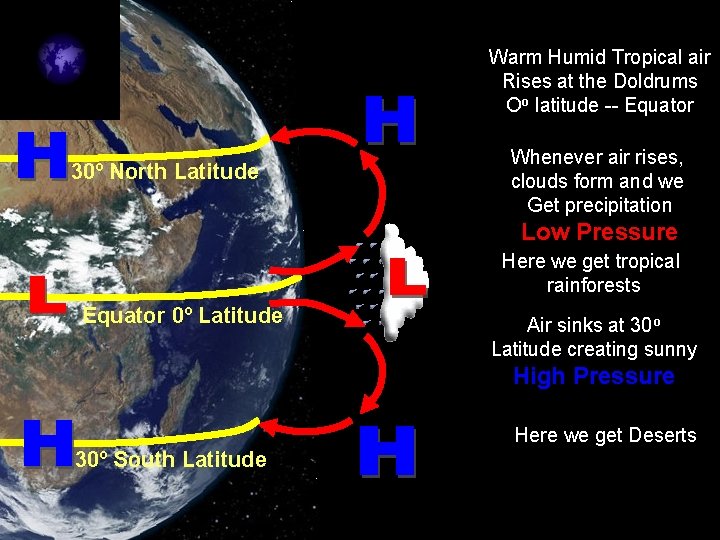
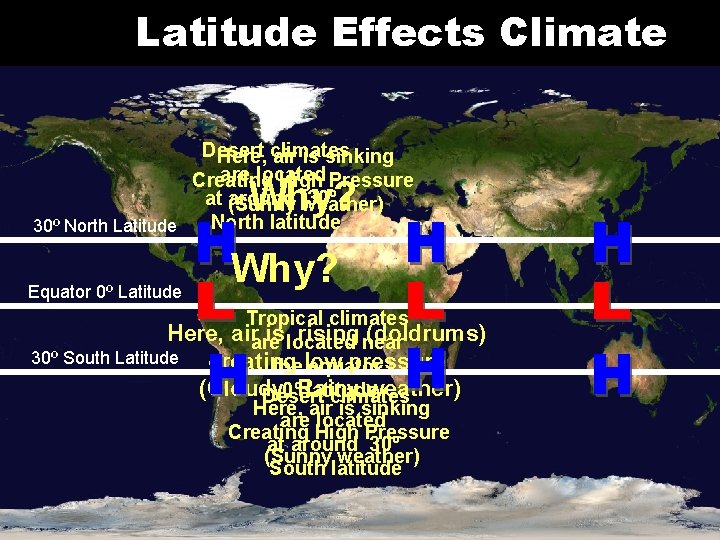
Latitude Effects Climate Desert Here, climates air is sinking are located Creating High Pressure at around 30º (Sunny weather) North latitude 30º North Latitude Why? Equator 0º Latitude Why? Tropical climates Here, airare is located rising near (doldrums) 30º South Latitude creating pressure the low equator (Cloudy, weather) 0ºRainy latitude Desert climates Here, air is sinking are located Creating High Pressure at around 30º (Sunny weather) South latitude
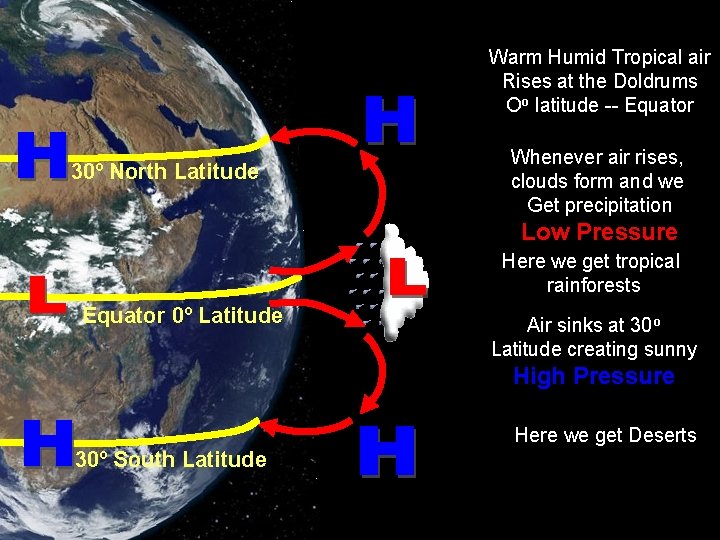
Warm Humid Tropical air Rises at the Doldrums Oo latitude -- Equator 30º North Latitude Whenever air rises, clouds form and we Get precipitation Low Pressure Here we get tropical rainforests Equator 0º Latitude Air sinks at 30 o Latitude creating sunny High Pressure Here we get Deserts 30º South Latitude
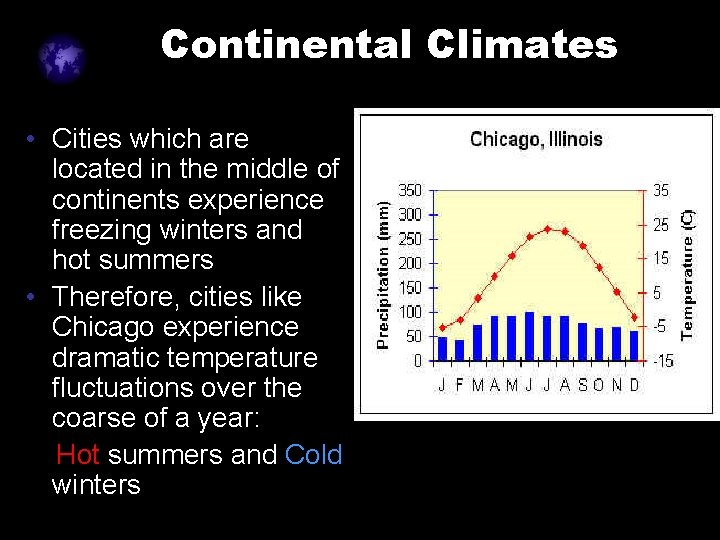
Continental Climates • Cities which are located in the middle of continents experience freezing winters and hot summers • Therefore, cities like Chicago experience dramatic temperature fluctuations over the coarse of a year: Hot summers and Cold winters
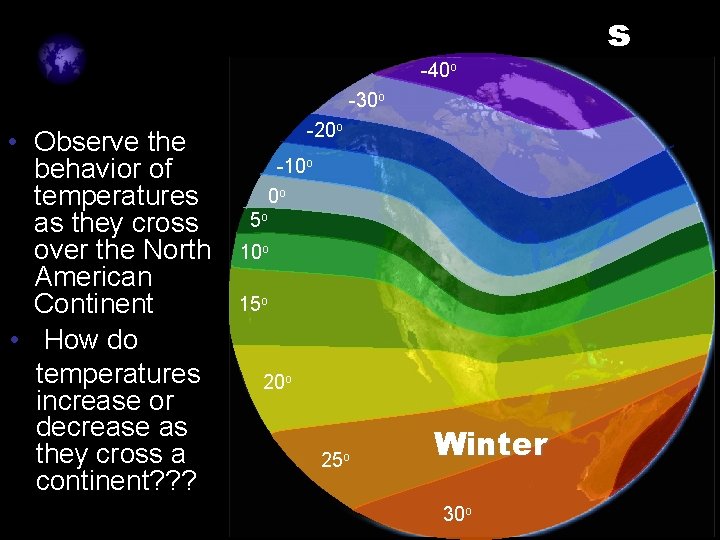
Continental Climates -40 o -30 o • Observe the behavior of temperatures as they cross over the North American Continent • How do temperatures increase or decrease as they cross a continent? ? ? -20 o -10 o 0 o 5 o 10 o 15 o 20 o 25 o Winter 30 o
Latitude Affects Climate • • As. As welatitude move increases farther • Latitudes near thestart from thefarther, equator even we equator receive temperatures start to move closer to the to getangle, colderdirect high poles sunlight, • • The At temperate 66. 5 they º northare and zones located southare of the equator heated more and between 23. 5ºzones and lie the polar have warmer 66. 5 º latitude Solar energy hits the climates polar zones at a low • Temperate zones • These latitudes are angle (less direct), have climates that known as the spreading the same can be both warm amount of energy and coldand —or tropics lie moderate year over a larger area between 0º and • round Alsolatitude polar ice reflects 23. 5º • Wesome live in the solar of this • The tropics temperate zone— energy (radiation) Experience warm winters • cold Polar zonesand are cold climates year warm summers year round 90 o 66. 5 o 23. 5 o 0 o 23. 5 o 66. 5 o 90 o
Latitude Effects Climate Desert Here, climates air is sinking are located Creating High Pressure at around 30º (Sunny weather) North latitude 30º North Latitude Why? Equator 0º Latitude Why? Tropical climates Here, airare is located rising near (doldrums) 30º South Latitude creating pressure the low equator (Cloudy, weather) 0ºRainy latitude Desert climates Here, air is sinking are located Creating High Pressure at around 30º (Sunny weather) South latitude
Warm Humid Tropical air Rises at the Doldrums Oo latitude -- Equator 30º North Latitude Whenever air rises, clouds form and we Get precipitation Low Pressure Here we get tropical rainforests Equator 0º Latitude Air sinks at 30 o Latitude creating sunny High Pressure Here we get Deserts 30º South Latitude
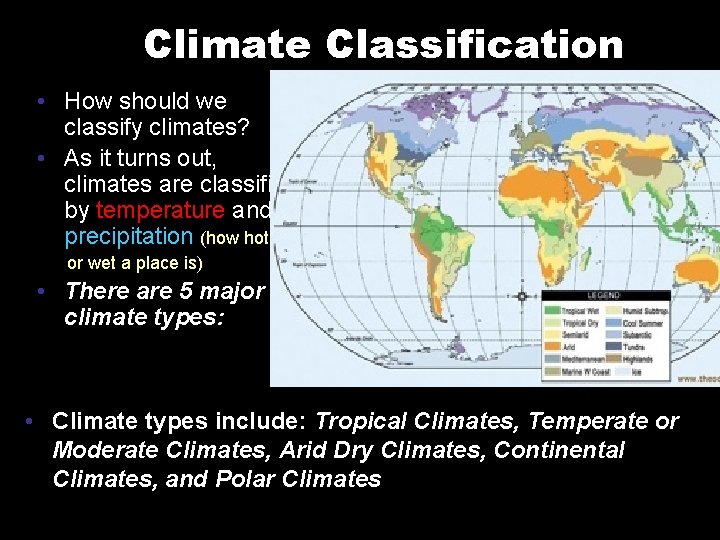
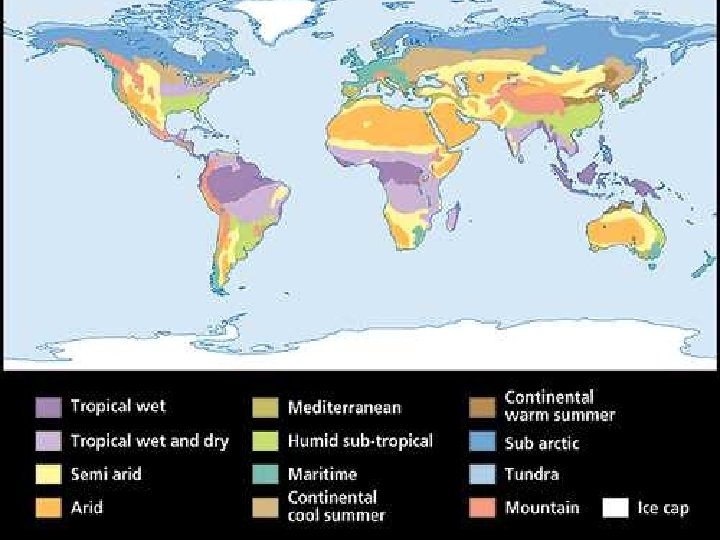
Climate Classification • How should we classify climates? • As it turns out, climates are classified by temperature and precipitation (how hot or wet a place is) • There are 5 major climate types: • Climate types include: Tropical Climates, Temperate or Moderate Climates, Arid Dry Climates, Continental Climates, and Polar Climates
Climate Mapping Lab 1/14/2022 18
Daily Routine • • Sit in your appropriate seat quietly Have all necessary materials out All back packs on the floor All cell phones on silent and away in backpacks • All music devices off and headphones out of your ears • No food or drink except for water
Bell Work • What type of winters and summers do continental areas experience? • Why do deserts form at 30 degrees N and S of the Equator?
Earth Science Announcements District Common Assessment Dec 15 Course Final Dec 18 th -19 th
Climate Is climate change real?
Finish Yesterday’s Climate Map Lab • • Complete the graphs Answer all questions Turn in work in the front You have 10 minutes to finish this assignment
Climate Lab 1/14/2022 24