
DAILY QUESTION March 11 2009 1 Name the
- Slides: 19
DAILY QUESTION March 11, 2009 1. Name the two ways light can be modeled.
Agenda 3/11/09 • Daily Question • Turn in: 15 -1 Wksht • 15 -2 Notes • Brain Pop “Electromagnetic Spectrum” • Electromagnetic Spectrum Signs Assignments: 1. Signs due 3/12 *** Remember ALL late work is due TODAY!***
Models to describe Light The most commonly used models describe light either as a wave or as a stream of particles.
• Light produces interference patterns like water waves. – Thomas Young saw the striped pattern on a screen
Light can be modeled as a wave • This model describes light as: Transverse waves that do not require a medium in which to travel. • Light waves are also called: Electromagentic waves because they consist of changing electric and magnetic fields.
• The wave model of light explains much of the observed behaviors of light: – Reflection – Refraction – Diffraction – Interference
• The wave model of light cannot explain some observations: – Blue light can knock off electrons of a metal plate
Light can be modeled as a stream of particles. • Photons: are a unit or quantum of light. – A beam of light is considered to be a stream of photons. – Considered particles – Do not have mass • Bundles of energy
• • The model of light used depends on the situation. Some believe that light has a “dual nature” so that it actually has different characteristics depending on the situation.
• The energy of light is proportional to frequency. Light is a form of energy. Each photon of light can be thought of as carrying a small amount of energy. The amount of this energy is proportional to the frequency of the corresponding electromagnetic wave.
• The speed of light depends on the medium. • The speed of light is: 3 x 10⁸ m/s • Light is the fastest signal in the universe. Nothing can travel faster than the speed of light.
• The brightness of light depends on intensity. • Intensity is the rate at which energy flows through a given area of space
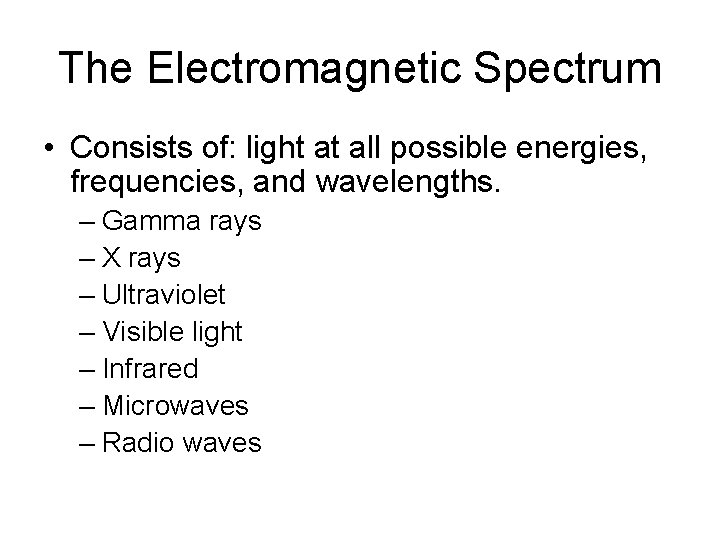
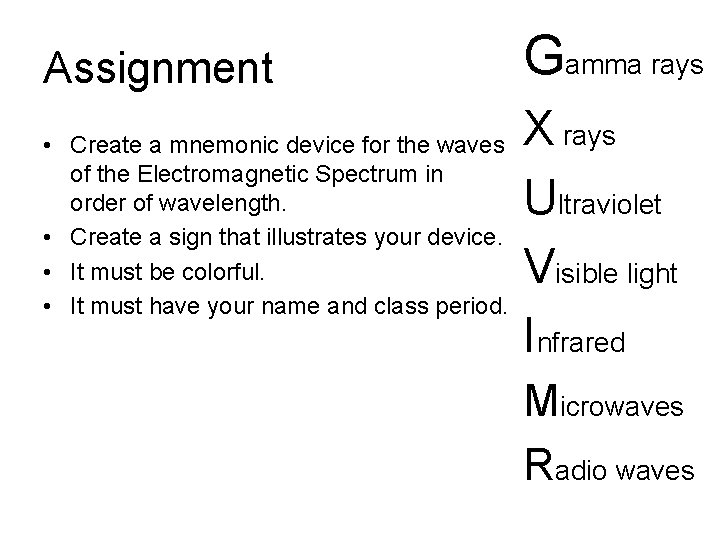
The Electromagnetic Spectrum • Consists of: light at all possible energies, frequencies, and wavelengths. – Gamma rays – X rays – Ultraviolet – Visible light – Infrared – Microwaves – Radio waves
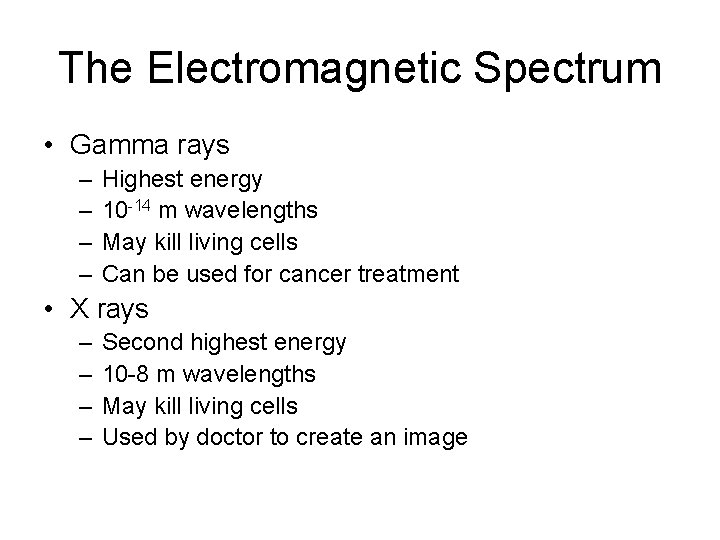
The Electromagnetic Spectrum • Gamma rays – – Highest energy 10 -14 m wavelengths May kill living cells Can be used for cancer treatment • X rays – – Second highest energy 10 -8 m wavelengths May kill living cells Used by doctor to create an image
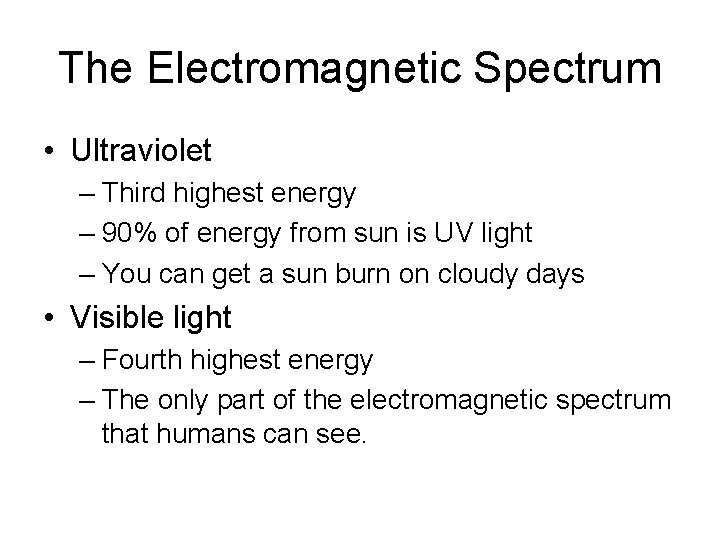
The Electromagnetic Spectrum • Ultraviolet – Third highest energy – 90% of energy from sun is UV light – You can get a sun burn on cloudy days • Visible light – Fourth highest energy – The only part of the electromagnetic spectrum that humans can see.
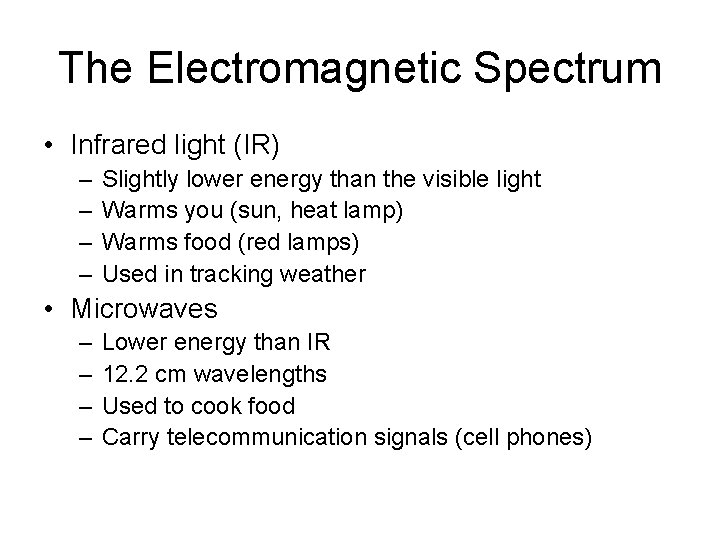
The Electromagnetic Spectrum • Infrared light (IR) – – Slightly lower energy than the visible light Warms you (sun, heat lamp) Warms food (red lamps) Used in tracking weather • Microwaves – – Lower energy than IR 12. 2 cm wavelengths Used to cook food Carry telecommunication signals (cell phones)
The Electromagnetic Spectrum • Radiowaves – Longest wavelength – Includes: TV, AM and FM radio – Radar: radio detection and ranging. A system that uses reflected radio waves to determine the velocity and location of objects • Air traffic control • Police officers
Mnemonic Device • A memory aid – For the colors of the rainbow, • Roy G. Biv – Order of Notes on the treble clef, • Every Good Boy Does Fine
Assignment • Create a mnemonic device for the waves of the Electromagnetic Spectrum in order of wavelength. • Create a sign that illustrates your device. • It must be colorful. • It must have your name and class period. Gamma rays X rays Ultraviolet Visible light Infrared Microwaves Radio waves