
Daily Hassles and Uplifts K Christopher La Retraite
- Slides: 12
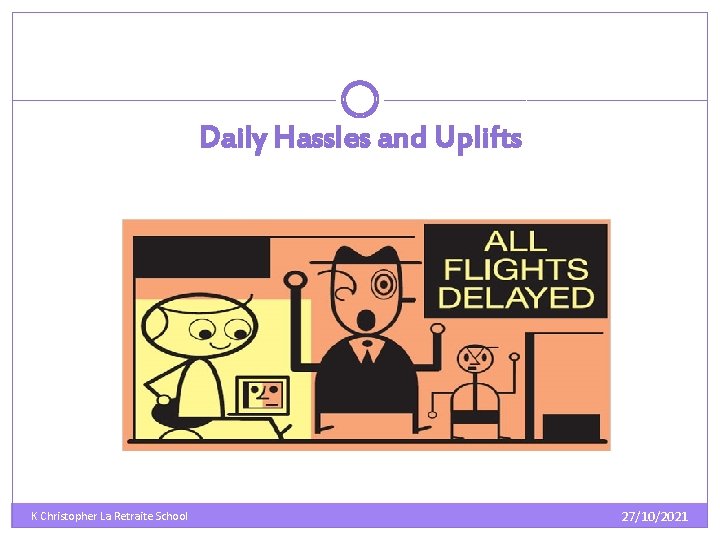
Daily Hassles and Uplifts K Christopher La Retraite School 27/10/2021
Learning objectives �To define ‘daily hassles’ and ‘uplifts’ �To understand the impact of these on mood, stress and illness �To find out why daily hassles are worse for your health than Life Changes K Christopher La Retraite School 27/10/2021
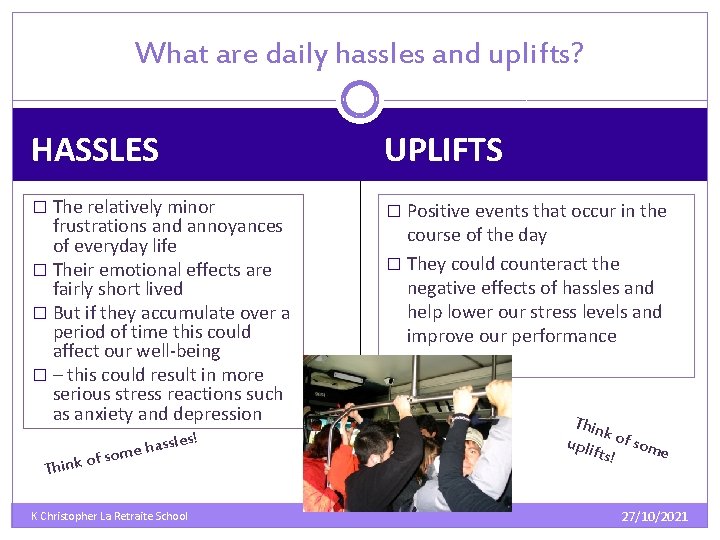
What are daily hassles and uplifts? HASSLES UPLIFTS � The relatively minor � Positive events that occur in the frustrations and annoyances of everyday life � Their emotional effects are fairly short lived � But if they accumulate over a period of time this could affect our well-being � – this could result in more serious stress reactions such as anxiety and depression Think es! o assl h e m f so K Christopher La Retraite School course of the day � They could counteract the negative effects of hassles and help lower our stress levels and improve our performance Thin k uplif of som e ts! 27/10/2021
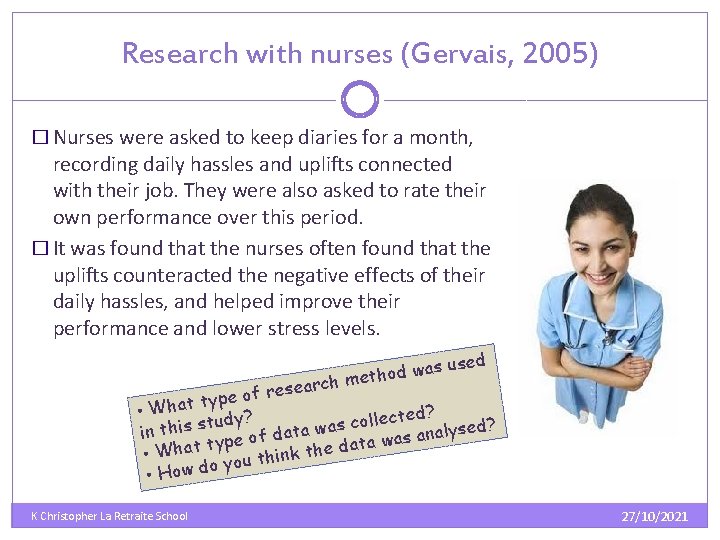
Research with nurses (Gervais, 2005) � Nurses were asked to keep diaries for a month, recording daily hassles and uplifts connected with their job. They were also asked to rate their own performance over this period. � It was found that the nurses often found that the uplifts counteracted the negative effects of their daily hassles, and helped improve their performance and lower stress levels. ed as us w d o h t me search e r f o e typ • What ted? ? c y e l d l u o t c s s wa sed? y a l t in this a a n d a f s ta wa type o a d e h t • What u think o y o d • How K Christopher La Retraite School 27/10/2021
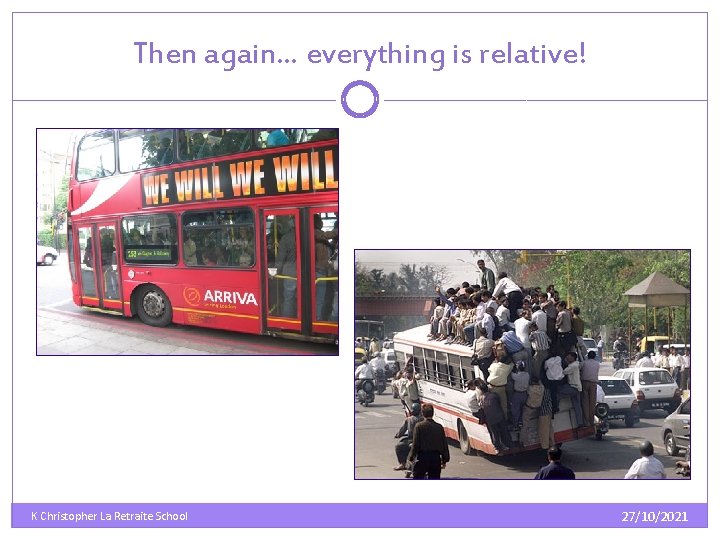
Then again. . . everything is relative! K Christopher La Retraite School 27/10/2021
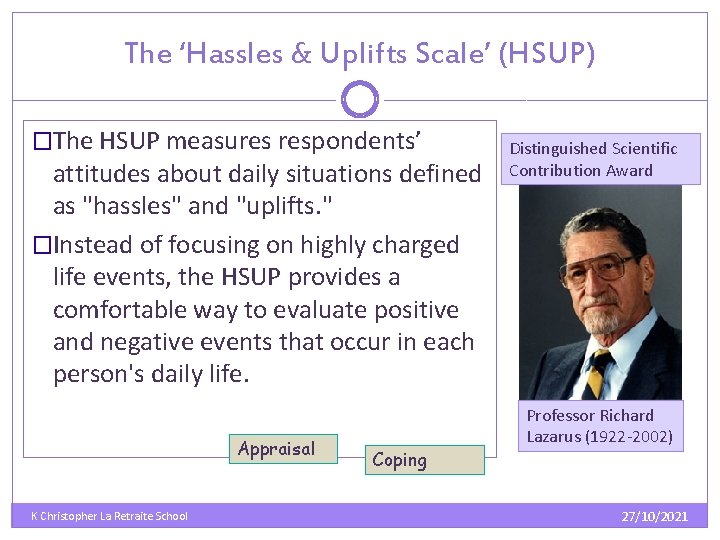
The ‘Hassles & Uplifts Scale’ (HSUP) �The HSUP measures respondents’ attitudes about daily situations defined as "hassles" and "uplifts. " �Instead of focusing on highly charged life events, the HSUP provides a comfortable way to evaluate positive and negative events that occur in each person's daily life. Appraisal K Christopher La Retraite School Coping Distinguished Scientific Contribution Award Professor Richard Lazarus (1922 -2002) 27/10/2021
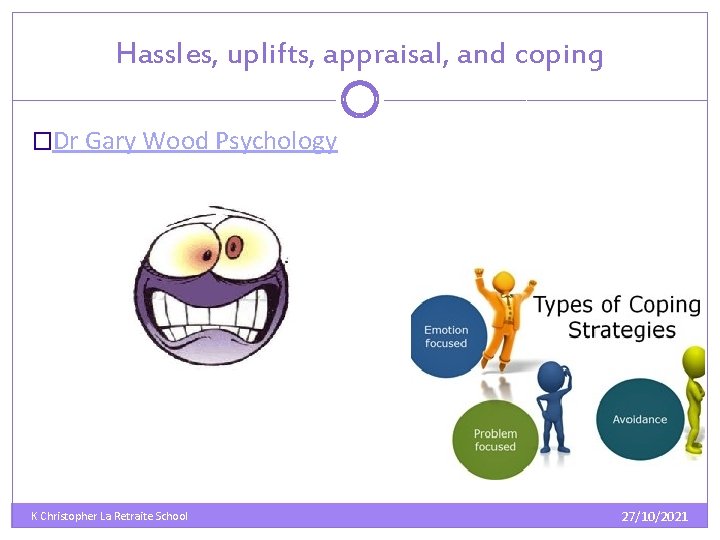
Hassles, uplifts, appraisal, and coping �Dr Gary Wood Psychology K Christopher La Retraite School 27/10/2021
Activity �Half the class: in a group, brainstorm a list of your top ten daily hassles. �Other half: in a group, brainstorm a list of your top ten daily uplifts. �Rank them in order (1 being the worst hassle or best uplift). K Christopher La Retraite School 27/10/2021
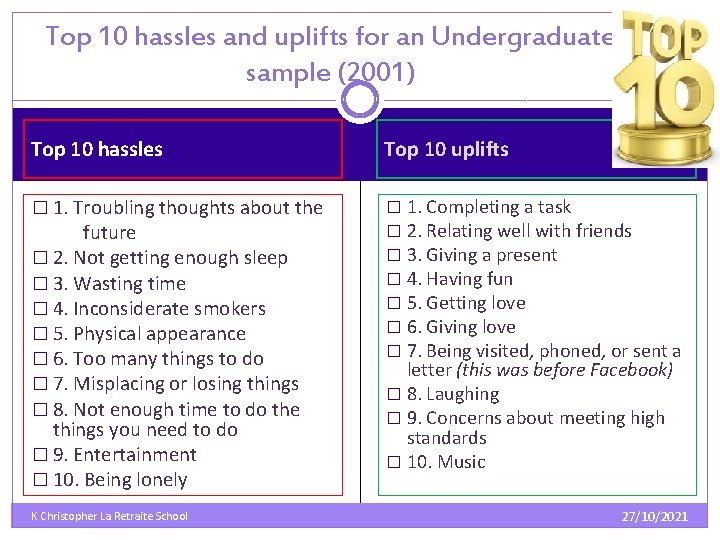
Top 10 hassles and uplifts for an Undergraduate sample (2001) Top 10 hassles Top 10 uplifts � 1. Troubling thoughts about the � 1. Completing a task � 2. Relating well with friends � 3. Giving a present � 4. Having fun � 5. Getting love � 6. Giving love � 7. Being visited, phoned, or sent a future � 2. Not getting enough sleep � 3. Wasting time � 4. Inconsiderate smokers � 5. Physical appearance � 6. Too many things to do � 7. Misplacing or losing things � 8. Not enough time to do the things you need to do � 9. Entertainment � 10. Being lonely K Christopher La Retraite School letter (this was before Facebook) � 8. Laughing � 9. Concerns about meeting high standards � 10. Music 27/10/2021
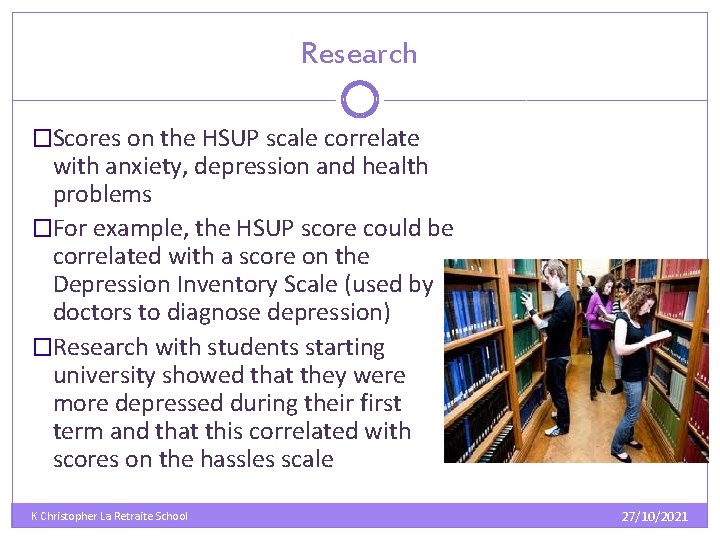
Research �Scores on the HSUP scale correlate with anxiety, depression and health problems �For example, the HSUP score could be correlated with a score on the Depression Inventory Scale (used by doctors to diagnose depression) �Research with students starting university showed that they were more depressed during their first term and that this correlated with scores on the hassles scale K Christopher La Retraite School 27/10/2021
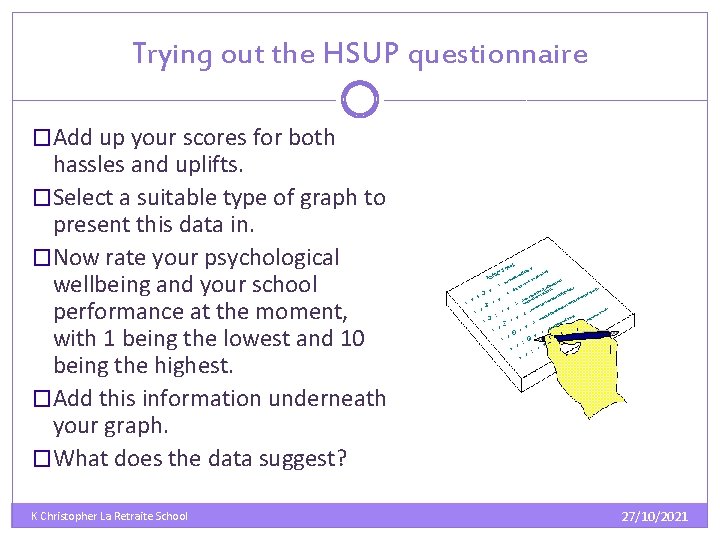
Trying out the HSUP questionnaire �Add up your scores for both hassles and uplifts. �Select a suitable type of graph to present this data in. �Now rate your psychological wellbeing and your school performance at the moment, with 1 being the lowest and 10 being the highest. �Add this information underneath your graph. �What does the data suggest? K Christopher La Retraite School 27/10/2021
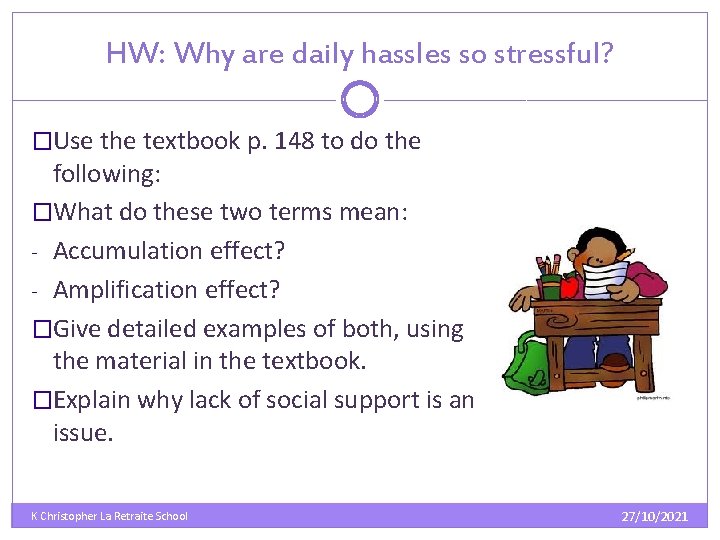
HW: Why are daily hassles so stressful? �Use the textbook p. 148 to do the following: �What do these two terms mean: - Accumulation effect? - Amplification effect? �Give detailed examples of both, using the material in the textbook. �Explain why lack of social support is an issue. K Christopher La Retraite School 27/10/2021