
DAC 6 Governance Best Practices and Penalty Mitigation
DAC 6: Governance, Best Practices and Penalty Mitigation K Keith Brockman, CEO, strategizingtaxrisks. com, U. S. Emily Dobbie, Senior Manager, TPA Global, The Netherlands 17 June 2020 1 Transforming the World of Tax tpa-global. com
DAC 6: Introduction • Directive 2018/822 (“DAC 6” or “the Directive”) imposes mandatory reporting of crossborder arrangements affecting at least one EU Member State that fall within one of the “hallmarks”. • EU Member States were required to adopt and publish national laws to comply with the Directive by 31 December 2019. • Poland, Portugal and Germany have extended the scope of the Directive in their domestic law (incl. domestic arrangements and VAT). • Guidance on the technical interpretation of the domestic law – still to come in many Member States. • What happens to the reported information? Automatic exchange of information – Common Communication Network (CCN) 2 Transforming the World of Tax tpa-global. com
DAC 6: Observations – practical notes • Legal privilege • Reporting mechanism – web-based form vs. electronic/XML file? • Notification details • DAC 6 reporting tools • No specific obligation to actively investigate missing data • Reliance on proof of filing by other intermediaries • Activities of an intermediary not covered by reporting obligation • No exemption from notification obligation 3 Transforming the World of Tax tpa-global. com
DAC 6 optional six-month deferral 30 -day timeline • Currently: commences 01 July 2020 • Proposed (elective): 01 January 2020, including the period between 01 July 2020 and 31 December 31 2020 Historical arrangements between 25 June 2018 and 30 June 2020 • Currently: 31 August 2020 • Proposed (elective): 28 February 2021 Next steps • Opinion required by the European Parliament (expected by 30 June 2020) • Unanimous agreement by the Council of the European Union • Member States formalize their choice to exercise this option; if they fail to respond the original timelines will apply 4 Transforming the World of Tax tpa-global. com
DAC 6 optional six-month deferral Member State actions • Luxembourg: Penalties will not apply until the amendments come into force • Belgium: Six-month deferral is granted under Belgian legislation • Germany: Historical arrangements originally due by 31 August 2020 can be submitted by 30 September 2020 Implementation options • Use current timelines with potential benefits to test governance, as Member States are still finalizing the original legislation 5 • Wait for Member State actions, although initial deferral proposal on 08 May 2020 did not achieve unanimity • Plan on six-month deferral for reporting, if the relevant Member States for a taxpayer/intermediary announce advance guidance, although current governance timelines should be maintained to remain current with hallmark arrangements Transforming the World of Tax tpa-global. com
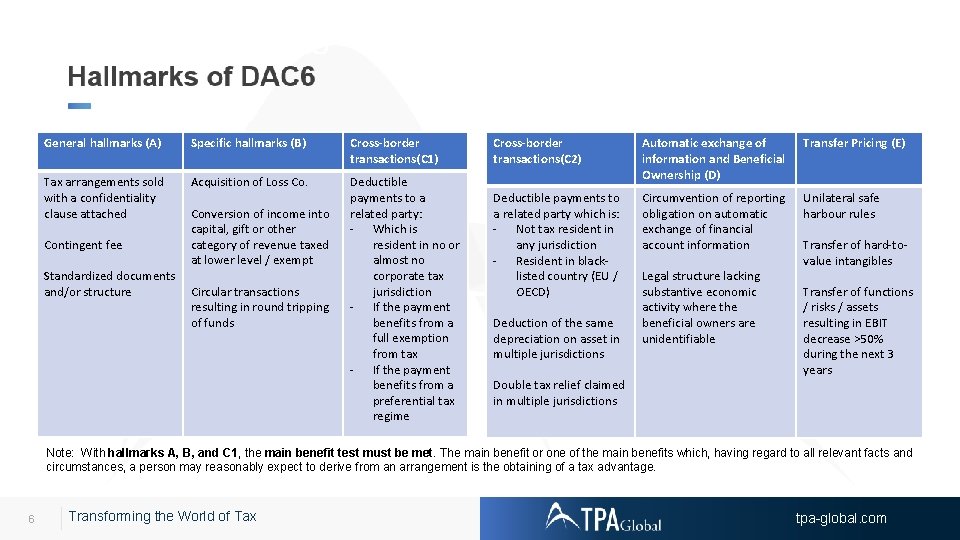
Hallmarks of DAC-6 General hallmarks (A) Introduction Specific hallmarks (B) Cross-border transactions(C 1) Tax arrangements sold Text with a confidentiality clause attached Acquisition of Loss Co. Deductible payments to a related party: - Which is resident in no or almost no corporate tax jurisdiction - If the payment benefits from a full exemption from tax - If the payment benefits from a preferential tax regime Contingent fee Standardized documents and/or structure Conversion of income into capital, gift or other category of revenue taxed at lower level / exempt Circular transactions resulting in round tripping of funds Cross-border transactions(C 2) Automatic exchange of information and Beneficial Ownership (D) Transfer Pricing (E) Deductible payments to a related party which is: - Not tax resident in any jurisdiction - Resident in blacklisted country (EU / OECD) Circumvention of reporting obligation on automatic exchange of financial account information Unilateral safe harbour rules Deduction of the same depreciation on asset in multiple jurisdictions Double tax relief claimed in multiple jurisdictions Legal structure lacking substantive economic activity where the beneficial owners are unidentifiable Transfer of hard-tovalue intangibles Transfer of functions / risks / assets resulting in EBIT decrease >50% during the next 3 years Note: With hallmarks A, B, and C 1, the main benefit test must be met. The main benefit or one of the main benefits which, having regard to all relevant facts and circumstances, a person may reasonably expect to derive from an arrangement is the obtaining of a tax advantage. 6 Transforming the World of Tax tpa-global. com

Definitions: a good starting point Hallmark A characteristic or feature of a cross-border arrangement that presents an indication of a potential risk of tax avoidance Arrangement Undefined; A broad category of transactions, with few exceptions, although defined by several Member States France: Any agreement, scheme, plan, mechanism, transaction(s) Ireland: A transaction, action(s), scheme, plan, proposal, promise, undertaking, whether express or implied Cross-border arrangement An arrangement between at least one Member State and another country (EU or non-EU), meeting a prescribed condition Intermediary, meeting one of the following conditions in a Member State: Tax resident, or Permanent establishment (PE), or Incorporated or governed, or Registered with a professional legal, tax or consulting association (Legal professional privilege is subject to a filing waiver, determined by the relevant Member State) Relevant taxpayer Any person to whom a reportable cross-border arrangement (RCBA) is made available for implementation, or who is ready to implement a RCBA, or who has implemented the first step of such an arrangement 7 Transforming the World of Tax tpa-global. com
Main Benefit Test (MBT): Subjectivity DAC 6 Annex IV, Part I: The main benefit, or one of the main benefits, with a reasonable expectation of obtaining a tax advantage OECD BEPS Action 12, Mandatory Disclosure Rules • Evolution of DAC 6 • The MBT threshold condition requires an objective assessment of the tax benefits • This quantification, and supporting documentation, provides an objective methodology for documentation comparing the value of the expected tax advantage, if any, with the commercial and economic benefits to be derived • Member States have generally conformed their guidance, or implicit reference, to DAC 6 • Review each relevant Member State for conformity / dissimilarity Member States exceptions to the objective tests • France: Legislative intent, and the object of the relevant law, should be considered (Would the arrangement have been carried out in the same way if the tax advantage did not exist) • Ireland: MBT cross-referenced to domestic law – objective and subjective tests are considered • UK: An almost identical MBT provision is in the UK Disclosure of Tax Avoidance Schemes (DOTAS) re: an intermediary 8 Transforming the World of Tax tpa-global. com
Hallmark A 1: Confidentiality (+ MBT) A condition of confidentiality is required for a tax advantage, in addition to the MBT Arrangements via email, verbal or written agreement M&A arrangements generally meet the MBT Interpretations by several Member States Confidentiality clauses to protect a commercial, industrial, trade or commercial secret would not meet this hallmark Best Practices • Use Member State interpretations, providing a concise summary of each type of NDA (e. g. , procurement, engineering, etc. ) • Quantify the tax advantage, or lack thereof, via a sample of each functional NDA provided by a Member State • Ensure (EU) legal counsel is knowledgeable of this hallmark • Develop a 30 -day governance procedure, acknowledged by (EU) legal counsel • Insert a DAC 6 clause in future agreements for clarification and reporting coordination by an intermediary 9 Transforming the World of Tax tpa-global. com
Hallmark A 2: Intermediary (+ MBT) An intermediary is any person that provides, directly or by means of other persons, aid, assistance or advice with respect to designing, marketing, organizing, making available for implementation or managing the implementation of a RCBA The language of this hallmark re: a tax advantage would automatically meet the MBT An in-house tax department may be an intermediary, based upon Member State interpretation (e. g. , France, Germany) The obligation to report the arrangement shifts to the relevant taxpayer when: (i) the intermediary is a non-EU intermediary, or (ii) no intermediary (i. e. , an in-house arrangement), or (iii) taxpayer is notified that an intermediary has the right to a waiver due to legal professional privilege Best Practices • Insert DAC 6 intermediary language in each relevant statement of work to formally outline each party’s responsibilities • Document timing to report the arrangement, noting DAC 6 Article 8 ab specifying the first to occur of three conditions • Determine if the obligation to report the arrangement has shifted to the taxpayer • If an intermediary is reporting an arrangement, coordinate draft DAC 6 reporting language, obtain filing verification numbers, evidence • Review an EU tax department to verify if it is considered an intermediary by the relevant Member State 10 Transforming the World of Tax tpa-global. com
Hallmark A 3: Standardized documentation (+ MBT) A ”plug-and-play” standardized arrangement fulfilling the MBT, available to more than one relevant taxpayer without substantial customization = Broad interpretation Member State interpretations France: A standardized share savings plan is a reportable arrangement Germany: White List exceptions to reporting: • Granting of loans • Licensing • Employee secondments • Service agreements Best Practices • Refer to Germany’s “white list” as documentation reportable in other Member States • Document “substantial customization” or MBT language for transactions not reported • Develop 30 -day governance for various functions re: cross-border arrangements ` 11 Transforming the World of Tax tpa-global. com
Hallmark B 1: Tax losses to reduce tax liability (+ MBT) A series of contrived steps to acquire a loss-making company, terminate its main activity and taking advantage of those losses to reduce its liability in one or more jurisdictions The language of this hallmark would automatically meet the MBT Member State interpretations Germany: • If loss utilization is restricted by law, the acquisition should not be disclosed • Includes companies with loss carryforwards or current losses • A lack of economic reasons presumes an avoidance or circumvention of tax Best Practices • Document economic reasons for the respective steps, including COVID-19 • Document the series of steps, or lack thereof, with contemporaneous documentation • Differentiate the company’s main activity, if applicable 12 Transforming the World of Tax tpa-global. com
Hallmark B 2: Income conversion (+ MBT) A conversion of income, an an income producing asset (e. g. , note receivable) to equity The language of this hallmark would automatically meet the MBT Member State interpretations France: Converting fee revenue into a dividend distribution Sweden: Distributing a dividend-in-kind to its shareholder Best Practices • Require tax approval, pre-execution, for all intercompany distributions to/from an EU entity • Review tax disclosures for historical arrangements on or after 25 June 2018 13 Transforming the World of Tax tpa-global. com
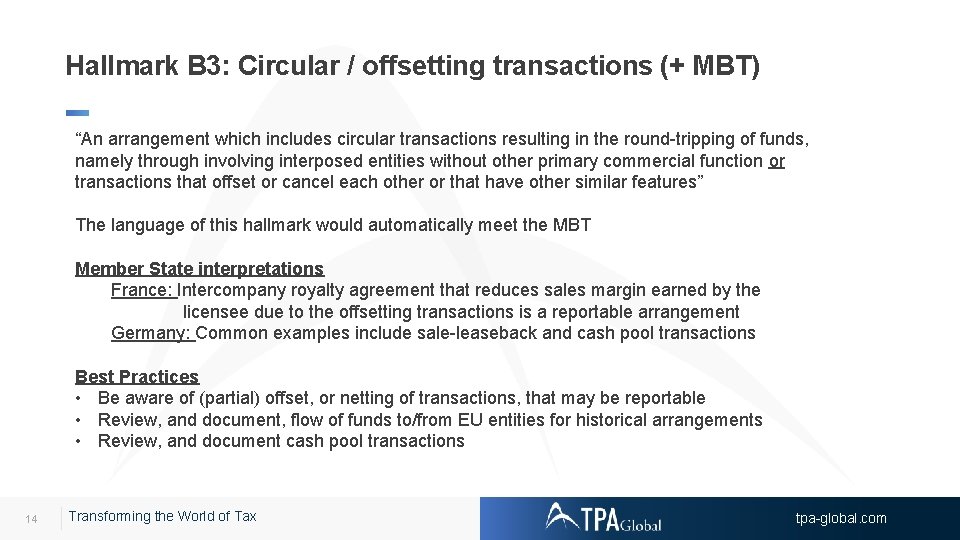
Hallmark B 3: Circular / offsetting transactions (+ MBT) “An arrangement which includes circular transactions resulting in the round-tripping of funds, namely through involving interposed entities without other primary commercial function or transactions that offset or cancel each other or that have other similar features” The language of this hallmark would automatically meet the MBT Member State interpretations France: Intercompany royalty agreement that reduces sales margin earned by the licensee due to the offsetting transactions is a reportable arrangement Germany: Common examples include sale-leaseback and cash pool transactions Best Practices • Be aware of (partial) offset, or netting of transactions, that may be reportable • Review, and document, flow of funds to/from EU entities for historical arrangements • Review, and document cash pool transactions 14 Transforming the World of Tax tpa-global. com
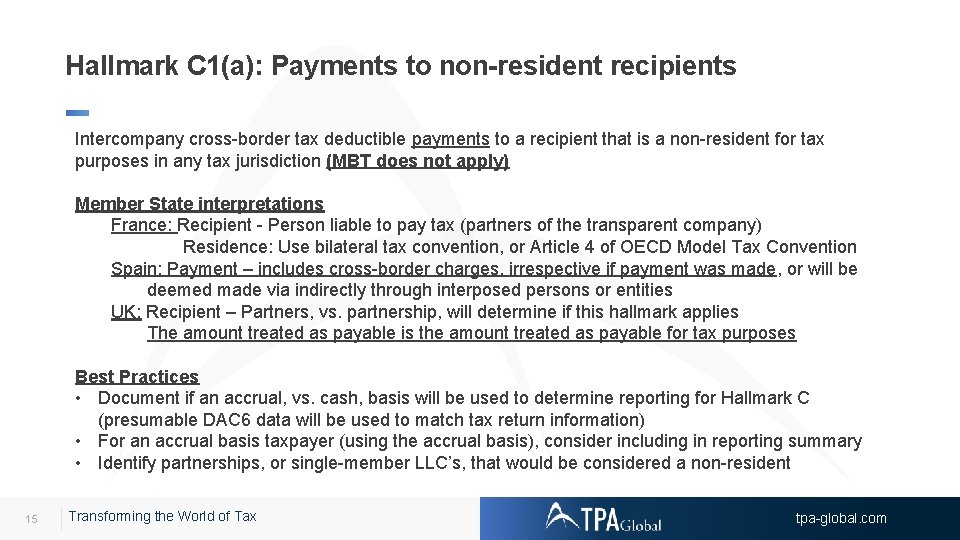
Hallmark C 1(a): Payments to non-resident recipients Intercompany cross-border tax deductible payments to a recipient that is a non-resident for tax purposes in any tax jurisdiction (MBT does not apply) Member State interpretations France: Recipient - Person liable to pay tax (partners of the transparent company) Residence: Use bilateral tax convention, or Article 4 of OECD Model Tax Convention Spain: Payment – includes cross-border charges, irrespective if payment was made, or will be deemed made via indirectly through interposed persons or entities UK: Recipient – Partners, vs. partnership, will determine if this hallmark applies The amount treated as payable is the amount treated as payable for tax purposes Best Practices • Document if an accrual, vs. cash, basis will be used to determine reporting for Hallmark C (presumable DAC 6 data will be used to match tax return information) • For an accrual basis taxpayer (using the accrual basis), consider including in reporting summary • Identify partnerships, or single-member LLC’s, that would be considered a non-resident 15 Transforming the World of Tax tpa-global. com
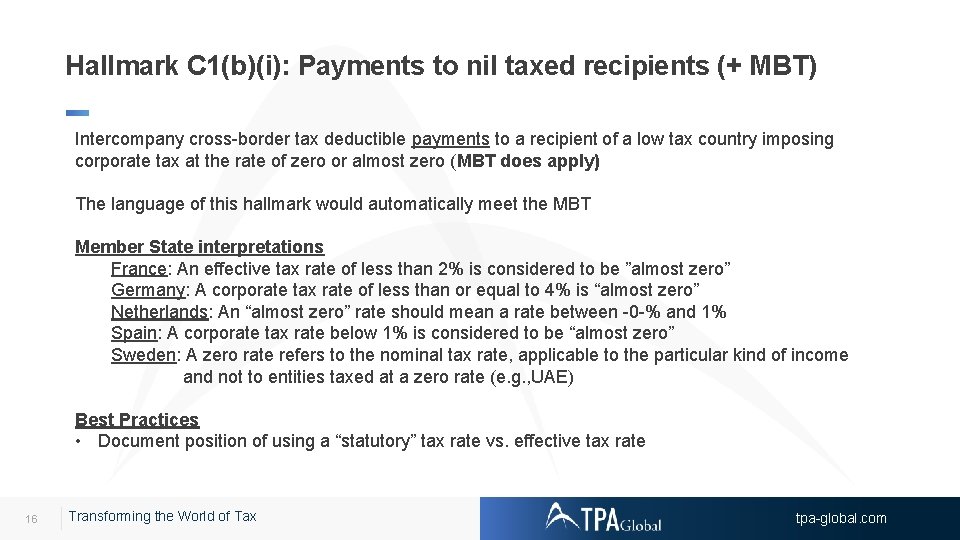
Hallmark C 1(b)(i): Payments to nil taxed recipients (+ MBT) Intercompany cross-border tax deductible payments to a recipient of a low tax country imposing corporate tax at the rate of zero or almost zero (MBT does apply) The language of this hallmark would automatically meet the MBT Member State interpretations France: An effective tax rate of less than 2% is considered to be ”almost zero” Germany: A corporate tax rate of less than or equal to 4% is “almost zero” Netherlands: An “almost zero” rate should mean a rate between -0 -% and 1% Spain: A corporate tax rate below 1% is considered to be “almost zero” Sweden: A zero rate refers to the nominal tax rate, applicable to the particular kind of income and not to entities taxed at a zero rate (e. g. , UAE) Best Practices • Document position of using a “statutory” tax rate vs. effective tax rate 16 Transforming the World of Tax tpa-global. com
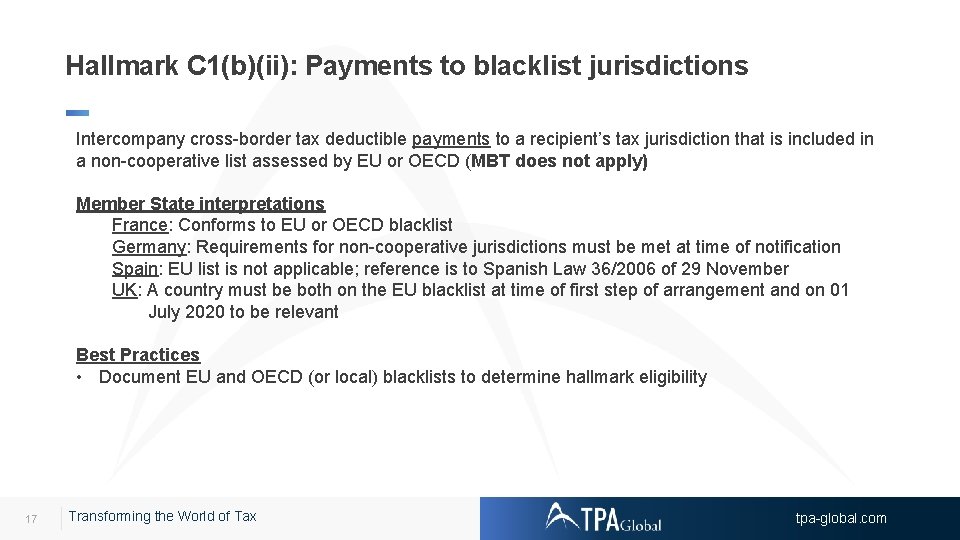
Hallmark C 1(b)(ii): Payments to blacklist jurisdictions Intercompany cross-border tax deductible payments to a recipient’s tax jurisdiction that is included in a non-cooperative list assessed by EU or OECD (MBT does not apply) Member State interpretations France: Conforms to EU or OECD blacklist Germany: Requirements for non-cooperative jurisdictions must be met at time of notification Spain: EU list is not applicable; reference is to Spanish Law 36/2006 of 29 November UK: A country must be both on the EU blacklist at time of first step of arrangement and on 01 July 2020 to be relevant Best Practices • Document EU and OECD (or local) blacklists to determine hallmark eligibility 17 Transforming the World of Tax tpa-global. com
Hallmark C 1(c): Payments subject to a tax exemption (+ MBT) Intercompany cross-border tax deductible payments to a recipient’s tax jurisdiction that benefits from a tax exemption in its tax jurisdiction (MBT does apply) The language of this hallmark would automatically meet the MBT Member State interpretations France: Payments which would not give rise to taxation by reason of setoff, deduction of losses or other deductible charges, deduction or imputation of taxes paid abroad, are deemed to benefit from a full tax exemption Germany: A full exemption from tax is assumed if the payments are not included in the tax base of the taxing state due to exemptions in domestic and treaty law, tax allowances, tax loss reliefs or tax credits Best Practices • Document if the payment benefits from a tax benefit (e. g. dividend), as determined by the Member State • Determine if payments are setoff, resulting in an assumed tax exemption 18 Transforming the World of Tax tpa-global. com
Hallmark C 1(d): Payments to a preferential tax regime (+ MBT) Intercompany cross-border tax deductible payments to a recipient’s tax jurisdiction that benefits from a preferential tax regime (MBT does apply) The language of this hallmark would automatically meet the MBT Member State interpretations France: Payments must be preferential in the relevant country, and not in other countries Germany: A patent box regime is reportable, even if it complies with modified OECD nexus Sweden: Reportable for Dutch innovation box and UK patent box regimes UK: A regime meeting criteria of the Forum on Harmful Tax Practices (FHTP) will be considered a preferential tax regime (Countries, including US, still under investigation) Best Practices • Document if there are patent or innovation box regimes, etc. for relevant transactions that would be reportable 19 Transforming the World of Tax tpa-global. com
Hallmark C 2: Payments for an asset receiving depreciation benefits in more than jurisdiction Intercompany cross-border tax deductible payments where an asset receives the benefit of depreciation in more than one jurisdiction (MBT does not apply) Member State interpretations Germany: An aircraft leasing transaction, where lessor and lessee each claim depreciation in their jurisdiction on the basis of their respective domestic legislation, is reportable UK: This hallmark does apply if the associated profits are taxed in both jurisdictions Best Practices • Document if there are dual-resident companies, or similar arrangements, that are applicable 20 Transforming the World of Tax tpa-global. com
Hallmark C 3: Double tax relief claims in > 1 jurisdiction Intercompany cross-border tax deductible payments where double tax relief is claimed for the same item in more than one jurisdiction (MBT does not apply) Member State interpretations Germany: Includes situations involving three jurisdictions in which an exemption from double taxation is applied in two different jurisdictions due to qualification/allocation conflicts Best Practices • Document if there are potential reporting arrangements 21 Transforming the World of Tax tpa-global. com
Hallmark C 4: Asset transfer with material amount differences Intercompany cross-border tax deductible payments for an asset transfer with a material difference in amounts recorded between those jurisdictions (MBT does not apply) Member State interpretations Germany: A difference of 10% or less is not material and not reportable Spain: A difference of more than 25% is a material difference UK: A material difference includes exploitation of tax system mismatches to an unintended outcome Best Practices • Document if there are valuation differences for applicable asset transfers (e. g. , applying different discount rates for net present values) 22 Transforming the World of Tax tpa-global. com
Hallmark E 1: Unilateral safe harbour rules An arrangement which involves the use of unilateral safe harbour rules (MBT does not apply) Member State interpretations France: The definition of unilateral safe harbour rules is the same as the OECD Transfer Pricing Guidelines in Chapter IV, Section E Germany/NL/Sweden: OECD safe harbour rules are not unilateral safe harbour rules; not reportable Best Practices • Document what arrangements fall within OECD safe harbour rules, and requirements of the relevant Member States • OECD rules are international rules, and not intended to be characterized as unilateral safe harbours 23 Transforming the World of Tax tpa-global. com
Hallmark E 2: Intangible transfers An arrangement which involves the transfer of hard-to-value intangibles (MBT does not apply) Best Practices • Treat any intangible transfer as subject to reporting if there are no comparables 24 Transforming the World of Tax tpa-global. com
Hallmark E 3: Transfer of functions, assets and/or risks An arrangement which involves the intergroup transfer of functions, assets and/or risks if the projected EBIT, during the 3 -years after the transfer, are less than 50% of projected annual EBIT of such transferors if the transfer had not been made (MBT does not apply) Member State interpretations Netherlands: Commercial EBIT (vs. tax EBIT) should be used UK: The 50% EBIT must be considered at the level of the individual company rather than at the level of the sub-group that is located in the same jurisdiction Best Practices • Treat the EBIT definition as earnings before interest and taxes • Document which projections are used for this determination • COVID-19 effects are not an exception to reporting 25 Transforming the World of Tax tpa-global. com
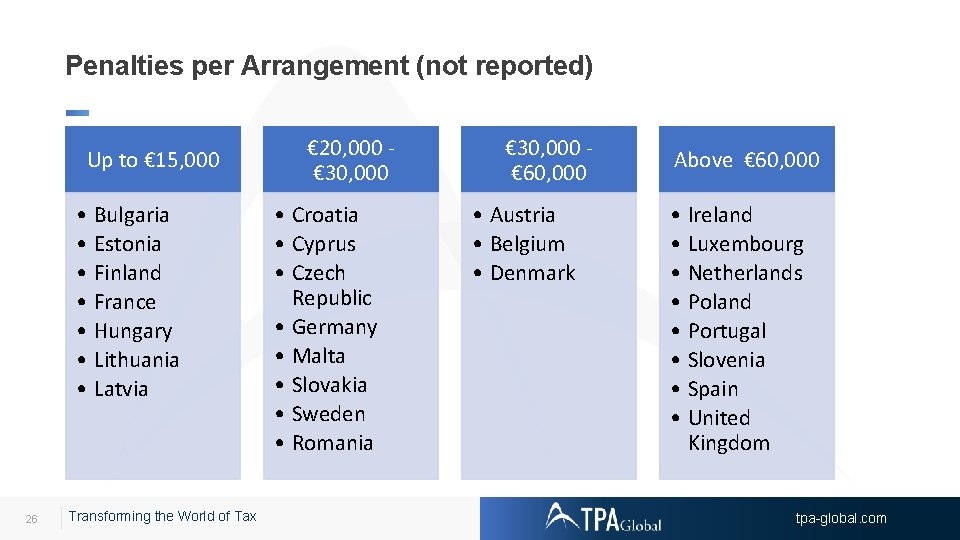
Penalties per Arrangement (not reported) Up to € 15, 000 • Bulgaria • Estonia • Finland • France • Hungary • Lithuania • Latvia 26 Transforming the World of Tax € 20, 000 € 30, 000 • Croatia • Cyprus • Czech Republic • Germany • Malta • Slovakia • Sweden • Romania € 30, 000 € 60, 000 • Austria • Belgium • Denmark Above € 60, 000 • Ireland • Luxembourg • Netherlands • Poland • Portugal • Slovenia • Spain • United Kingdom tpa-global. com
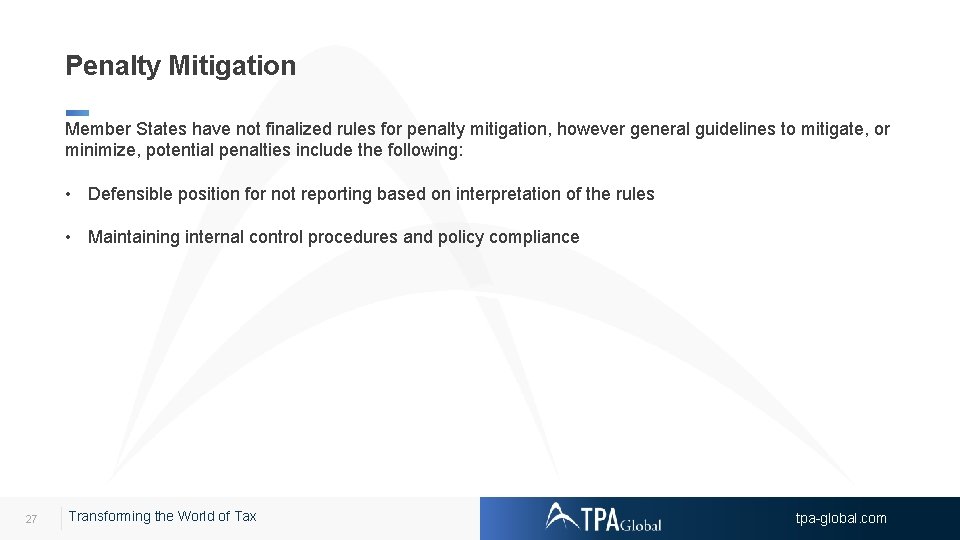
Penalty Mitigation Member States have not finalized rules for penalty mitigation, however general guidelines to mitigate, or minimize, potential penalties include the following: • Defensible position for not reporting based on interpretation of the rules • Maintaining internal control procedures and policy compliance 27 Transforming the World of Tax tpa-global. com
Questions? • How will you mitigate the risk of non - compliance? • Are you in control? 28 Transforming the World of Tax tpa-global. com
Get In Touch Transforming the World of Tax info@tpa-global. com +31 20 462 3530 www. tpa-global. com 29 Transforming the World of Tax Headquarters: H. J. E. Wenckebachweg 210 1096 AS Amsterdam The Netherlands. Find Us tpa-global. com
Thank You Our global network covers over 5, 000 professionals who enable us to deliver scalable solutions in the area of tax & legal, digital transformation, running a compliance factory and effectively dealing with dispute resolution. To ensure the highest quality and seamless service provision, thereby meeting international standards and regulations, a global team of dedicated professionals and specialists is a key and determining factor. Through linking three ecosystems: Tax, Transfer Pricing and Valuation, Tax + Technology and Tax Litigation and Mediation – we deliver a world of tax in control. The views expressed and the information provided in this material are of general nature and is not intended to address the circumstances of any particular individual or entity. The above content should neither be regarded as comprehensive nor sufficient for making decisions. No one should act on the information or views provided in this publication without appropriate professional advise. It should be noted that no assurance is given for any loss arising from any actions taken or to be taken or not taken by anyone based on this publication. © 2020 V. All Rights Reserved. H. J. E. Wenckebachweg 210. 1096 AS Amsterdam. The Netherlands. +31 (0)20 462 3530. tpa-global. com 30 Transforming the World of Tax tpa-global. com
- Slides: 30