
DAC 501 FINANCIAL ACCOUNTING BY H O ONDIGO
DAC 501 : FINANCIAL ACCOUNTING BY H O ONDIGO UNIVERSITY OF NAIROBI SCHOOL OF BUSINESS JAN 2013

COURSE OUTLINE • COURSE TITLE: FINANCIAL ACCOUNTING. COURSE CODE: DAC 501 • LECTURERS: HERICK ONDIGO & JAMES NGANGA • SEMESTER: JAN-APRIL 2013 1 -2
COURSE OBJECTIVES: • To introduce students to the role of financial accounting in the economic decision making process. • To develop a firm understanding of the basic concepts and methods used in the preparation of financial statements for use by investors and other interested external users. 1 -3
COURSE EMPHASIS • The emphasis throughout the course is on underlying concepts and on analysis of the problems that arise in the application of concepts in preparing and communicating business information. • Appropriate attention is given to the use of accounting information as a basis for making decisions by various interested parties. 1 -4
REQUIRED TEXTS/READINGS: • No single textbook can be used to adequately cover all the topics to be discussed. Students are therefore expected to refer to various sources. In addition to the class handouts that will be given from time to time as a basis for discussion, additional readings will come from among other sources, the texts listed below. 1 -5
COURSE TEXT & CASE TEXT • Jan R. Williams, Susan F. Haka, Mark S. Bettner and Robert F. Meigs: Financial and Managerial Accounting: The Basis for Business Decisions, Mc Graw Hill, Irwin, 13 th Edition, 2004. • COURSE CASE TEXT • Robert N. Anthony, David F. Hawkins, Kenneth. A, Accounting Texts and Cases, Tata Mc. Graw-Hill Publishing Company Limited, New Delhi, India, 11 th Edition, 2003 1 -6
METHODOLOGY & EVALUATION • The course will be conducted mainly by way of lectures and class discussions. Students are advised to read the relevant texts before topics are covered in class. This will enhance their participation in the class discussions. • Assignments 20% • Tests 30% • Final Examination 50% • Total Mark 100% 1 -7
TOPICS 1: INTRODUCTION TO ACCOUNTING • • The nature and scope of accounting. The objectives of accounting. Accounting as an information system. Users of financial statements and reports and their information needs. • The fields (specializations) of accounting. • Careers in Financial Accounting 1 -8
2. FINANCIAL STATEMENTSContent & Formats • • • Statement of (comprehensive) income Statement of changes in equity Statement of financial position Statement of cash flows. Notes to the Financial Statements 1 -9
3. ANALYSIS AND INTERPRETATION OF FINANCIAL STATEMENTS . • Objectives of analyzing financial statements and reports. • Standards of comparison. • Techniques of analysis. • Limitations of financial statement analysis. 1 -10
4. CONCEPTUAL FRAMEWORK • Definition & Need for a conceptual framework • Structure (content) of The Framework – – Objectives of financial reporting. Qualitative characteristics of accounting information. Elements of financial statements. Measurement and recognition guidelines. • Accounting assumptions, principles and constraints. 1 -11
5. REGULATIONS AND INFLUENCES ON FINANCIAL REPORTING. • The legislation. • Accounting standards – – – Definition The need for and objectives of standards. Advantages and disadvantages of standards Application of accounting standards Arguments for and against regulation of the accounting profession. • Security exchange rules. 1 -12
6. RECORDING TRANSACTIONS AND EVENTS AND SUMMARISING ACCOUNTING DATA • • . Business transactions and events and source documents The Accounting Equation (MODEL) Double entry system of record keeping. The Accounting Cycle (PROCESS). – Analyzing business transactions and events – Journalizing the transactions and events – Posting to the general ledger – Preparing an unadjusted trial balance. 1 -13
7. PERIODIC MEASUREMENT AND END OF PERIOD ADJUSTMENTS. • Cash versus accrual basis of accounting • End of period adjustments – – Apportionment of recorded costs Apportionment of recorded revenues Accrual of unrecorded costs • Losses in asset values – Receivables – Inventories – Property, Plant & Equipment 1 -14
8. PREPARATION OF FINANCIAL STATEMENTS • • Statement of (comprehensive) of income Statement of changes in equity Statement of financial position Statement of cash flows. 1 -15
9. ETHICS FOR ACCOUNTANTS • • The nature of business ethics The role of ethics in modern business The role of professional accounting ethics The role of the accountant as a guardian of business ethics • The IFAC Code of Ethics for Professional Accountants 1 -16

THE END OF COURSE • BEST OF LUCK IN THE COURSE 1 -17
TOPIC 1: INTRODUCTION TO ACCOUNTING • 1 -18
Definitions of Accounting 1 -19 “The American Institute of Certified Public Accountants (AICPA), 1961, defines accounting as ‘the art of recording, classifying and summarizing in a significant manner and in terms of money, transactions and events, which are, in part of at least of a financial character, and interpreting the results thereof’ ”
Definitions of Accounting cont… 1 -20 The Accounting Standards Board , ASB (1991) on the other hand has defines accounting as “the provision of information about the financial position, performance and financial adaptability of an enterprise that is useful to a wide range of potential users in making economic decisions”.
Definitions of Accounting cont. . 1 -21 Prof N. D Nzomo (1992) defines accounting as ‘the art and science of recording transactions, processing the recorded transactions into a comprehensible form and communicating the information to interested parties. ’
Definitions of Accounting cont… 1 -22 The American Accounting (AAA) Association (1966) defines accounting as the process of identifying, measuring and communicating economic information to permit informed judgments by users of information.
Consensus Definition of Accounting 1 -23 “Accounting is a service activity. Its function is to provide quantitative information, primarily financial in nature, about economic entities that is intended to be useful in making economic decisions—in making reasoned choices among alternative courses of action. ”
Key Features of Accounting Definition 1 -24 Accounting— Provides a vital service in today’s business environment. Is concerned primarily with quantitative financial information that is used in conjunction with qualitative evaluations in making judgments. Information is used in making decisions about how to allocate scarce resources. Information is intended to be useful in making economic decisions about the future.
Accounting as an Information system 1 -25 Accounting as a social science lends itself easily to its analysis as an information system. It has the attributes of a system; It has a basic goal, which is to provide information, It has clear and well defined elements in the form of people and equipment, and It has the typical activities of a system, namely; input, process and output.
Accounting as an Information system c 0 nt… 1 -26 The first boundary is the filtering process by which the accountant selects data. The second boundary is established by specific information needed of its users. The output requirements determine the type of data selected as the input. The output of the system is the financial statements and reports. The task of the accountant is therefore to transform raw data into information; a form that has meaning and is able to influence decisions.
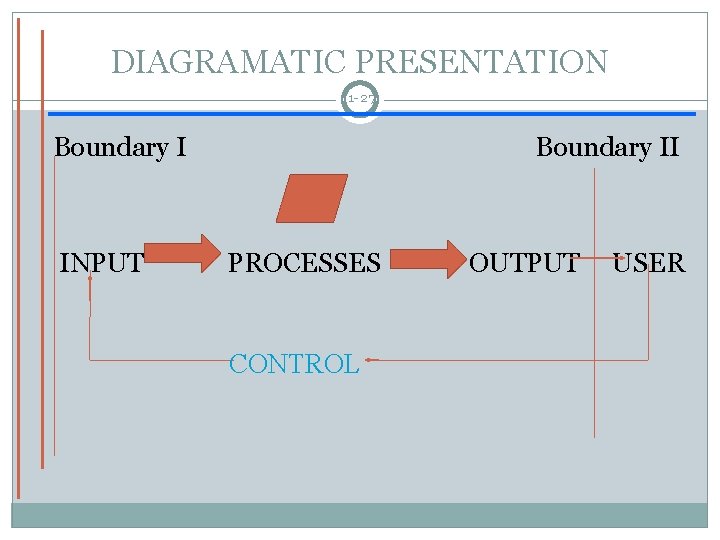
DIAGRAMATIC PRESENTATION 1 -27 Boundary I INPUT Boundary II PROCESSES OUTPUT USER CONTROL
Users of Accounting Information 1 -28 Stakeholders are all parties interested in the financial health of a company. Internal users make decisions that directly affect the internal operations of the enterprise. External users make decisions concerning their relationship to the enterprise.
Specific Users of Accounting information 1 -29 Investors (both existing stockholders and potential investors) need information concerning the safety and profitability of their investment. 1. Profitability and financial soundness would, therefore, be matters of prime importance to them
Specific Users of Accounting information cont. . 1 -30 2. Creditors (Lenders, suppliers) They need information about the profitability and stability of the company to decide whether to lend money to the company and, if so, what interest rate(s) to charge. They are interested in information that enables them to determine whether the amounts owing to them will be paid when due. They will be concerned about the liquid assets of an enterprise relative to the amount of liability falling due in the near future, and about the owner’s investment relative to outside funding. To the lenders, suppliers and other creditors, owner’s investment serves as a protecting buffer between lenders, suppliers and other creditors and any losses which may befall the enterprise.
Specific Users of Accounting information cont. . 1 -31 3. Employees and their representatives. Employees and their representative groups are interested about the profitability and stability of their employers. They are also interested in information which enables them to assess the ability of enterprises to provide remuneration, retirement benefits and employment opportunities.
Specific Users of Accounting information cont. . 1 -32 4. Management requires accounting information to assist them in discharging their managerial function. The management process may be analyzed into three major functions – planning, organizing and controlling the activities of the enterprise. These various management functions have one thing in common: they are all concerned with making decisions.
Specific Users of Accounting information cont. . 1 -33 5. Governments and their agencies. Governments and other regulatory agencies are interested in the allocation of resources and therefore the activities of enterprises. They also require information in order to regulate the activities of enterprises, determine taxation policies and as a basis for national income and similar statistics. These will include employment, provision of goods and services and the contribution of enterprises to socio– economic development.
Specific Users of Accounting information cont. . 1 -34 6. Customers have an interest in information of an enterprise indicating the continuance of an enterprise especially when they have a long-term involvement with, or are dependent on the entity. Customers would also be concerned about the fairness of pricing policies, differential costs between one product and another produced by the same firm at a different price.
Specific Users of Accounting information cont. . 1 -35 7. Competitors. Enterprises compare their performance with those of other enterprises. They assess their position against their competitors. Financial statements enable them to know profit – margins, value of assets, and resource utilization among other items of their competitors.
Specific Users of Accounting information cont. . 1 -36 8. Public. The general public requires information on the activities of enterprises in light of social benefits and costs that accrue to the community. 9. Others Academicians, Researchers, New Investors (entrepreneurs), Financial Analysts etc. . To obtain input data for analysis and decision making
Specializations of Accounting 1 -37 To meet the varied needs of users of accounting information accounting has developed specializations and sub-specializations. These include the following specialized fields each with its own area of expertise, responsibility as well as educational requirements; 1. Financial Accounting. 6. Human Resources Accounting 2. Managerial Accounting. 7. Social Accounting 3. Tax Accounting. 8. Environmental Accounting 4. Fund Accounting 9. Forensic Accounting 5. Auditing 10. Behavoiral Accounting Two requirements that are shared by all these fields are a sound mathematical background an understanding of business and economic environment.
Specializations of Accounting cont… 1 -38 1. Financial accounting focuses on the development and communication of financial information for external users. This is the process of recording the financial activities of a business and reporting summarized information to individuals or groups who are not involved in the day-to day operations of an organization. These individuals or groups include the owner(s), creditors, governmental agencies, or prospective investors. The information is communicated primarily through general purpose financial statements. Financial statements describe the condition of the organization and the events that happened during a period. Since the outside parties do not have direct access to business records, and must rely on the authenticity of reports, there have been some standard practices established to be followed by all accounting entities reporting to the outside parties
Specializations of Accounting cont… 1 -39 Management accounting is concerned primarily with financial reporting for internal users, especially management. Management accounting is concerned with the provisions and use of accounting information to managers within an organizations, to provide them with the basis to make informed business decisions that will allow them to be better equipped in their management and control functions. 2.
Financial Vs. Management Accounting 1 -40 In contrast to Financial Accounting information, Management Accounting information is: usually confidential and used by management, instead of publicly reported; forward-looking, instead of historical; Pragmatically computed using extensive management information system and internal controls, instead of complying with accounting standards.
Specializations of Accounting cont… 1 -41 3. Tax Accounting This specialization deals with the process of establishing tax liability of an accounting entity, preparing and submitting tax returns, reviewing returns with income tax auditors and planning for the minimization of tax liabilities and payments. A tax accountant is simply an individual who assists a taxpayer in preparing a tax return (Hussey, 1999). For businesses, the accounting system must also provide data for use in the completion of the company's tax returns. This function is the concern of the tax accountant
Specializations of Accounting cont… 1 -42 4. Auditing is process of thoroughly examining the financial records of an enterprise and the facts on which they are based. After an adequate investigation, the external auditor will give a statement of opinion as to whether the accounting statements or reports reflect a true and fair view of the results of operations, financial position and financial adaptability of an accounting entity. It extends to ascertain that the business entity maintains and keeps proper books of accounts. Internal auditors are employee of management who constantly check the records prepared in, and the operating procedures of, each department or branch of the corporation and make recommendations for improvements.
Specializations of Accounting cont… 1 -43 5. Fund Accounting. This specialization deals with accounting for non-profit making organizations. These organizations include charitable organizations, philanthropic foundations, religious groups, governmental agencies and schools. The organizations set up different funds for their various activities. Each fund consists of assets, liabilities, and a fund balance and constitutes a separate accounting entity created and maintained for a specific purpose. The inflow and outflow of each fund must be accounted for in such a way that they can be compared with the approved or stipulated resource flows for the fund.
Specializations of Accounting cont… 1 -44 6. Human Resources Accounting "Human Capital/Resource" this is an accounting practice that treats people as machines with a monetary value (e. g. dollar) attached to them as individuals, and not to their labor. They involve accounting methods that recognizes a variety of human resources and shows them on a company's financial statements. Under human resource accounting, a value is placed on people based on such factors as experience, education, and psychological traits, and, most importantly, future earning power (benefit) to the company. The idea has been well received by human-resource-oriented firms, such as those engaged in accounting, law, and consulting. Practical application is limited, however, primarily because of difficulty and the lack of uniform, consistent methods of quantifying the values of human resources.
Specializations of Accounting cont… 1 -45 7. Social Accounting This is the process of communicating the social and environmental effects of organizations’ economic actions to particular interest groups within society and to society at large. Social accounting emphasizes the notion of corporate accountability. It is "an approach to reporting a firm’s activities which stresses the need for the identification of socially relevant behavior, the determination of those to whom the company is accountable for its social performance and the development of appropriate measures and reporting techniques. "
Specializations of Accounting cont… 1 -46 8. Environmental/Green Accounting Environmental accounting is a subset of social accounting, focuses on the cost structure and environmental performance of a company. It principally describes the preparation, presentation, and communication of information related to an organization’s interaction with the natural environment. Although environmental accounting is most commonly undertaken as voluntary self-reporting by companies, third-party reports by government agencies, NGOs and other bodies posit to pressure for environmental accountability
Specializations of Accounting cont… 1 -47 9. Forensic Accounting The forensic Accountant is usually hired in: Engagements relating to civil disputes may fall into several categories: calculating and quantifying losses and economic damages, whether suffered through tort or breach of contract; disagreements relating to company acquisitions—perhaps earn outs or breaches of warranties; and business valuation. Forensic accountants often assist in professional negligence claims where they are assessing and commenting on the work of other
Forensic Accounting cont… 1 -48 Forensic accountants utilize an understanding of business information and financial reporting systems, accounting and auditing standards and procedures, evidence gathering and investigative techniques, and litigation processes and procedures to perform their work. Forensic accountants are also increasingly playing more proactive risk reduction roles by designing and performing extended procedures as part of the statutory audit, acting as advisers to audit committees, fraud deterrence engagements, and assisting in investment analyst research.
Specializations of Accounting cont… 1 -49 10. Behavioural Accounting This is an approach to accounting that stresses psychological considerations in decision making; For example, a budget should be participative so departmental managers who are involved with it will internalize the goals. Also profit centres engage a manager's ego because the financial results of the entity are a direct reflection of the manager's performance. It rests on theory that the management accounting function is essentially behavioural. Theory states that the nature and scope of accounting systems is materially influenced by the view of human behaviour that is held by the accountants who design and operate these systems. Budgeting is a simple application of behavioural accounting.
Careers in Financial Accounting 1 -50 1. Public Accounting Pubic accountants do not work for a single business enterprise. Rather, they provide a variety of services for many different individuals and business clients.
Careers in Financial Accounting cont 2. Corporate Accounting A large business enterprise employs financial accountants who are primarily concerned with external financial reporting, management accountants who are primarily concerned with internal financial reporting, and tax accountants. 1 -51
Careers in Financial Accounting cont 3. Analyst, Banker, Consultant- Users Many students take accounting in preparation for becoming a user of financial statements. Credit analysts, investment bankers, brokers, and business consultants need a strong working knowledge of accounting as well as strong skills in information technology. 1 -52

THE END 1 -53 THANK YOU
- Slides: 53