
D Y N A M I C P
- Slides: 43
D Y N A M I C P O W E R P O I N™ T CHAPTER 14(29) SLIDES BY SOLINA LINDAHL Money, Banking, and the Federal Reserve System C O P Y R I G 2 H 0 T 1 3 WORTH PUBLISHERS
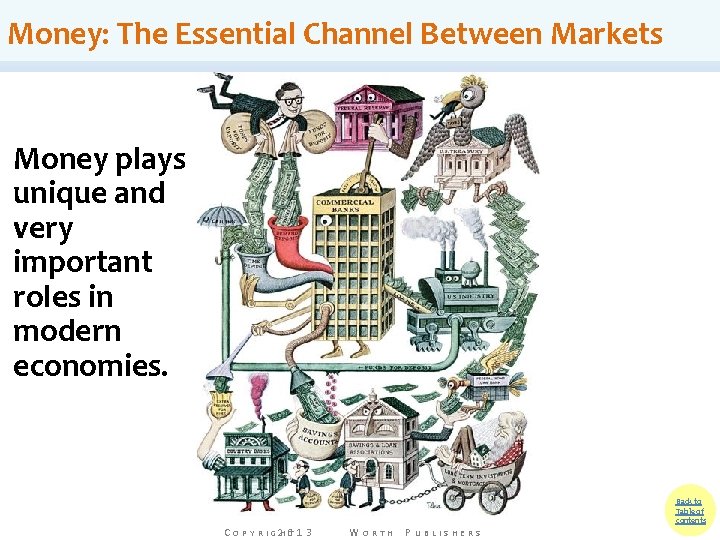
Money: The Essential Channel Between Markets Money plays unique and very important roles in modern economies. C O P Y R I G 2 H 0 T 1 3 WORTH PUBLISHERS Back to Table of contents
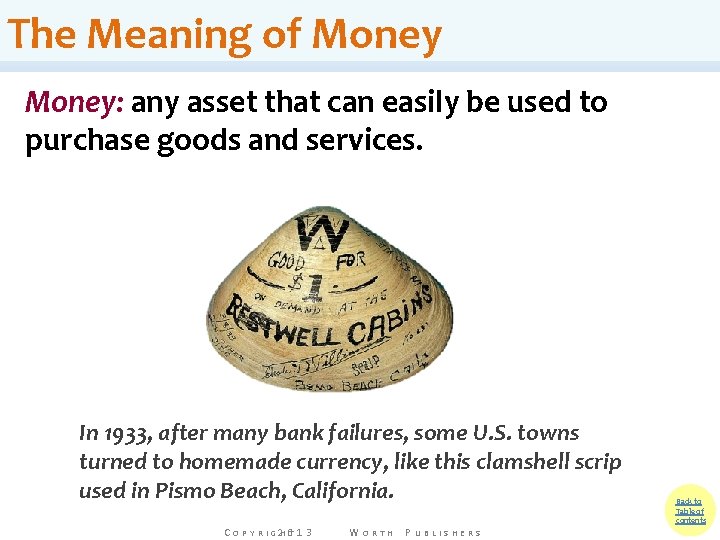
The Meaning of Money: any asset that can easily be used to purchase goods and services. In 1933, after many bank failures, some U. S. towns turned to homemade currency, like this clamshell scrip used in Pismo Beach, California. C O P Y R I G 2 H 0 T 1 3 WORTH PUBLISHERS Back to Table of contents
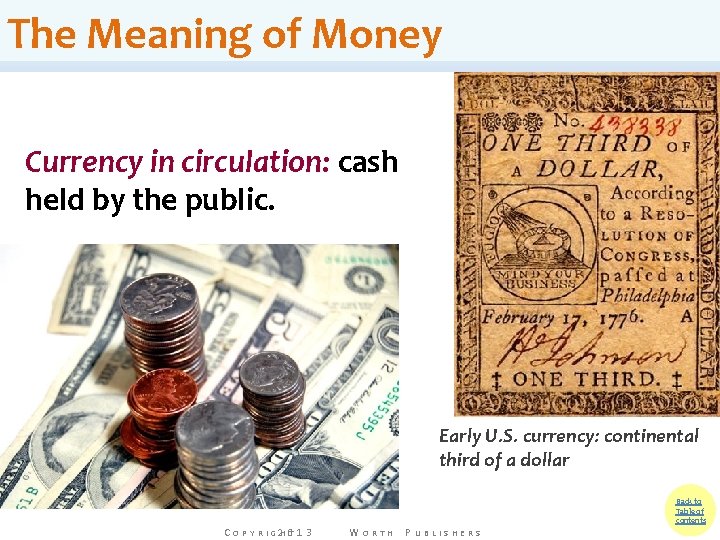
The Meaning of Money Currency in circulation: cash held by the public. Early U. S. currency: continental third of a dollar C O P Y R I G 2 H 0 T 1 3 WORTH PUBLISHERS Back to Table of contents
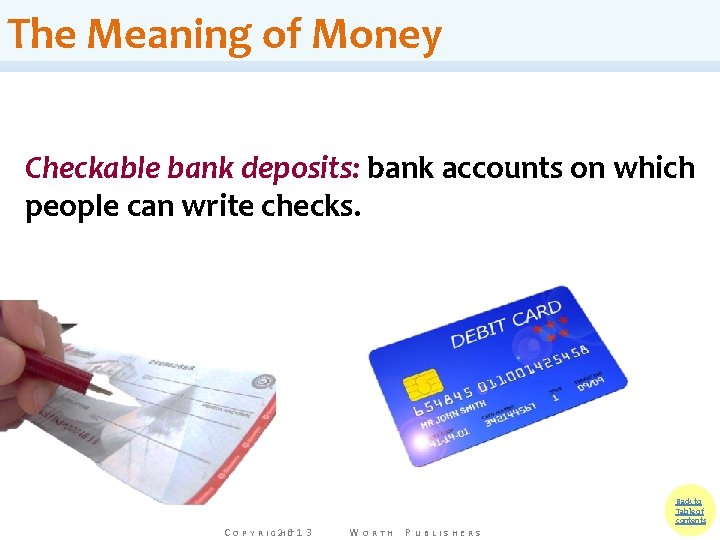
The Meaning of Money Checkable bank deposits: bank accounts on which people can write checks. C O P Y R I G 2 H 0 T 1 3 WORTH PUBLISHERS Back to Table of contents
The Meaning of Money The money supply is the total value of financial assets in the economy that are considered money. C O P Y R I G 2 H 0 T 1 3 WORTH PUBLISHERS Back to Table of contents
The Roles of Money must function as: a medium of exchange. a store of value. a unit of account. C O P Y R I G 2 H 0 T 1 3 WORTH PUBLISHERS Back to Table of contents
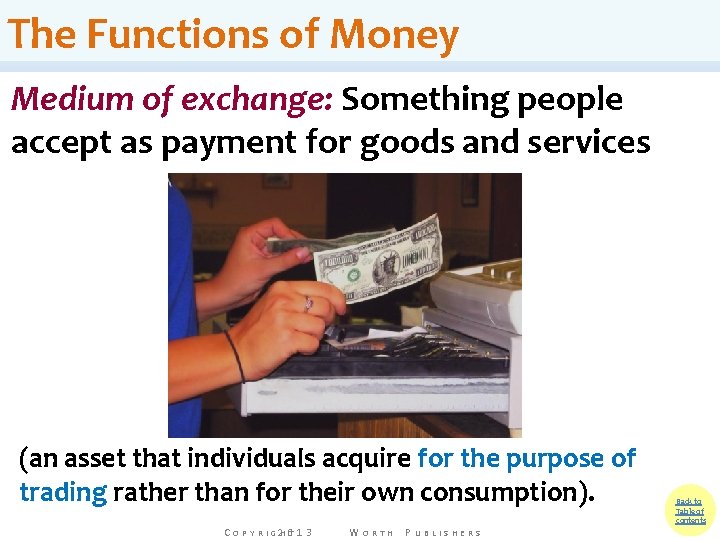
The Functions of Money Medium of exchange: Something people accept as payment for goods and services (an asset that individuals acquire for the purpose of trading rather than for their own consumption). C O P Y R I G 2 H 0 T 1 3 WORTH PUBLISHERS Back to Table of contents
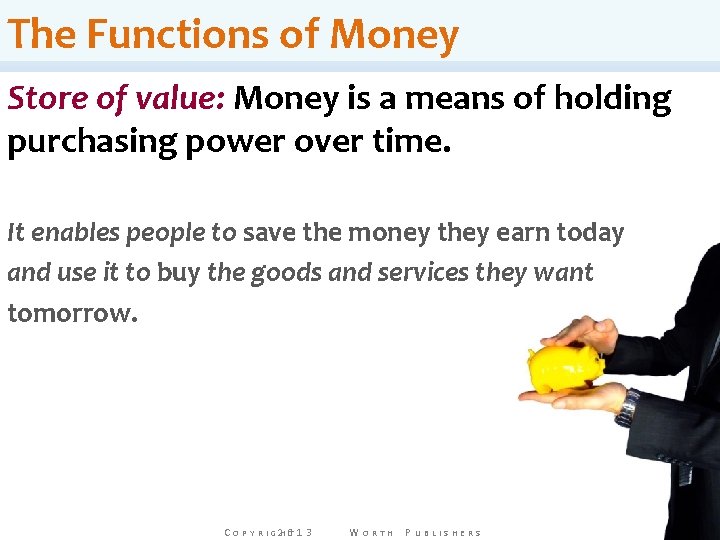
The Functions of Money Store of value: Money is a means of holding purchasing power over time. It enables people to save the money they earn today and use it to buy the goods and services they want tomorrow. C O P Y R I G 2 H 0 T 1 3 WORTH PUBLISHERS Back to Table of contents
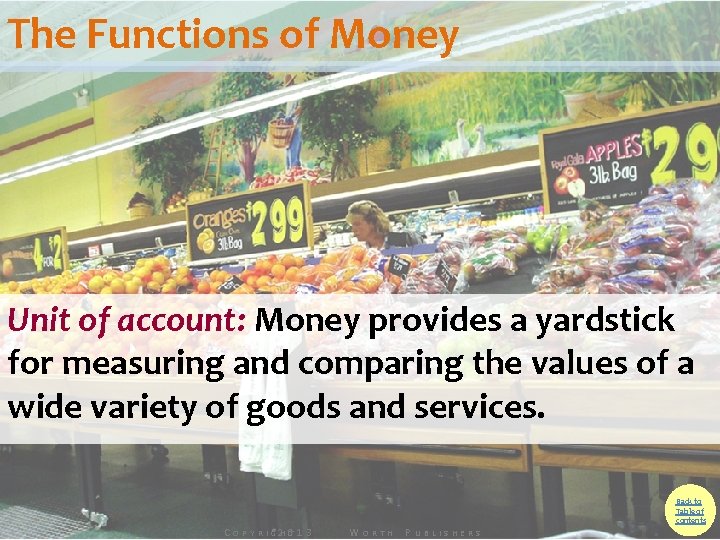
The Functions of Money Unit of account: Money provides a yardstick for measuring and comparing the values of a wide variety of goods and services. C O P Y R I G 2 H 0 T 1 3 WORTH PUBLISHERS Back to Table of contents
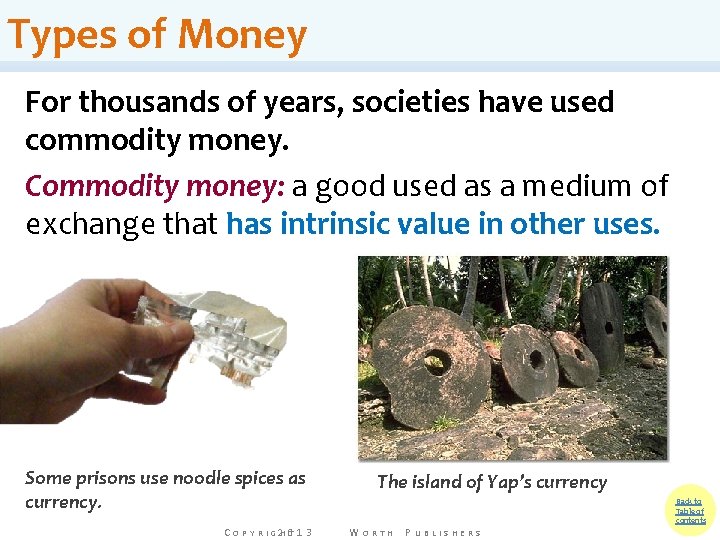
Types of Money For thousands of years, societies have used commodity money. Commodity money: a good used as a medium of exchange that has intrinsic value in other uses. Some prisons use noodle spices as currency. C O P Y R I G 2 H 0 T 1 3 The island of Yap’s currency WORTH PUBLISHERS Back to Table of contents
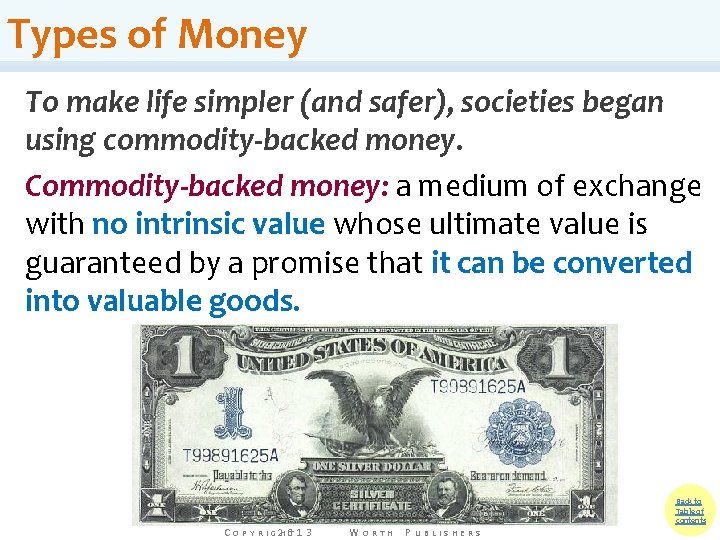
Types of Money To make life simpler (and safer), societies began using commodity-backed money. Commodity-backed money: a medium of exchange with no intrinsic value whose ultimate value is guaranteed by a promise that it can be converted into valuable goods. C O P Y R I G 2 H 0 T 1 3 WORTH PUBLISHERS Back to Table of contents
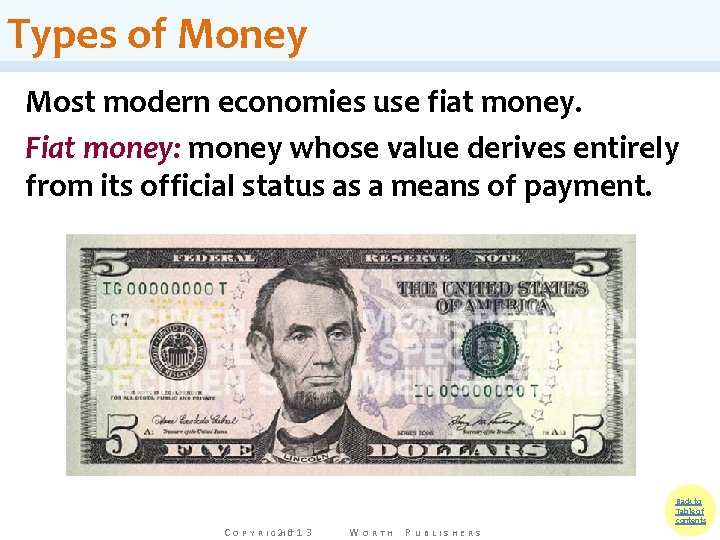
Types of Money Most modern economies use fiat money. Fiat money: money whose value derives entirely from its official status as a means of payment. C O P Y R I G 2 H 0 T 1 3 WORTH PUBLISHERS Back to Table of contents
Measuring the Money Supply Monetary aggregate: an overall measure of the money supply. M 1 and M 2: two definitions of the money supply. C O P Y R I G 2 H 0 T 1 3 WORTH PUBLISHERS Back to Table of contents
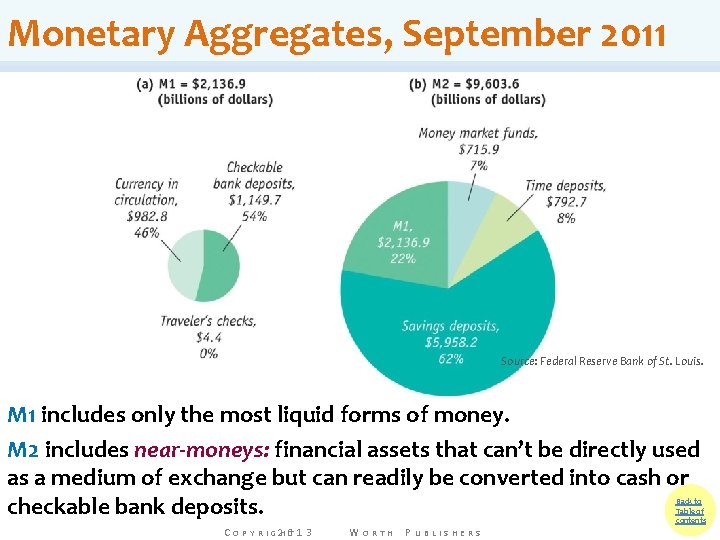
Monetary Aggregates, September 2011 Source: Federal Reserve Bank of St. Louis. M 1 includes only the most liquid forms of money. M 2 includes near-moneys: financial assets that can’t be directly used as a medium of exchange but can readily be converted into cash or checkable bank deposits. C O P Y R I G 2 H 0 T 1 3 WORTH PUBLISHERS Back to Table of contents
Active Learning: Practice Which of the following assets would you classify as being most liquid? a) demand deposits b) small-time deposits c) a home d) gold bullion To Next Active Learning C O P Y R I G 2 H 0 T 1 3 WORTH PUBLISHERS Back to Table of contents
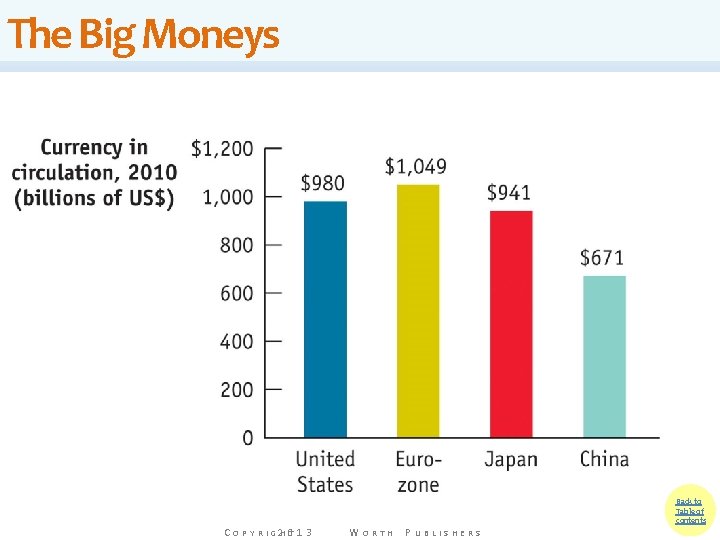
The Big Moneys C O P Y R I G 2 H 0 T 1 3 WORTH PUBLISHERS Back to Table of contents
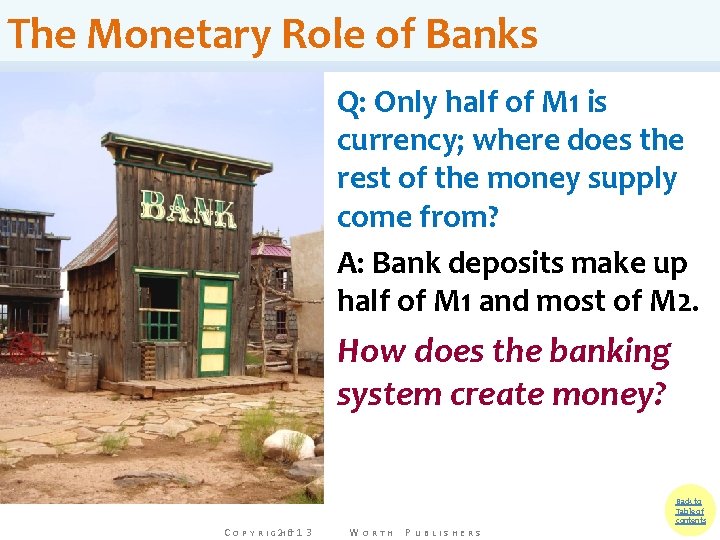
The Monetary Role of Banks Q: Only half of M 1 is currency; where does the rest of the money supply come from? A: Bank deposits make up half of M 1 and most of M 2. How does the banking system create money? C O P Y R I G 2 H 0 T 1 3 WORTH PUBLISHERS Back to Table of contents
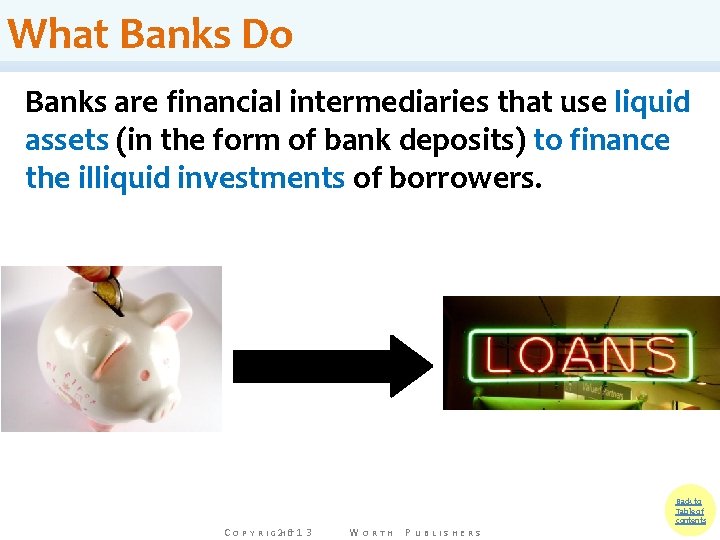
What Banks Do Banks are financial intermediaries that use liquid assets (in the form of bank deposits) to finance the illiquid investments of borrowers. C O P Y R I G 2 H 0 T 1 3 WORTH PUBLISHERS Back to Table of contents
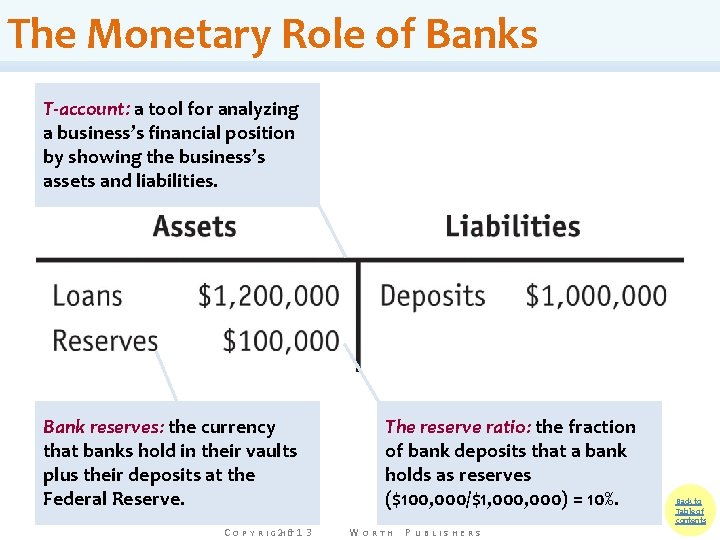
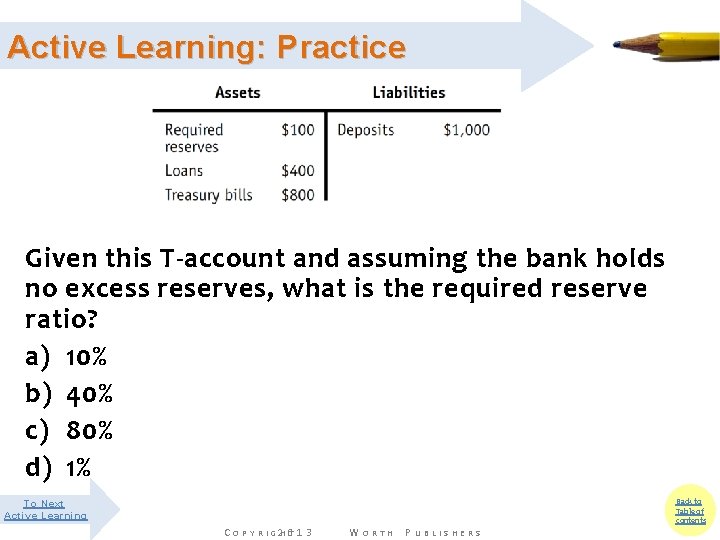
The Monetary Role of Banks T-account: a tool for analyzing a business’s financial position by showing the business’s assets and liabilities. Bank reserves: the currency that banks hold in their vaults plus their deposits at the Federal Reserve. C O P Y R I G 2 H 0 T 1 3 The reserve ratio: the fraction of bank deposits that a bank holds as reserves ($100, 000/$1, 000) = 10%. WORTH PUBLISHERS Back to Table of contents
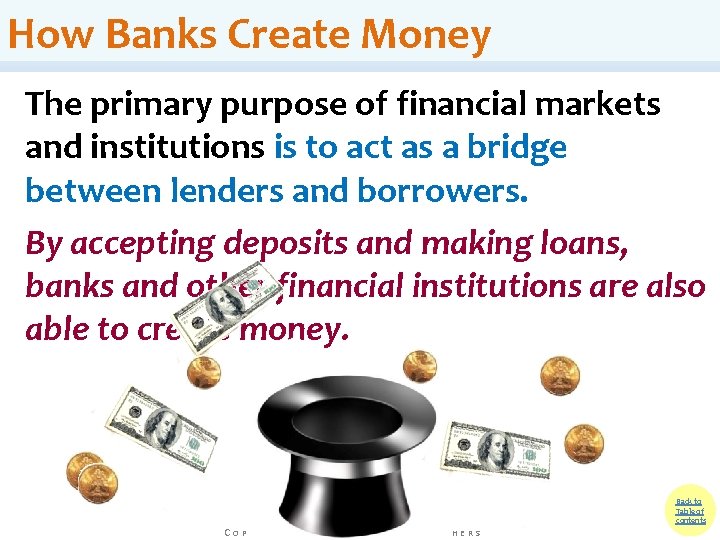
How Banks Create Money The primary purpose of financial markets and institutions is to act as a bridge between lenders and borrowers. By accepting deposits and making loans, banks and other financial institutions are also able to create money. C O P Y R I G 2 H 0 T 1 3 WORTH PUBLISHERS Back to Table of contents
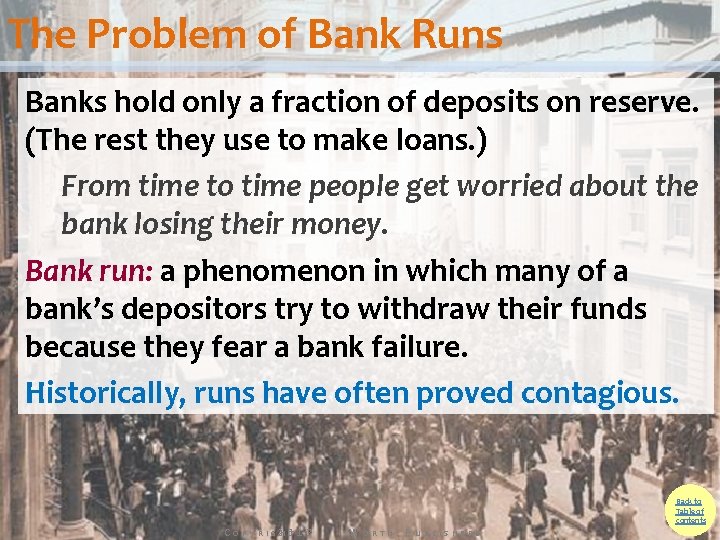
The Problem of Bank Runs Banks hold only a fraction of deposits on reserve. (The rest they use to make loans. ) From time to time people get worried about the bank losing their money. Bank run: a phenomenon in which many of a bank’s depositors try to withdraw their funds because they fear a bank failure. Historically, runs have often proved contagious. C O P Y R I G 2 H 0 T 1 3 WORTH PUBLISHERS Back to Table of contents
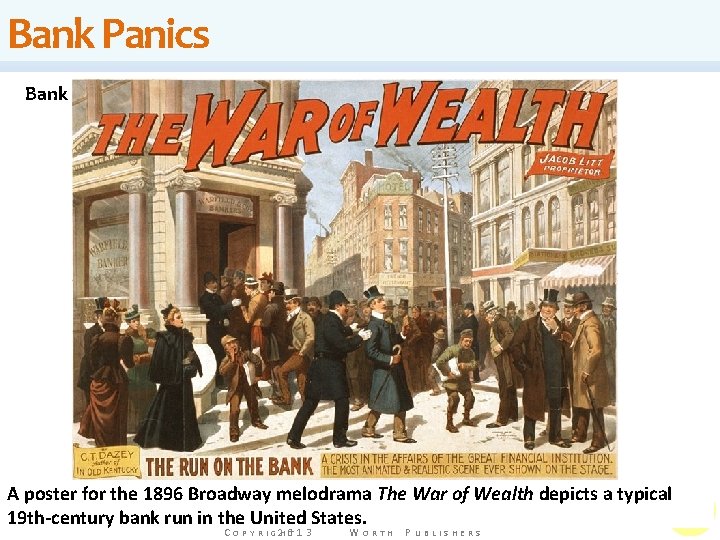
Bank Panics Bank run during the Great Depression in the United States, 1933. A poster for the 1896 Broadway melodrama The War of Wealth depicts a typical 19 th-century bank run in the United States. C O P Y R I G 2 H 0 T 1 3 WORTH PUBLISHERS Back to Table of contents
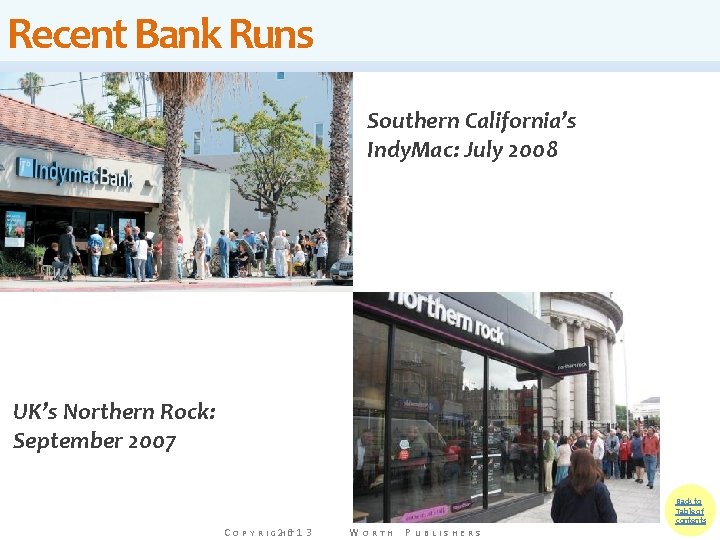
Recent Bank Runs Southern California’s Indy. Mac: July 2008 UK’s Northern Rock: September 2007 C O P Y R I G 2 H 0 T 1 3 WORTH PUBLISHERS Back to Table of contents
Bank Regulations 1. Deposit insurance: a guarantee that a bank’s depositors will be paid even if the bank can’t come up with the funds. (The FDIC currently guarantees the first $250, 000 of each account. ) C O P Y R I G 2 H 0 T 1 3 WORTH PUBLISHERS Back to Table of contents
Bank Regulations 2. Capital requirements: requirement that the owners of banks hold substantially more assets than the value of bank deposits. Deposit insurance creates a well-known incentive problem: Banks can take more risks, since they are insured. To help motivate safe behavior, banks’ capital is required to equal to 7% or more of their assets. C O P Y R I G 2 H 0 T 1 3 WORTH PUBLISHERS Back to Table of contents
Bank Regulations 3. Reserve requirements: rules set by the Federal Reserve that determine the minimum reserve ratio for a bank. For example, in the United States, the minimum reserve ratio for checkable bank deposits is 10%. 4. The discount window: an arrangement in which the Federal Reserve stands ready to lend money to banks in trouble. C O P Y R I G 2 H 0 T 1 3 WORTH PUBLISHERS Back to Table of contents
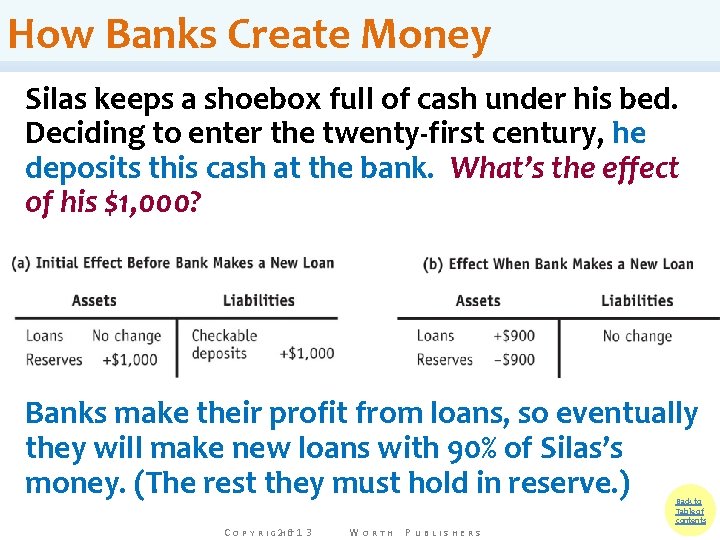
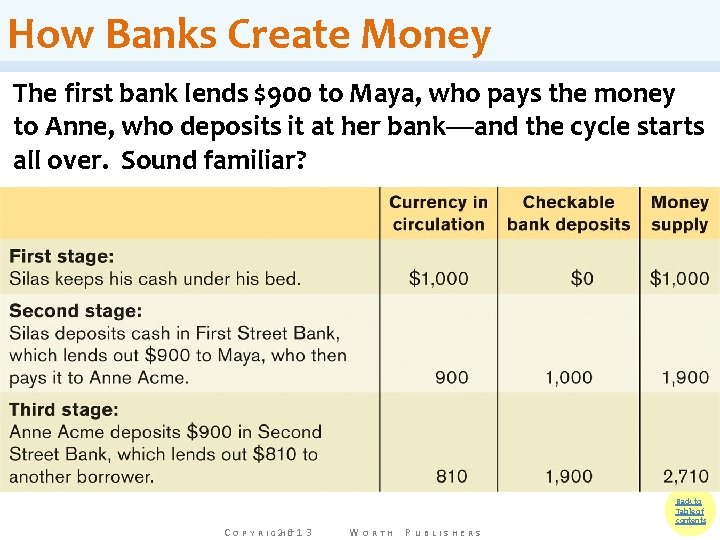
How Banks Create Money Silas keeps a shoebox full of cash under his bed. Deciding to enter the twenty-first century, he deposits this cash at the bank. What’s the effect of his $1, 000? Banks make their profit from loans, so eventually they will make new loans with 90% of Silas’s money. (The rest they must hold in reserve. ) C O P Y R I G 2 H 0 T 1 3 WORTH PUBLISHERS Back to Table of contents
How Banks Create Money The first bank lends $900 to Maya, who pays the money to Anne, who deposits it at her bank—and the cycle starts all over. Sound familiar? C O P Y R I G 2 H 0 T 1 3 WORTH PUBLISHERS Back to Table of contents
Active Learning: Practice Given this T-account and assuming the bank holds no excess reserves, what is the required reserve ratio? a) 10% b) 40% c) 80% d) 1% To Next Active Learning C O P Y R I G 2 H 0 T 1 3 WORTH PUBLISHERS Back to Table of contents
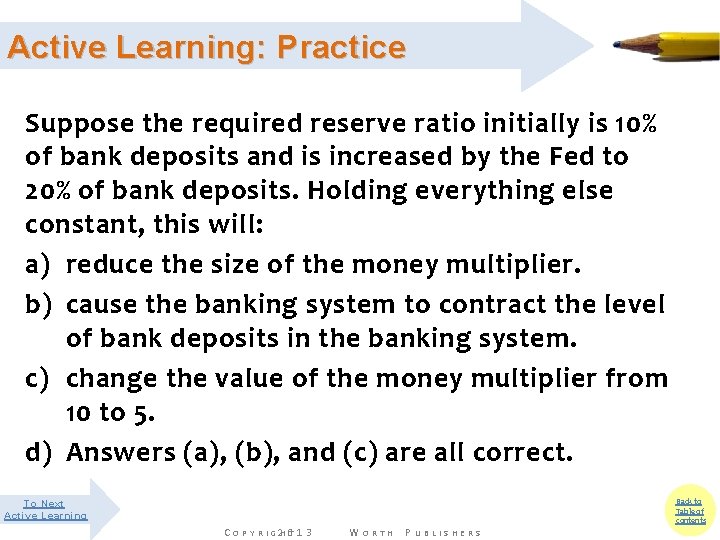
Active Learning: Practice Suppose the required reserve ratio initially is 10% of bank deposits and is increased by the Fed to 20% of bank deposits. Holding everything else constant, this will: a) reduce the size of the money multiplier. b) cause the banking system to contract the level of bank deposits in the banking system. c) change the value of the money multiplier from 10 to 5. d) Answers (a), (b), and (c) are all correct. To Next Active Learning C O P Y R I G 2 H 0 T 1 3 WORTH PUBLISHERS Back to Table of contents
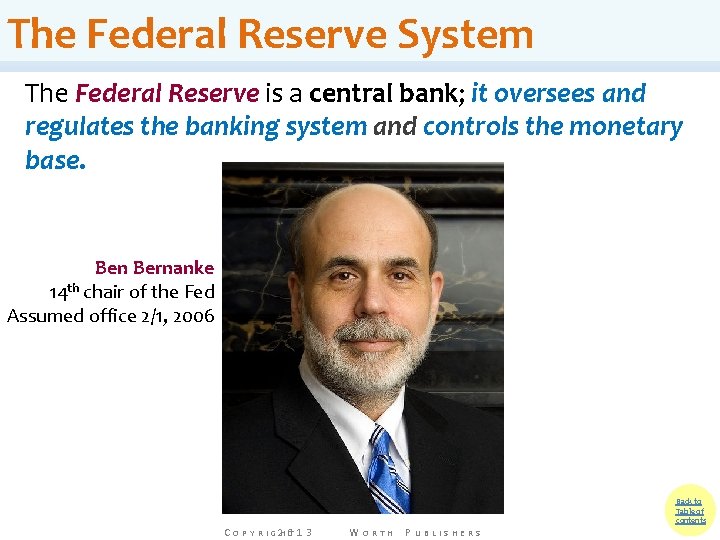
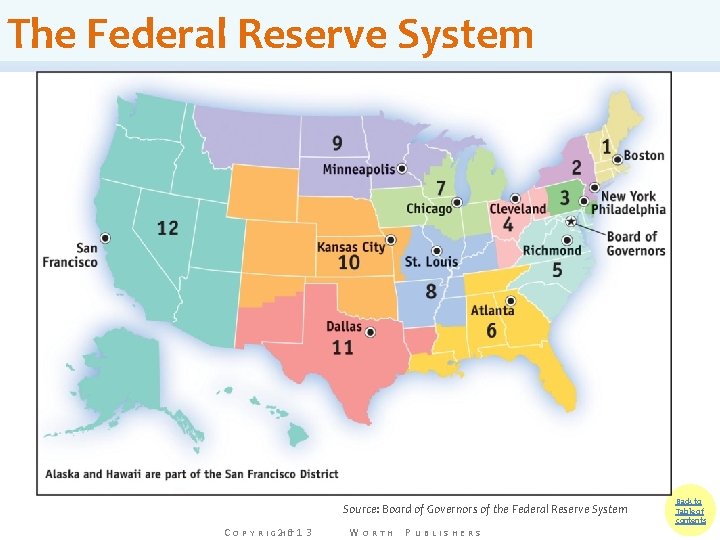
The Federal Reserve System The Federal Reserve is a central bank; it oversees and regulates the banking system and controls the monetary base. Ben Bernanke 14 th chair of the Fed Assumed office 2/1, 2006 C O P Y R I G 2 H 0 T 1 3 WORTH PUBLISHERS Back to Table of contents
The Federal Reserve System Source: Board of Governors of the Federal Reserve System C O P Y R I G 2 H 0 T 1 3 WORTH PUBLISHERS Back to Table of contents
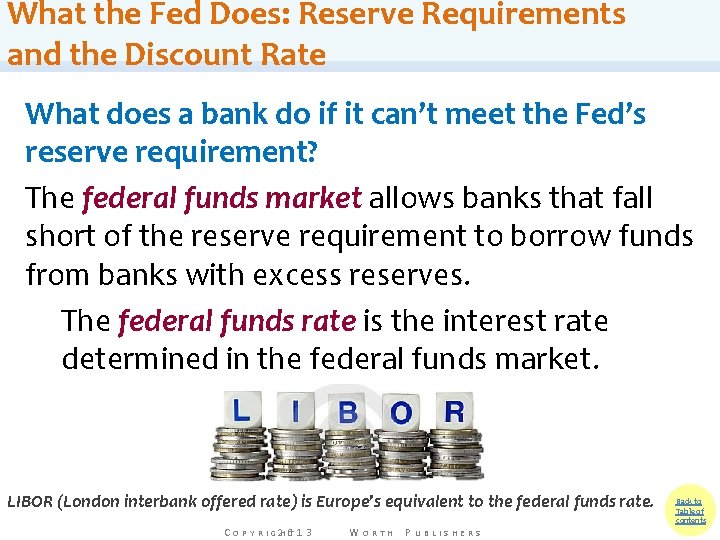
What the Fed Does: Reserve Requirements and the Discount Rate What does a bank do if it can’t meet the Fed’s reserve requirement? The federal funds market allows banks that fall short of the reserve requirement to borrow funds from banks with excess reserves. The federal funds rate is the interest rate determined in the federal funds market. LIBOR (London interbank offered rate) is Europe’s equivalent to the federal funds rate. C O P Y R I G 2 H 0 T 1 3 WORTH PUBLISHERS Back to Table of contents
What the Fed Does: Reserve Requirements and the Discount Rate The discount rate is the rate of interest the Fed charges on loans to banks. Normally, the discount rate is set 1 percentage point above the federal funds rate in order to discourage banks from turning to the Fed when they are in need of reserves. C O P Y R I G 2 H 0 T 1 3 WORTH PUBLISHERS Back to Table of contents
Open-Market Operations The Fed does not buy bonds directly from the government. When a central bank buys government debt directly from the government, it is lending directly to the government—in effect printing money to finance the government’s budget deficit. The Fed’s decisions are independent of the government. C O P Y R I G 2 H 0 T 1 3 WORTH PUBLISHERS Back to Table of contents
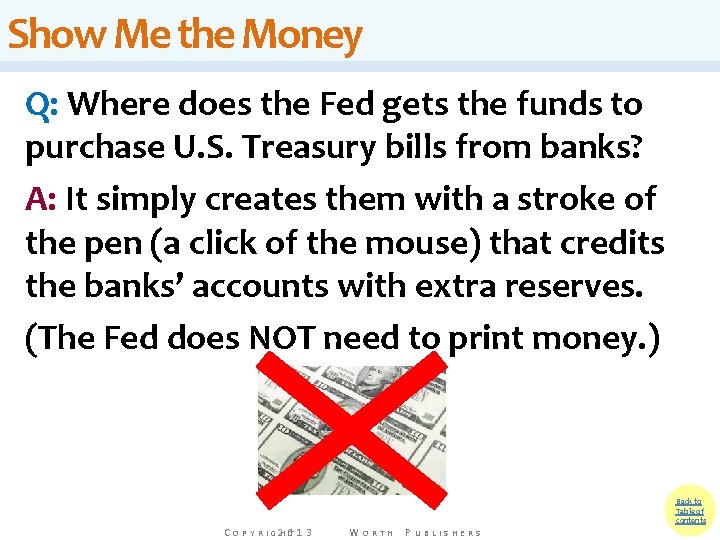
Show Me the Money Q: Where does the Fed gets the funds to purchase U. S. Treasury bills from banks? A: It simply creates them with a stroke of the pen (a click of the mouse) that credits the banks’ accounts with extra reserves. (The Fed does NOT need to print money. ) C O P Y R I G 2 H 0 T 1 3 WORTH PUBLISHERS Back to Table of contents
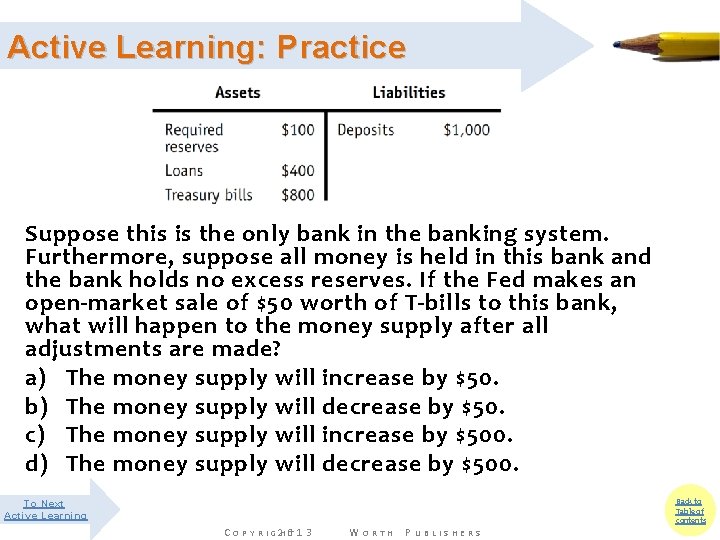
Active Learning: Practice Suppose this is the only bank in the banking system. Furthermore, suppose all money is held in this bank and the bank holds no excess reserves. If the Fed makes an open-market sale of $50 worth of T-bills to this bank, what will happen to the money supply after all adjustments are made? a) The money supply will increase by $50. b) The money supply will decrease by $50. c) The money supply will increase by $500. d) The money supply will decrease by $500. To Next Active Learning C O P Y R I G 2 H 0 T 1 3 WORTH PUBLISHERS Back to Table of contents
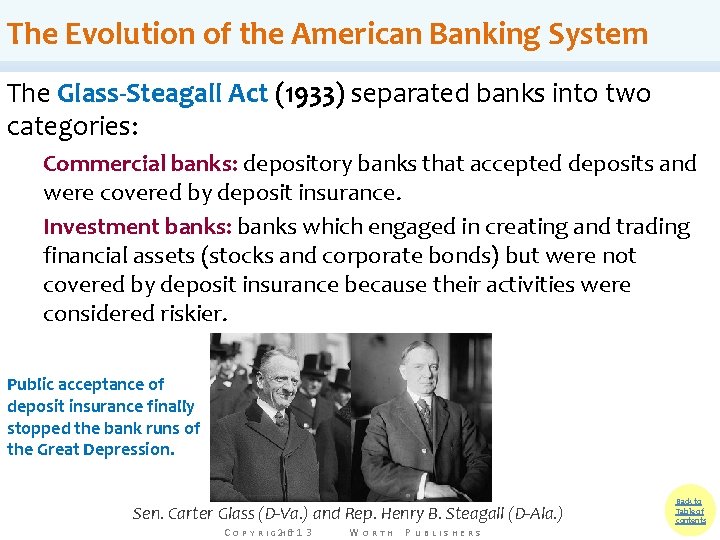
The Evolution of the American Banking System The Glass-Steagall Act (1933) separated banks into two categories: Commercial banks: depository banks that accepted deposits and were covered by deposit insurance. Investment banks: banks which engaged in creating and trading financial assets (stocks and corporate bonds) but were not covered by deposit insurance because their activities were considered riskier. Public acceptance of deposit insurance finally stopped the bank runs of the Great Depression. Sen. Carter Glass (D-Va. ) and Rep. Henry B. Steagall (D-Ala. ) C O P Y R I G 2 H 0 T 1 3 WORTH PUBLISHERS Back to Table of contents
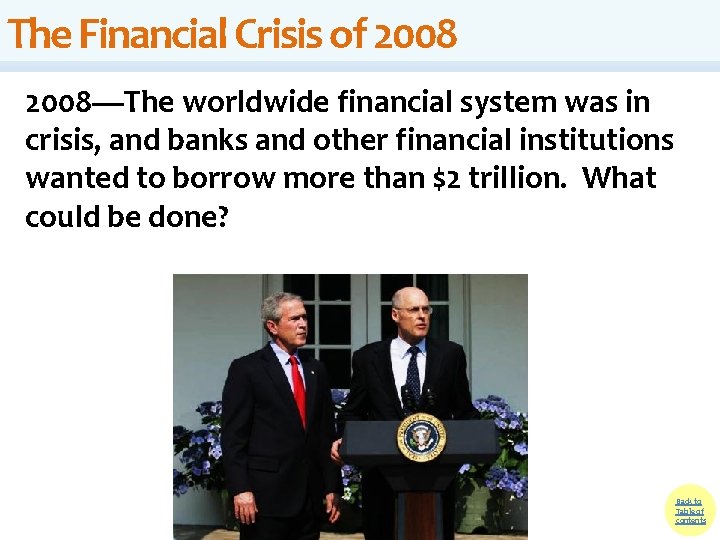
The Financial Crisis of 2008—The worldwide financial system was in crisis, and banks and other financial institutions wanted to borrow more than $2 trillion. What could be done? C O P Y R I G 2 H 0 T 1 3 WORTH PUBLISHERS Back to Table of contents
The Financial Crisis of 2008 Subprime lending during the U. S. housing bubble of the mid-2000 s spread through the financial system via securitization. Subprime lending: lending to home buyers who don’t meet the usual criteria for being able to make the payments. Securitization: a pool of loans assembled and shares of it sold to investors. When the bubble burst, massive losses by banks and other financial institutions led to widespread collapse in the financial system. To prevent another Great Depression, the Fed and the U. S. Treasury expanded lending to banks and other financial institutions, provided capital through the purchase of bank shares, and purchased private debt. C O P Y R I G 2 H 0 T 1 3 WORTH PUBLISHERS Back to Table of contents
Regulation after the 2008 Crisis In July 2010, President Obama signed the Dodd. Frank Act (Wall Street Reform and Consumer Protection Act). Gives a special government committee, the Financial Stability Oversight Council, the right to designate institutions as “systemically important” and thus subject to normal bank regulation (even though they are not traditional banks). Established new rules on the trading of derivatives: They must now be traded in exchanges so their prices and volume are more transparent. C O P Y R I G 2 H 0 T 1 3 WORTH PUBLISHERS Back to Table of contents
Active Learning: Practice The Federal Funds rate is the rate that banks are charged when they borrow from the Fed. a) True b) False C O P Y R I G 2 H 0 T 1 3 WORTH PUBLISHERS Back to Table of contents