
D Y N A M I C P









- Slides: 56
D Y N A M I C P O W E R P O I N™ T CHAPTER 6 SLIDES BY SOLINA LINDAHL Elasticity
Food for Thought…. Some good blogs and other sites to get the juices flowing: C O P Y R I G 2 H 0 T 1 2 WORTH PUBLISHERS
Why economists use elasticity to measure responsiveness to changes in prices or incomes Why the price elasticity of demand, the income elasticity of demand, and the cross-price elasticity of demand are important indicators of consumer behavior in response to changes in prices and income Why the price elasticity of supply is an important indicator of producer behavior in response to changes in price What factors influence the size of these various elasticities To Video To First Active Learning C O P Y R I G 2 H 0 T 1 3 WORTH PUBLISHERS
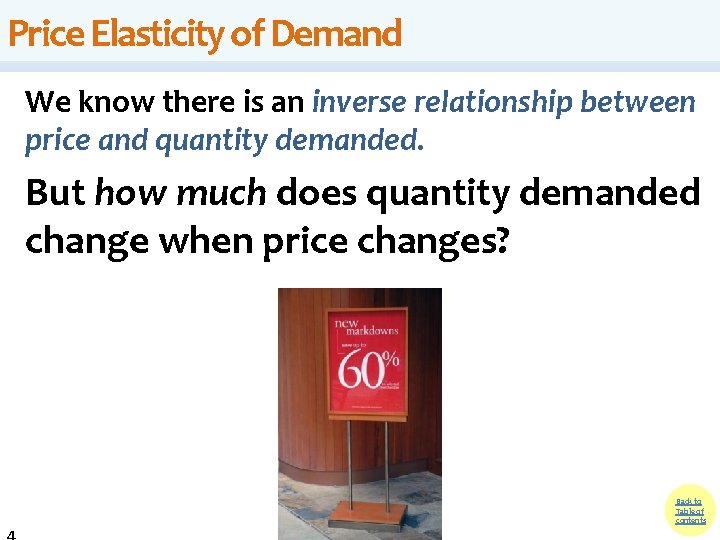
Price Elasticity of Demand We know there is an inverse relationship between price and quantity demanded. But how much does quantity demanded change when price changes? Back to Table of contents
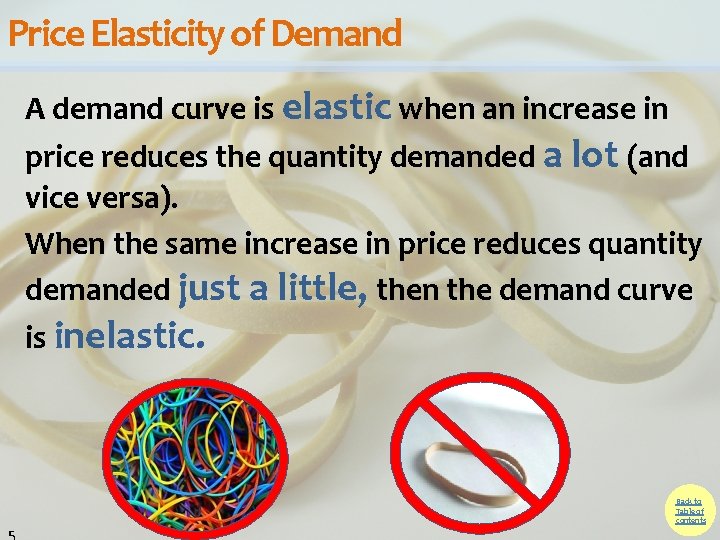
Price Elasticity of Demand A demand curve is elastic when an increase in price reduces the quantity demanded a lot (and vice versa). When the same increase in price reduces quantity demanded just a little, then the demand curve is inelastic. Back to Table of contents
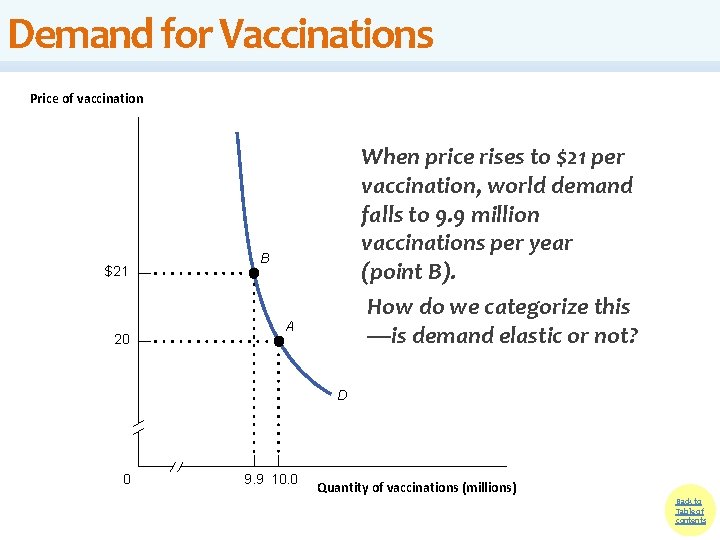
Demand for Vaccinations Price of vaccination $21 20 When price rises to $21 per vaccination, world demand falls to 9. 9 million vaccinations per year (point B). How do we categorize this —is demand elastic or not? B A D 0 9. 9 10. 0 Quantity of vaccinations (millions) Back to Table of contents
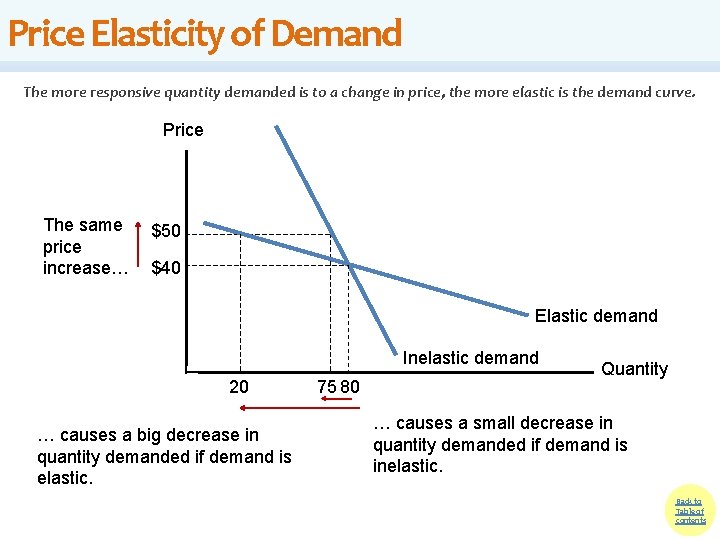
Price Elasticity of Demand The more responsive quantity demanded is to a change in price, the more elastic is the demand curve. Price The same price increase… $50 $40 Elastic demand Inelastic demand 20 … causes a big decrease in quantity demanded if demand is elastic. 75 80 Quantity … causes a small decrease in quantity demanded if demand is inelastic. Back to Table of contents
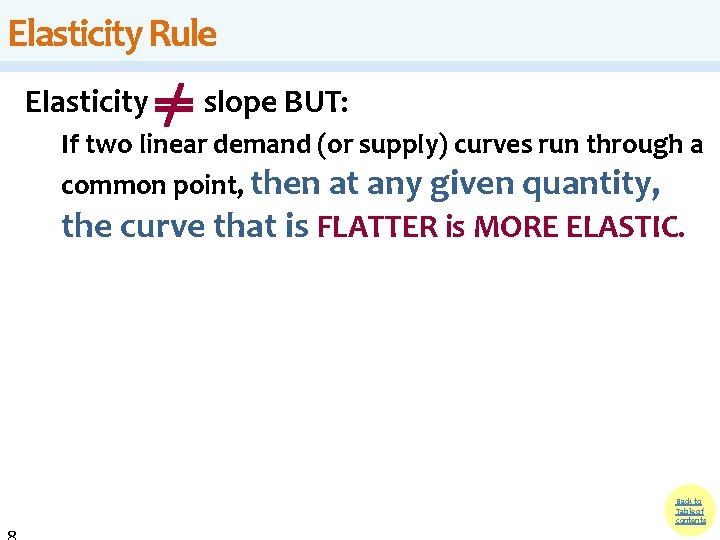
Elasticity Rule Elasticity slope BUT: If two linear demand (or supply) curves run through a common point, then at any given quantity, the curve that is FLATTER is MORE ELASTIC. Back to Table of contents
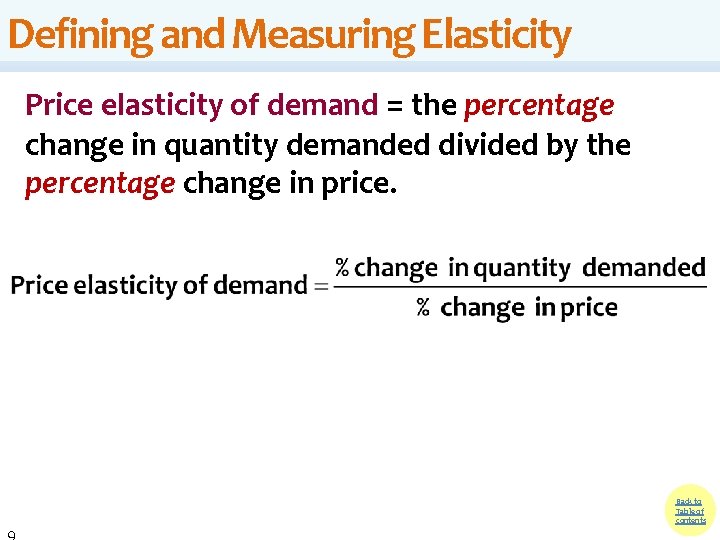
Defining and Measuring Elasticity Price elasticity of demand = the percentage change in quantity demanded divided by the percentage change in price. Back to Table of contents
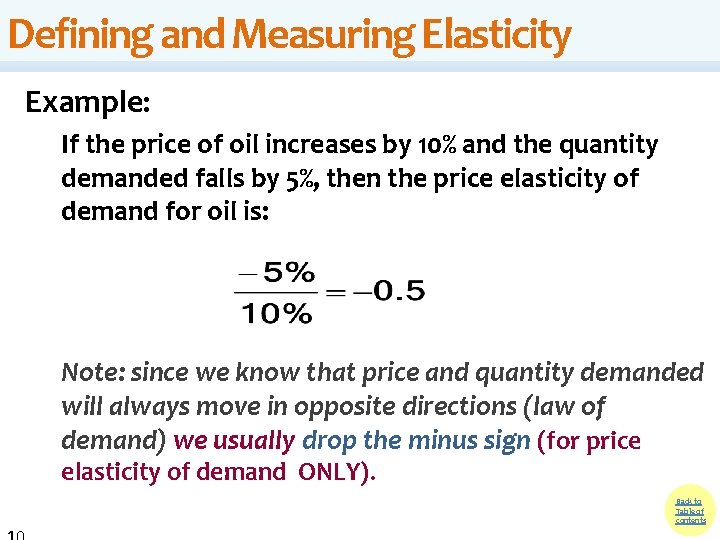
Defining and Measuring Elasticity Example: If the price of oil increases by 10% and the quantity demanded falls by 5%, then the price elasticity of demand for oil is: Note: since we know that price and quantity demanded will always move in opposite directions (law of demand) we usually drop the minus sign (for price elasticity of demand ONLY). Back to Table of contents
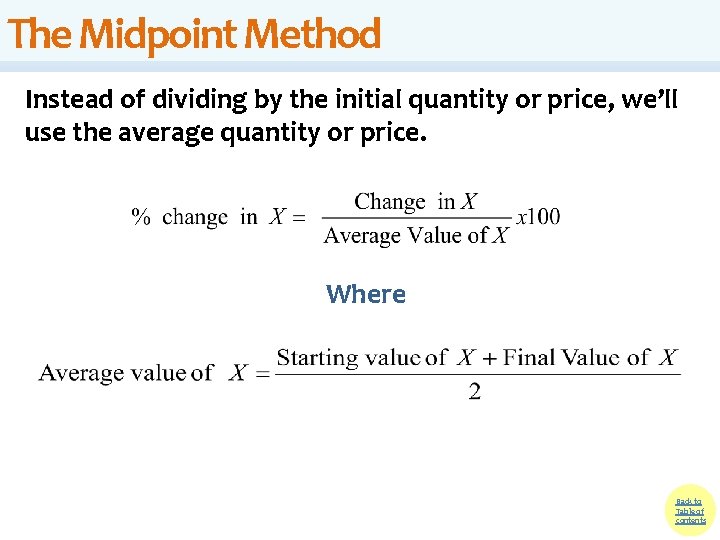
Using the Midpoint Formula for Elasticity There is a problem: Our percent change calculation depends on our choice of starting point. To solve this problem, we calculate the price elasticity of demand using the midpoint formula for percentage changes. Back to Table of contents
The Midpoint Method Instead of dividing by the initial quantity or price, we’ll use the average quantity or price. Where Back to Table of contents
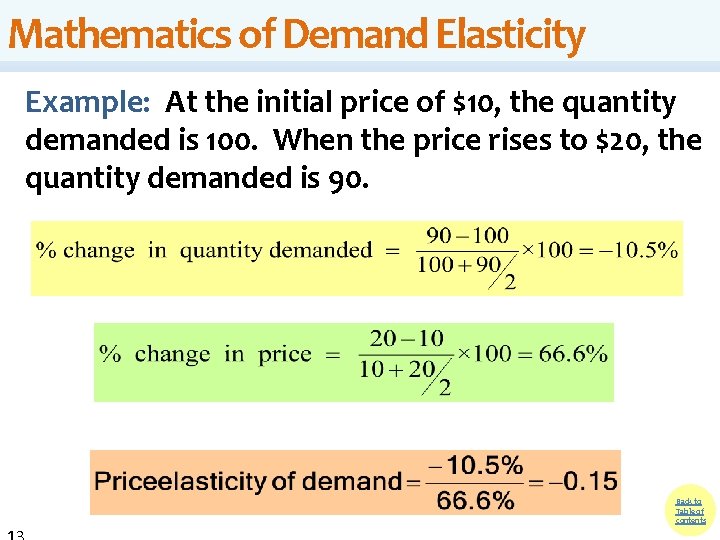
Mathematics of Demand Elasticity Example: At the initial price of $10, the quantity demanded is 100. When the price rises to $20, the quantity demanded is 90. Back to Table of contents
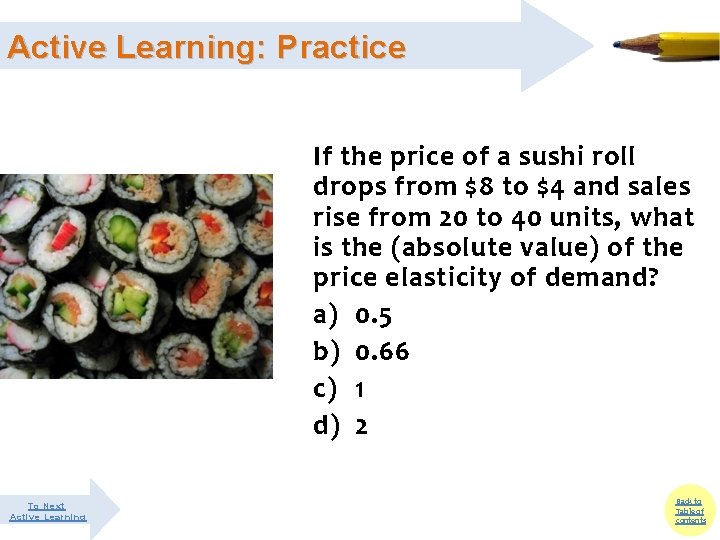
Active Learning: Practice If the price of a sushi roll drops from $8 to $4 and sales rise from 20 to 40 units, what is the (absolute value) of the price elasticity of demand? a) 0. 5 b) 0. 66 c) 1 d) 2 To Next Active Learning Back to Table of contents
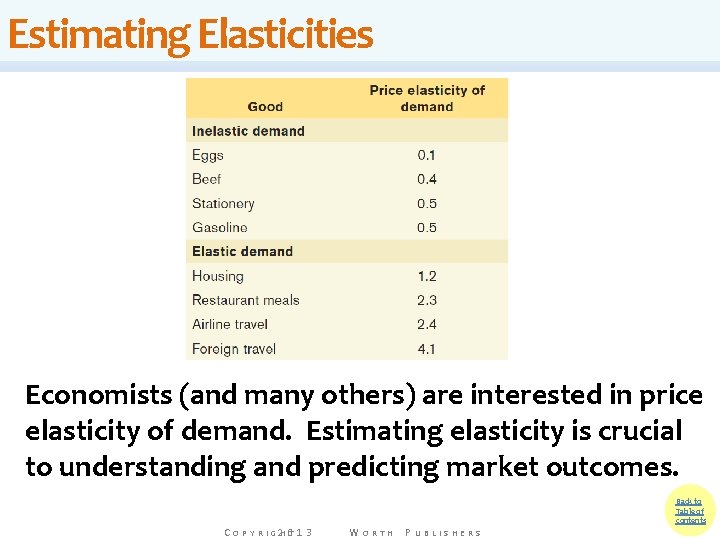
Estimating Elasticities Economists (and many others) are interested in price elasticity of demand. Estimating elasticity is crucial to understanding and predicting market outcomes. C O P Y R I G 2 H 0 T 1 3 WORTH PUBLISHERS Back to Table of contents
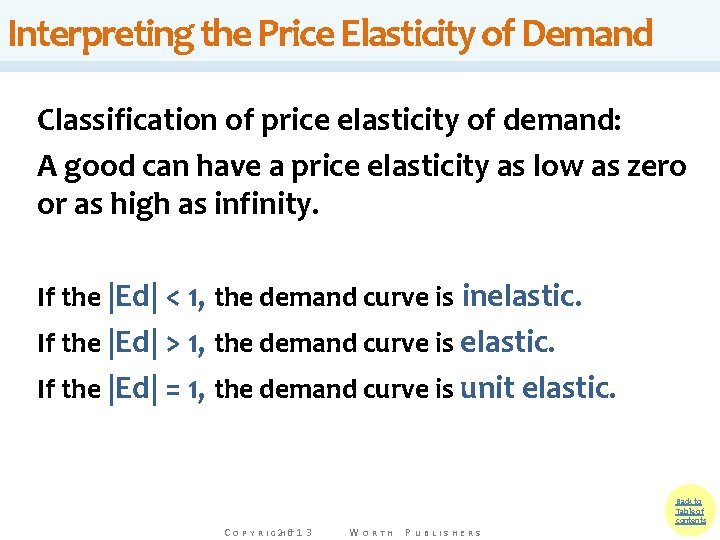
Interpreting the Price Elasticity of Demand Classification of price elasticity of demand: A good can have a price elasticity as low as zero or as high as infinity. If the |Ed| < 1, the demand curve is inelastic. If the |Ed| > 1, the demand curve is elastic. If the |Ed| = 1, the demand curve is unit elastic. C O P Y R I G 2 H 0 T 1 3 WORTH PUBLISHERS Back to Table of contents
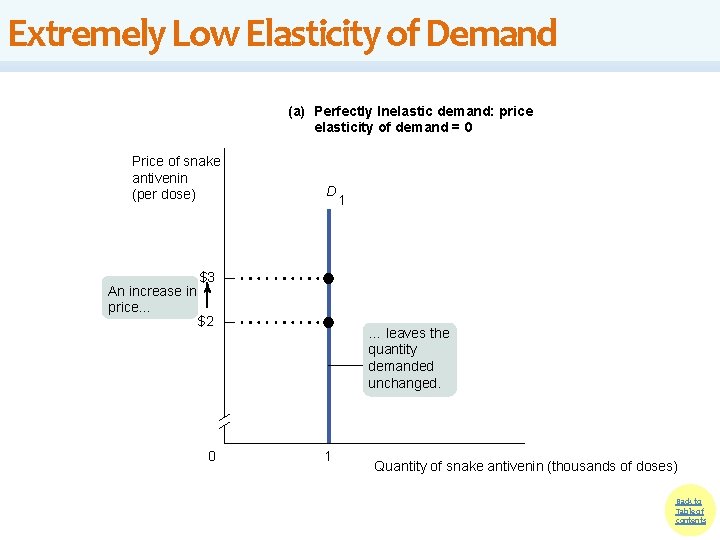
Extremely Low Elasticity of Demand (a) Perfectly Inelastic demand: price elasticity of demand = 0 Price of snake antivenin (per dose) An increase in price… D 1 $3 $2 0 … leaves the quantity demanded unchanged. 1 Quantity of snake antivenin (thousands of doses) Back to Table of contents
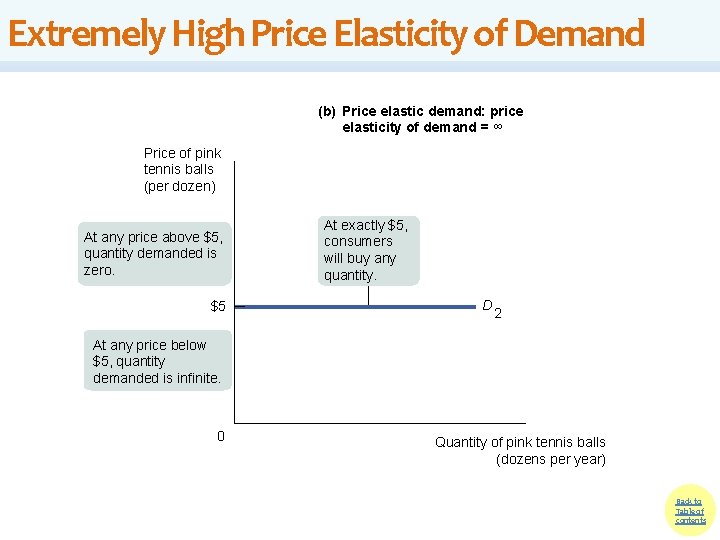
Extremely High Price Elasticity of Demand (b) Price elastic demand: price elasticity of demand = ∞ Price of pink tennis balls (per dozen) At any price above $5, quantity demanded is zero. $5 At exactly $5, consumers will buy any quantity. D 2 At any price below $5, quantity demanded is infinite. 0 Quantity of pink tennis balls (dozens per year) Back to Table of contents
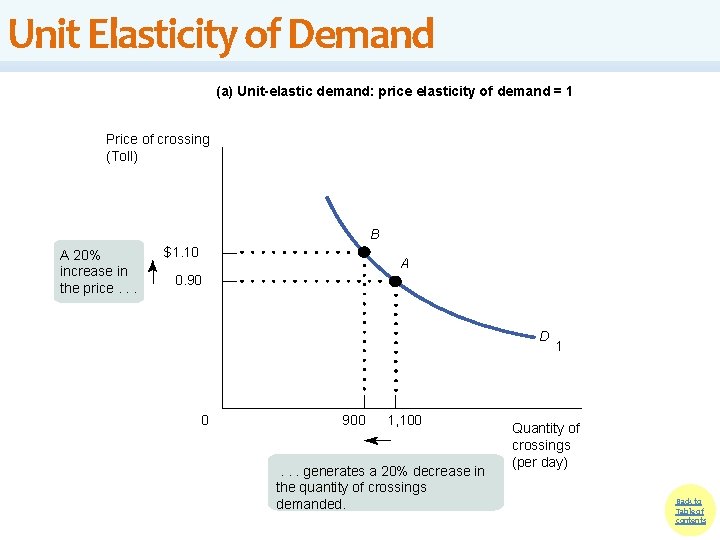
Unit Elasticity of Demand (a) Unit-elastic demand: price elasticity of demand = 1 Price of crossing (Toll) B A 20% increase in the price. . . $1. 10 A 0. 90 D 0 900 1, 100 . . . generates a 20% decrease in the quantity of crossings demanded. 1 Quantity of crossings (per day) Back to Table of contents
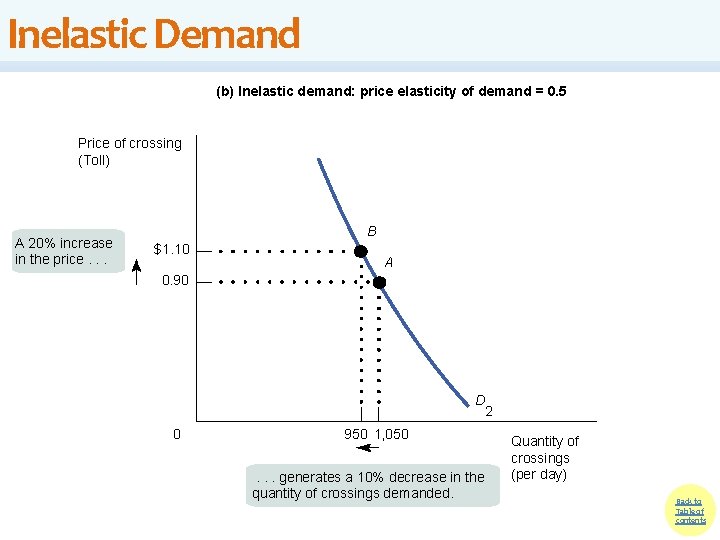
Inelastic Demand (b) Inelastic demand: price elasticity of demand = 0. 5 Price of crossing (Toll) A 20% increase in the price. . . B $1. 10 A 0. 90 D 0 950 1, 050. . . generates a 10% decrease in the quantity of crossings demanded. 2 Quantity of crossings (per day) Back to Table of contents
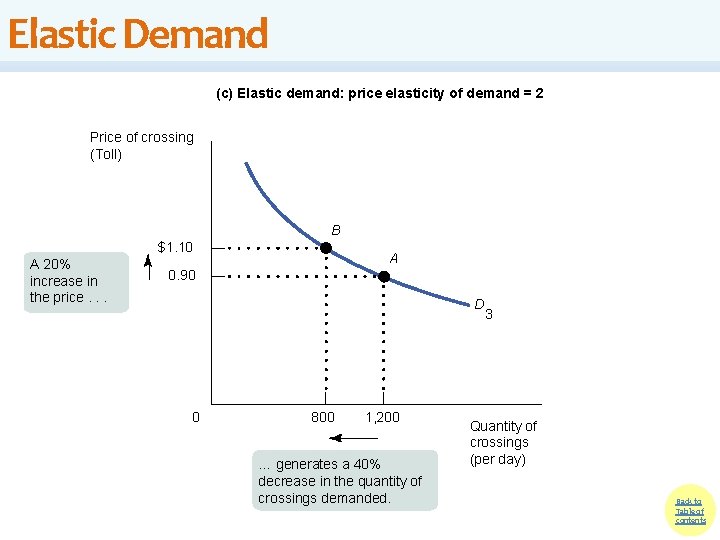
Elastic Demand (c) Elastic demand: price elasticity of demand = 2 Price of crossing (Toll) B $1. 10 A 20% increase in the price. . . A 0. 90 D 0 800 1, 200 … generates a 40% decrease in the quantity of crossings demanded. 3 Quantity of crossings (per day) Back to Table of contents
Take a look…. . In this pragmatic and moving talk, Kevin Bales explains the business of modern slavery, analyzes the price of humans… and implies that price and income elasticity data offer hope. (18 minutes) C O P Y R I G 2 H 0 T 1 3 WORTH PUBLISHERS Back to Table of contents
Elasticity and Total Revenue Total revenue: price times quantity demanded (sold). TR = P × Q Sellers need to know how elastic their good is so they can plan. Back to Table of contents
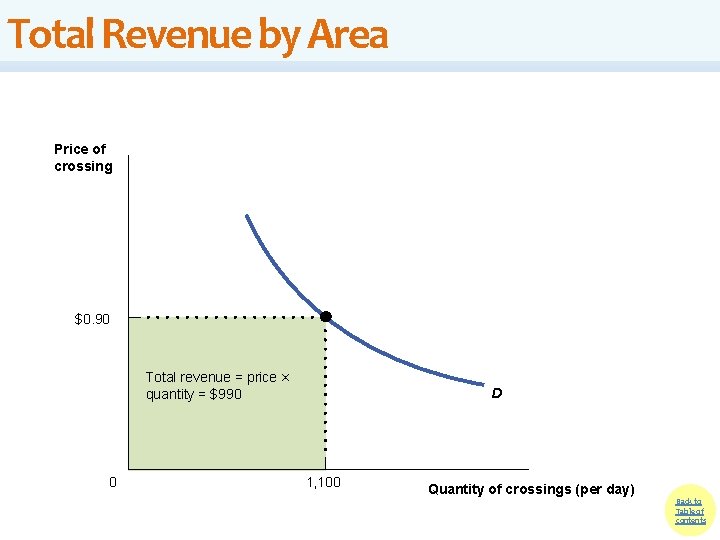
Total Revenue by Area Price of crossing $0. 90 Total revenue = price × quantity = $990 0 D 1, 100 Quantity of crossings (per day) Back to Table of contents
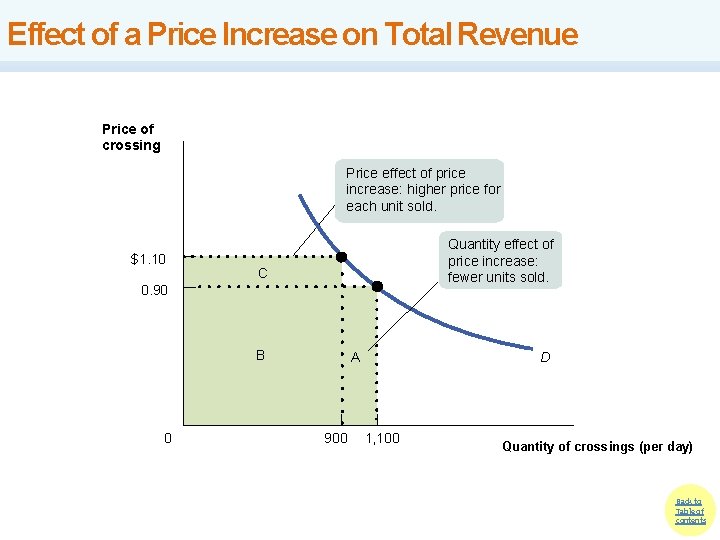
Effect of a Price Increase on Total Revenue Price of crossing Price effect of price increase: higher price for each unit sold. $1. 10 Quantity effect of price increase: fewer units sold. C 0. 90 B 0 A 900 D 1, 100 Quantity of crossings (per day) Back to Table of contents
Elasticity and Total Revenue When demand is inelastic, the price effect dominates the quantity effect So an increase in price will cause only a slight reduction in the quantity demanded. In this instance, total revenue will rise when the price rises (and vice versa). What happens if salt prices go up? TR will likely rise. Back to Table of contents
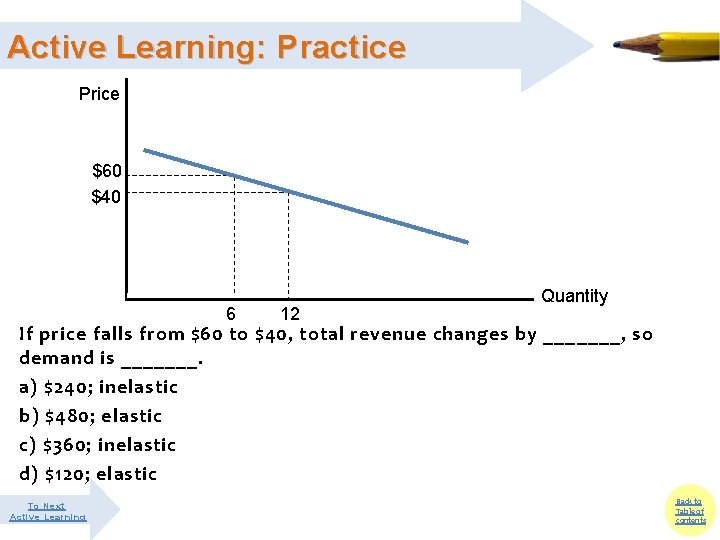
Active Learning: Practice Price $60 $40 6 12 Quantity If price falls from $60 to $40, total revenue changes by _______, so demand is _______. a) $240; inelastic b) $480; elastic c) $360; inelastic d) $120; elastic To Next Active Learning Back to Table of contents
Elasticity and Total Revenue When demand is elastic, the quantity effect dominates the price effect. So an increase in price will cause significant reduction in the quantity demanded. In this instance, total revenue will fall when the price rises (and vice versa). What happens if airfare goes up? TR will likely fall. Back to Table of contents
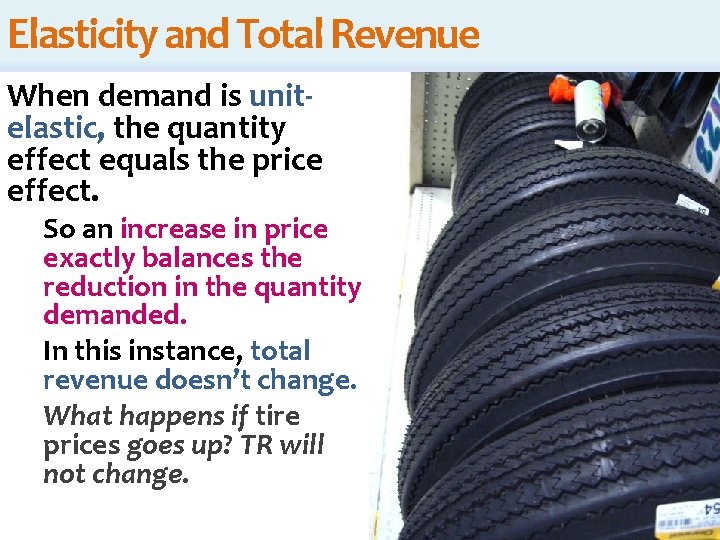
Elasticity and Total Revenue When demand is unitelastic, the quantity effect equals the price effect. So an increase in price exactly balances the reduction in the quantity demanded. In this instance, total revenue doesn’t change. What happens if tire prices goes up? TR will not change. Back to Table of contents
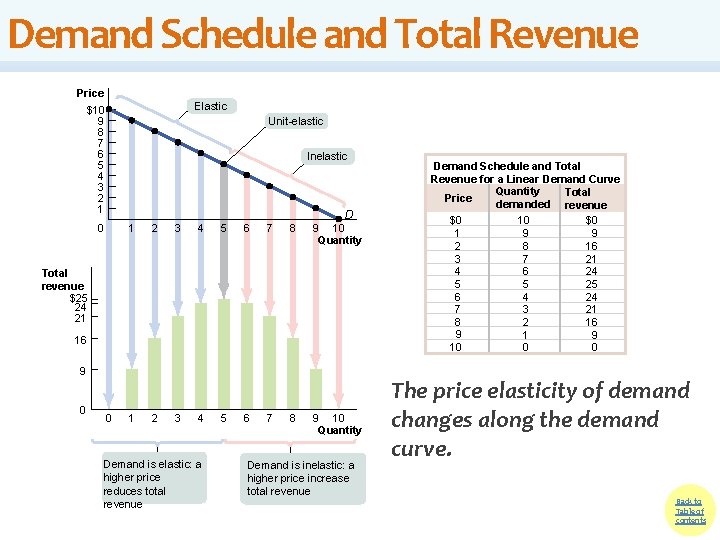
Demand Schedule and Total Revenue Price Elastic $10 9 8 7 6 5 4 3 2 1 Unit-elastic Inelastic D 0 1 2 3 4 5 6 7 8 9 10 Quantity Total revenue $25 24 21 16 9 0 0 1 2 3 4 Demand is elastic: a higher price reduces total revenue 5 6 7 8 9 10 Quantity Demand is inelastic: a higher price increase total revenue Demand Schedule and Total Revenue for a Linear Demand Curve Quantity Total Price demanded revenue $0 10 $0 1 9 9 2 8 16 3 7 21 4 6 24 5 5 25 6 4 24 7 3 21 8 2 16 9 10 0 0 The price elasticity of demand changes along the demand curve. Back to Table of contents
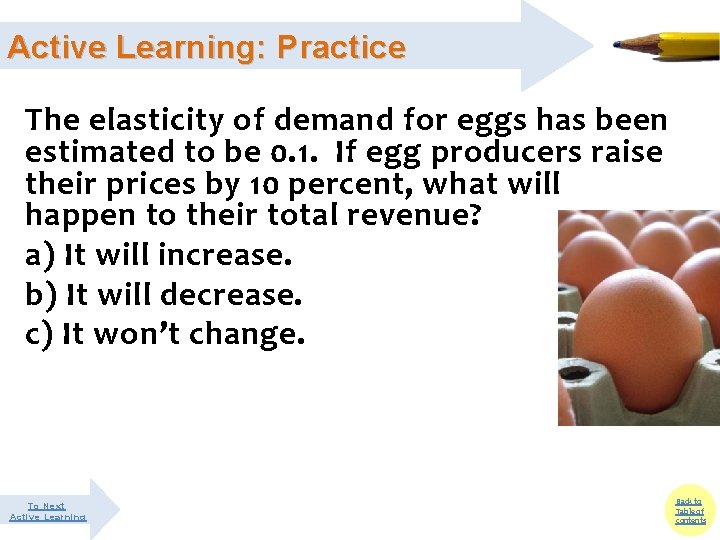
Active Learning: Practice The elasticity of demand for eggs has been estimated to be 0. 1. If egg producers raise their prices by 10 percent, what will happen to their total revenue? a) It will increase. b) It will decrease. c) It won’t change. To Next Active Learning Back to Table of contents
Active Learning: Practice If a fashionable clothing store raised its prices by 25%, what does that tell you about the store’s estimate of the elasticity of demand for its products? a) They think it’s elastic. b) They think it’s inelastic. To Next Active Learning Back to Table of contents
What Factors Determine the Price Elasticity of Demand? 1. The availability of close substitutes is very important. Fewer substitutes makes it harder for consumers to adjust Q when P changes, so demand is inelastic. Many substitutes? Switching brands when prices change is EASY, so demand is elastic. Back to Table of contents
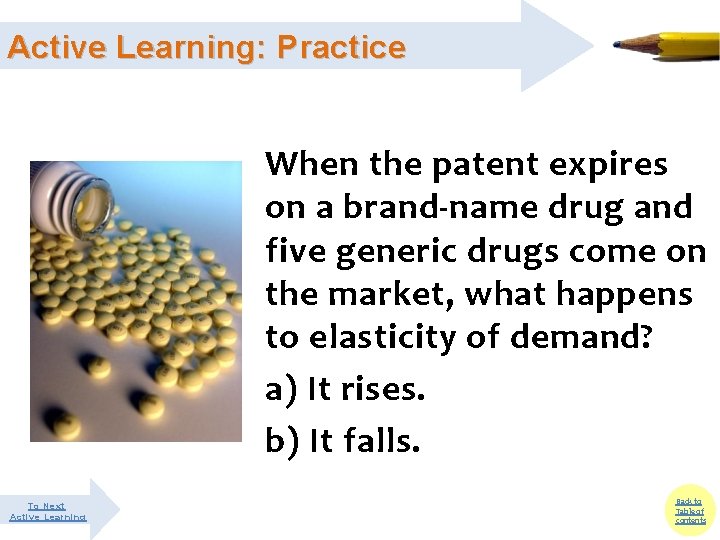
Active Learning: Practice When the patent expires on a brand-name drug and five generic drugs come on the market, what happens to elasticity of demand? a) It rises. b) It falls. To Next Active Learning Back to Table of contents
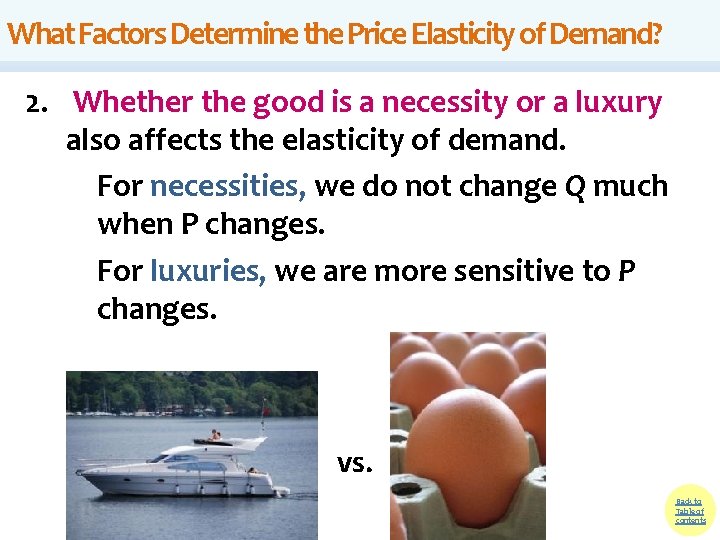
What Factors Determine the Price Elasticity of Demand? 2. Whether the good is a necessity or a luxury also affects the elasticity of demand. For necessities, we do not change Q much when P changes. For luxuries, we are more sensitive to P changes. vs. Back to Table of contents
What Factors Determine the Price Elasticity of Demand? 3. The share of income spent on the good matters. We are less sensitive to price changes when the good feels cheap. We are more sensitive to price changes when the good feels expensive. Back to Table of contents
What Factors Determine the Price Elasticity of Demand? 4. The length of time elapsed since the price change matters. Less time to adjust means lower elasticity. Over time consumers can adjust their behavior by finding substitutes (making demand more elastic). Back to Table of contents
Applications of Active Learning: Application Elasticity of Demand Why the war on drugs is hard to win: Because demand for most illegal drugs is inelastic, drug dealers earn greater revenue and gain more power as the drug war becomes more effective. Back to Table of contents
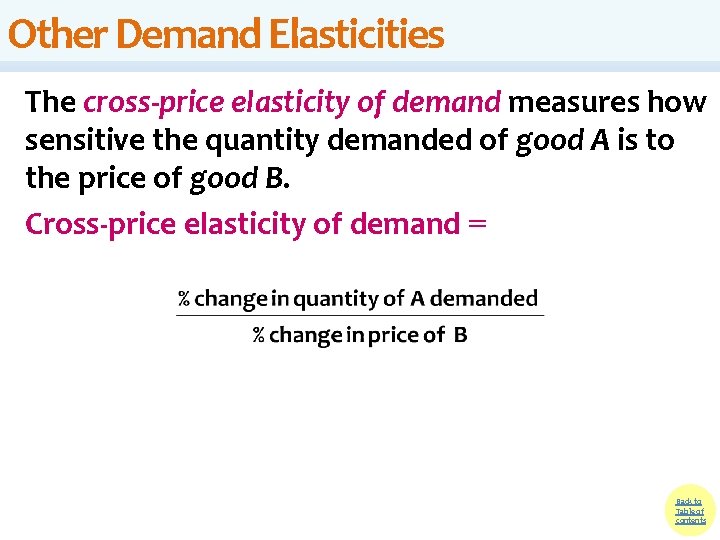
Other Demand Elasticities The cross-price elasticity of demand measures how sensitive the quantity demanded of good A is to the price of good B. Cross-price elasticity of demand = Back to Table of contents
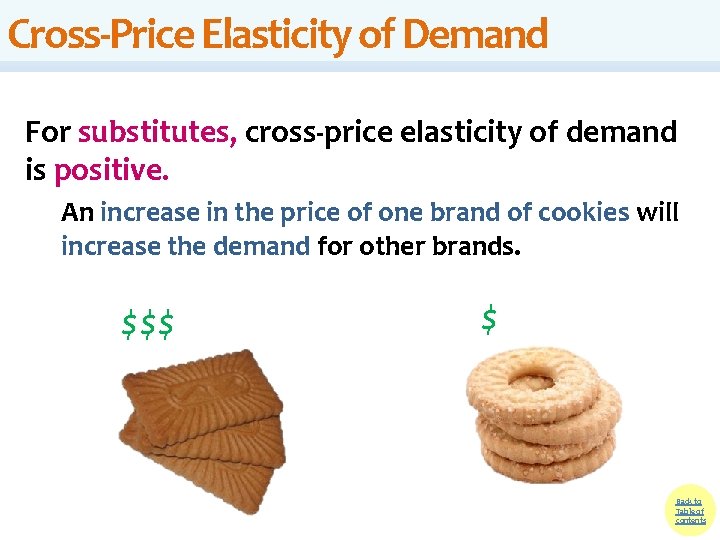
Cross-Price Elasticity of Demand For substitutes, cross-price elasticity of demand is positive. An increase in the price of one brand of cookies will increase the demand for other brands. $ $$ $ Back to Table of contents
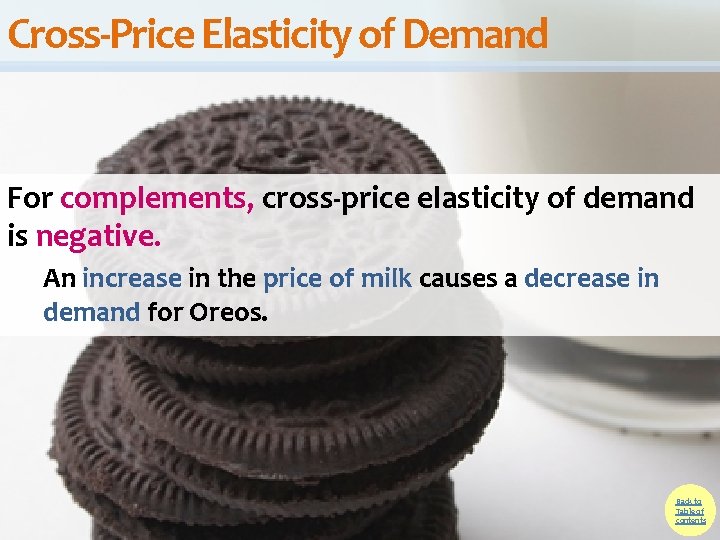
Cross-Price Elasticity of Demand For complements, cross-price elasticity of demand is negative. An increase in the price of milk causes a decrease in demand for Oreos. Back to Table of contents
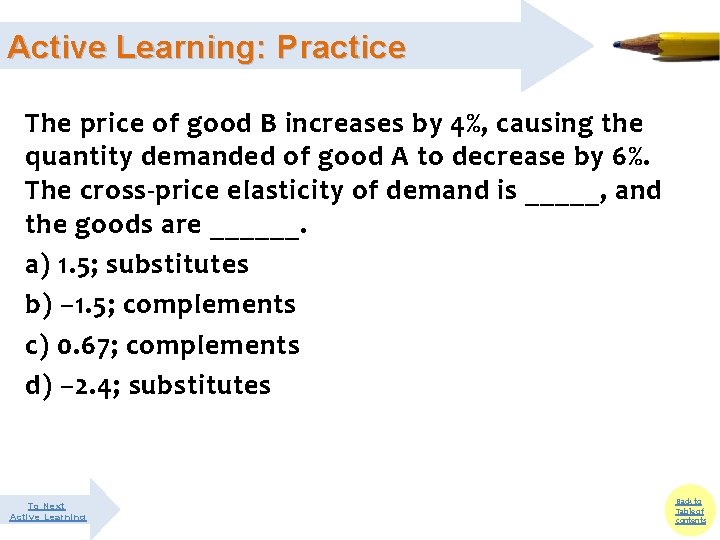
Active Learning: Practice The price of good B increases by 4%, causing the quantity demanded of good A to decrease by 6%. The cross-price elasticity of demand is _____, and the goods are ______. a) 1. 5; substitutes b) – 1. 5; complements c) 0. 67; complements d) – 2. 4; substitutes To Next Active Learning Back to Table of contents
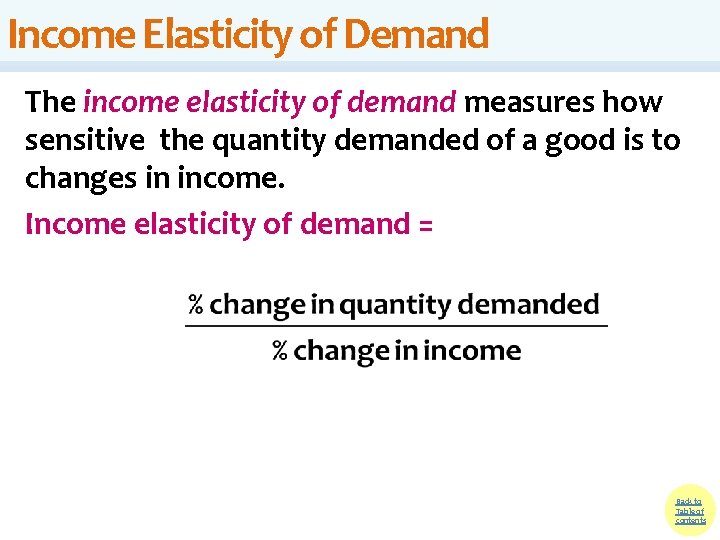
Income Elasticity of Demand The income elasticity of demand measures how sensitive the quantity demanded of a good is to changes in income. Income elasticity of demand = Back to Table of contents
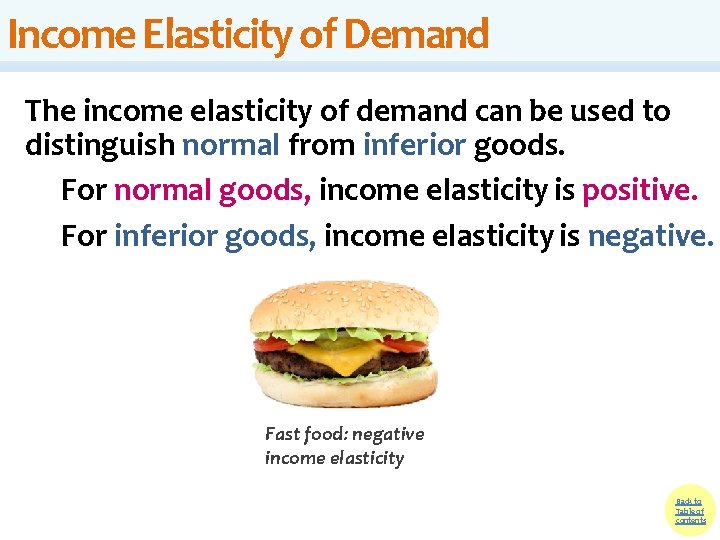
Income Elasticity of Demand The income elasticity of demand can be used to distinguish normal from inferior goods. For normal goods, income elasticity is positive. For inferior goods, income elasticity is negative. Fast food: negative income elasticity Back to Table of contents
Income Elasticity of Demand Normal goods can be income-elastic or not. For income-elastic goods, income elasticity is greater than 1. For income-inelastic goods, income elasticity is positive but less than 1. Vacations are income-elastic Back to Table of contents
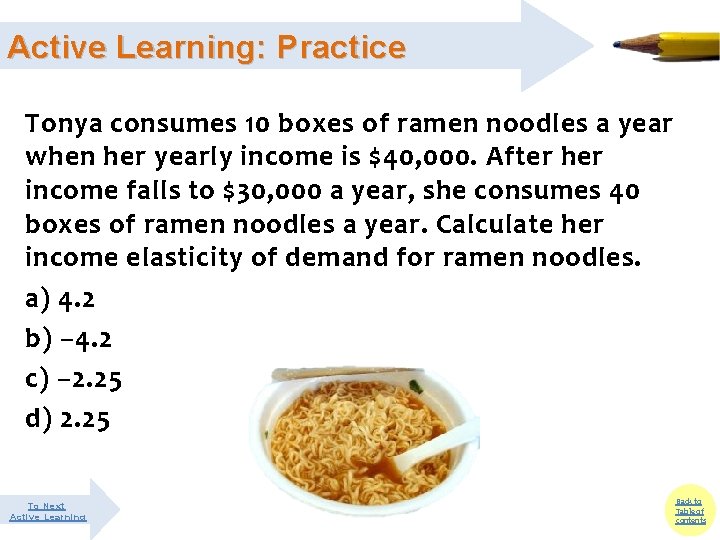
Active Learning: Practice Tonya consumes 10 boxes of ramen noodles a year when her yearly income is $40, 000. After her income falls to $30, 000 a year, she consumes 40 boxes of ramen noodles a year. Calculate her income elasticity of demand for ramen noodles. a) 4. 2 b) – 4. 2 c) – 2. 25 d) 2. 25 To Next Active Learning Back to Table of contents
Price Elasticity of Supply Usually, sellers offer more when prices are higher, but how strong is that relationship? Back to Table of contents
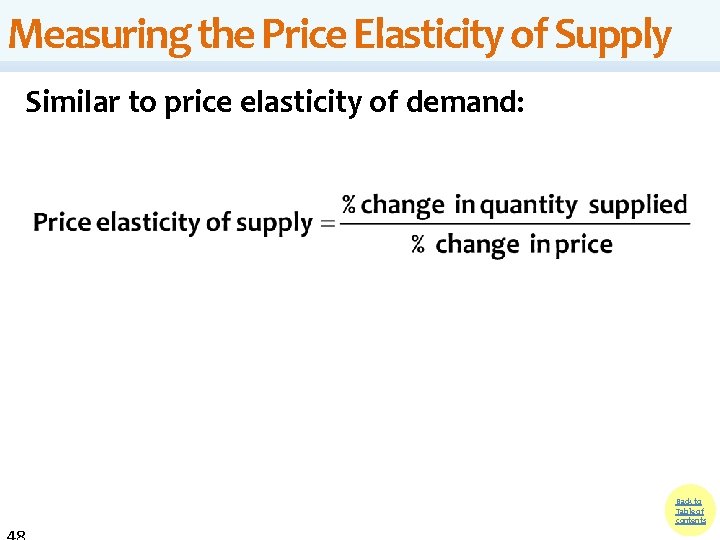
Measuring the Price Elasticity of Supply Similar to price elasticity of demand: Back to Table of contents
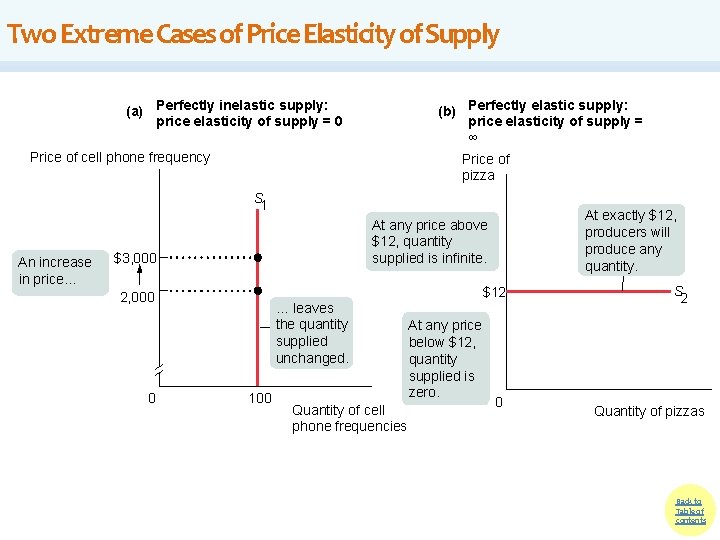
Two Extreme Cases of Price Elasticity of Supply (b) Perfectly elastic supply: price elasticity of supply = ∞ Price of pizza (a) Perfectly inelastic supply: price elasticity of supply = 0 Price of cell phone frequency S 1 An increase in price… $3, 000 $12 2, 000 0 At exactly $12, producers will produce any quantity. At any price above $12, quantity supplied is infinite. … leaves the quantity supplied unchanged. 100 Quantity of cell phone frequencies At any price below $12, quantity supplied is zero. 0 S 2 Quantity of pizzas Back to Table of contents
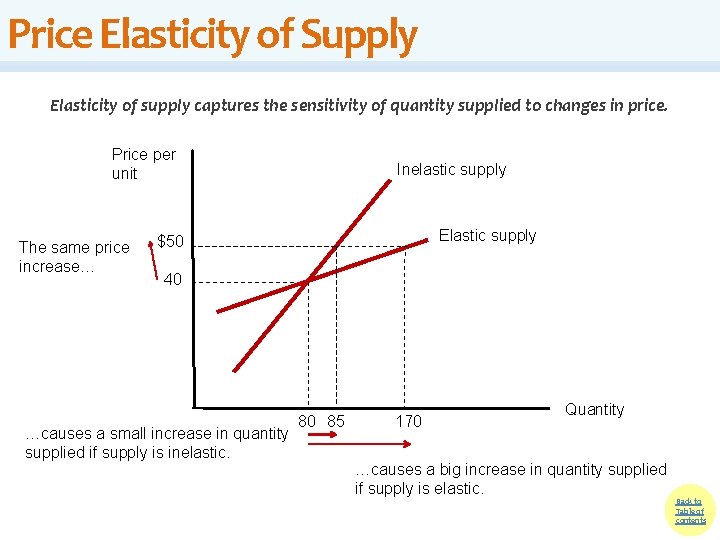
Price Elasticity of Supply Elasticity of supply captures the sensitivity of quantity supplied to changes in price. Price per unit The same price increase… Inelastic supply Elastic supply $50 40 …causes a small increase in quantity supplied if supply is inelastic. 80 85 170 Quantity …causes a big increase in quantity supplied if supply is elastic. Back to Table of contents
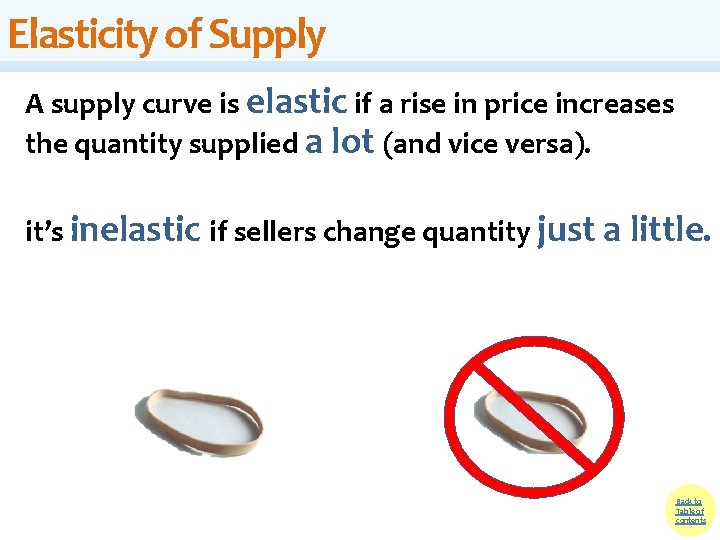
Elasticity of Supply A supply curve is elastic if a rise in price increases the quantity supplied a lot (and vice versa). it’s inelastic if sellers change quantity just a little. Back to Table of contents
What Factors Determine the Price Elasticity of Supply? 1. Availability of inputs If increased production is very expensive, then the supply curve will be inelastic. If production can be increased cheaply, then the supply curve will be elastic. Ivory: increasing collection costs, inelastic supply Back to Table of contents
What Factors Determine the Price Elasticity of Supply? 2. Time Price elasticity of supply increases as producers have more time to respond to price changes. Long-run price elasticity of supply is usually higher than the short-run elasticity. Back to Table of contents
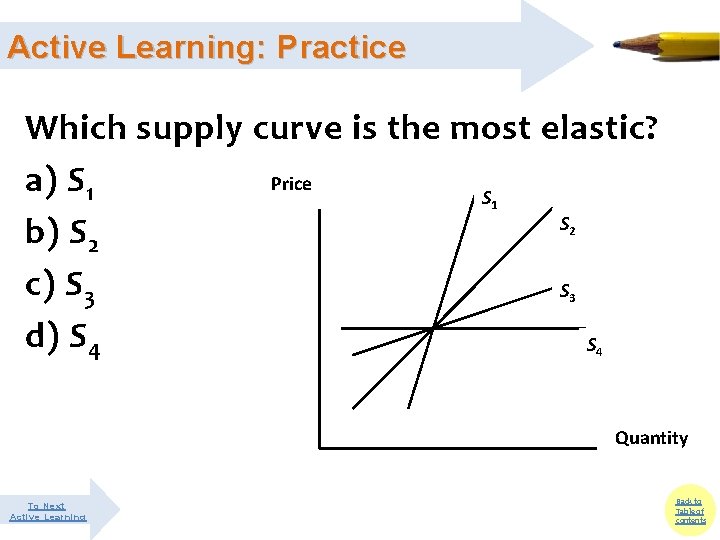
Active Learning: Practice Which supply curve is the most elastic? Price a) S 1 S S b) S 2 c) S 3 S d) S 4 S 1 2 3 4 Quantity To Next Active Learning Back to Table of contents
Active Learning: Practice A computer manufacturer makes an experimental computer chip that critics praise, leading to a huge increase in the demand for the chip. How elastic is supply in the short run? What about the long run? Graph both. To Next Active Learning Back to Table of contents
Active Learning: Practice Will the same increase in the demand for housing increase prices more in Manhattan or in Des Moines, Iowa? Graph both. Back to Table of contents