
d n a y r o e h
- Slides: 38
d n a y r o e h T r o t c a f Traity r o e h T y g o l o p y T r Caree N S B , N R , d r a W Heather r e n n a T n a h g e M
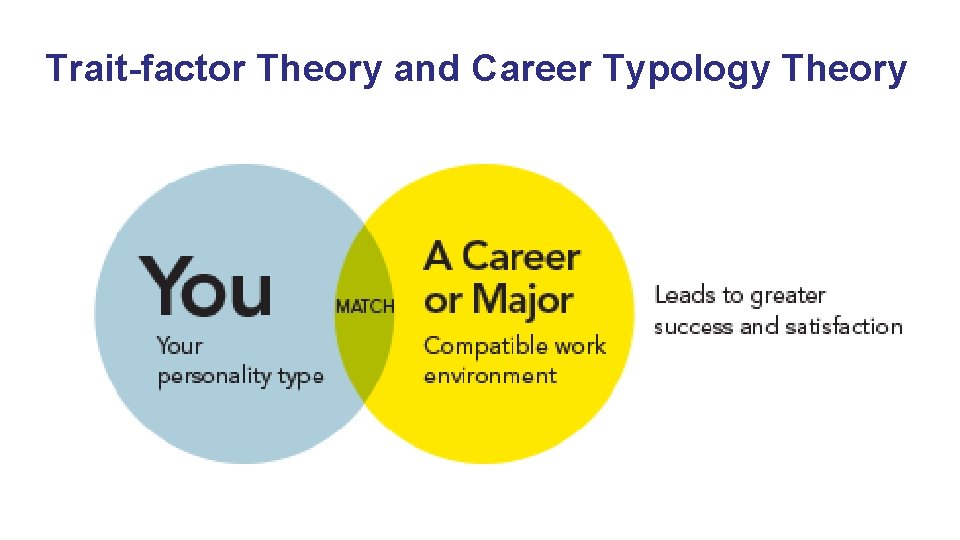
Trait-factor Theory and Career Typology Theory
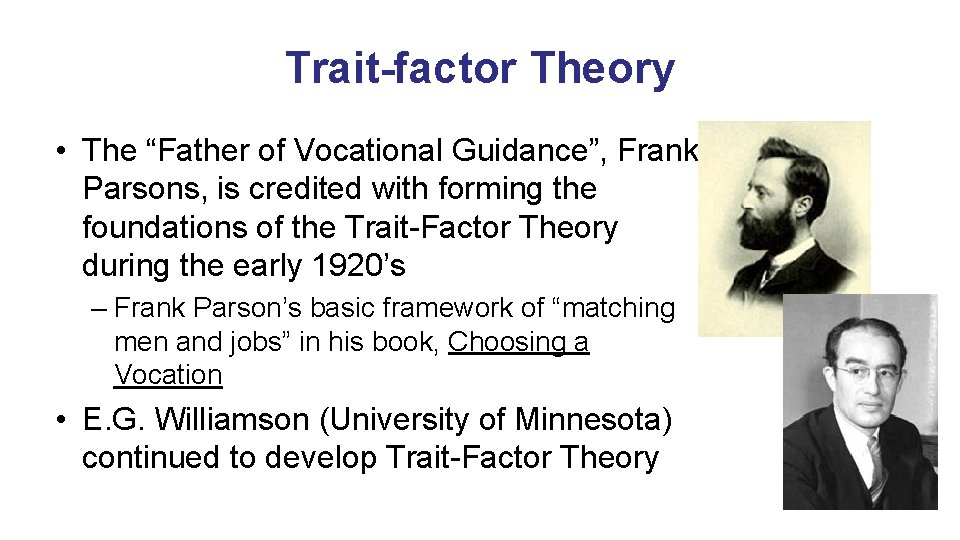
Trait-factor Theory • The “Father of Vocational Guidance”, Frank Parsons, is credited with forming the foundations of the Trait-Factor Theory during the early 1920’s – Frank Parson’s basic framework of “matching men and jobs” in his book, Choosing a Vocation • E. G. Williamson (University of Minnesota) continued to develop Trait-Factor Theory
What is Trait-Factor Theory? The Trait-and-Factor Theory focuses on identifying an individual’s characteristics and factoring these traits into informed occupation decisions. Using trait-and-factory inventories will help to determine the strength of these traits and then help match the individual with the ideal situation. This theory can be used to help facilitate job opportunities based on an individual’s abilities.
Trait Factor Theory 1. Understand YOURSELF and YOUR traits 2. Recognize the skills needed for the workforce 3. Use reason to match your traits to the right job
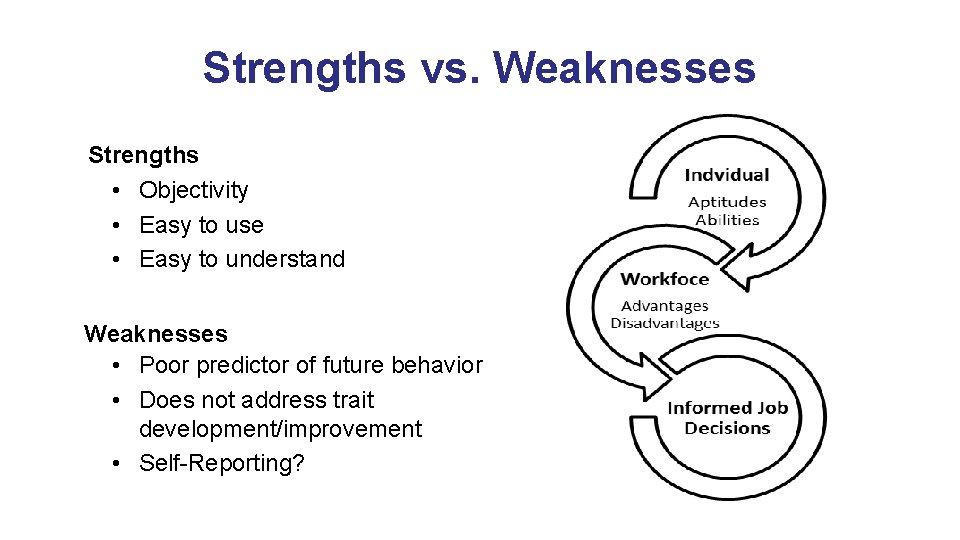
Strengths vs. Weaknesses Strengths • Objectivity • Easy to use • Easy to understand Weaknesses • Poor predictor of future behavior • Does not address trait development/improvement • Self-Reporting?
Theories that Developed from Trait-Factor Theory • • Holland’s Career Typology Theory (Holland, 1959) Composite Theory of Career Development (Hoppock, 1976) Theory of Work Adjustment (Dawis & Lofquist, 1984) Cognitive Information Processing Approach (Peterson, Sampson, & Reardon, 1991) • Person X Environment (Chartrand, 1991) • Many current aptitude/personality tests (i. e. True Colors, General Aptitude Test Battery, etc. )
Example of Trait-Factor Theory • PERSONALITY – “The Big 5” Test – Meyer’s-Brigg’s Personality Test • http: //northernlightscdc. org/wp-content/uploads/2015/10/Fund_-Module-10_Personaility-types-test. pdf • http: //www. humanmetrics. com/cgi-win/jtypes 2. asp • CAREER – https: //dlr. sd. gov/lmic/pdfs_and_other_files/cwonders_interest_survey. pdf – http: //www. eastfieldcollege. edu/Assets/ssi/Career-Self-Assessment. pdf – http: //www. ncpn. info/2013 handouts/Presentation-Career-Exploration. pdf
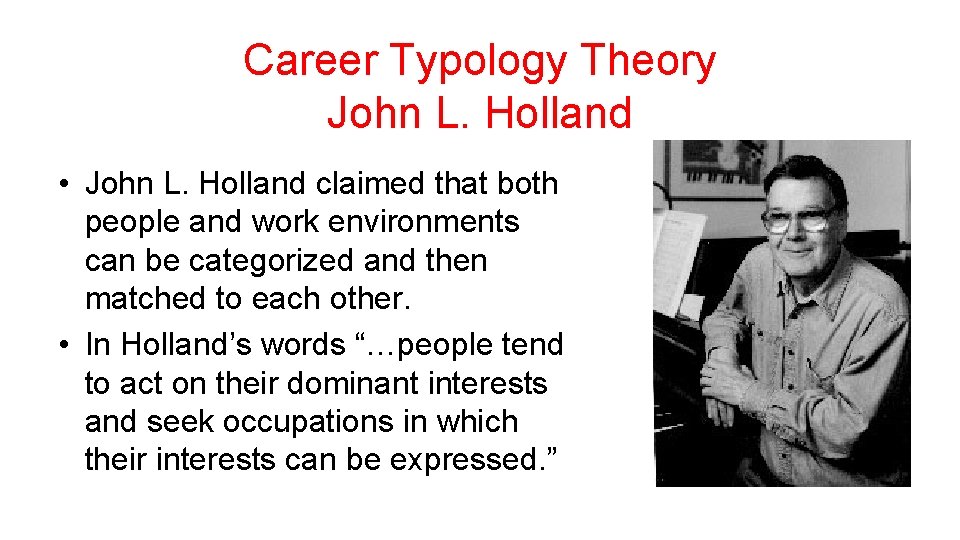
Career Typology Theory John L. Holland • John L. Holland claimed that both people and work environments can be categorized and then matched to each other. • In Holland’s words “…people tend to act on their dominant interests and seek occupations in which their interests can be expressed. ”
Let’s go to a Party! • You have been invited to a Career Exploration Party in this room. There are 6 different groups around this room at this party. Each group has different people with different personalities in them • The descriptions of the type of people and activities they like doing are below the pictures of the group. • Who do you want to mingle with? Chose the group you are most drawn to - the people you would most like to meet and talk with. After that, find the second group you are most interested in, and then the third group. List them on your ticket. • Think about why you chose that group. Does the description of that group describe you? Can you give an example? Group 1 _____ Group 2 _____ Group 3 _____
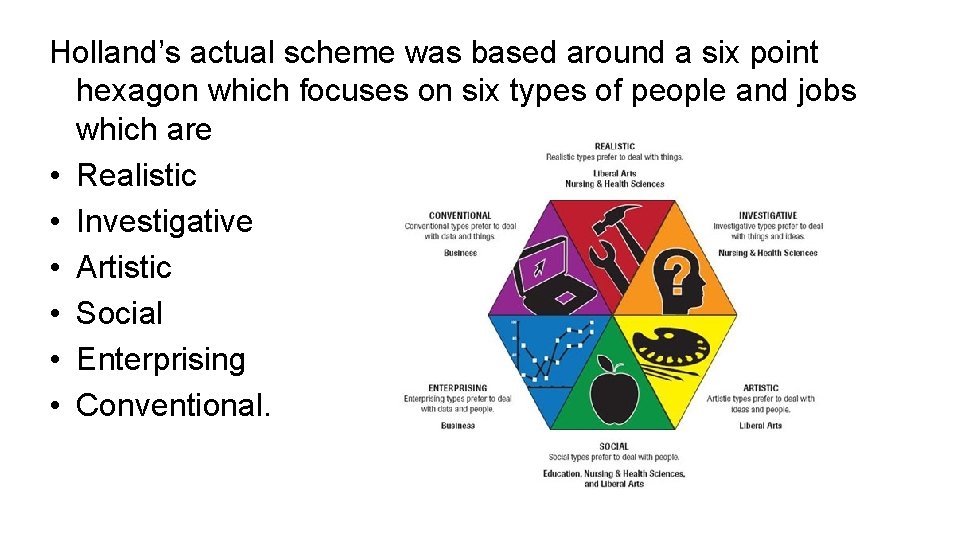
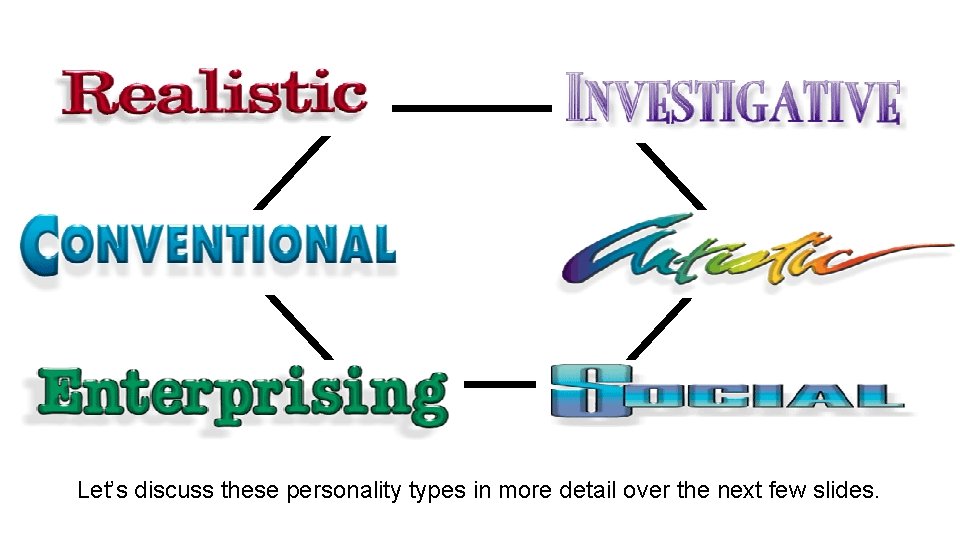
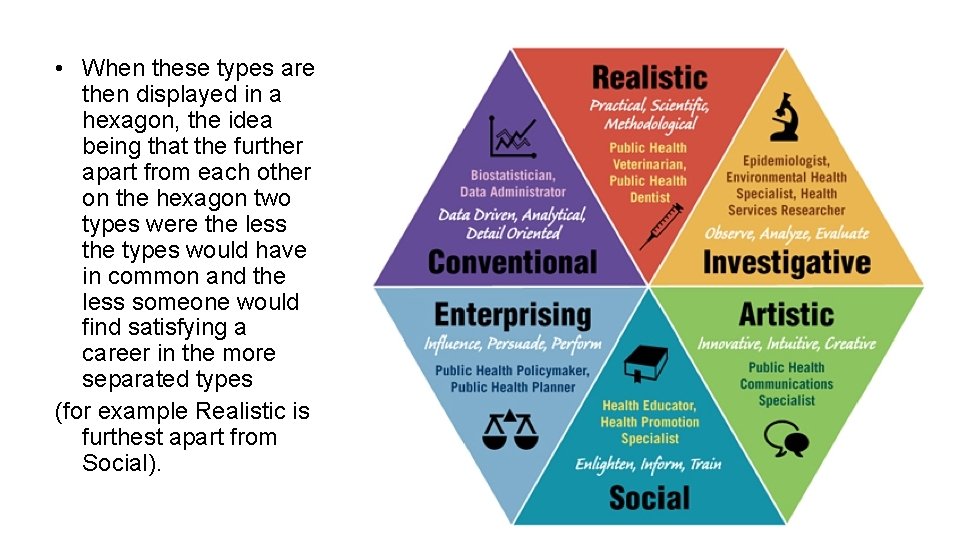
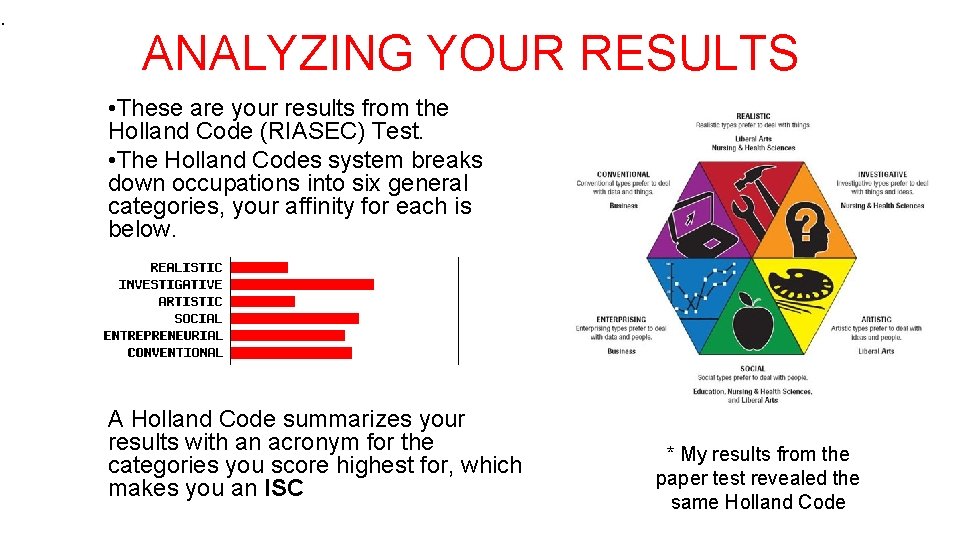
Holland’s actual scheme was based around a six point hexagon which focuses on six types of people and jobs which are • Realistic • Investigative • Artistic • Social • Enterprising • Conventional.
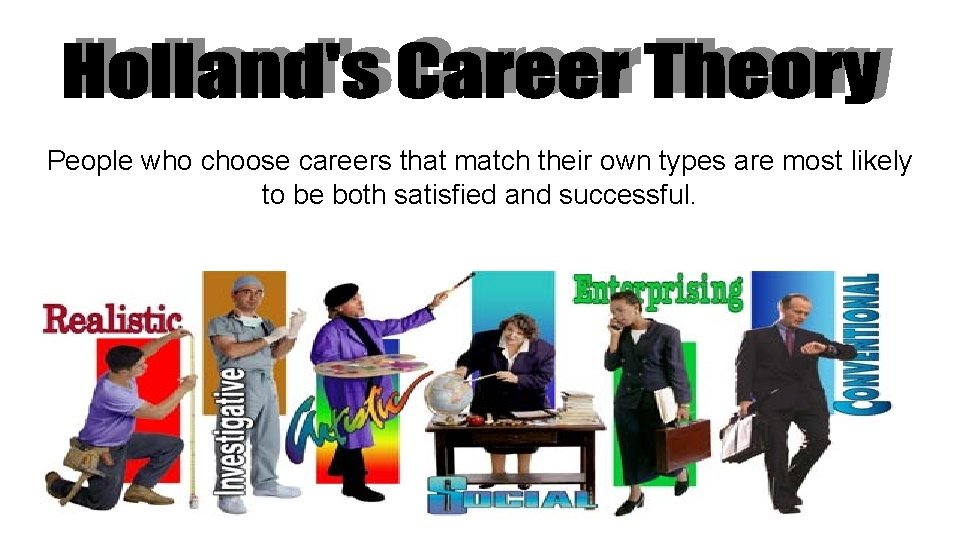
People who choose careers that match their own types are most likely to be both satisfied and successful.
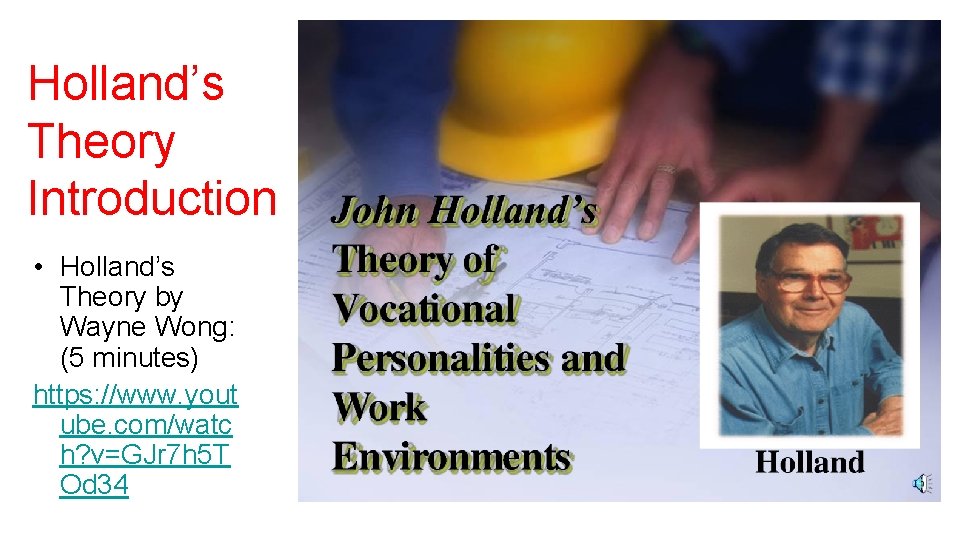
Holland’s Theory Introduction • Holland’s Theory by Wayne Wong: (5 minutes) https: //www. yout ube. com/watc h? v=GJr 7 h 5 T Od 34
Let’s discuss these personality types in more detail over the next few slides.
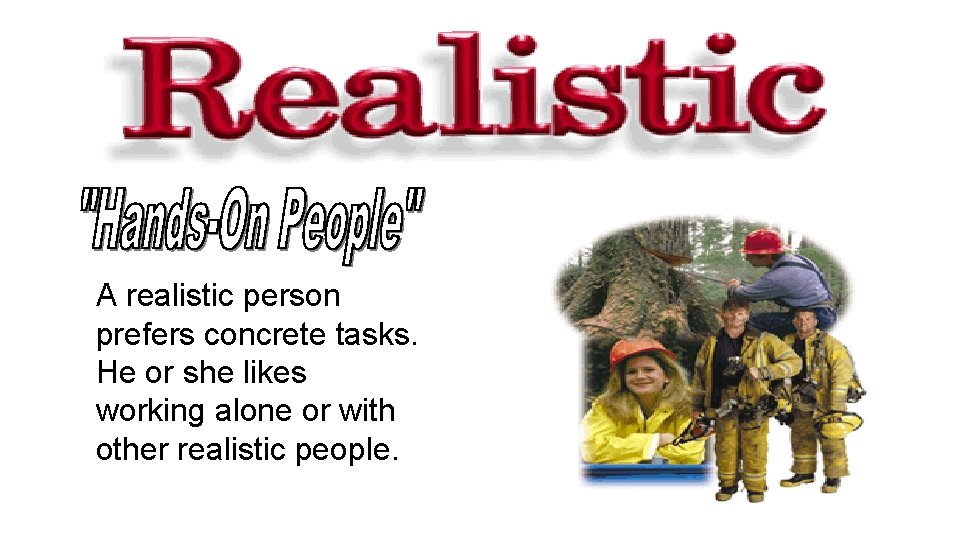
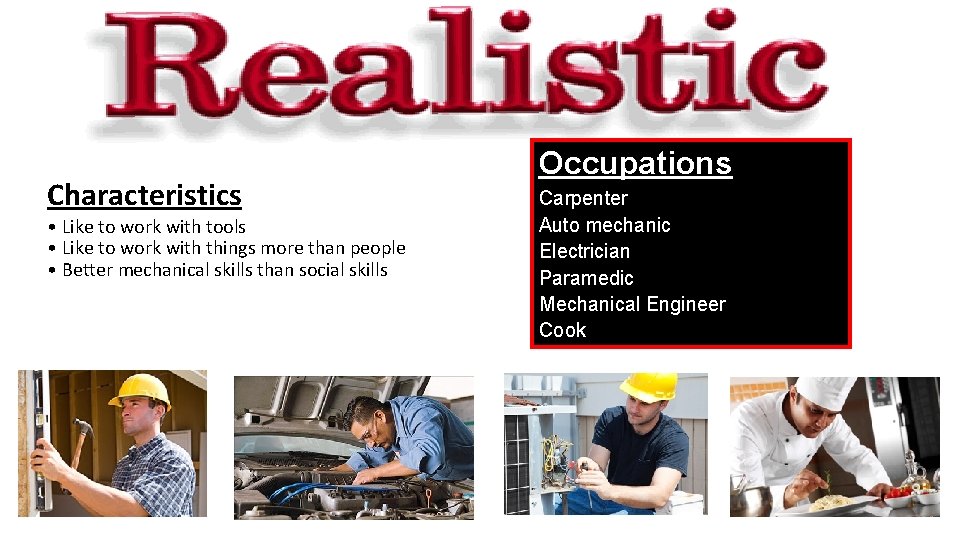
A realistic person prefers concrete tasks. He or she likes working alone or with other realistic people.
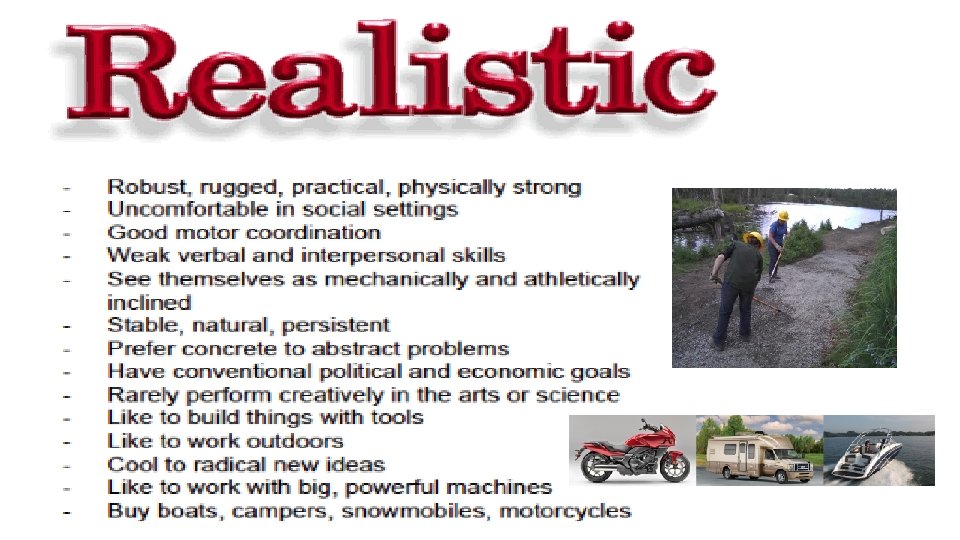
Characteristics • Like to work with tools • Like to work with things more than people • Better mechanical skills than social skills Occupations Carpenter Auto mechanic Electrician Paramedic Mechanical Engineer Cook
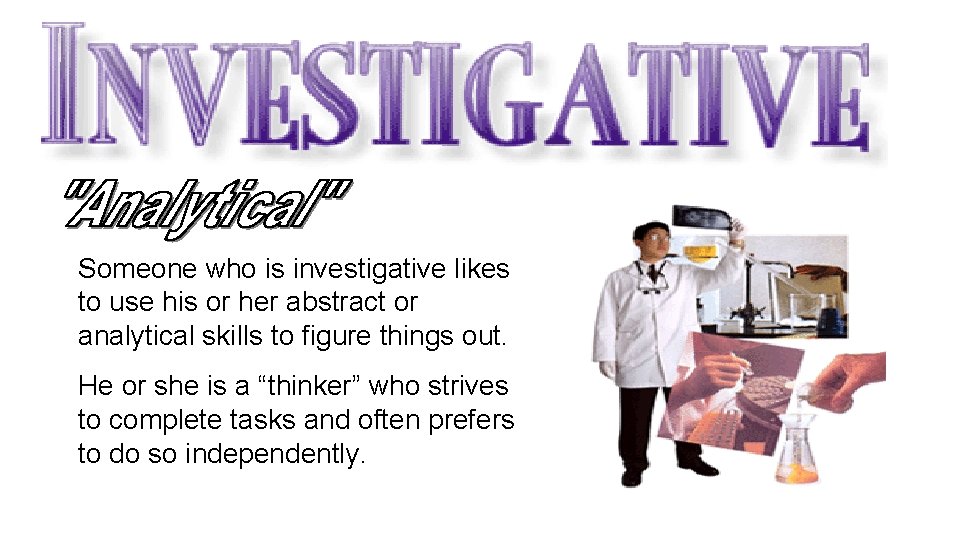
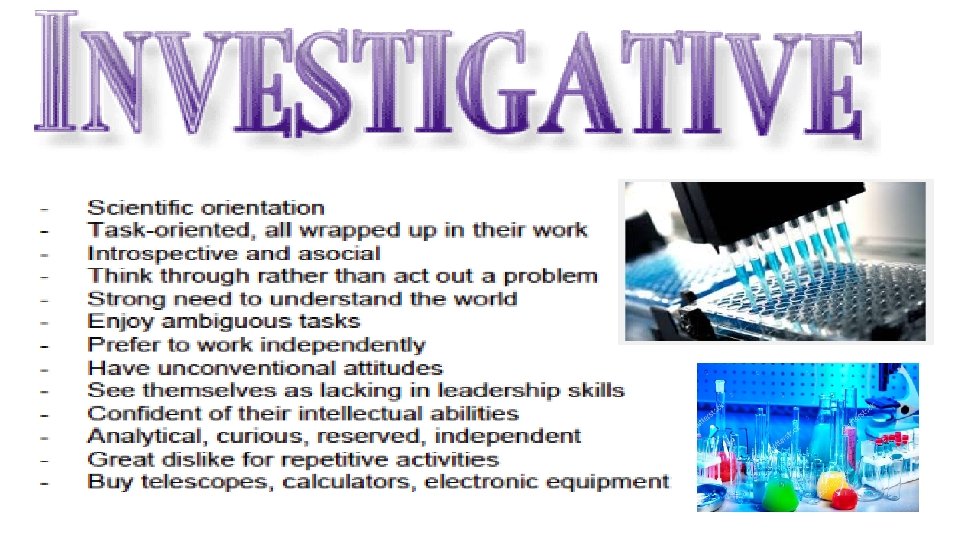
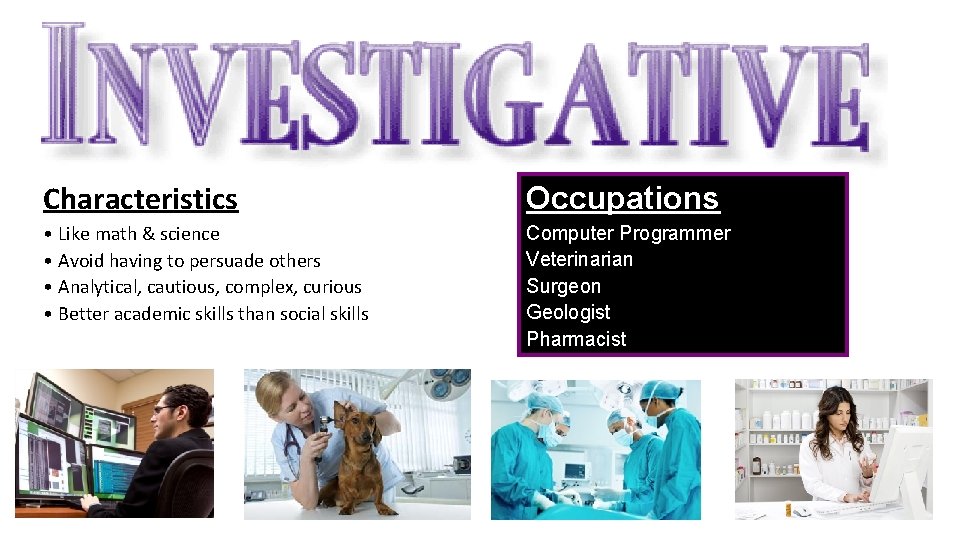
Someone who is investigative likes to use his or her abstract or analytical skills to figure things out. He or she is a “thinker” who strives to complete tasks and often prefers to do so independently.
Characteristics Occupations • Like math & science • Avoid having to persuade others • Analytical, cautious, complex, curious • Better academic skills than social skills Computer Programmer Veterinarian Surgeon Geologist Pharmacist
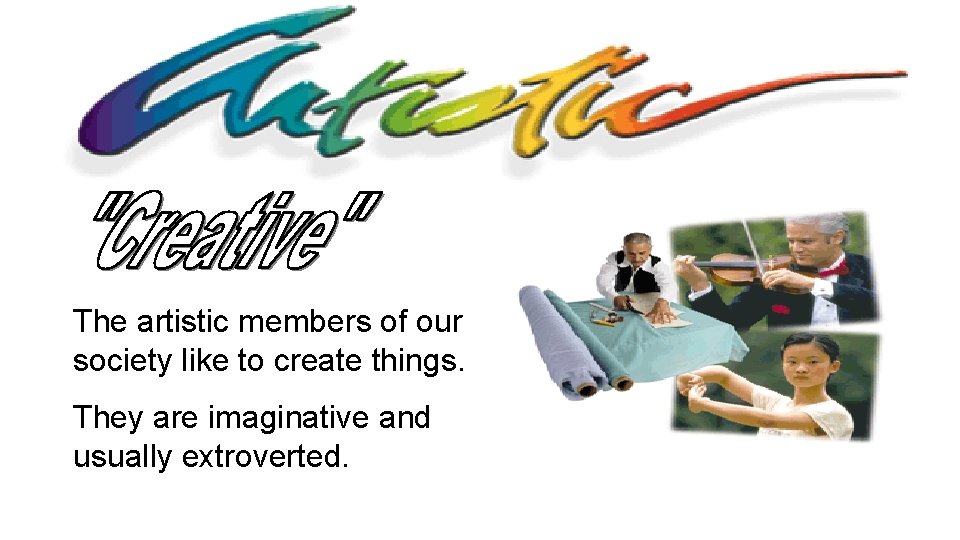
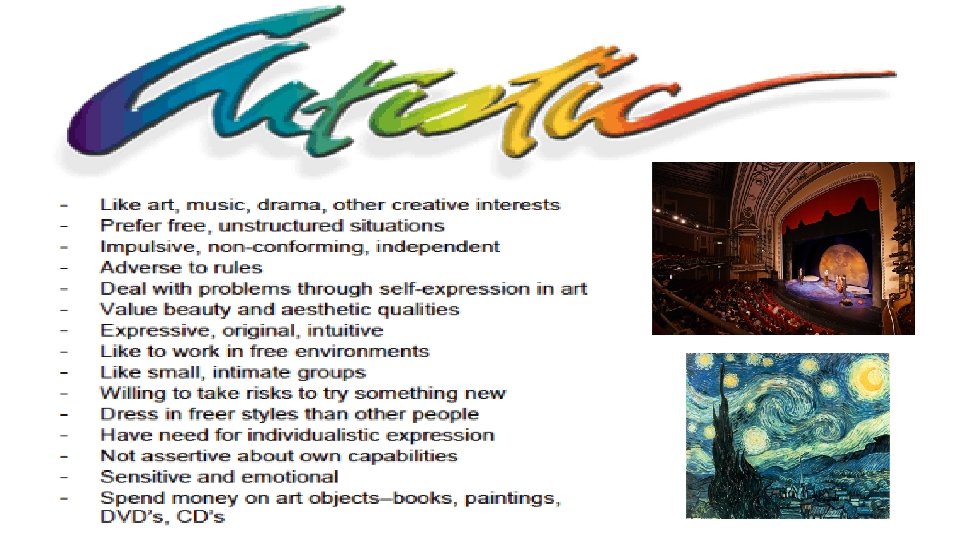
The artistic members of our society like to create things. They are imaginative and usually extroverted.
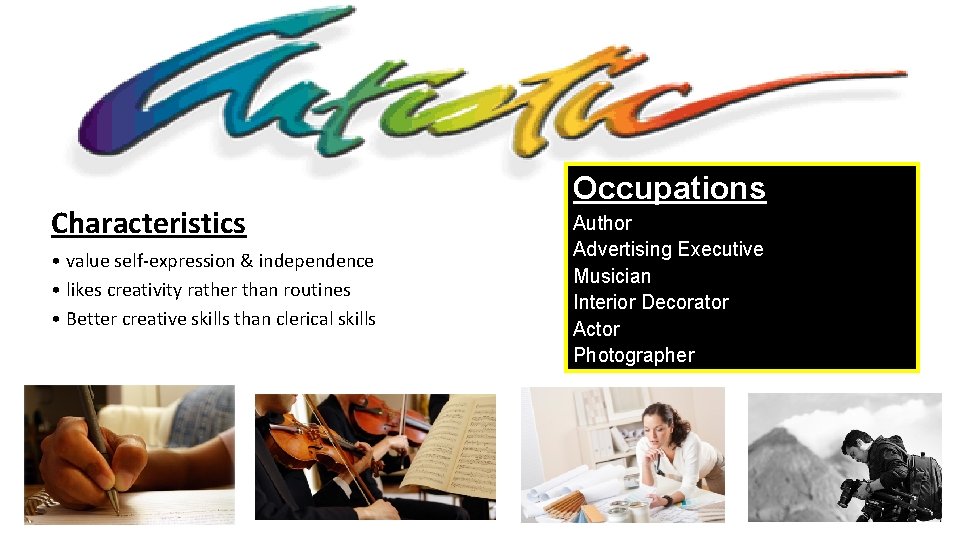
Characteristics • value self-expression & independence • likes creativity rather than routines • Better creative skills than clerical skills Occupations Author Advertising Executive Musician Interior Decorator Actor Photographer
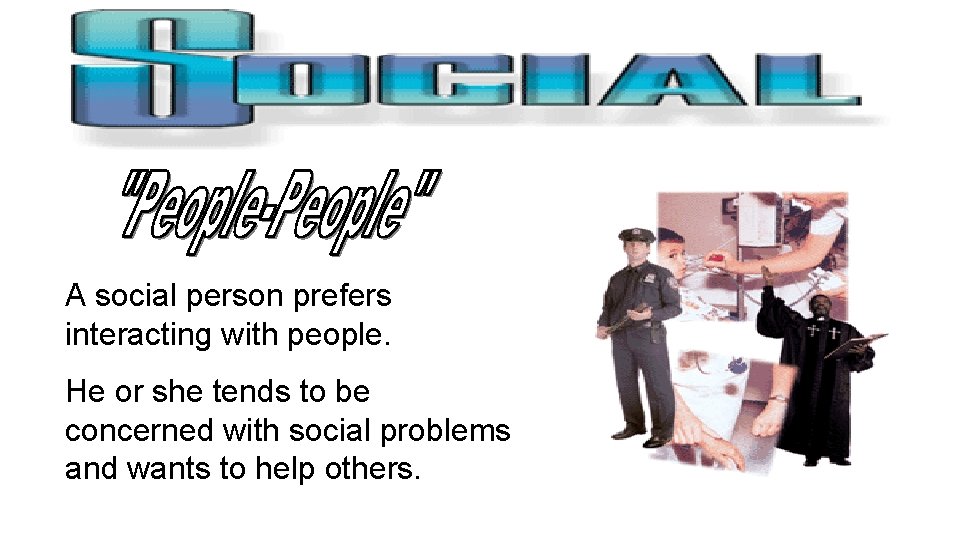
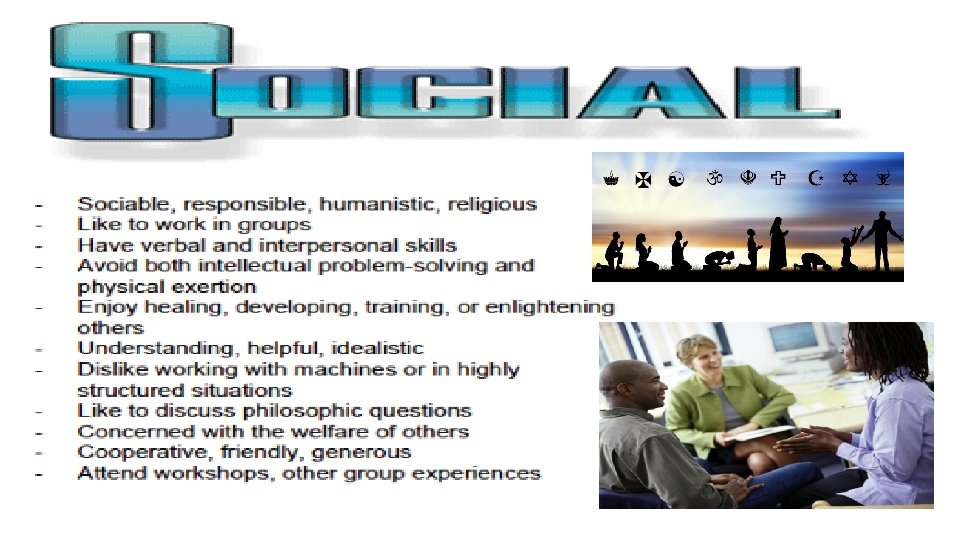
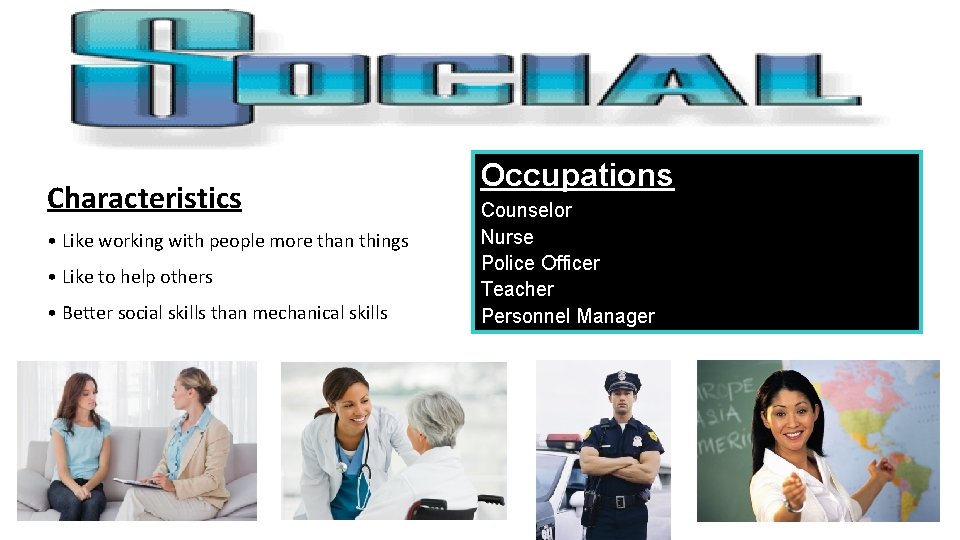
A social person prefers interacting with people. He or she tends to be concerned with social problems and wants to help others.
Characteristics • Like working with people more than things • Like to help others • Better social skills than mechanical skills Occupations Counselor Nurse Police Officer Teacher Personnel Manager
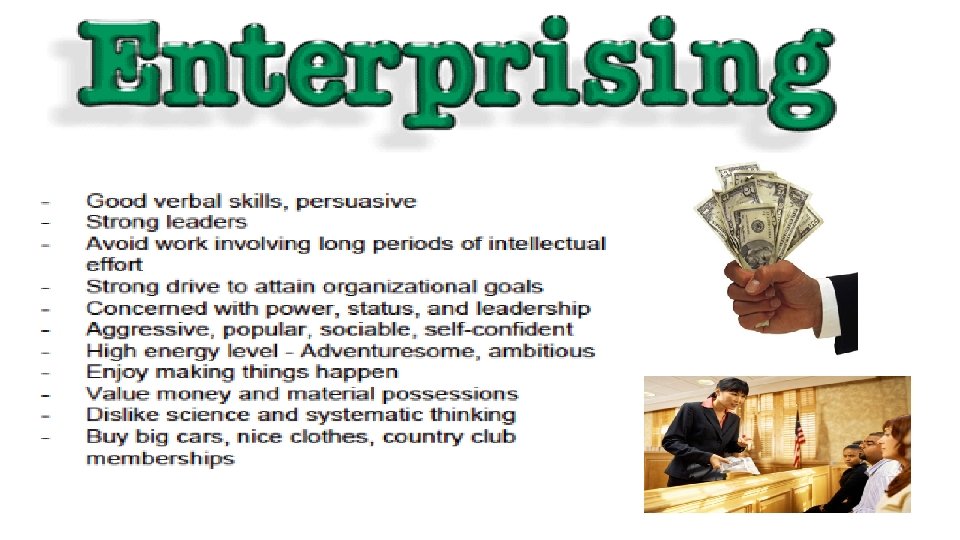
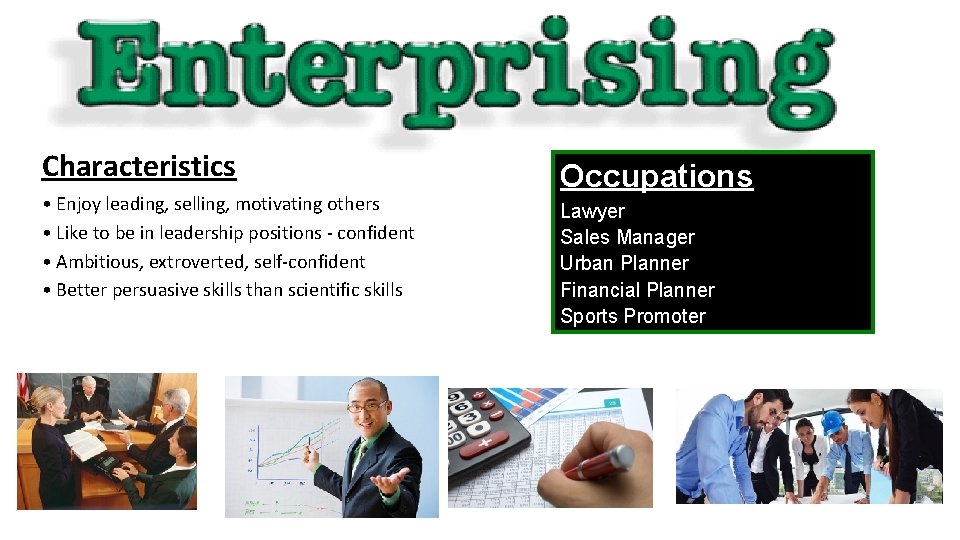
Those who are enterprising lean toward leadership roles. They are willing to take on challenges and are extroverted. They can be aggressive as well.
Characteristics • Enjoy leading, selling, motivating others • Like to be in leadership positions - confident • Ambitious, extroverted, self-confident • Better persuasive skills than scientific skills Occupations Lawyer Sales Manager Urban Planner Financial Planner Sports Promoter
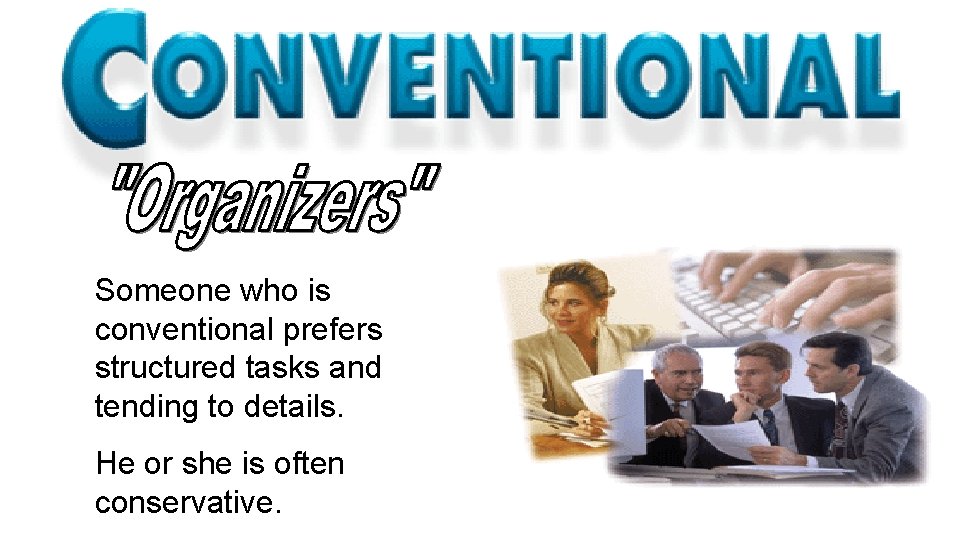
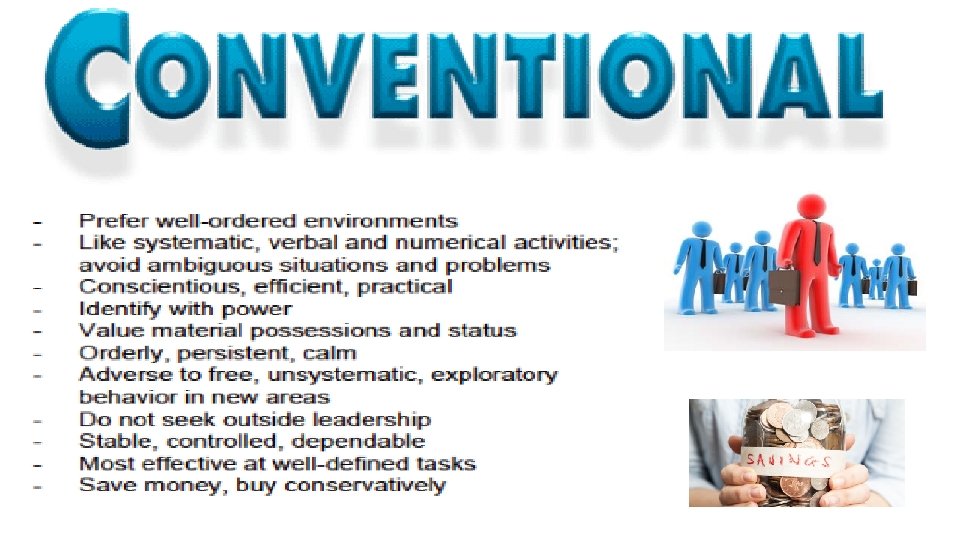
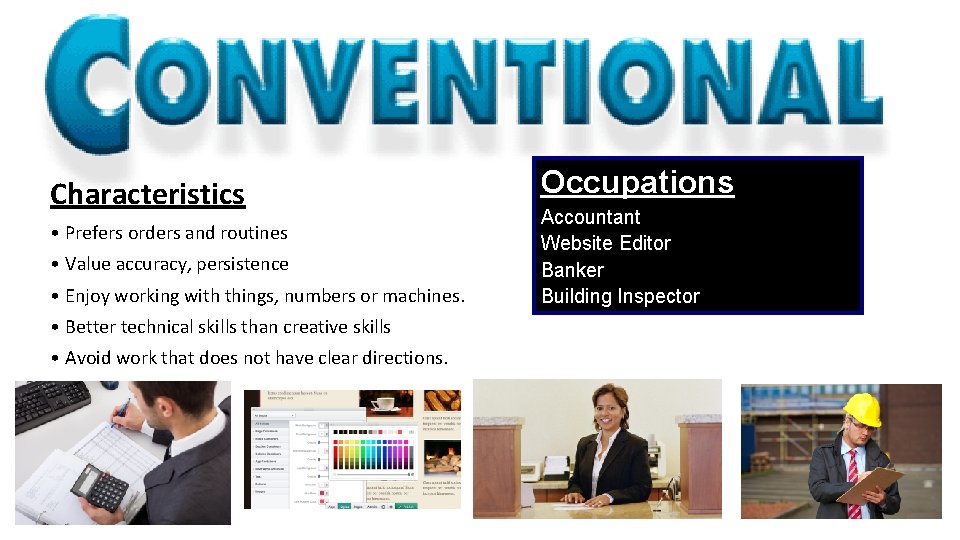
Someone who is conventional prefers structured tasks and tending to details. He or she is often conservative.
Characteristics • Prefers orders and routines • Value accuracy, persistence • Enjoy working with things, numbers or machines. • Better technical skills than creative skills • Avoid work that does not have clear directions. Occupations Accountant Website Editor Banker Building Inspector
• When these types are then displayed in a hexagon, the idea being that the further apart from each other on the hexagon two types were the less the types would have in common and the less someone would find satisfying a career in the more separated types (for example Realistic is furthest apart from Social).
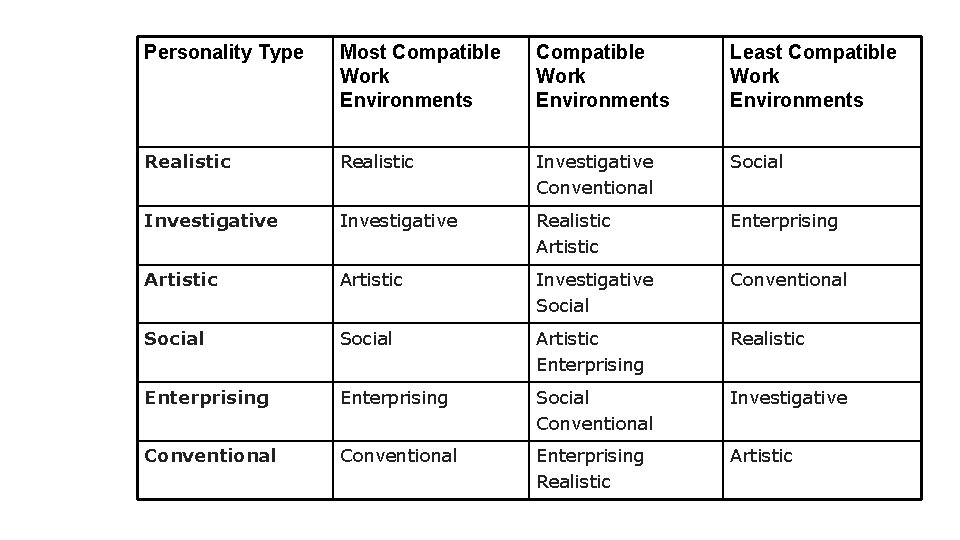
Personality Type Most Compatible Work Environments Least Compatible Work Environments Realistic Investigative Conventional Social Investigative Realistic Artistic Enterprising Artistic Investigative Social Conventional Social Artistic Enterprising Realistic Enterprising Social Conventional Investigative Conventional Enterprising Realistic Artistic
Career Typology Theory John L. Holland • Holland claims we all have three dominant types which are displayed in order (referred to as our Holland code). • The main idea is that individuals should use their dominant type and then look for a career in that field (for example people with Social would benefit from considering careers in educational or health and social care field). • Holland developed a tool called the “self-directed search” (SDS) for individuals to make use of to identify their code, it consists of a series of questions and then a scoring chart where you add up your answers in various categories giving your code.
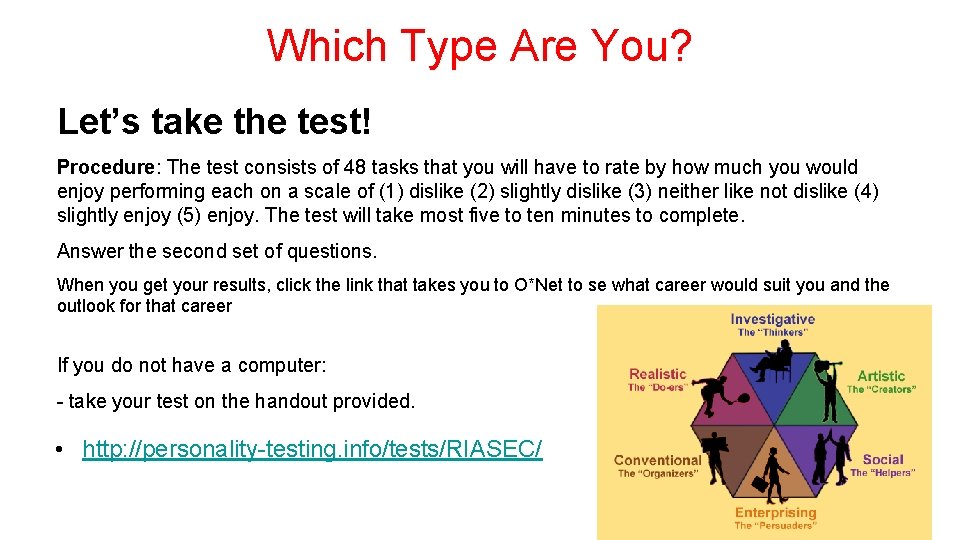
Which Type Are You? Let’s take the test! Procedure: The test consists of 48 tasks that you will have to rate by how much you would enjoy performing each on a scale of (1) dislike (2) slightly dislike (3) neither like not dislike (4) slightly enjoy (5) enjoy. The test will take most five to ten minutes to complete. Answer the second set of questions. When you get your results, click the link that takes you to O*Net to se what career would suit you and the outlook for that career If you do not have a computer: - take your test on the handout provided. • http: //personality-testing. info/tests/RIASEC/
. ANALYZING YOUR RESULTS • These are your results from the Holland Code (RIASEC) Test. • The Holland Codes system breaks down occupations into six general categories, your affinity for each is below. A Holland Code summarizes your results with an acronym for the categories you score highest for, which makes you an ISC * My results from the paper test revealed the same Holland Code
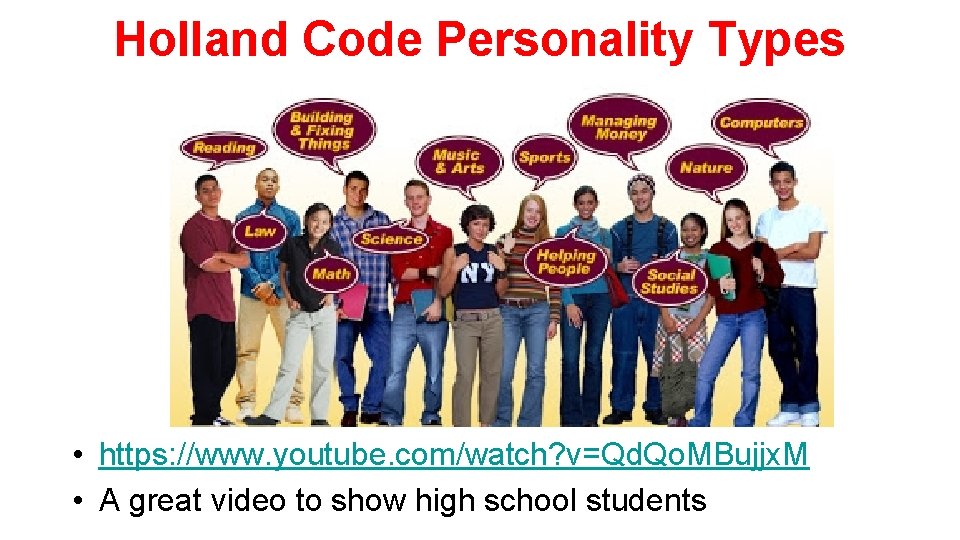
Holland Code Personality Types • https: //www. youtube. com/watch? v=Qd. Qo. MBujjx. M • A great video to show high school students