
D ef en s e m ec h


- Slides: 64
D ef en s e m ec h a n i s m s Presented By Dr Nadia Mohamed §lecturer of Psychiatric Nursing & Mental Health
Outlines: Ø Psychoanalytic approach. Ø Definition of Defense Mechanisms. Ø Purpose of Defense Mechanisms. Ø Important properities of Defense Mechanisms. Ø Common Defense Mechanisms.
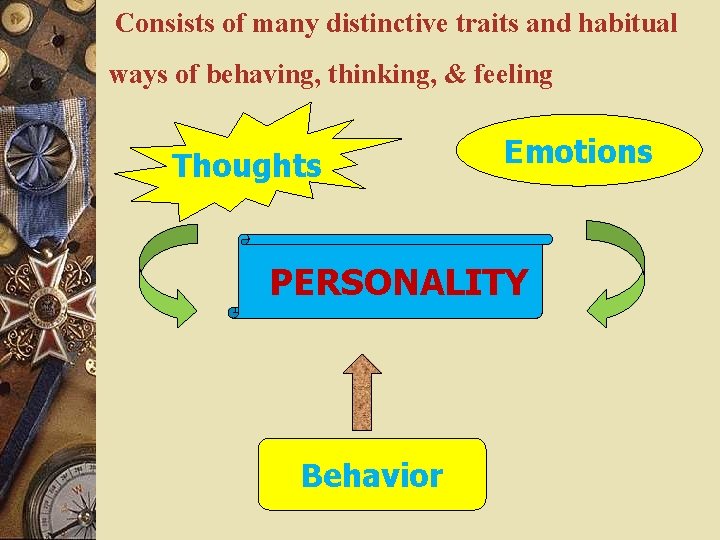
PERSONALITY q Combines a set of physical, emotional, social and mental characteristics, individual’s traits, habits, attitudes, beliefs and viewpoints that reflect how a person looks, thinks, acts, and feels. q The sum total of ways in which an individual reacts
PERSONALITY q. A person’s general style of interacting with the world. q. Personality refers a relatively stable set of traits & behaviors that characterize an individual (unique nature of a person).
Consists of many distinctive traits and habitual ways of behaving, thinking, & feeling Thoughts Emotions PERSONALITY Behavior
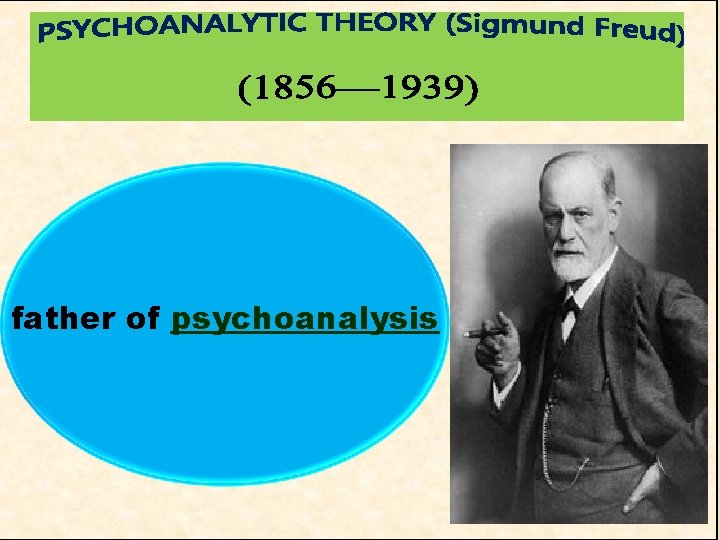
father of psychoanalysis
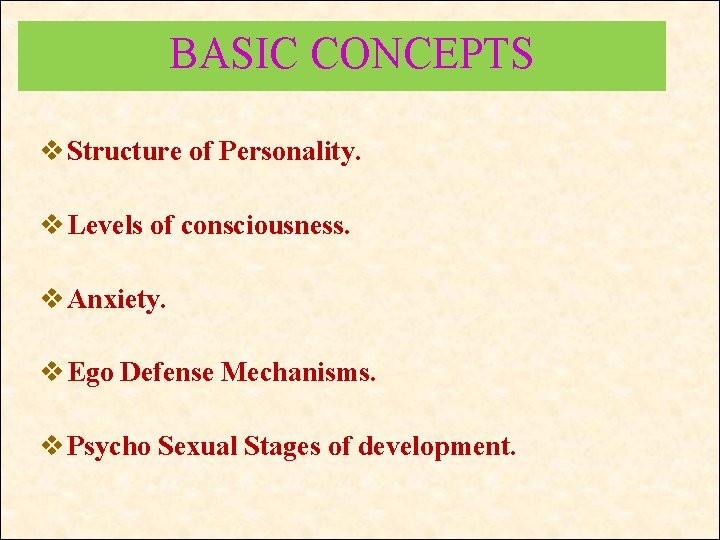
BASIC CONCEPTS v Structure of Personality. v Levels of consciousness. v Anxiety. v Ego Defense Mechanisms. v Psycho Sexual Stages of development.
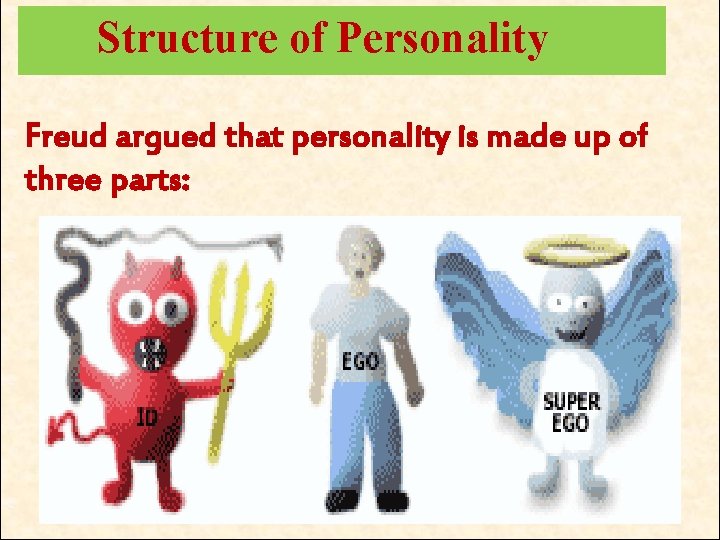
Structure of Personality Freud argued that personality is made up of three parts:
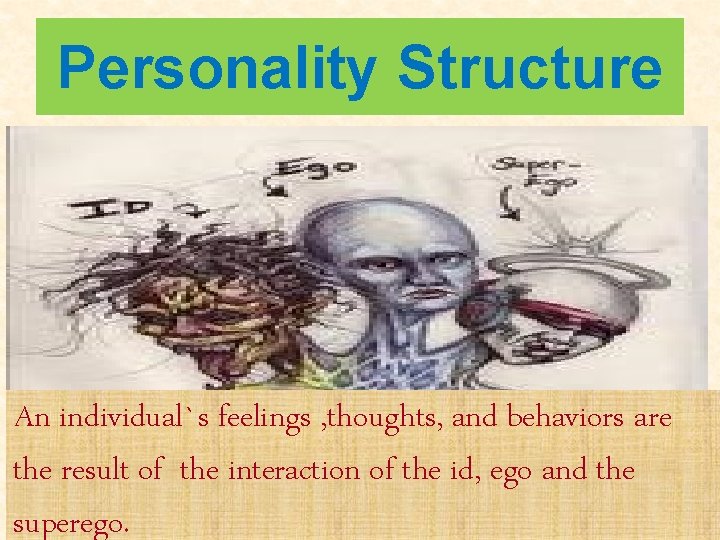
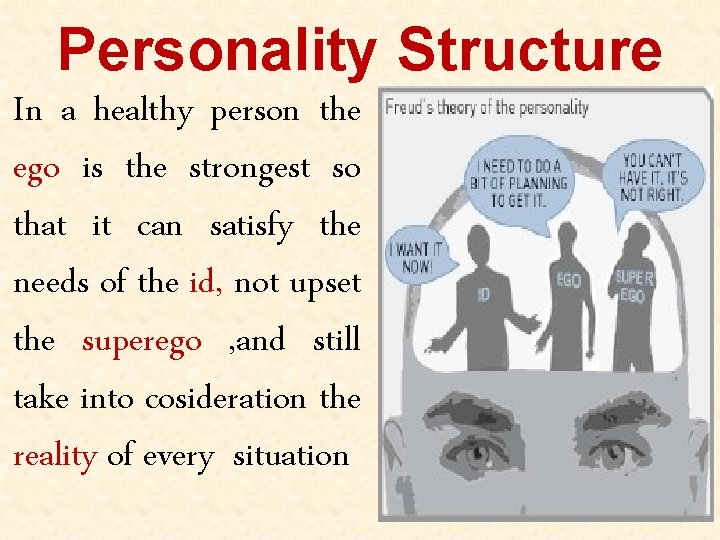
Personality Structure An individual`s feelings , thoughts, and behaviors are the result of the interaction of the id, ego and the superego.
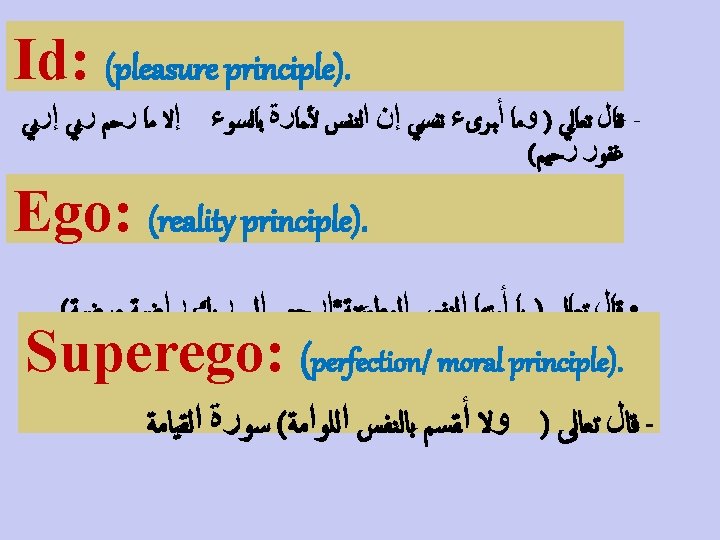
Id q It is the irrational, illogical and impulsive part of personality. q Completely unconscious. q Presents at birth. q The seat of instincts. q operates according to the (pleasure principle), it always aims to avoid pain and gain pleasure.
Id q It lacks organization, is blind, and very demanding. It cannot tolerate tension. q once it does feel tension, it functions toward immediately gratification of needs regardless of reality. q Does not distinguish between reality and fantasy.
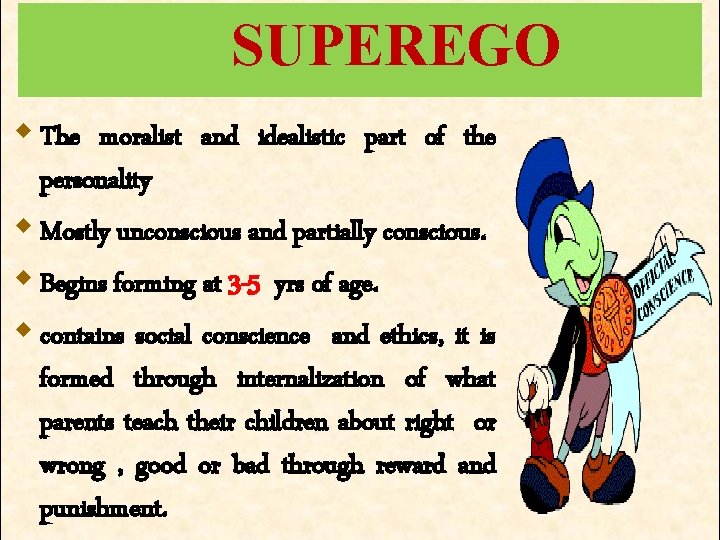
SUPEREGO w The moralist and idealistic part of the personality w Mostly unconscious and partially conscious. w Begins forming at 3 -5 yrs of age. w contains social conscience and ethics, it is formed through internalization of what parents teach their children about right or wrong , good or bad through reward and punishment.
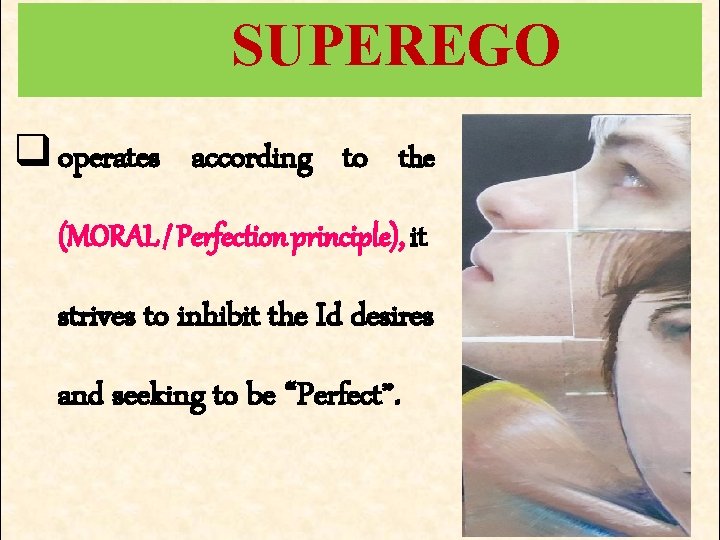
SUPEREGO q operates according to the (MORAL / Perfection principle), it strives to inhibit the Id desires and seeking to be “Perfect”.
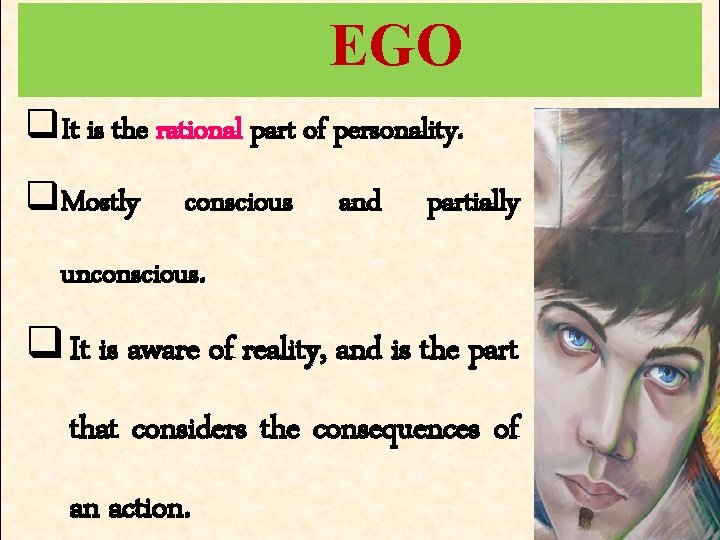
EGO q. It is the rational part of personality. q. Mostly conscious and partially unconscious. q It is aware of reality, and is the part that considers the consequences of an action.
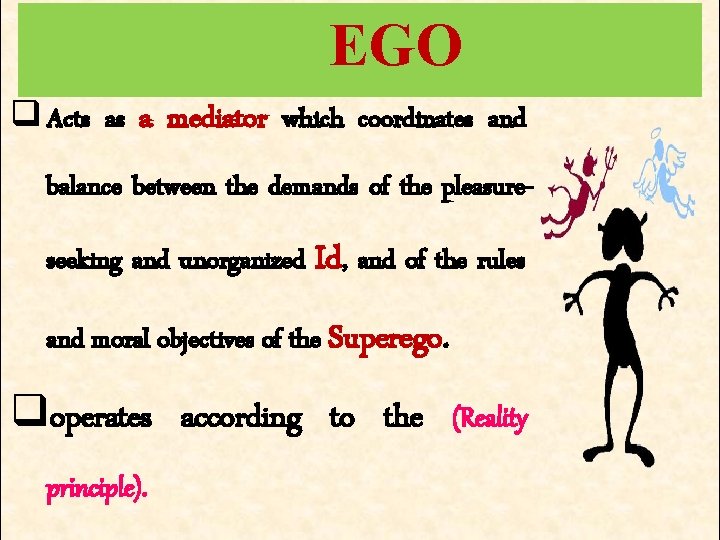
EGO q Acts as a mediator which coordinates and balance between the demands of the pleasureseeking and unorganized Id, and of the rules and moral objectives of the Superego. qoperates according to the principle). (Reality
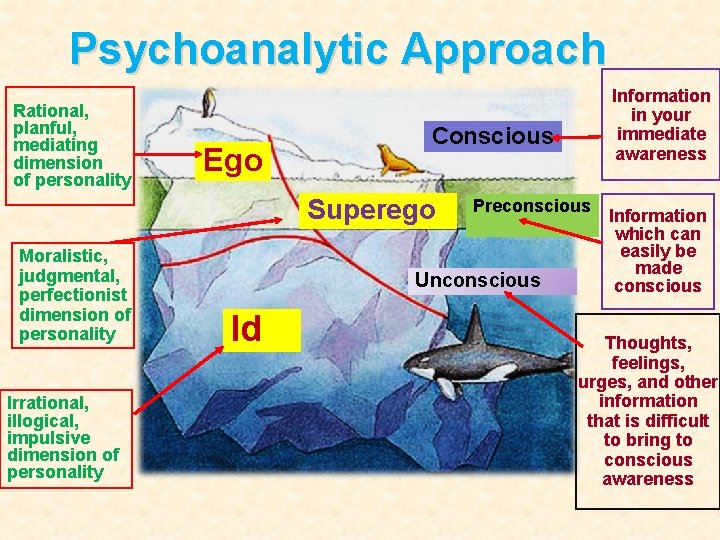
Psychoanalytic Approach Rational, planful, mediating dimension of personality Ego Conscious Superego Moralistic, judgmental, perfectionist dimension of personality Irrational, illogical, impulsive dimension of personality Preconscious Unconscious Id Information in your immediate awareness Information which can easily be made conscious Thoughts, feelings, urges, and other information that is difficult to bring to conscious awareness
Personality Structure In a healthy person the ego is the strongest so that it can satisfy the needs of the id, not upset the superego , and still take into cosideration the reality of every situation
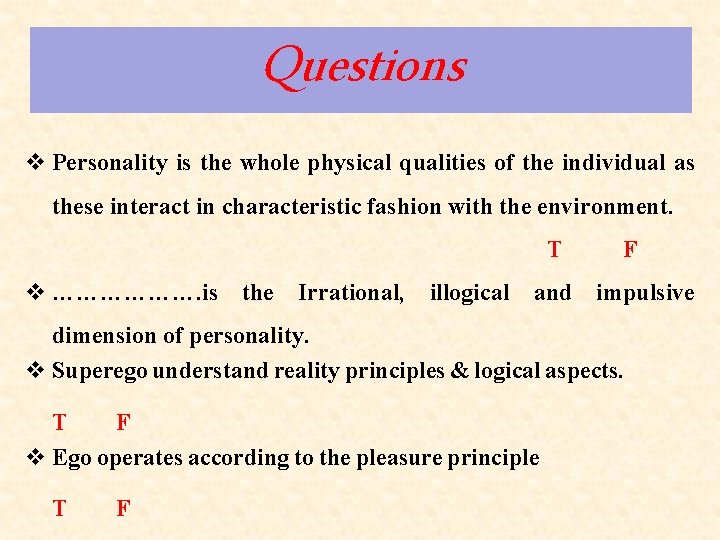
Questions v Personality is the whole physical qualities of the individual as these interact in characteristic fashion with the environment. T F v ………………. is the Irrational, illogical and impulsive dimension of personality. v Superego understand reality principles & logical aspects. T F v Ego operates according to the pleasure principle T F
Anxiety • Feelings of anxiety are so common in our society, it is an integral part of the universal human experience. • Fears of the unknown and conditions of uncertainty offer a perfect chance for anxiety to develop and grow. • Low levels of anxiety are adaptive and can provide the motivation required for survival. • Anxiety becomes problematic when the individual is unable to prevent the anxiety from escalating to a level that interferes with the ability to meet basic needs.
Anxiety A sense of apprehension that is vague in nature and associated with feelings of uncertainty, helplessness, insecurity and impending danger resulting from a real or perceived threat whose actual source is unknown or un recognized.
Basic Concept • According to Freud, anxiety is an unpleasant inner state that people seek to avoid. • When anxiety occurs, the mind first responds by an increase in problem-solving thinking, seeking rational ways of escaping the situation. • If this is not productive, ego has some tools, it can use in its job as the mediator, tools that help defend the ego, these are called Ego Defenses, Adjustment Mechanisms or Defense Mechanisms.
Definition Defense mechanisms are psychological strategies brought into play by the unconscious mind to cope with reality, to defend against feelings of anxiety and to maintain self-image.
Definition Defense mechanisms are ways to behave or think to protect or defend ourselves from anxiety.
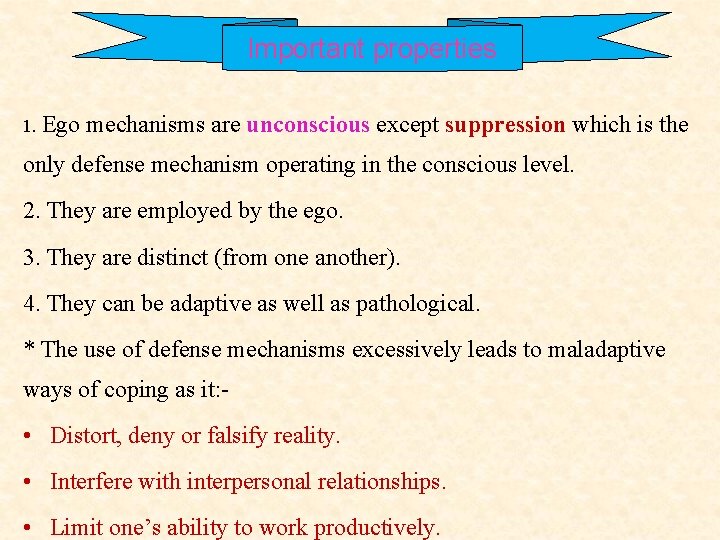
Important properties 1. Ego mechanisms are unconscious except suppression which is the only defense mechanism operating in the conscious level. 2. They are employed by the ego. 3. They are distinct (from one another). 4. They can be adaptive as well as pathological. * The use of defense mechanisms excessively leads to maladaptive ways of coping as it: - • Distort, deny or falsify reality. • Interfere with interpersonal relationships. • Limit one’s ability to work productively.
Development of defense mechanisms start during the early stages of personality development. BY tenth year of life mental mechanism are well developed. Becoming older, defense mechanisms are either reinforced or changed.
defense mechanisms
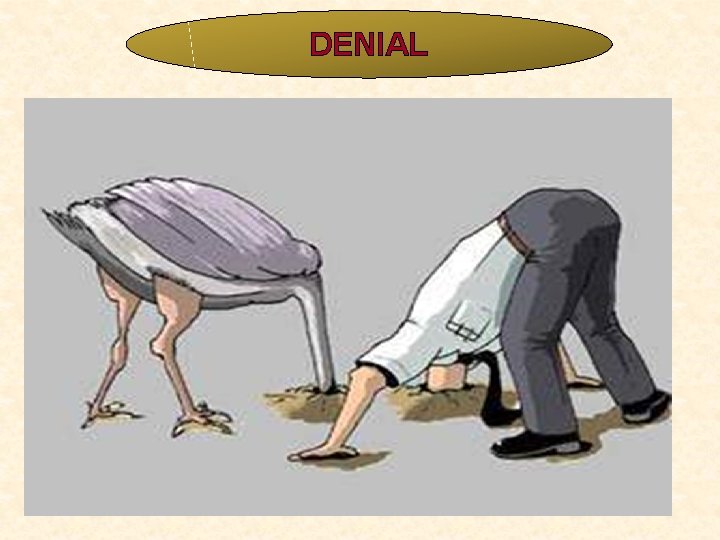
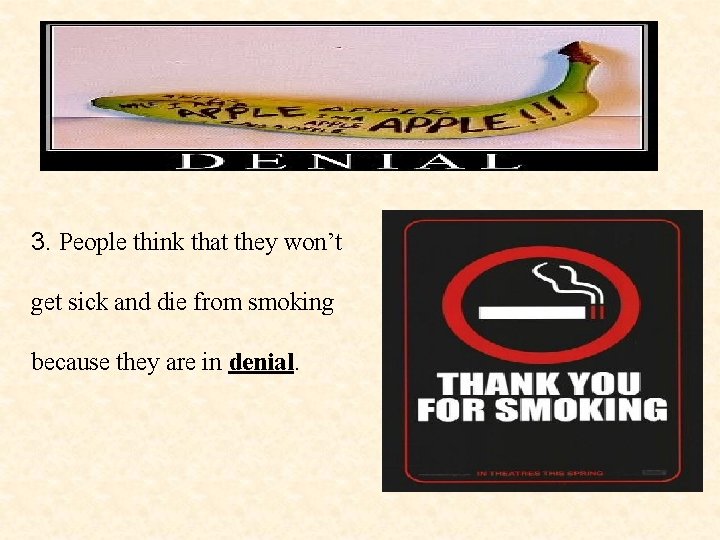
1. DENIAL • Denial is characterized by refusing to acknowledge the existence of certain painful experience or realities. • Many people use denial in their everyday lives to avoid dealing with painful feelings or areas of their life they don’t wish to admit. Example: 1) Patient denies that his physician's diagnosis of cancer is correct and seeks a second opinion. 2) Alcoholics deny that they have a problem.
DENIAL
3. People think that they won’t get sick and die from smoking because they are in denial.
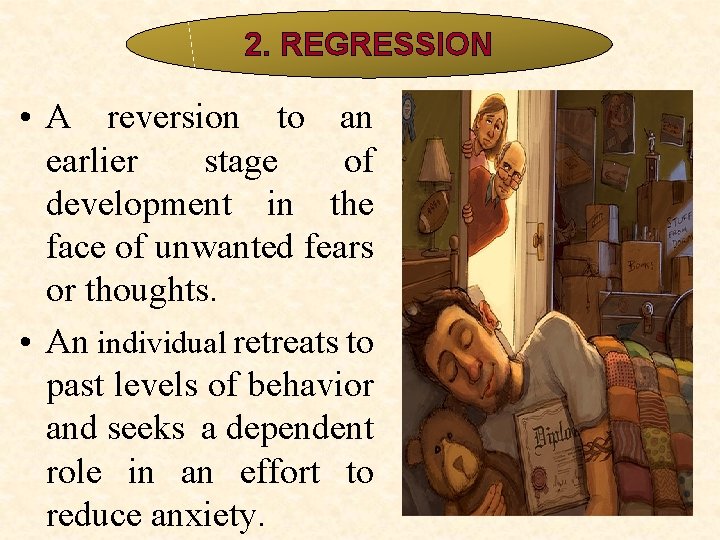
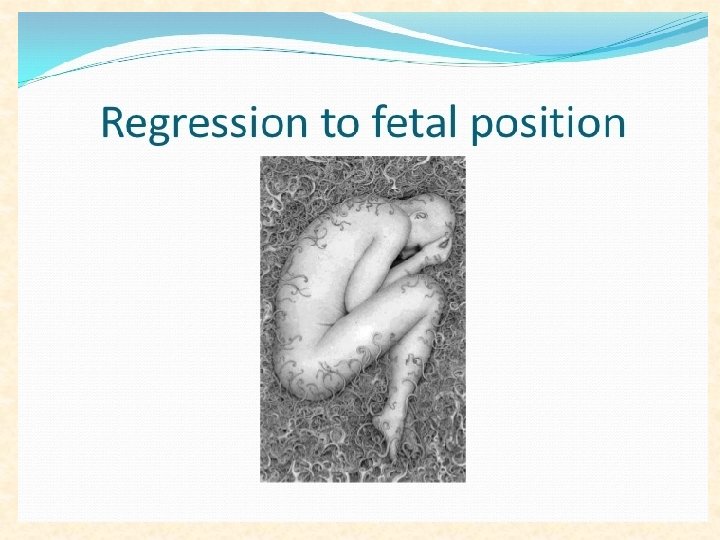
2. REGRESSION • A reversion to an earlier stage of development in the face of unwanted fears or thoughts. • An individual retreats to past levels of behavior and seeks a dependent role in an effort to reduce anxiety.
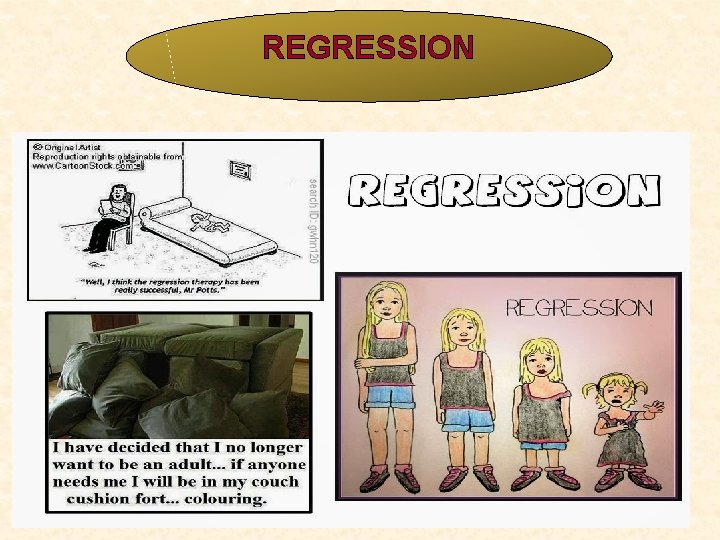
REGRESSION
REGRESSION Examples 1) A person who suffers a mental breakdown assumes a fetal position, rocking and crying. 2) A child suddenly starts to wet the bed after years of not doing so (this is a typical response to the arrival of a new sibling). 3) A patient makes childish demands and becomes dependent on the nurse for care that they could do for themselves.
3. CONVERSION A defense mechanism in which an individual transfers /converts emotional conflicts into physical symptoms to reduce anxiety. Examples 1) a student develops paralysis of right arm when face with difficult exam. 2) An elderly person loses function in the lower limps when told a close friend has died.
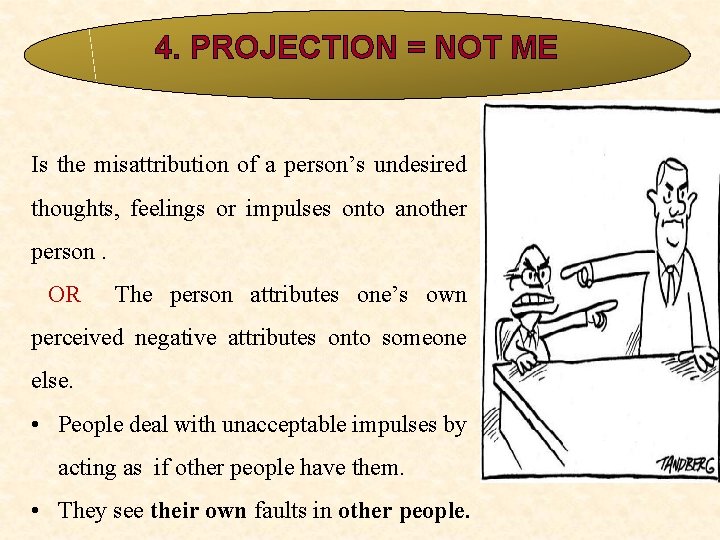
4. PROJECTION = NOT ME Is the misattribution of a person’s undesired thoughts, feelings or impulses onto another person. OR The person attributes one’s own perceived negative attributes onto someone else. • People deal with unacceptable impulses by acting as if other people have them. • They see their own faults in other people.
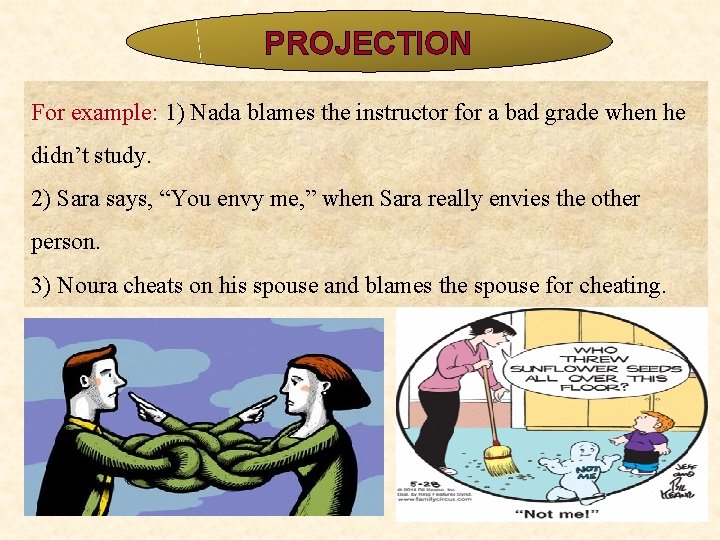
PROJECTION For example: 1) Nada blames the instructor for a bad grade when he didn’t study. 2) Sara says, “You envy me, ” when Sara really envies the other person. 3) Noura cheats on his spouse and blames the spouse for cheating.
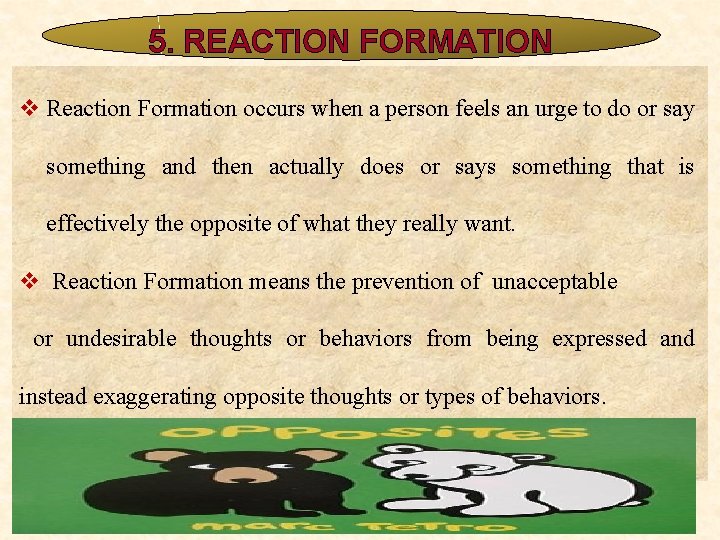
5. REACTION FORMATION v Reaction Formation occurs when a person feels an urge to do or say something and then actually does or says something that is effectively the opposite of what they really want. v Reaction Formation means the prevention of unacceptable or undesirable thoughts or behaviors from being expressed and instead exaggerating opposite thoughts or types of behaviors.
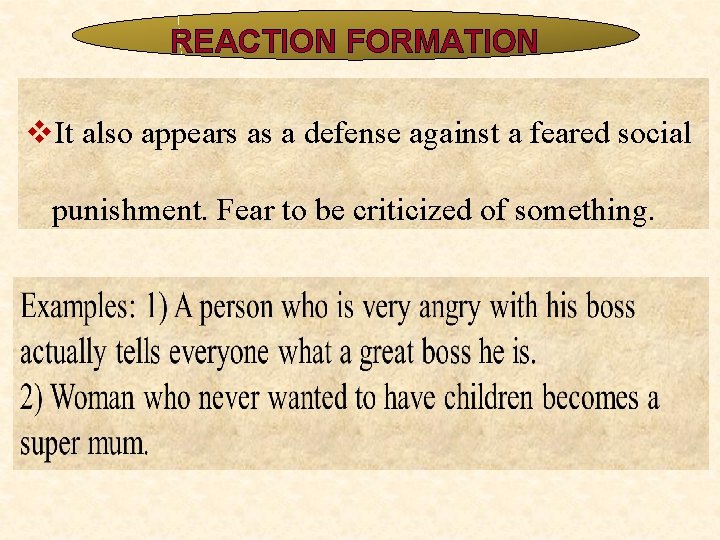
REACTION FORMATION v. It also appears as a defense against a feared social punishment. Fear to be criticized of something.
6. RATIONALIZATION (MAKING EXCUSE) Ø It is a mechanism in which a person justify unacceptable ideas and behaviors. Makes excuses to try to make it seem like unacceptable behavior is ok. Ø It is often used to preserve self-respect, reduce guilt feelings, or obtain social approval.
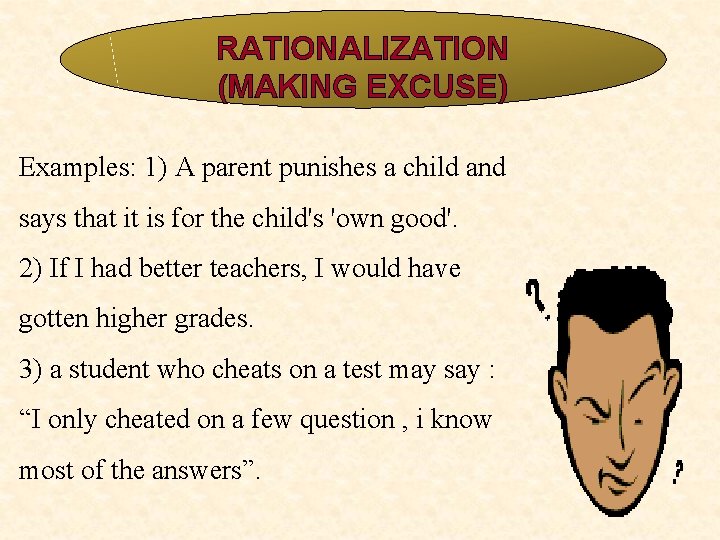
RATIONALIZATION (MAKING EXCUSE) Examples: 1) A parent punishes a child and says that it is for the child's 'own good'. 2) If I had better teachers, I would have gotten higher grades. 3) a student who cheats on a test may say : “I only cheated on a few question , i know most of the answers”.
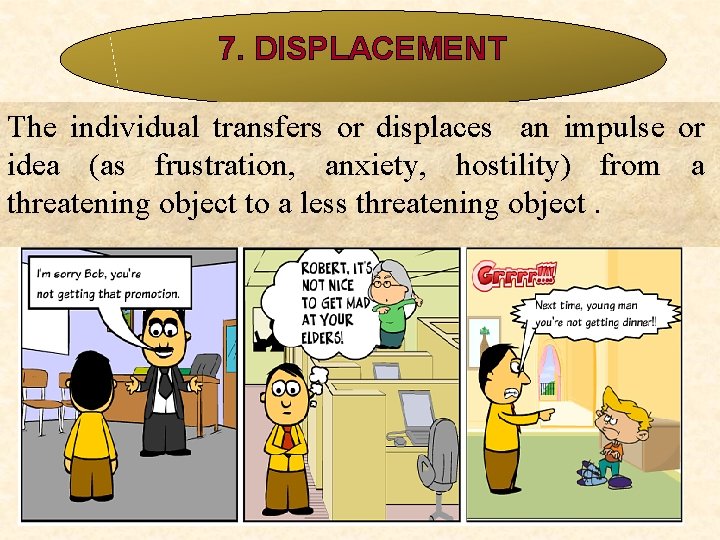
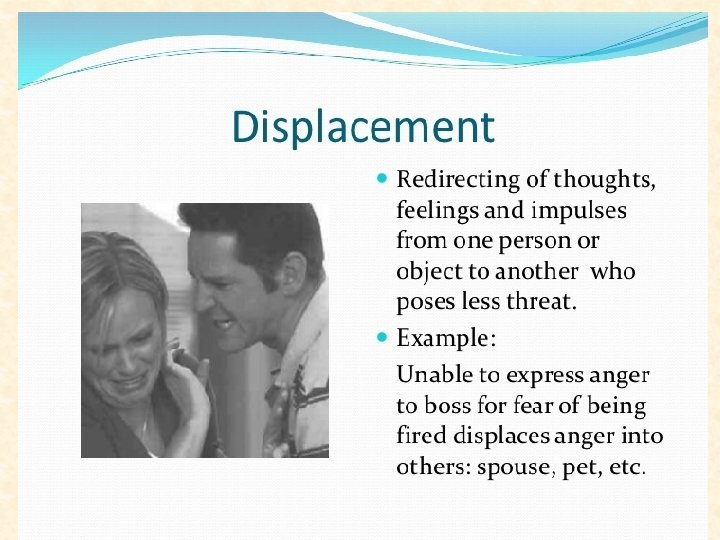
7. DISPLACEMENT The individual transfers or displaces an impulse or idea (as frustration, anxiety, hostility) from a threatening object to a less threatening object.
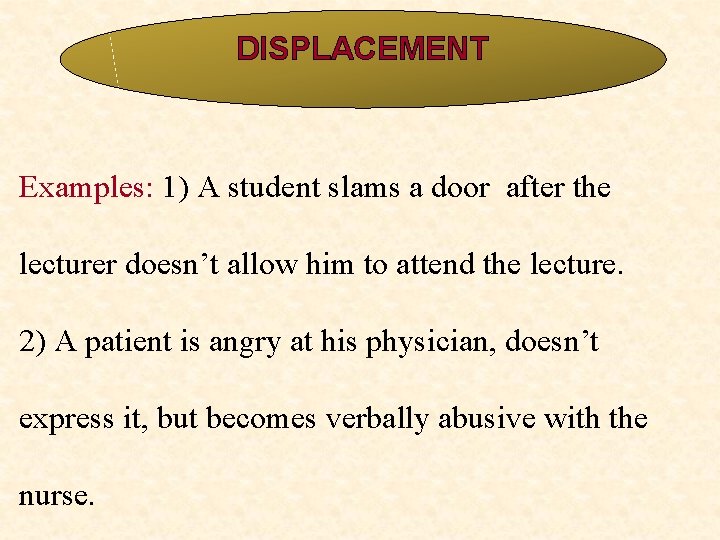
DISPLACEMENT Examples: 1) A student slams a door after the lecturer doesn’t allow him to attend the lecture. 2) A patient is angry at his physician, doesn’t express it, but becomes verbally abusive with the nurse.
8. INTELLECTUALIZATION “flight into reason” q An attempt to avoid expressing actual emotions associated with a stressful situation by using the intellectual processes of logic, reasoning, and analysis. q Individual transfers emotions and feelings into the intellectual domain.
INTELLECTUALIZATION Examples: 1) Abeer husband’s transferred with his job to a city far away from her parents. She hides anxiety by explaining to her parents the advantages associated with the move. 2) A family member close to you becomes terminally ill, you involve yourself in the study of the disease in order to avoid dealing with the emotions of the situation
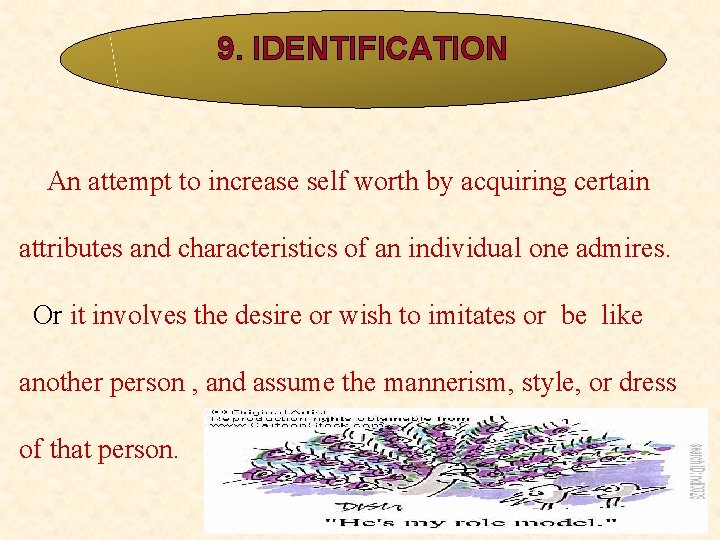
9. IDENTIFICATION An attempt to increase self worth by acquiring certain attributes and characteristics of an individual one admires. Or it involves the desire or wish to imitates or be like another person , and assume the mannerism, style, or dress of that person.
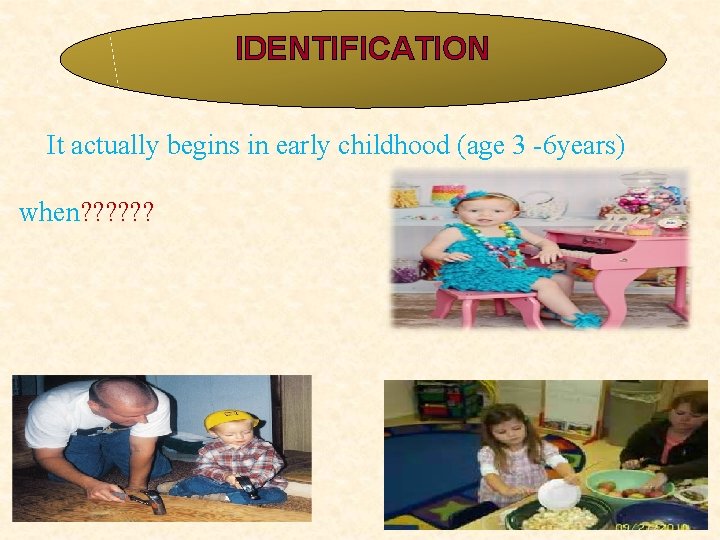
IDENTIFICATION It actually begins in early childhood (age 3 -6 years) when? ? ?
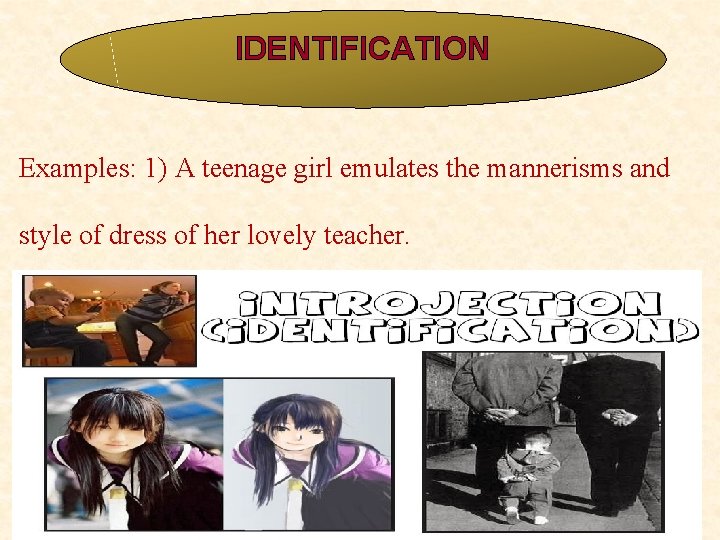
IDENTIFICATION Examples: 1) A teenage girl emulates the mannerisms and style of dress of her lovely teacher.
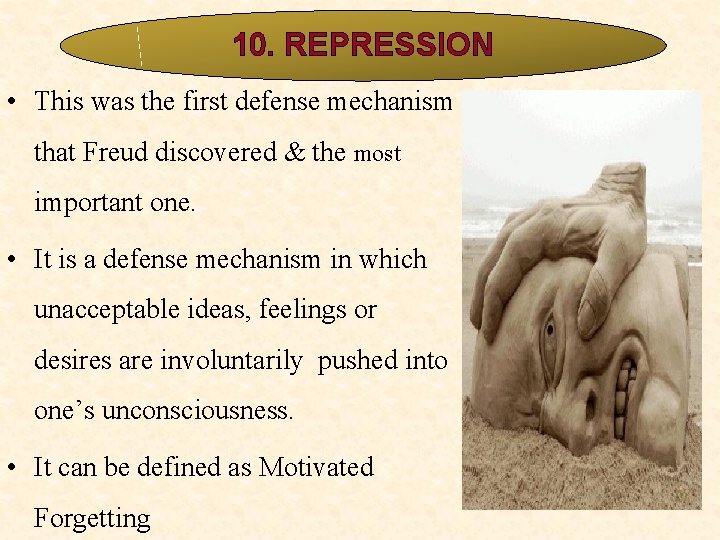
10. REPRESSION • This was the first defense mechanism that Freud discovered & the most important one. • It is a defense mechanism in which unacceptable ideas, feelings or desires are involuntarily pushed into one’s unconsciousness. • It can be defined as Motivated Forgetting
REPRESSION Example: - Hysterical Amnesia , in which the victim has performed or witnessed disturbing act & then completely forgotten the act itself & the circumstances surrounding it.
11. SUPPRESSION The only consciously defense mechanism. • Refers to voluntarily blocking of unpleasant feelings and experiences from one’s awareness.
SUPPRESSION • The suppressed content temporarily resides in the unconscious. • The individual is able to retrieve it at will (unlike repression). Examples: - 1) “I don’t want to think about that now. I’ll think about that tomorrow. ”
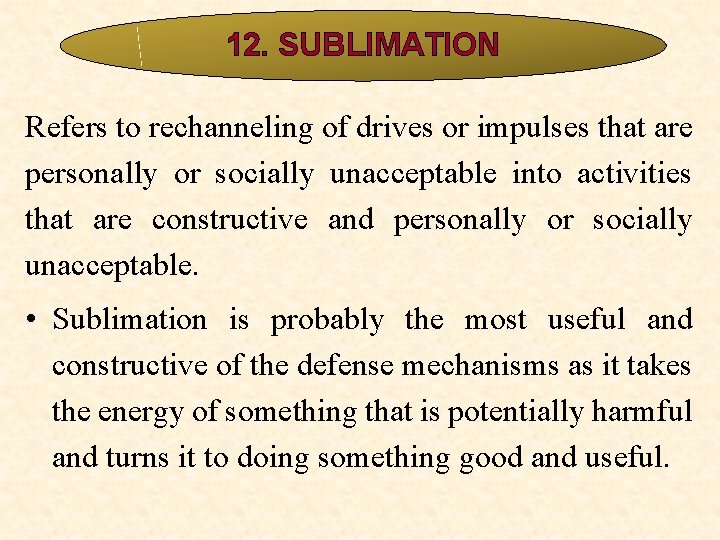
12. SUBLIMATION Refers to rechanneling of drives or impulses that are personally or socially unacceptable into activities that are constructive and personally or socially unacceptable. • Sublimation is probably the most useful and constructive of the defense mechanisms as it takes the energy of something that is potentially harmful and turns it to doing something good and useful.
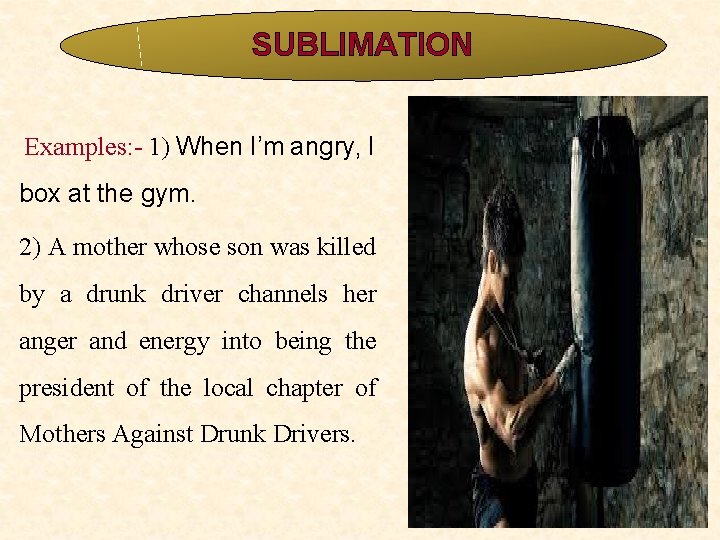
SUBLIMATION Examples: - 1) When I’m angry, I box at the gym. 2) A mother whose son was killed by a drunk driver channels her anger and energy into being the president of the local chapter of Mothers Against Drunk Drivers.
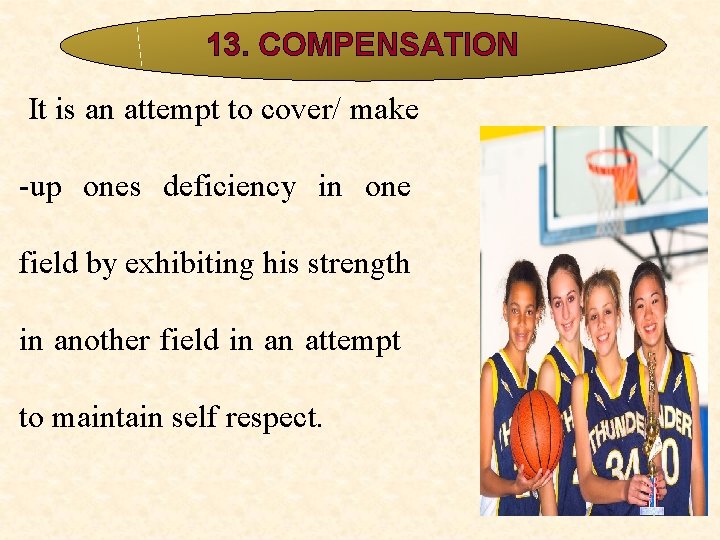
13. COMPENSATION It is an attempt to cover/ make -up ones deficiency in one field by exhibiting his strength in another field in an attempt to maintain self respect.
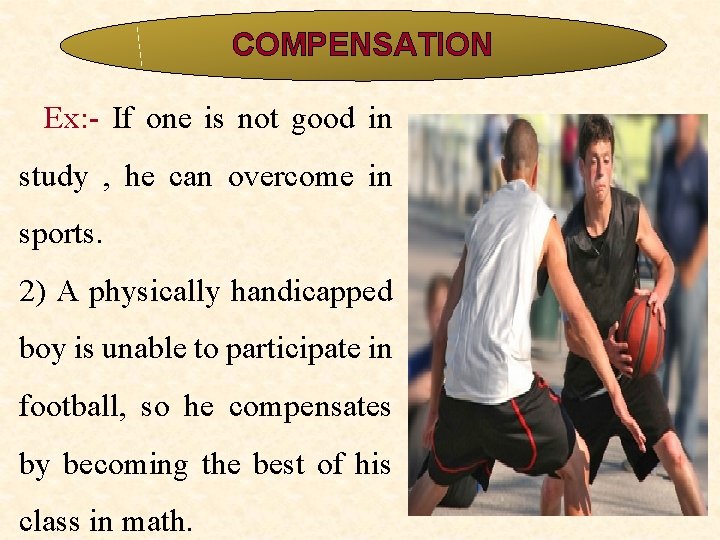
COMPENSATION Ex: - If one is not good in study , he can overcome in sports. 2) A physically handicapped boy is unable to participate in football, so he compensates by becoming the best of his class in math.
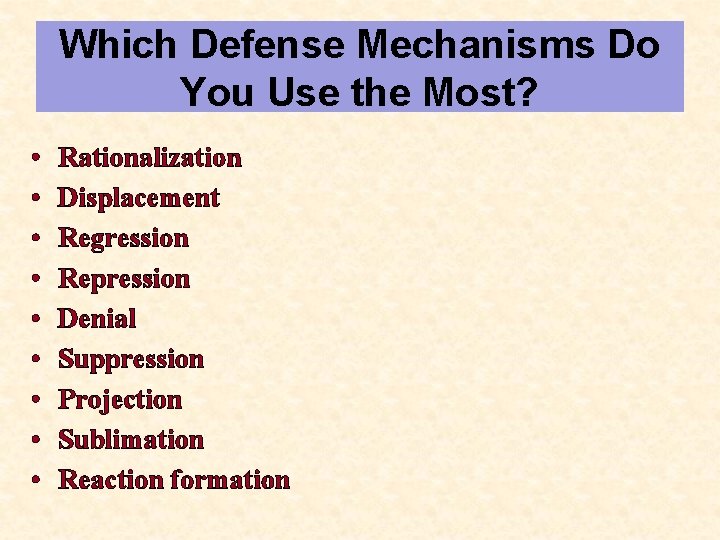
Which Defense Mechanisms Do You Use the Most? • • • Rationalization Displacement Regression Repression Denial Suppression Projection Sublimation Reaction formation
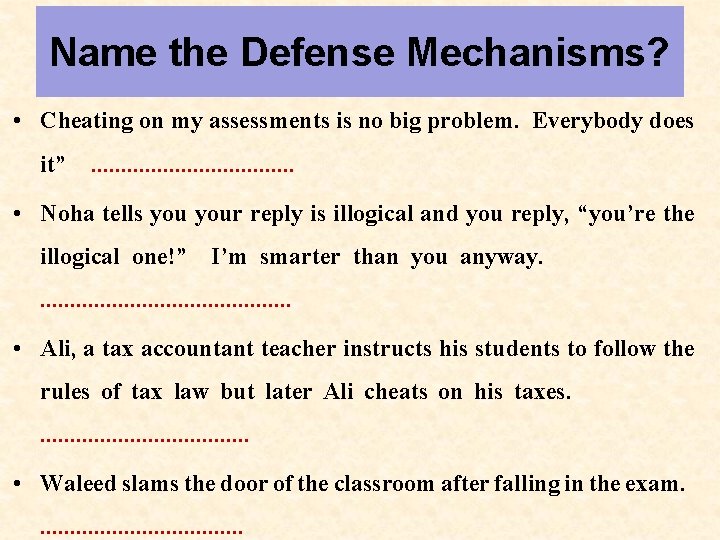
Name the Defense Mechanisms? • Cheating on my assessments is no big problem. Everybody does it” . . . . • Noha tells your reply is illogical and you reply, “you’re the illogical one!” I’m smarter than you anyway. . . • Ali, a tax accountant teacher instructs his students to follow the rules of tax law but later Ali cheats on his taxes. . . . . • Waleed slams the door of the classroom after falling in the exam. . . . .