
d EDM deuteron electric dipole moment Time reversal
- Slides: 14
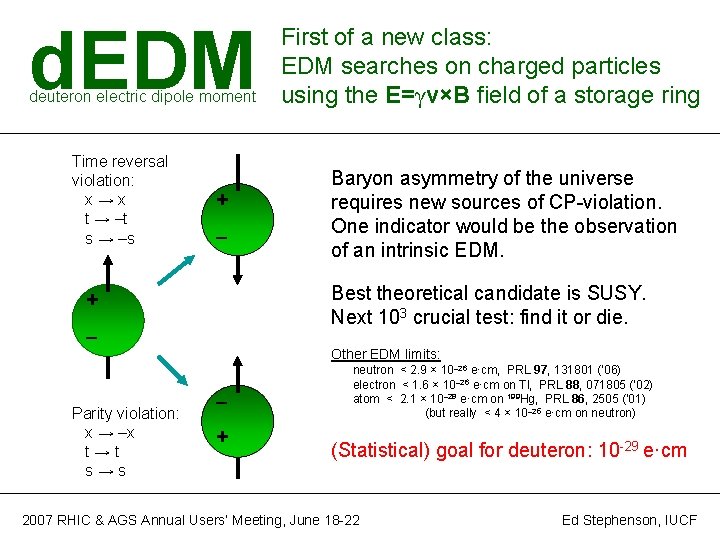
d. EDM deuteron electric dipole moment Time reversal violation: x→x t → –t s → –s + – Baryon asymmetry of the universe requires new sources of CP-violation. One indicator would be the observation of an intrinsic EDM. Best theoretical candidate is SUSY. Next 103 crucial test: find it or die. + – Parity violation: x → –x t→t s→s First of a new class: EDM searches on charged particles using the E=γv×B field of a storage ring Other EDM limits: – + neutron < 2. 9 × 10– 26 e·cm, PRL 97, 131801 (’ 06) electron < 1. 6 × 10– 26 e·cm on Tl, PRL 88, 071805 (’ 02) atom < 2. 1 × 10– 28 e·cm on 199 Hg, PRL 86, 2505 (’ 01) (but really < 4 × 10– 25 e·cm on neutron) (Statistical) goal for deuteron: 10 -29 e·cm 2007 RHIC & AGS Annual Users’ Meeting, June 18 -22 Ed Stephenson, IUCF
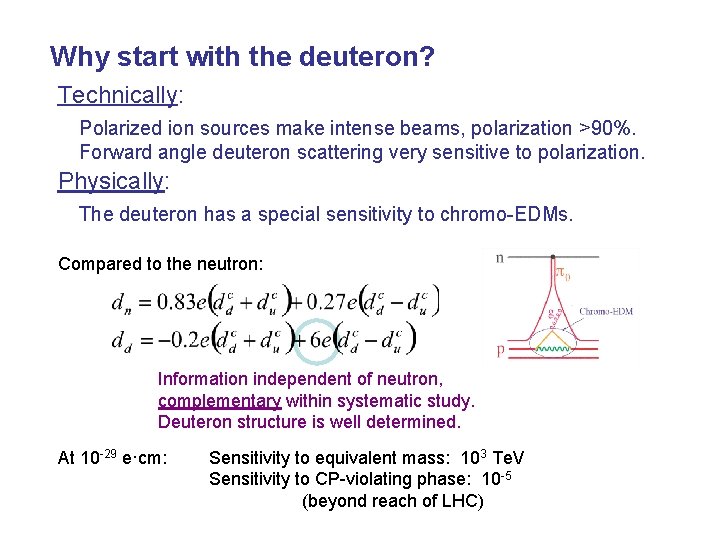
Why start with the deuteron? Technically: Polarized ion sources make intense beams, polarization >90%. Forward angle deuteron scattering very sensitive to polarization. Physically: The deuteron has a special sensitivity to chromo-EDMs. Compared to the neutron: Information independent of neutron, complementary within systematic study. Deuteron structure is well determined. At 10 -29 e·cm: Sensitivity to equivalent mass: 103 Te. V Sensitivity to CP-violating phase: 10 -5 (beyond reach of LHC)
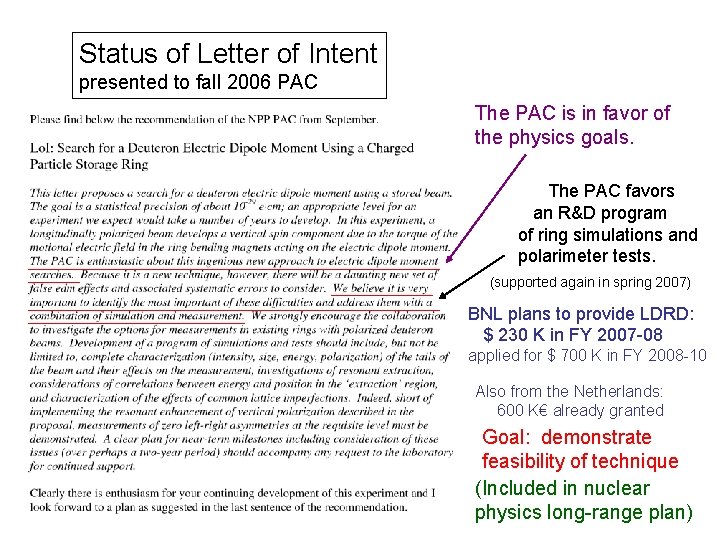
Status of Letter of Intent presented to fall 2006 PAC The PAC is in favor of the physics goals. The PAC favors an R&D program of ring simulations and polarimeter tests. (supported again in spring 2007) BNL plans to provide LDRD: $ 230 K in FY 2007 -08 applied for $ 700 K in FY 2008 -10 Also from the Netherlands: 600 K€ already granted Goal: demonstrate feasibility of technique (Included in nuclear physics long-range plan)
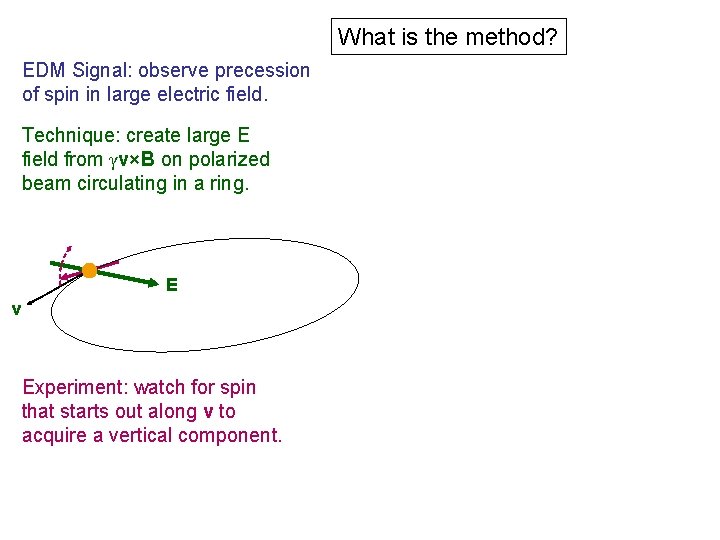
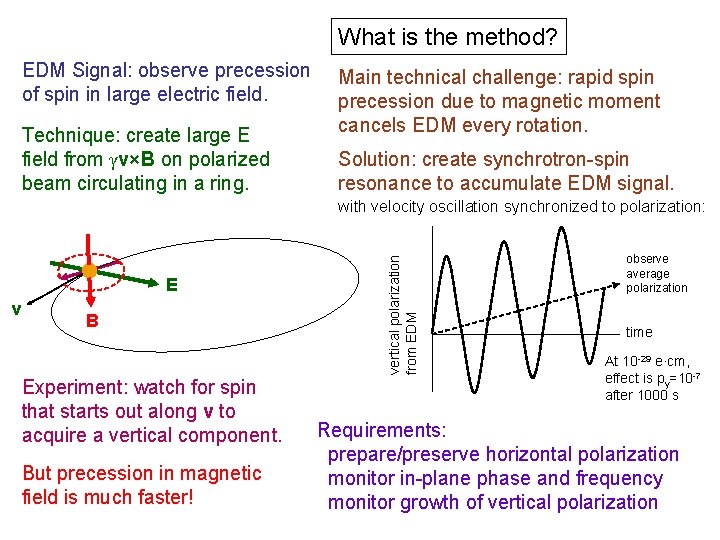
What is the method? EDM Signal: observe precession of spin in large electric field. Technique: create large E field from γv×B on polarized beam circulating in a ring. E v Experiment: watch for spin that starts out along v to acquire a vertical component.
What is the method? EDM Signal: observe precession of spin in large electric field. Technique: create large E field from γv×B on polarized beam circulating in a ring. Main technical challenge: rapid spin precession due to magnetic moment cancels EDM every rotation. Solution: create synchrotron-spin resonance to accumulate EDM signal. E v B Experiment: watch for spin that starts out along v to acquire a vertical component. But precession in magnetic field is much faster! vertical polarization from EDM with velocity oscillation synchronized to polarization: observe average polarization time At 10 -29 e·cm, effect is py=10 -7 after 1000 s Requirements: prepare/preserve horizontal polarization monitor in-plane phase and frequency monitor growth of vertical polarization
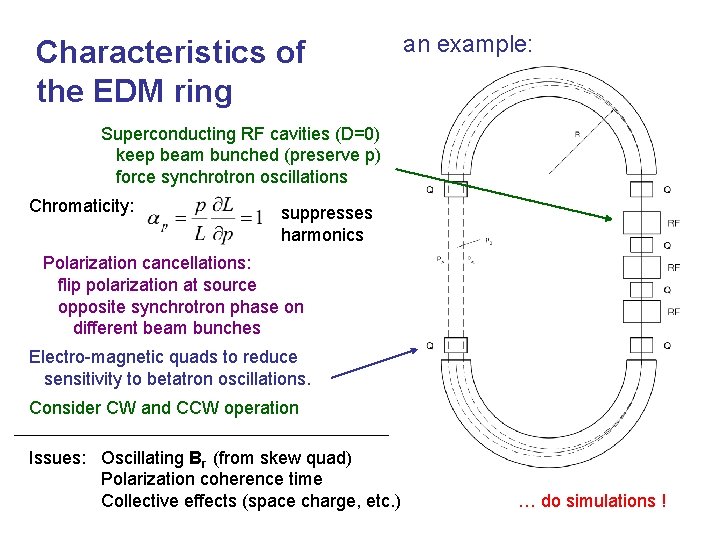
Characteristics of the EDM ring an example: Superconducting RF cavities (D=0) keep beam bunched (preserve p) force synchrotron oscillations Chromaticity: suppresses harmonics Polarization cancellations: flip polarization at source opposite synchrotron phase on different beam bunches Electro-magnetic quads to reduce sensitivity to betatron oscillations. Consider CW and CCW operation Issues: Oscillating Br (from skew quad) Polarization coherence time Collective effects (space charge, etc. ) … do simulations !
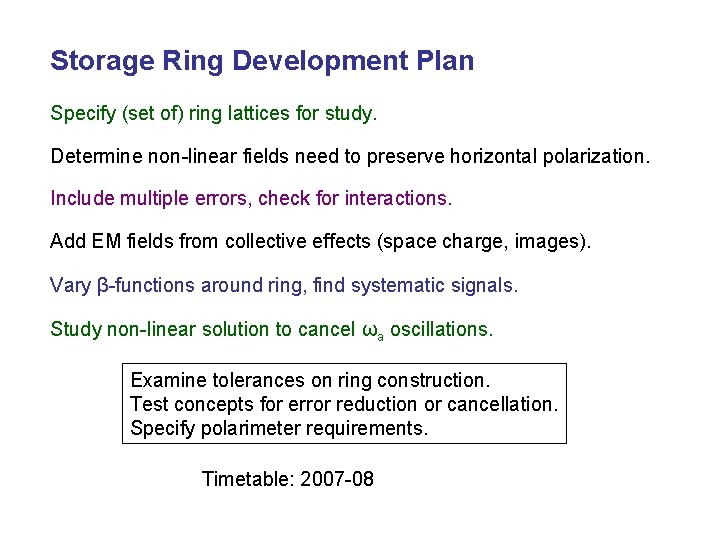
Storage Ring Development Plan Specify (set of) ring lattices for study. Determine non-linear fields need to preserve horizontal polarization. Include multiple errors, check for interactions. Add EM fields from collective effects (space charge, images). Vary β-functions around ring, find systematic signals. Study non-linear solution to cancel ωa oscillations. Examine tolerances on ring construction. Test concepts for error reduction or cancellation. Specify polarimeter requirements. Timetable: 2007 -08
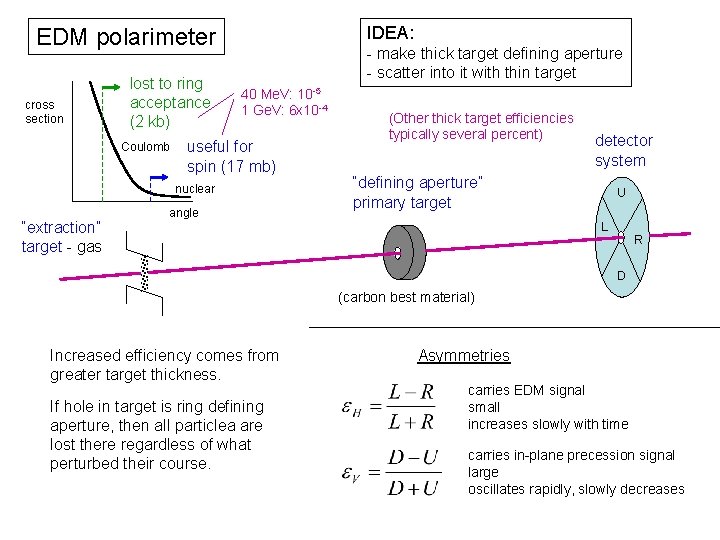
IDEA: EDM polarimeter cross section lost to ring acceptance (2 kb) Coulomb - make thick target defining aperture - scatter into it with thin target 40 Me. V: 10 -5 1 Ge. V: 6 x 10 -4 useful for spin (17 mb) nuclear “extraction” target - gas angle (Other thick target efficiencies typically several percent) detector system “defining aperture” primary target U L R D (carbon best material) Increased efficiency comes from greater target thickness. If hole in target is ring defining aperture, then all particlea are lost there regardless of what perturbed their course. Asymmetries carries EDM signal small increases slowly with time carries in-plane precession signal large oscillates rapidly, slowly decreases
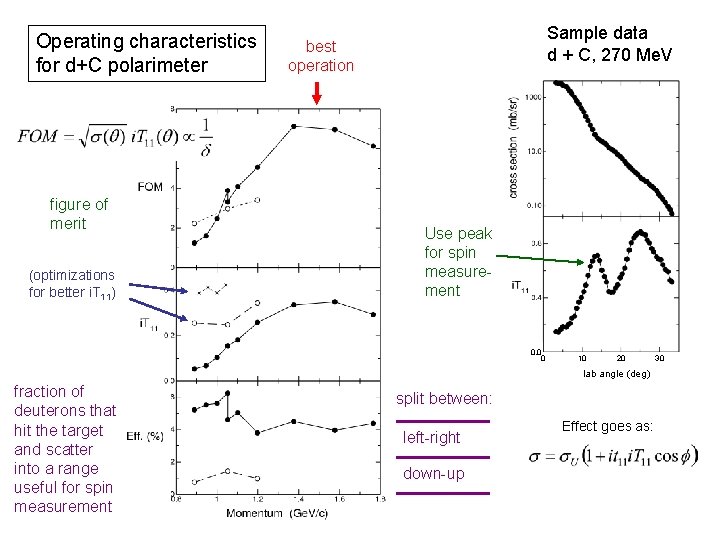
Operating characteristics for d+C polarimeter figure of merit (optimizations for better i. T 11) Sample data d + C, 270 Me. V best operation Use peak for spin measurement 0. 0 0 10 20 lab angle (deg) fraction of deuterons that hit the target and scatter into a range useful for spin measurement split between: left-right down-up Effect goes as: 30
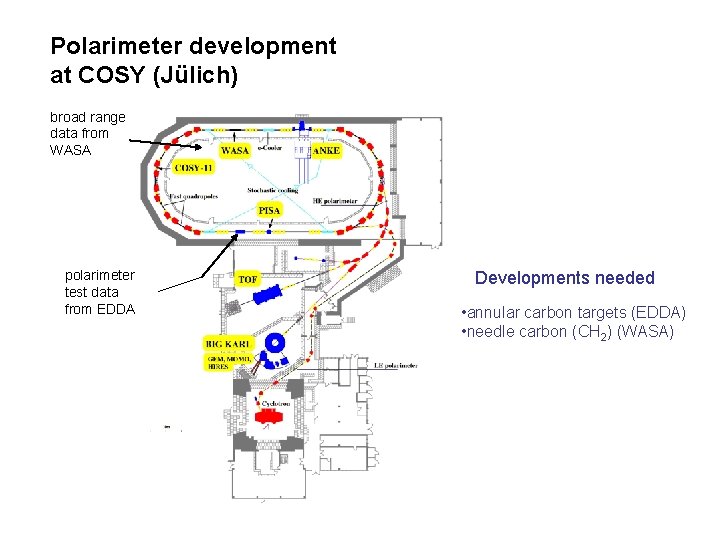
Polarimeter development at COSY (Jülich) broad range data from WASA polarimeter test data from EDDA Developments needed • annular carbon targets (EDDA) • needle carbon (CH 2) (WASA)
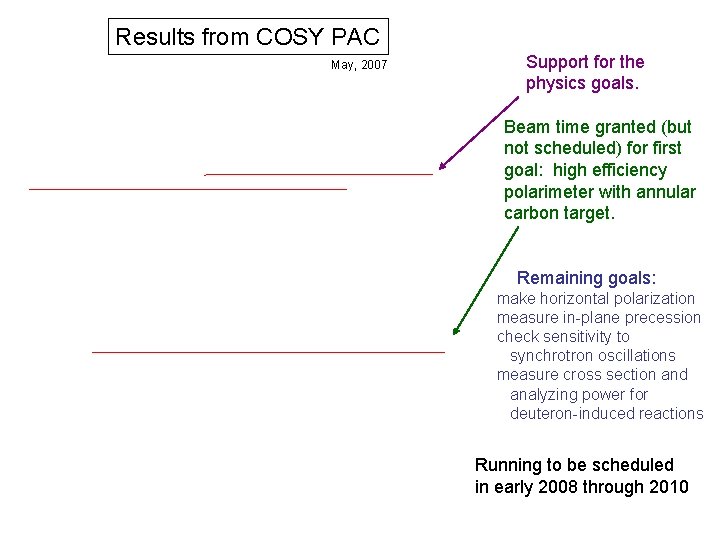
Results from COSY PAC May, 2007 Support for the physics goals. Beam time granted (but not scheduled) for first goal: high efficiency polarimeter with annular carbon target. Remaining goals: make horizontal polarization measure in-plane precession check sensitivity to synchrotron oscillations measure cross section and analyzing power for deuteron-induced reactions Running to be scheduled in early 2008 through 2010
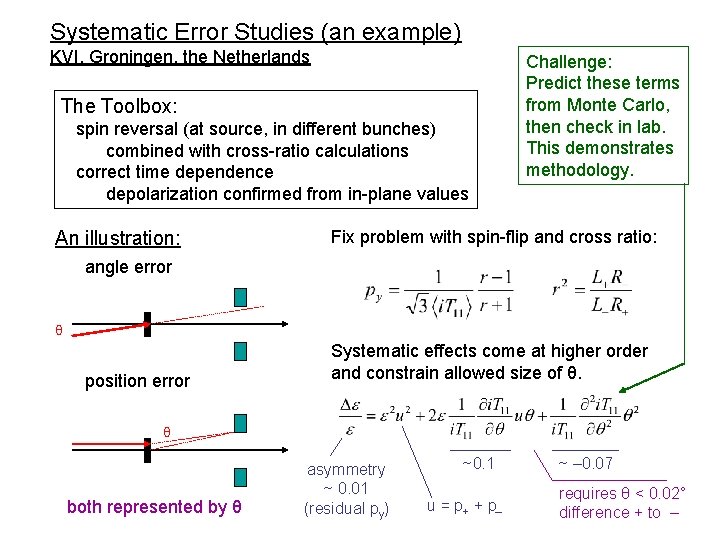
Systematic Error Studies (an example) KVI, Groningen, the Netherlands The Toolbox: spin reversal (at source, in different bunches) combined with cross-ratio calculations correct time dependence depolarization confirmed from in-plane values An illustration: Challenge: Predict these terms from Monte Carlo, then check in lab. This demonstrates methodology. Fix problem with spin-flip and cross ratio: angle error θ position error Systematic effects come at higher order and constrain allowed size of θ. θ both represented by θ asymmetry ~ 0. 01 (residual py) ~0. 1 u = p + + p– ~ – 0. 07 requires θ < 0. 02° difference + to –
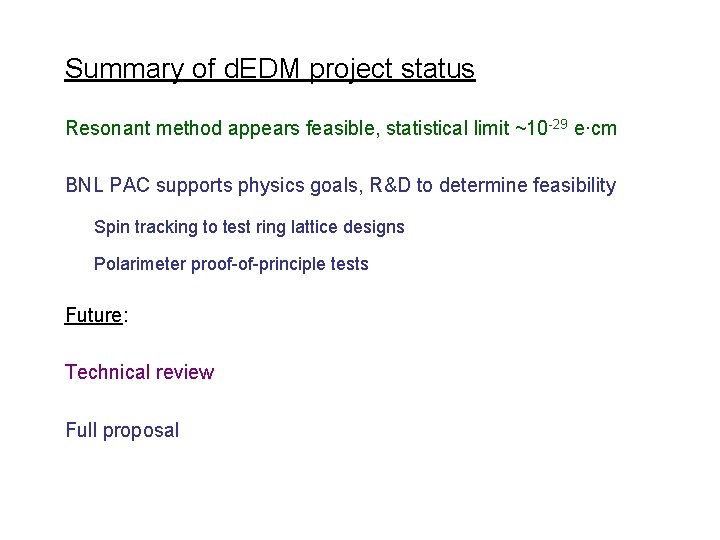
Summary of d. EDM project status Resonant method appears feasible, statistical limit ~10 -29 e·cm BNL PAC supports physics goals, R&D to determine feasibility Spin tracking to test ring lattice designs Polarimeter proof-of-principle tests Future: Technical review Full proposal
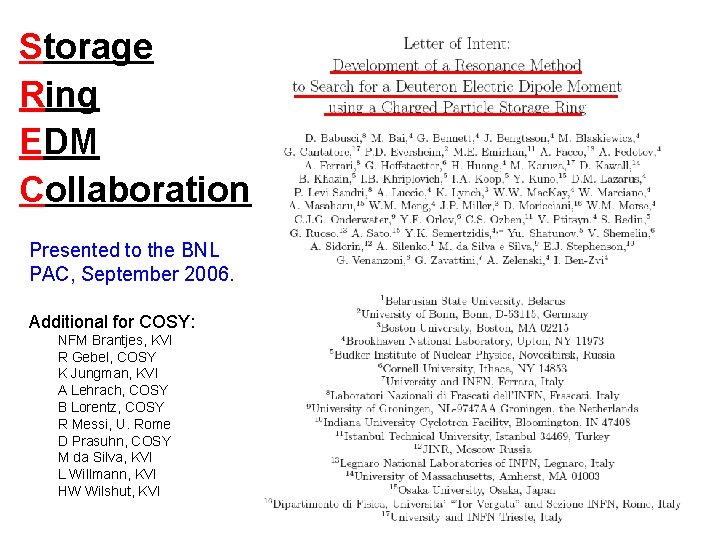
Storage Ring EDM Collaboration Presented to the BNL PAC, September 2006. Additional for COSY: NFM Brantjes, KVI R Gebel, COSY K Jungman, KVI A Lehrach, COSY B Lorentz, COSY R Messi, U. Rome D Prasuhn, COSY M da Silva, KVI L Willmann, KVI HW Wilshut, KVI