
D E S I R E Dose Estimation
- Slides: 19
D E S I R E Dose Estimation by Simulation of the ISS Radiation Environment http: //www. particle. kth. se/desire/ Geant 4 simulations of the Columbus/ISS radiation environment T. Ersmark 1, P. Carlson 1, E. Daly 2, C. Fuglesang 3, I. Gudowska 4, B. Lund-Jensen 1, R. Nartallo 2, P. Nieminen 2, M. Pearce 1, G. Santin 2, N. Sobolevsky 5 1 Royal Institute of Technology (KTH) (Stockholm) 2 ESA-ESTEC (Noordwijk) 3 EAC/JSC (Cologne/Houston) 4 Karolinska Institutet (Stockholm) 5 Institute for Nuclear Research (Moscow) SPENVIS and Geant 4 Workshop, Leuven, 051006, Tore Ersmark (KTH)
Outline 1. 2. 3. 4. 5. 6. The DESIRE project Geant 4 physics validation studies Columbus and ISS geometries Radiation environment models Simulation results Conclusions and future SPENVIS and Geant 4 Workshop, Leuven, 051006, Tore Ersmark (KTH) 2
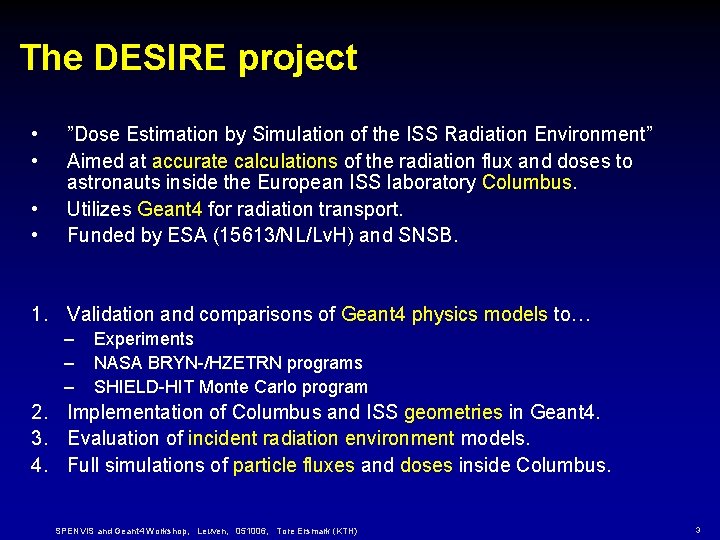
The DESIRE project • • ”Dose Estimation by Simulation of the ISS Radiation Environment” Aimed at accurate calculations of the radiation flux and doses to astronauts inside the European ISS laboratory Columbus. Utilizes Geant 4 for radiation transport. Funded by ESA (15613/NL/Lv. H) and SNSB. 1. Validation and comparisons of Geant 4 physics models to… – – – Experiments NASA BRYN-/HZETRN programs SHIELD-HIT Monte Carlo program 2. Implementation of Columbus and ISS geometries in Geant 4. 3. Evaluation of incident radiation environment models. 4. Full simulations of particle fluxes and doses inside Columbus. SPENVIS and Geant 4 Workshop, Leuven, 051006, Tore Ersmark (KTH) 3
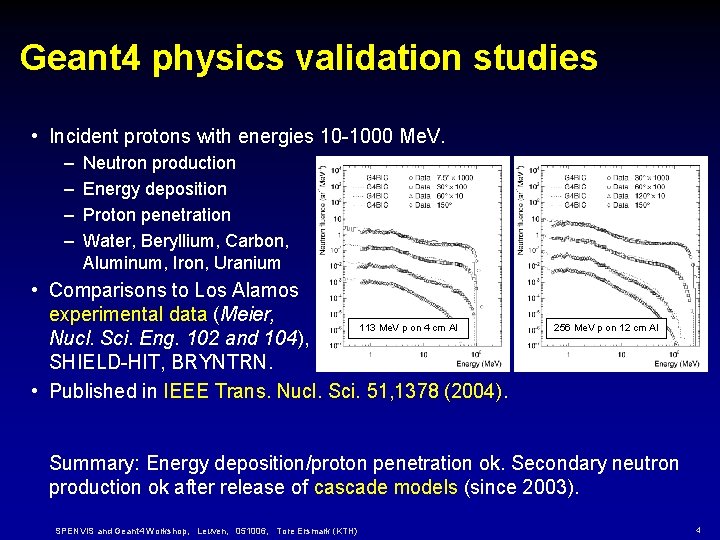
Geant 4 physics validation studies • Incident protons with energies 10 -1000 Me. V. – – Neutron production Energy deposition Proton penetration Water, Beryllium, Carbon, Aluminum, Iron, Uranium • Comparisons to Los Alamos experimental data (Meier, 113 Me. V p on 4 cm Al Nucl. Sci. Eng. 102 and 104), SHIELD-HIT, BRYNTRN. • Published in IEEE Trans. Nucl. Sci. 51, 1378 (2004). 256 Me. V p on 12 cm Al Summary: Energy deposition/proton penetration ok. Secondary neutron production ok after release of cascade models (since 2003). SPENVIS and Geant 4 Workshop, Leuven, 051006, Tore Ersmark (KTH) 4
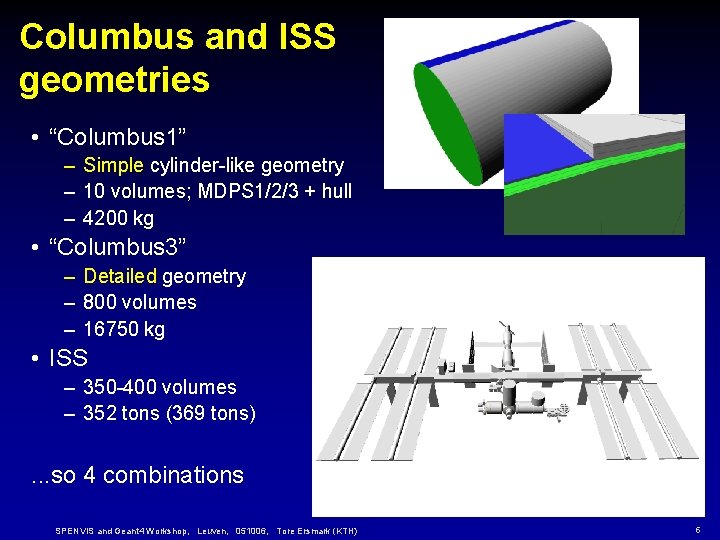
Columbus and ISS geometries • “Columbus 1” – Simple cylinder-like geometry – 10 volumes; MDPS 1/2/3 + hull – 4200 kg • “Columbus 3” – Detailed geometry – 800 volumes – 16750 kg • ISS – 350 -400 volumes – 352 tons (369 tons) . . . so 4 combinations SPENVIS and Geant 4 Workshop, Leuven, 051006, Tore Ersmark (KTH) 5
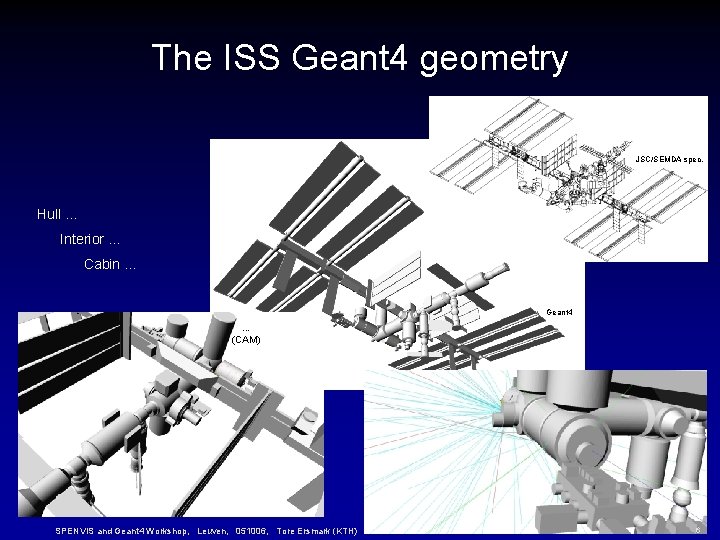
The ISS Geant 4 geometry JSC/SEMDA spec. Hull. . . Interior. . . Cabin. . . Geant 4 . . . (CAM) SPENVIS and Geant 4 Workshop, Leuven, 051006, Tore Ersmark (KTH) 6
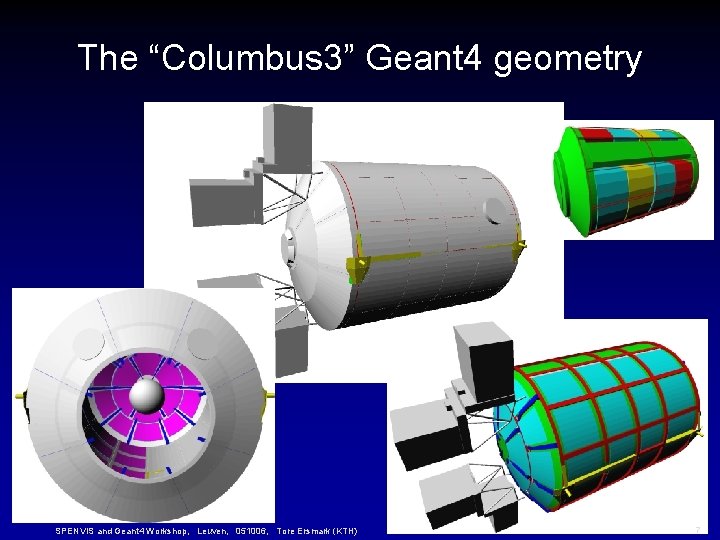
The “Columbus 3” Geant 4 geometry SPENVIS and Geant 4 Workshop, Leuven, 051006, Tore Ersmark (KTH) 7
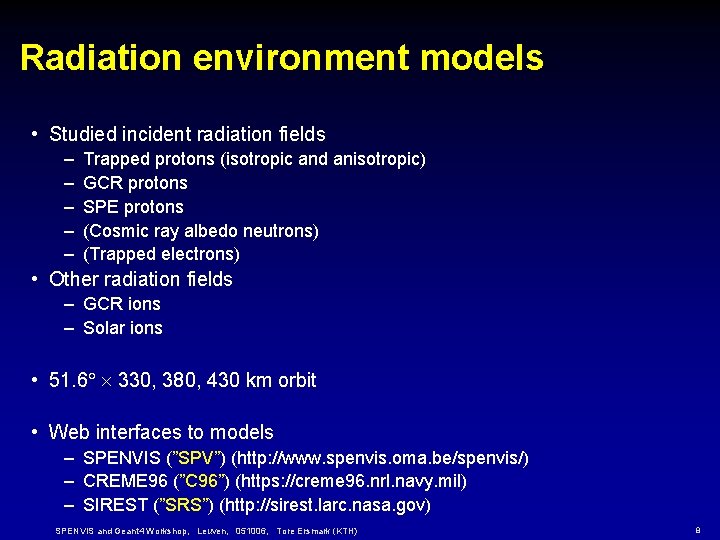
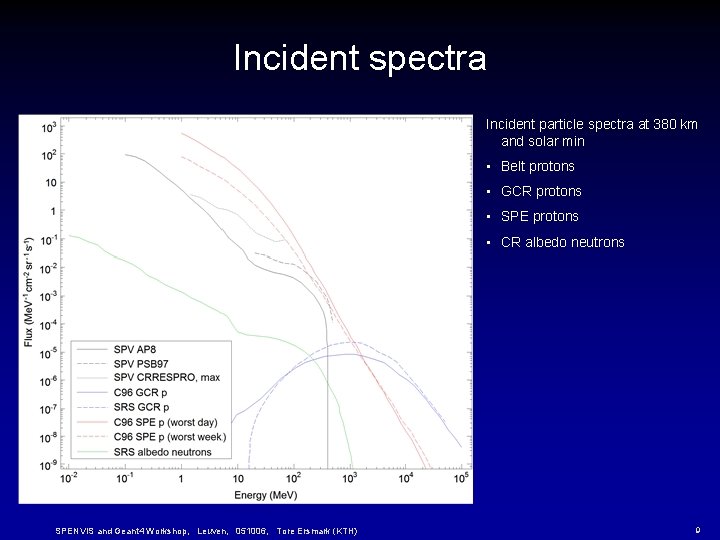
Radiation environment models • Studied incident radiation fields – – – Trapped protons (isotropic and anisotropic) GCR protons SPE protons (Cosmic ray albedo neutrons) (Trapped electrons) • Other radiation fields – GCR ions – Solar ions • 51. 6 330, 380, 430 km orbit • Web interfaces to models – SPENVIS (”SPV”) (http: //www. spenvis. oma. be/spenvis/) – CREME 96 (”C 96”) (https: //creme 96. nrl. navy. mil) – SIREST (”SRS”) (http: //sirest. larc. nasa. gov) SPENVIS and Geant 4 Workshop, Leuven, 051006, Tore Ersmark (KTH) 8
Incident spectra Incident particle spectra at 380 km and solar min • Belt protons • GCR protons • SPE protons • CR albedo neutrons SPENVIS and Geant 4 Workshop, Leuven, 051006, Tore Ersmark (KTH) 9
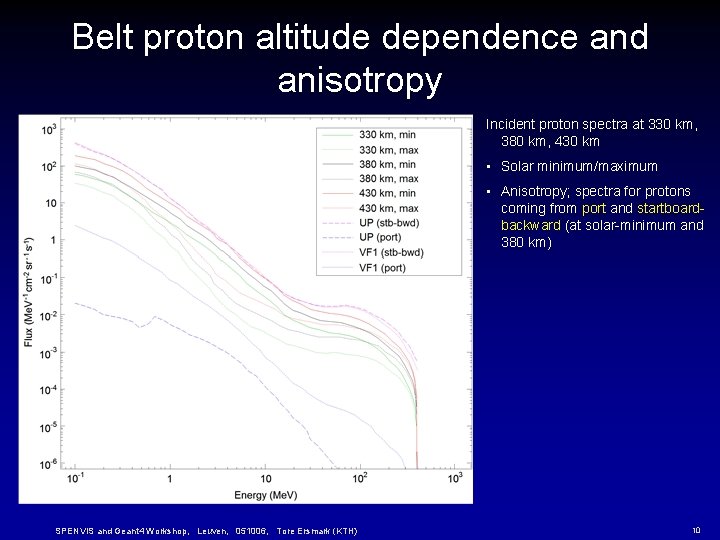
Belt proton altitude dependence and anisotropy Incident proton spectra at 330 km, 380 km, 430 km • Solar minimum/maximum • Anisotropy; spectra for protons coming from port and startboardbackward (at solar-minimum and 380 km) SPENVIS and Geant 4 Workshop, Leuven, 051006, Tore Ersmark (KTH) 10
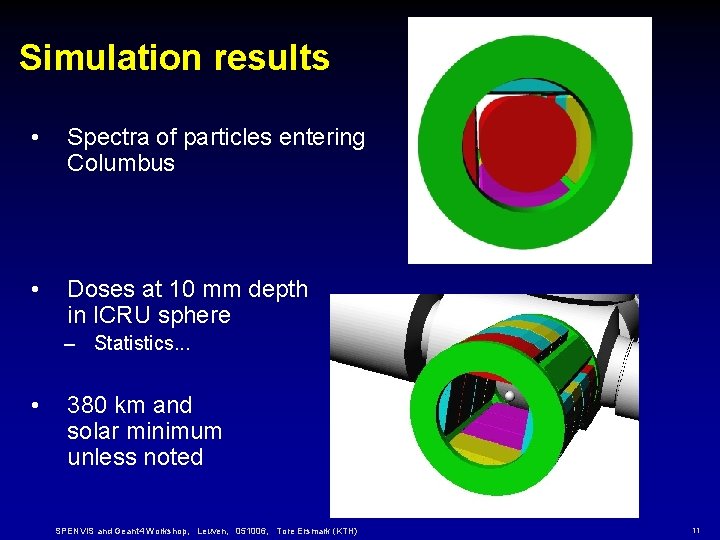
Simulation results • Spectra of particles entering Columbus • Doses at 10 mm depth in ICRU sphere – Statistics. . . • 380 km and solar minimum unless noted SPENVIS and Geant 4 Workshop, Leuven, 051006, Tore Ersmark (KTH) 11
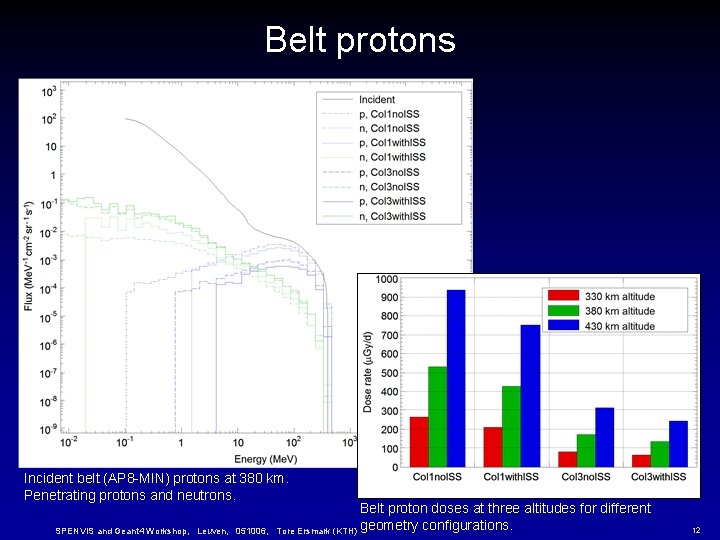
Belt protons Incident belt (AP 8 -MIN) protons at 380 km. Penetrating protons and neutrons. SPENVIS and Geant 4 Workshop, Leuven, 051006, Belt proton doses at three altitudes for different geometry configurations. Tore Ersmark (KTH) 12
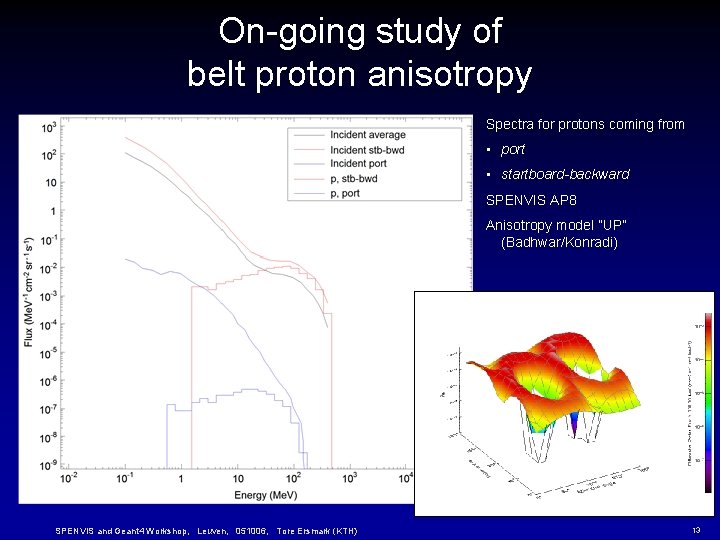
On-going study of belt proton anisotropy Spectra for protons coming from • port • startboard-backward SPENVIS AP 8 Anisotropy model ”UP” (Badhwar/Konradi) SPENVIS and Geant 4 Workshop, Leuven, 051006, Tore Ersmark (KTH) 13
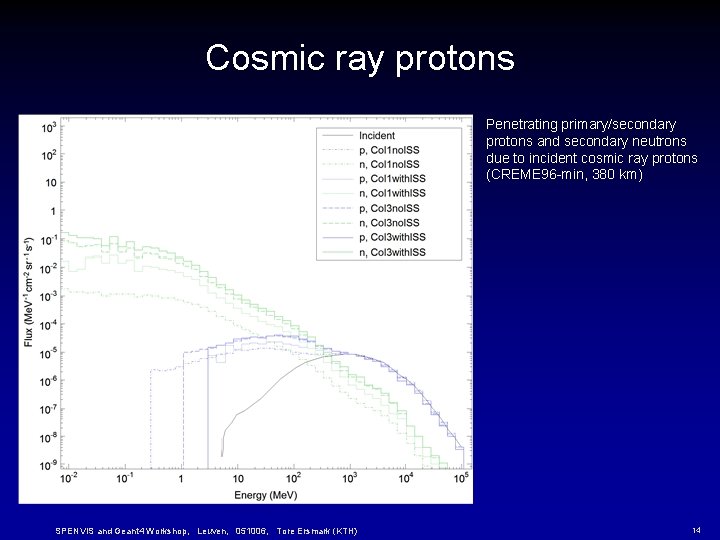
Cosmic ray protons Penetrating primary/secondary protons and secondary neutrons due to incident cosmic ray protons (CREME 96 -min, 380 km) SPENVIS and Geant 4 Workshop, Leuven, 051006, Tore Ersmark (KTH) 14
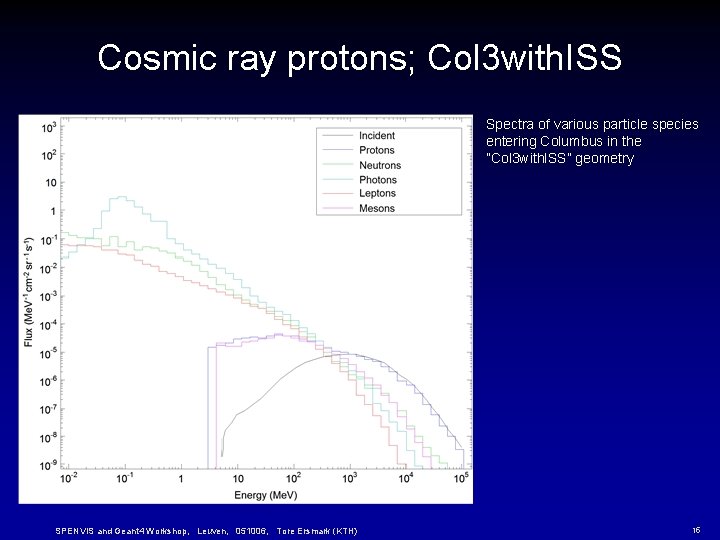
Cosmic ray protons; Col 3 with. ISS Spectra of various particle species entering Columbus in the ”Col 3 with. ISS” geometry SPENVIS and Geant 4 Workshop, Leuven, 051006, Tore Ersmark (KTH) 15
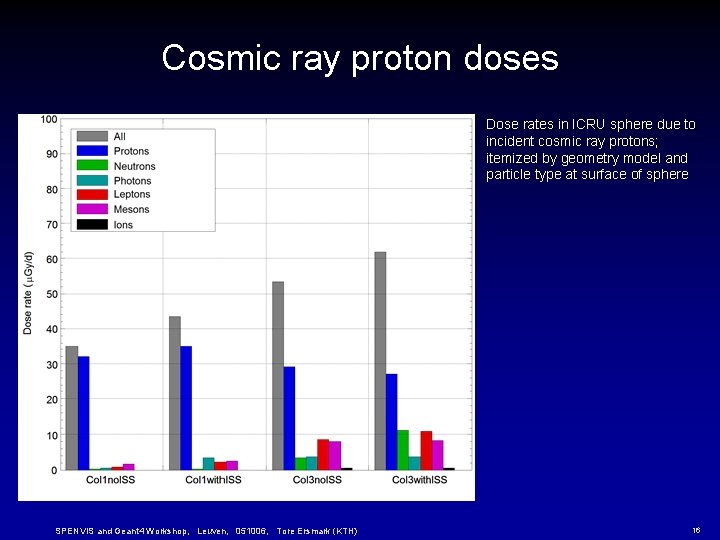
Cosmic ray proton doses Dose rates in ICRU sphere due to incident cosmic ray protons; itemized by geometry model and particle type at surface of sphere SPENVIS and Geant 4 Workshop, Leuven, 051006, Tore Ersmark (KTH) 16
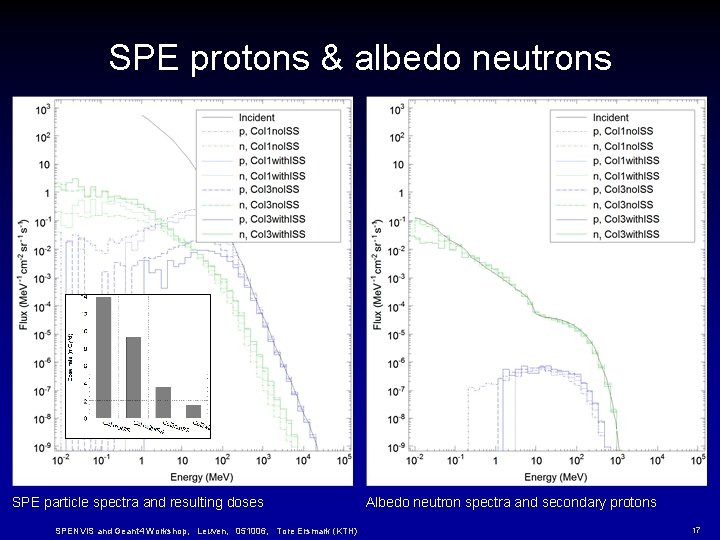
SPE protons & albedo neutrons SPE particle spectra and resulting doses SPENVIS and Geant 4 Workshop, Leuven, 051006, Tore Ersmark (KTH) Albedo neutron spectra and secondary protons 17
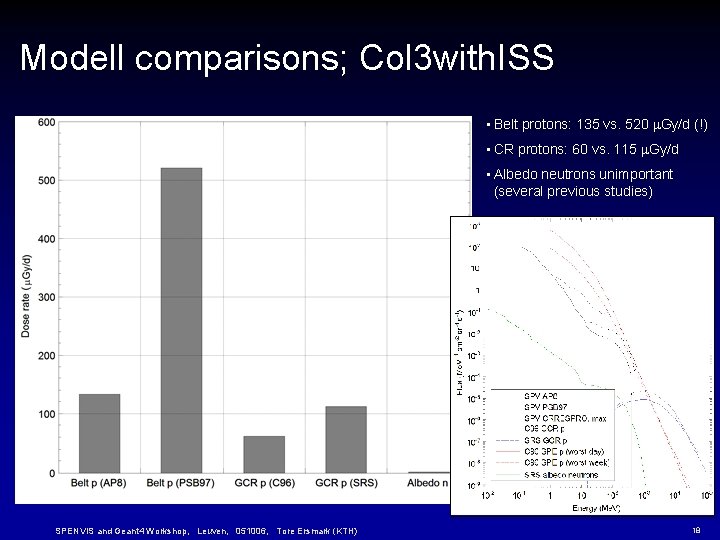
Modell comparisons; Col 3 with. ISS • Belt protons: 135 vs. 520 Gy/d (!) • CR protons: 60 vs. 115 Gy/d • Albedo neutrons unimportant (several previous studies) SPENVIS and Geant 4 Workshop, Leuven, 051006, Tore Ersmark (KTH) 18
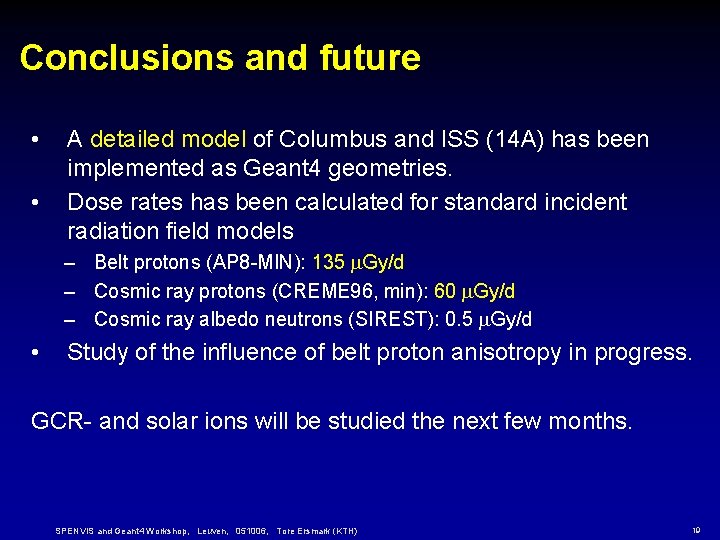
Conclusions and future • • A detailed model of Columbus and ISS (14 A) has been implemented as Geant 4 geometries. Dose rates has been calculated for standard incident radiation field models – Belt protons (AP 8 -MIN): 135 Gy/d – Cosmic ray protons (CREME 96, min): 60 Gy/d – Cosmic ray albedo neutrons (SIREST): 0. 5 Gy/d • Study of the influence of belt proton anisotropy in progress. GCR- and solar ions will be studied the next few months. SPENVIS and Geant 4 Workshop, Leuven, 051006, Tore Ersmark (KTH) 19