
D Digital Trip Relay 6 IO InputOutput Port

- Slides: 8
D. Digital Trip Relay 6. IO (Input-Output) Port RS-485 MODBUS COMM. Other Network d Local Systems ar nd r fo P, S a St RTU Terminating Resistance - P and S type are equipped with RS 485 communication terminal. 1. Terminal number is 485+ 485 -. 2. Communication available at speed of 9600 bps, 19200 bps, 38400 bps, 57600 bps. 3. There is no terminating resistance within the device. Thus, add a 150Ω terminating resistance at the end after composing RS-485 line. 4. Monitoring all the measurement item and recording elements of P/S type are available via communication. 5. MODBUS communication map is put in a separate manual. (Refer to P/S type MODBUS map) 6. Various data of P, S type can be initialized and reset, when the device is set at Remote. Also, DO related control can be performed. pe Ty RS-485 Line 485+ 485 - 150Ω Digital Trip Relay PLC Profibus -DP COMM. - P and S type are equipped with RS-485 FA Network communication terminal. 1. Terminal number is 485+ 485 -. 2. Possible to transmit data by installing Profibus-DP module on the exterior, which is often used in factor automation. e as ch 3. There is no terminating resistance within resistance at the end after composing RS 485 line. te ra r pu RS-485 Line a p Se 4. For details on Profibus-DP 485+ 485 - communication, refer to Profibus-DP communication module manual. 0 Terminating Resistance the device. Thus, add a 150Ω terminating Profibus-DP comm. module 150Ω
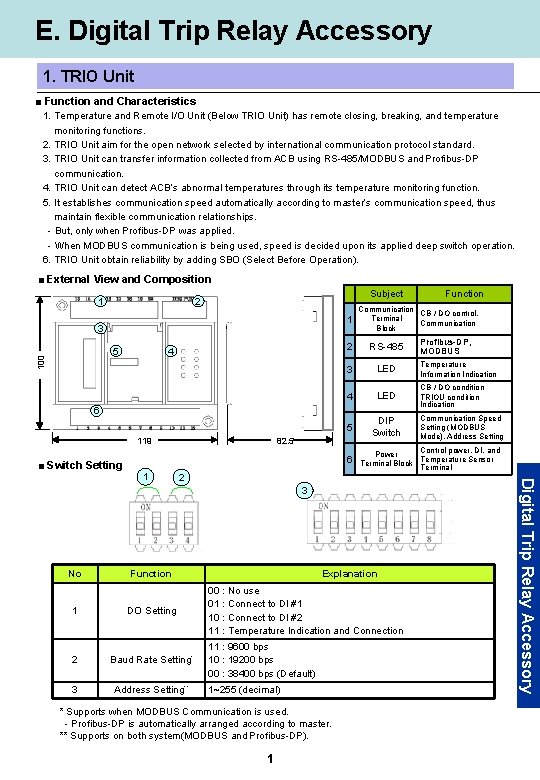
E. Digital Trip Relay Accessory 1. TRIO Unit ■ Function and Characteristics 1. Temperature and Remote I/O Unit (Below TRIO Unit) has remote closing, breaking, and temperature monitoring functions. 2. TRIO Unit aim for the open network selected by international communication protocol standard. 3. TRIO Unit can transfer information collected from ACB using RS-485/MODBUS and Profibus-DP communication. 4. TRIO Unit can detect ACB’s abnormal temperatures through its temperature monitoring function. 5. It establishes communication speed automatically according to master’s communication speed, thus maintain flexible communication relationships. - But, only when Profibus-DP was applied. - When MODBUS communication is being used, speed is decided upon its applied deep switch operation. 6. TRIO Unit obtain reliability by adding SBO (Select Before Operation). ■ External View and Composition 1 Subject 2 1 3 100 5 4 RS-485 3 LED Temperature Information Indication 4 LED CB / DO condition TRIOU condition Indication 5 DIP Switch 82. 5 6 ■ Switch Setting Control power, DI, and Power Temperature Sensor Terminal Block Terminal 2 3 No Function 1 DO Setting 2 Baud Rate Setting* 3 Address Setting** Explanation 00 : No use 01 : Connect to DI #1 10 : Connect to DI #2 11 : Temperature Indication and Connection 11 : 9600 bps 10 : 19200 bps 00 : 38400 bps (Default) 1~255 (decimal) * Supports when MODBUS Communication is used. - Profibus-DP is automatically arranged according to master. ** Supports on both system(MODBUS and Profibus-DP). 1 Communication Speed Setting (MODBUS Mode), Address Setting Digital Trip Relay Accessory 1 Profibus-DP, MODBUS 2 6 119 Function Communication CB / DO control, Terminal Communication Block
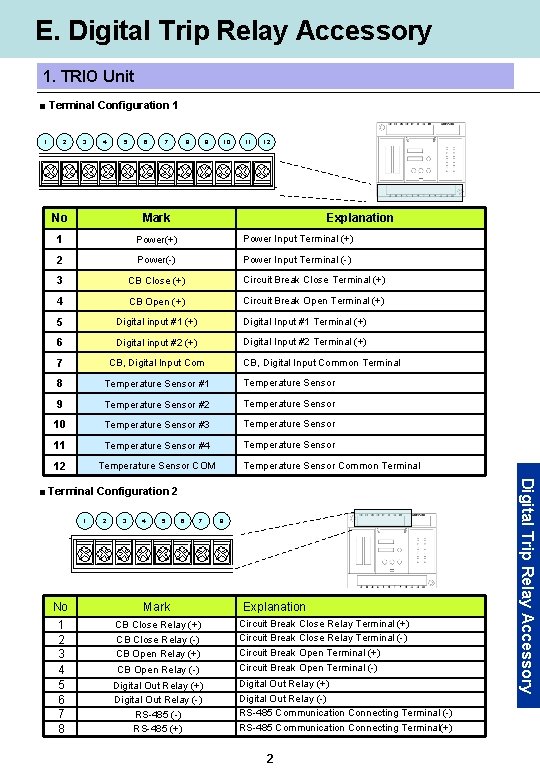
E. Digital Trip Relay Accessory 1. TRIO Unit ■ Terminal Configuration 1 1 2 3 4 5 6 7 8 9 10 11 12 No Mark Explanation 1 Power(+) Power Input Terminal (+) 2 Power(-) Power Input Terminal (-) 3 CB Close (+) Circuit Break Close Terminal (+) 4 CB Open (+) Circuit Break Open Terminal (+) 5 Digital input #1 (+) Digital Input #1 Terminal (+) 6 Digital input #2 (+) Digital Input #2 Terminal (+) 7 CB, Digital Input Com 8 Temperature Sensor #1 Temperature Sensor 9 Temperature Sensor #2 Temperature Sensor 10 Temperature Sensor #3 Temperature Sensor 11 Temperature Sensor #4 Temperature Sensor 12 Temperature Sensor COM CB, Digital Input Common Terminal Temperature Sensor Common Terminal 1 2 3 4 5 6 7 No Mark 1 2 3 4 5 6 7 8 CB Close Relay (+) CB Close Relay (-) CB Open Relay (+) CB Open Relay (-) Digital Out Relay (+) Digital Out Relay (-) RS-485 (+) 8 Explanation Circuit Break Close Relay Terminal (+) Circuit Break Close Relay Terminal (-) Circuit Break Open Terminal (+) Circuit Break Open Terminal (-) Digital Out Relay (+) Digital Out Relay (-) RS-485 Communication Connecting Terminal(+) 2 Digital Trip Relay Accessory ■ Terminal Configuration 2
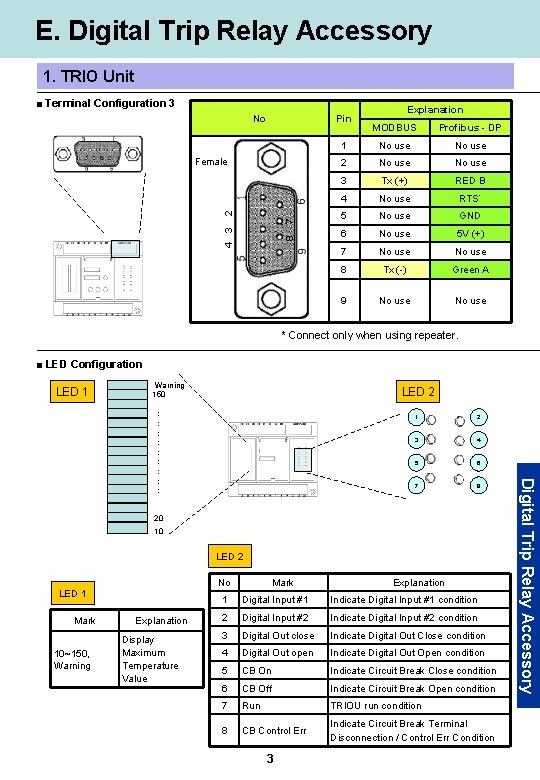
E. Digital Trip Relay Accessory 1. TRIO Unit ■ Terminal Configuration 3 MODBUS Profibus - DP 1 No use 2 No use 3 Tx (+) RED B 4 No use RTS* 5 No use GND 6 No use 5 V (+) 7 No use 8 Tx (-) Green A 9 No use 2 Female 4 3 Explanation 7 Pin 8 No * Connect only when using repeater. ■ LED Configuration LED 1 Warning 150 LED 2 1 2 3 4 5 6 7 8 20 10 LED 2 No LED 1 Mark 10~150, Warning Explanation Display Maximum Temperature Value Mark Explanation 1 Digital Input #1 Indicate Digital Input #1 condition 2 Digital Input #2 Indicate Digital Input #2 condition 3 Digital Out close Indicate Digital Out Close condition 4 Digital Out open Indicate Digital Out Open condition 5 CB On Indicate Circuit Break Close condition 6 CB Off Indicate Circuit Break Open condition 7 Run TRIOU run condition 8 CB Control Err Indicate Circuit Break Terminal Disconnection / Control Err Condition 3 Digital Trip Relay Accessory : : : : :
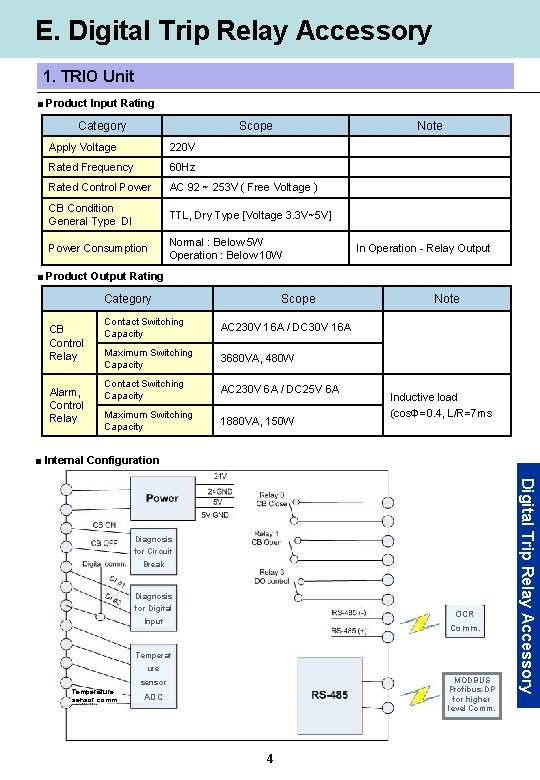
E. Digital Trip Relay Accessory 1. TRIO Unit ■ Product Input Rating Category Scope Note Apply Voltage 220 V Rated Frequency 60 Hz Rated Control Power AC 92 ~ 253 V ( Free Voltage ) CB Condition General Type DI TTL, Dry Type [Voltage 3. 3 V~5 V] Power Consumption Normal : Below 5 W Operation : Below 10 W In Operation - Relay Output ■ Product Output Rating Category CB Control Relay Alarm, Control Relay Scope Contact Switching Capacity AC 230 V 16 A / DC 30 V 16 A Maximum Switching Capacity 3680 VA, 480 W Contact Switching Capacity AC 230 V 6 A / DC 25 V 6 A Maximum Switching Capacity 1880 VA, 150 W Note Inductive load (cosΦ=0. 4, L/R=7 ms ■ Internal Configuration for Circuit Break Diagnosis for Digital OCR Input Comm. Temperat ure MODBUS Profibus-DP for higher level Comm. sensor Temperature sensor comm. ADC 4 Digital Trip Relay Accessory Diagnosis
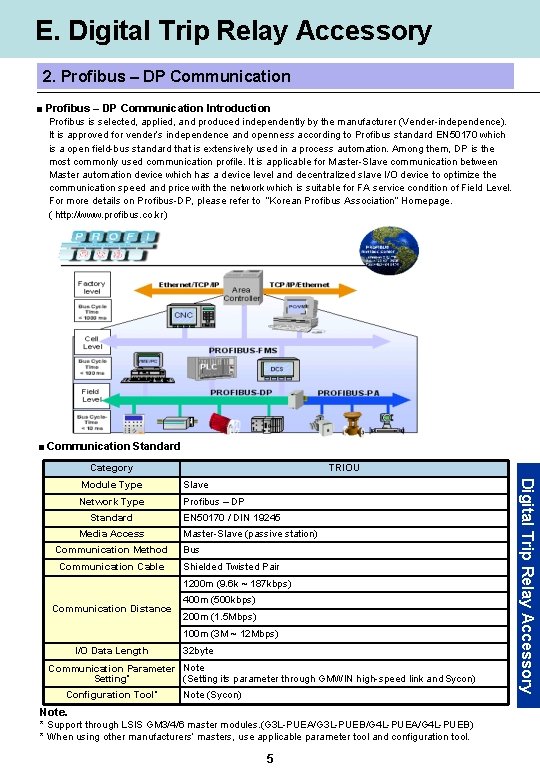
E. Digital Trip Relay Accessory 2. Profibus – DP Communication ■ Profibus – DP Communication Introduction Profibus is selected, applied, and produced independently by the manufacturer (Vender-independence). It is approved for vender’s independence and openness according to Profibus standard EN 50170 which is a open field-bus standard that is extensively used in a process automation. Among them, DP is the most commonly used communication profile. It is applicable for Master-Slave communication between Master automation device which has a device level and decentralized slave I/O device to optimize the communication speed and price with the network which is suitable for FA service condition of Field Level. For more details on Profibus-DP, please refer to “Korean Profibus Association” Homepage. ( http: //www. profibus. co. kr) ■ Communication Standard Category TRIOU Slave Network Type Profibus – DP Standard Media Access Communication Method Communication Cable EN 50170 / DIN 19245 Master-Slave (passive station) Bus Shielded Twisted Pair 1200 m (9. 6 k ~ 187 kbps) Communication Distance 400 m (500 kbps) 200 m (1. 5 Mbps) 100 m (3 M ~ 12 Mbps) I/O Data Length 32 byte Communication Parameter Note (Setting its parameter through GMWIN high-speed link and Sycon) Setting* Configuration Tool* Note (Sycon) Note. * Support through LSIS GM 3/4/6 master modules. (G 3 L-PUEA/G 3 L-PUEB/G 4 L-PUEA/G 4 L-PUEB) * When using other manufacturers’ masters, use applicable parameter tool and configuration tool. 5 Digital Trip Relay Accessory Module Type
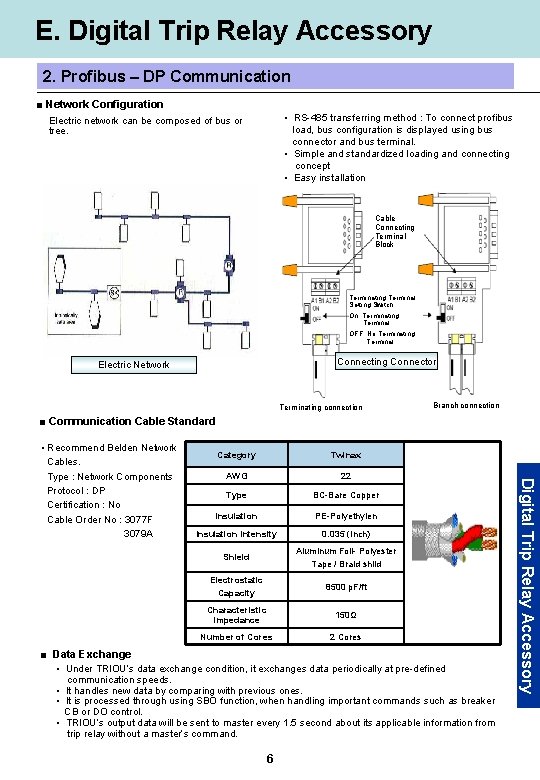
E. Digital Trip Relay Accessory 2. Profibus – DP Communication ■ Network Configuration • RS-485 transferring method : To connect profibus load, bus configuration is displayed using bus connector and bus terminal. • Simple and standardized loading and connecting concept • Easy installation Electric network can be composed of bus or tree. Cable Connecting Terminal Block Terminating Terminal Setting Switch On: Terminating Terminal OFF: No Terminating Terminal Connecting Connector Electric Network Terminating connection Branch connection ■ Communication Cable Standard Category Twinax AWG 22 Type BC-Bare Copper Insulation PE-Polyethylen Insulation Intensity 0. 035 (Inch) Shield Aluminum Foil- Polyester Tape / Braid shild Electrostatic Capacity 8500 p. F/ft Characteristic Impedance 150Ω Number of Cores 2 Cores ■ Data Exchange • Under TRIOU’s data exchange condition, it exchanges data periodically at pre-defined communication speeds. • It handles new data by comparing with previous ones. • It is processed through using SBO function, when handling important commands such as breaker CB or DO control. • TRIOU’s output data will be sent to master every 1. 5 second about its applicable information from trip relay without a master’s command. 6 Digital Trip Relay Accessory • Recommend Belden Network Cables. Type : Network Components Protocol : DP Certification : No Cable Order No : 3077 F 3079 A
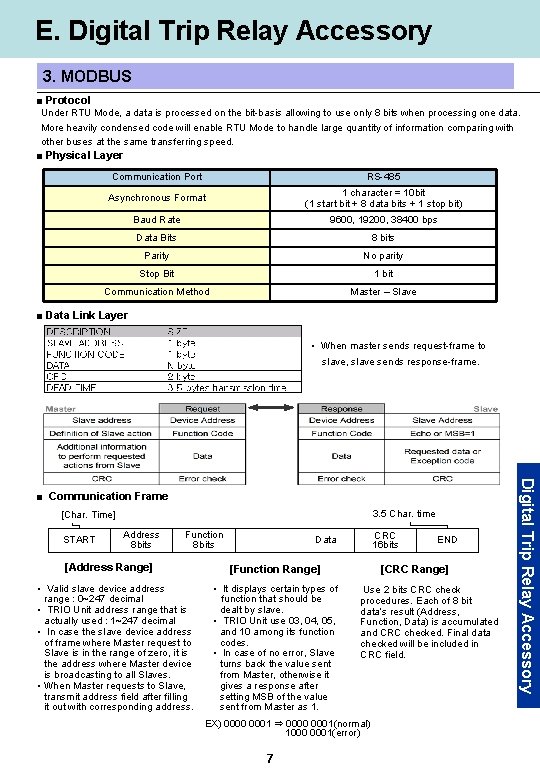
E. Digital Trip Relay Accessory 3. MODBUS ■ Protocol Under RTU Mode, a data is processed on the bit-basis allowing to use only 8 bits when processing one data. More heavily condensed code will enable RTU Mode to handle large quantity of information comparing with other buses at the same transferring speed. ■ Physical Layer Communication Port RS-485 Asynchronous Format 1 character = 10 bit (1 start bit + 8 data bits + 1 stop bit) Baud Rate 9600, 19200, 38400 bps Data Bits 8 bits Parity No parity Stop Bit 1 bit Communication Method Master – Slave ■ Data Link Layer • When master sends request-frame to slave, slave sends response-frame. 3. 5 Char. time [Char. Time] START Address 8 bits Function 8 bits [Address Range] • Valid slave device address range : 0~247 decimal • TRIO Unit address range that is actually used : 1~247 decimal • In case the slave device address of frame where Master request to Slave is in the range of zero, it is the address where Master device is broadcasting to all Slaves. • When Master requests to Slave, transmit address field after filling it out with corresponding address. CRC 16 bits Data [Function Range] • It displays certain types of function that should be dealt by slave. • TRIO Unit use 03, 04, 05, and 10 among its function codes. • In case of no error, Slave turns back the value sent from Master, otherwise it gives a response after setting MSB of the value sent from Master as 1. [CRC Range] Use 2 bits CRC check procedures. Each of 8 bit data’s result (Address, Function, Data) is accumulated and CRC checked. Final data checked will be included in CRC field. EX) 0000 0001 ⇒ 0000 0001(normal) 1000 0001(error) 7 END Digital Trip Relay Accessory ■ Communication Frame