
D A Glide Reflection Practice C C B
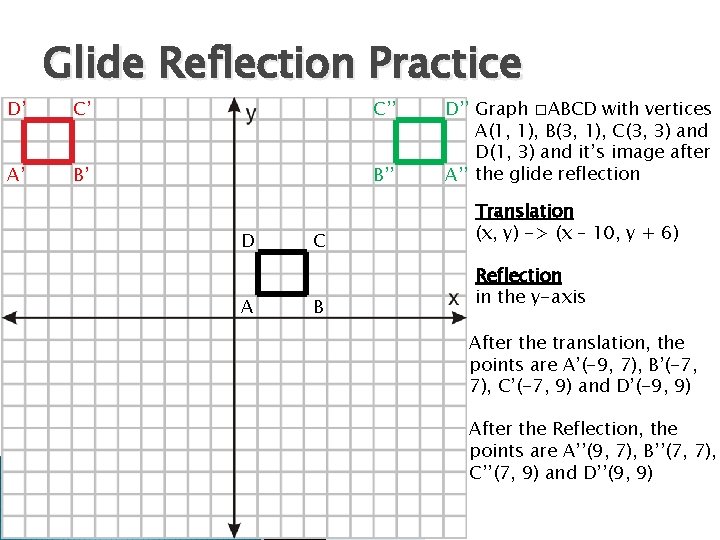
D’ A’ Glide Reflection Practice C’ C’’ B’ B’’ D A C B D’’ Graph □ABCD with vertices A(1, 1), B(3, 1), C(3, 3) and D(1, 3) and it’s image after A’’ the glide reflection Translation (x, y) -> (x – 10, y + 6) Reflection in the y-axis After the translation, the points are A’(-9, 7), B’(-7, 7), C’(-7, 9) and D’(-9, 9) After the Reflection, the points are A’’(9, 7), B’’(7, 7), C’’(7, 9) and D’’(9, 9)
Transformations: The Rotation Big Ideas Geometry Section 4. 3
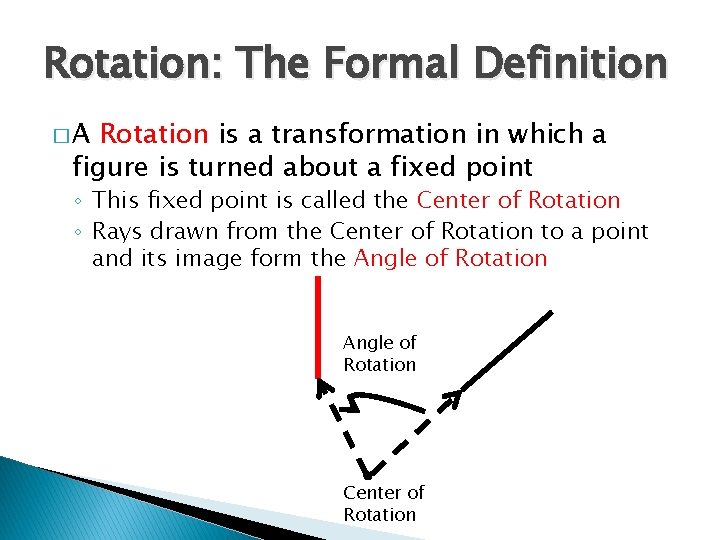
Rotation: The Formal Definition �A Rotation is a transformation in which a figure is turned about a fixed point ◦ This fixed point is called the Center of Rotation ◦ Rays drawn from the Center of Rotation to a point and its image form the Angle of Rotation Center of Rotation
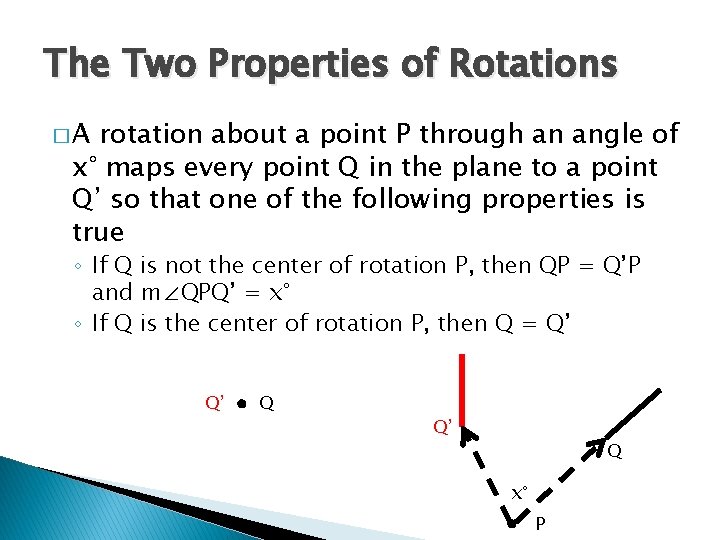
The Two Properties of Rotations �A rotation about a point P through an angle of x° maps every point Q in the plane to a point Q’ so that one of the following properties is true ◦ If Q is not the center of rotation P, then QP = Q’P and m∠QPQ’ = x° ◦ If Q is the center of rotation P, then Q = Q’ Q’ Q x° P

Rotational Types Clockwise Counterclockwise Unless specified, all rotations will be done counterclockwise. This is the standard direction
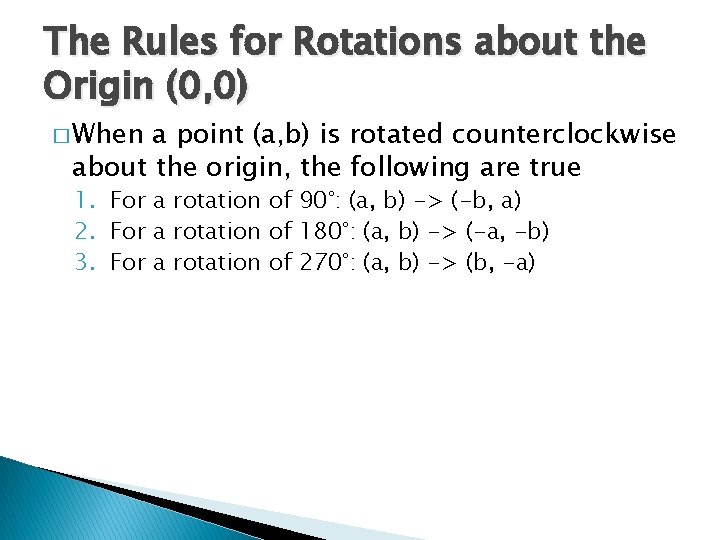
The Rules for Rotations about the Origin (0, 0) � When a point (a, b) is rotated counterclockwise about the origin, the following are true 1. For a rotation of 90°: (a, b) -> (-b, a) 2. For a rotation of 180°: (a, b) -> (-a, -b) 3. For a rotation of 270°: (a, b) -> (b, -a)
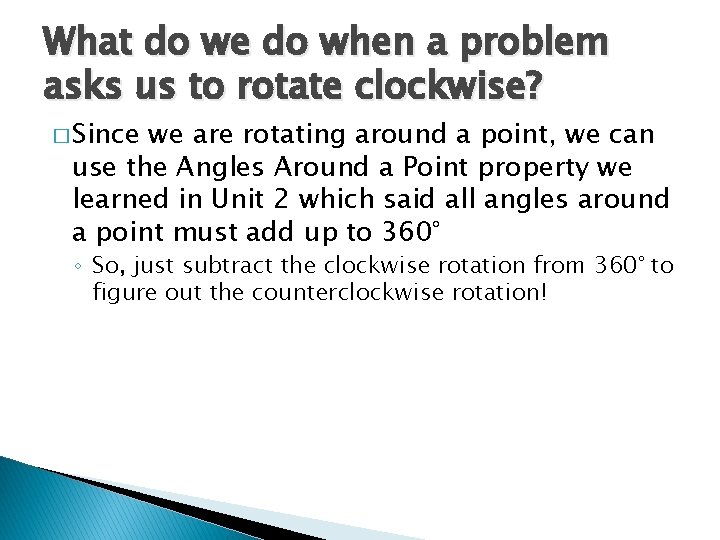
What do we do when a problem asks us to rotate clockwise? � Since we are rotating around a point, we can use the Angles Around a Point property we learned in Unit 2 which said all angles around a point must add up to 360° ◦ So, just subtract the clockwise rotation from 360° to figure out the counterclockwise rotation!
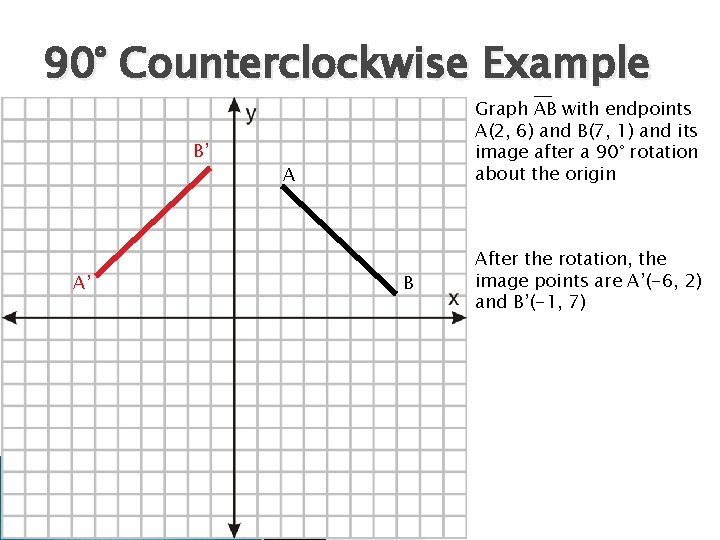
90° Counterclockwise Example B’ A’ Graph AB with endpoints A(2, 6) and B(7, 1) and its image after a 90° rotation about the origin A B After the rotation, the image points are A’(-6, 2) and B’(-1, 7)

180° Counterclockwise Example Graph AB with endpoints A(5, 1), and B(-2, -4), and its image after a 180° rotation about the origin B’ A A’ B After the rotation, the image points are A’(-5, -1) and B’(2, 4)
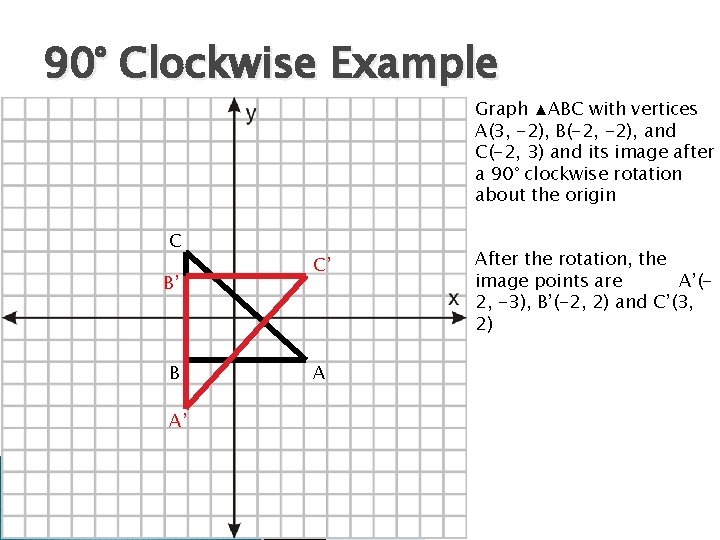
90° Clockwise Example Graph ▲ABC with vertices A(3, -2), B(-2, -2), and C(-2, 3) and its image after a 90° clockwise rotation about the origin C B’ B A’ C’ A After the rotation, the image points are A’(2, -3), B’(-2, 2) and C’(3, 2)
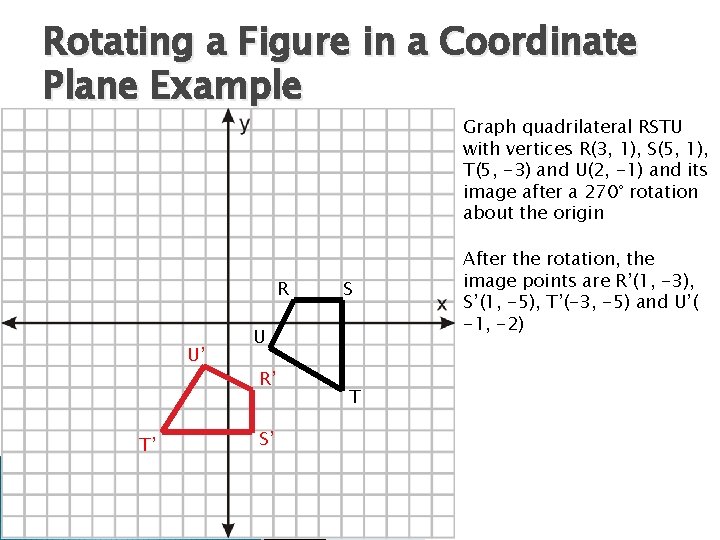
Rotating a Figure in a Coordinate Plane Example Graph quadrilateral RSTU with vertices R(3, 1), S(5, 1), T(5, -3) and U(2, -1) and its image after a 270° rotation about the origin R U’ T’ S U R’ S’ T After the rotation, the image points are R’(1, -3), S’(1, -5), T’(-3, -5) and U’( -1, -2)
Bibliography � Big Ideas Geometry
- Slides: 12