
D 50 vs D 10 Hypogycemia Paul S
- Slides: 16
D 50 vs D 10 Hypogycemia Paul S. Rostykus, MD, MPH EMS Supervising Physician Ambulance and Fire Agencies Jackson County Oregon 5/14/2013 © Paul S. Rostykus, MD, MPH 2013 1
5/14/2013 © Paul S. Rostykus, MD, MPH 2013 2
Hypoglycemia S 21 yo female c/c decreased LOC. Took her insulin this morning and didn’t eat breakfast before working out. Allergies – NKDA Meds – Insulin PMH - IDDM O BP 132/79 P 78 R 20 GCS 6 Sp. O 2 100% Unresponsive CBG = 36 A Hypoglycemia in an IDDM P OMI 1 amp D 50 awake GCS = 15 CBG = 290 5/14/2013 © Paul S. Rostykus, MD, MPH 2013 3
D 50? • Tradition? “If a little is good, then a lot is better” • Predates CBG availability? • Science? Have not yet found it 5/14/2013 © Paul S. Rostykus, MD, MPH 2013 4
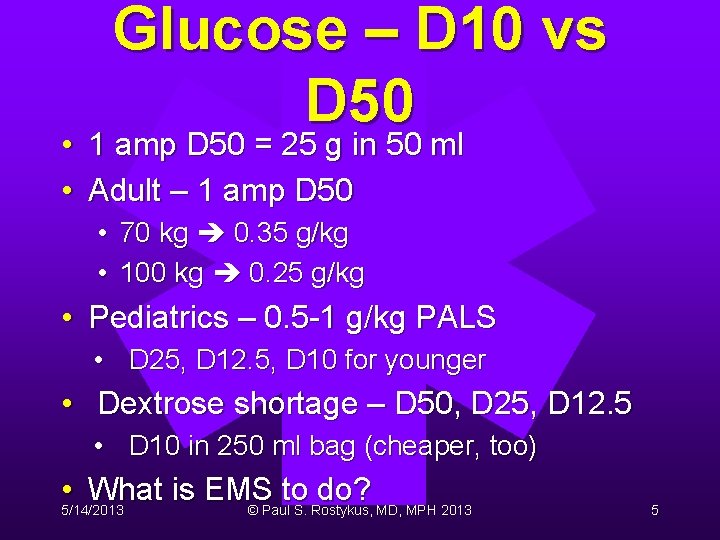
Glucose – D 10 vs D 50 • 1 amp D 50 = 25 g in 50 ml • Adult – 1 amp D 50 • 70 kg 0. 35 g/kg • 100 kg 0. 25 g/kg • Pediatrics – 0. 5 -1 g/kg PALS • D 25, D 12. 5, D 10 for younger • Dextrose shortage – D 50, D 25, D 12. 5 • D 10 in 250 ml bag (cheaper, too) • 5/14/2013 What is EMS to do? © Paul S. Rostykus, MD, MPH 2013 5
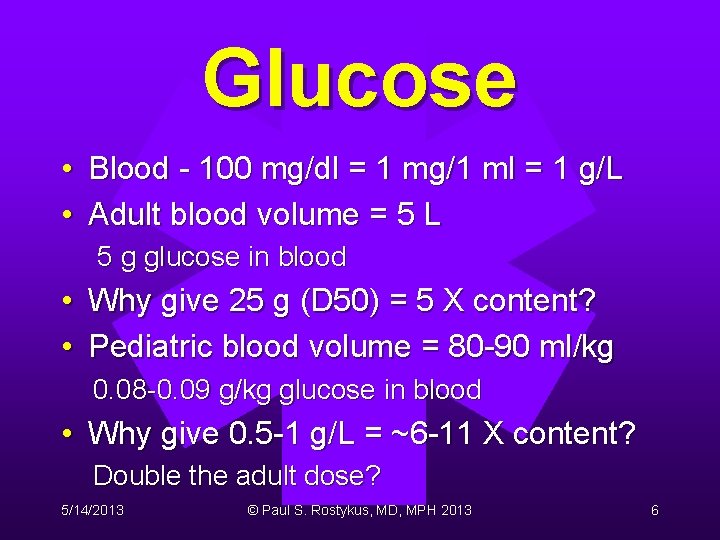
Glucose • Blood - 100 mg/dl = 1 mg/1 ml = 1 g/L • Adult blood volume = 5 L 5 g glucose in blood • Why give 25 g (D 50) = 5 X content? • Pediatric blood volume = 80 -90 ml/kg 0. 08 -0. 09 g/kg glucose in blood • Why give 0. 5 -1 g/L = ~6 -11 X content? Double the adult dose? 5/14/2013 © Paul S. Rostykus, MD, MPH 2013 6
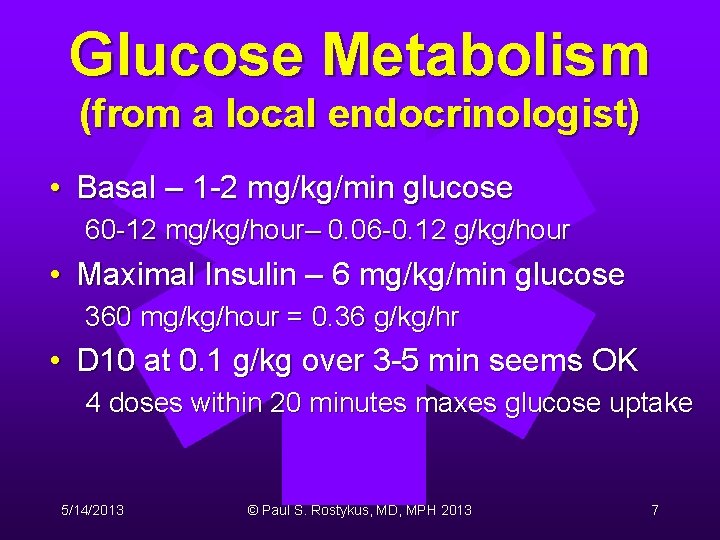
Glucose Metabolism (from a local endocrinologist) • Basal – 1 -2 mg/kg/min glucose 60 -12 mg/kg/hour– 0. 06 -0. 12 g/kg/hour • Maximal Insulin – 6 mg/kg/min glucose 360 mg/kg/hour = 0. 36 g/kg/hr • D 10 at 0. 1 g/kg over 3 -5 min seems OK 4 doses within 20 minutes maxes glucose uptake 5/14/2013 © Paul S. Rostykus, MD, MPH 2013 7
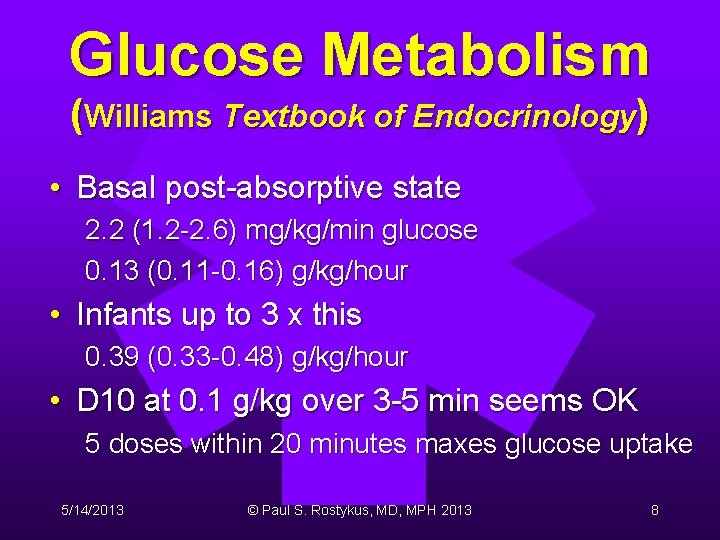
Glucose Metabolism (Williams Textbook of Endocrinology) • Basal post-absorptive state 2. 2 (1. 2 -2. 6) mg/kg/min glucose 0. 13 (0. 11 -0. 16) g/kg/hour • Infants up to 3 x this 0. 39 (0. 33 -0. 48) g/kg/hour • D 10 at 0. 1 g/kg over 3 -5 min seems OK 5 doses within 20 minutes maxes glucose uptake 5/14/2013 © Paul S. Rostykus, MD, MPH 2013 8
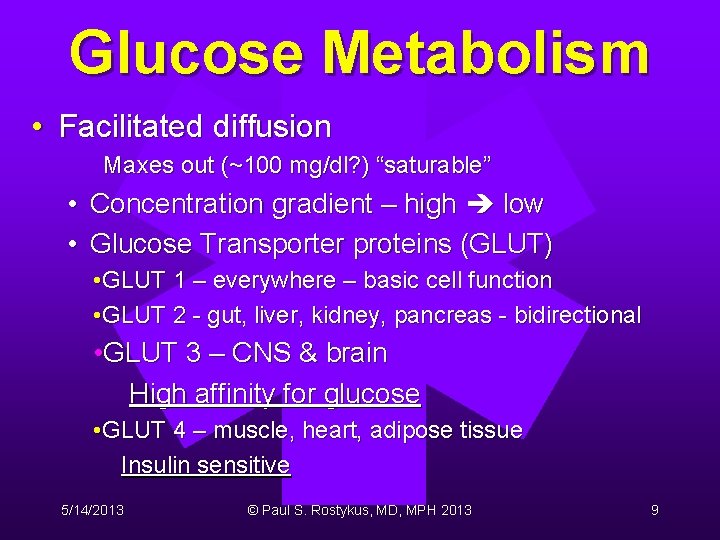
Glucose Metabolism • Facilitated diffusion Maxes out (~100 mg/dl? ) “saturable” • Concentration gradient – high low • Glucose Transporter proteins (GLUT) • GLUT 1 – everywhere – basic cell function • GLUT 2 - gut, liver, kidney, pancreas - bidirectional • GLUT 3 – CNS & brain High affinity for glucose • GLUT 4 – muscle, heart, adipose tissue Insulin sensitive 5/14/2013 © Paul S. Rostykus, MD, MPH 2013 9
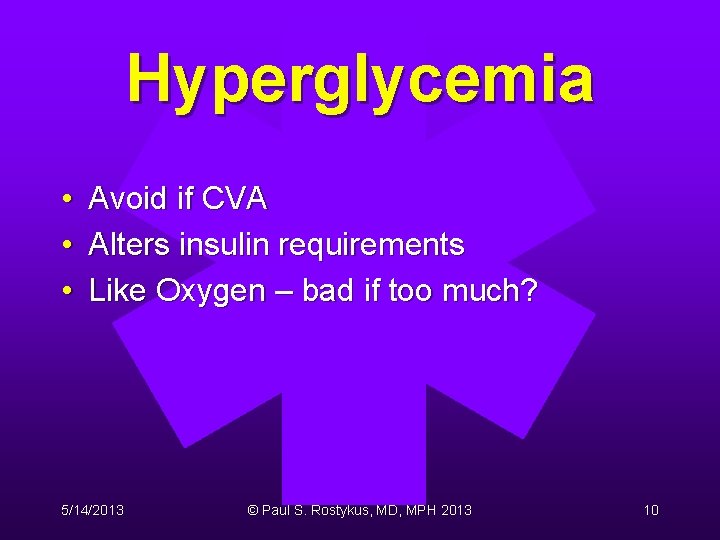
Hyperglycemia • • • Avoid if CVA Alters insulin requirements Like Oxygen – bad if too much? 5/14/2013 © Paul S. Rostykus, MD, MPH 2013 10
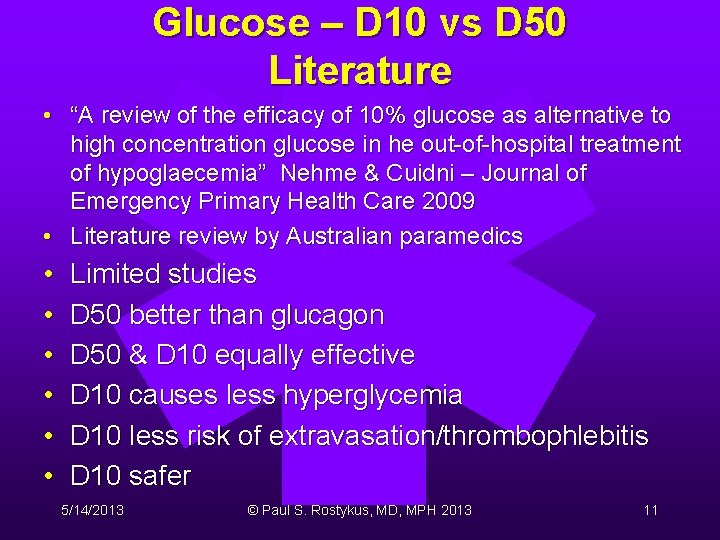
Glucose – D 10 vs D 50 Literature • “A review of the efficacy of 10% glucose as alternative to high concentration glucose in he out-of-hospital treatment of hypoglaecemia” Nehme & Cuidni – Journal of Emergency Primary Health Care 2009 • Literature review by Australian paramedics • • • Limited studies D 50 better than glucagon D 50 & D 10 equally effective D 10 causes less hyperglycemia D 10 less risk of extravasation/thrombophlebitis D 10 safer 5/14/2013 © Paul S. Rostykus, MD, MPH 2013 11
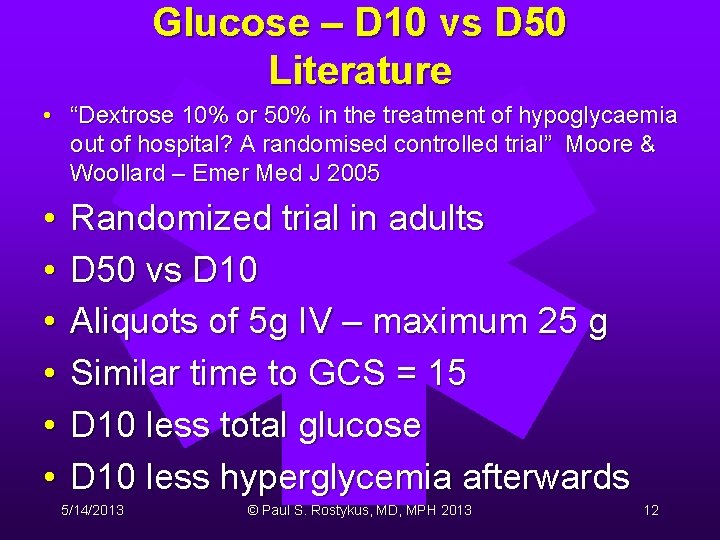
Glucose – D 10 vs D 50 Literature • “Dextrose 10% or 50% in the treatment of hypoglycaemia out of hospital? A randomised controlled trial” Moore & Woollard – Emer Med J 2005 • • • Randomized trial in adults D 50 vs D 10 Aliquots of 5 g IV – maximum 25 g Similar time to GCS = 15 D 10 less total glucose D 10 less hyperglycemia afterwards 5/14/2013 © Paul S. Rostykus, MD, MPH 2013 12
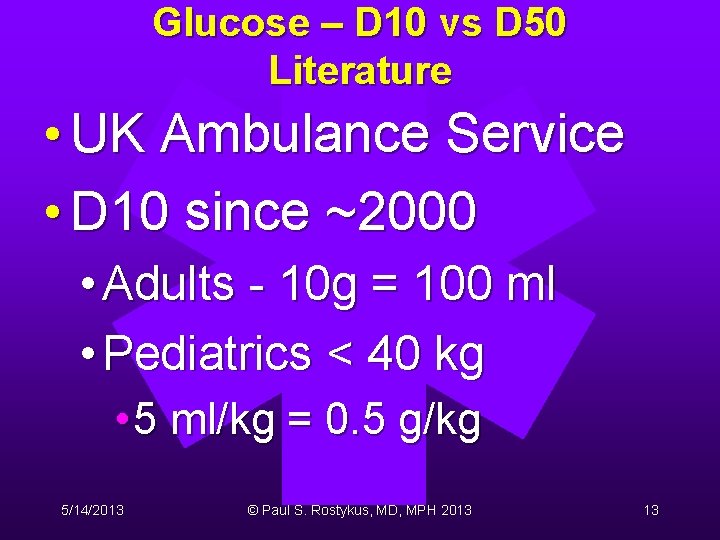
Glucose – D 10 vs D 50 Literature • UK Ambulance Service • D 10 since ~2000 • Adults - 10 g = 100 ml • Pediatrics < 40 kg • 5 ml/kg = 0. 5 g/kg 5/14/2013 © Paul S. Rostykus, MD, MPH 2013 13
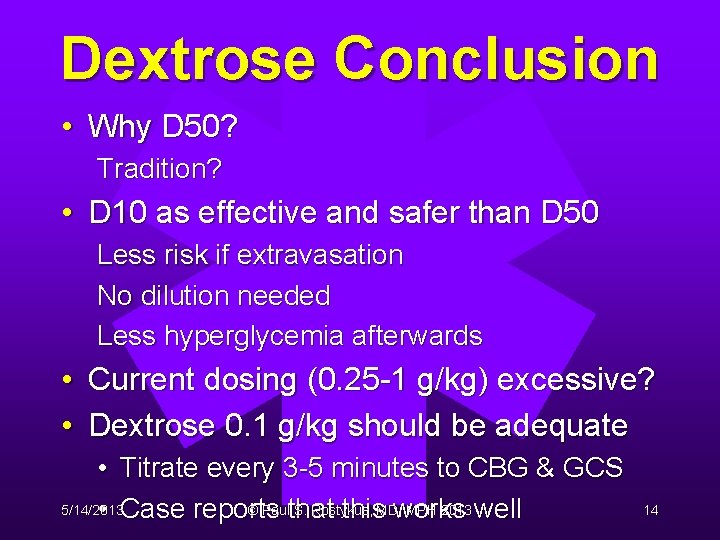
Dextrose Conclusion • Why D 50? Tradition? • D 10 as effective and safer than D 50 Less risk if extravasation No dilution needed Less hyperglycemia afterwards • Current dosing (0. 25 -1 g/kg) excessive? • Dextrose 0. 1 g/kg should be adequate • Titrate every 3 -5 minutes to CBG & GCS 5/14/2013 © Paulthat S. Rostykus, MPH 2013 well • Case reports this. MD, works 14
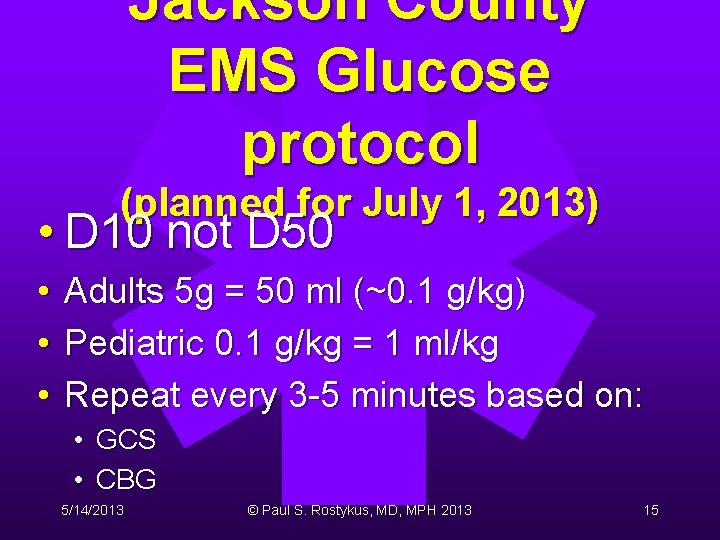
Jackson County EMS Glucose protocol (planned for July 1, 2013) • D 10 not D 50 • • • Adults 5 g = 50 ml (~0. 1 g/kg) Pediatric 0. 1 g/kg = 1 ml/kg Repeat every 3 -5 minutes based on: • GCS • CBG 5/14/2013 © Paul S. Rostykus, MD, MPH 2013 15
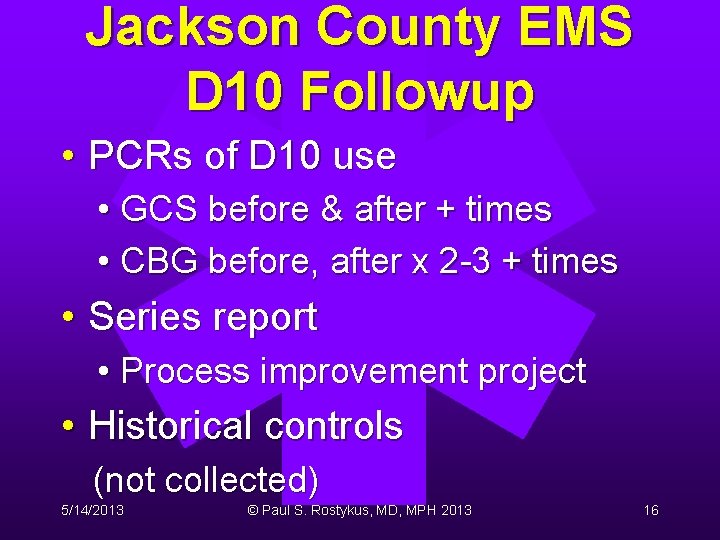
Jackson County EMS D 10 Followup • PCRs of D 10 use • GCS before & after + times • CBG before, after x 2 -3 + times • Series report • Process improvement project • Historical controls (not collected) 5/14/2013 © Paul S. Rostykus, MD, MPH 2013 16