
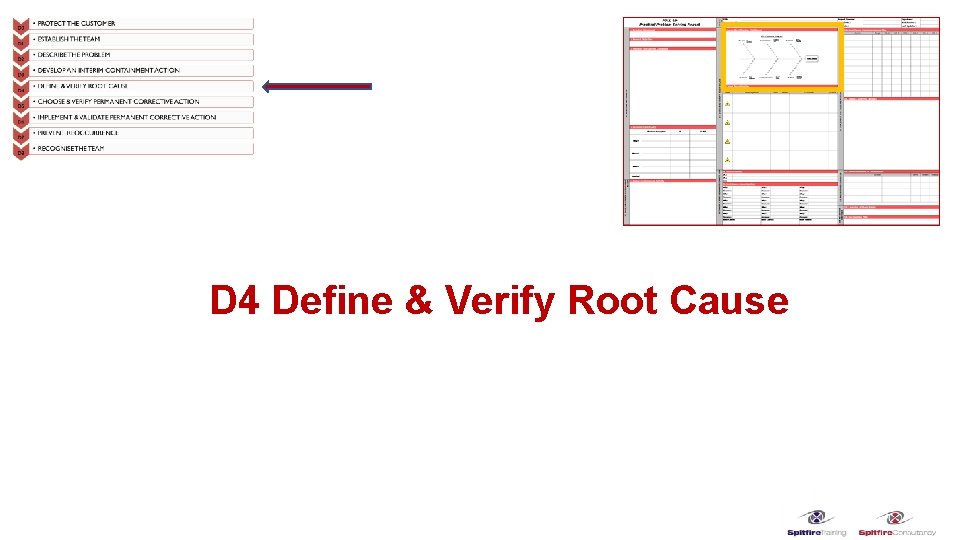
D 4 Define Verify Root Cause Define Verify
- Slides: 15
D 4 Define & Verify Root Cause
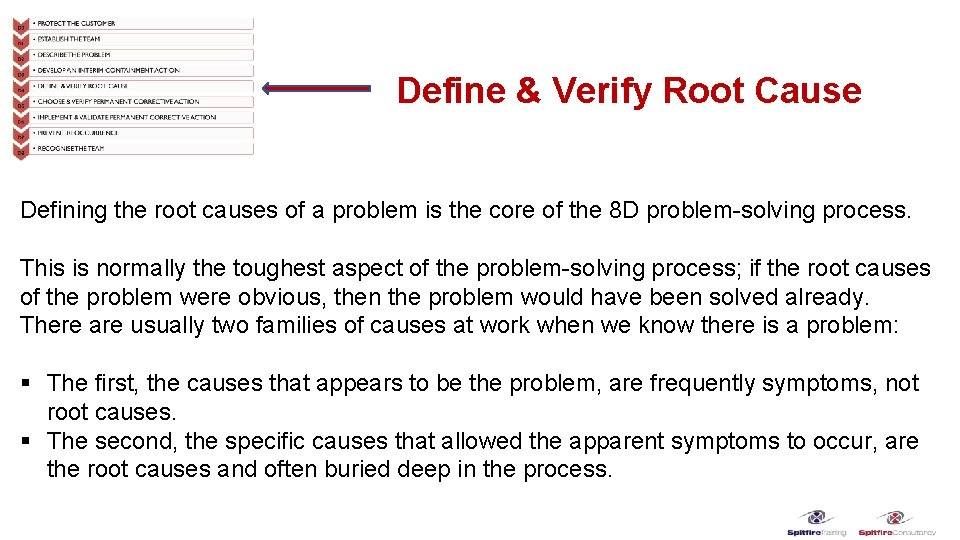
Define & Verify Root Cause Defining the root causes of a problem is the core of the 8 D problem-solving process. This is normally the toughest aspect of the problem-solving process; if the root causes of the problem were obvious, then the problem would have been solved already. There are usually two families of causes at work when we know there is a problem: § The first, the causes that appears to be the problem, are frequently symptoms, not root causes. § The second, the specific causes that allowed the apparent symptoms to occur, are the root causes and often buried deep in the process.
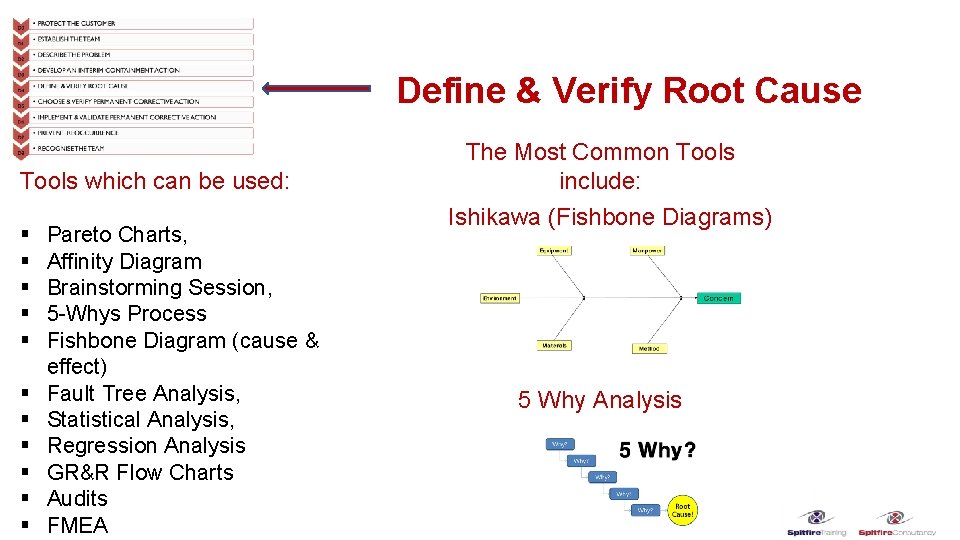
Define & Verify Root Cause Tools which can be used: § § § Pareto Charts, Affinity Diagram Brainstorming Session, 5 -Whys Process Fishbone Diagram (cause & effect) Fault Tree Analysis, Statistical Analysis, Regression Analysis GR&R Flow Charts Audits FMEA The Most Common Tools include: Ishikawa (Fishbone Diagrams) 5 Why Analysis
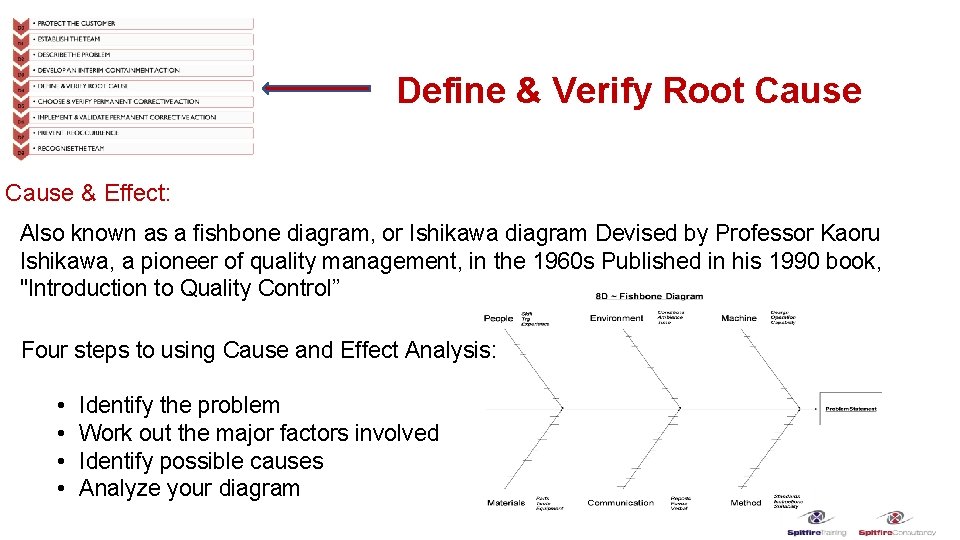
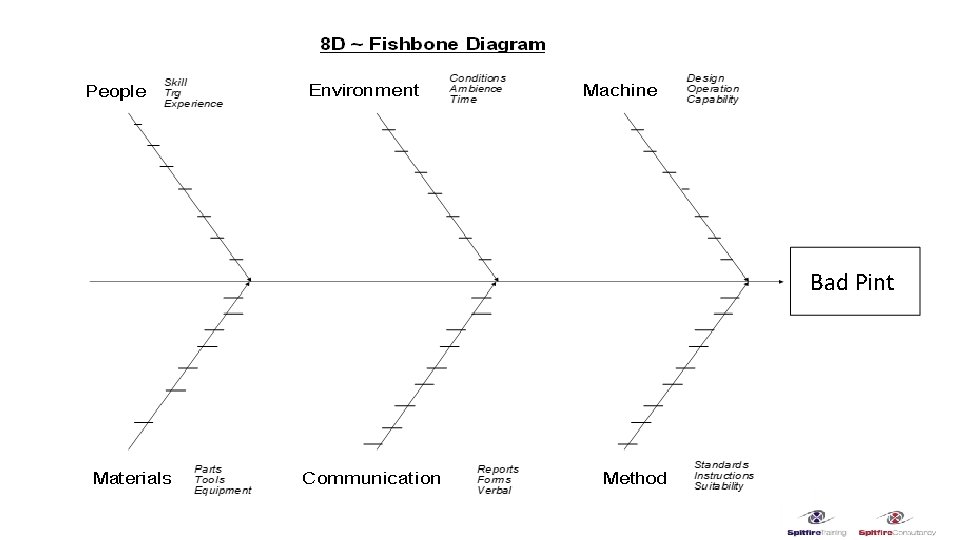
Define & Verify Root Cause & Effect: Also known as a fishbone diagram, or Ishikawa diagram Devised by Professor Kaoru Ishikawa, a pioneer of quality management, in the 1960 s Published in his 1990 book, "Introduction to Quality Control” Four steps to using Cause and Effect Analysis: • • Identify the problem Work out the major factors involved Identify possible causes Analyze your diagram
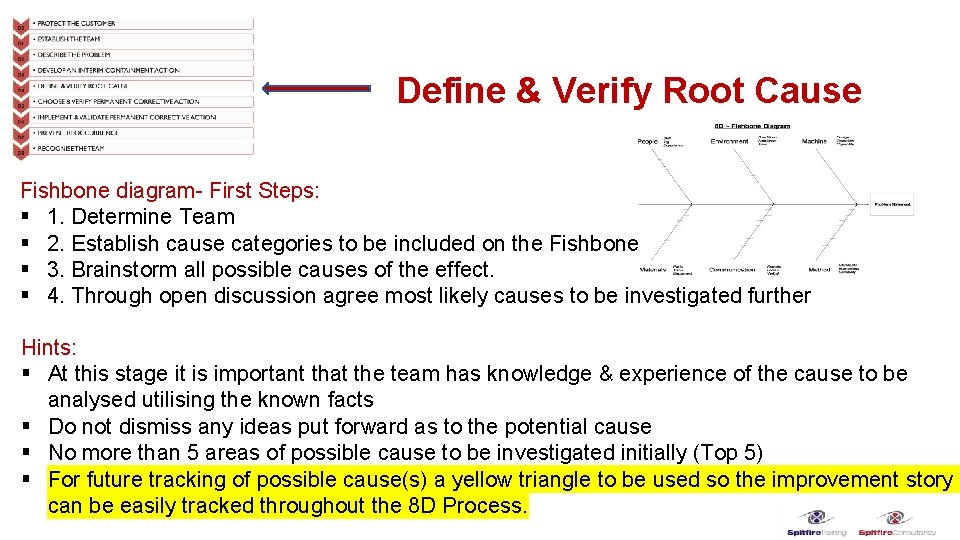
Define & Verify Root Cause Fishbone diagram- First Steps: § 1. Determine Team § 2. Establish cause categories to be included on the Fishbone § 3. Brainstorm all possible causes of the effect. § 4. Through open discussion agree most likely causes to be investigated further Hints: § At this stage it is important that the team has knowledge & experience of the cause to be analysed utilising the known facts § Do not dismiss any ideas put forward as to the potential cause § No more than 5 areas of possible cause to be investigated initially (Top 5) § For future tracking of possible cause(s) a yellow triangle to be used so the improvement story can be easily tracked throughout the 8 D Process.
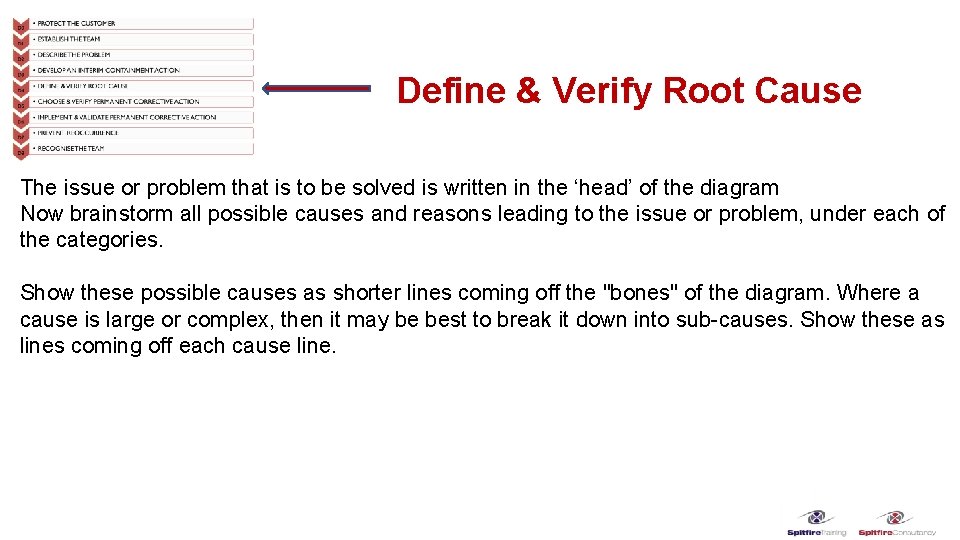
Define & Verify Root Cause The issue or problem that is to be solved is written in the ‘head’ of the diagram Now brainstorm all possible causes and reasons leading to the issue or problem, under each of the categories. Show these possible causes as shorter lines coming off the "bones" of the diagram. Where a cause is large or complex, then it may be best to break it down into sub-causes. Show these as lines coming off each cause line.
Define & Verify Root Cause Hints: • Agree the problem • Use flip charts – create a permanent record • Write down every idea • Don’t change the way the idea is expressed 2 • Don’t criticise - quantity not quality • Be quick, 10 -15 mins • Collect ideas ‘round robin’ style then open forum • Develop ideas – ‘piggy back’ • Use ‘pass’ if stuck for ideas • Allow a recess prior to idea appraisal • As a group select the Top 5 items that you believe have the strongest probability of being a root cause • Create an action or test plan from results 1 3
Activity Please divide into your syndicate groups 30 Minutes Activity !! Complete the Fishbone Diagram
Bad Pint
Define & Verify Root Cause 5 Why Analysis: The 5 Whys is a technique used in the Analyse phase of the Six Sigma DMAIC (Define, Measure, Analyse, Improve, Control) methodology. . By repeatedly asking the question “Why” (five is a good rule of thumb), you can peel away the layers of symptoms which can lead to the root cause of a problem.
Define & Verify Root Cause 5 Why Analysis: § A tool for finding and fixing the root cause / causes of problems § Useful in troubleshooting and day to day problem solving § Can be completed quickly by one person, or a team of people § Find the root cause or causes by asking ‘why’ did the problem occur § Keep asking why did the problem occur to the previous answer § Five layers of ‘why? ’ is usually sufficient to find the root cause (but not always!)
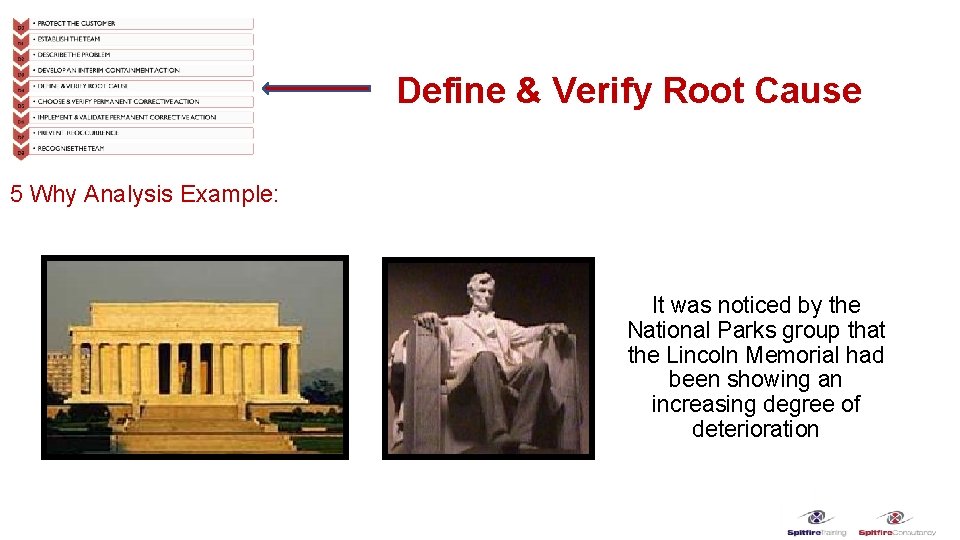
Define & Verify Root Cause 5 Why Analysis Example: It was noticed by the National Parks group that the Lincoln Memorial had been showing an increasing degree of deterioration
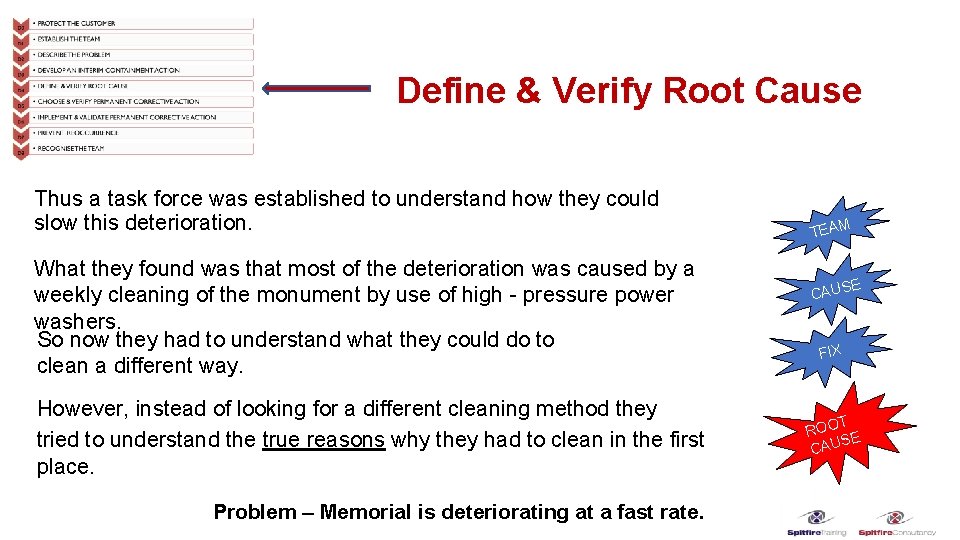
Define & Verify Root Cause Thus a task force was established to understand how they could slow this deterioration. What they found was that most of the deterioration was caused by a weekly cleaning of the monument by use of high - pressure power washers. So now they had to understand what they could do to clean a different way. However, instead of looking for a different cleaning method they tried to understand the true reasons why they had to clean in the first place. Problem – Memorial is deteriorating at a fast rate. TEAM E CAUS FIX T ROO E S CAU
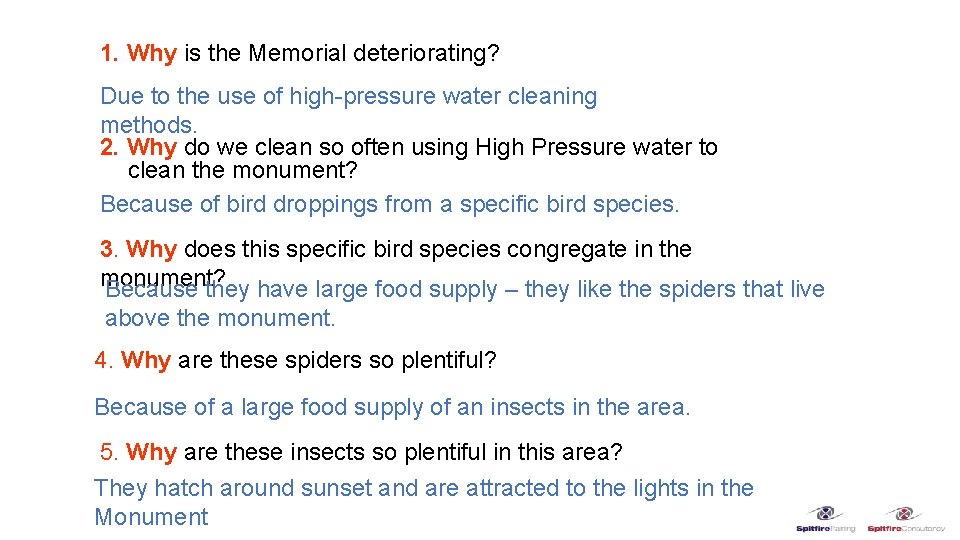
1. Why is the Memorial deteriorating? Due to the use of high-pressure water cleaning methods. 2. Why do we clean so often using High Pressure water to clean the monument? Because of bird droppings from a specific bird species. 3. Why does this specific bird species congregate in the monument? Because they have large food supply – they like the spiders that live above the monument. 4. Why are these spiders so plentiful? Because of a large food supply of an insects in the area. 5. Why are these insects so plentiful in this area? They hatch around sunset and are attracted to the lights in the Monument
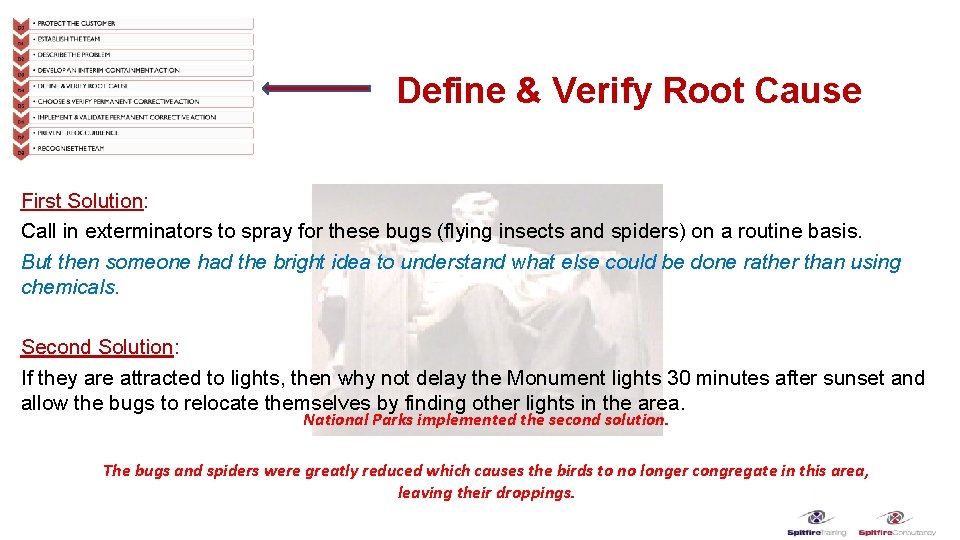
Define & Verify Root Cause First Solution: Call in exterminators to spray for these bugs (flying insects and spiders) on a routine basis. But then someone had the bright idea to understand what else could be done rather than using chemicals. Second Solution: If they are attracted to lights, then why not delay the Monument lights 30 minutes after sunset and allow the bugs to relocate themselves by finding other lights in the area. National Parks implemented the second solution. The bugs and spiders were greatly reduced which causes the birds to no longer congregate in this area, leaving their droppings.