
Cytology The Study of Cells Robert Hookes drawing
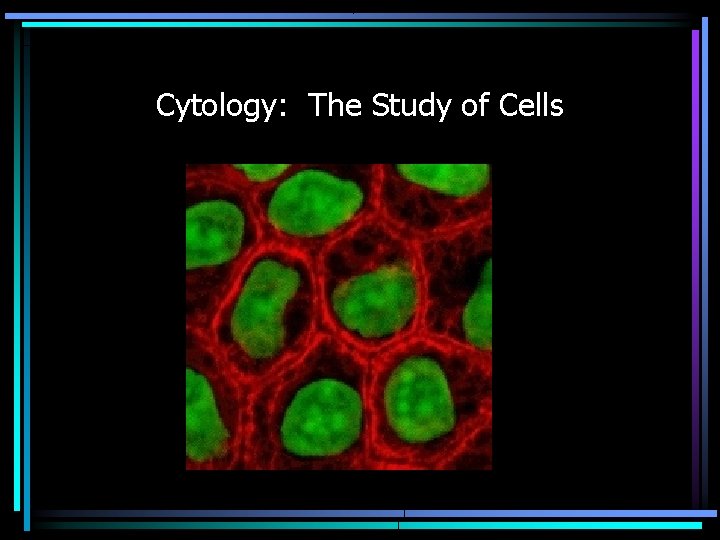
Cytology: The Study of Cells
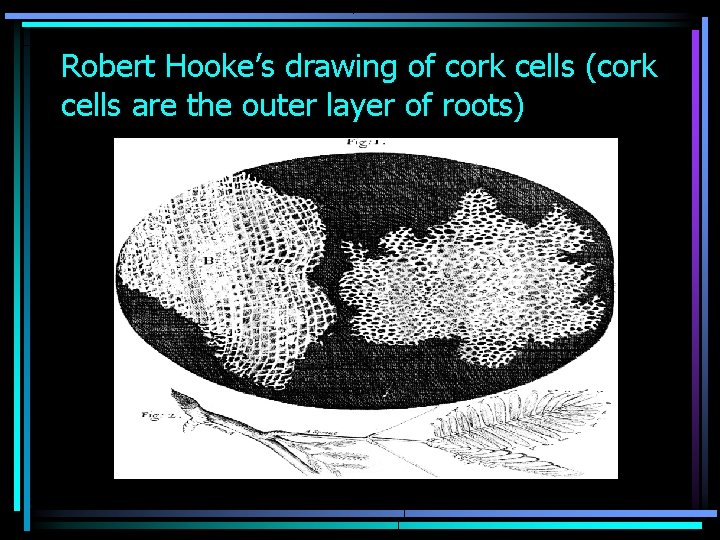
Robert Hooke’s drawing of cork cells (cork cells are the outer layer of roots)

Some History of Cells Robert Hooke 1665 Observed cork slice under microscope. Coined the word “cell”. Matthias Schleiden 1838 First to state that all plants are made of cells. Theodor Schwann 1839 First to state that all animals are made of cells. Rudolf Virchow 1858 Stated that cells have to come from other cells.
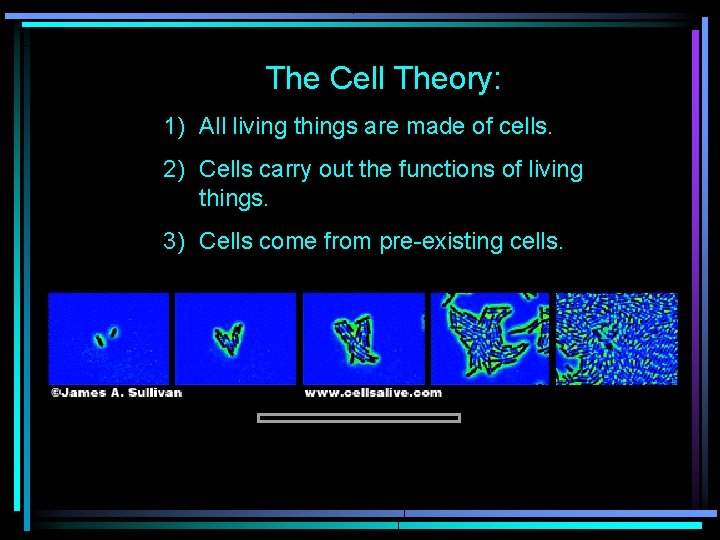
The Cell Theory: 1) All living things are made of cells. 2) Cells carry out the functions of living things. 3) Cells come from pre-existing cells.
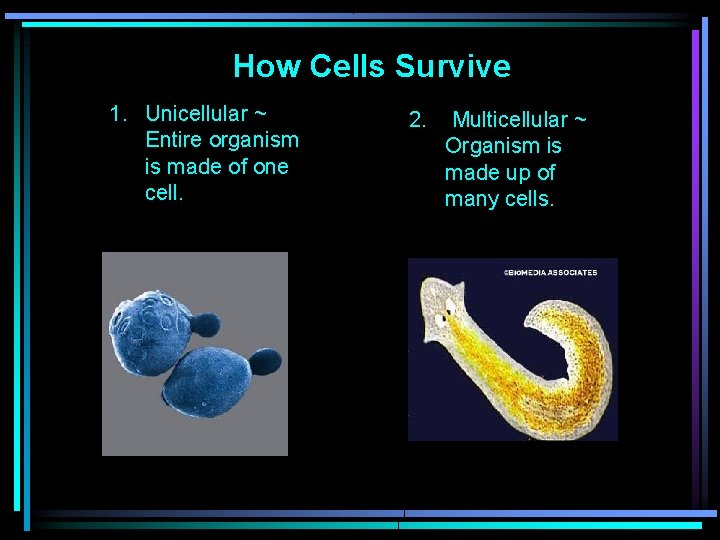
How Cells Survive 1. Unicellular ~ Entire organism is made of one cell. 2. Multicellular ~ Organism is made up of many cells.

Levels of Organization for Multicellular Organisms: Cell → Tissue → Organ System → Organism
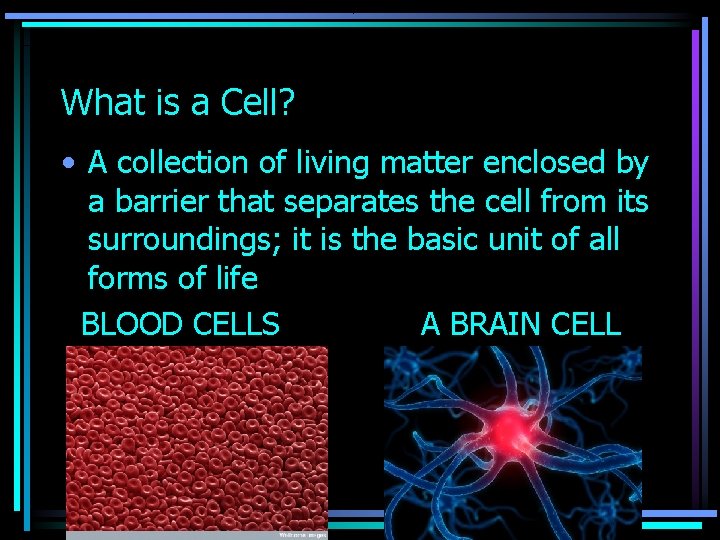
What is a Cell? • A collection of living matter enclosed by a barrier that separates the cell from its surroundings; it is the basic unit of all forms of life BLOOD CELLS A BRAIN CELL
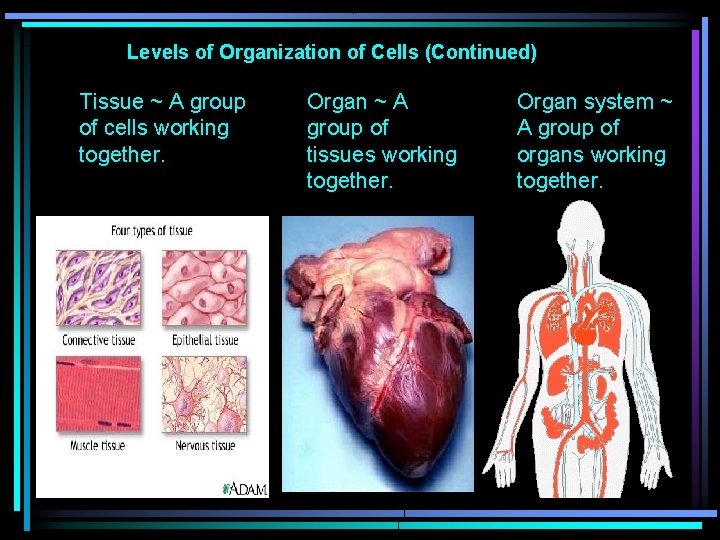
Levels of Organization of Cells (Continued) Tissue ~ A group of cells working together. Organ ~ A group of tissues working together. Organ system ~ A group of organs working together.
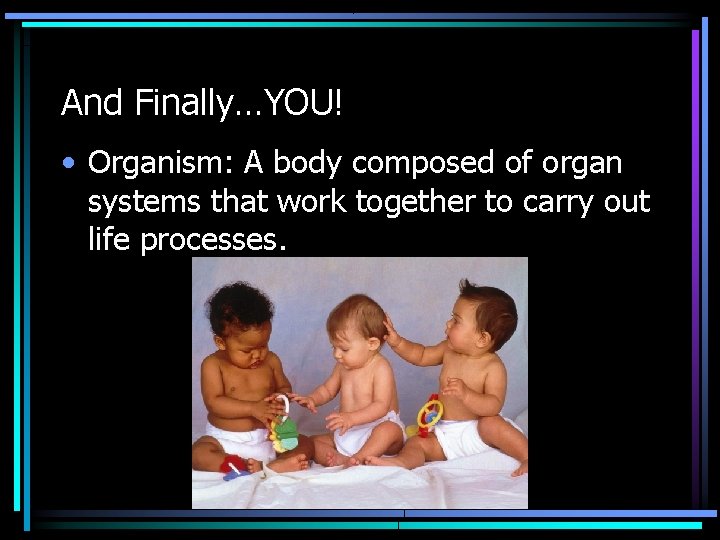
And Finally…YOU! • Organism: A body composed of organ systems that work together to carry out life processes.
Some Amazing Facts… • There are over 210 different types of cells in your body (blood cell, heart cell, liver cell, kidney cell, muscle cell, nerve cell, bone cell, etc. ) • There are over 100 Trillion Cells in your body (that’s 100, 000, 000) • If you counted to 100 trillion, counting one number a second, it would take you 3, 171, 000 years (that would be 31, 710 lifetimes, assuming you lived to be 100)
The Inner Life of a Cell Video
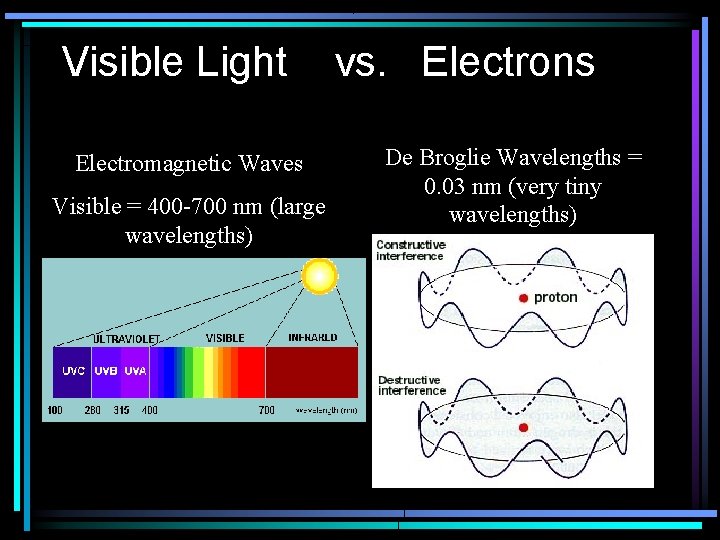
Visible Light Electromagnetic Waves Visible = 400 -700 nm (large wavelengths) vs. Electrons De Broglie Wavelengths = 0. 03 nm (very tiny wavelengths)
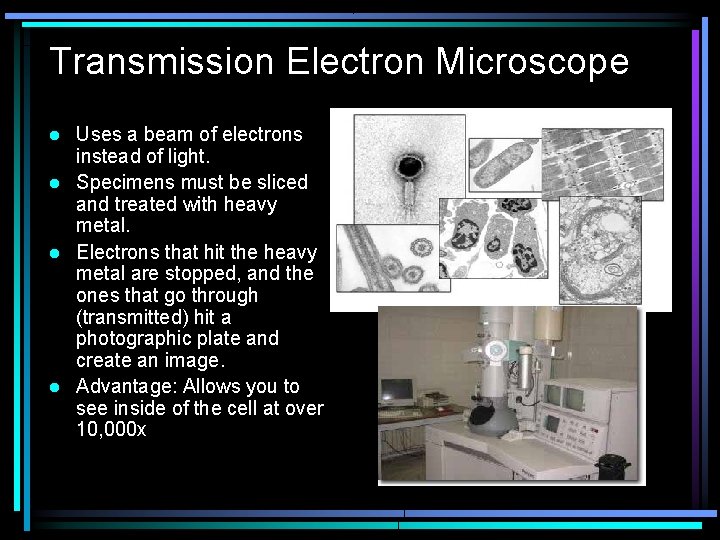
Transmission Electron Microscope Uses a beam of electrons instead of light. l Specimens must be sliced and treated with heavy metal. l Electrons that hit the heavy metal are stopped, and the ones that go through (transmitted) hit a photographic plate and create an image. l Advantage: Allows you to see inside of the cell at over 10, 000 x l
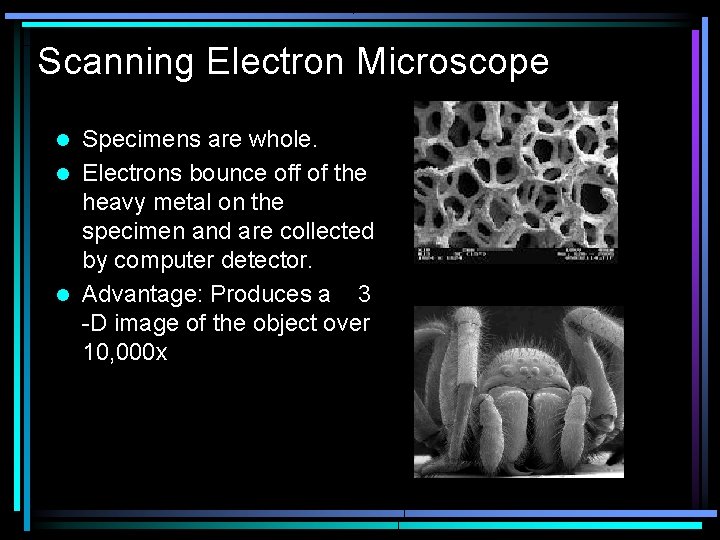
Scanning Electron Microscope Specimens are whole. l Electrons bounce off of the heavy metal on the specimen and are collected by computer detector. l Advantage: Produces a 3 -D image of the object over 10, 000 x l
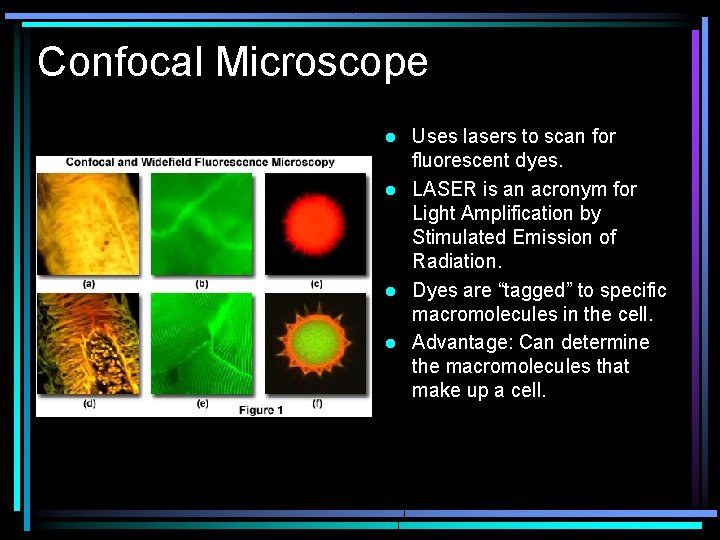
Confocal Microscope Uses lasers to scan for fluorescent dyes. l LASER is an acronym for Light Amplification by Stimulated Emission of Radiation. l Dyes are “tagged” to specific macromolecules in the cell. l Advantage: Can determine the macromolecules that make up a cell. l
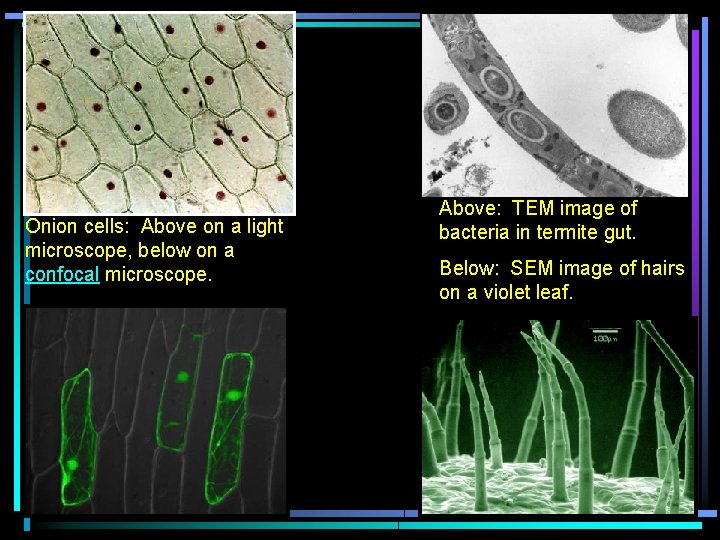
Onion cells: Above on a light microscope, below on a confocal microscope. Above: TEM image of bacteria in termite gut. Below: SEM image of hairs on a violet leaf.
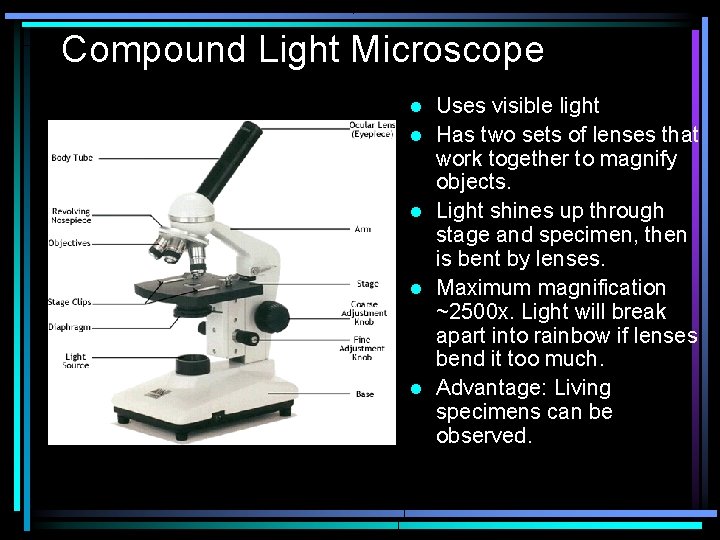
Compound Light Microscope l l l Uses visible light Has two sets of lenses that work together to magnify objects. Light shines up through stage and specimen, then is bent by lenses. Maximum magnification ~2500 x. Light will break apart into rainbow if lenses bend it too much. Advantage: Living specimens can be observed.
All cells can be classified as one of these two: • Prokaryotic (Bacteria Cells) or Eukaryotic (Plant and Animal Cells)
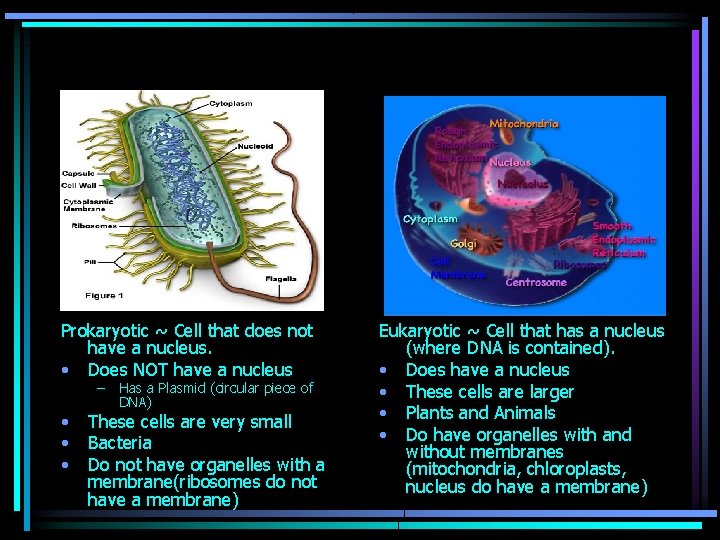
Prokaryotic ~ Cell that does not have a nucleus. • Does NOT have a nucleus – • • • Has a Plasmid (circular piece of DNA) These cells are very small Bacteria Do not have organelles with a membrane(ribosomes do not have a membrane) Eukaryotic ~ Cell that has a nucleus (where DNA is contained). • Does have a nucleus • These cells are larger • Plants and Animals • Do have organelles with and without membranes (mitochondria, chloroplasts, nucleus do have a membrane)
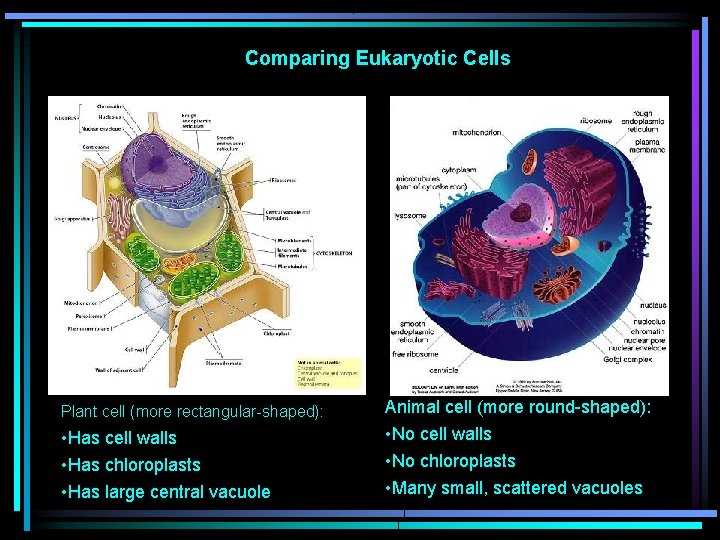
Comparing Eukaryotic Cells Plant cell (more rectangular-shaped): • Has cell walls • Has chloroplasts • Has large central vacuole Animal cell (more round-shaped): • No cell walls • No chloroplasts • Many small, scattered vacuoles
What are organelles? • Organelle literally means “tiny organs” and just like the organs in our bodies (heart, liver, brain, lungs), organelles carry out specific functions. • The liquid that organelles float around in is called cytoplasm (cyto=cell, plasm=liquid).
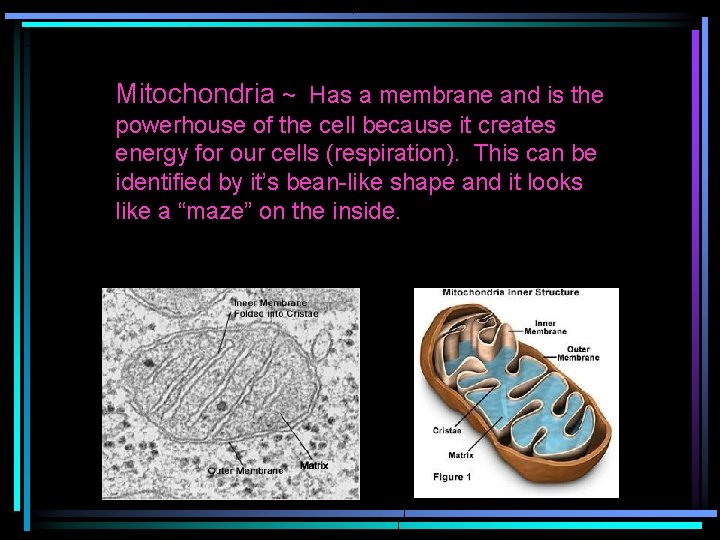
Mitochondria ~ Has a membrane and is the powerhouse of the cell because it creates energy for our cells (respiration). This can be identified by it’s bean-like shape and it looks like a “maze” on the inside.
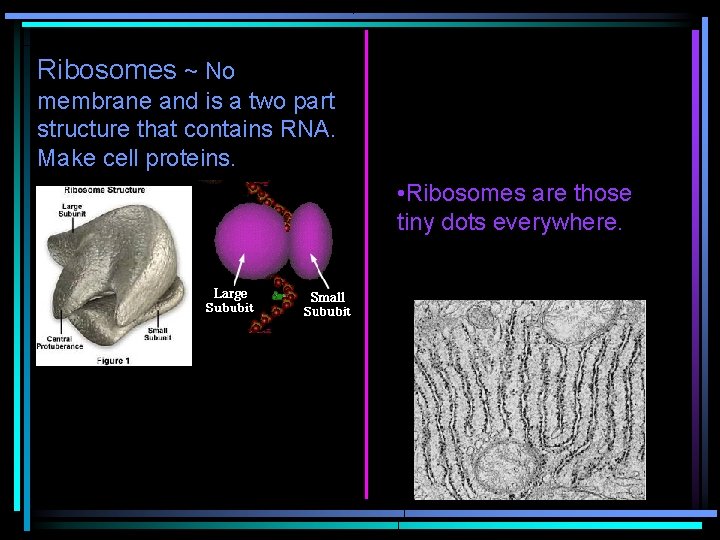
Ribosomes ~ No membrane and is a two part structure that contains RNA. Make cell proteins. • Ribosomes are those tiny dots everywhere.
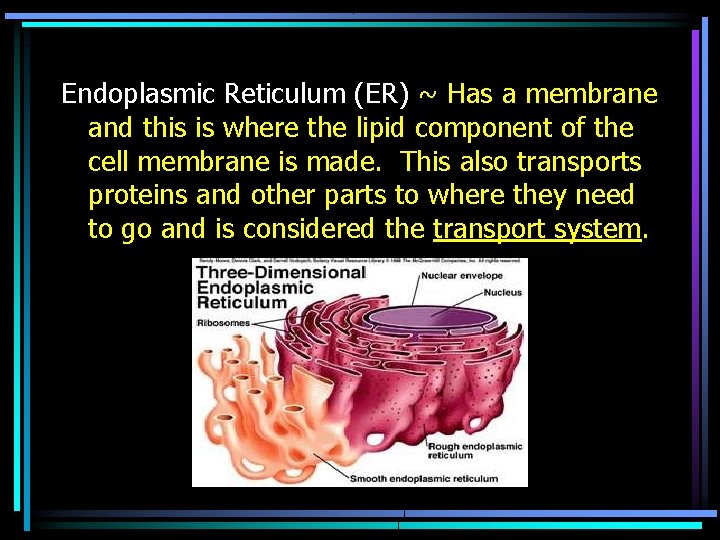
Endoplasmic Reticulum (ER) ~ Has a membrane and this is where the lipid component of the cell membrane is made. This also transports proteins and other parts to where they need to go and is considered the transport system.
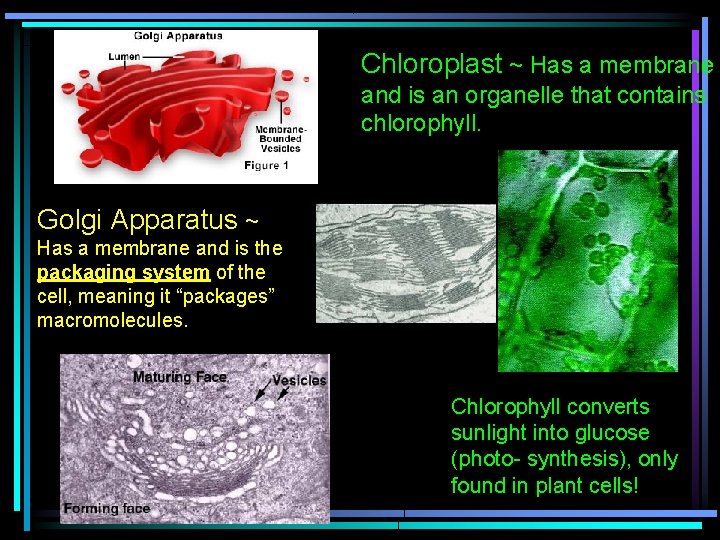
Chloroplast ~ Has a membrane and is an organelle that contains chlorophyll. Golgi Apparatus ~ Has a membrane and is the packaging system of the cell, meaning it “packages” macromolecules. Chlorophyll converts sunlight into glucose (photo- synthesis), only found in plant cells!
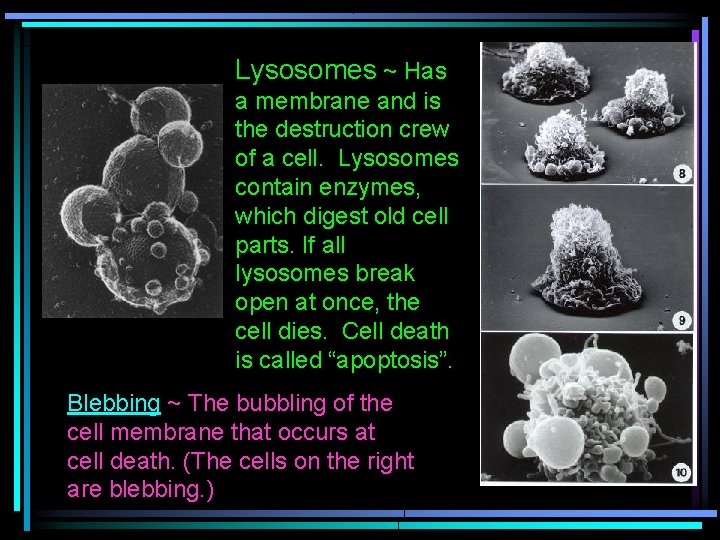
Lysosomes ~ Has a membrane and is the destruction crew of a cell. Lysosomes contain enzymes, which digest old cell parts. If all lysosomes break open at once, the cell dies. Cell death is called “apoptosis”. Blebbing ~ The bubbling of the cell membrane that occurs at cell death. (The cells on the right are blebbing. )

Vacuole ~ Storage bubble made of a part of the phospholipid bilayer from the cell membrane. Waste vacuole ~ Stores waste Food vacuole ~ Stores food (phagocytosis is shown in the picture) Central vacuole ~ Stores oil, starch, and water in plant cells.
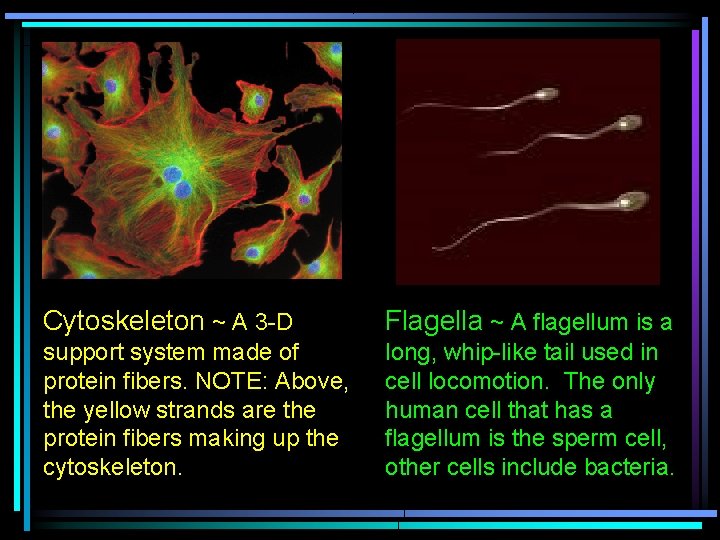
Cytoskeleton ~ A 3 -D Flagella ~ A flagellum is a support system made of protein fibers. NOTE: Above, the yellow strands are the protein fibers making up the cytoskeleton. long, whip-like tail used in cell locomotion. The only human cell that has a flagellum is the sperm cell, other cells include bacteria.
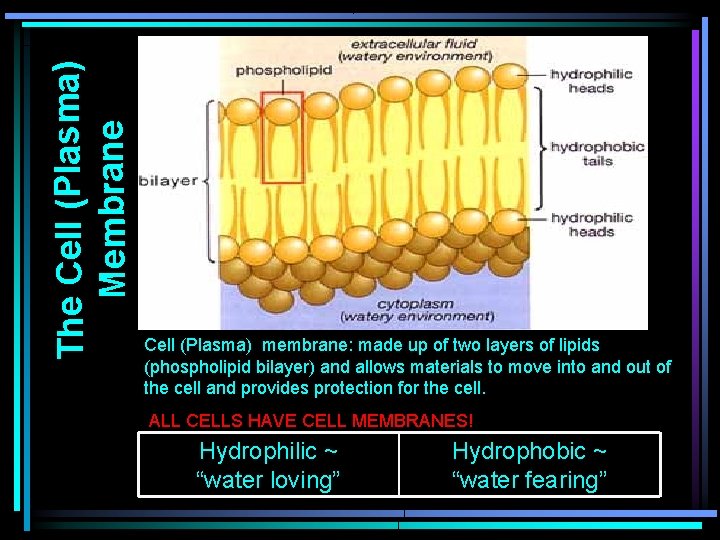
The Cell (Plasma) Membrane Cell (Plasma) membrane: made up of two layers of lipids (phospholipid bilayer) and allows materials to move into and out of the cell and provides protection for the cell. ALL CELLS HAVE CELL MEMBRANES! Hydrophilic ~ “water loving” Hydrophobic ~ “water fearing”
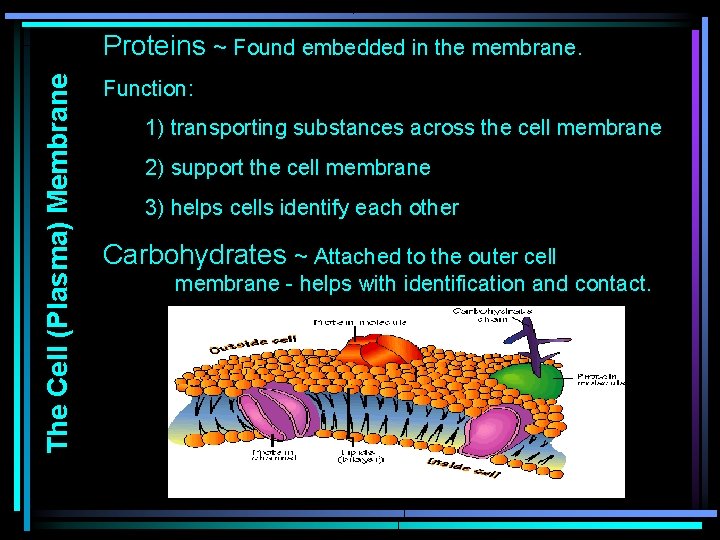
The Cell (Plasma) Membrane Proteins ~ Found embedded in the membrane. Function: 1) transporting substances across the cell membrane 2) support the cell membrane 3) helps cells identify each other Carbohydrates ~ Attached to the outer cell membrane - helps with identification and contact.
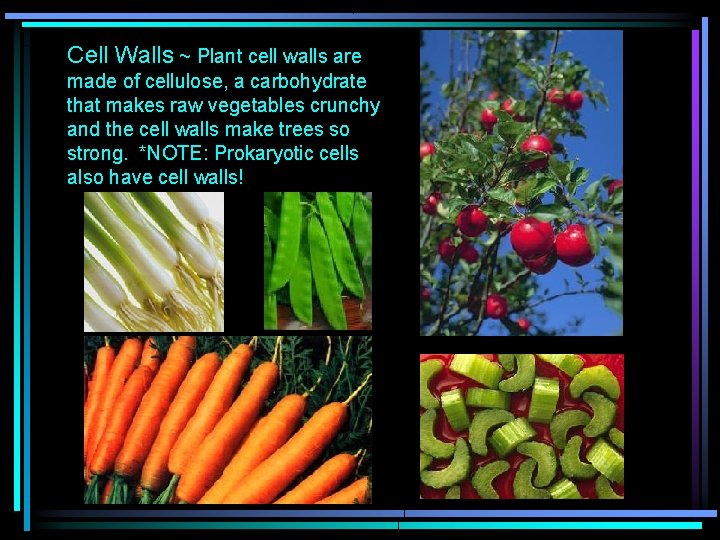
Cell Walls ~ Plant cell walls are made of cellulose, a carbohydrate that makes raw vegetables crunchy and the cell walls make trees so strong. *NOTE: Prokaryotic cells also have cell walls!
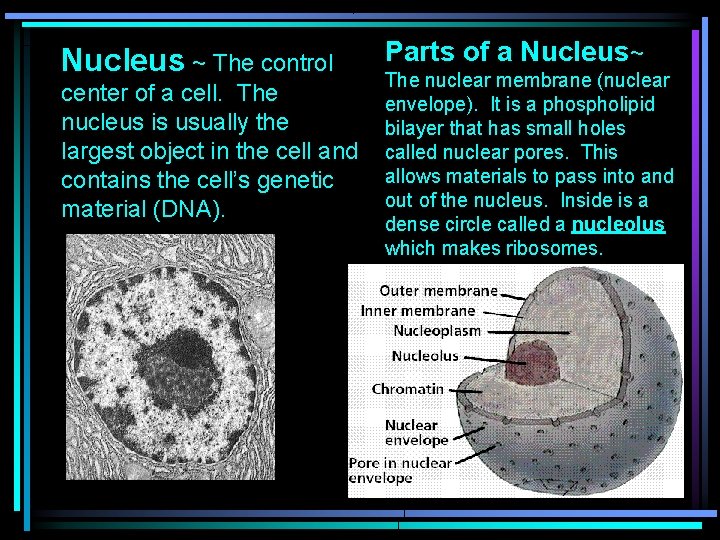
Nucleus ~ The control center of a cell. The nucleus is usually the largest object in the cell and contains the cell’s genetic material (DNA). Parts of a Nucleus~ The nuclear membrane (nuclear envelope). It is a phospholipid bilayer that has small holes called nuclear pores. This allows materials to pass into and out of the nucleus. Inside is a dense circle called a nucleolus which makes ribosomes.

Cell Specialization: Cells have specific functions. • Red Blood Cell (RBC) • White Blood Cell (WBC) – T Cell – B Cell • Muscle Cell • Neuron (Nerve Cell)
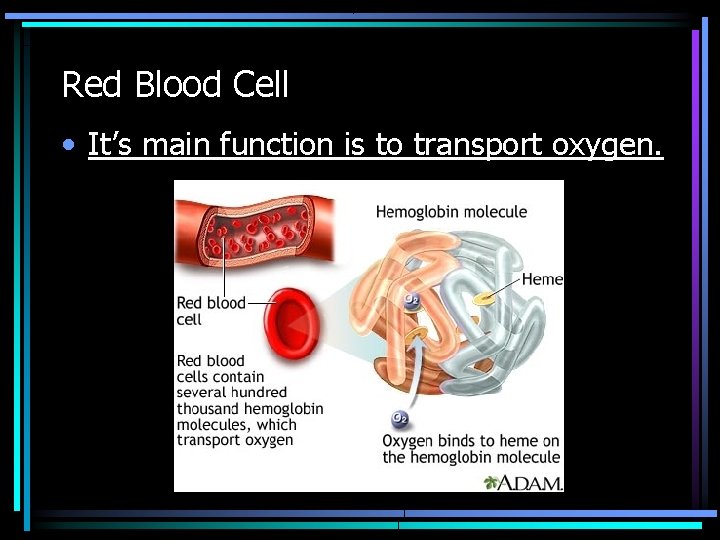
Red Blood Cell • It’s main function is to transport oxygen.
White Blood Cells • These are cells that are involved in your immune system (helps fight disease), 2 Types we will discuss: – T-Cells: Develop in the Thymus Gland INDIRECTLY fight disease by triggering BCells to be made – B-Cells: Develop in your Bone Marrow and DIRECTLY fight disease by producing antibodies (proteins that fight against infection of bacteria or viruses)
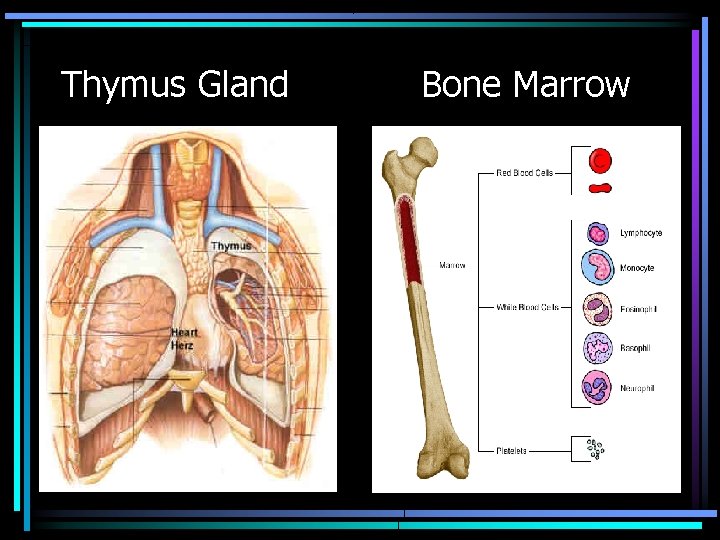
Thymus Gland Bone Marrow

Muscle Cells • Long, skinny cells that can contract (get short and fat) and relax, they connect to your bones and pull them so you can move.
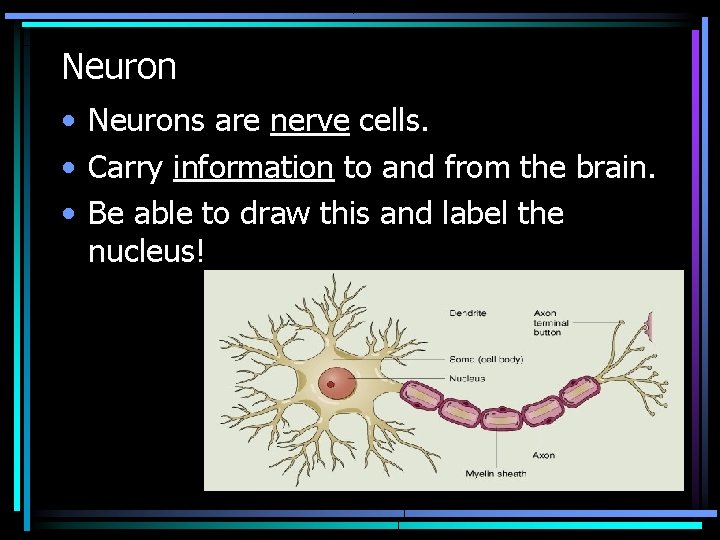
Neuron • Neurons are nerve cells. • Carry information to and from the brain. • Be able to draw this and label the nucleus!
Hormones • Hormones are lipid and protein based chemicals that control body functions. The 3 types we will study are: 1) Estrogen 2) Testosterone 3) Adrenaline
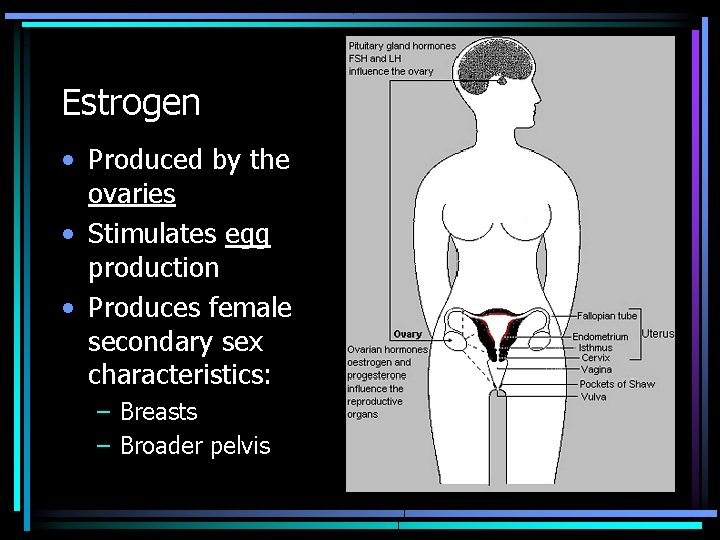
Estrogen • Produced by the ovaries • Stimulates egg production • Produces female secondary sex characteristics: – Breasts – Broader pelvis
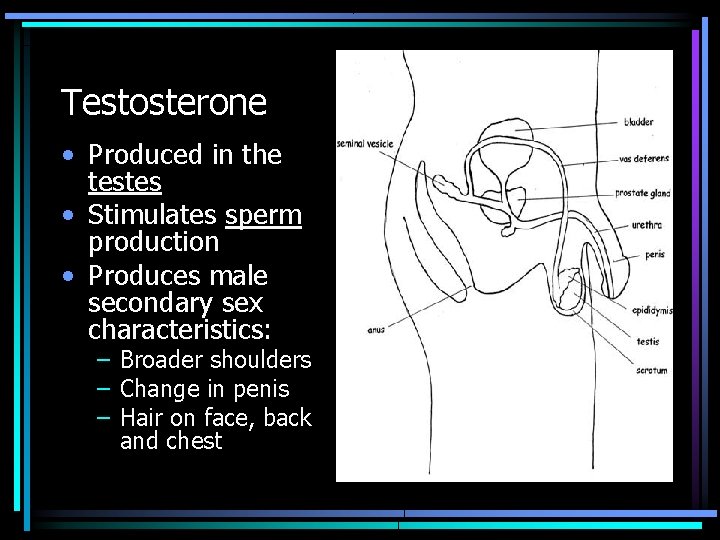
Testosterone • Produced in the testes • Stimulates sperm production • Produces male secondary sex characteristics: – Broader shoulders – Change in penis – Hair on face, back and chest

Adrenaline • Produced by adrenal glands • Triggers “Fight or flight” reaction: – Increased heart rate – Increased breathing – Dilated (relaxed) pupils
- Slides: 42