
Cystatin C as a Marker of Renal Function




- Slides: 38
Cystatin C as a Marker of Renal Function Dr. Adnan Mustafa Zubairi Associate Prof. / Chemical Pathologist Ziauddin University Hospital Karachi
n n n The negative outcomes of chronic kidney disease can be averted with early diagnosis and treatment. In an effort to improve early diagnosis, the National Kidney Foundation has issued standardized clinical practice guidelines according to the Kidney Disease Quality Initiative (K/DOQI). In these guidelines and recommendations the primary measure of renal function is the Glomerular Filtration Rate (GFR).
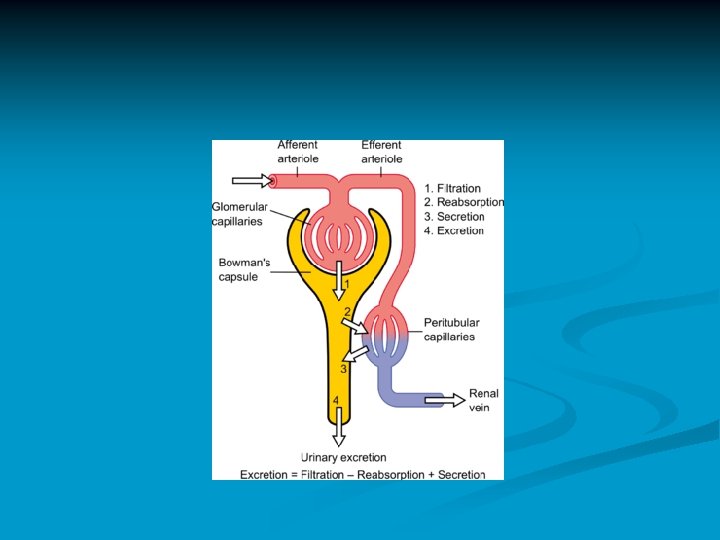
Glomerular Filtration Rate (GFR) The GFR is a measure of the rate at which water and dissolved substances (low molecular weight, ultrafiltrateable compounds) are filtered out of the blood per unit time. n Normal GFR’s for males are about of 150 m. L/min per 1. 73 m 2 and 130 m. L/min per 1. 73 m 2 for females. n
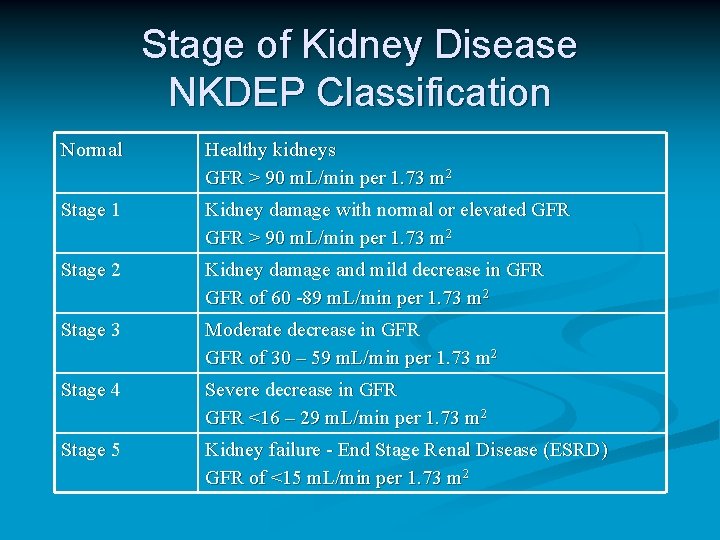
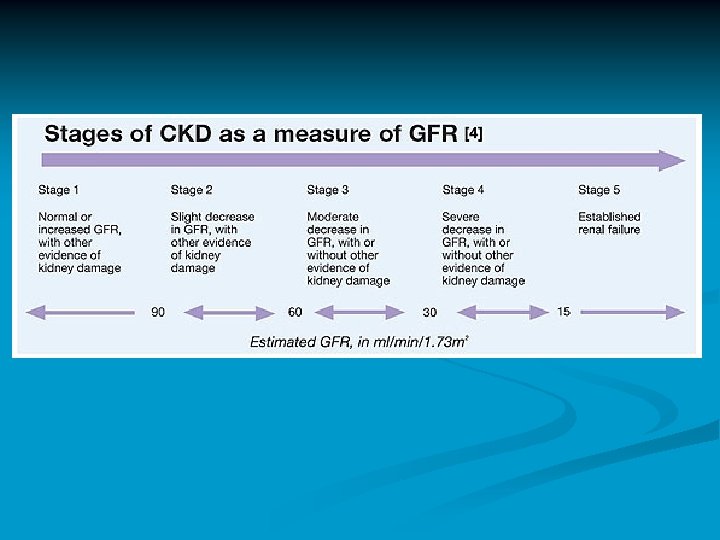
Stage of Kidney Disease NKDEP Classification Normal Healthy kidneys GFR > 90 m. L/min per 1. 73 m 2 Stage 1 Kidney damage with normal or elevated GFR > 90 m. L/min per 1. 73 m 2 Stage 2 Kidney damage and mild decrease in GFR of 60 -89 m. L/min per 1. 73 m 2 Stage 3 Moderate decrease in GFR of 30 – 59 m. L/min per 1. 73 m 2 Stage 4 Severe decrease in GFR <16 – 29 m. L/min per 1. 73 m 2 Stage 5 Kidney failure - End Stage Renal Disease (ESRD) GFR of <15 m. L/min per 1. 73 m 2
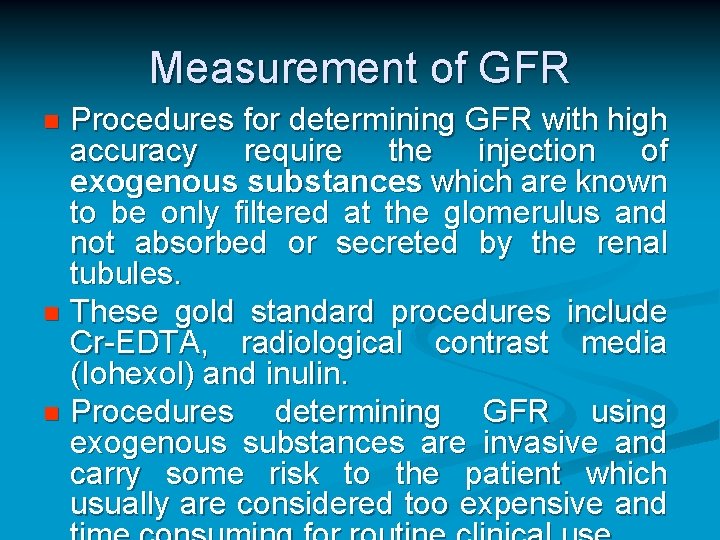
Measurement of GFR Procedures for determining GFR with high accuracy require the injection of exogenous substances which are known to be only filtered at the glomerulus and not absorbed or secreted by the renal tubules. n These gold standard procedures include Cr-EDTA, radiological contrast media (Iohexol) and inulin. n Procedures determining GFR using exogenous substances are invasive and carry some risk to the patient which usually are considered too expensive and n
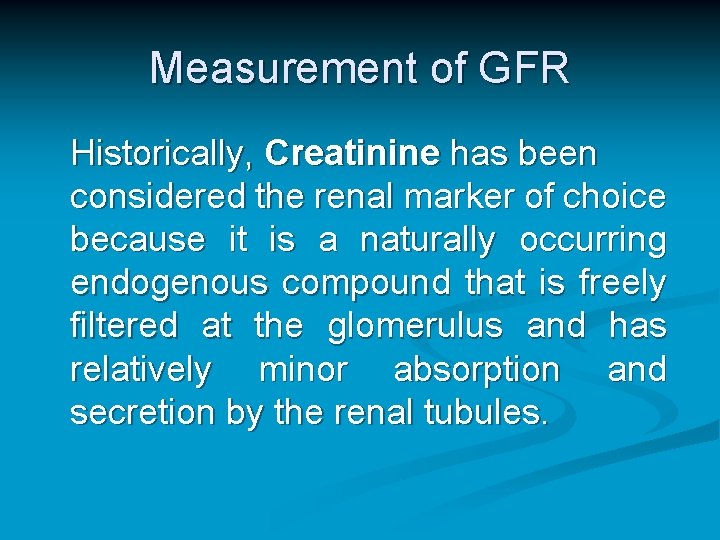
Measurement of GFR Historically, Creatinine has been considered the renal marker of choice because it is a naturally occurring endogenous compound that is freely filtered at the glomerulus and has relatively minor absorption and secretion by the renal tubules.
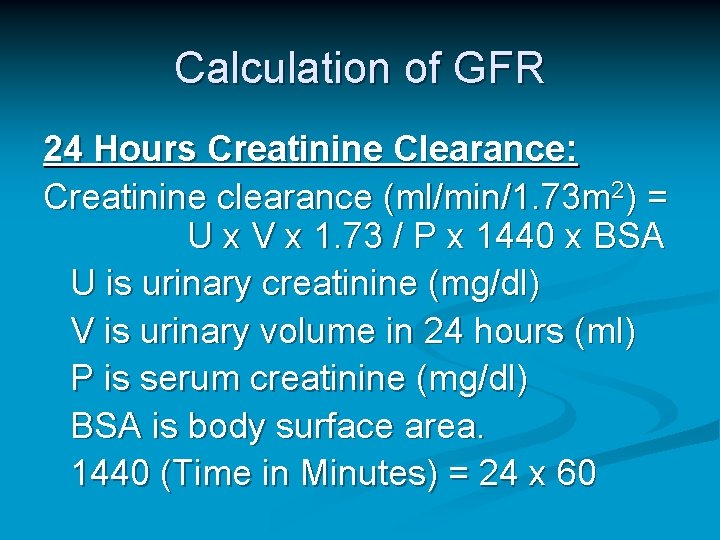
Calculation of GFR 24 Hours Creatinine Clearance: Creatinine clearance (ml/min/1. 73 m 2) = U x V x 1. 73 / P x 1440 x BSA U is urinary creatinine (mg/dl) V is urinary volume in 24 hours (ml) P is serum creatinine (mg/dl) BSA is body surface area. 1440 (Time in Minutes) = 24 x 60
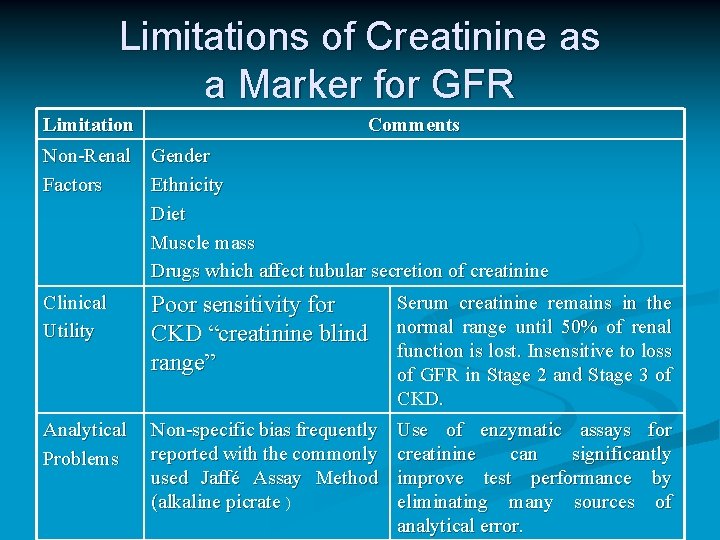
Measurement of GFR Even though serum creatinine determination remains the most commonly used renal marker for estimation of GFR, it is known to have a number of inherent difficulties which limit its clinical reliability.
Limitations of Creatinine as a Marker for GFR Limitation Comments Non-Renal Gender Factors Ethnicity Diet Muscle mass Drugs which affect tubular secretion of creatinine Clinical Utility Poor sensitivity for CKD “creatinine blind range” Serum creatinine remains in the normal range until 50% of renal function is lost. Insensitive to loss of GFR in Stage 2 and Stage 3 of CKD. Analytical Problems Non-specific bias frequently reported with the commonly used Jaffé Assay Method (alkaline picrate ) Use of enzymatic assays for creatinine can significantly improve test performance by eliminating many sources of analytical error.
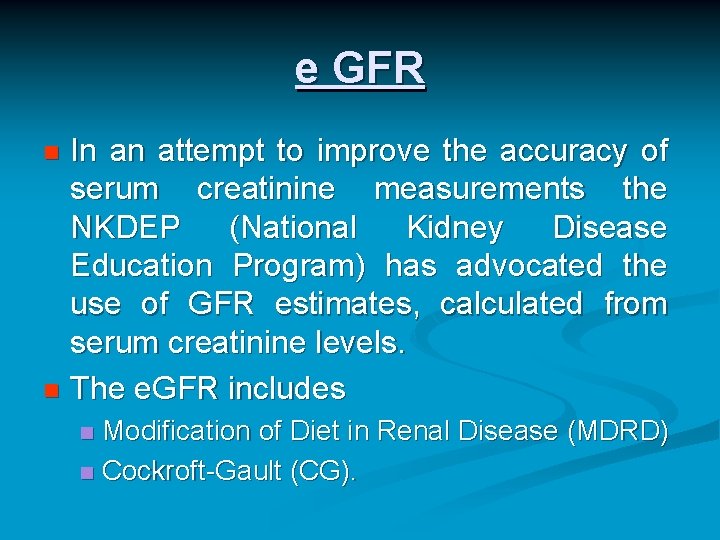
e GFR In an attempt to improve the accuracy of serum creatinine measurements the NKDEP (National Kidney Disease Education Program) has advocated the use of GFR estimates, calculated from serum creatinine levels. n The e. GFR includes n Modification of Diet in Renal Disease (MDRD) n Cockroft-Gault (CG). n
Calculation of e. GFR Cockcroft- Gault estimated creatinine clearance (ml/min) = (140 -age) x (weight in Kg) / serum creatinine (mg/dl) x 72 x (0. 85 if female). n MDRD estimated creatinine clearance (ml/min/1. 73 m 2) = 186 x [serum creatinine (mg/dl)] -1. 154 x (age in years) -0. 203 x (0. 742 if female). n
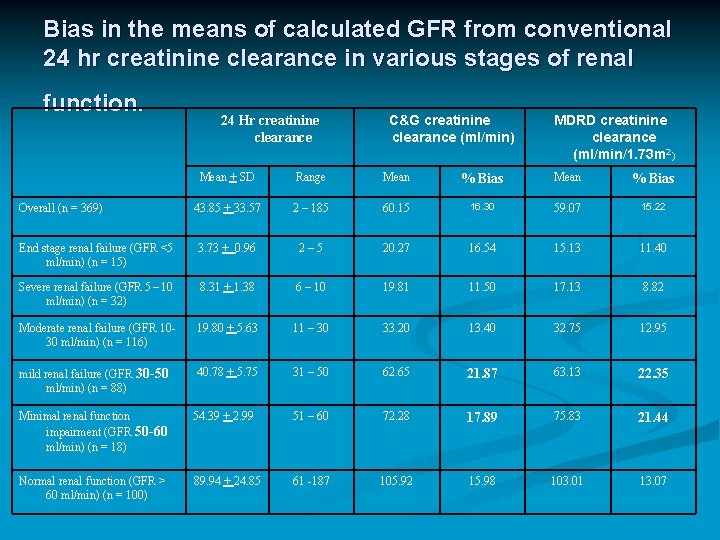
Bias in the means of calculated GFR from conventional 24 hr creatinine clearance in various stages of renal function. 24 Hr creatinine clearance C&G creatinine clearance (ml/min) MDRD creatinine clearance (ml/min/1. 73 m 2) Mean + SD Range Mean % Bias 43. 85 + 33. 57 2 – 185 60. 15 16. 30 59. 07 15. 22 End stage renal failure (GFR <5 ml/min) (n = 15) 3. 73 + 0. 96 2– 5 20. 27 16. 54 15. 13 11. 40 Severe renal failure (GFR 5 – 10 ml/min) (n = 32) 8. 31 + 1. 38 6 – 10 19. 81 11. 50 17. 13 8. 82 Moderate renal failure (GFR 1030 ml/min) (n = 116) 19. 80 + 5. 63 11 – 30 33. 20 13. 40 32. 75 12. 95 mild renal failure (GFR 30 -50 ml/min) (n = 88) 40. 78 + 5. 75 31 – 50 62. 65 21. 87 63. 13 22. 35 Overall (n = 369) Minimal renal function impairment (GFR 50 -60 ml/min) (n = 18) 54. 39 + 2. 99 51 – 60 72. 28 17. 89 75. 83 21. 44 Normal renal function (GFR > 60 ml/min) (n = 100) 89. 94 + 24. 85 61 -187 105. 92 15. 98 103. 01 13. 07
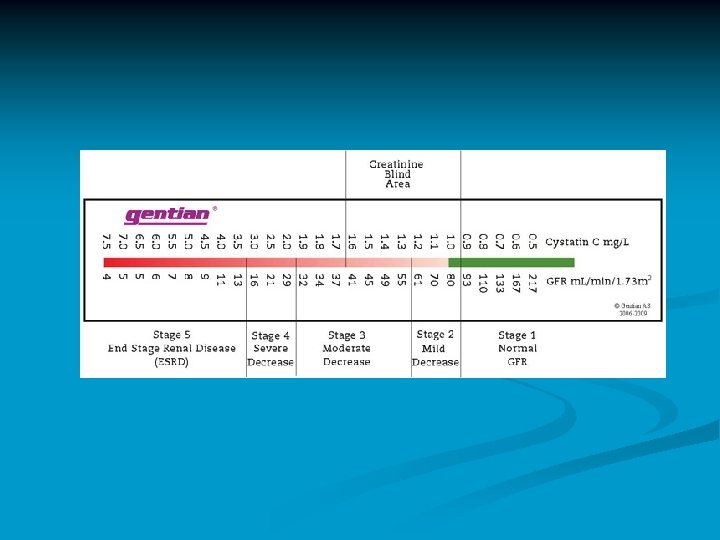
Even though creatinine based GFR equations such as the MDRD improve the accuracy of serum creatinine measurements, concentrations of creatinine can be within the normal range even with a GFR of around 40 m. L/min/1. 73 m 2 resulting in a so called “creatinine blind” range. This is due to the fact that MDRD understates normal and elevated GFR’s and overstates decreases in GFR
Cystatin C as a GFR Marker A substantial body of evidence has developed over the past several years which supports the use of Cystatin C as an alternative and more sensitive endogenous marker for the estimation of GFR than serum creatinine and serum creatinine based GFR estimations
“Cystatin C is emerging as a biomarker superior to serum creatinine for estimating GFR and predicting the risk of death and cardiovascular events” (DIABETES, VOL 56, NOVEMBER 2007)
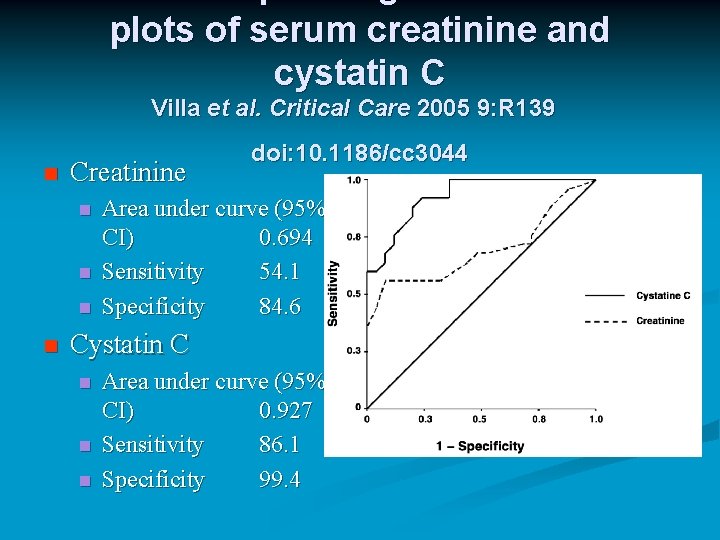
plots of serum creatinine and cystatin C Villa et al. Critical Care 2005 9: R 139 n Creatinine n n Area under curve (95% CI) 0. 694 Sensitivity 54. 1 Specificity 84. 6 Cystatin C n n n doi: 10. 1186/cc 3044 Area under curve (95% CI) 0. 927 Sensitivity 86. 1 Specificity 99. 4
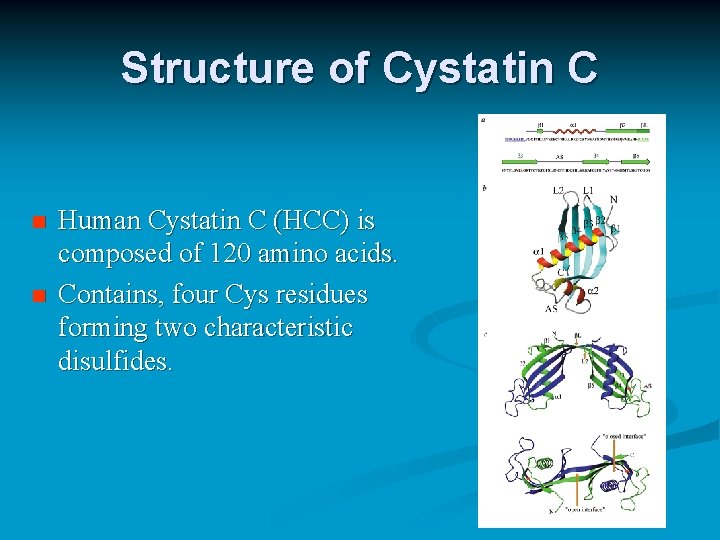
Structure of Cystatin C n n Human Cystatin C (HCC) is composed of 120 amino acids. Contains, four Cys residues forming two characteristic disulfides.
n n n Cystatin C is a small 13 –k. Da protein that is a member of the cysteine proteinase inhibitor family that is produced at a constant rate by all nucleated cells. Due to its small size & positive charge at physiological p. H, it is freely filtered by the glomerulus, and is not secreted but is fully reabsorbed and catabolized in proximal renal tubules. This means the primary determinate of blood Cystatin C levels is the rate at which it is filtered at the glomerulus making it an excellent GFR marker.
n n Unlike creatinine, Cystatin C serum levels are virtually unaffected by age (>1 yr), muscle mass, gender and race. A number of very simple formulas have been introduced which can be used to obtain an estimated GFR using Cystatin C. Multiple studies have found Cystatin C to be more sensitive to actual changes in GFR in the early stages of CKD than creatinine based GFR estimates. A significant advantage of Cystatin C based formulas, unlike creatinine based equations, is that Cystatin C based estimated GFR formulas are not biased according to GFR and there is no GFR blind area with Cystatin C.
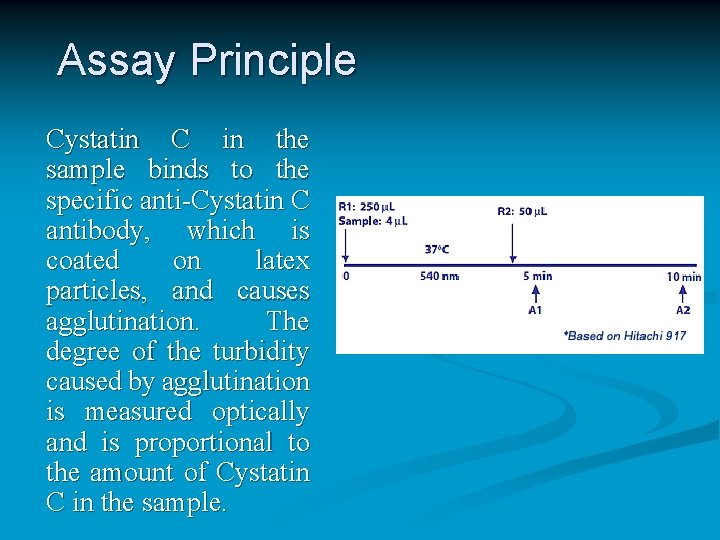
Assay Principle Cystatin C in the sample binds to the specific anti-Cystatin C antibody, which is coated on latex particles, and causes agglutination. The degree of the turbidity caused by agglutination is measured optically and is proportional to the amount of Cystatin C in the sample.
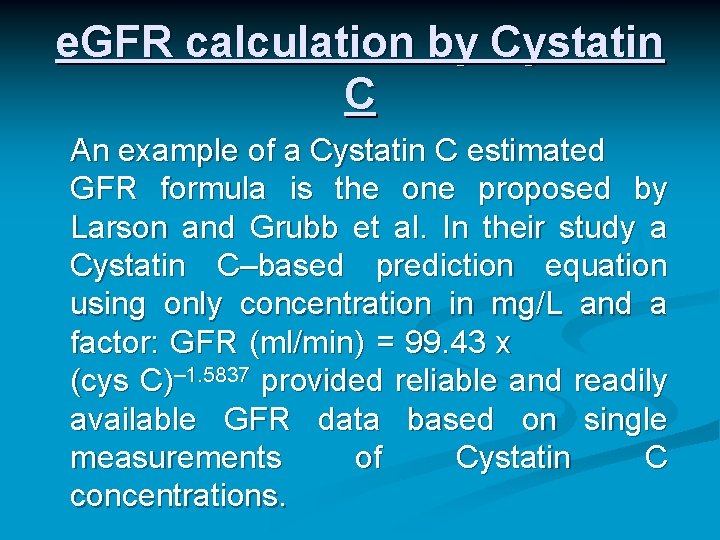
e. GFR calculation by Cystatin C An example of a Cystatin C estimated GFR formula is the one proposed by Larson and Grubb et al. In their study a Cystatin C–based prediction equation using only concentration in mg/L and a factor: GFR (ml/min) = 99. 43 x (cys C)– 1. 5837 provided reliable and readily available GFR data based on single measurements of Cystatin C concentrations.
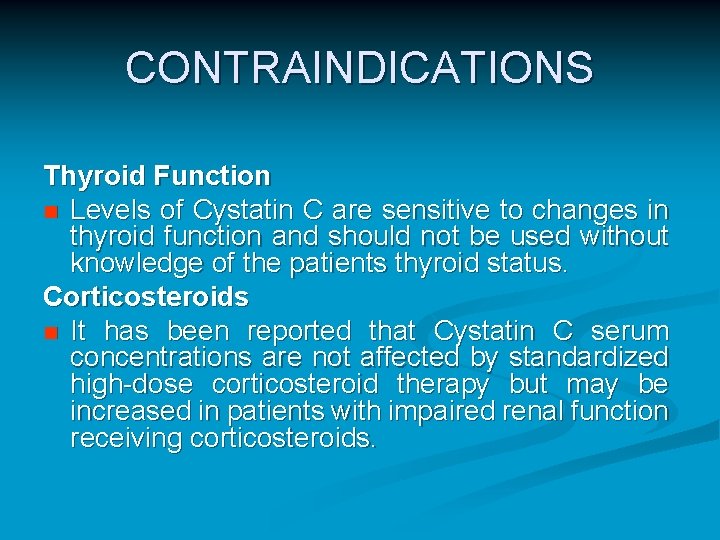
CONTRAINDICATIONS Thyroid Function n Levels of Cystatin C are sensitive to changes in thyroid function and should not be used without knowledge of the patients thyroid status. Corticosteroids n It has been reported that Cystatin C serum concentrations are not affected by standardized high-dose corticosteroid therapy but may be increased in patients with impaired renal function receiving corticosteroids.
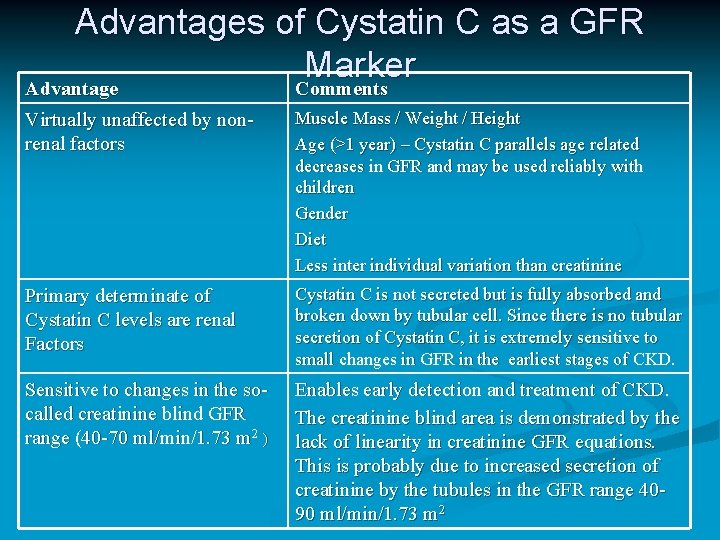
Advantages of Cystatin C as a GFR Marker Advantage Comments Virtually unaffected by nonrenal factors Muscle Mass / Weight / Height Age (>1 year) – Cystatin C parallels age related decreases in GFR and may be used reliably with children Gender Diet Less inter individual variation than creatinine Primary determinate of Cystatin C levels are renal Factors Cystatin C is not secreted but is fully absorbed and broken down by tubular cell. Since there is no tubular secretion of Cystatin C, it is extremely sensitive to small changes in GFR in the earliest stages of CKD. Sensitive to changes in the socalled creatinine blind GFR range (40 -70 ml/min/1. 73 m 2 ) Enables early detection and treatment of CKD. The creatinine blind area is demonstrated by the lack of linearity in creatinine GFR equations. This is probably due to increased secretion of creatinine by the tubules in the GFR range 4090 ml/min/1. 73 m 2
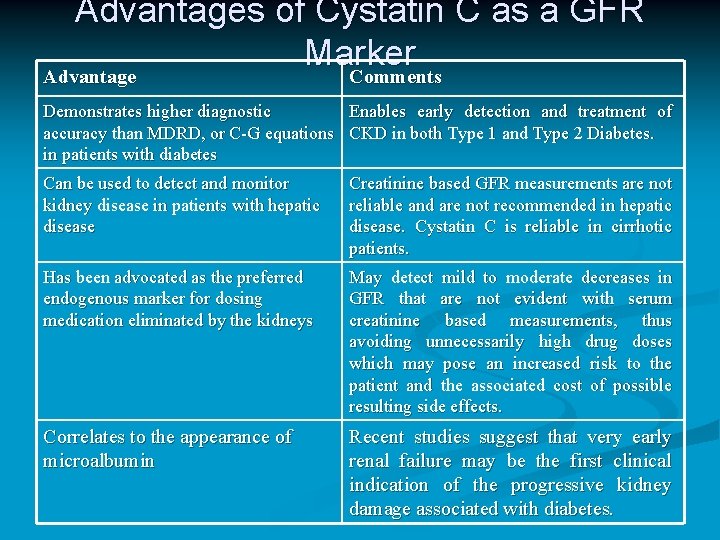
Advantages of Cystatin C as a GFR Marker Advantage Comments Demonstrates higher diagnostic Enables early detection and treatment of accuracy than MDRD, or C-G equations CKD in both Type 1 and Type 2 Diabetes. in patients with diabetes Can be used to detect and monitor kidney disease in patients with hepatic disease Creatinine based GFR measurements are not reliable and are not recommended in hepatic disease. Cystatin C is reliable in cirrhotic patients. Has been advocated as the preferred endogenous marker for dosing medication eliminated by the kidneys May detect mild to moderate decreases in GFR that are not evident with serum creatinine based measurements, thus avoiding unnecessarily high drug doses which may pose an increased risk to the patient and the associated cost of possible resulting side effects. Correlates to the appearance of microalbumin Recent studies suggest that very early renal failure may be the first clinical indication of the progressive kidney damage associated with diabetes.
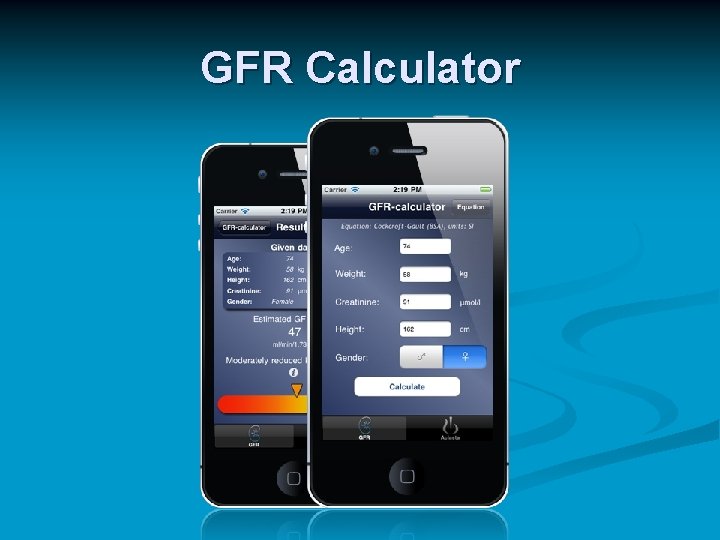
GFR Calculator
Conclusions :
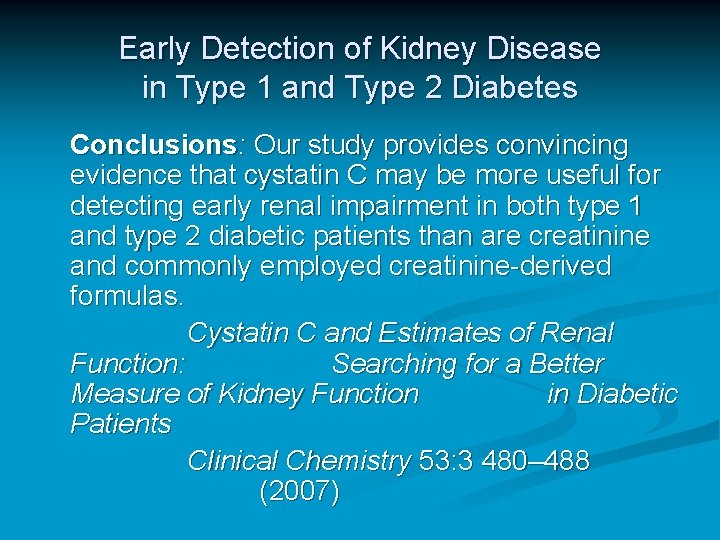
Early Detection of Kidney Disease in Type 1 and Type 2 Diabetes Conclusions: Our study provides convincing evidence that cystatin C may be more useful for detecting early renal impairment in both type 1 and type 2 diabetic patients than are creatinine and commonly employed creatinine-derived formulas. Cystatin C and Estimates of Renal Function: Searching for a Better Measure of Kidney Function in Diabetic Patients Clinical Chemistry 53: 3 480– 488 (2007)
Early Detection of Kidney Disease in Type 1 Diabetes Conclusion: Cystatin C was more accurate in detecting decline in renal function than creatinine based methods in this population of subjects with Type 1 and a normal mean baseline GFR. Serial Measurements of Cystatin C Are More Accurate than Creatinine-based Methods in Detecting Declining Renal Function in Type 1 Diabetes Care. 2008; 0: dc 07 -1588 v 1 -0
Early Detection of Kidney Disease in Type 2 Diabetes Conclusions: Cystatin C may be considered as an alternative and more accurate serum marker than serum creatinine or the Cockcroft and Gault estimated GFR in discriminating type 2 diabetic patients with reduced GFR from those with normal GFR. Cystatin C Is a More Sensitive Marker Than Creatinine for the Estimation of GFR in Type 2 Diabetic Patients Kidney International, Vol. 61 (2002), pp. 1453– 1461
Early Detection of Chronic Kidney Disease Conclusions: Among elderly persons without chronic kidney disease, cystatin C is a prognostic biomarker of risk for death, cardiovascular disease, and chronic kidney disease. In this setting, cystatin C seems to identify a “preclinical” state of kidney dysfunction that is not detected with serum creatinine or estimated GFR. Cystatin C and Prognosis for Cardiovascular and Kidney Outcomes in Elderly Persons without Chronic Kidney Disease Ann Intern Med. 2006; 145: 237 -246
A recent meta-analysis demonstrated that serum cystatin C is a better marker for GFR than serum creatinine. In clinical practice, it has been suggested that serum cystatin C can optimize early detection for diabetic or hypertensive nephropathy. In addition, the use of serum cystatin C is possibly more appropriate for establishing an appropriate dose adjustment of drugs that are mainly eliminated by the kidney A New Approach for Evaluating Renal Function and Its Practical Application J Pharmacol Sci 105, 1 – 5 (2007)
Improved Marker of Drug Elimination Cystatin C is a marker of drug elimination which is superior to serum creatinine for Topotecan (Chemotherapeutic agent). It deserves to be further explored as a promising covariate for drug dosing as well as selection criteria for clinical studies of drugs eliminated mainly or partially by the kidney. Serum Cystatin C is a Better Marker of Topotecan Clearance than Serum Creatinine
Early Detection of of Acute Renal Failure Conclusions: Serum cystatin C is a useful detection marker of acute renal failure (ARF), and may detect ARF one to two days earlier than creatinine. Early Detection of Acute Renal Failure by Serum Cystatin C Kidney Int 2004; 66: 1115 -1122
Cardiovascular Risk Conclusions: High cystatin C concentrations predict substantial increased risks of all-cause mortality, cardiovascular events, and incident heart failure among ambulatory persons with CHD. This risk is not completely captured by measures of kidney function routinely used in clinical practice. Association of Cystatin C With Mortality, Cardiovascular Events, and Incident Heart Failure Among Persons With Coronary Heart Disease Circulation. 2007; 115: 173 -179