
CYPS Foundation Degree How to write an Essay
- Slides: 34
CYPS – Foundation Degree How to write an Essay M. Henshaw@derby. ac. uk
Aims n To examine the principles of writing an Essay. Extracts from www. laura-lee. co. uk/WAOMake. ITWork
Writing your essay Turn your notes into a good piece of writing Øappropriately introduced Øwell-argued and concluded Ømeets formal and academic writing conventions Øreflects both your subject knowledge and transferable skills. ØContains no subheadings.
What is the word count? Ø Ø This affects how you balance your piece. For example a word count of 3000 words might be broken down into an introduction and conclusion of 150 -200 words each and the main body divided evenly over the remaining 24 -2500. Be it a report or an essay it comprises three main parts: 1. An introduction 2. The body of your discussion 3. A conclusion/set of conclusion
Paragraphs Ø These are structured using paragraphs so it is important to understand the format and purpose of a paragraph: Ø Each paragraph represents a set of related points or pieces of evidence that together form a specific section of the argument
Paragraphs continued Ø Therefore each paragraph contains sentences relating to a single theme or topic so whenever the piece changes direction or introduces a new point, idea or data, a new paragraph is needed Ø Paragraphs have more than two sentences but should rarely be longer than half a page
Paragraphs continued Ø Ø Paragraphs must be organised in a logical sequence so that the arguments flow easily from one point to the next Each part needs to clearly signpost to and link with the next part so that your work flows smoothly.
Important! Ø The last paragraph that you check is not the conclusion; it is the introduction! As you re-drafted you may well have made changes to the order of events or even overall approach, and so you may need to amend your introductory paragraph. Ensure that your introduction does in fact introduce the rest of your piece!
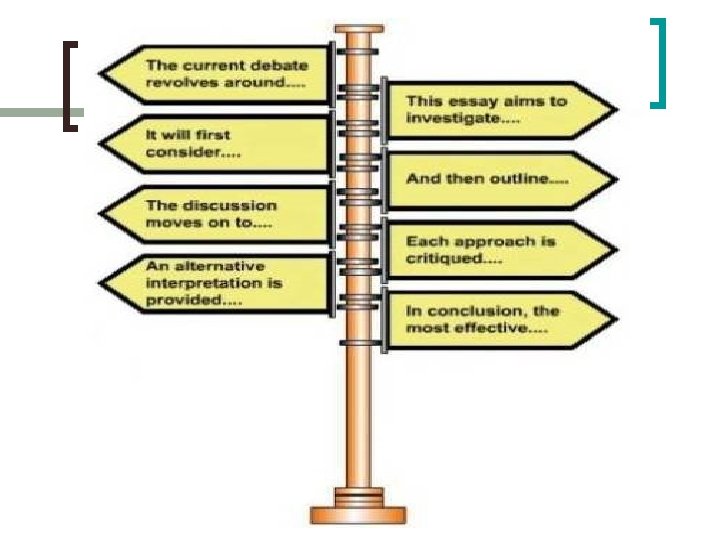
Signposts Ø Ø Signposts are phrases you use to help your reader navigate your writing. They introduce and indicate the structure of an argument and are particularly important where it is changing direction.
The introductions - signpost n The introduction comprises a series of statements that act as signposts to the whole piece. n You identify the key issue(s) and point to themes and structure of the piece
Introductions continued Ø Short introductions are more effective; each statement should be a concise summation of an intention or direction. Ø In essence this is where you introduce the topic, the particular angle you are going to pursue.
Linking Phrases • • Linking phrases are also signposts but they serve specifically to indicate a change in direction as the discussion moves on. The final statement of one paragraph should smoothly introduce the new idea contained in the next. They guide your reader through your thinking processes all the way to your conclusions. In this way your conclusions can be clearly seen as reasoned and reasonable.
Useful essay words and phrases Ø Ø Certain words are used to link ideas and to signpost the reader the direction your line of reasoning is about to take, such as adding more emphasis, or introducing an alternative point of view. The following slides demonstrate a selection of words used to link ideas, depending on the direction of your argument.
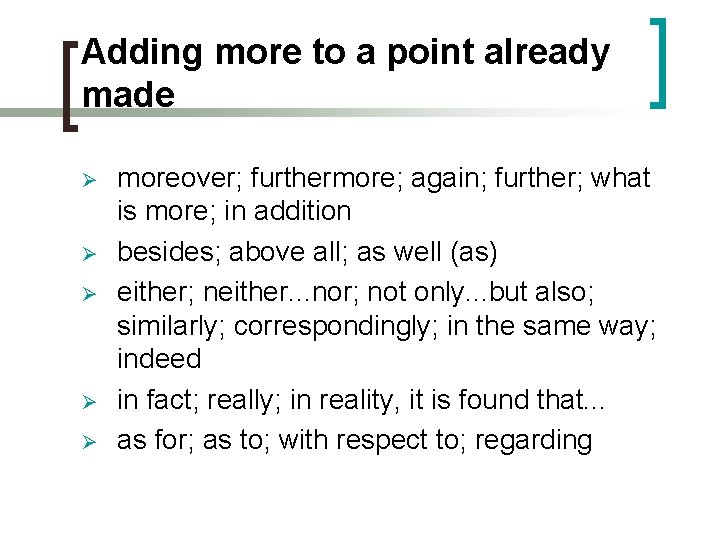
Adding more to a point already made Ø Ø Ø moreover; furthermore; again; further; what is more; in addition besides; above all; as well (as) either; neither. . . nor; not only. . . but also; similarly; correspondingly; in the same way; indeed in fact; really; in reality, it is found that. . . as for; as to; with respect to; regarding
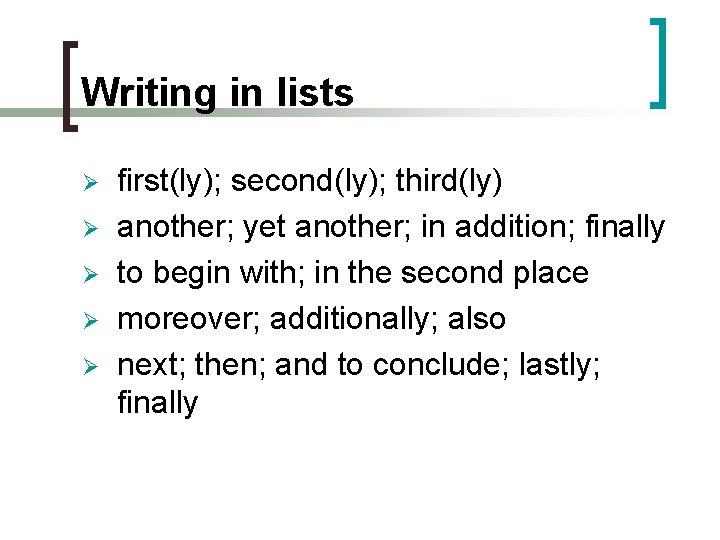
Writing in lists Ø Ø Ø first(ly); second(ly); third(ly) another; yet another; in addition; finally to begin with; in the second place moreover; additionally; also next; then; and to conclude; lastly; finally
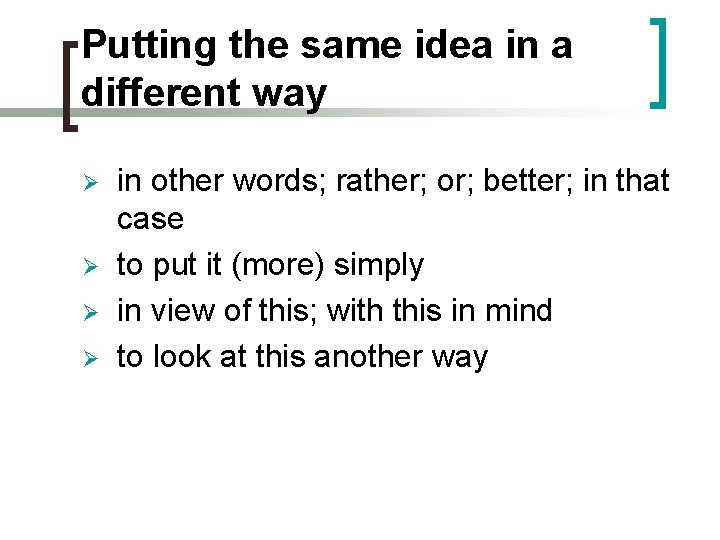
Putting the same idea in a different way Ø Ø in other words; rather; or; better; in that case to put it (more) simply in view of this; with this in mind to look at this another way
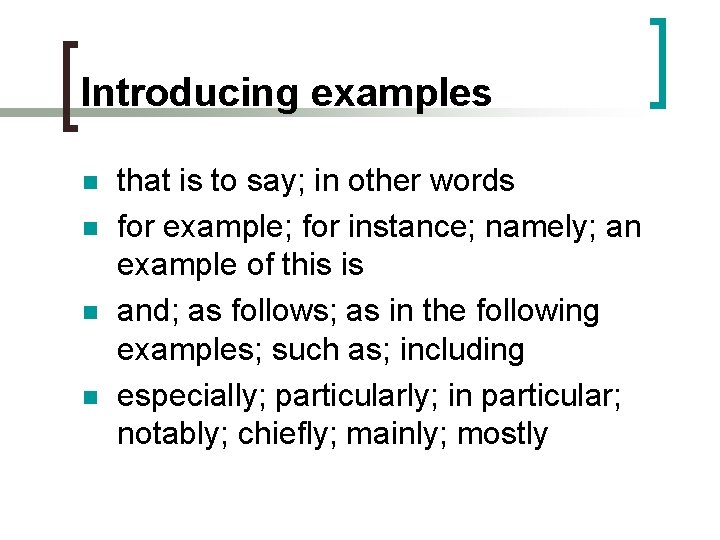
Introducing examples n n that is to say; in other words for example; for instance; namely; an example of this is and; as follows; as in the following examples; such as; including especially; particularly; in particular; notably; chiefly; mainly; mostly
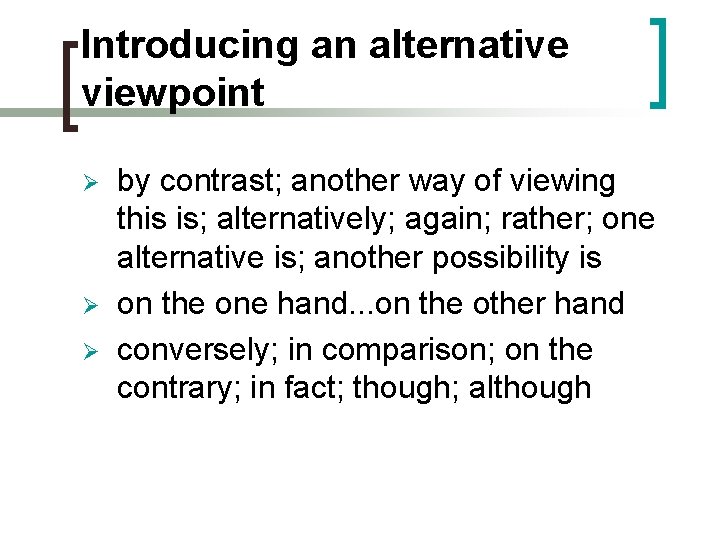
Introducing an alternative viewpoint Ø Ø Ø by contrast; another way of viewing this is; alternatively; again; rather; one alternative is; another possibility is on the one hand. . . on the other hand conversely; in comparison; on the contrary; in fact; though; although
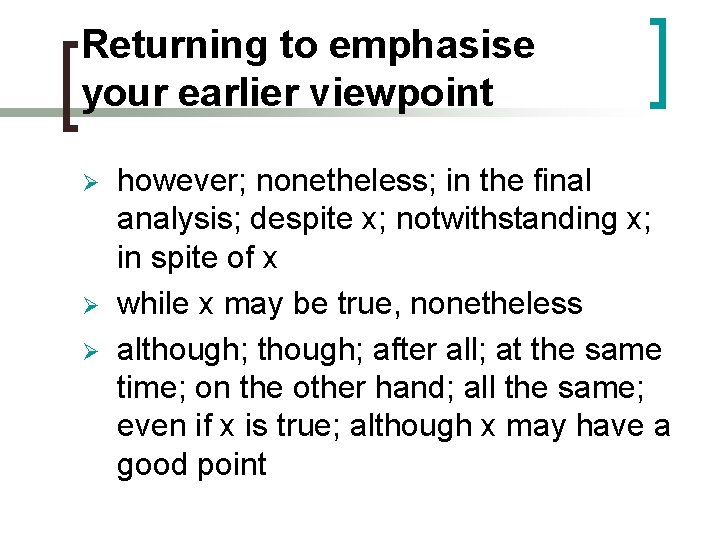
Returning to emphasise your earlier viewpoint Ø Ø Ø however; nonetheless; in the final analysis; despite x; notwithstanding x; in spite of x while x may be true, nonetheless although; after all; at the same time; on the other hand; all the same; even if x is true; although x may have a good point
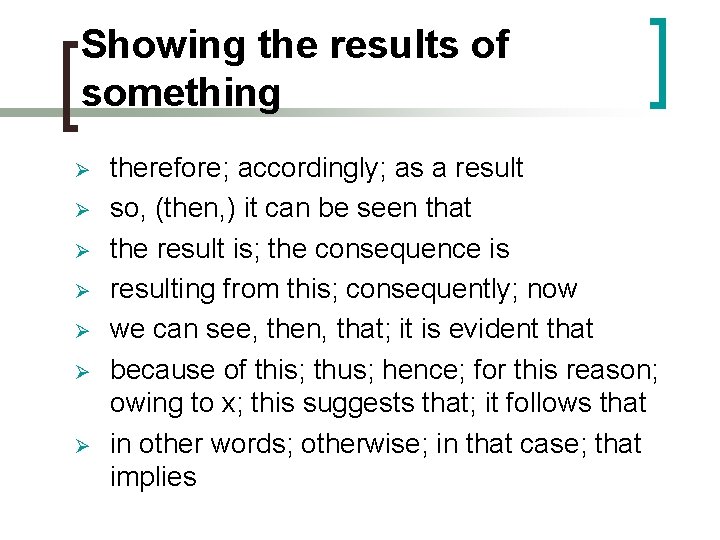
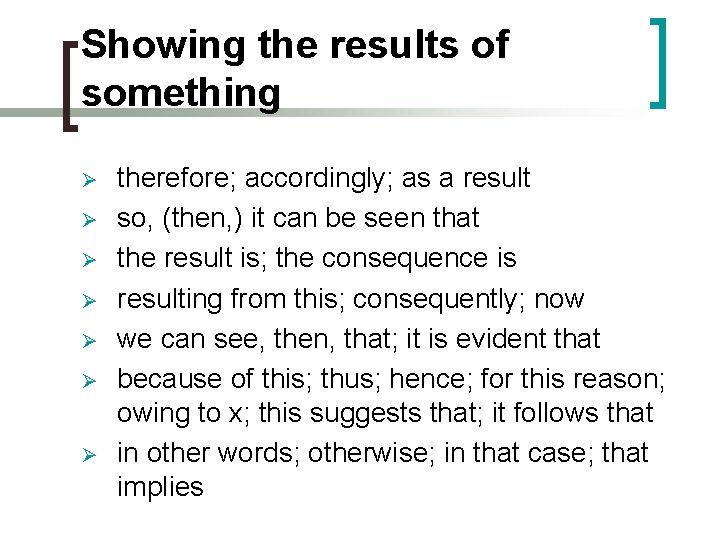
Showing the results of something Ø Ø Ø Ø therefore; accordingly; as a result so, (then, ) it can be seen that the result is; the consequence is resulting from this; consequently; now we can see, then, that; it is evident that because of this; thus; hence; for this reason; owing to x; this suggests that; it follows that in other words; otherwise; in that case; that implies
Showing the results of something Ø Ø Ø Ø therefore; accordingly; as a result so, (then, ) it can be seen that the result is; the consequence is resulting from this; consequently; now we can see, then, that; it is evident that because of this; thus; hence; for this reason; owing to x; this suggests that; it follows that in other words; otherwise; in that case; that implies
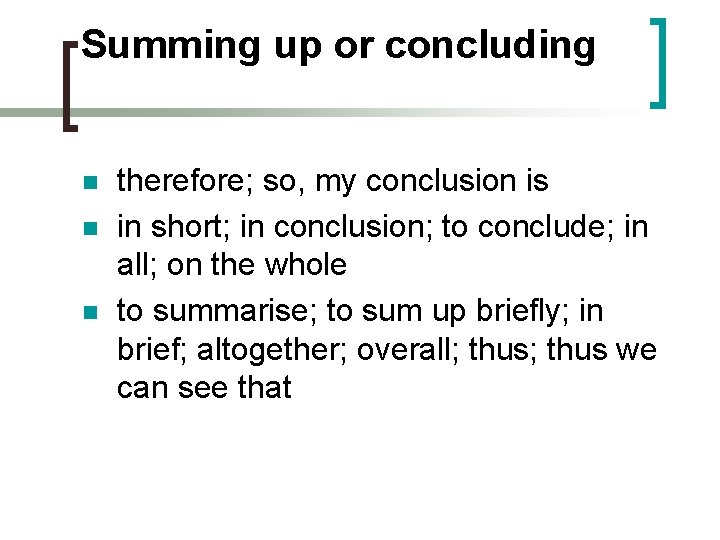
Summing up or concluding n n n therefore; so, my conclusion is in short; in conclusion; to conclude; in all; on the whole to summarise; to sum up briefly; in brief; altogether; overall; thus we can see that
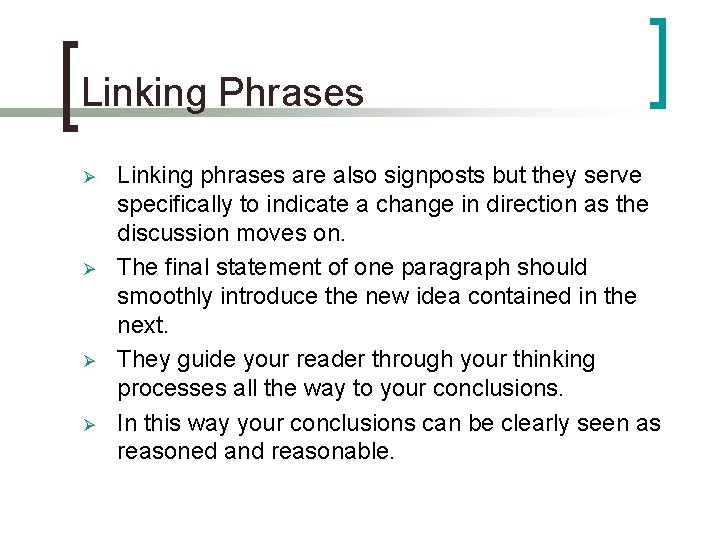
Linking Phrases Ø Ø Linking phrases are also signposts but they serve specifically to indicate a change in direction as the discussion moves on. The final statement of one paragraph should smoothly introduce the new idea contained in the next. They guide your reader through your thinking processes all the way to your conclusions. In this way your conclusions can be clearly seen as reasoned and reasonable.
The Conclusion n Important! n The conclusion wraps up your arguments, make sure that you have included everything you intended to - don't just come to an abrupt halt!
The Conclusion Continued Ø Ø The conclusion draws together the strands of what has gone before No new information is ever introduced at this stage It considers whether an answer can be given or one approach has more merit than another depending upon the objectives of the piece A complete piece of writing will also comment upon possible implications for the future for example, is there a need for more research? Should other circumstances be investigated? Are policy or practice changes indicated?
Bibliography n n The bibliography is best left to the end because as you know, only sources you use are included. Remember for every citation there are full details in the reference section - to check that you have included them all print off your work and highlight each corresponding entry.
Drafting and editing n Drafting is about refining your work. It is usual to write several drafts of a single piece. This is because the process of writing generates ideas, reveals gaps and suggests alternative ordering strategies.
Vocabulary, grammar, spelling and punctuation n n Not everyone was taught the basics at school, if you have difficulties in any of these areas then use kid's learning resources - there are some fantastic games on the web - have fun with the range of links available below through: http: //www. sheffcol. ac. uk/links/Basic_E ducation/Student_Links
Vocabulary n Colloquialisms ie casual every day 'parts of speech' are not appropriate in academic writing eg it 'failed', it did not 'go pear-shaped'!
Spelling Ø Correct spelling is an essential part of academic writing. Do not rely solely on your computer spellchecker. Ø It will not detect homonyms: words that sound the same but are spelled differently eg there, their, they're, compliment, complement, dependant, dependent Ø It will not detect a typing error that results in a word that is correctly spelt but not the one you intended eg: 'there is nor yet evidence' rather than 'there is not yet evidence
Make an effort Ø Ø Spelling errors and typos are a dead give away that you haven't proof read your work! If you can't be bothered to read your work, why should anyone else? !
Grammar Ø Ø Ø Grammar is about sentence construction, including sense and tense. The basic rule is that all sentences must start with a capital letter, contain a finite (main) verb and end with a full stop. When less is more Short sentences are preferable to long sentences. This is where redrafts are particularly useful. The rule of thumb is that no sentence should be longer than 12 -15 words.
Useing of I n We have said that academic writing is usually in the third person eg 'It is considered that. . . ' rather than 'I think'. However, if you are directed to draw upon personal experience or reflect upon learning in the light of the module, use the first person singular when writing that part of the essay eg 'I found that. . . ' never 'we' or 'one'.