
CYPHER Stent Fracture An Uncommon Complication after Ultra
- Slides: 31
CYPHER™ Stent Fracture: An Uncommon Complication after “Ultra” Complex PCI Jeffrey J. Popma, MD Klaus A. Tiroch, MD Brigham and Women’s Hospital Harvard Medical School Boston, MA
Conflict of Interest Statement Within the past 12 months, I have had a financial interest/arrangement or affiliation with the organization(s) listed below. Physician Name Company/Relationship Jeffrey J. Popma, MD Research Grants: Cordis, Boston Scientific, Medtronic, Abbott-Guidant, Biosensors, Radiant, e. V 3 Medical Advisory Board: Cordis, Boston Scientific, Medtronic Speaker’s Bureau: Sanofi, BMS, Boston Scientific, Pfizer
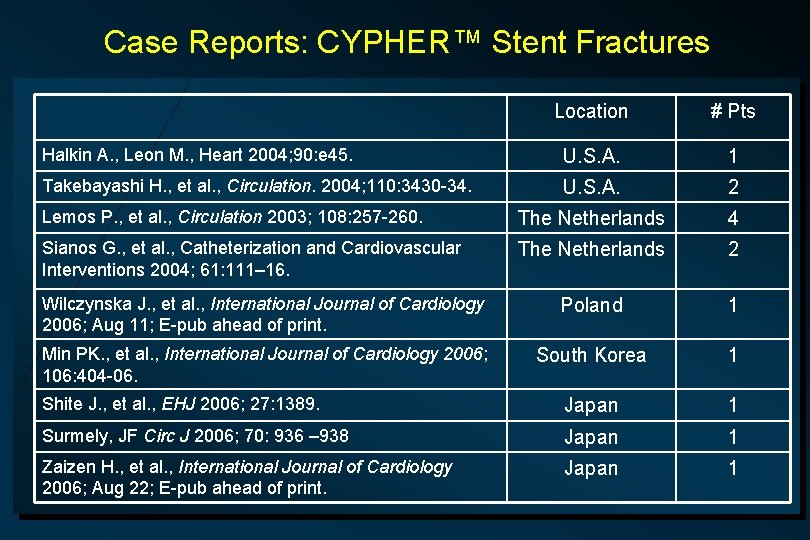
Case Reports: CYPHER™ Stent Fractures Location # Pts Halkin A. , Leon M. , Heart 2004; 90: e 45. U. S. A. 1 Takebayashi H. , et al. , Circulation. 2004; 110: 3430 -34. U. S. A. 2 Lemos P. , et al. , Circulation 2003; 108: 257 -260. The Netherlands 4 Sianos G. , et al. , Catheterization and Cardiovascular Interventions 2004; 61: 111– 16. The Netherlands 2 Wilczynska J. , et al. , International Journal of Cardiology 2006; Aug 11; E-pub ahead of print. Poland 1 Min PK. , et al. , International Journal of Cardiology 2006; 106: 404 -06. South Korea 1 Shite J. , et al. , EHJ 2006; 27: 1389. Japan 1 Surmely, JF Circ J 2006; 70: 936 – 938 Japan 1 Zaizen H. , et al. , International Journal of Cardiology 2006; Aug 22; E-pub ahead of print. Japan 1
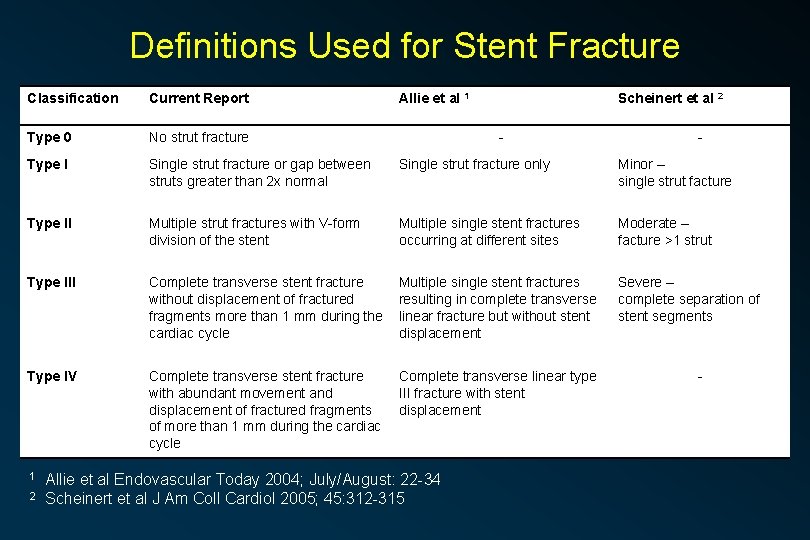
Definitions Used for Stent Fracture Classification Current Report Type 0 No strut fracture Type I Single strut fracture or gap between struts greater than 2 x normal Single strut fracture only Minor – single strut facture Type II Multiple strut fractures with V-form division of the stent Multiple single stent fractures occurring at different sites Moderate – facture >1 strut Type III Complete transverse stent fracture without displacement of fractured fragments more than 1 mm during the cardiac cycle Multiple single stent fractures resulting in complete transverse linear fracture but without stent displacement Severe – complete separation of stent segments Type IV Complete transverse stent fracture with abundant movement and displacement of fractured fragments of more than 1 mm during the cardiac cycle Complete transverse linear type III fracture with stent displacement 1 2 Allie et al 1 Scheinert et al 2 - Allie et al Endovascular Today 2004; July/August: 22 -34 Scheinert et al J Am Coll Cardiol 2005; 45: 312 -315 - -
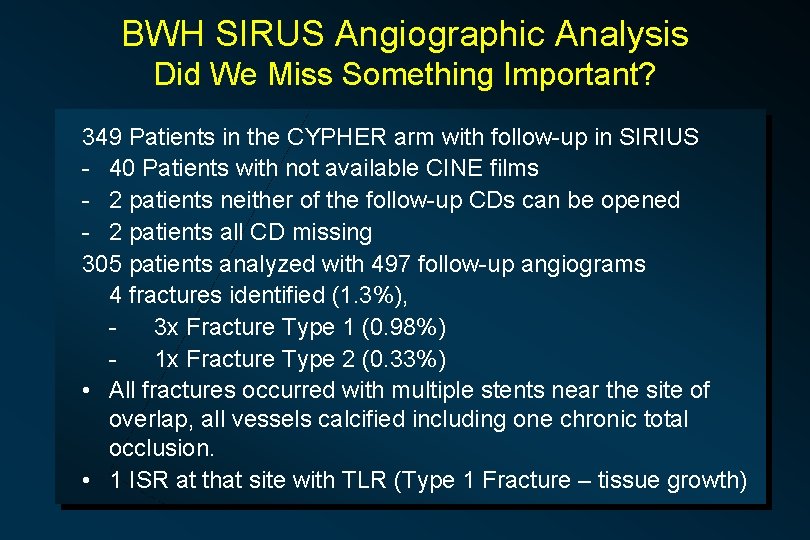
BWH SIRUS Angiographic Analysis Did We Miss Something Important? 349 Patients in the CYPHER arm with follow-up in SIRIUS - 40 Patients with not available CINE films - 2 patients neither of the follow-up CDs can be opened - 2 patients all CD missing 305 patients analyzed with 497 follow-up angiograms 4 fractures identified (1. 3%), 3 x Fracture Type 1 (0. 98%) 1 x Fracture Type 2 (0. 33%) • All fractures occurred with multiple stents near the site of overlap, all vessels calcified including one chronic total occlusion. • 1 ISR at that site with TLR (Type 1 Fracture – tissue growth)
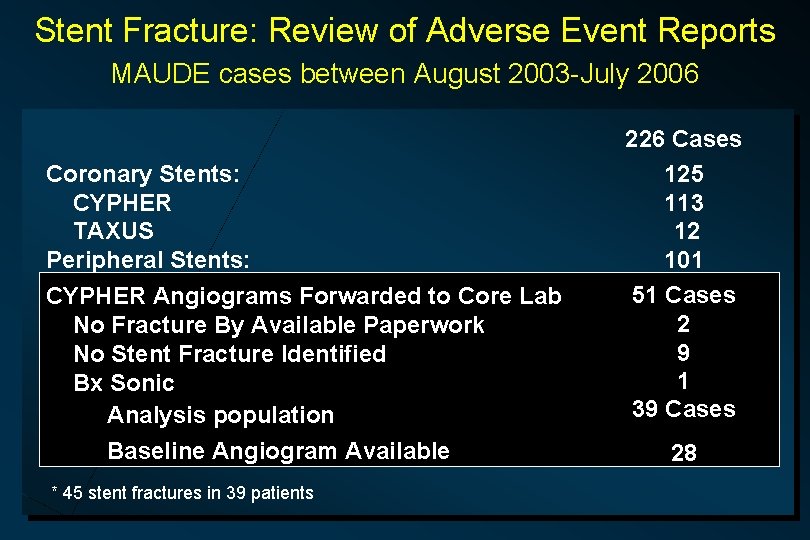
Stent Fracture: Review of Adverse Event Reports MAUDE cases between August 2003 -July 2006 Coronary Stents: CYPHER TAXUS Peripheral Stents: CYPHER Angiograms Forwarded to Core Lab No Fracture By Available Paperwork No Stent Fracture Identified Bx Sonic Analysis population Baseline Angiogram Available * 45 stent fractures in 39 patients 226 Cases 125 113 12 101 51 Cases 2 9 1 39 Cases 28
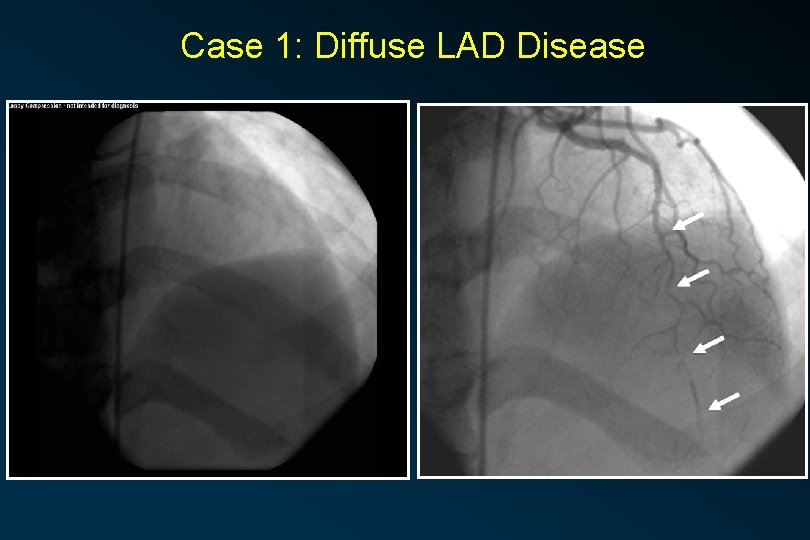
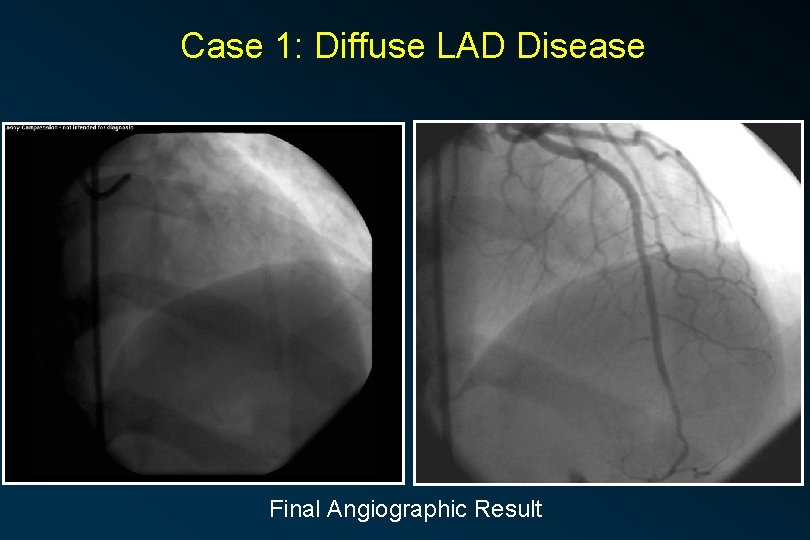
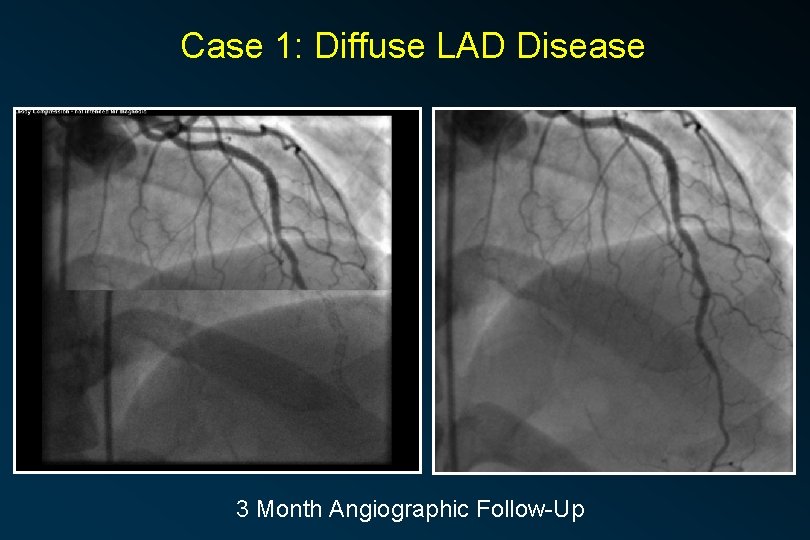
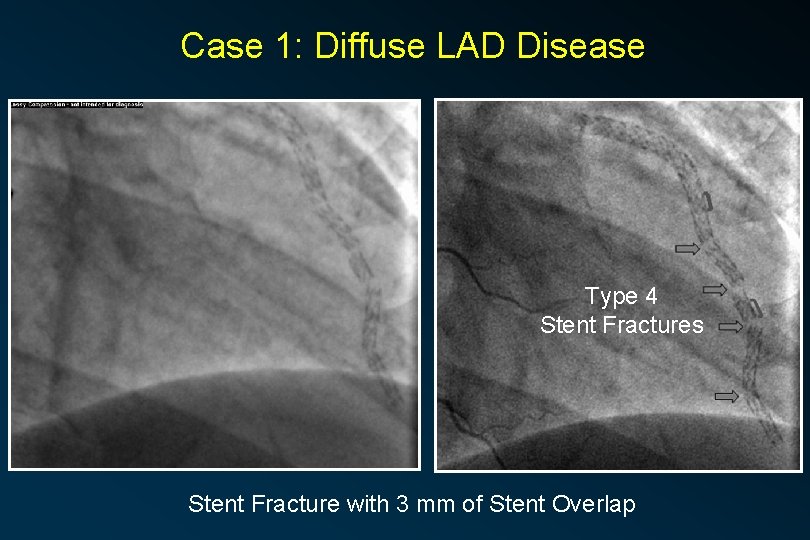
Case 1: Diffuse LAD Disease
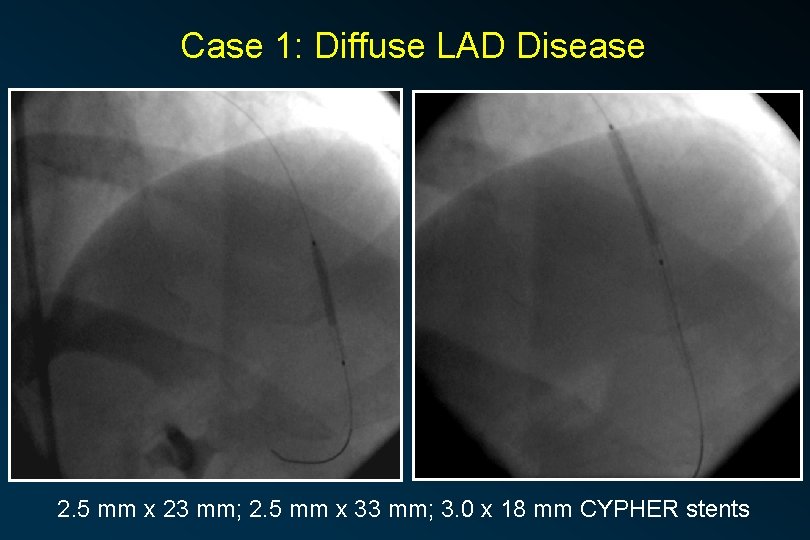
Case 1: Diffuse LAD Disease 2. 5 mm x 23 mm; 2. 5 mm x 33 mm; 3. 0 x 18 mm CYPHER stents
Case 1: Diffuse LAD Disease Final Angiographic Result
Case 1: Diffuse LAD Disease 3 Month Angiographic Follow-Up
Case 1: Diffuse LAD Disease Type 4 Stent Fractures Stent Fracture with 3 mm of Stent Overlap
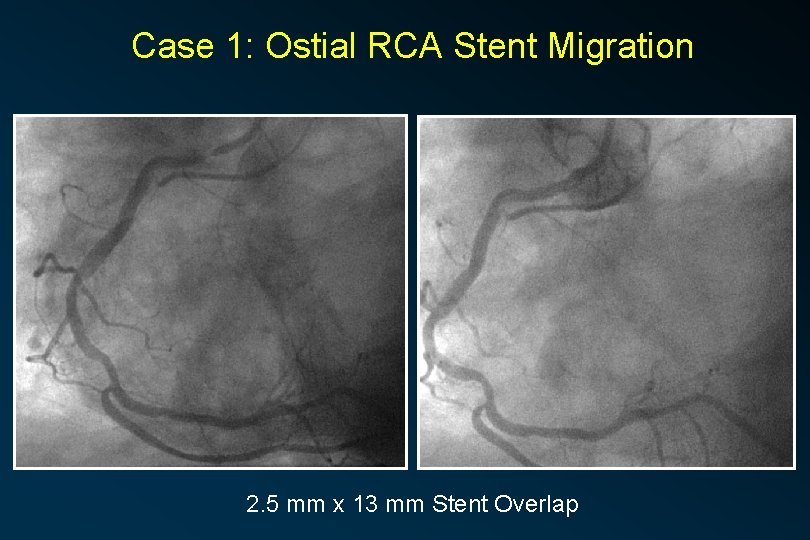
Case 1: Ostial RCA Stent Migration 2. 5 mm x 13 mm Stent Overlap
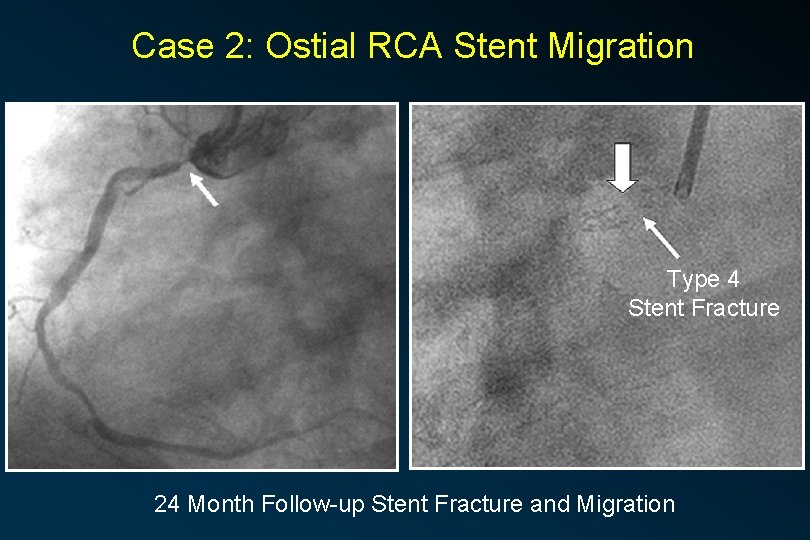
Case 2: Ostial RCA Stent Migration Type 4 Stent Fracture 24 Month Follow-up Stent Fracture and Migration
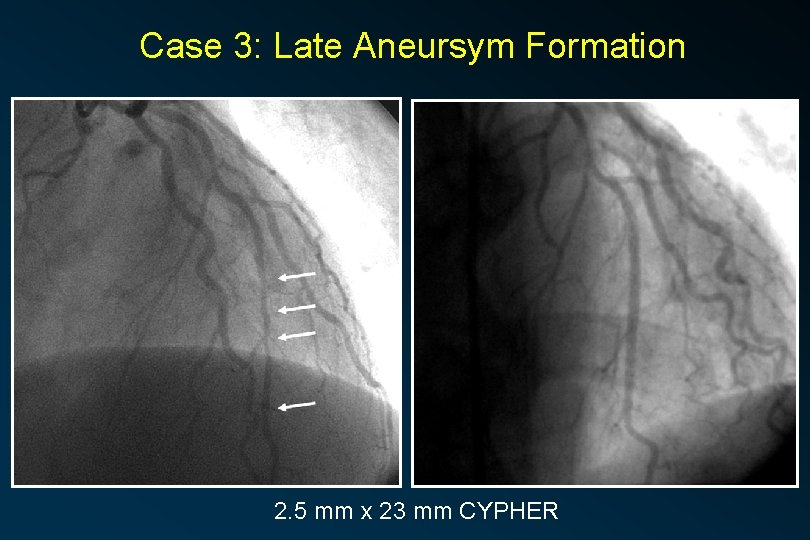
Case 3: Late Aneursym Formation 2. 5 mm x 23 mm CYPHER
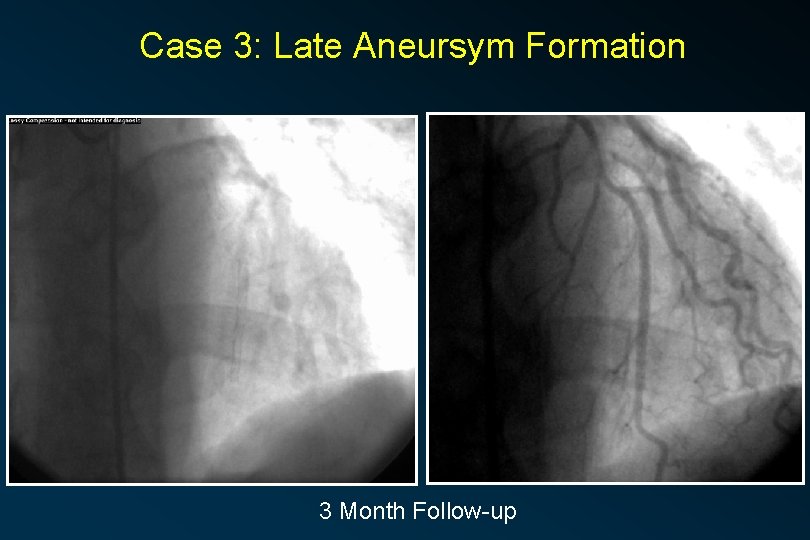
Case 3: Late Aneursym Formation 3 Month Follow-up
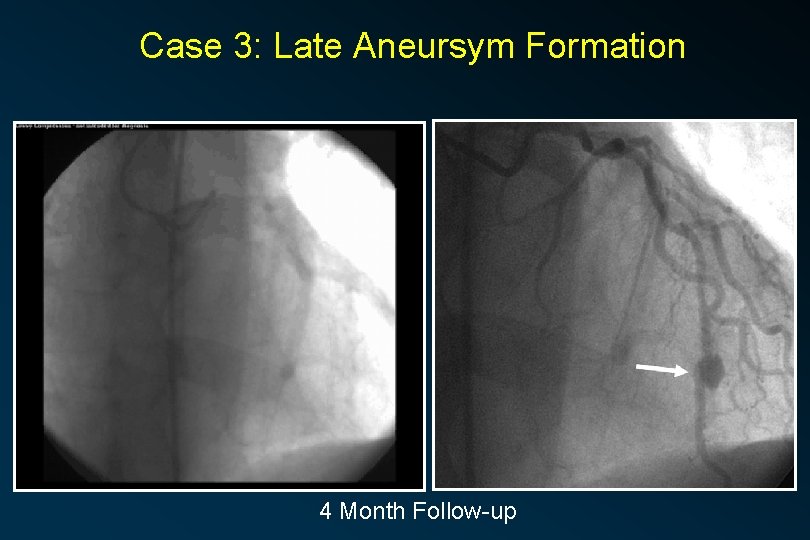
Case 3: Late Aneursym Formation 4 Month Follow-up
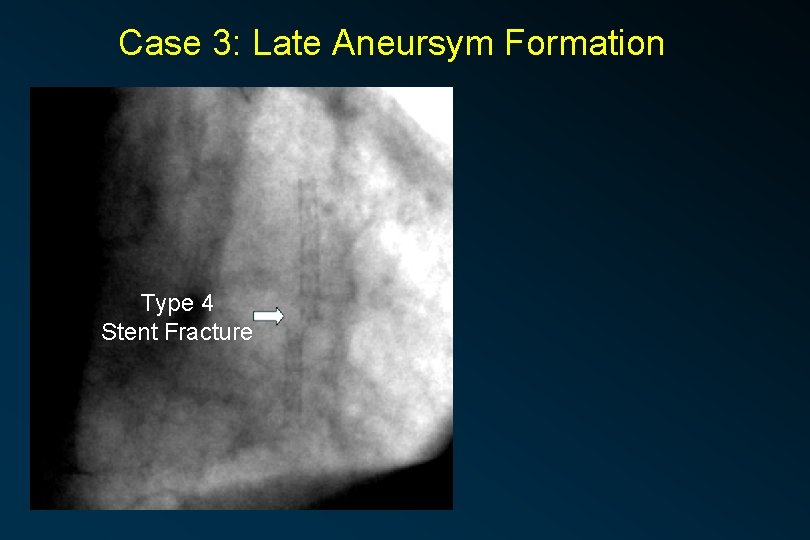
Case 3: Late Aneursym Formation Type 4 Stent Fracture
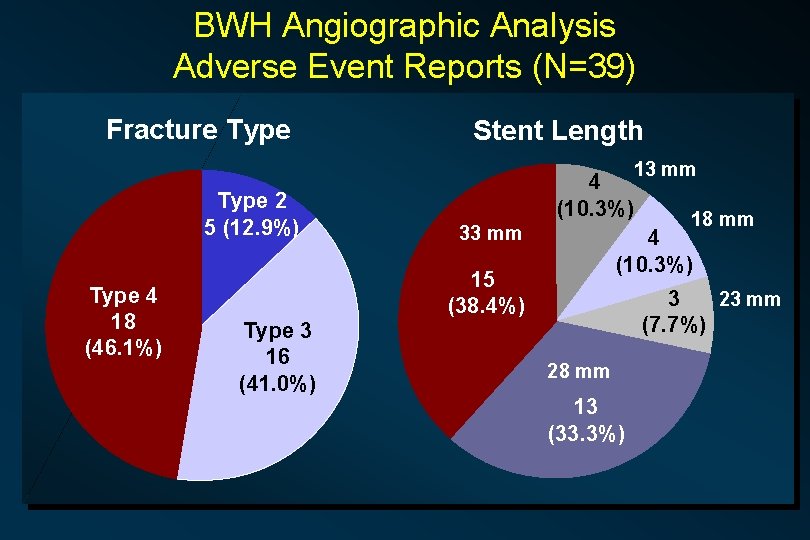
BWH Angiographic Analysis Adverse Event Reports (N=39) Fracture Type Stent Length 13 mm Type 2 5 (12. 9%) Type 4 18 (46. 1%) 4 (10. 3%) 33 mm 4 (10. 3%) 15 (38. 4%) Type 3 16 (41. 0%) 18 mm 3 23 mm (7. 7%) 28 mm 13 (33. 3%)
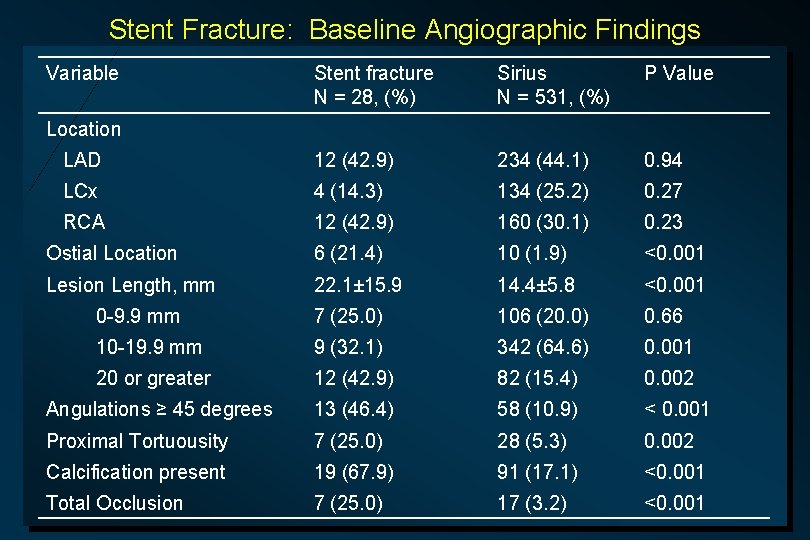
Stent Fracture: Baseline Angiographic Findings Variable Stent fracture N = 28, (%) Sirius N = 531, (%) P Value LAD 12 (42. 9) 234 (44. 1) 0. 94 LCx 4 (14. 3) 134 (25. 2) 0. 27 RCA 12 (42. 9) 160 (30. 1) 0. 23 Ostial Location 6 (21. 4) 10 (1. 9) <0. 001 Lesion Length, mm 22. 1± 15. 9 14. 4± 5. 8 <0. 001 0 -9. 9 mm 7 (25. 0) 106 (20. 0) 0. 66 10 -19. 9 mm 9 (32. 1) 342 (64. 6) 0. 001 20 or greater 12 (42. 9) 82 (15. 4) 0. 002 Angulations ≥ 45 degrees 13 (46. 4) 58 (10. 9) < 0. 001 Proximal Tortuousity 7 (25. 0) 28 (5. 3) 0. 002 Calcification present 19 (67. 9) 91 (17. 1) <0. 001 Total Occlusion 7 (25. 0) 17 (3. 2) <0. 001 Location
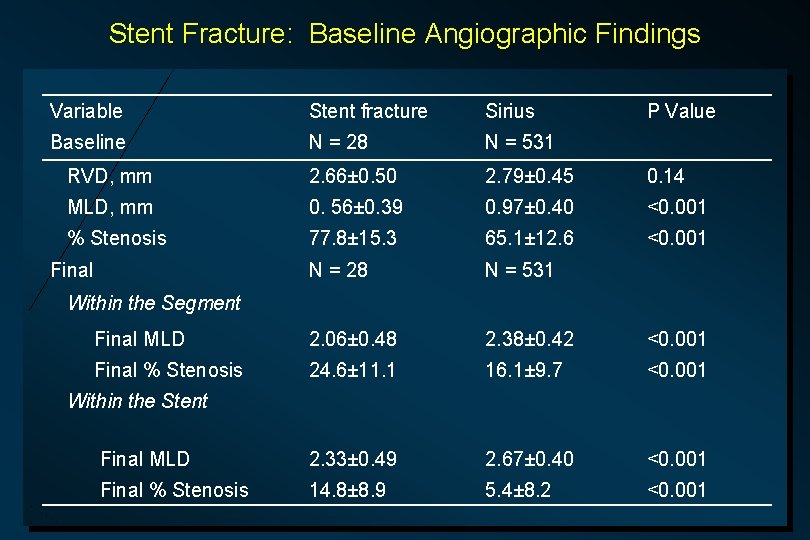
Stent Fracture: Baseline Angiographic Findings Variable Stent fracture Sirius Baseline N = 28 N = 531 RVD, mm 2. 66± 0. 50 2. 79± 0. 45 0. 14 MLD, mm 0. 56± 0. 39 0. 97± 0. 40 <0. 001 % Stenosis 77. 8± 15. 3 65. 1± 12. 6 <0. 001 N = 28 N = 531 Final MLD 2. 06± 0. 48 2. 38± 0. 42 <0. 001 Final % Stenosis 24. 6± 11. 1 16. 1± 9. 7 <0. 001 Final MLD 2. 33± 0. 49 2. 67± 0. 40 <0. 001 Final % Stenosis 14. 8± 8. 9 5. 4± 8. 2 <0. 001 Final P Value Within the Segment Within the Stent
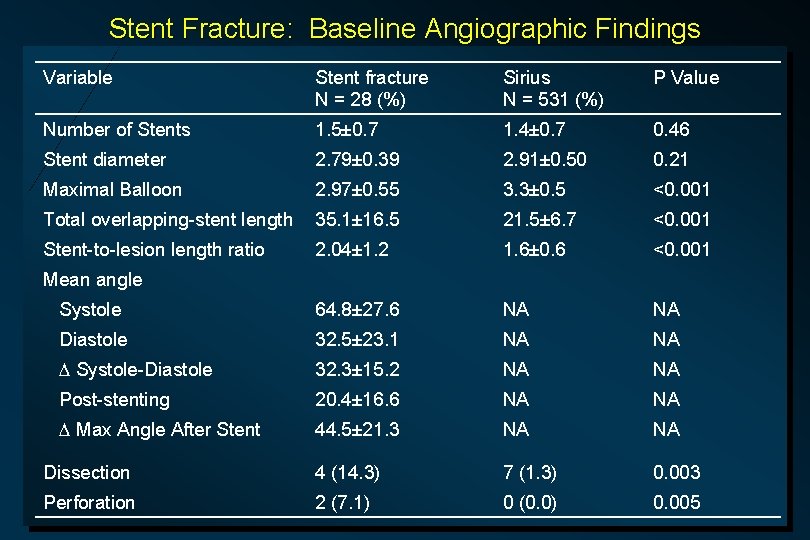
Stent Fracture: Baseline Angiographic Findings Variable Stent fracture N = 28 (%) Sirius N = 531 (%) P Value Number of Stents 1. 5± 0. 7 1. 4± 0. 7 0. 46 Stent diameter 2. 79± 0. 39 2. 91± 0. 50 0. 21 Maximal Balloon 2. 97± 0. 55 3. 3± 0. 5 <0. 001 Total overlapping-stent length 35. 1± 16. 5 21. 5± 6. 7 <0. 001 Stent-to-lesion length ratio 2. 04± 1. 2 1. 6± 0. 6 <0. 001 Systole 64. 8± 27. 6 NA NA Diastole 32. 5± 23. 1 NA NA Systole-Diastole 32. 3± 15. 2 NA NA Post-stenting 20. 4± 16. 6 NA NA Max Angle After Stent 44. 5± 21. 3 NA NA Dissection 4 (14. 3) 7 (1. 3) 0. 003 Perforation 2 (7. 1) 0 (0. 0) 0. 005 Mean angle
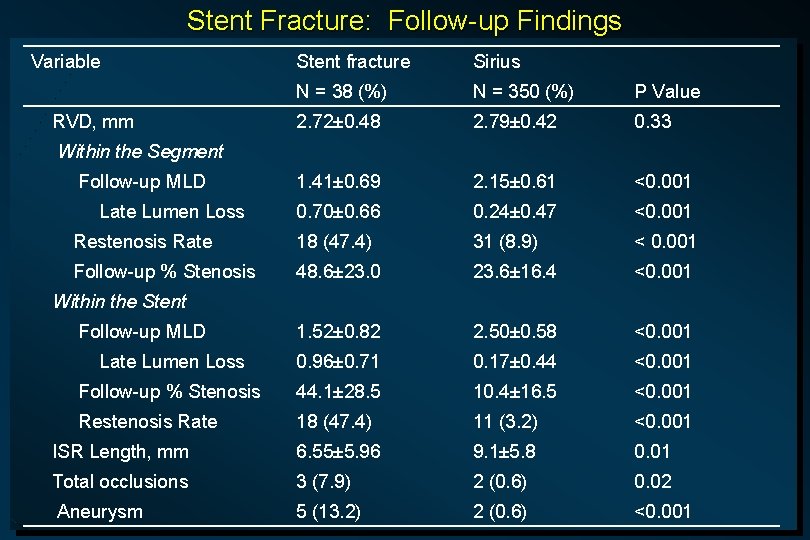
Stent Fracture: Follow-up Findings Variable Stent fracture Sirius N = 38 (%) N = 350 (%) P Value 2. 72± 0. 48 2. 79± 0. 42 0. 33 1. 41± 0. 69 2. 15± 0. 61 <0. 001 0. 70± 0. 66 0. 24± 0. 47 <0. 001 Restenosis Rate 18 (47. 4) 31 (8. 9) < 0. 001 Follow-up % Stenosis 48. 6± 23. 0 23. 6± 16. 4 <0. 001 1. 52± 0. 82 2. 50± 0. 58 <0. 001 Late Lumen Loss 0. 96± 0. 71 0. 17± 0. 44 <0. 001 Follow-up % Stenosis 44. 1± 28. 5 10. 4± 16. 5 <0. 001 Restenosis Rate 18 (47. 4) 11 (3. 2) <0. 001 ISR Length, mm 6. 55± 5. 96 9. 1± 5. 8 0. 01 Total occlusions 3 (7. 9) 2 (0. 6) 0. 02 Aneurysm 5 (13. 2) 2 (0. 6) <0. 001 RVD, mm Within the Segment Follow-up MLD Late Lumen Loss Within the Stent Follow-up MLD
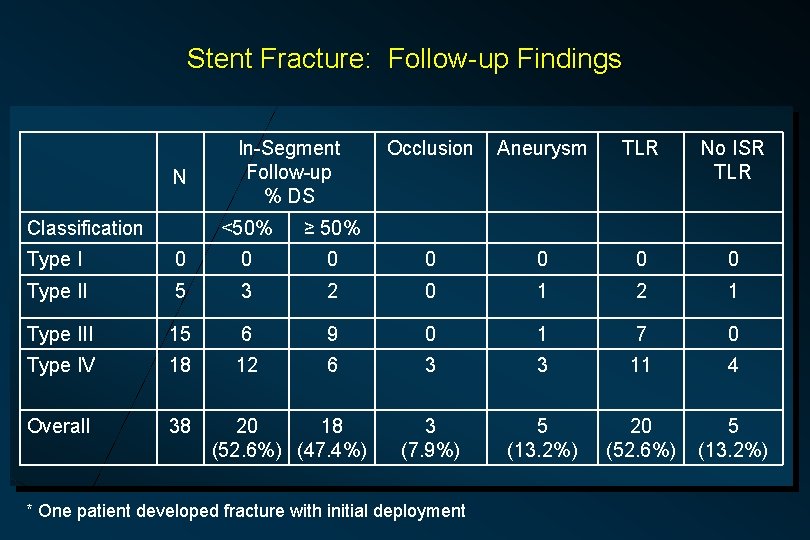
Stent Fracture: Follow-up Findings N Classification In-Segment Follow-up % DS <50% ≥ 50% Occlusion Aneurysm TLR No ISR TLR Type I 0 0 0 0 Type II 5 3 2 0 1 2 1 Type III 15 6 9 0 1 7 0 Type IV 18 12 6 3 3 11 4 Overall 38 3 (7. 9%) 5 (13. 2%) 20 (52. 6%) 5 (13. 2%) 20 18 (52. 6%) (47. 4%) * One patient developed fracture with initial deployment
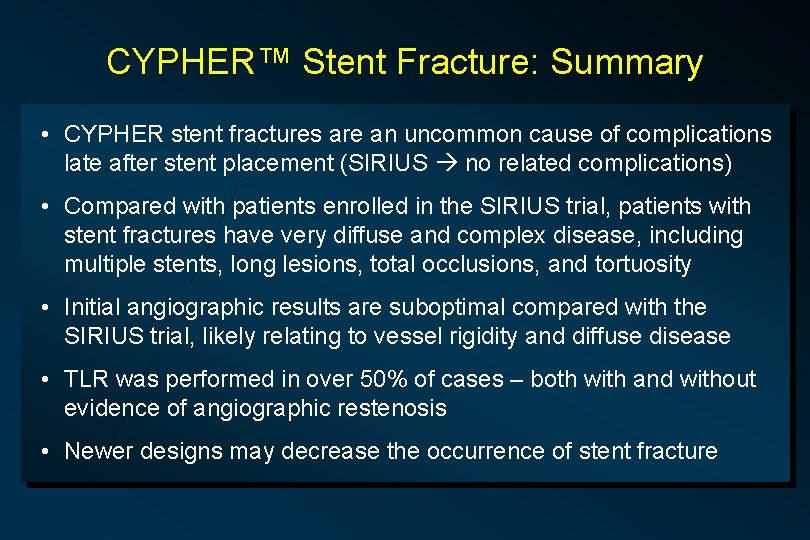
CYPHER™ Stent Fracture: Summary • CYPHER stent fractures are an uncommon cause of complications late after stent placement (SIRIUS no related complications) • Compared with patients enrolled in the SIRIUS trial, patients with stent fractures have very diffuse and complex disease, including multiple stents, long lesions, total occlusions, and tortuosity • Initial angiographic results are suboptimal compared with the SIRIUS trial, likely relating to vessel rigidity and diffuse disease • TLR was performed in over 50% of cases – both with and without evidence of angiographic restenosis • Newer designs may decrease the occurrence of stent fracture
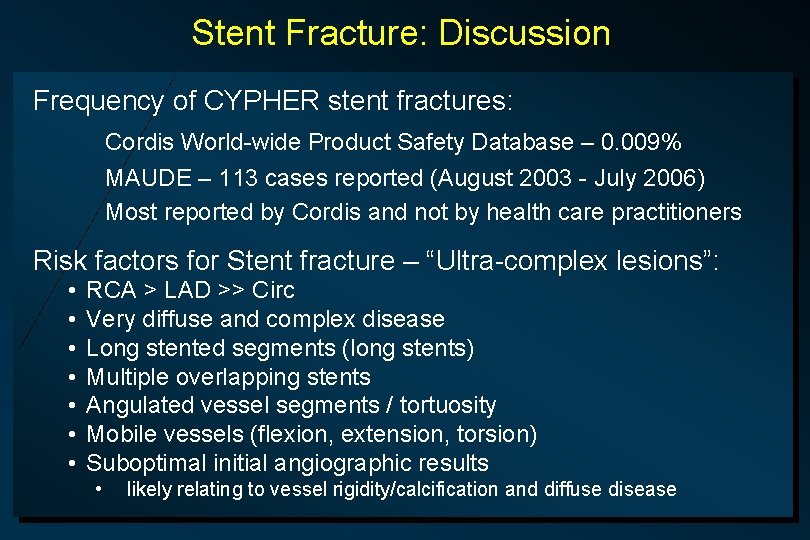
Stent Fracture: Discussion Frequency of CYPHER stent fractures: Cordis World-wide Product Safety Database – 0. 009% MAUDE – 113 cases reported (August 2003 - July 2006) Most reported by Cordis and not by health care practitioners Risk factors for Stent fracture – “Ultra-complex lesions”: • • RCA > LAD >> Circ Very diffuse and complex disease Long stented segments (long stents) Multiple overlapping stents Angulated vessel segments / tortuosity Mobile vessels (flexion, extension, torsion) Suboptimal initial angiographic results • likely relating to vessel rigidity/calcification and diffuse disease
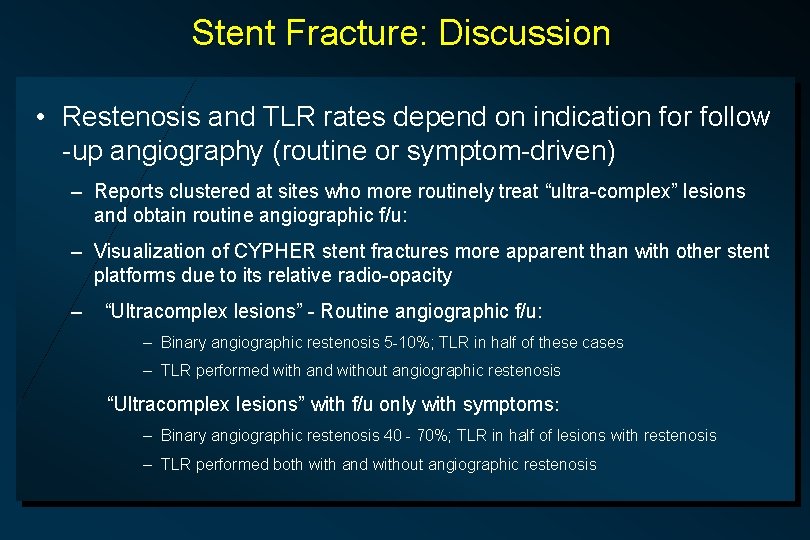
Stent Fracture: Discussion • Restenosis and TLR rates depend on indication for follow -up angiography (routine or symptom-driven) – Reports clustered at sites who more routinely treat “ultra-complex” lesions and obtain routine angiographic f/u: – Visualization of CYPHER stent fractures more apparent than with other stent platforms due to its relative radio-opacity – “Ultracomplex lesions” - Routine angiographic f/u: – Binary angiographic restenosis 5 -10%; TLR in half of these cases – TLR performed with and without angiographic restenosis “Ultracomplex lesions” with f/u only with symptoms: – Binary angiographic restenosis 40 - 70%; TLR in half of lesions with restenosis – TLR performed both with and without angiographic restenosis
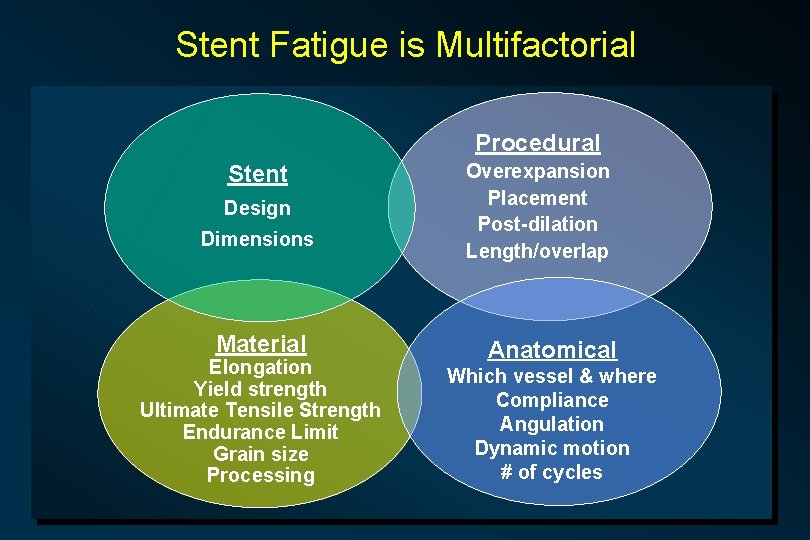
Stent Fatigue is Multifactorial Procedural Stent Design Dimensions Material Elongation Yield strength Ultimate Tensile Strength Endurance Limit Grain size Processing Overexpansion Placement Post-dilation Length/overlap Anatomical Which vessel & where Compliance Angulation Dynamic motion # of cycles
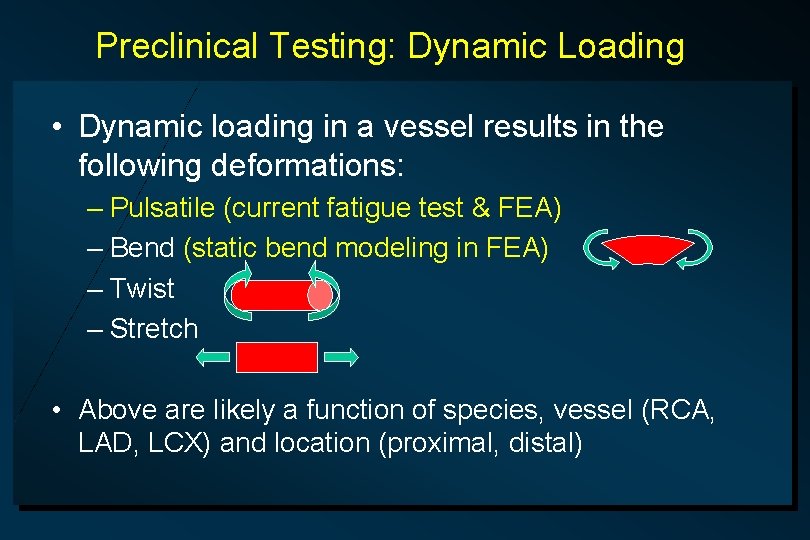
Preclinical Testing: Dynamic Loading • Dynamic loading in a vessel results in the following deformations: – Pulsatile (current fatigue test & FEA) – Bend (static bend modeling in FEA) – Twist – Stretch • Above are likely a function of species, vessel (RCA, LAD, LCX) and location (proximal, distal)
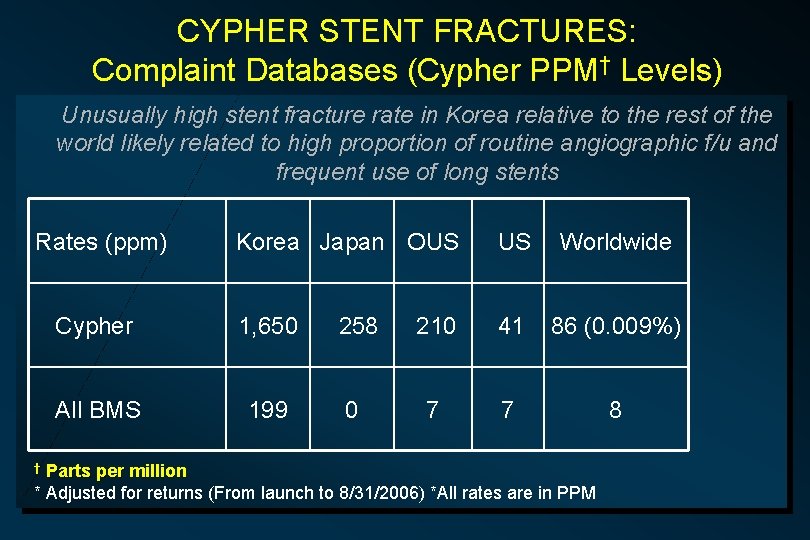
CYPHER STENT FRACTURES: Complaint Databases (Cypher PPM† Levels) Unusually high stent fracture rate in Korea relative to the rest of the world likely related to high proportion of routine angiographic f/u and frequent use of long stents Rates (ppm) Korea Japan OUS US Worldwide Cypher 1, 650 258 210 41 86 (0. 009%) All BMS 199 0 7 7 8 Parts per million * Adjusted for returns (From launch to 8/31/2006) *All rates are in PPM †
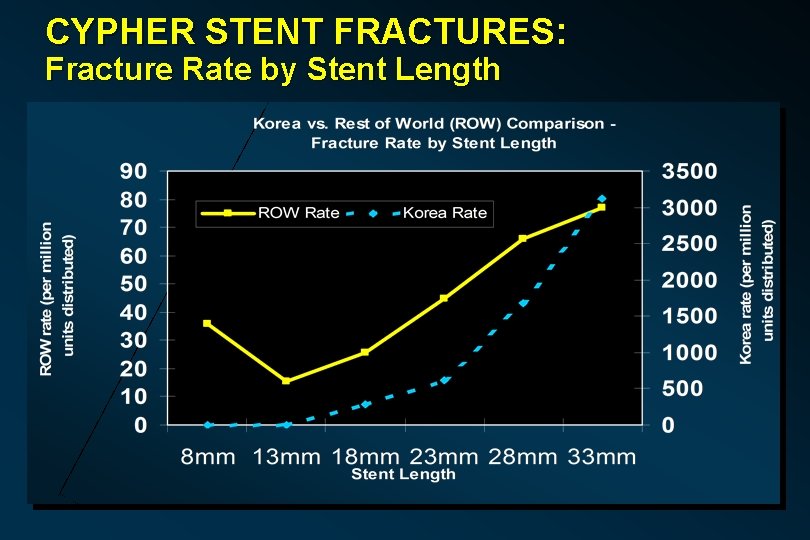
CYPHER STENT FRACTURES: Fracture Rate by Stent Length
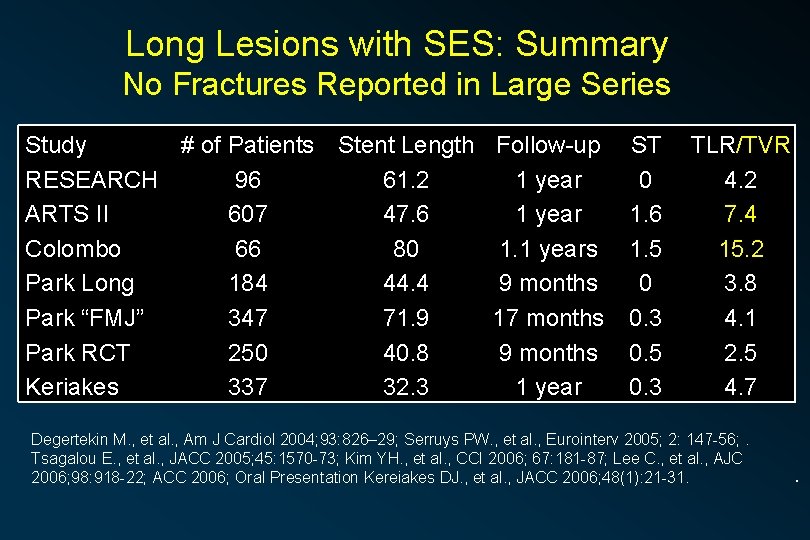
Long Lesions with SES: Summary No Fractures Reported in Large Series Study # of Patients RESEARCH 96 ARTS II 607 Colombo 66 Park Long 184 Park “FMJ” 347 Park RCT 250 Keriakes 337 Stent Length Follow-up 61. 2 1 year 47. 6 1 year 80 1. 1 years 44. 4 9 months 71. 9 17 months 40. 8 9 months 32. 3 1 year ST 0 1. 6 1. 5 0 0. 3 0. 5 0. 3 TLR/TVR 4. 2 7. 4 15. 2 3. 8 4. 1 2. 5 4. 7 Degertekin M. , et al. , Am J Cardiol 2004; 93: 826– 29; Serruys PW. , et al. , Eurointerv 2005; 2: 147 -56; . Tsagalou E. , et al. , JACC 2005; 45: 1570 -73; Kim YH. , et al. , CCI 2006; 67: 181 -87; Lee C. , et al. , AJC 2006; 98: 918 -22; ACC 2006; Oral Presentation Kereiakes DJ. , et al. , JACC 2006; 48(1): 21 -31. .