
CYCLOPEPTIDE SEQUENCING PROBLEM By Camille Hendry The problem
CYCLOPEPTIDE SEQUENCING PROBLEM By Camille Hendry
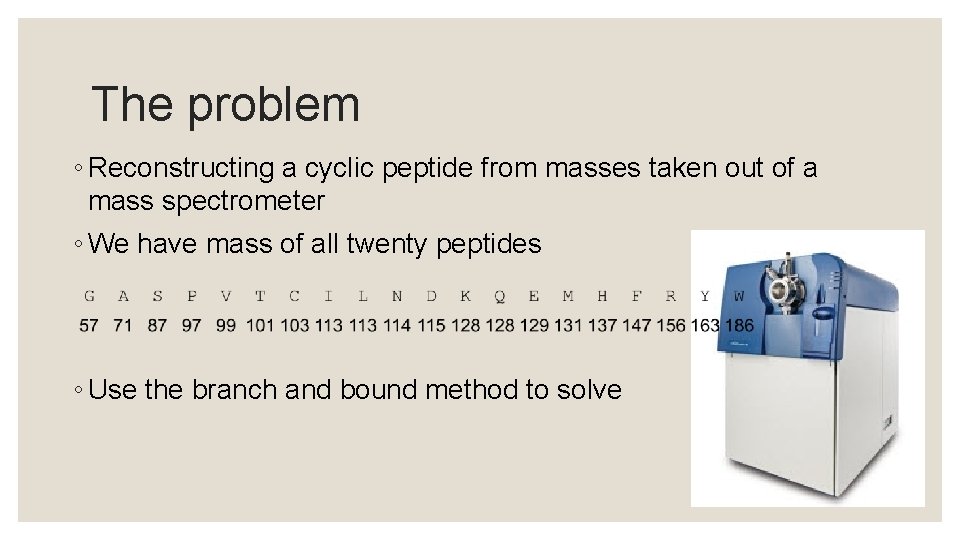
The problem ◦ Reconstructing a cyclic peptide from masses taken out of a mass spectrometer ◦ We have mass of all twenty peptides ◦ Use the branch and bound method to solve
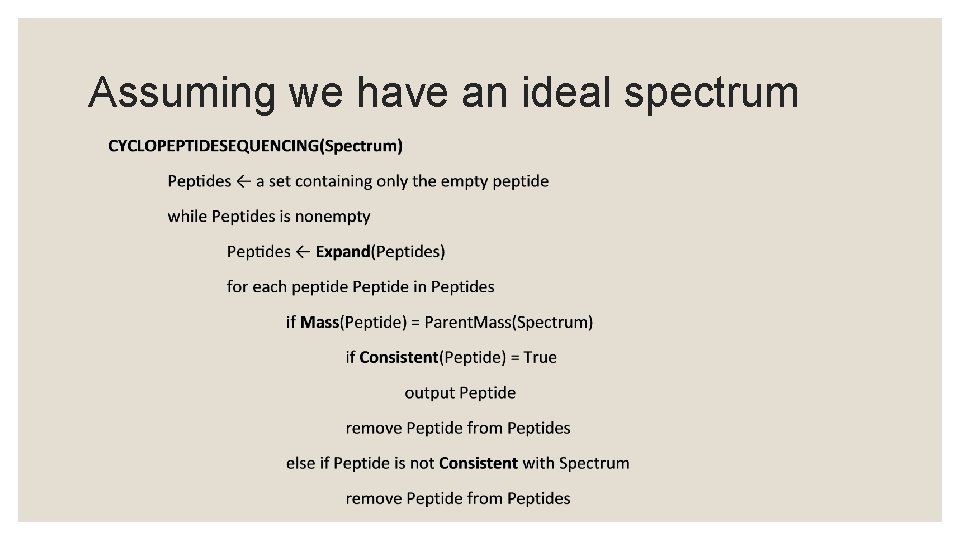
Assuming we have an ideal spectrum
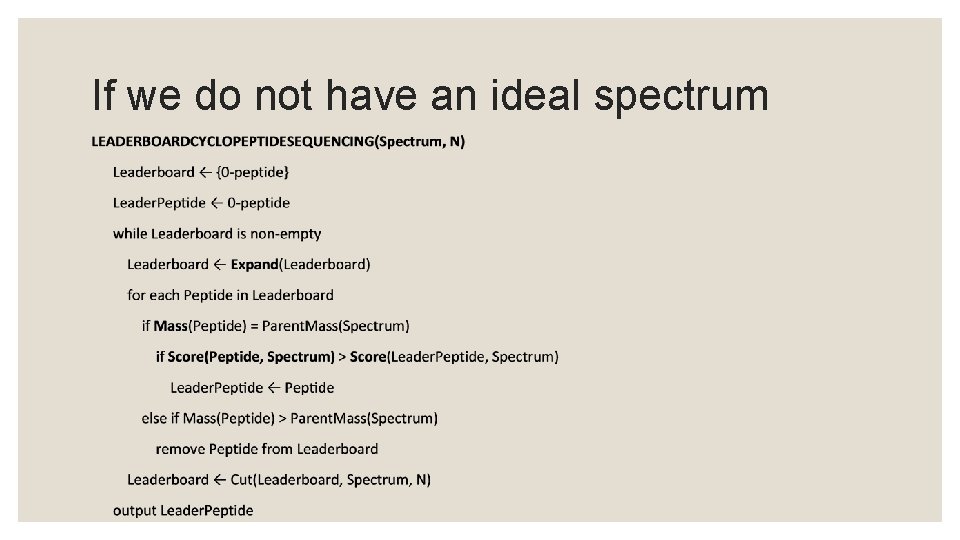
If we do not have an ideal spectrum
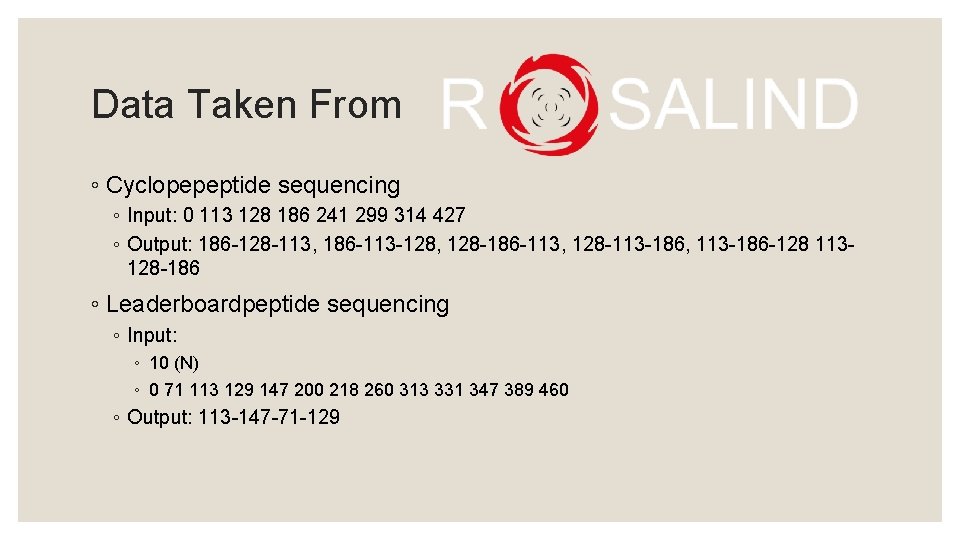
Data Taken From ◦ Cyclopepeptide sequencing ◦ Input: 0 113 128 186 241 299 314 427 ◦ Output: 186 -128 -113, 186 -113 -128, 128 -186 -113, 128 -113 -186, 113 -186 -128 113128 -186 ◦ Leaderboardpeptide sequencing ◦ Input: ◦ 10 (N) ◦ 0 71 113 129 147 200 218 260 313 331 347 389 460 ◦ Output: 113 -147 -71 -129
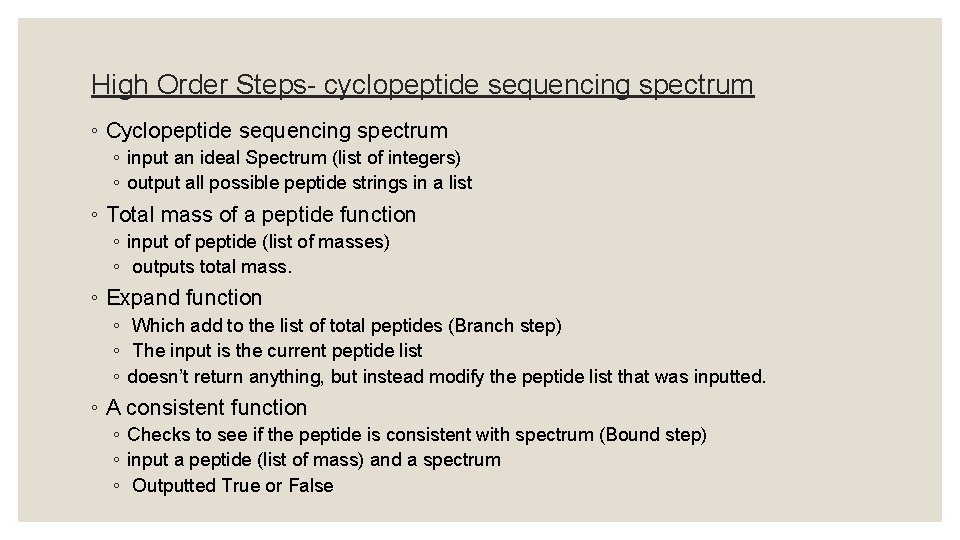
High Order Steps- cyclopeptide sequencing spectrum ◦ Cyclopeptide sequencing spectrum ◦ input an ideal Spectrum (list of integers) ◦ output all possible peptide strings in a list ◦ Total mass of a peptide function ◦ input of peptide (list of masses) ◦ outputs total mass. ◦ Expand function ◦ Which add to the list of total peptides (Branch step) ◦ The input is the current peptide list ◦ doesn’t return anything, but instead modify the peptide list that was inputted. ◦ A consistent function ◦ Checks to see if the peptide is consistent with spectrum (Bound step) ◦ input a peptide (list of mass) and a spectrum ◦ Outputted True or False
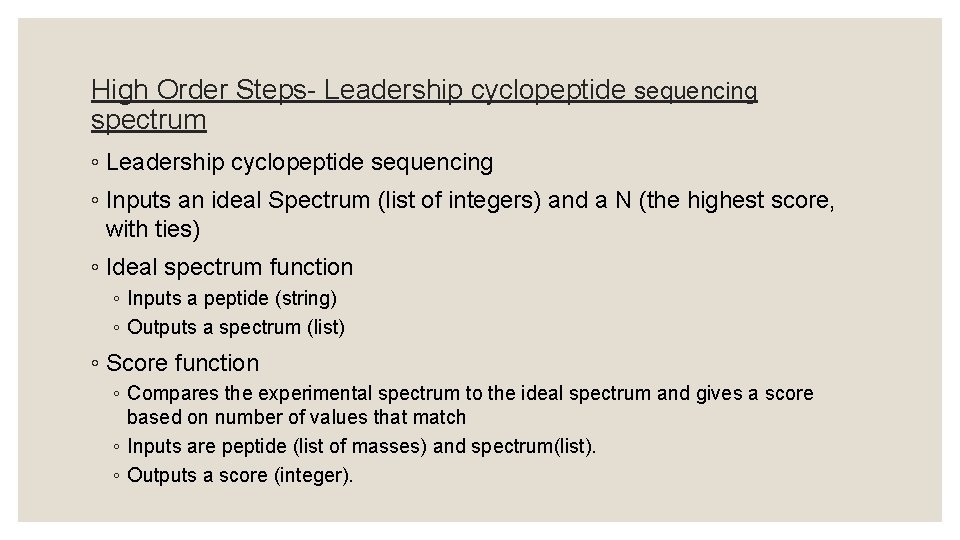
High Order Steps- Leadership cyclopeptide sequencing spectrum ◦ Leadership cyclopeptide sequencing ◦ Inputs an ideal Spectrum (list of integers) and a N (the highest score, with ties) ◦ Ideal spectrum function ◦ Inputs a peptide (string) ◦ Outputs a spectrum (list) ◦ Score function ◦ Compares the experimental spectrum to the ideal spectrum and gives a score based on number of values that match ◦ Inputs are peptide (list of masses) and spectrum(list). ◦ Outputs a score (integer).
Conclusion ◦ Each function one step closer ◦ Leadership still not prefect ◦ Due to time saving nature of algorithm you could get rid of best possibility ◦ But In practice it works pretty well
- Slides: 8