
Cyclins Controlling a Cells Progress through the Cell
- Slides: 13
Cyclins Controlling a Cell’s Progress through the Cell Cycle
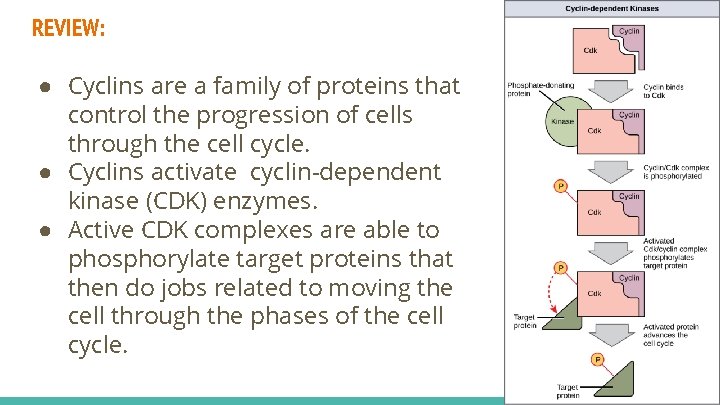
REVIEW: ● Cyclins are a family of proteins that control the progression of cells through the cell cycle. ● Cyclins activate cyclin-dependent kinase (CDK) enzymes. ● Active CDK complexes are able to phosphorylate target proteins that then do jobs related to moving the cell through the phases of the cell cycle.
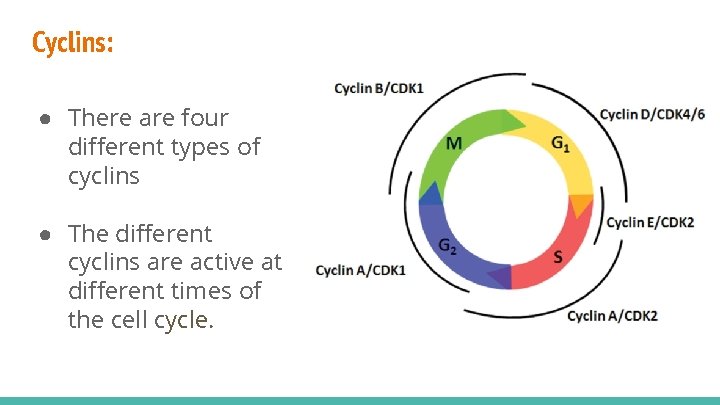
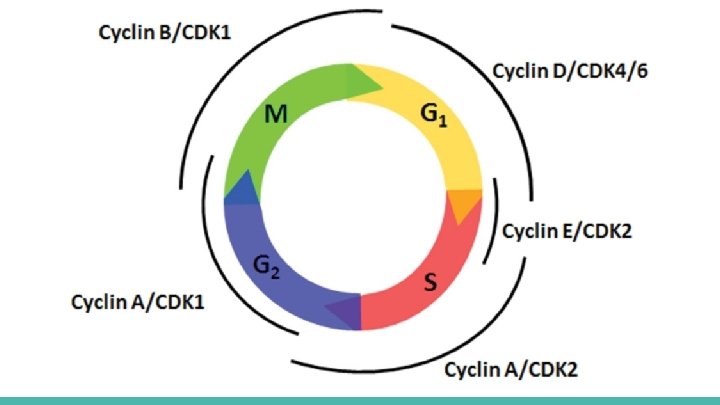
Cyclins: ● There are four different types of cyclins ● The different cyclins are active at different times of the cell cycle.
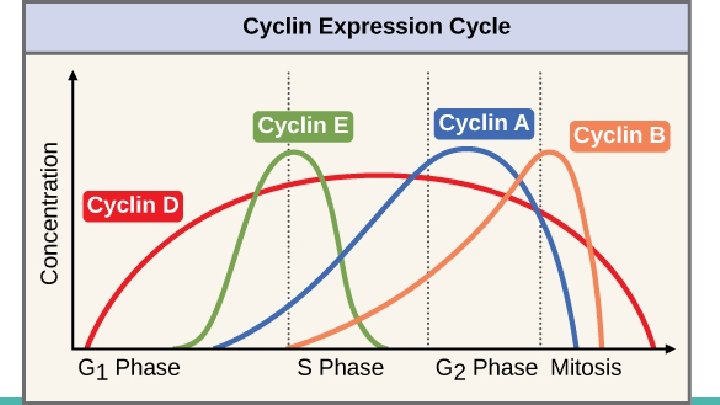
Cyclin D NORMAL ● Cyclin D begins being synthesized during early G 1. ● Once at a high enough concentration, Cyclin D triggers the cell’s transition from G 1 to S phase. ● The active cyclin D-CDK complex phosphorylates a target protein that is a tumor suppressor. ○ ○ Before the target protein is phosphorylated(when cyclin D levels are low), the tumor suppressor protein STOPS the cell from moving into S phase. The cell will stay in G 1. After the target protein is phosphorylated (when cyclin D levels are high), the tumor suppressor protein no longer stops the cell from moving into S phase… so the cell moves into S phase and begins to replicate its DNA.
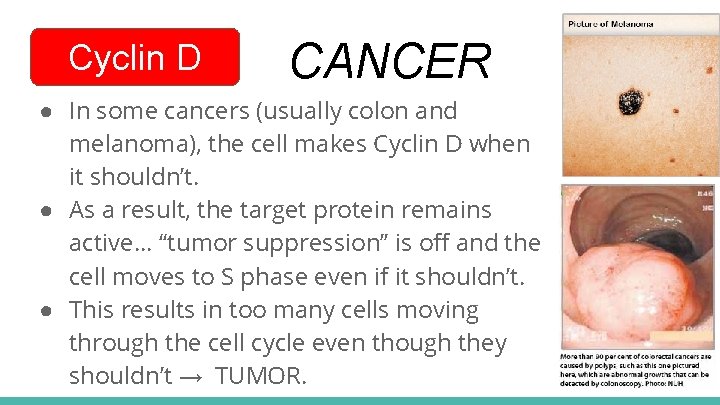
Cyclin D CANCER ● In some cancers (usually colon and melanoma), the cell makes Cyclin D when it shouldn’t. ● As a result, the target protein remains active. . . “tumor suppression” is off and the cell moves to S phase even if it shouldn’t. ● This results in too many cells moving through the cell cycle even though they shouldn’t → TUMOR.
Cyclin E NORMAL ● Cyclin E begins being synthesized midway through G 1. ● Once at a high enough concentration, Cyclin E triggers the cell’s transition from G 1 to S phase. ● The active cyclin E-CDK complex phosphorylates a target protein that gets DNA ready for replication. ○ ○ Before the target protein is phosphorylated(when cyclin E levels are low), the DNA will not prepare for replication. After the target protein is phosphorylated (when cyclin E levels are high), the DNA will prepare for replication.
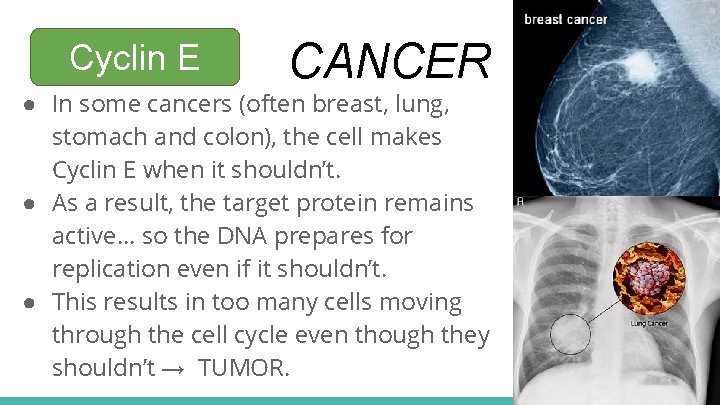
Cyclin E CANCER ● In some cancers (often breast, lung, stomach and colon), the cell makes Cyclin E when it shouldn’t. ● As a result, the target protein remains active. . . so the DNA prepares for replication even if it shouldn’t. ● This results in too many cells moving through the cell cycle even though they shouldn’t → TUMOR.
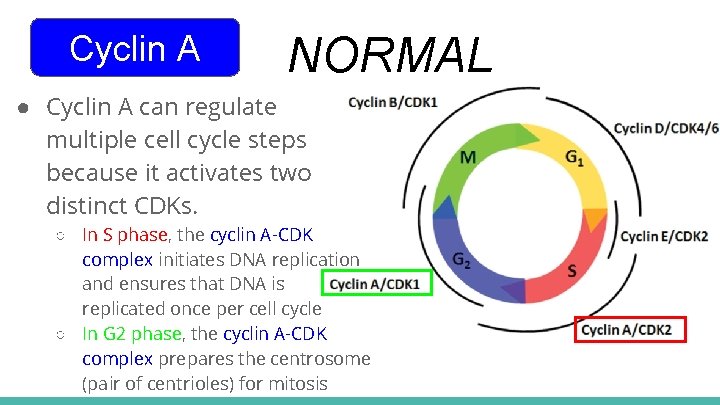
Cyclin A NORMAL ● Cyclin A can regulate multiple cell cycle steps because it activates two distinct CDKs. ○ In S phase, the cyclin A-CDK complex initiates DNA replication and ensures that DNA is replicated once per cell cycle ○ In G 2 phase, the cyclin A-CDK complex prepares the centrosome (pair of centrioles) for mitosis
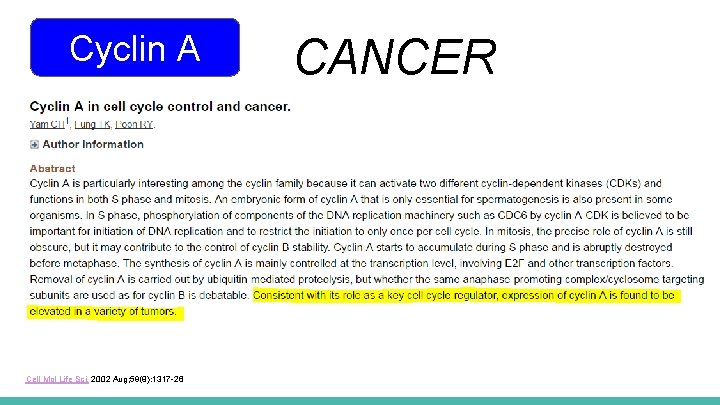
Cyclin A Cell Mol Life Sci. 2002 Aug; 59(8): 1317 -26 CANCER
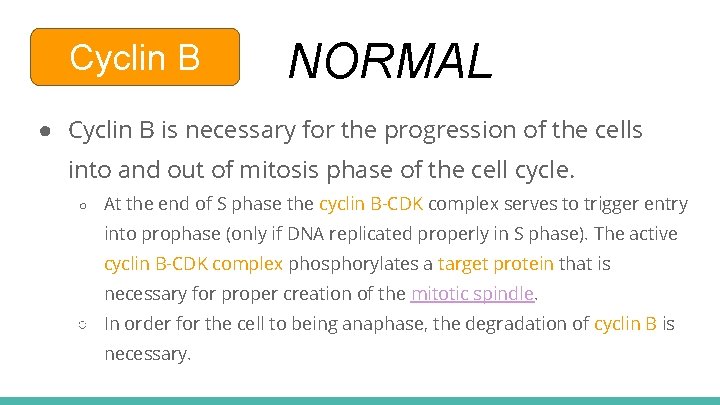
Cyclin B NORMAL ● Cyclin B is necessary for the progression of the cells into and out of mitosis phase of the cell cycle. ○ At the end of S phase the cyclin B-CDK complex serves to trigger entry into prophase (only if DNA replicated properly in S phase). The active cyclin B-CDK complex phosphorylates a target protein that is necessary for proper creation of the mitotic spindle. ○ In order for the cell to being anaphase, the degradation of cyclin B is necessary.
Cyclin B CANCER ● When cyclin B levels are elevated, cells can enter mitosis prematurely (and therefore divide when they shouldn’t) ● Some anti-cancer therapies have been designed to prevent cyclin B/CDK complex formation in cancer cells to slow or prevent cell division.