
Cycling will improve environment and health The Ecological
- Slides: 29
Cycling will improve environment and health The Ecological Council and Thomas Krag Mobility Advice Velo-city Dublin, 2005
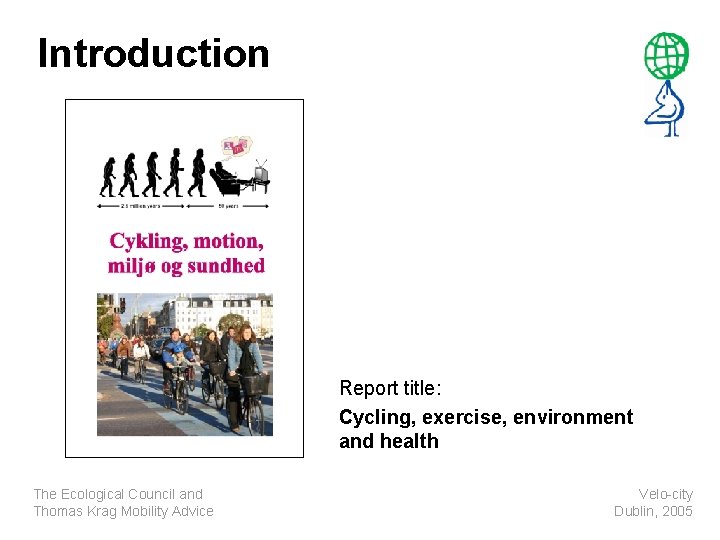
Introduction Report title: Cycling, exercise, environment and health The Ecological Council and Thomas Krag Mobility Advice Velo-city Dublin, 2005
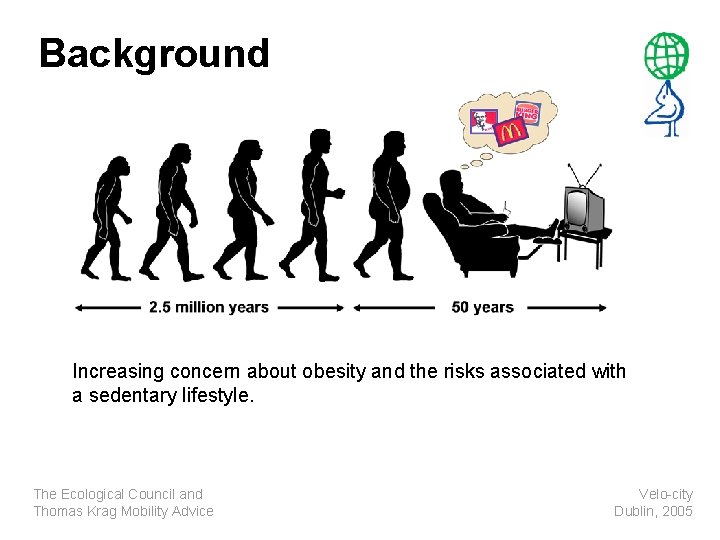
Background Increasing concern about obesity and the risks associated with a sedentary lifestyle. The Ecological Council and Thomas Krag Mobility Advice Velo-city Dublin, 2005
Approach taken • numerous reports on the health impact of physical inactivity studied • special look taken on studies involving bicycle use • further investigations made on linkages between cycling and physical activity • knowledge about the impact of air pollution on cyclists' health collected • overview made on the knowledge about traffic safety and cycling • basic knowledge about infrastructure and cycling collected • several reports and investigations about levers for bicycle use read • existing cost-benefit analysis of cycling, physical activity and health examined • a cost-benefit analysis of a potential Danish bicycle promotion scheme carried out • European cities or regions where cycling has been prioritised investigated • international targets for cycling studied • present and perspective cycling promotion policies in Denmark studied The Ecological Council and Thomas Krag Mobility Advice Velo-city Dublin, 2005
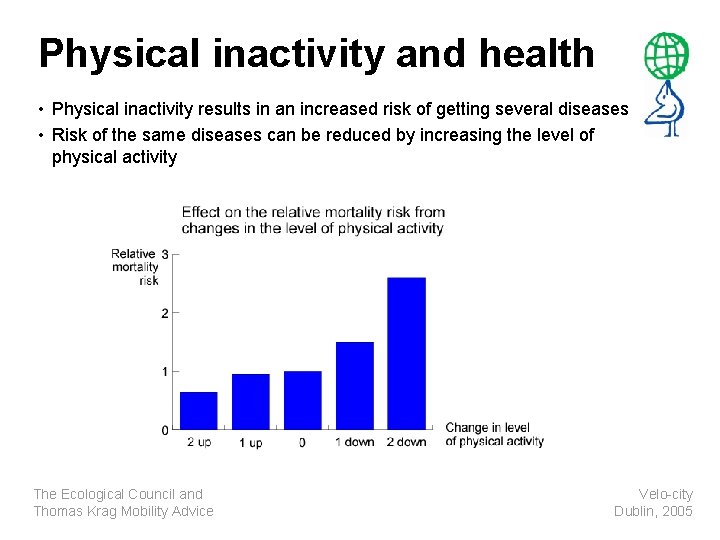
Physical inactivity and health • Physical inactivity results in an increased risk of getting several diseases • Risk of the same diseases can be reduced by increasing the level of physical activity The Ecological Council and Thomas Krag Mobility Advice Velo-city Dublin, 2005
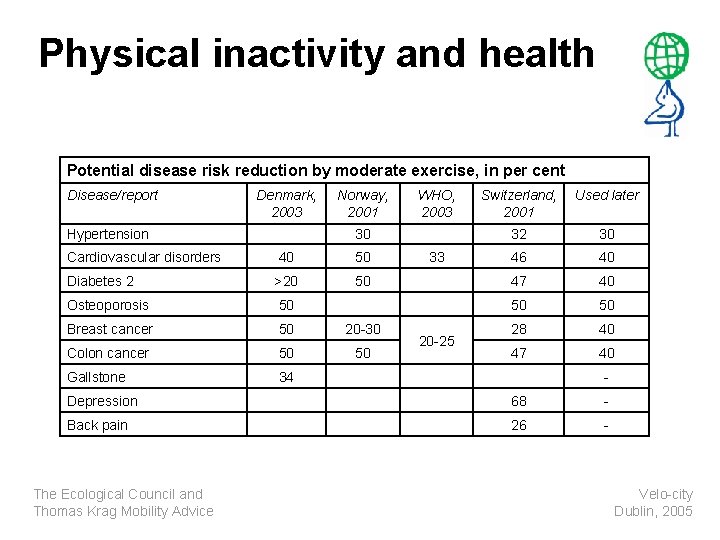
Physical inactivity and health Potential disease risk reduction by moderate exercise, in per cent Disease/report Denmark, 2003 Hypertension Norway, 2001 WHO, 2003 30 Cardiovascular disorders 40 50 Diabetes 2 >20 50 Osteoporosis 50 Breast cancer 50 20 -30 Colon cancer 50 50 Gallstone 34 33 20 -25 Switzerland, 2001 Used later 32 30 46 40 47 40 50 50 28 40 47 40 - Depression 68 - Back pain 26 - The Ecological Council and Thomas Krag Mobility Advice Velo-city Dublin, 2005
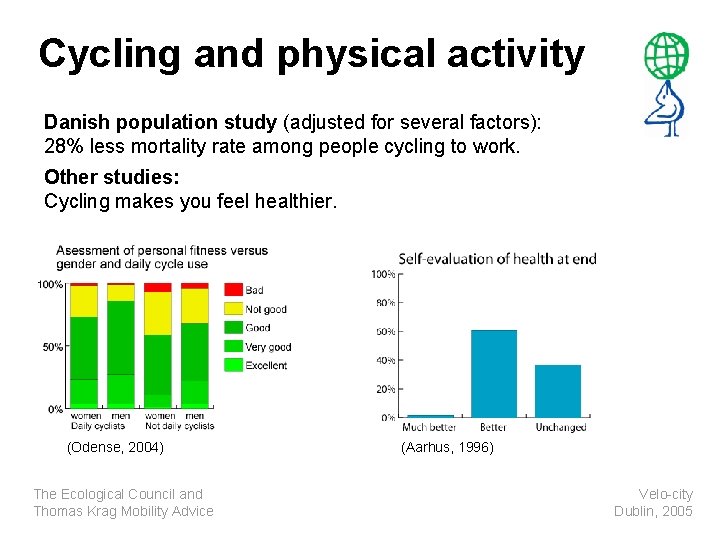
Cycling and physical activity Danish population study (adjusted for several factors): 28% less mortality rate among people cycling to work. Other studies: Cycling makes you feel healthier. (Odense, 2004) The Ecological Council and Thomas Krag Mobility Advice (Aarhus, 1996) Velo-city Dublin, 2005
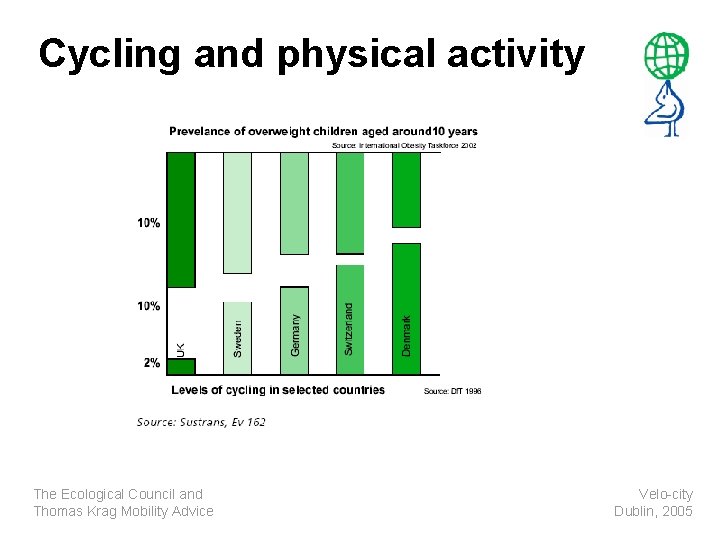
Cycling and physical activity The Ecological Council and Thomas Krag Mobility Advice Velo-city Dublin, 2005
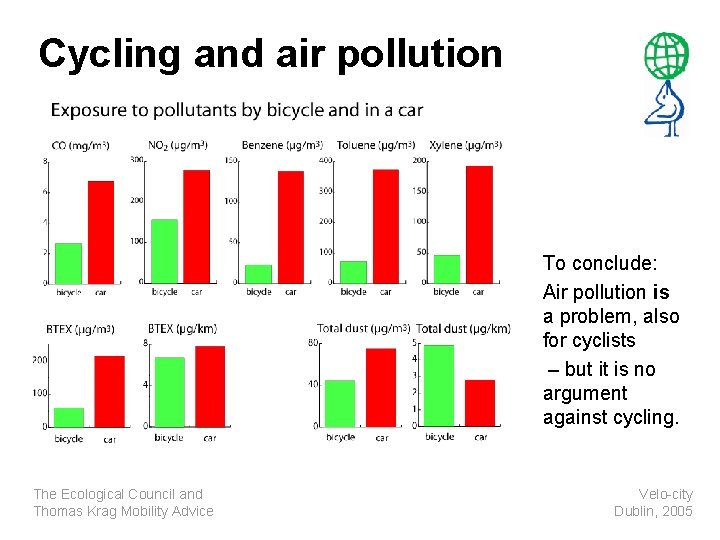
Cycling and air pollution To conclude: Air pollution is a problem, also for cyclists – but it is no argument against cycling. The Ecological Council and Thomas Krag Mobility Advice Velo-city Dublin, 2005
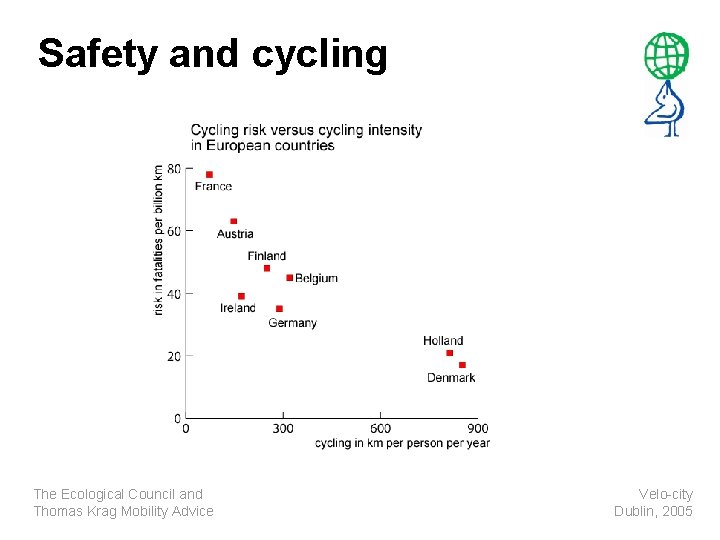
Safety and cycling Is cycling dangerous? Risk can be calculated in several ways: • injuries per km (big figure) • fatalities per km (smaller figure than for pedestrians) • fatalities per hour (figure comparable to car users) The Ecological Council and Thomas Krag Mobility Advice Velo-city Dublin, 2005
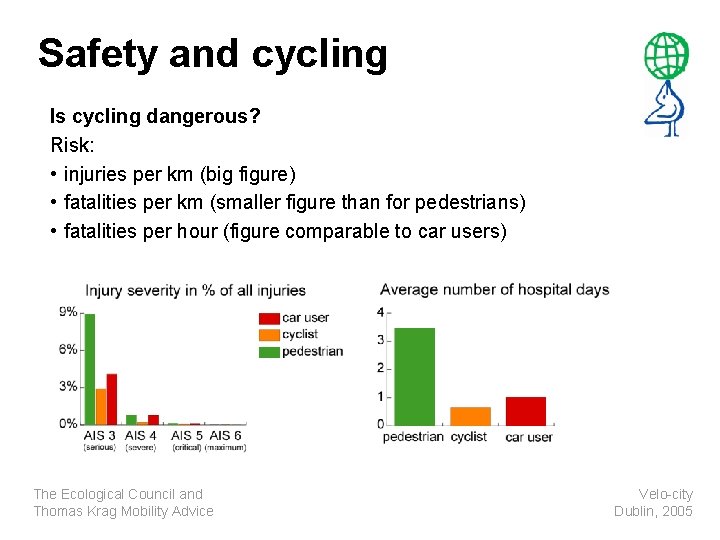
Safety and cycling Is cycling dangerous? Risk: • injuries per km (big figure) • fatalities per km (smaller figure than for pedestrians) • fatalities per hour (figure comparable to car users) The Ecological Council and Thomas Krag Mobility Advice Velo-city Dublin, 2005
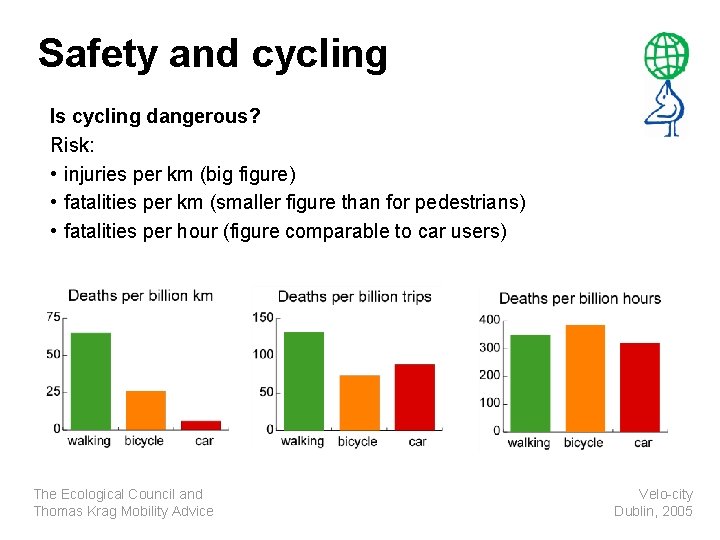
Safety and cycling Is cycling dangerous? Risk: • injuries per km (big figure) • fatalities per km (smaller figure than for pedestrians) • fatalities per hour (figure comparable to car users) The Ecological Council and Thomas Krag Mobility Advice Velo-city Dublin, 2005
Safety and cycling The Ecological Council and Thomas Krag Mobility Advice Velo-city Dublin, 2005
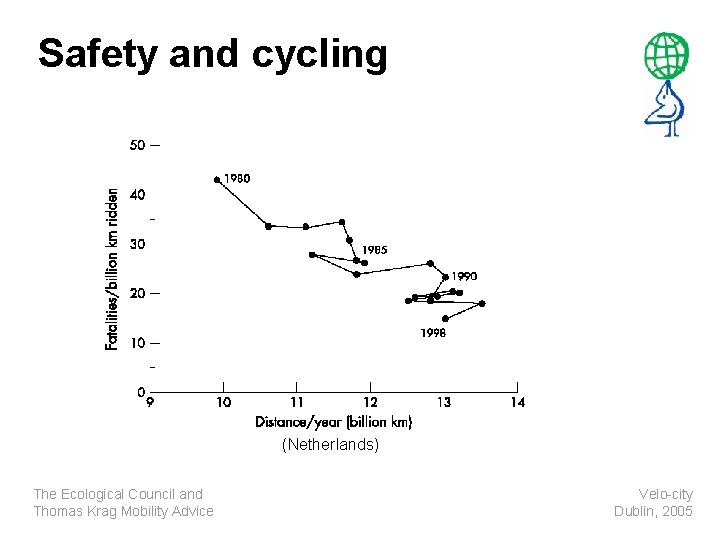
Safety and cycling (Netherlands) The Ecological Council and Thomas Krag Mobility Advice Velo-city Dublin, 2005
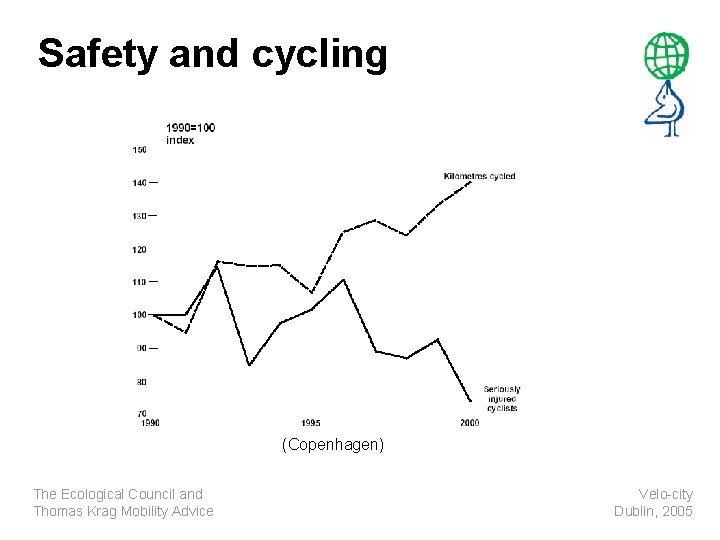
Safety and cycling (Copenhagen) The Ecological Council and Thomas Krag Mobility Advice Velo-city Dublin, 2005
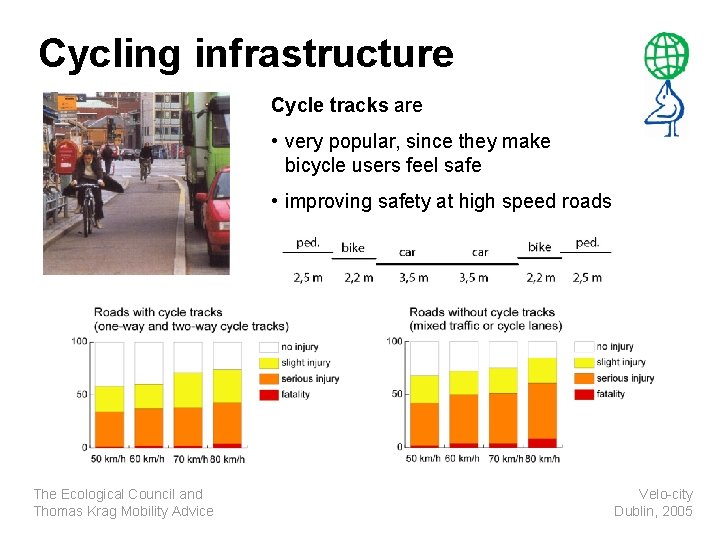
Cycling infrastructure Cycle tracks are • very popular, since they make bicycle users feel safe • improving safety at high speed roads The Ecological Council and Thomas Krag Mobility Advice Velo-city Dublin, 2005
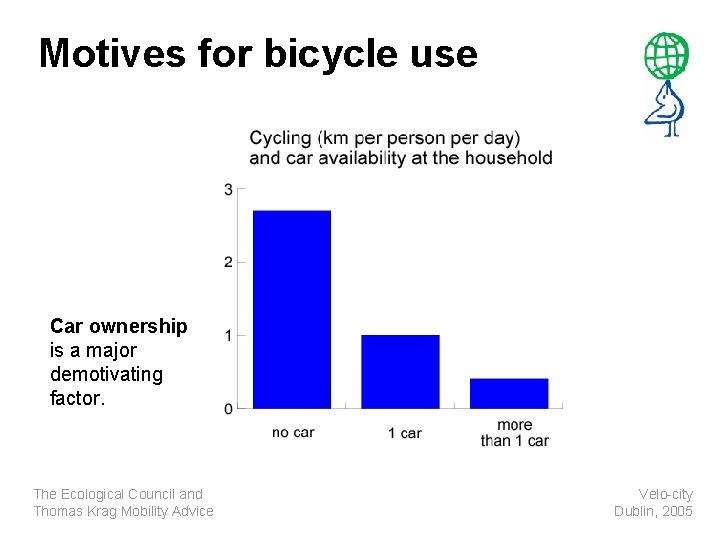
Motives for bicycle use Car ownership is a major demotivating factor. The Ecological Council and Thomas Krag Mobility Advice Velo-city Dublin, 2005
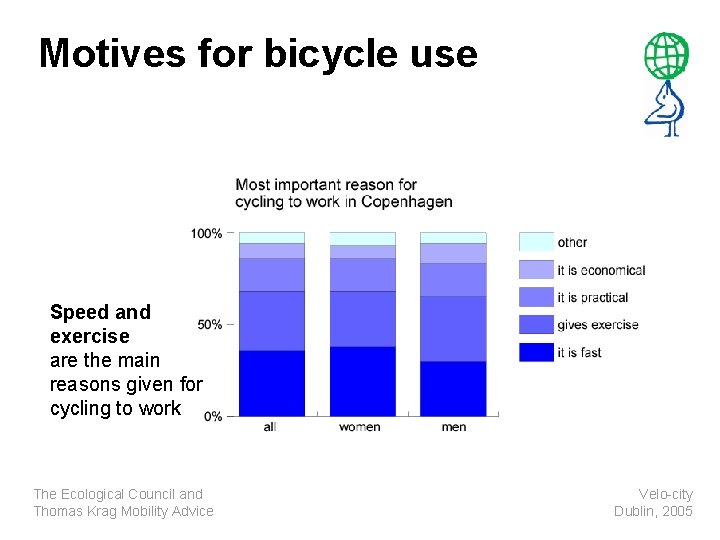
Motives for bicycle use Speed and exercise are the main reasons given for cycling to work The Ecological Council and Thomas Krag Mobility Advice Velo-city Dublin, 2005
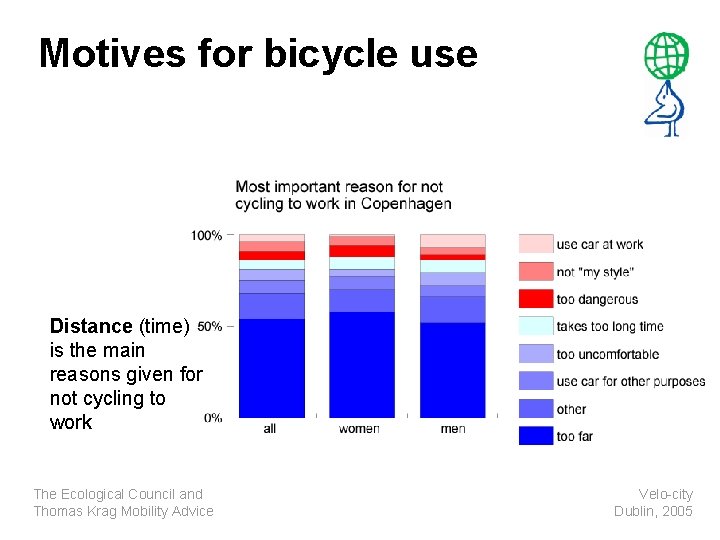
Motives for bicycle use Distance (time) is the main reasons given for not cycling to work The Ecological Council and Thomas Krag Mobility Advice Velo-city Dublin, 2005
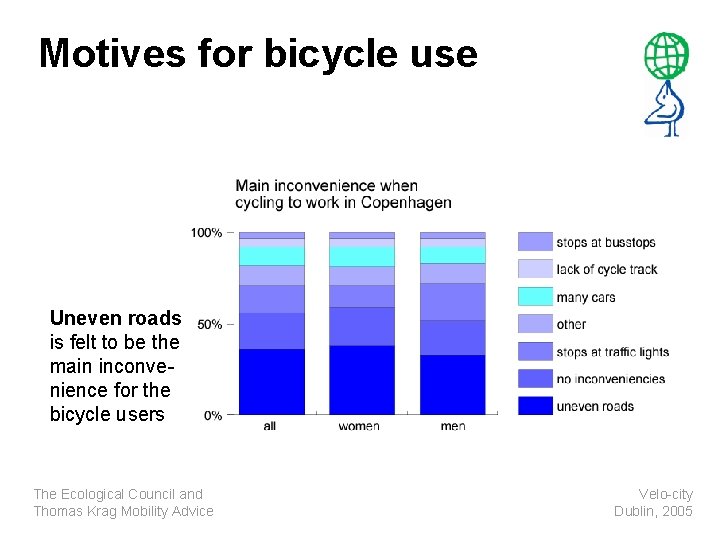
Motives for bicycle use Uneven roads is felt to be the main inconvenience for the bicycle users The Ecological Council and Thomas Krag Mobility Advice Velo-city Dublin, 2005
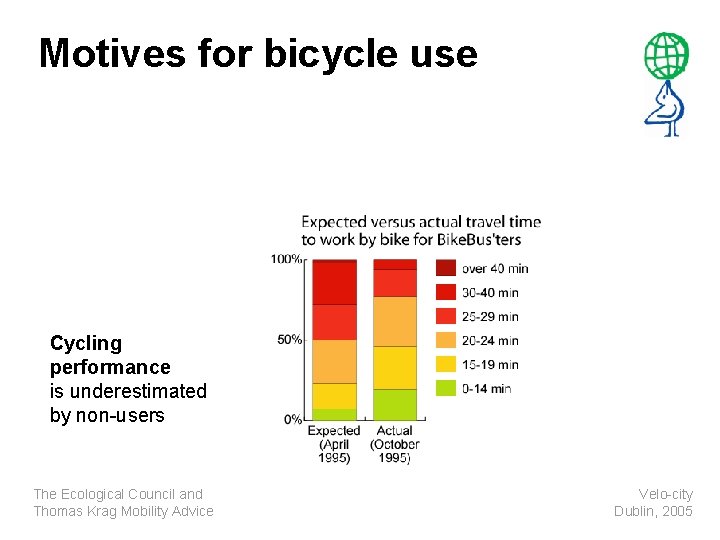
Motives for bicycle use Cycling performance is underestimated by non-users The Ecological Council and Thomas Krag Mobility Advice Velo-city Dublin, 2005
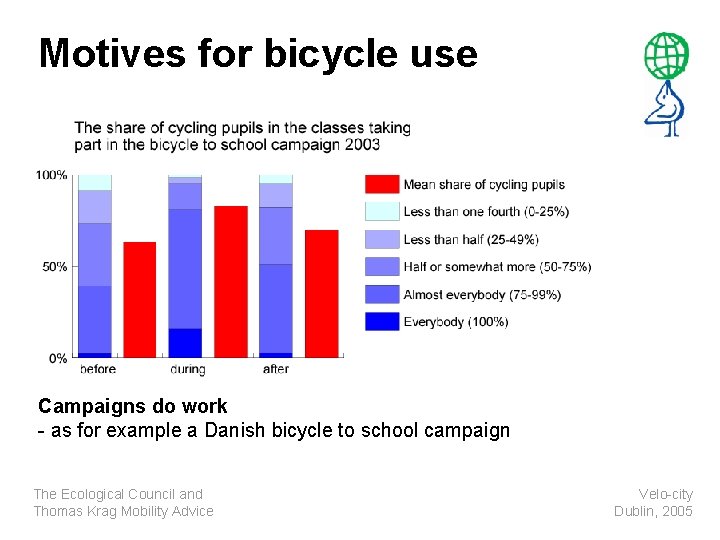
Motives for bicycle use Campaigns do work - as for example a Danish bicycle to school campaign The Ecological Council and Thomas Krag Mobility Advice Velo-city Dublin, 2005
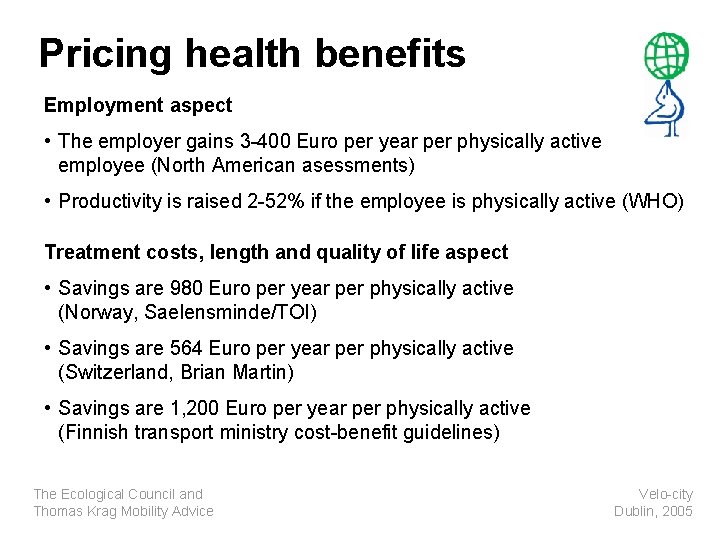
Pricing health benefits Employment aspect • The employer gains 3 -400 Euro per year per physically active employee (North American asessments) • Productivity is raised 2 -52% if the employee is physically active (WHO) Treatment costs, length and quality of life aspect • Savings are 980 Euro per year per physically active (Norway, Saelensminde/TOI) • Savings are 564 Euro per year per physically active (Switzerland, Brian Martin) • Savings are 1, 200 Euro per year per physically active (Finnish transport ministry cost-benefit guidelines) The Ecological Council and Thomas Krag Mobility Advice Velo-city Dublin, 2005
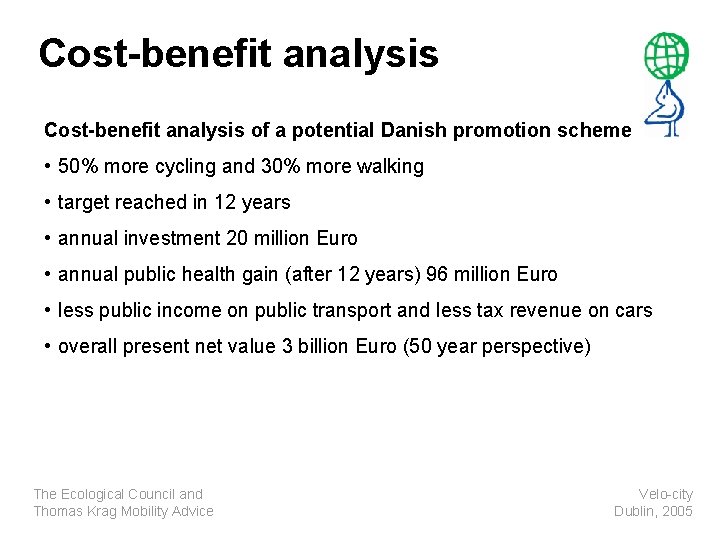
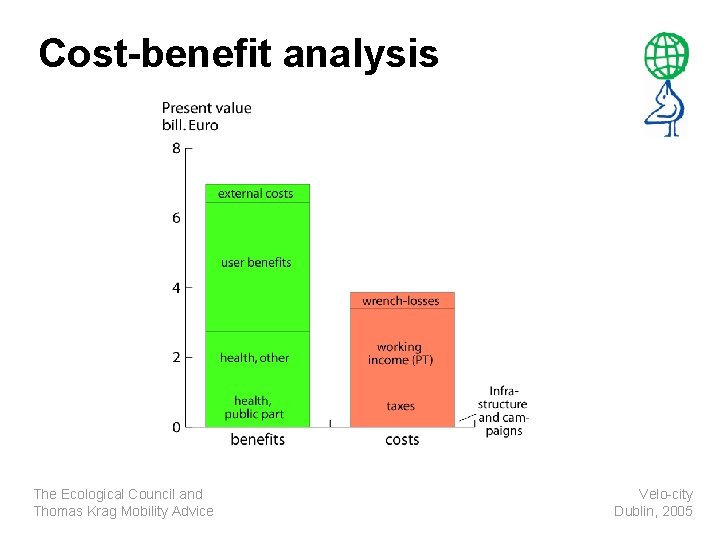
Cost-benefit analysis of a potential Danish promotion scheme • 50% more cycling and 30% more walking • target reached in 12 years • annual investment 20 million Euro • annual public health gain (after 12 years) 96 million Euro • less public income on public transport and less tax revenue on cars • overall present net value 3 billion Euro (50 year perspective) The Ecological Council and Thomas Krag Mobility Advice Velo-city Dublin, 2005
Cost-benefit analysis The Ecological Council and Thomas Krag Mobility Advice Velo-city Dublin, 2005
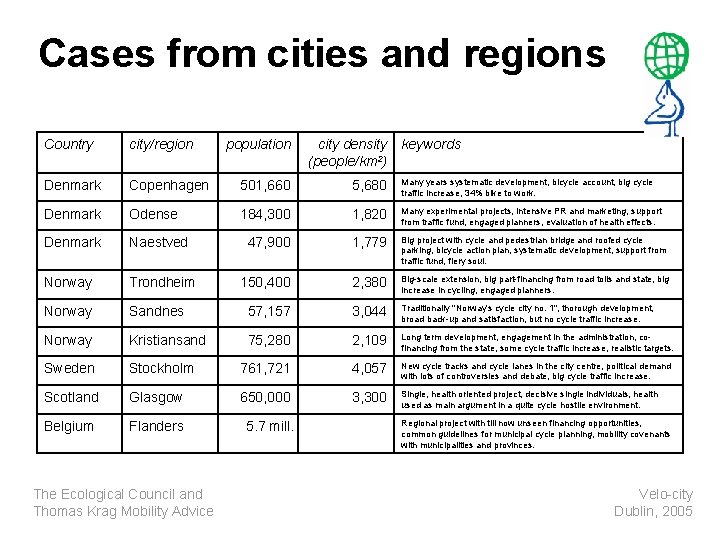
Cases from cities and regions Country city/region population city density (people/km 2) Denmark Copenhagen 501, 660 5, 680 Many years systematic development, bicycle account, big cycle traffic increase, 34% bike to work. Denmark Odense 184, 300 1, 820 Many experimental projects, intensive PR and marketing, support from traffic fund, engaged planners, evaluation of health effects. Denmark Naestved 47, 900 1, 779 Big project with cycle and pedestrian bridge and roofed cycle parking, bicycle action plan, systematic development, support from traffic fund, fiery soul. Norway Trondheim 150, 400 2, 380 Big-scale extension, big part-financing from road tolls and state, big increase in cycling, engaged planners. Norway Sandnes 57, 157 3, 044 Traditionally "Norway's cycle city no. 1", thorough development, broad back-up and satisfaction, but no cycle traffic increase. Norway Kristiansand 75, 280 2, 109 Long term development, engagement in the administration, cofinancing from the state, some cycle traffic increase, realistic targets. Sweden Stockholm 761, 721 4, 057 New cycle tracks and cycle lanes in the city centre, political demand with lots of controversies and debate, big cycle traffic increase. Scotland Glasgow 650, 000 3, 300 Single, health oriented project, decisive single individuals, health used as main argument in a quite cycle hostile environment. Belgium Flanders 5. 7 mill. The Ecological Council and Thomas Krag Mobility Advice keywords Regional project with till now unseen financing opportunities, common guidelines for municipal cycle planning, mobility covenants with municipalities and provinces. Velo-city Dublin, 2005
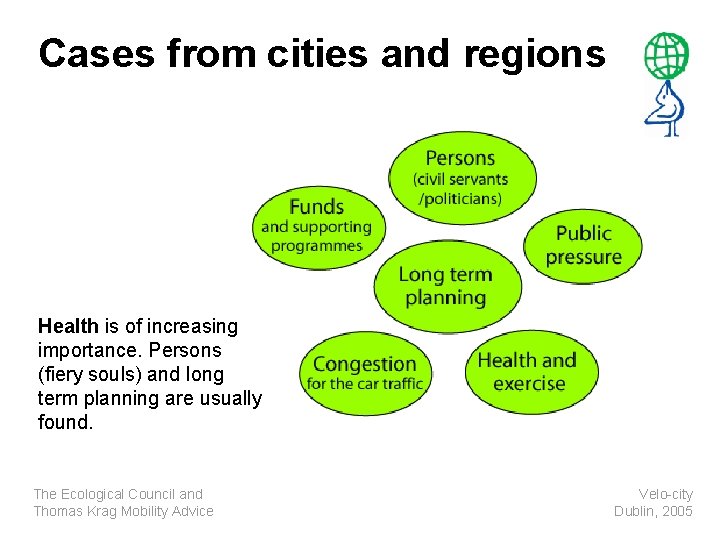
Cases from cities and regions Health is of increasing importance. Persons (fiery souls) and long term planning are usually found. The Ecological Council and Thomas Krag Mobility Advice Velo-city Dublin, 2005
International cycling targets • National cycling strategies are found in several countries • Cycling strategies usually include targets for increased cycling • Cycling targets are usually not met • Resources are often lacking • WHO can – with the 1999 London Charter on Transport, Environment and Health as the starting point – be regarded as working on an international cycling strategy. The Ecological Council and Thomas Krag Mobility Advice Velo-city Dublin, 2005
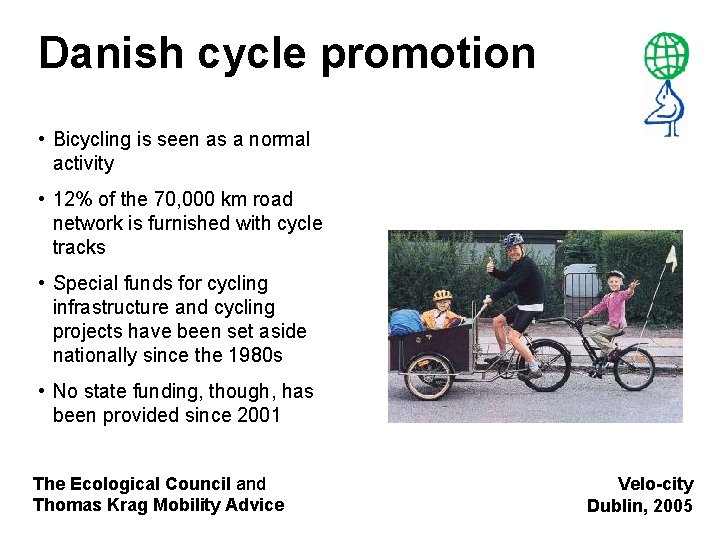
Danish cycle promotion • Bicycling is seen as a normal activity • 12% of the 70, 000 km road network is furnished with cycle tracks • Special funds for cycling infrastructure and cycling projects have been set aside nationally since the 1980 s • No state funding, though, has been provided since 2001 The Ecological Council and Thomas Krag Mobility Advice Velo-city Dublin, 2005