
Cycle Route Network Development and Evaluation using Spatial














- Slides: 45
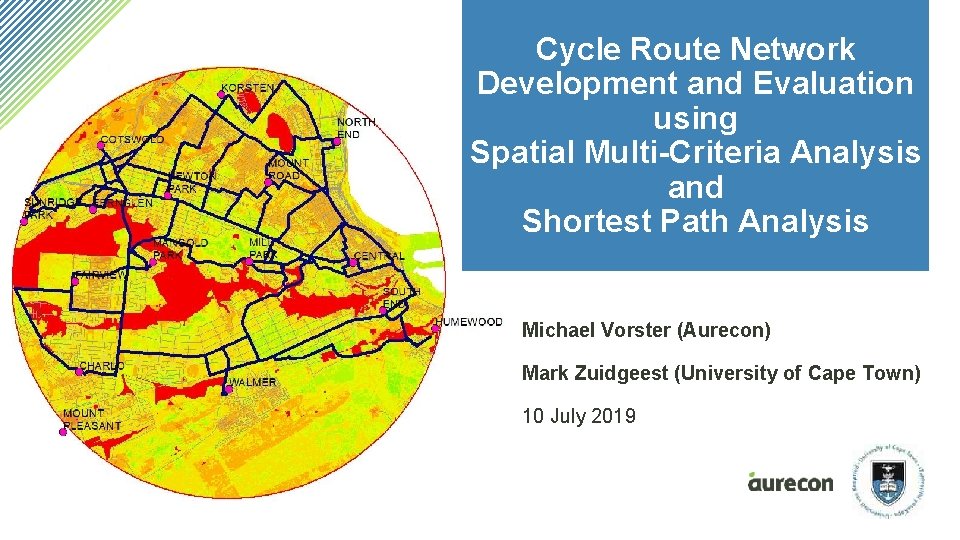
Cycle Route Network Development and Evaluation using Spatial Multi-Criteria Analysis and Shortest Path Analysis Michael Vorster (Aurecon) Mark Zuidgeest (University of Cape Town) 10 July 2019
Introduction
Introduction • Planning of cycle routes is challenging as it involves: • various stakeholders; • multiple criteria (spatial and non-spatial); and • conflicting objectives. • Traditional methods cannot adequately accommodate the above and are criticised for not being open and transparent. • Primary aim of this study set out to develop a method capable of incorporating these challenges.
Introduction • Proposed method aims to identify optimal routes by quantitatively evaluating all possible route alternatives against the route qualities defined and weighted by stakeholders. • This is achieved by using: • GIS for the manipulation and analysis of spatial information; and • MCA for structuring decision problems, and designing, evaluating and prioritising alternatives. • This combination is known as spatial multi-criteria analysis (SMCA).
Introduction • SMCA in cycle route planning has been previously applied. • Locally, a method developed by Beukes et al. (2011 a) was applied in Cape Town and Tshwane. • Physical routes not identified but rather the contextual suitability of areas for cycling. • Existing planned routes prioritised based on suitability. • Internationally, a similar parallel study to that being presented here, by Terh and Cao (2018), applied SMCA in Singapore. • Some route qualities desired by cyclists (no other stakeholders) included, but focused on proximity to select destinations.
Introduction • For the proposed method to gain acceptability among stakeholders and practitioners, the following requirements were deemed essential: • • • facilitate stakeholder engagement; address multiple criteria from various stakeholders; be transparent and back-traceable; be user-friendly, cost-effective and time efficient; be capable of developing either a single route or a network of routes; and be flexible in its use of available data sources.
Study Area for Proof of Concept
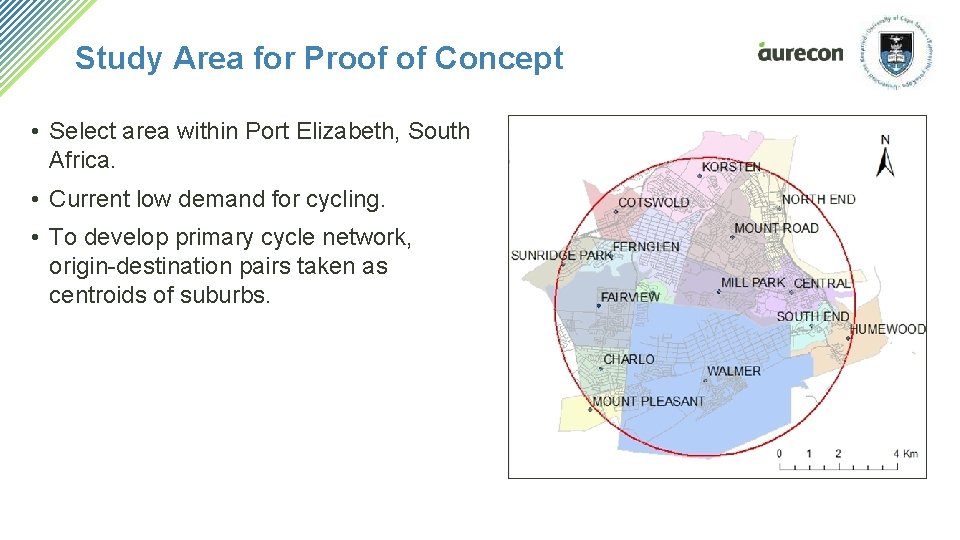
Study Area for Proof of Concept • Select area within Port Elizabeth, South Africa. • Current low demand for cycling. • To develop primary cycle network, origin-destination pairs taken as centroids of suburbs.
The Method
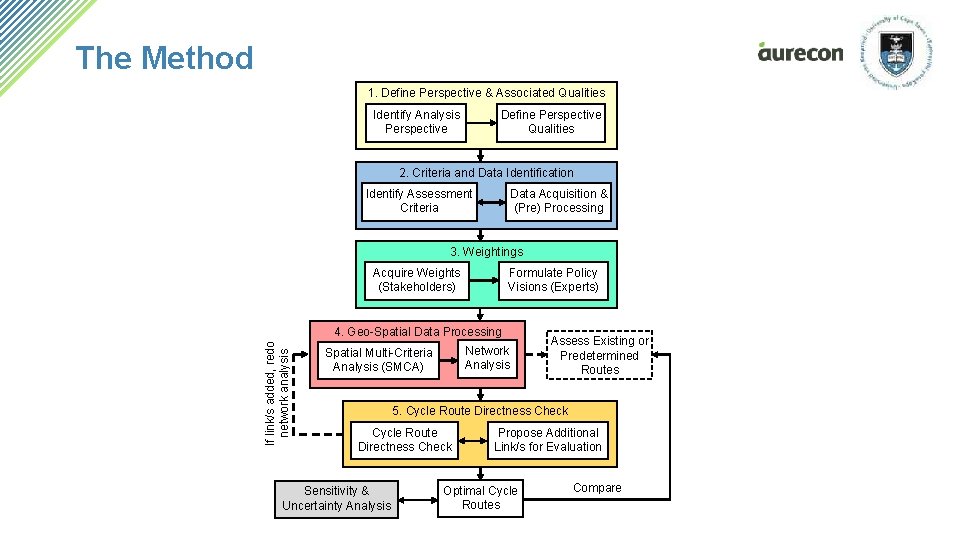
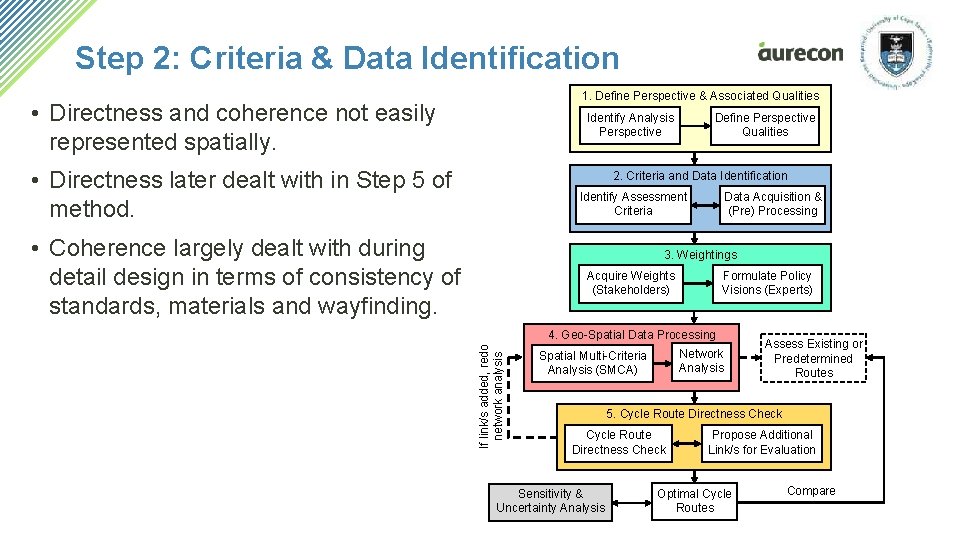
The Method 1. Define Perspective & Associated Qualities Identify Analysis Perspective Define Perspective Qualities 2. Criteria and Data Identification Identify Assessment Criteria Data Acquisition & (Pre) Processing 3. Weightings Acquire Weights (Stakeholders) Formulate Policy Visions (Experts) If link/s added, redo network analysis 4. Geo-Spatial Data Processing Network Analysis Spatial Multi-Criteria Analysis (SMCA) Assess Existing or Predetermined Routes 5. Cycle Route Directness Check Sensitivity & Uncertainty Analysis Propose Additional Link/s for Evaluation Optimal Cycle Routes Compare
Step 1 Perspective and Associated Qualities
Step 1: Perspective & Associated Qualities • Variety of stakeholders with varying perspectives, for example: • • cyclists environmentalists technical experts local government Perspectives considered in study • Affected stakeholders to meet and agree on the qualities. • The user’s perspective should be prioritised to promote cycling.
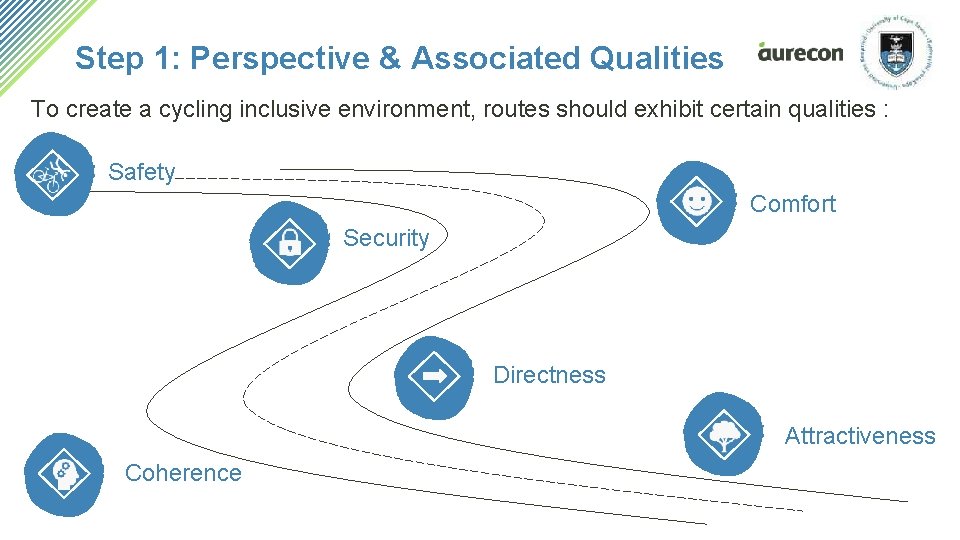
Step 1: Perspective & Associated Qualities To create a cycling inclusive environment, routes should exhibit certain qualities : Safety Comfort Security Directness Attractiveness Coherence
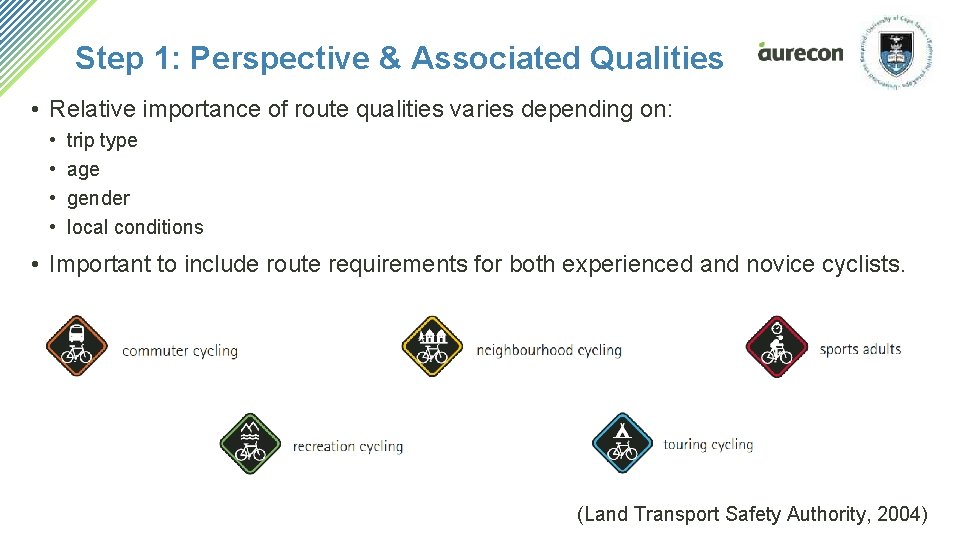
Step 1: Perspective & Associated Qualities • Relative importance of route qualities varies depending on: • • trip type age gender local conditions • Important to include route requirements for both experienced and novice cyclists. (Land Transport Safety Authority, 2004)
Step 2 Criteria and Data Identification
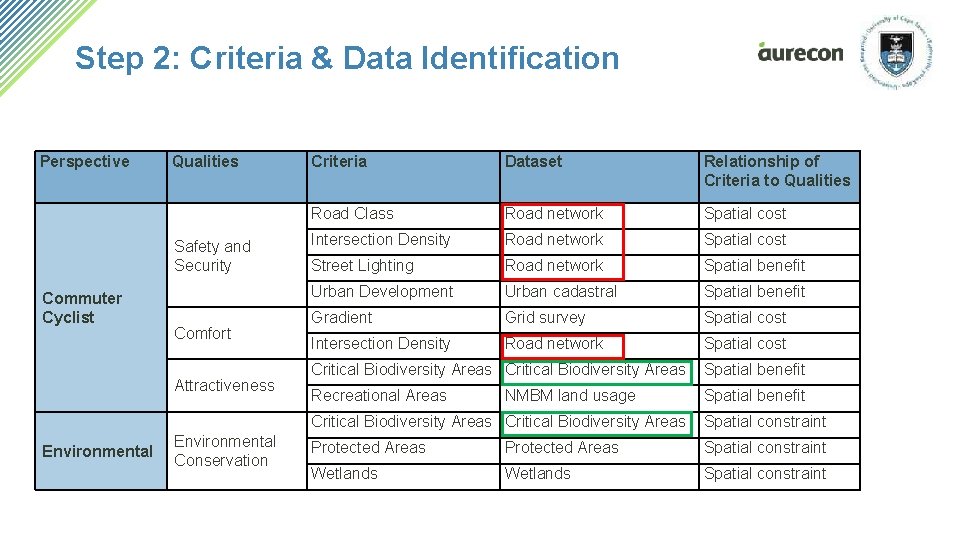
Step 2: Criteria & Data Identification Perspective Qualities Safety and Security Commuter Cyclist Comfort Attractiveness Environmental Conservation Criteria Dataset Relationship of Criteria to Qualities Road Class Road network Spatial cost Intersection Density Road network Spatial cost Street Lighting Road network Spatial benefit Urban Development Urban cadastral Spatial benefit Gradient Grid survey Spatial cost Intersection Density Road network Spatial cost Critical Biodiversity Areas Spatial benefit Recreational Areas Spatial benefit NMBM land usage Critical Biodiversity Areas Spatial constraint Protected Areas Spatial constraint Wetlands Spatial constraint
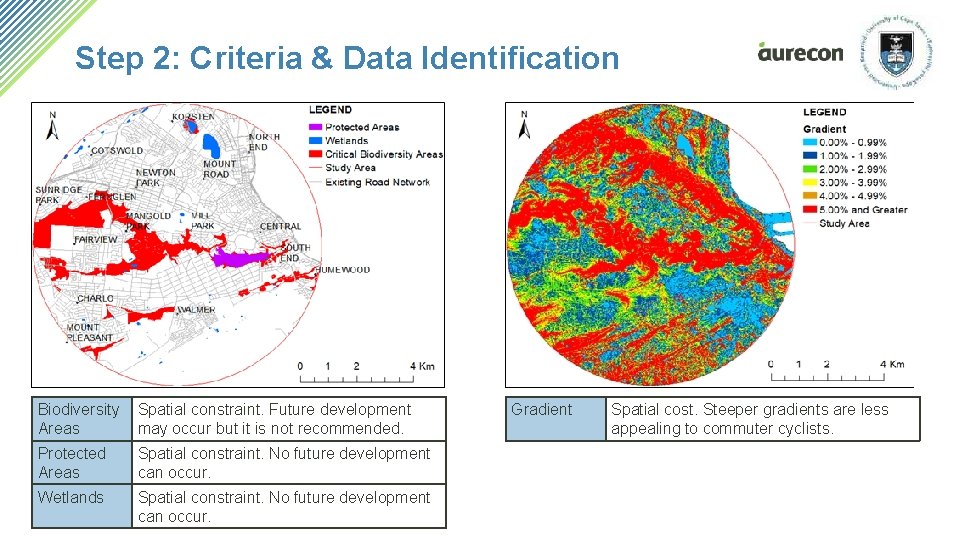
Step 2: Criteria & Data Identification Biodiversity Areas Spatial constraint. Future development may occur but it is not recommended. Protected Areas Spatial constraint. No future development can occur. Wetlands Spatial constraint. No future development can occur. Gradient Spatial cost. Steeper gradients are less appealing to commuter cyclists.
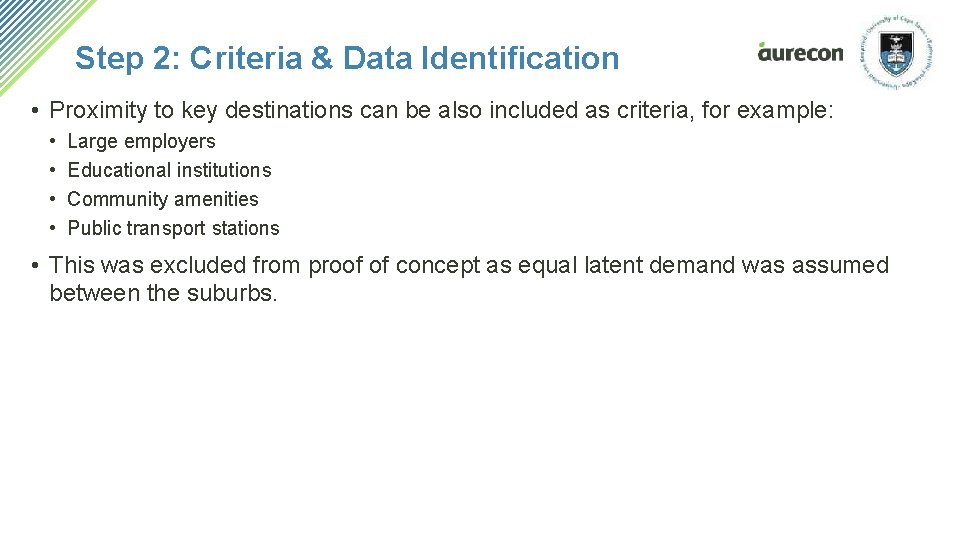
Step 2: Criteria & Data Identification • Proximity to key destinations can be also included as criteria, for example: • • Large employers Educational institutions Community amenities Public transport stations • This was excluded from proof of concept as equal latent demand was assumed between the suburbs.
Step 2: Criteria & Data Identification 1. Define Perspective & Associated Qualities • Directness and coherence not easily represented spatially. Identify Analysis Perspective • Directness later dealt with in Step 5 of method. Define Perspective Qualities 2. Criteria and Data Identification Identify Assessment Criteria • Coherence largely dealt with during detail design in terms of consistency of standards, materials and wayfinding. Data Acquisition & (Pre) Processing 3. Weightings Acquire Weights (Stakeholders) Formulate Policy Visions (Experts) If link/s added, redo network analysis 4. Geo-Spatial Data Processing Network Analysis Spatial Multi-Criteria Analysis (SMCA) Assess Existing or Predetermined Routes 5. Cycle Route Directness Check Sensitivity & Uncertainty Analysis Propose Additional Link/s for Evaluation Optimal Cycle Routes Compare
Step 3 Weighting of Route Qualities and Criteria
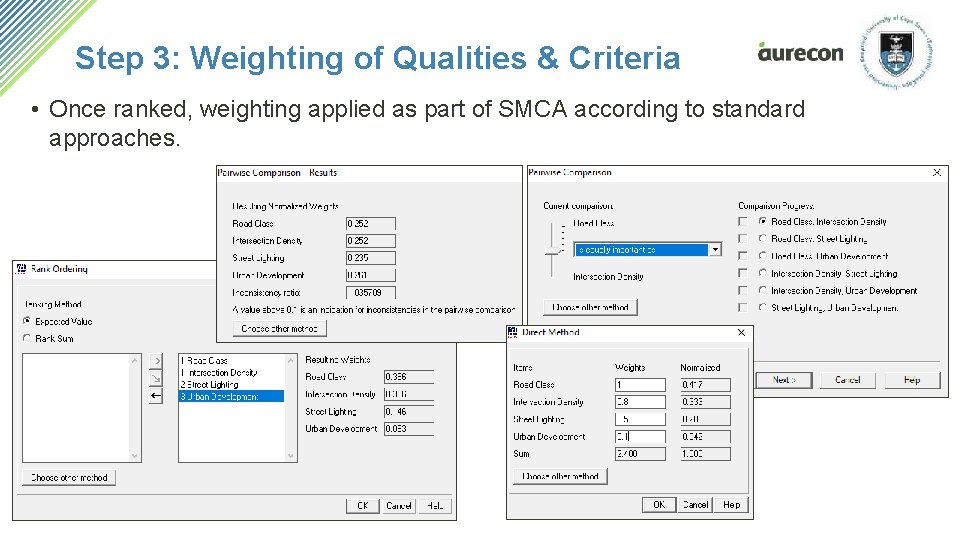
Step 3: Weighting of Qualities & Criteria • Point at which stakeholders have influence over the outcome. • First, relative importance of these needs to be determined by stakeholders via a ranking process, for example: • Pairwise comparison • Linkert type scale
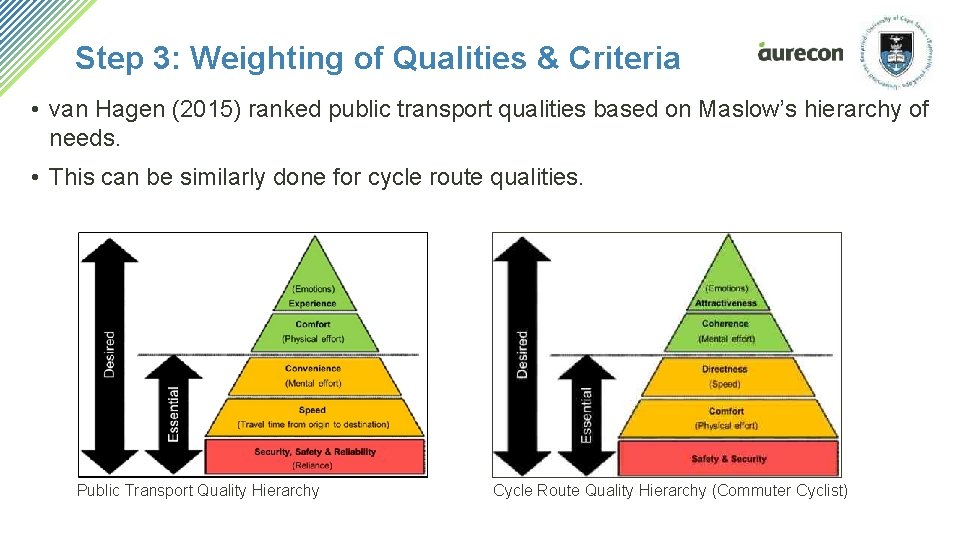
Step 3: Weighting of Qualities & Criteria • van Hagen (2015) ranked public transport qualities based on Maslow’s hierarchy of needs. • This can be similarly done for cycle route qualities. Public Transport Quality Hierarchy Cycle Route Quality Hierarchy (Commuter Cyclist)
Step 3: Weighting of Qualities & Criteria • Once ranked, weighting applied as part of SMCA according to standard approaches.
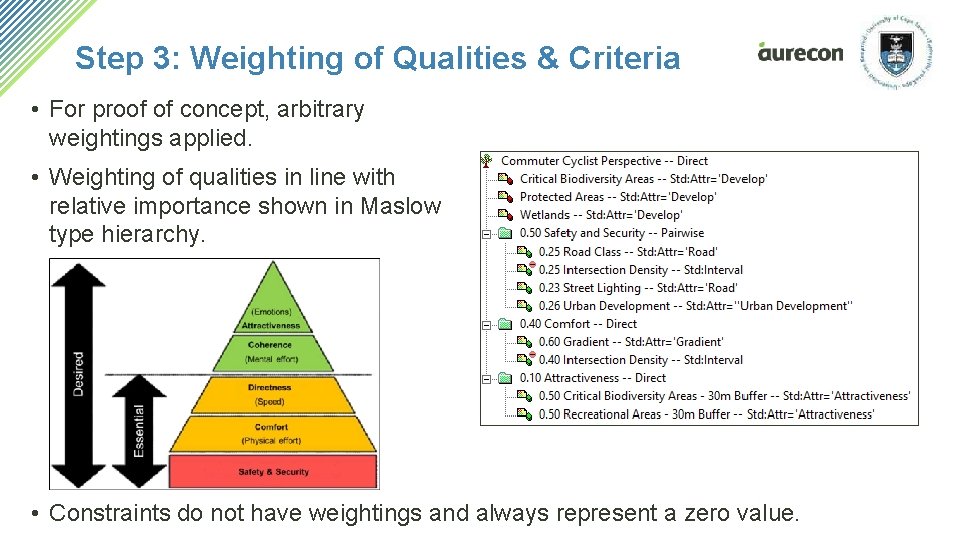
Step 3: Weighting of Qualities & Criteria • For proof of concept, arbitrary weightings applied. • Weighting of qualities in line with relative importance shown in Maslow type hierarchy. • Constraints do not have weightings and always represent a zero value.
Step 4 Geo-Spatial Data Processing
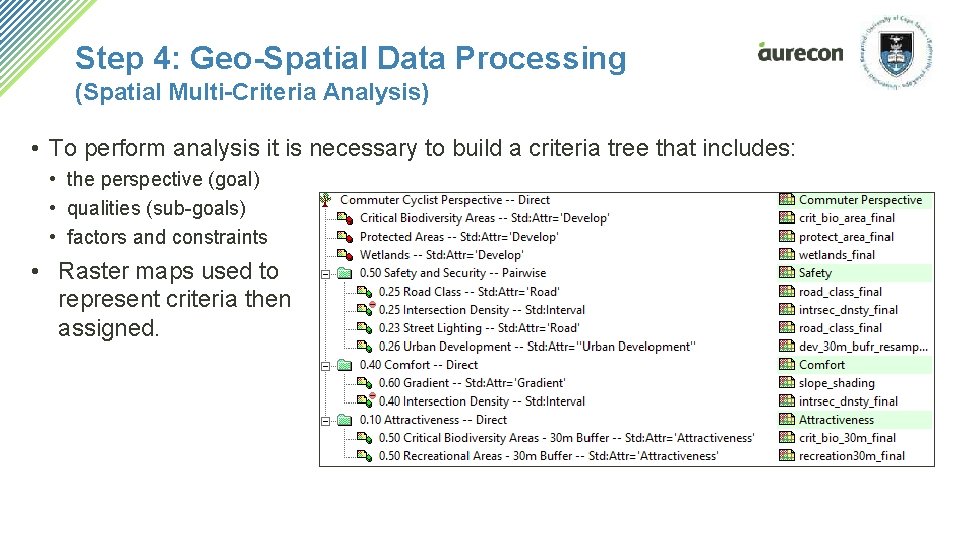
Step 4: Geo-Spatial Data Processing (Spatial Multi-Criteria Analysis) • To perform analysis it is necessary to build a criteria tree that includes: • the perspective (goal) • qualities (sub-goals) • factors and constraints • Raster maps used to represent criteria then assigned.
Step 4: Geo-Spatial Data Processing (Spatial Multi-Criteria Analysis)
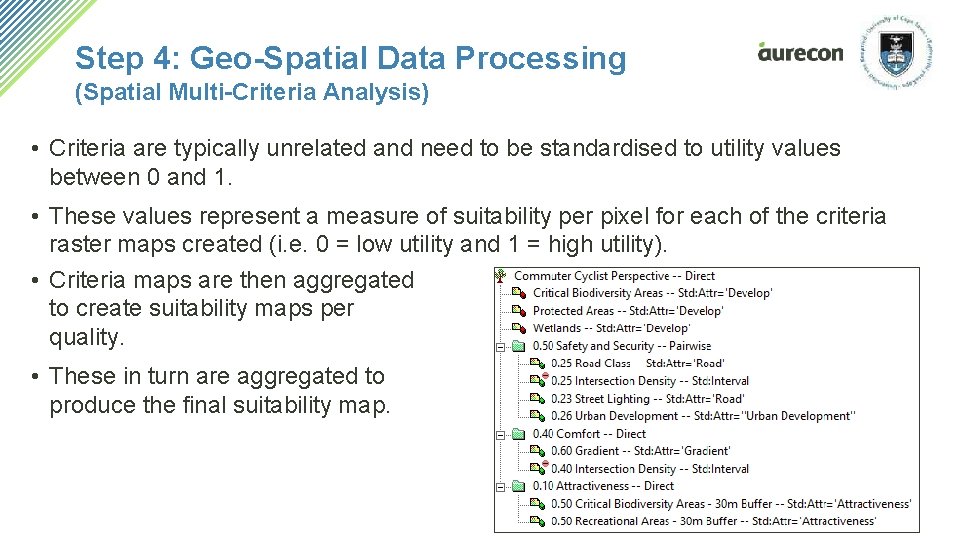
Step 4: Geo-Spatial Data Processing (Spatial Multi-Criteria Analysis) • Criteria are typically unrelated and need to be standardised to utility values between 0 and 1. • These values represent a measure of suitability per pixel for each of the criteria raster maps created (i. e. 0 = low utility and 1 = high utility). • Criteria maps are then aggregated to create suitability maps per quality. • These in turn are aggregated to produce the final suitability map.
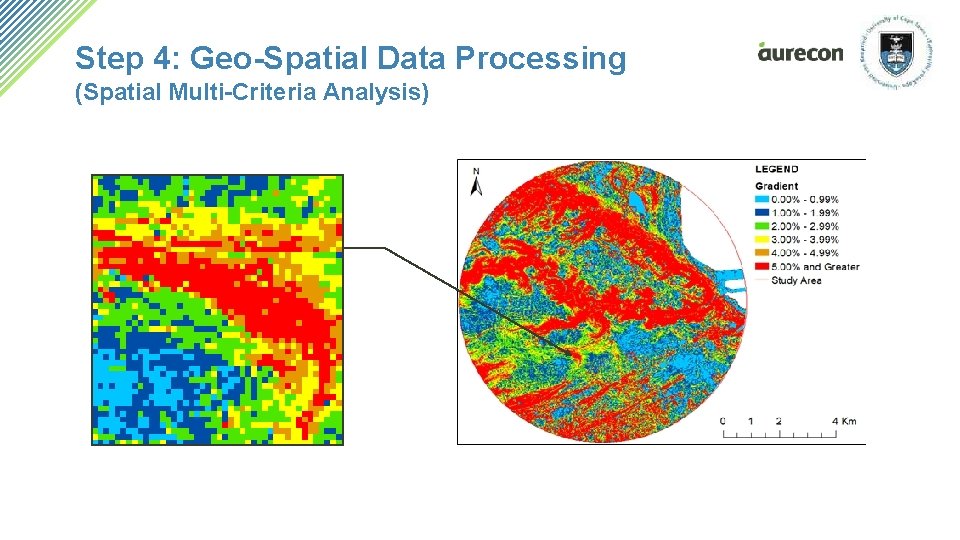
Step 4: Geo-Spatial Data Processing (Spatial Multi-Criteria Analysis) • Overlapping cells cumulate to contribute to the final suitability score. • Dark red pixels represent no-go areas (i. e. constraints).
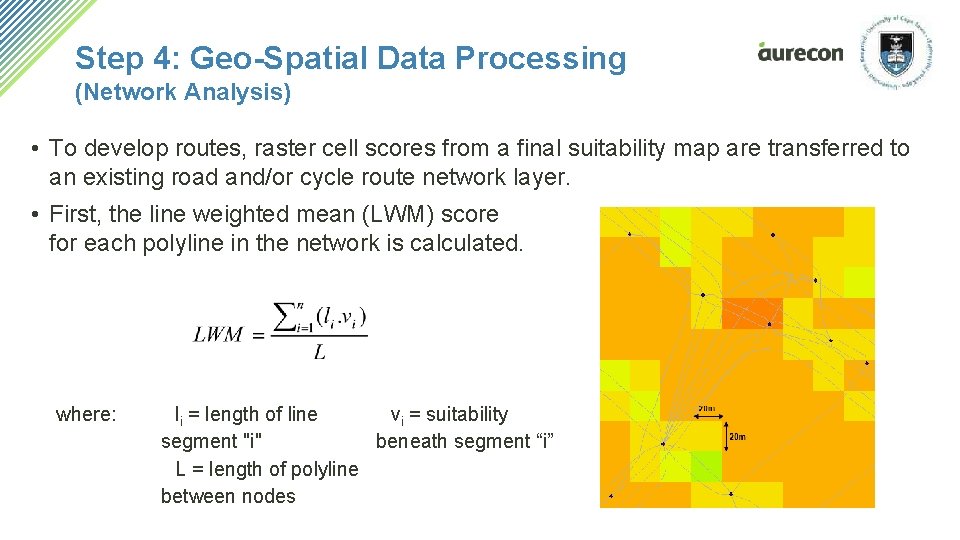
Step 4: Geo-Spatial Data Processing (Network Analysis) • To develop routes, raster cell scores from a final suitability map are transferred to an existing road and/or cycle route network layer. • First, the line weighted mean (LWM) score for each polyline in the network is calculated. where: li = length of line vi = suitability segment "i" beneath segment “i” L = length of polyline between nodes
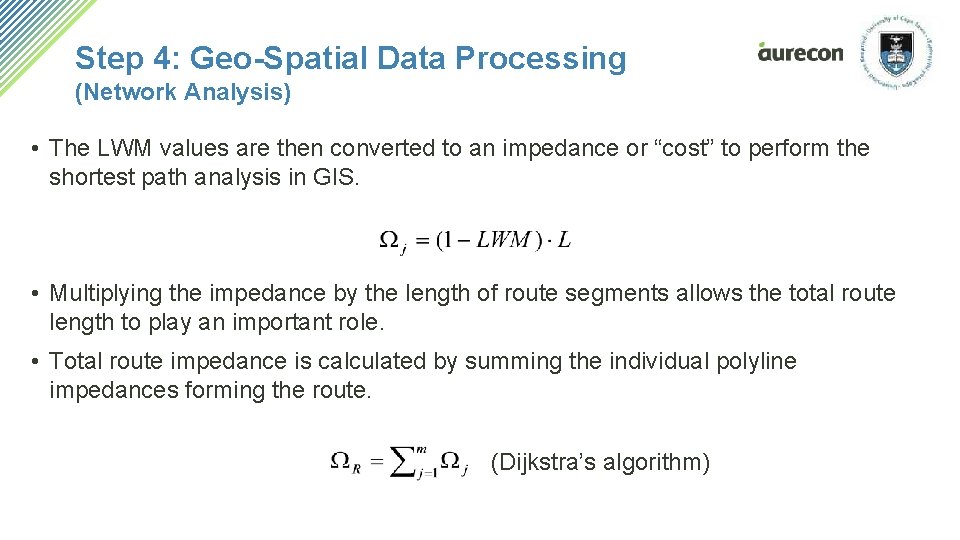
Step 4: Geo-Spatial Data Processing (Network Analysis) • The LWM values are then converted to an impedance or “cost” to perform the shortest path analysis in GIS. • Multiplying the impedance by the length of route segments allows the total route length to play an important role. • Total route impedance is calculated by summing the individual polyline impedances forming the route. (Dijkstra’s algorithm)
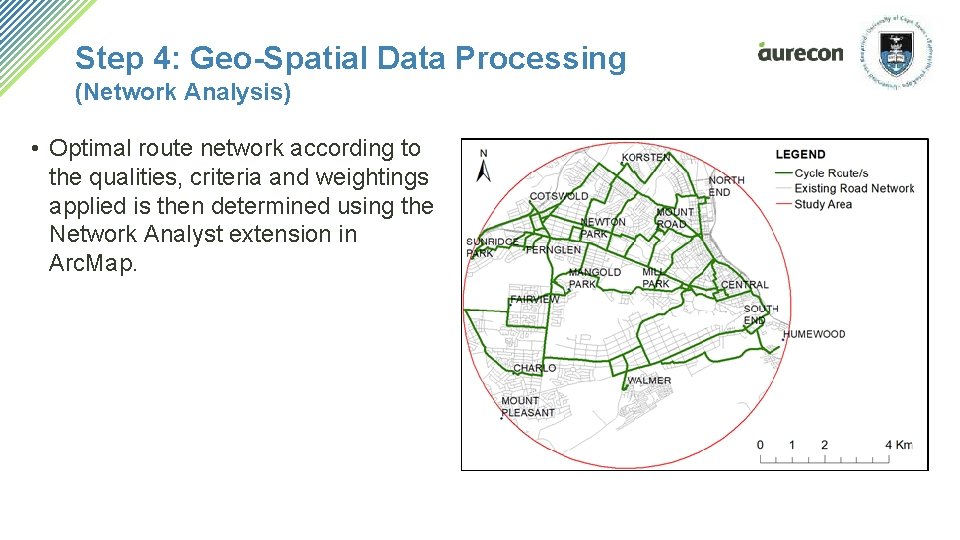
Step 4: Geo-Spatial Data Processing (Network Analysis) • Optimal route network according to the qualities, criteria and weightings applied is then determined using the Network Analyst extension in Arc. Map.
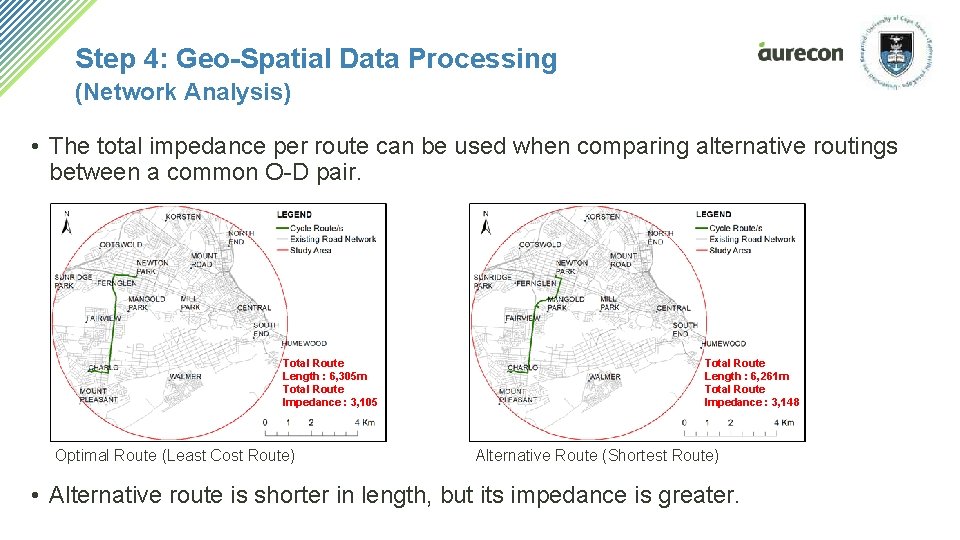
Step 4: Geo-Spatial Data Processing (Network Analysis) • The total impedance per route can be used when comparing alternative routings between a common O-D pair. Total Route Length : 6, 305 m Total Route Impedance : 3, 105 Optimal Route (Least Cost Route) Total Route Length : 6, 261 m Total Route Impedance : 3, 148 Alternative Route (Shortest Route) • Alternative route is shorter in length, but its impedance is greater.
Step 5 Cycle Route Directness
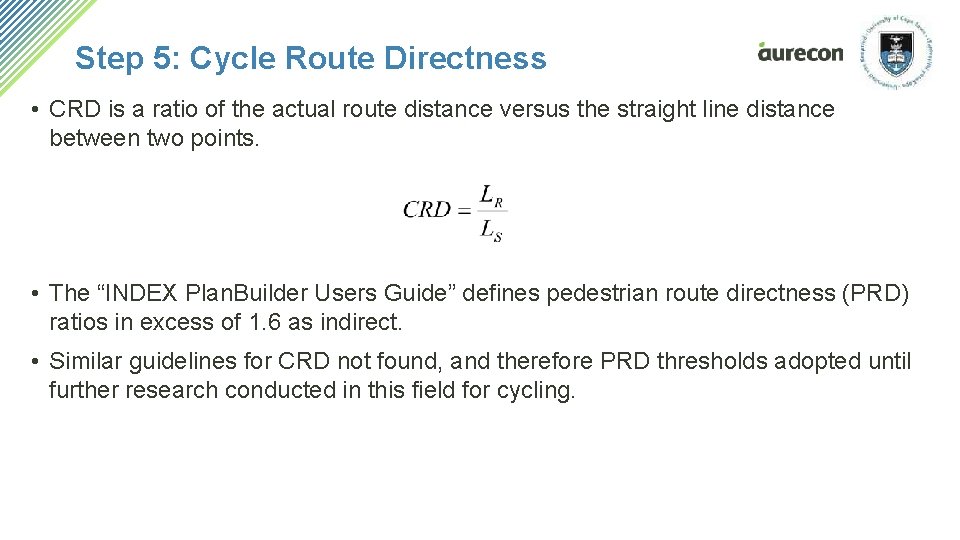
Step 5: Cycle Route Directness • CRD is a ratio of the actual route distance versus the straight line distance between two points. • The “INDEX Plan. Builder Users Guide” defines pedestrian route directness (PRD) ratios in excess of 1. 6 as indirect. • Similar guidelines for CRD not found, and therefore PRD thresholds adopted until further research conducted in this field for cycling.
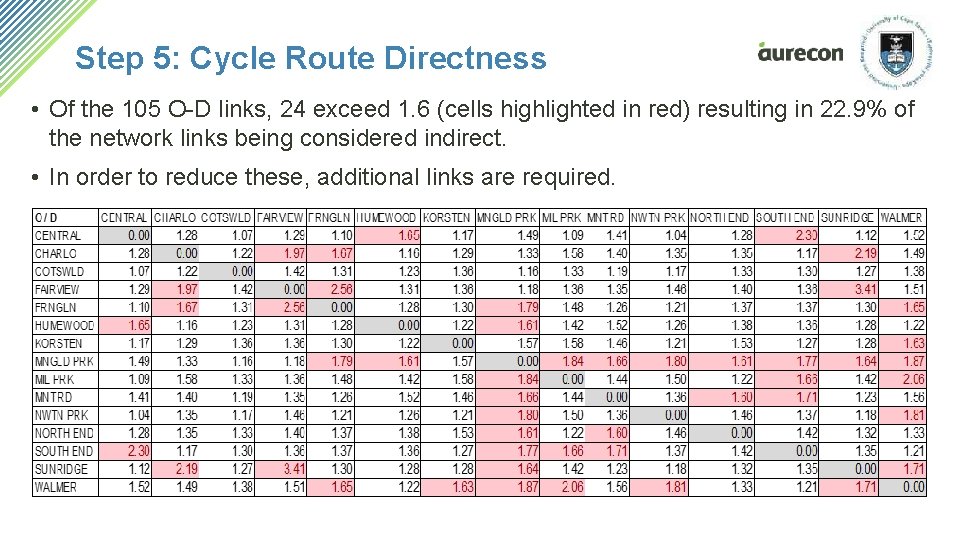
Step 5: Cycle Route Directness • Of the 105 O-D links, 24 exceed 1. 6 (cells highlighted in red) resulting in 22. 9% of the network links being considered indirect. • In order to reduce these, additional links are required.
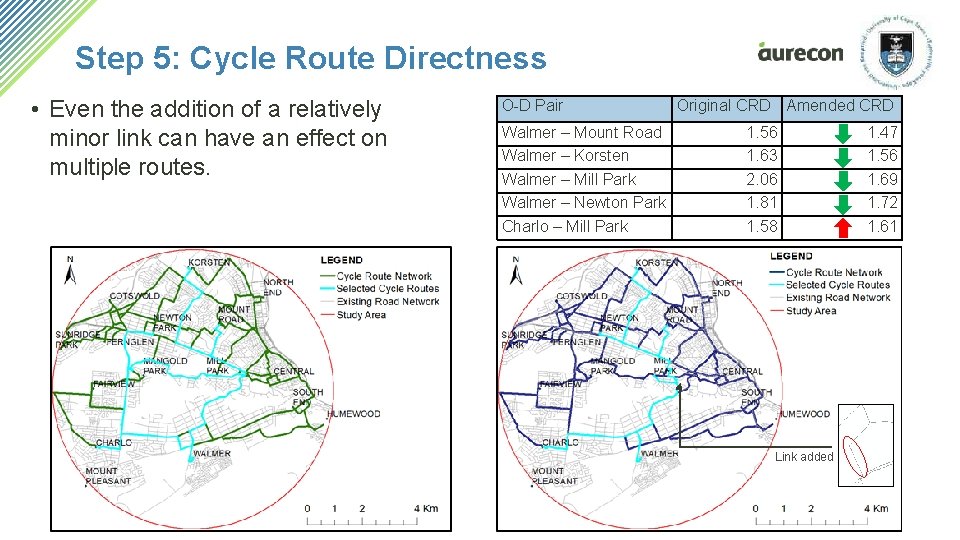
Step 5: Cycle Route Directness • Even the addition of a relatively minor link can have an effect on multiple routes. O-D Pair Walmer – Mount Road Walmer – Korsten Walmer – Mill Park Walmer – Newton Park Charlo – Mill Park Original CRD Amended CRD 1. 56 1. 63 2. 06 1. 81 1. 58 Link added 1. 47 1. 56 1. 69 1. 72 1. 61
Step 5: Cycle Route Directness • The increased CRD between Charlo and Mill Park is due to the heavy weighting applied to safety and security. O-D Pair Walmer – Mount Road Walmer – Korsten Walmer – Mill Park Walmer – Newton Park Charlo – Mill Park Original CRD Amended CRD 1. 56 1. 63 2. 06 1. 81 1. 58 1. 47 1. 56 1. 69 1. 72 1. 61 • Optimal route is shorter in the original network, but is considered more dangerous as it passes by vacant land on higher order roads for a greater portion of its length. Route Length (m) Impedance [-] Revised Route Original Route Difference 7, 730 7, 565 165 3, 466 4, 017 551
Conclusions
Conclusions • Requirements met based on proof of concept: facilitate stakeholder engagement; • • • Defining and weighting of qualities and criteria. Identification of missing links. Ability to review and comment on suitability maps. address multiple criteria from various stakeholders; be transparent and back-traceable; • • Stakeholders involved in defining and weighting of qualities and criteria. Suitability maps visual representation of inputs. Route impedance scores allow for an objective comparison. Systematic and structured approach means that method is back-traceable.
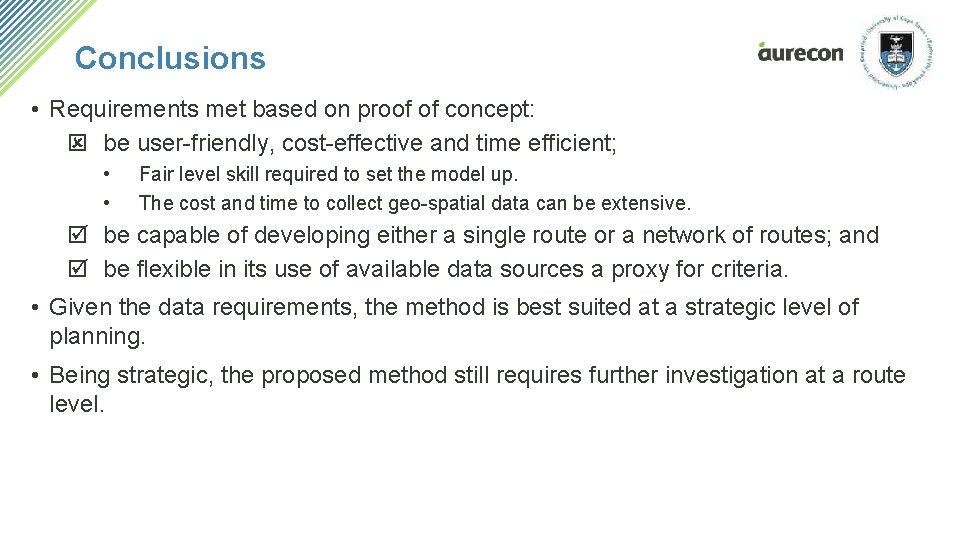
Conclusions • Requirements met based on proof of concept: be user-friendly, cost-effective and time efficient; • • Fair level skill required to set the model up. The cost and time to collect geo-spatial data can be extensive. be capable of developing either a single route or a network of routes; and be flexible in its use of available data sources a proxy for criteria. • Given the data requirements, the method is best suited at a strategic level of planning. • Being strategic, the proposed method still requires further investigation at a route level.
Conclusions • Route qualities and length considered in route development, thereby improving on existing methods. • Lastly, this study adds innovation to the field of SMCA for cycle route planning by: • Solving for a network of routes as opposed to a single route. • Proposing use of CRD and using it to identify missing links. • Utilising CRD as an additional measure in the prioritisation of cycle facility upgrades. It is recommended that this criterion not be used in isolation but be combined with other criteria, for example: demand, crash data and project costs.
Recommendations
Recommendations • Further research into the relationships between criteria and data be undertaken, with the aim of producing a guideline document detailing how data can be used as a proxy where the required information is not available. • That a comparative study for CRD be undertaken to verify the PRD threshold value between direct and indirect routes for cycling. • That a comparative study of alternative methods of route identification be undertaken to determine the pros and cons of each and their areas of suitability.
Thank You