
CYCLADS an EU FET proposal for high power
- Slides: 29
CYCLADS, an EU FET proposal for high power cyclotron conceptual design Marcello Losasso Knowledge Transfer Group - CERN On behalf of CYCLADS collaboration EUCARD 2 Status of Accelerator Driven Systems R&T Development - CERN – 09/02/2017 - Marcello Losasso
H-2020: the biggest EU R&I programme ever: € 80 billion of funding available over 7 years (2014 to 2020). Under H-2020, FET Open is a funding program focusing on collaborative actions beyond what is accepted or adopted. It supports novel and visionary thinking to open promising paths towards new technological possibilities. FET Open is an extremely competitive program: in 2016/16 #47 projects awarded out of #2104 eligible. The actions need to satisfy special characteristics that define the kind of research that FET is looking for. These are called the 'gatekeepers': Breakthrough scientific and technological target has clear identified targets Foundational envisages new line of investigation bringing to new technology Novelty it must presents innovative aspects high-risk it represents a move into uncharted territory long-term vision it reaches far beyond the immediate future Interdisciplinary it presents collaboration patterns from sparse disciplines EUCARD 2 Status of Accelerator Driven Systems R&T Development - CERN – 09/02/2017 - Marcello Losasso 2
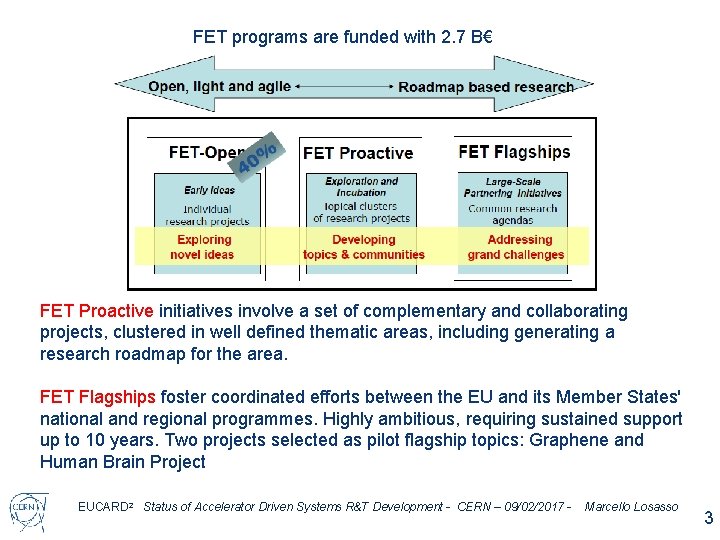
FET programs are funded with 2. 7 B€ FET Proactive initiatives involve a set of complementary and collaborating projects, clustered in well defined thematic areas, including generating a research roadmap for the area. FET Flagships foster coordinated efforts between the EU and its Member States' national and regional programmes. Highly ambitious, requiring sustained support up to 10 years. Two projects selected as pilot flagship topics: Graphene and Human Brain Project EUCARD 2 Status of Accelerator Driven Systems R&T Development - CERN – 09/02/2017 - Marcello Losasso 3
An accelerator driven system FET project in H-2020 Having in mind a collaborative research project that can lay foundations for next generation technologies and able to convert concepts and scaled demonstrators into industrial applications and systems, and By analyzing the different H-2020 funding possibilities FET-OPEN turns out to be the most suitable scheme to propose a research project centered on ADS and nuclear waste issue at present. EUCARD 2 Status of Accelerator Driven Systems R&T Development - CERN – 09/02/2017 - Marcello Losasso 4
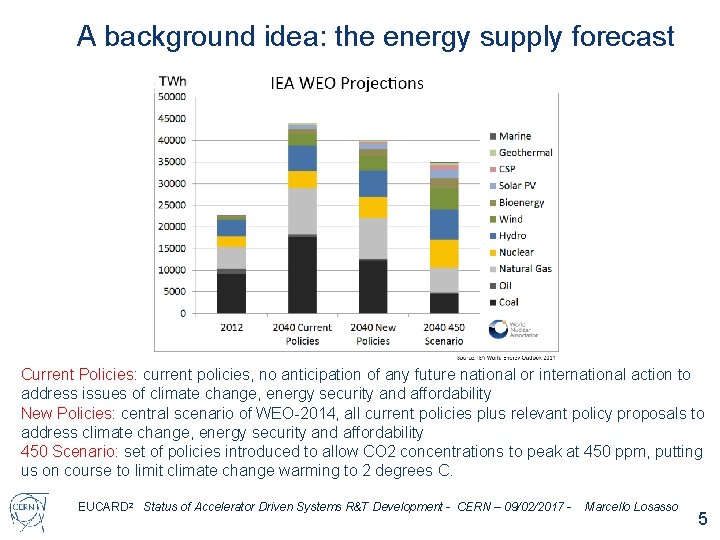
A background idea: the energy supply forecast Current Policies: current policies, no anticipation of any future national or international action to address issues of climate change, energy security and affordability New Policies: central scenario of WEO-2014, all current policies plus relevant policy proposals to address climate change, energy security and affordability 450 Scenario: set of policies introduced to allow CO 2 concentrations to peak at 450 ppm, putting us on course to limit climate change warming to 2 degrees C. EUCARD 2 Status of Accelerator Driven Systems R&T Development - CERN – 09/02/2017 - Marcello Losasso 5
Nuclear will still be part of the energy portfolio in all three scenarios the amount of nuclear generation increases from 2012 levels. As expected, the more effort put in to policies to reduce greenhouse gas emissions, the greater the amount of nuclear generation forecast. On a global scale, this is already happening: Between the start of 2015 and late 2016, 19 new nuclear reactors commenced operation, two-thirds of them in China, and construction started on nine new reactors in the same period. Some 64 GW of new nuclear capacity is under construction, principally in China (one-third), but also in Russia, the United Arab Emirates, the United States, South Korea, the European Union and India. EUCARD 2 Status of Accelerator Driven Systems R&T Development - CERN – 09/02/2017 - Marcello Losasso 6
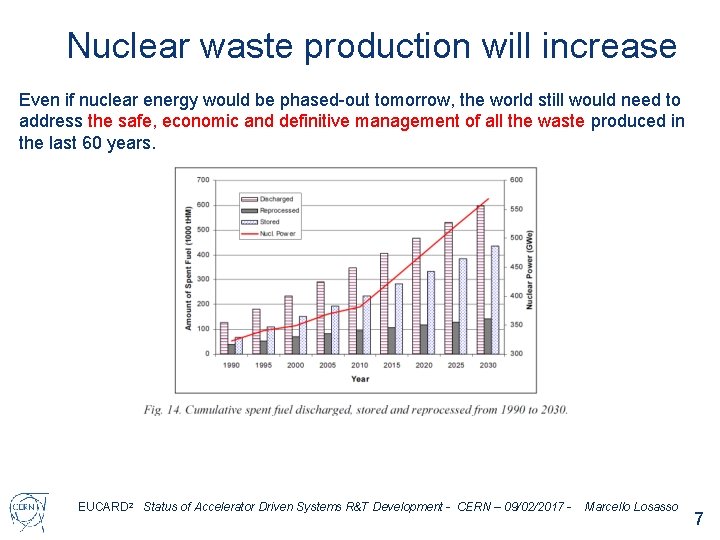
Nuclear waste production will increase Even if nuclear energy would be phased-out tomorrow, the world still would need to address the safe, economic and definitive management of all the waste produced in the last 60 years. EUCARD 2 Status of Accelerator Driven Systems R&T Development - CERN – 09/02/2017 - Marcello Losasso 7
From the societal need to a FET proposal To facilitate deployment of nuclear as GHG energy supply it is necessary to increase acceptability of the technology. Interlinked aspects are: • • Waste reduction of waste volume and radiotoxicity Safety subcritical reactor, passive safety systems Proliferation reduction of Pu stockpile Advanced fuels Creating new alternatives to U-powered plant (only 0. 7% used. . ) EUCARD 2 Status of Accelerator Driven Systems R&T Development - CERN – 09/02/2017 - Marcello Losasso 8
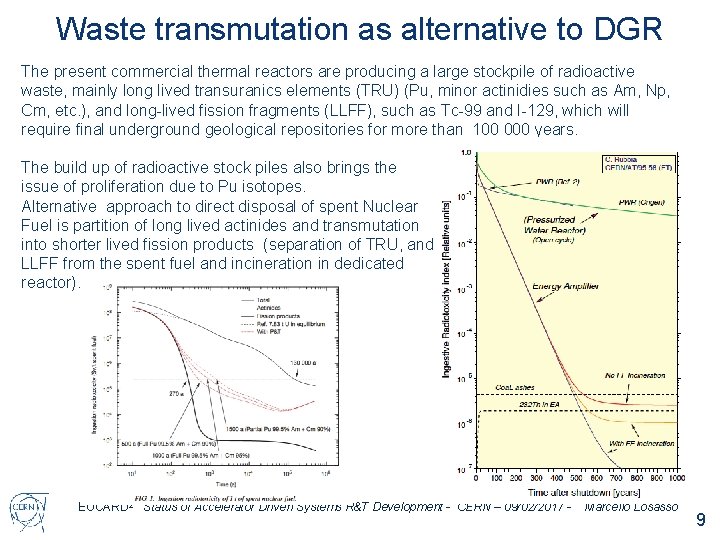
Waste transmutation as alternative to DGR The present commercial thermal reactors are producing a large stockpile of radioactive waste, mainly long lived transuranics elements (TRU) (Pu, minor actinidies such as Am, Np, Cm, etc. ), and long-lived fission fragments (LLFF), such as Tc-99 and I-129, which will require final underground geological repositories for more than 100 000 years. The build up of radioactive stock piles also brings the issue of proliferation due to Pu isotopes. Alternative approach to direct disposal of spent Nuclear Fuel is partition of long lived actinides and transmutation into shorter lived fission products (separation of TRU, and LLFF from the spent fuel and incineration in dedicated reactor). EUCARD 2 Status of Accelerator Driven Systems R&T Development - CERN – 09/02/2017 - Marcello Losasso 9
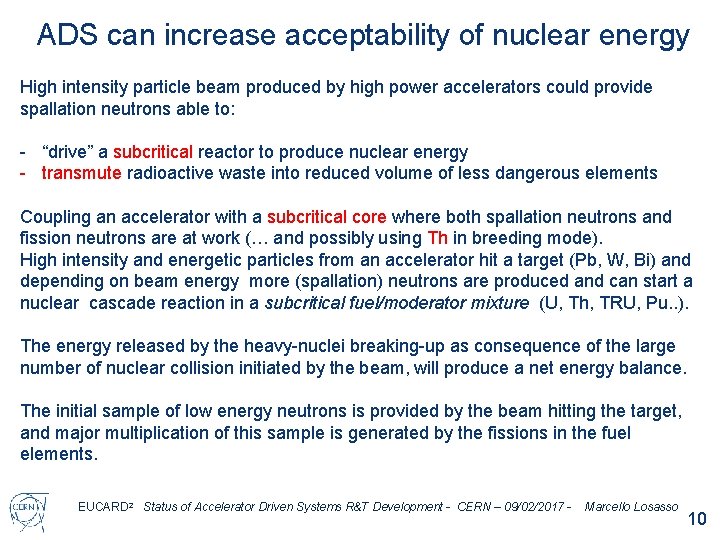
ADS can increase acceptability of nuclear energy High intensity particle beam produced by high power accelerators could provide spallation neutrons able to: - “drive” a subcritical reactor to produce nuclear energy - transmute radioactive waste into reduced volume of less dangerous elements Coupling an accelerator with a subcritical core where both spallation neutrons and fission neutrons are at work (… and possibly using Th in breeding mode). High intensity and energetic particles from an accelerator hit a target (Pb, W, Bi) and depending on beam energy more (spallation) neutrons are produced and can start a nuclear cascade reaction in a subcritical fuel/moderator mixture (U, Th, TRU, Pu. . ). The energy released by the heavy-nuclei breaking-up as consequence of the large number of nuclear collision initiated by the beam, will produce a net energy balance. The initial sample of low energy neutrons is provided by the beam hitting the target, and major multiplication of this sample is generated by the fissions in the fuel elements. EUCARD 2 Status of Accelerator Driven Systems R&T Development - CERN – 09/02/2017 - Marcello Losasso 10
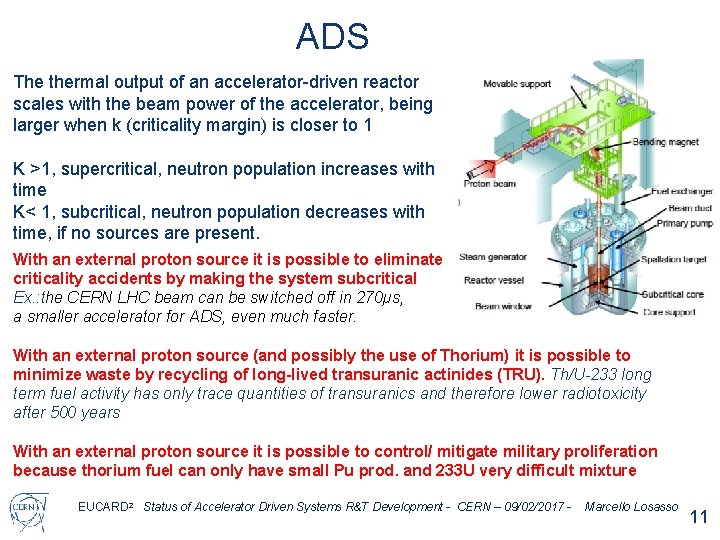
ADS The thermal output of an accelerator-driven reactor scales with the beam power of the accelerator, being larger when k (criticality margin) is closer to 1 K >1, supercritical, neutron population increases with time K< 1, subcritical, neutron population decreases with time, if no sources are present. With an external proton source it is possible to eliminate criticality accidents by making the system subcritical Ex. : the CERN LHC beam can be switched off in 270µs, a smaller accelerator for ADS, even much faster. With an external proton source (and possibly the use of Thorium) it is possible to minimize waste by recycling of long-lived transuranic actinides (TRU). Th/U-233 long term fuel activity has only trace quantities of transuranics and therefore lower radiotoxicity after 500 years With an external proton source it is possible to control/ mitigate military proliferation because thorium fuel can only have small Pu prod. and 233 U very difficult mixture EUCARD 2 Status of Accelerator Driven Systems R&T Development - CERN – 09/02/2017 - Marcello Losasso 11
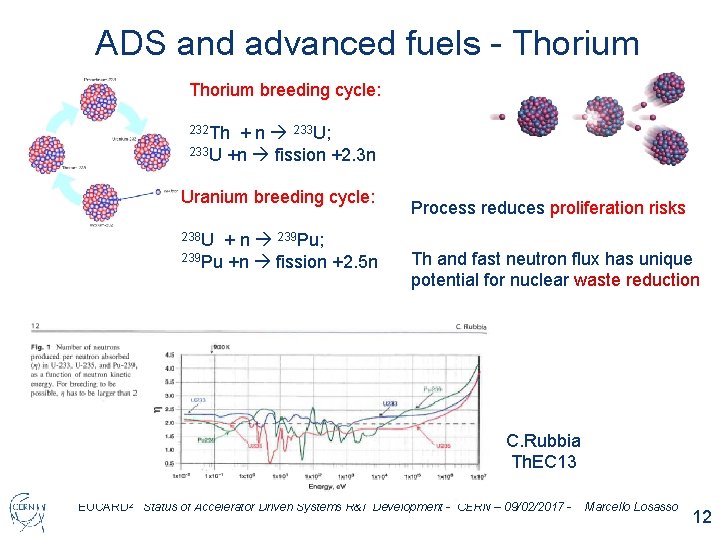
ADS and advanced fuels - Thorium breeding cycle: 232 Th + n 233 U; 233 U +n fission +2. 3 n Uranium breeding cycle: 238 U + n 239 Pu; 239 Pu +n fission +2. 5 n Process reduces proliferation risks Th and fast neutron flux has unique potential for nuclear waste reduction C. Rubbia Th. EC 13 EUCARD 2 Status of Accelerator Driven Systems R&T Development - CERN – 09/02/2017 - Marcello Losasso 12
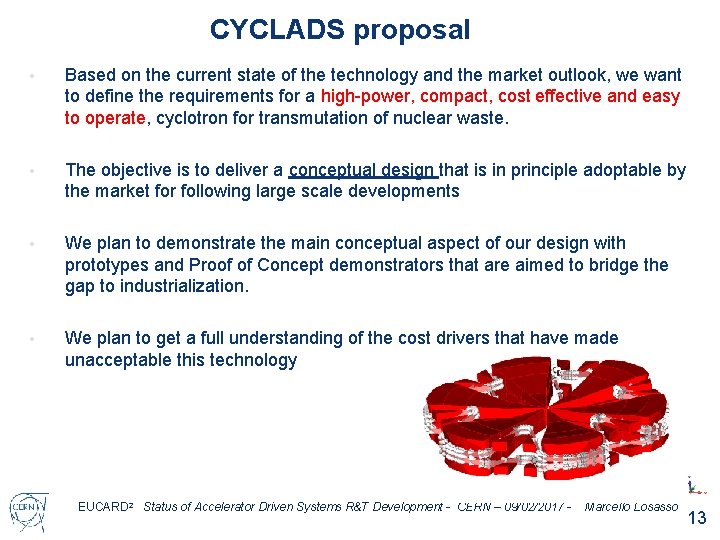
CYCLADS proposal • Based on the current state of the technology and the market outlook, we want to define the requirements for a high-power, compact, cost effective and easy to operate, cyclotron for transmutation of nuclear waste. • The objective is to deliver a conceptual design that is in principle adoptable by the market for following large scale developments • We plan to demonstrate the main conceptual aspect of our design with prototypes and Proof of Concept demonstrators that are aimed to bridge the gap to industrialization. • We plan to get a full understanding of the cost drivers that have made unacceptable this technology EUCARD 2 Status of Accelerator Driven Systems R&T Development - CERN – 09/02/2017 - Marcello Losasso 13
CYCLADS Precise project targets The project has concrete objectives to be achieved in a period of 3 years: 1. Introduce novel concepts (new magnetic configuration, HTS, multiple injection source to increase the reliability above today level, reduce its cost and dimension (1 stage instead of 3 stages means a factor 3. 5 in volume reduction and a factor 4 in cost); 2. increase its simplicity of operation (i. e, removing the conventional injection and extraction devices of the machine, that accounts for more than 5% of the downtime, reduces highly activated areas Therefore a reduction in shielding. 3. Study the interfaces with the spallation target and with an innovative subcritical unit, developing a new complete integrated software system to evaluate spallation and particle transport process effectively and accurately, with improved quality beam control, and reduction of beam-losses; 4. Present a life-cycle analysis of the machine to assess the economic viability of the proposed process and its safety for all foreseen applications (waste transmutation, heat/electricity generation, radioisotope production, etc. ). 5. Manufacture industrial Proof-of-Concept to demonstrate technical viability of proposed solution, on a meaningful scale. EUCARD 2 Status of Accelerator Driven Systems R&T Development - CERN – 09/02/2017 - Marcello Losasso 14
The project fits scope of the call: • • Partitioning or sorting of nuclear waste isotopes AND accelerator-based transmutation combined with geological disposal can lead to an acceptable societal solution to the problem of managing spent nuclear fuel. A long term vision: to bring closer science and society by finding a concrete technical solution for a grand society challenge Clear target: to help Europe grasping leadership in the management of radioactive waste : from IAEA data Waste Counter: 30 Mm 3 in ~366 Facilities, thousands ton of toxic materials are produced each year, without any yet accepted and adopted solution of definitive disposing Foundational: it will open a new line of market into the cyclotron business, with expected new jobs in Europe, addressing as well the challenges of next-generation reactors that burn advanced fuels (or even non-fissile such as Th) with the use of particle beams. These approaches could lead to an increase in power generation through GHG-free nuclear energy and could provide a long-term strategy for the energy supply. Innovative: because of the integration into the design of the machine of concepts never explored before in this context (High temperature superconductors, new magnetic field configuration, new sub-critical unit, for example) that will increase the reliability, reduce the cost, improve simplicity of the operation. EUCARD 2 Status of Accelerator Driven Systems R&T Development - CERN – 09/02/2017 - Marcello Losasso 15
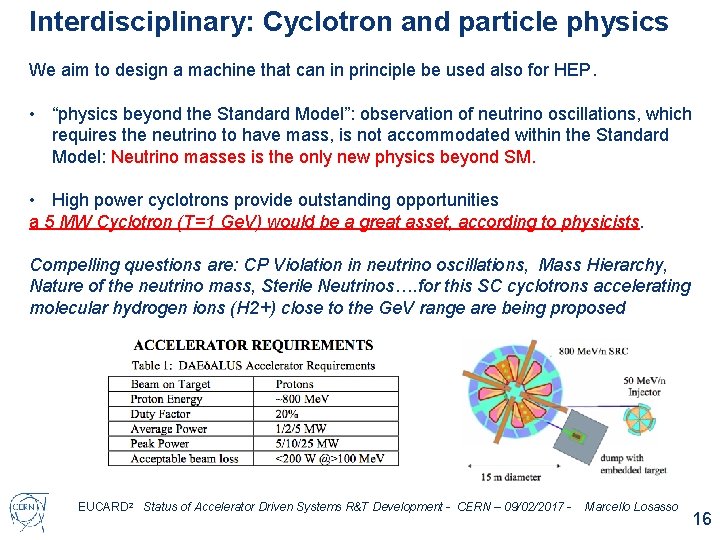
Interdisciplinary: Cyclotron and particle physics We aim to design a machine that can in principle be used also for HEP. • “physics beyond the Standard Model”: observation of neutrino oscillations, which requires the neutrino to have mass, is not accommodated within the Standard Model: Neutrino masses is the only new physics beyond SM. • High power cyclotrons provide outstanding opportunities a 5 MW Cyclotron (T=1 Ge. V) would be a great asset, according to physicists. Compelling questions are: CP Violation in neutrino oscillations, Mass Hierarchy, Nature of the neutrino mass, Sterile Neutrinos…. for this SC cyclotrons accelerating molecular hydrogen ions (H 2+) close to the Ge. V range are being proposed EUCARD 2 Status of Accelerator Driven Systems R&T Development - CERN – 09/02/2017 - Marcello Losasso 16
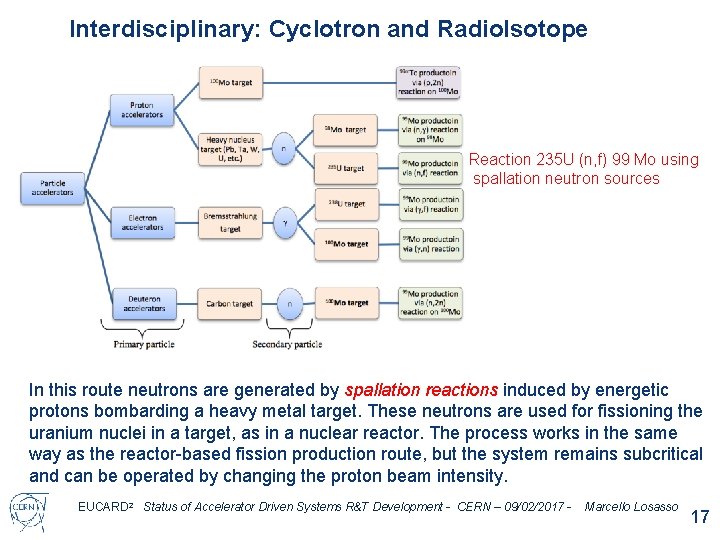
Interdisciplinary: Cyclotron and Radio. Isotope production Reaction 235 U (n, f) 99 Mo using spallation neutron sources In this route neutrons are generated by spallation reactions induced by energetic protons bombarding a heavy metal target. These neutrons are used for fissioning the uranium nuclei in a target, as in a nuclear reactor. The process works in the same way as the reactor-based fission production route, but the system remains subcritical and can be operated by changing the proton beam intensity. EUCARD 2 Status of Accelerator Driven Systems R&T Development - CERN – 09/02/2017 - Marcello Losasso 17
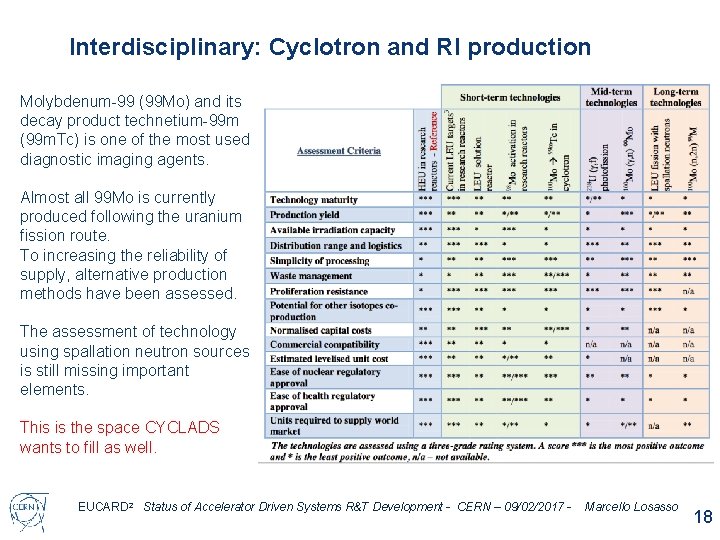
Interdisciplinary: Cyclotron and RI production Molybdenum-99 (99 Mo) and its decay product technetium-99 m (99 m. Tc) is one of the most used diagnostic imaging agents. Almost all 99 Mo is currently produced following the uranium fission route. To increasing the reliability of supply, alternative production methods have been assessed. The assessment of technology using spallation neutron sources is still missing important elements. This is the space CYCLADS wants to fill as well. EUCARD 2 Status of Accelerator Driven Systems R&T Development - CERN – 09/02/2017 - Marcello Losasso 18
Cyclotrons advantages With the waste transmutation in mind: - Beam losses in cyclotron are mainly localized in limited region of the machine (at the beam extraction) so these can be better controlled. In CYCLADS we aim at minimizing these losses by an innovative simulation modelling optimization analysis. - Cyclotron as accelerator for ADS presents the clear advantage of compactness (reduced space and no need to extend the power plant site). Single Stage cyclotron for CYCLADS will be smaller than any status of the art equivalent power accelerator, with a minimum factor 3 - 4 in dimension reduction. - Cyclotrons have comparatively less number of components, so that reliability can be higher than in machines requiring long series of elements. CYCLADS will improve the cyclotron present level of reliability by use of multi-injection lines, to act on one of the most problematic sub-components of the machine - Attempt will be made to use HTS as Mg. B 2 for the magnet, increasing the stability of the magnets, reducing cost of construction and operation, simplifying infrastructures. EUCARD 2 Status of Accelerator Driven Systems R&T Development - CERN – 09/02/2017 - Marcello Losasso 19
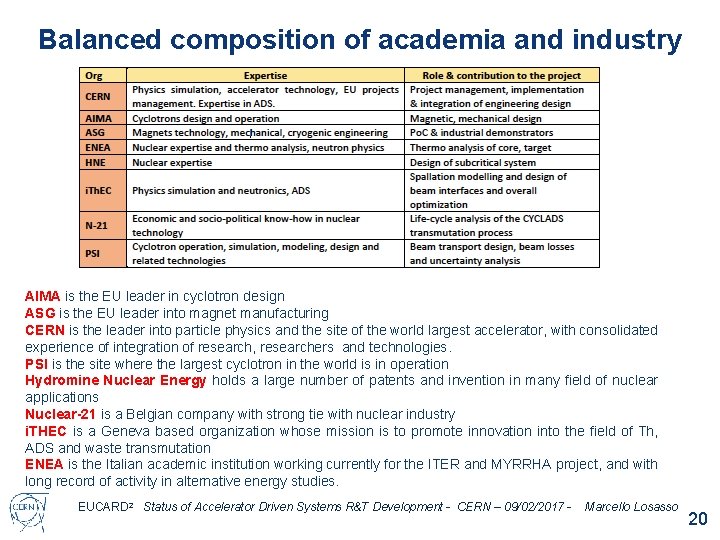
Balanced composition of academia and industry AIMA is the EU leader in cyclotron design ASG is the EU leader into magnet manufacturing CERN is the leader into particle physics and the site of the world largest accelerator, with consolidated experience of integration of research, researchers and technologies. PSI is the site where the largest cyclotron in the world is in operation Hydromine Nuclear Energy holds a large number of patents and invention in many field of nuclear applications Nuclear-21 is a Belgian company with strong tie with nuclear industry i. THEC is a Geneva based organization whose mission is to promote innovation into the field of Th, ADS and waste transmutation ENEA is the Italian academic institution working currently for the ITER and MYRRHA project, and with long record of activity in alternative energy studies. EUCARD 2 Status of Accelerator Driven Systems R&T Development - CERN – 09/02/2017 - Marcello Losasso 20
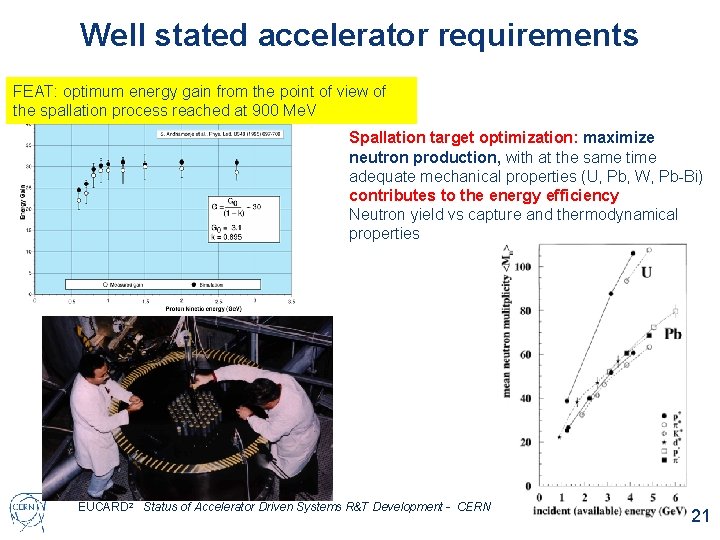
Well stated accelerator requirements FEAT: optimum energy gain from the point of view of the spallation process reached at 900 Me. V Spallation target optimization: maximize neutron production, with at the same time adequate mechanical properties (U, Pb, W, Pb-Bi) contributes to the energy efficiency Neutron yield vs capture and thermodynamical properties EUCARD 2 Status of Accelerator Driven Systems R&T Development - CERN – 09/02/2017 - Marcello Losasso 21
PSI - WP 2 - Powerful beam dynamics analysis Not-linear beam analysis and losses mitigation • • Today it is possible to overcome one of the main limitations of all high intensity particle accelerators: the beam losses. For high intensity cyclotrons space charge models and studies are an active area of Research. New high-performance algorithmic and software framework of Object Oriented Parallel Accelerator Library (OPAL modelling will be used by PSI to characterize the halo formation, contributing the injection/extraction element design to optimize and mitigate the beam losses. Calibration and benchmark of the model will be carried out with data from PSI proton cyclotron facility and data from PSI-HIPA facility. EUCARD 2 Status of Accelerator Driven Systems R&T Development - CERN – 09/02/2017 - Marcello Losasso 22
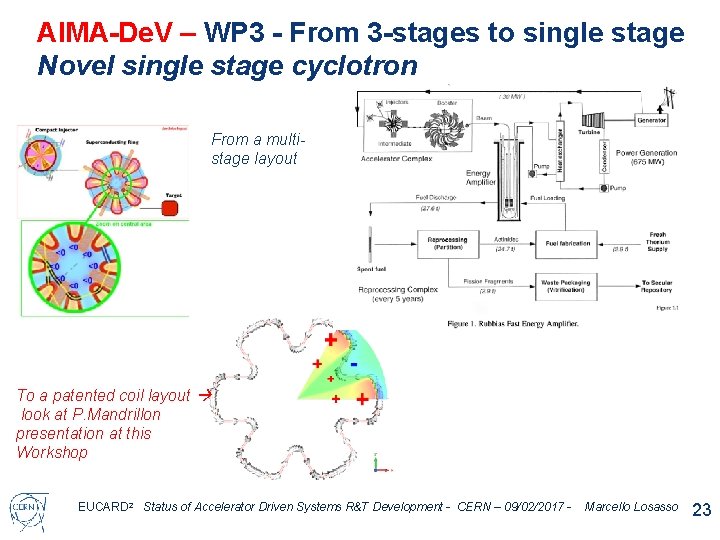
AIMA-De. V – WP 3 - From 3 -stages to single stage Novel single stage cyclotron From a multistage layout To a patented coil layout look at P. Mandrillon presentation at this Workshop EUCARD 2 Status of Accelerator Driven Systems R&T Development - CERN – 09/02/2017 - Marcello Losasso 23
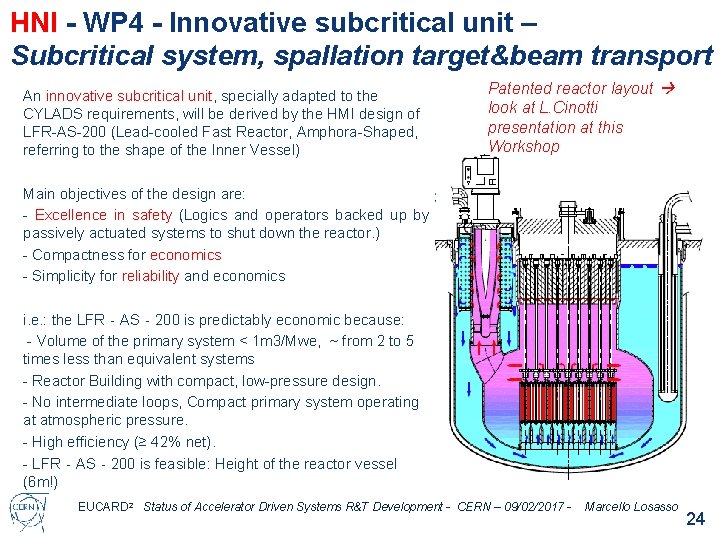
HNI - WP 4 - Innovative subcritical unit – Subcritical system, spallation target&beam transport An innovative subcritical unit, specially adapted to the CYLADS requirements, will be derived by the HMI design of LFR-AS-200 (Lead-cooled Fast Reactor, Amphora-Shaped, referring to the shape of the Inner Vessel) Patented reactor layout look at L. Cinotti presentation at this Workshop Main objectives of the design are: - Excellence in safety (Logics and operators backed up by passively actuated systems to shut down the reactor. ) - Compactness for economics - Simplicity for reliability and economics i. e. : the LFR‐AS‐ 200 is predictably economic because: - Volume of the primary system < 1 m 3/Mwe, ~ from 2 to 5 times less than equivalent systems - Reactor Building with compact, low-pressure design. - No intermediate loops, Compact primary system operating at atmospheric pressure. - High efficiency (≥ 42% net). - LFR‐AS‐ 200 is feasible: Height of the reactor vessel (6 m!) EUCARD 2 Status of Accelerator Driven Systems R&T Development - CERN – 09/02/2017 - Marcello Losasso 24
i. Th. EC -WP 5 – neutronic and simulations System simulation and overall optimization • The R&D of ADS generator needs state of the art Monte. Carlo simulations. Complete solution to the problem of the design and optimisation of ADS (spallation and particle transport process) is still missing. • Based on seminal work from C. Rubbia, CERN & i. Th. EC will integrate a code system capable of accurate Monte. Carlo simulation of a full ADS system. • Code will Process the available nuclear data, describe the nuclear spallation process between hundreds of Me. V and 10 Ge. V, analyse the transport of the generated particles simulating their interactions with the matter • Simulate the geometry of the beam, the spallation target and the subcritical core, Simulate the spallation neutron source, Simulate the core physics including temperature effects • Optimize the accelerator beam energy, power, time structure, footprint on the spallation target, losses into the environment, etc. EUCARD 2 Status of Accelerator Driven Systems R&T Development - CERN – 09/02/2017 - Marcello Losasso 25
N-21 - WP 6 – full cycle economic analysis – Technology and market outlook • Because of the absence of sufficiently long-term energy and technology development vision in most countries, ADS systems intended to address nuclear material management objectives, face uncertain technology and market prospects • N-21 in WP 6 will assess advanced S&T technologies addressing the practical basis of effective management of used fuel and separated materials for a sustainable future. • Energy and technology development stakeholders need to have a clear decision-supporting framework to allow addressing critical questions such as: (a) What is the final pay-off for these technology developments? (b) When could a market be envisaged and what are the key drivers influencing this market potential? (c) What is the cost-risk-optimised level of activity and funding for innovative technologies in uncertain market context? EUCARD 2 Status of Accelerator Driven Systems R&T Development - CERN – 09/02/2017 - Marcello Losasso 26
ASG - WP 7 – industrial scaled demonstrators Proof of Concept & Prototypes • Industrially manufactured Po. C and prototypes will investigate the main technological aspects relative to magnet design. • Mg. B 2 based conductor for CYCLADS will be designed, developed in short samples and characterized for specified critical current. • Study of radiation effect on critical current • Manufacturing of Po. C scaled conductor will be carried out, in order to investigate minimum bending radius, cooling concepts, quench protection system, maximum operating critical current • Measure and testing of the superconducting parameters on a significant conductor sample in a scaled Mock up assembly. EUCARD 2 Status of Accelerator Driven Systems R&T Development - CERN – 09/02/2017 - Marcello Losasso 27
Expected impact Enlarge portfolio of viable solutions to the radioactive waste management Spain case study: 5 ADS, with estimated cost of 12. 5 B$ necessary to incinerate spent fuel projected for Spain in 40 y. With our estimated accelerator cost reduction, incineration cost of the of spent fuel goes down to 10 B$. By comparison, 2016 cost of GDR for the 7 x 10⁶ Kg of Spain accumulated waste is 24. 0 B$. (ref. OECD/NEA, 1993, and CERN/LHC/97 -001) Improve the technology base for medical Radio. Isotope (RI) production, increase the production yield of conventional Radio. Isotopes (RI), and extend the offer to non-conventional ones and to alpha-emitters Extend the deployment of a CO 2 free and safe energy source. Present a ADS-technology option which may also be used for next-generation nuclear reactors systems, using advanced fuel. Provide new tools for physics investigations beyond SM EUCARD 2 Status of Accelerator Driven Systems R&T Development - CERN – 09/02/2017 - Marcello Losasso 28
Conclusions CYCLADS project has been proposed to address a clear societal need. A Consortium has been formed and has worked to prepare a FET proposal that was submitted on January 2017. The answer is expected by May 2017. If the proposal is successful, project partners shall finalize a Consortium Agreement, with full details of IPR. If FET-OPEN proposal is not successful new initiatives will be considered to finance the project (FET-Proactive, for example). EUCARD 2 Status of Accelerator Driven Systems R&T Development - CERN – 09/02/2017 - Marcello Losasso 29