
Cycladic culture flourished on the islands of the

- Slides: 50
Cycladic culture flourished on the islands of the central Aegean during the Early Bronze Age Cycladic, Minoan and Mycenaean Art (from ca. 3000 - 1200 B. C. ) Aegean Civilization denotes the Bronze Age civilization that developed in the basin of the Aegean Sea. It had three major cultures: the Cycladic, the Minoan and the Mycenaean. Aegean art is noticeable for its naturalistic, vivid style, originated in Minoan Crete. Not much was known about the Aegean civilization until the late 19 th century, when archaeological excavations began at the sites of the legendary cities of Troy, Mycenae, Knossos, and other centers of the Bronze Age.
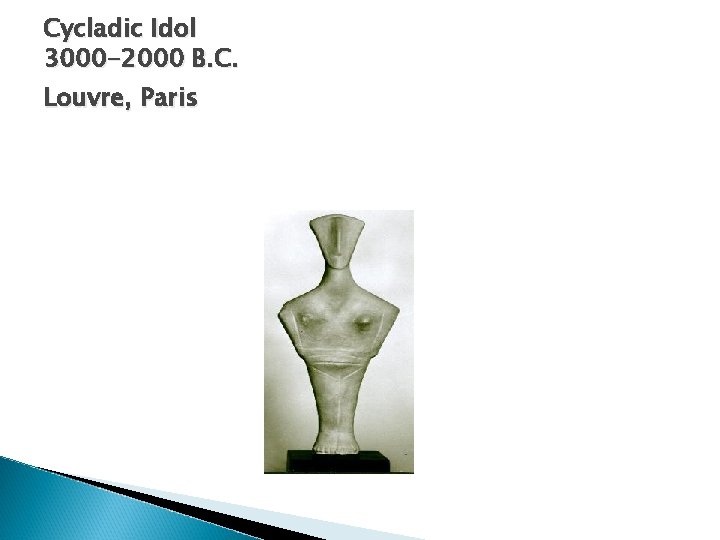
Cycladic Culture Cycladic culture - Early Bronze Age (About 3000 -2200 B. C. ) The Cycladic civilization of the Aegean Sea flourished at about the same time as the early Egyptian and Mesopotamian civilizations. That is considered the forerunner of the first truly European civilization - Greece. On the mainland, villages were small independent units, often protected by thick walls. The buildings on Crete and in the Cyclads became more complex. Cycladic culture developed pottery, often decorated with rectangular, circular, or spiral designs. They also produced silver jewelry. The sculpture sproduced there was very unique compared to the art being produced by the Egyptians and Mesopotamians. These sculptures, commonly called Cycladic idols, were often used as grave offerings. Characteristic of that sculpture is that all were made of Parian marble and the figures are made with a geometric, twodimensional nature, which has a strangely modern familiarity. The Cycladic artists made obvious attempts to represent the human form. Therefore, Cycladic sculpture can safely be called the first truly great sculpture in Greece.
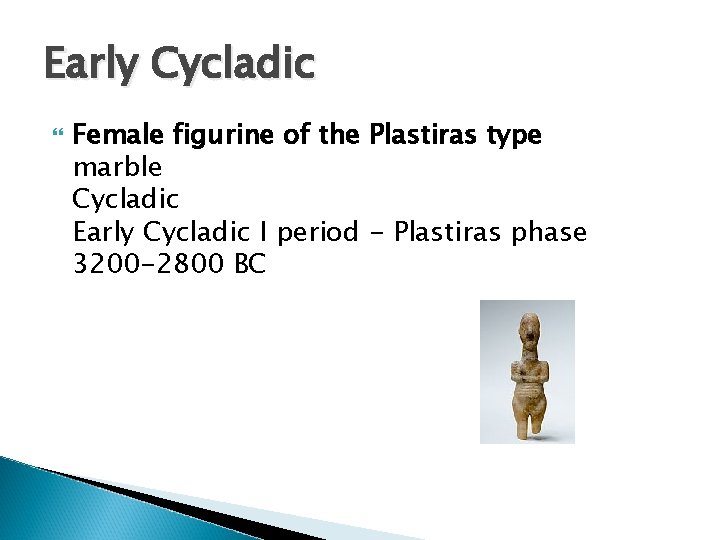
Early Cycladic Female figurine of the Plastiras type marble Cycladic Early Cycladic I period - Plastiras phase 3200 -2800 BC
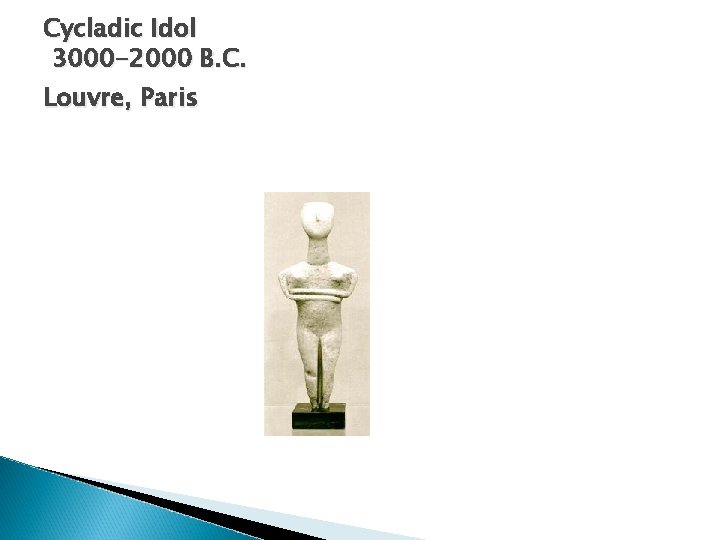
Cycladic Idol 3000 -2000 B. C. Louvre, Paris
Cycladic Idol 3000 -2000 B. C. Louvre, Paris
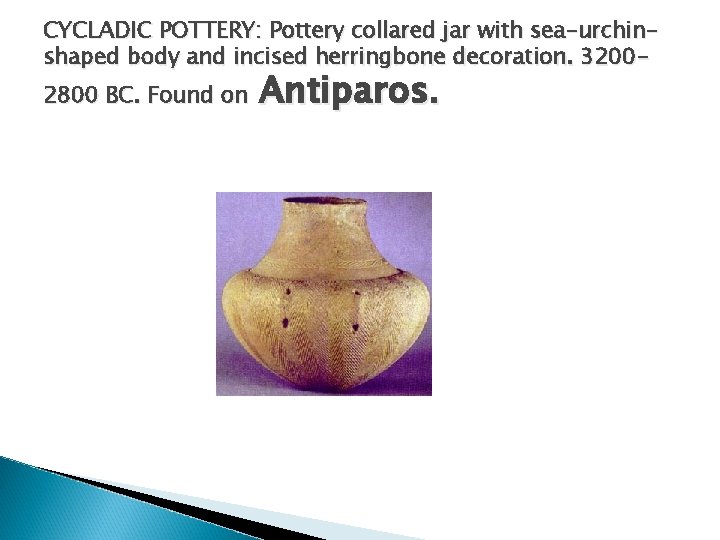
CYCLADIC POTTERY: Pottery collared jar with sea-urchinshaped body and incised herringbone decoration. 32002800 BC. Found on Antiparos.
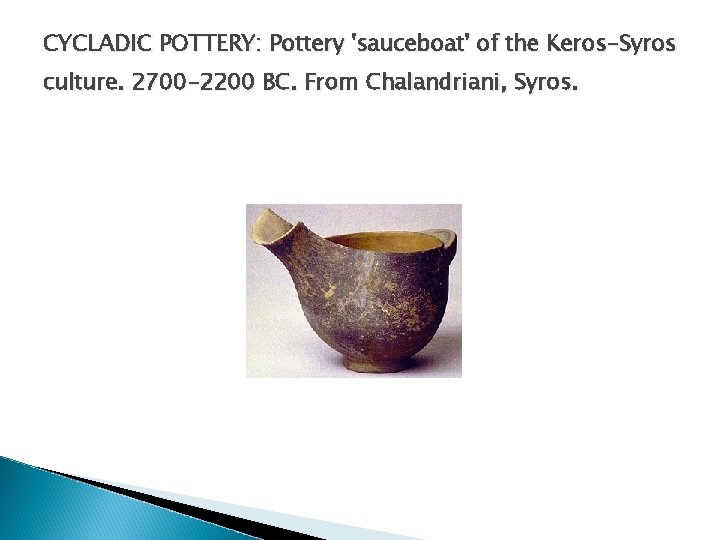
CYCLADIC POTTERY: Pottery 'sauceboat' of the Keros-Syros culture. 2700 -2200 BC. From Chalandriani, Syros.
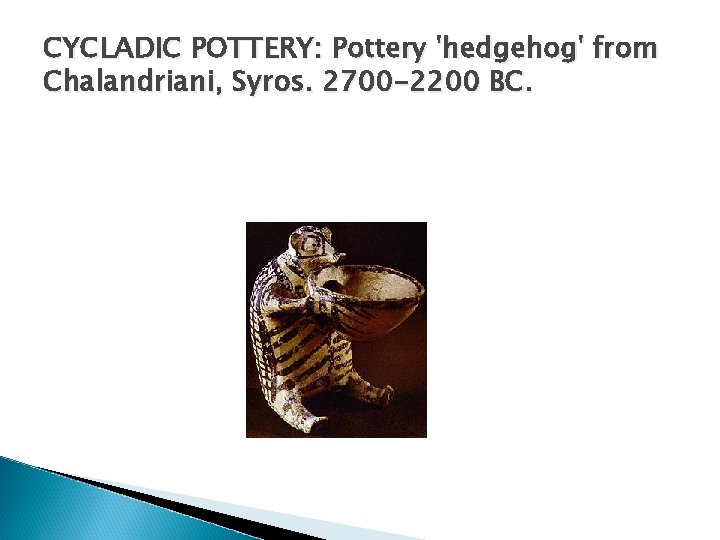
CYCLADIC POTTERY: Pottery 'hedgehog' from Chalandriani, Syros. 2700 -2200 BC.
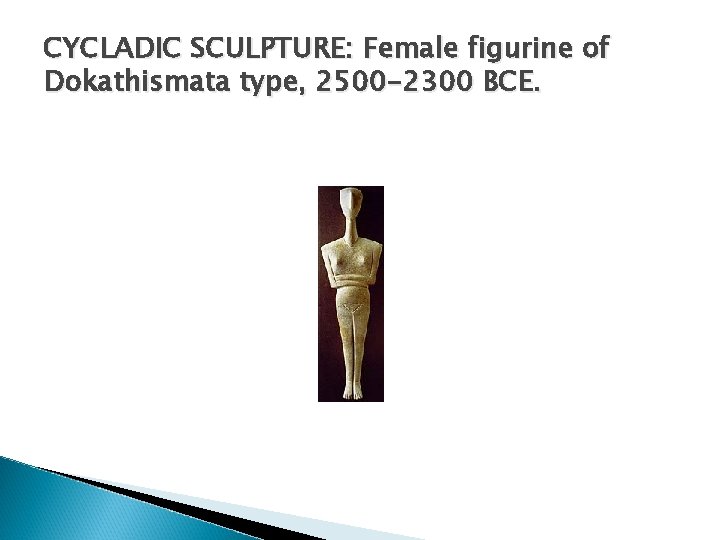
CYCLADIC SCULPTURE: Female figurine of Dokathismata type, 2500 -2300 BCE.
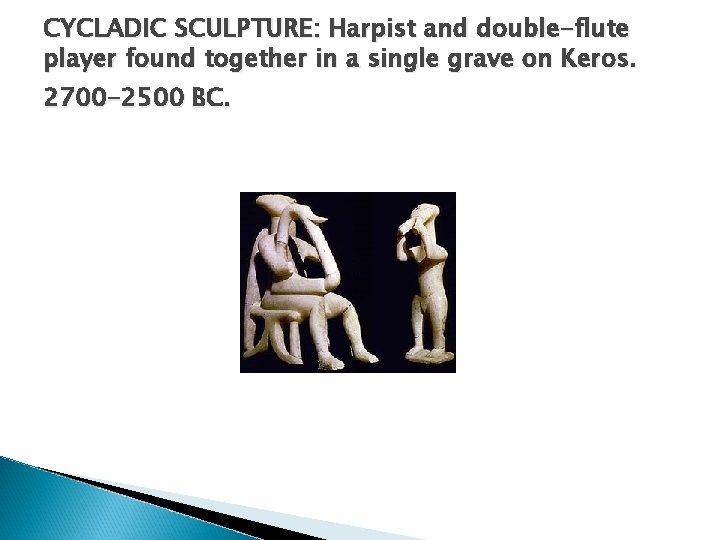
CYCLADIC SCULPTURE: Harpist and double-flute player found together in a single grave on Keros. 2700 -2500 BC.
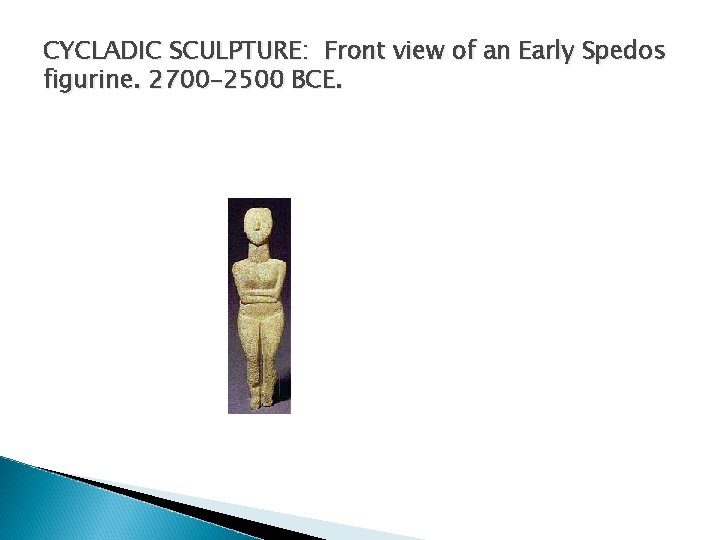
CYCLADIC SCULPTURE: Front view of an Early Spedos figurine. 2700 -2500 BCE.
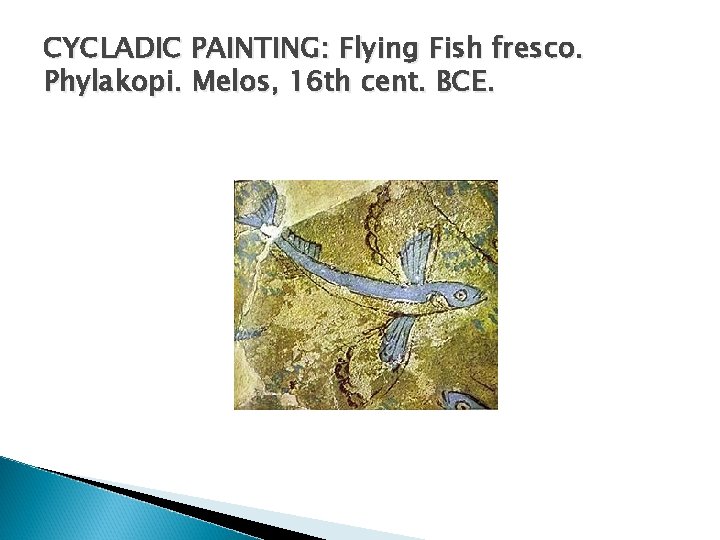
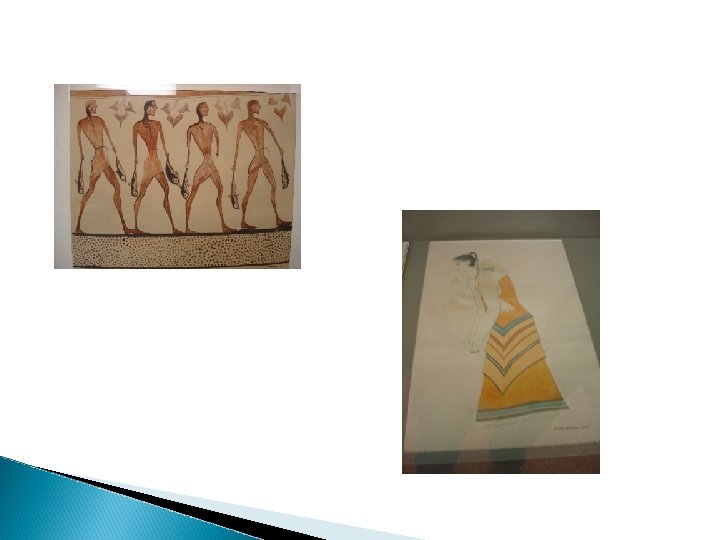
CYCLADIC PAINTING: Flying Fish fresco. Phylakopi. Melos, 16 th cent. BCE.
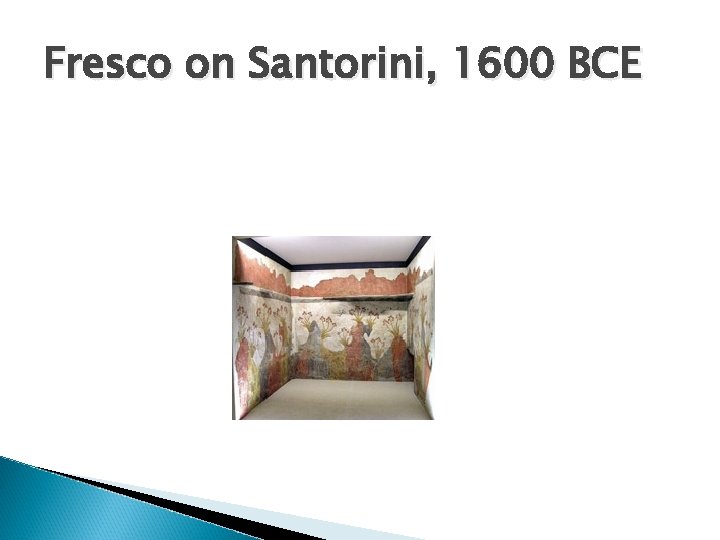
Fresco on Santorini, 1600 BCE
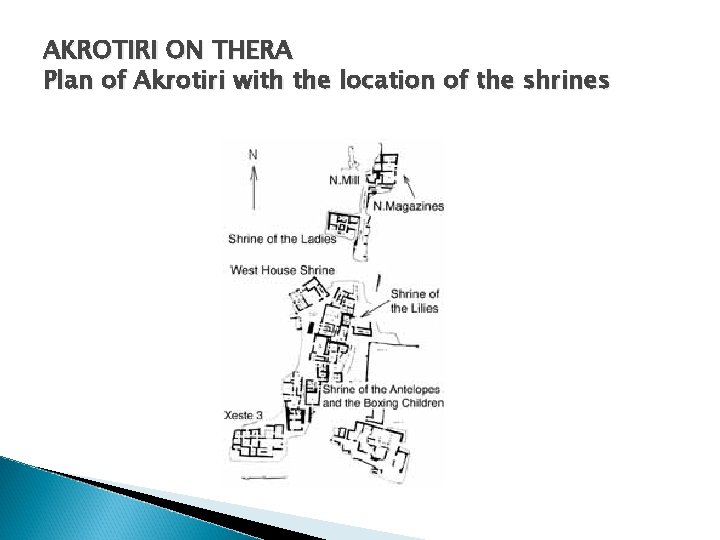
AKROTIRI ON THERA Plan of Akrotiri with the location of the shrines
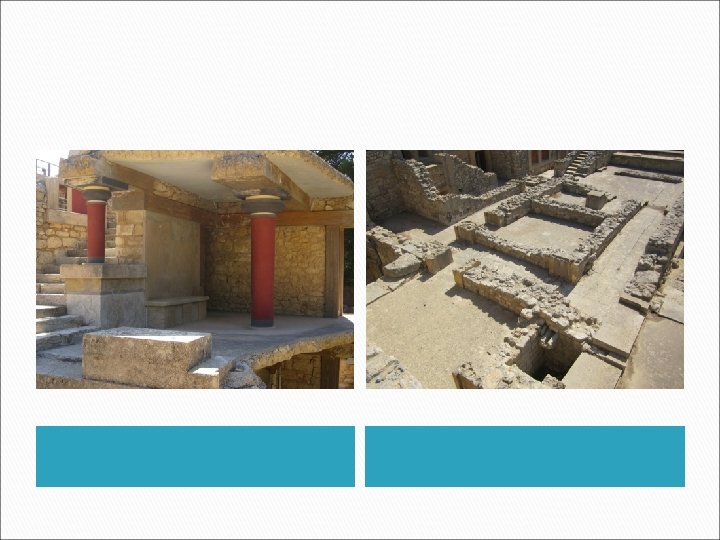
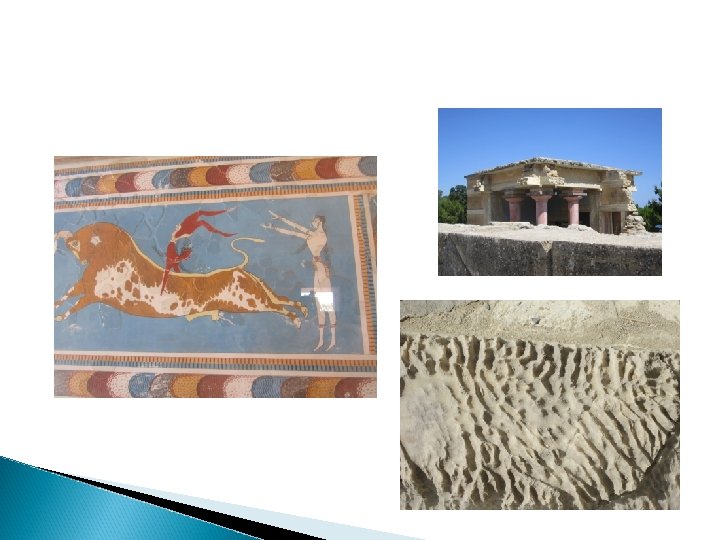
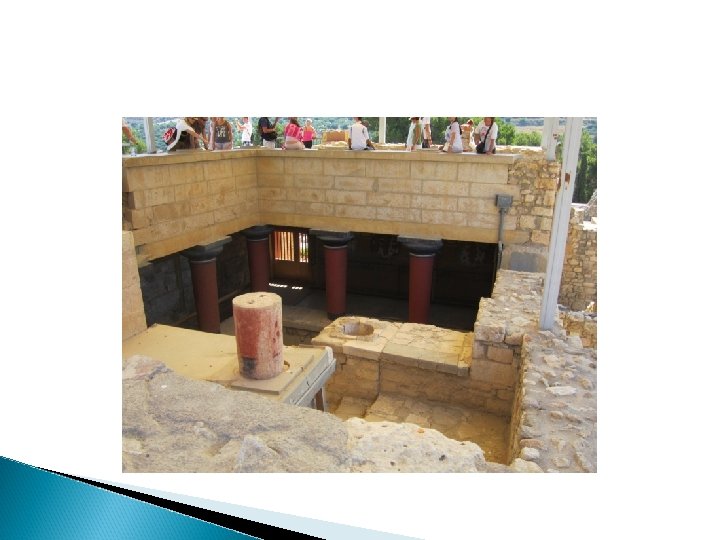
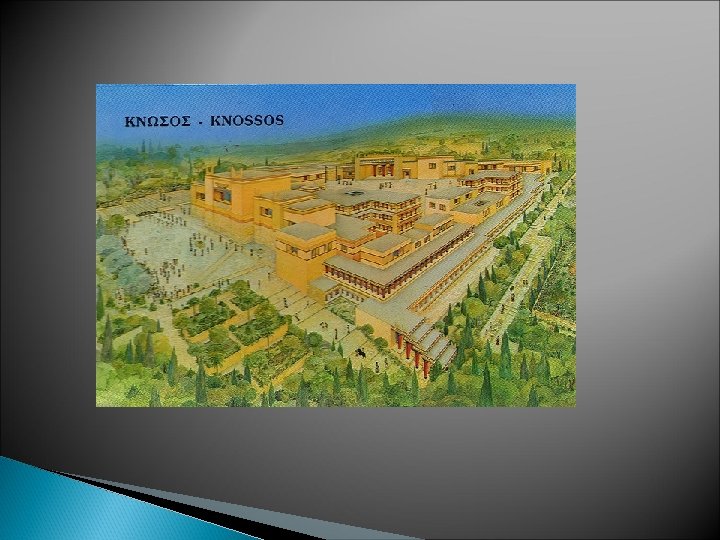
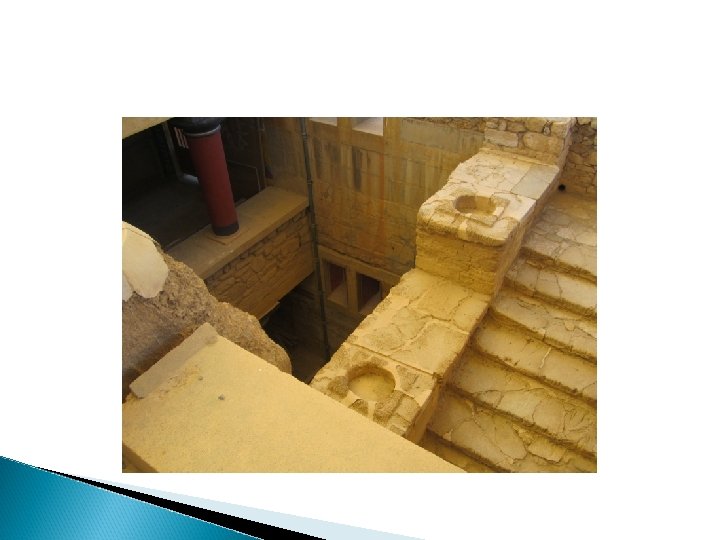
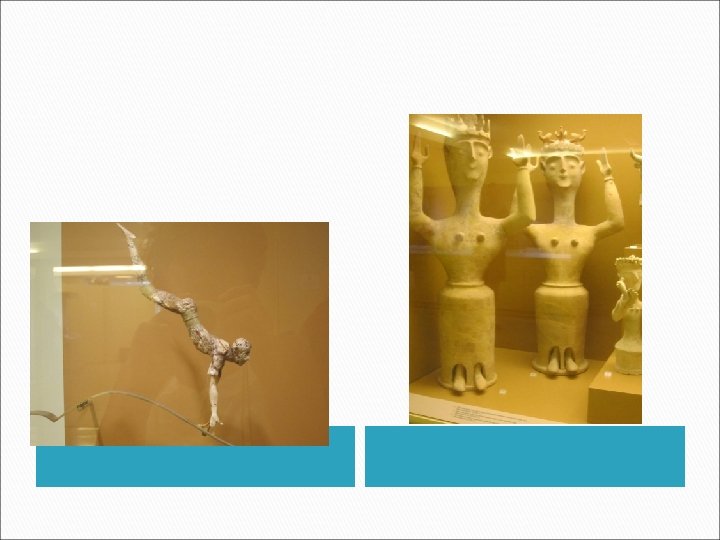
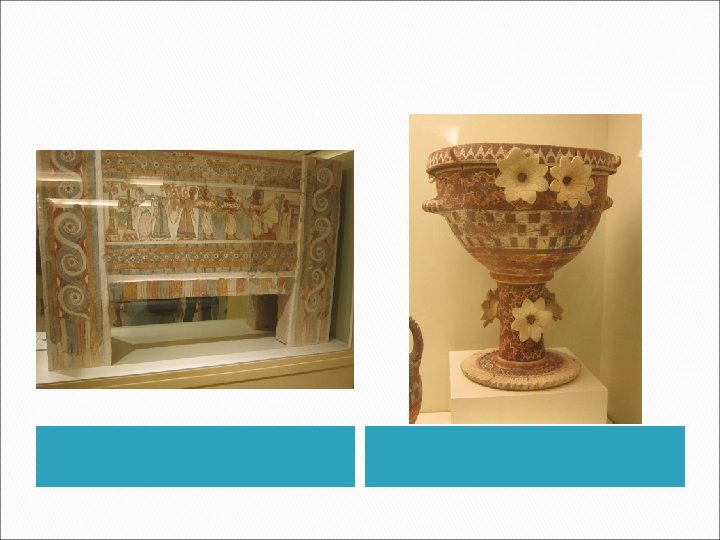
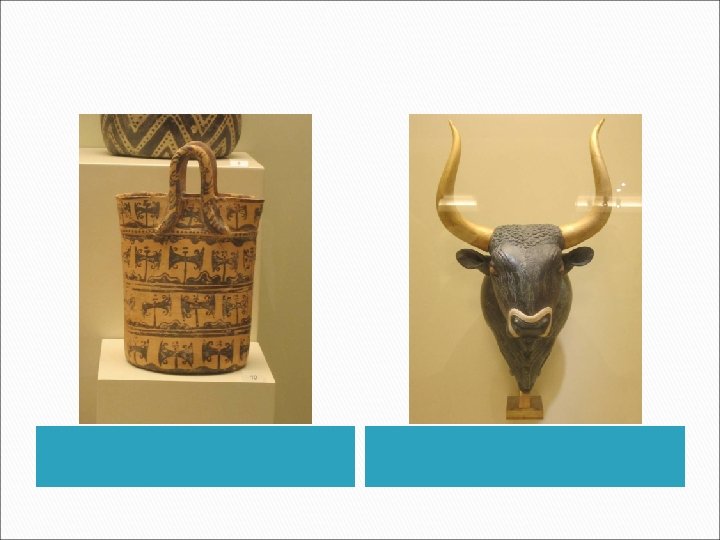
Minoan Art Minoan Culture - Middle Bronze Age (About 2200 -1800 B. C. ) Newcomers arrived in the Cyclades and on the mainland caused destruction. For about two centuries civilization was disrupted. New pottery and the introduction of horses at this time indicate that the invaders were of the Indo-European language family. Minoan culture developed on Crete, in the 2 nd millennium B. C. E Impressive buildings, frescoes, vases, and early writing are evidence of that flourishing culture. Great royal palaces built around large courtyards were the focal points of these communities. The Minoan empire appears to have coordinated and defended the bronze-age trade. They maintained a marine empire, trading not only with the Cyclades and the mainland but also with Sicily, Egypt, and cities on the eastern shore of the Mediterranean. Minoan religion featured a female snake deity, whose worship involved the symbolism of fertility and the lunar and solar cycles. Minoan art is unusual for the time. It is naturalistic, quite different from the stiff stereotypes of contemporary art elsewhere. The vibrant colors, smooth lines, and sense of nature make Minoan art a pleasure for eyes even today. Minoan artists broke away from the two-dimensional expression of figure and created three-dimensional figures. The frescoes are art of exceptional beauty and their fluidity makes the figures dynamic. The easy pleasure-loving lifestyle comes across in their art. The Minoan civilization rivaled that of Egypt. From Crete, this style spread to the Aegean. On the Greek mainland it was modified by geometric tendencies. Minoan palaces: Knossos, Phaestos, Malia, Zakros.
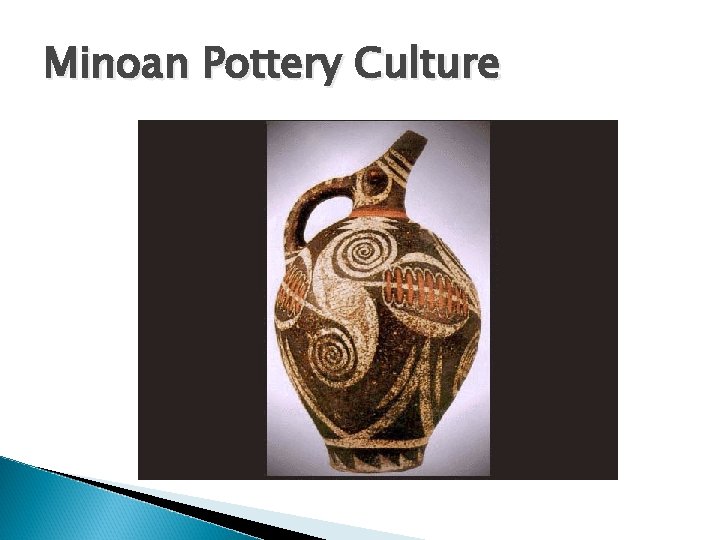
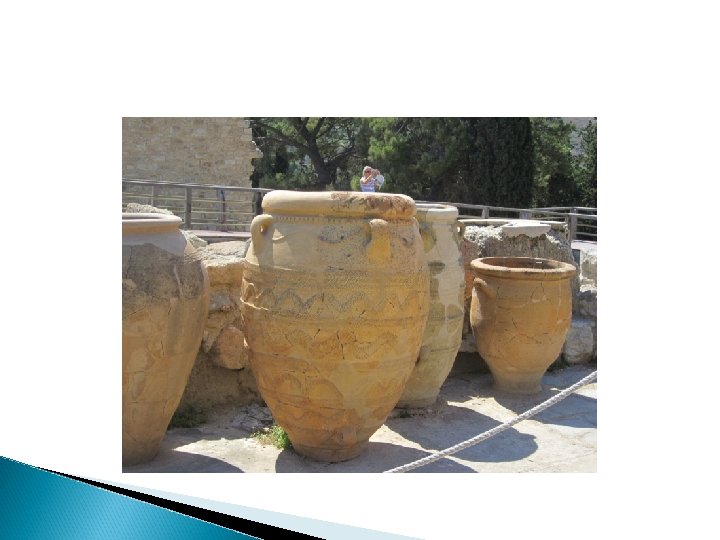
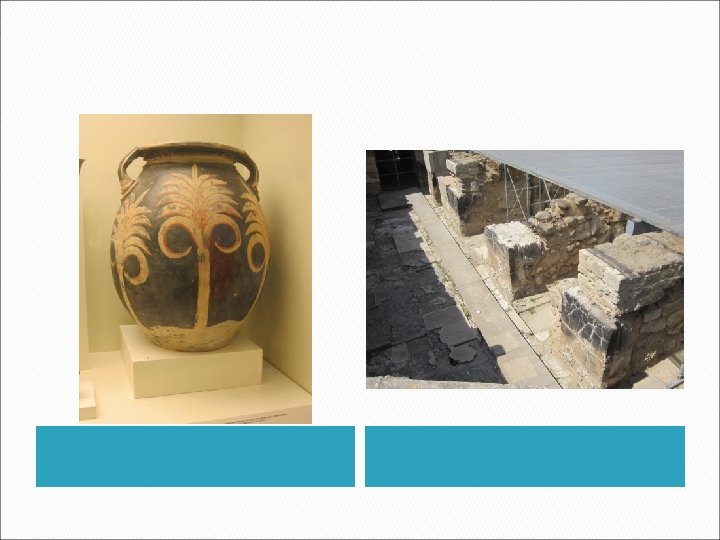
Minoan Pottery Culture
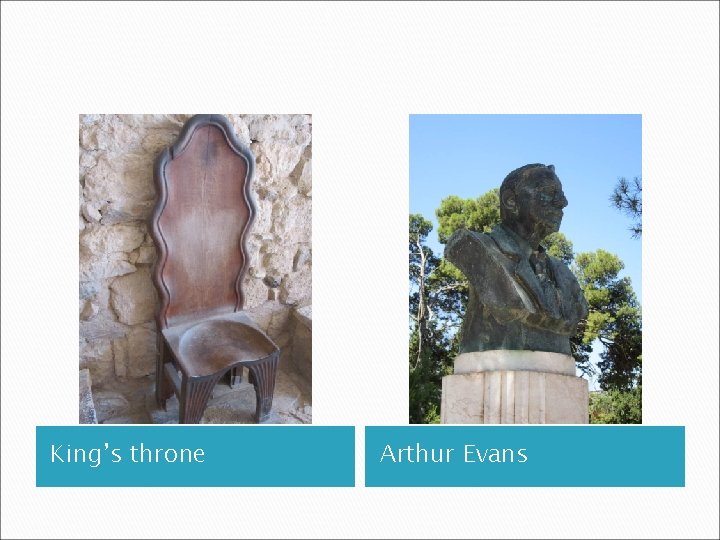
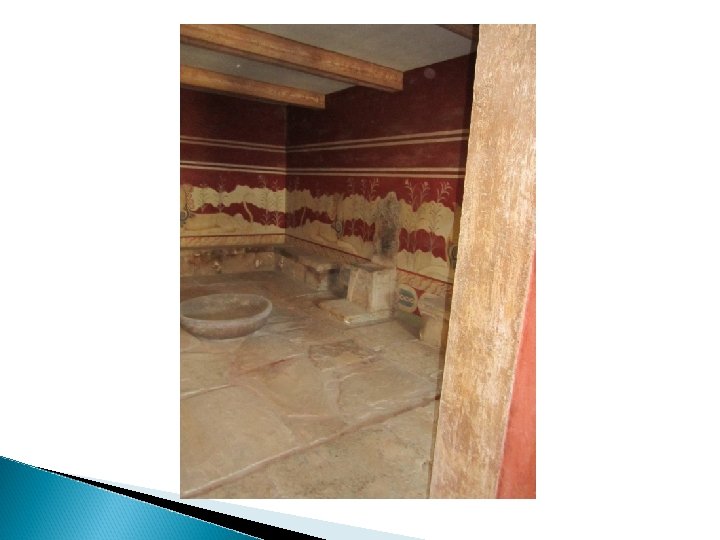
King’s throne Arthur Evans
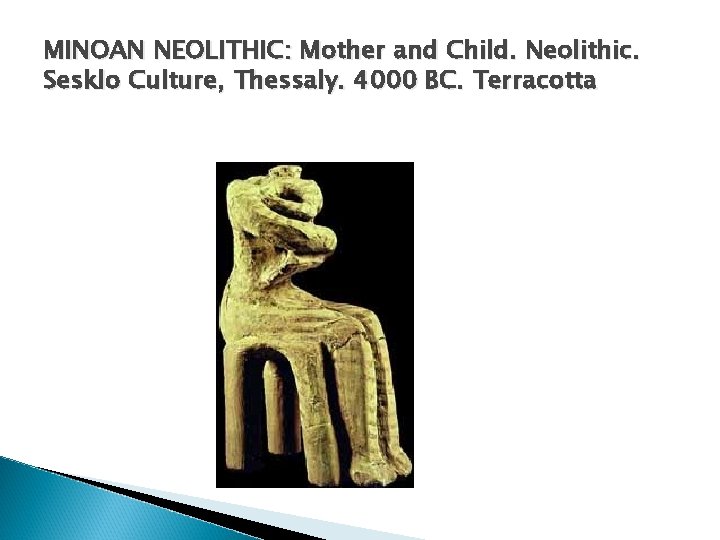
MINOAN NEOLITHIC: Mother and Child. Neolithic. Sesklo Culture, Thessaly. 4000 BC. Terracotta
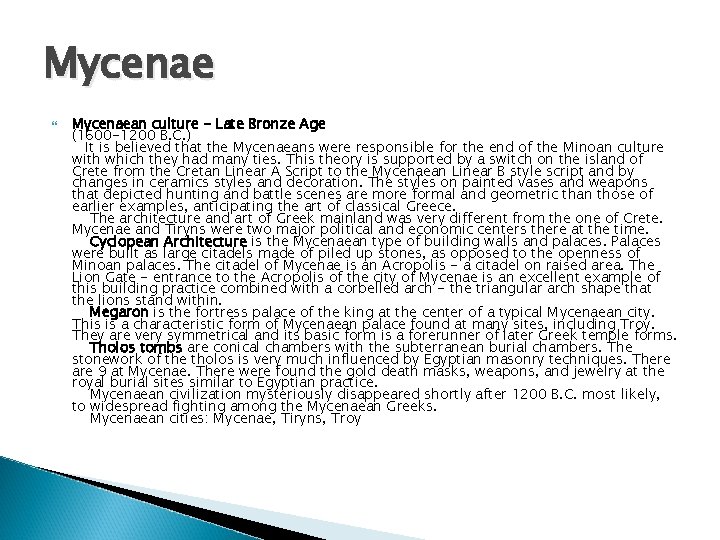
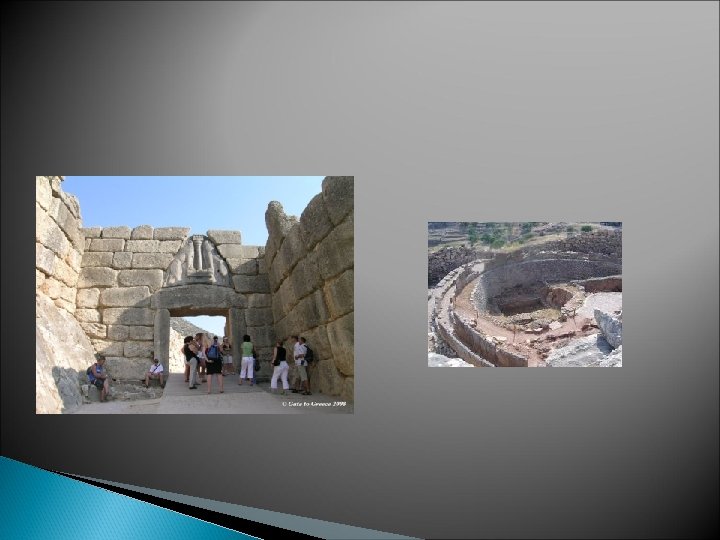
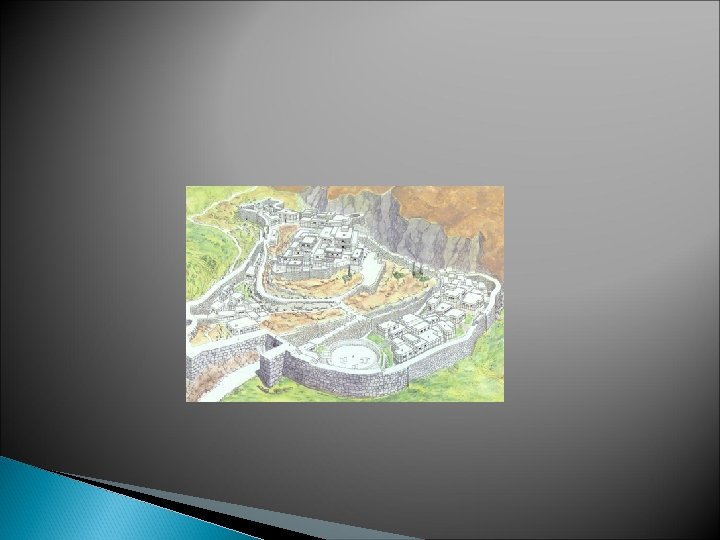
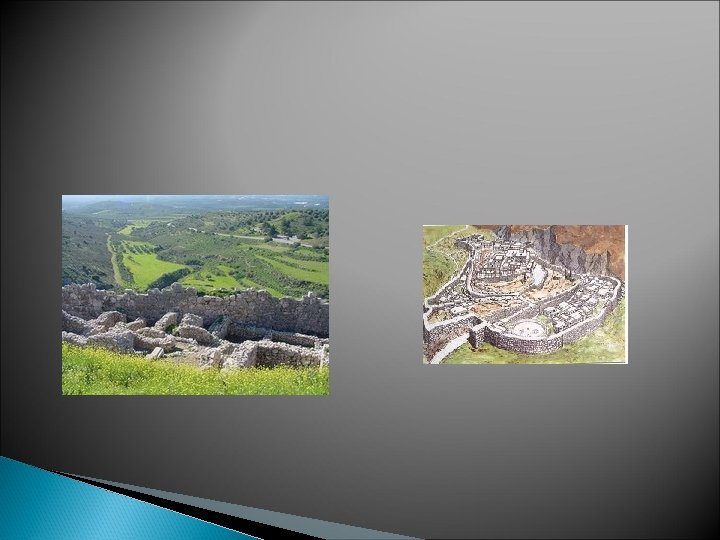
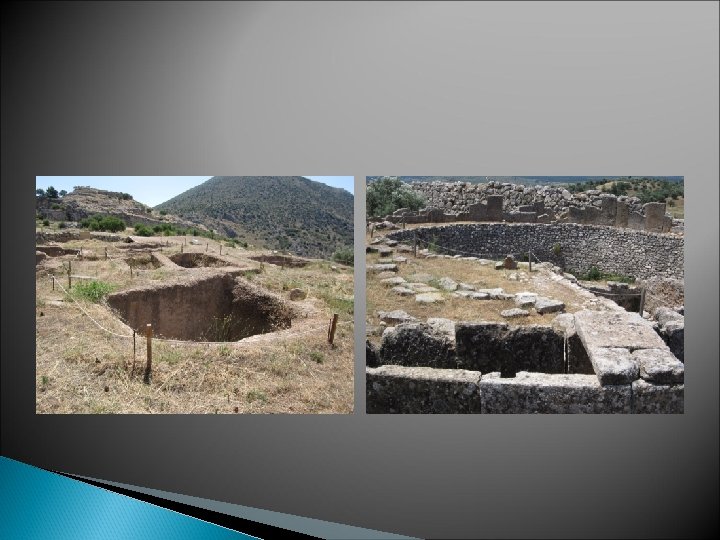
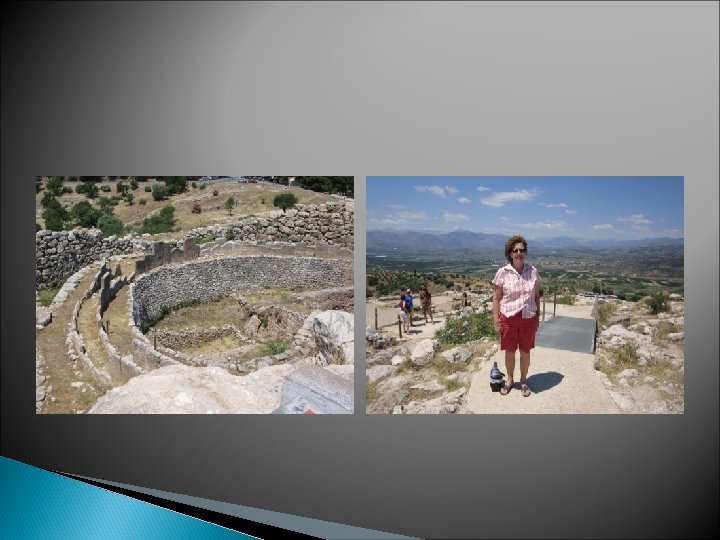
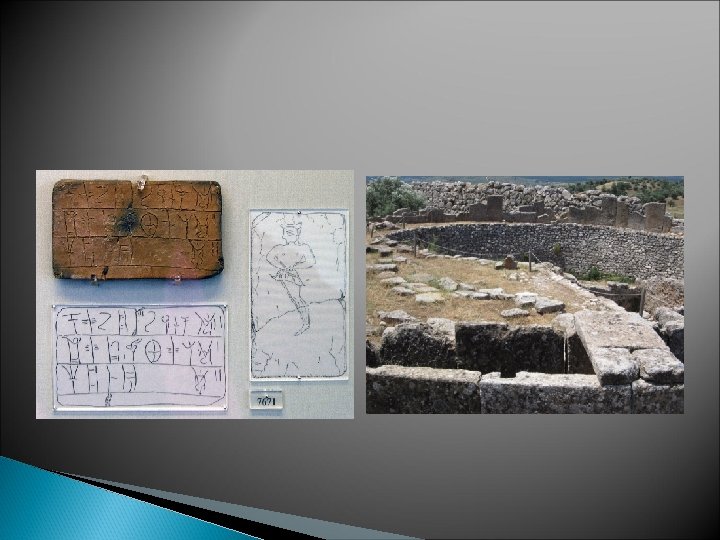
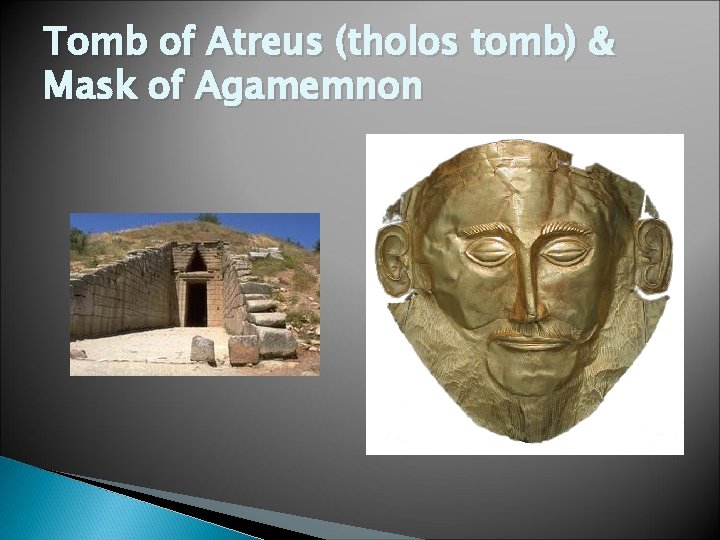
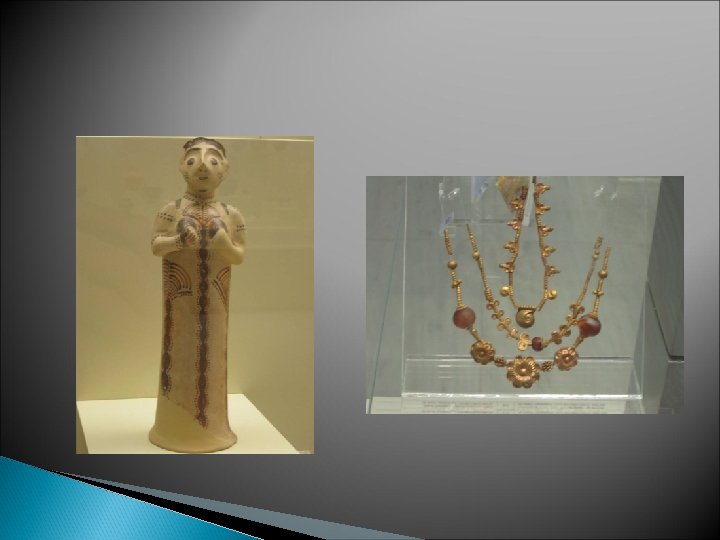
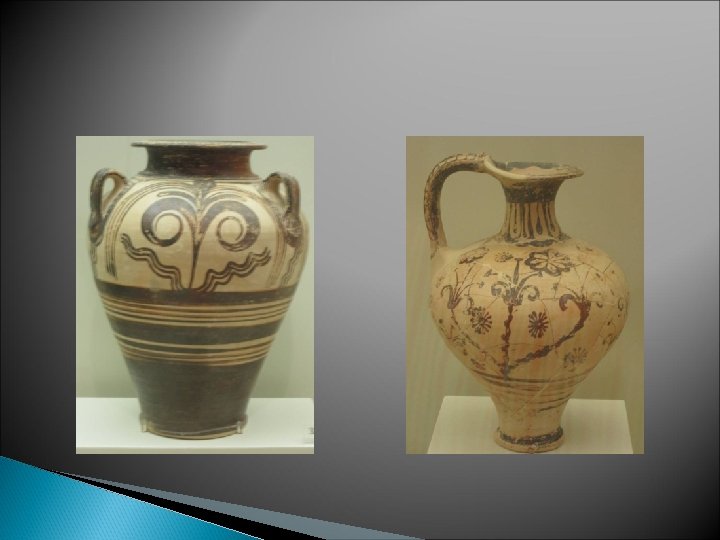
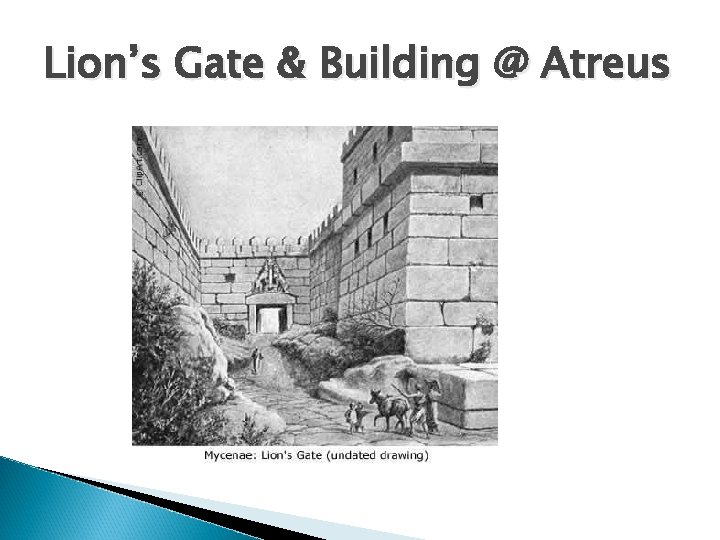
Mycenae Mycenaean culture - Late Bronze Age (1600 -1200 B. C. ) It is believed that the Mycenaeans were responsible for the end of the Minoan culture with which they had many ties. This theory is supported by a switch on the island of Crete from the Cretan Linear A Script to the Mycenaean Linear B style script and by changes in ceramics styles and decoration. The styles on painted vases and weapons that depicted hunting and battle scenes are more formal and geometric than those of earlier examples, anticipating the art of classical Greece. The architecture and art of Greek mainland was very different from the one of Crete. Mycenae and Tiryns were two major political and economic centers there at the time. Cyclopean Architecture is the Mycenaean type of building walls and palaces. Palaces were built as large citadels made of piled up stones, as opposed to the openness of Minoan palaces. The citadel of Mycenae is an Acropolis - a citadel on raised area. The Lion Gate - entrance to the Acropolis of the city of Mycenae is an excellent example of this building practice combined with a corbelled arch - the triangular arch shape that the lions stand within. Megaron is the fortress palace of the king at the center of a typical Mycenaean city. This is a characteristic form of Mycenaean palace found at many sites, including Troy. They are very symmetrical and its basic form is a forerunner of later Greek temple forms. Tholos tombs are conical chambers with the subterranean burial chambers. The stonework of the tholos is very much influenced by Egyptian masonry techniques. There are 9 at Mycenae. There were found the gold death masks, weapons, and jewelry at the royal burial sites similar to Egyptian practice. Mycenaean civilization mysteriously disappeared shortly after 1200 B. C. most likely, to widespread fighting among the Mycenaean Greeks. Mycenaean cities: Mycenae, Tiryns, Troy
Tomb of Atreus (tholos tomb) & Mask of Agamemnon
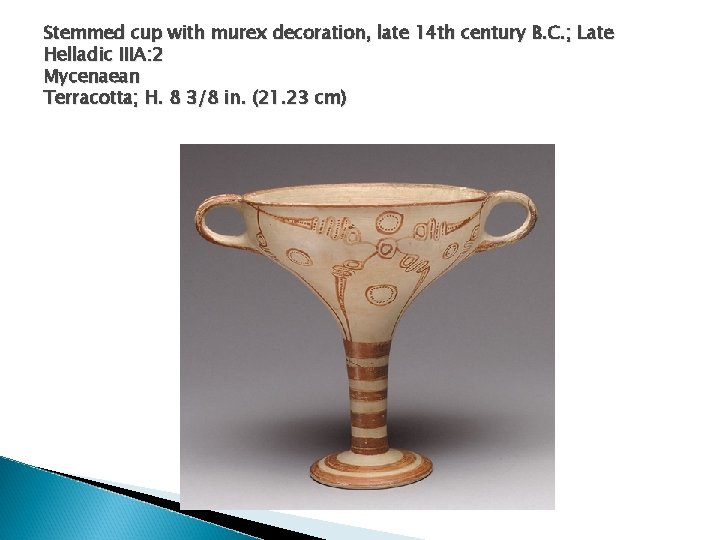
Stemmed cup with murex decoration, late 14 th century B. C. ; Late Helladic IIIA: 2 Mycenaean Terracotta; H. 8 3/8 in. (21. 23 cm)
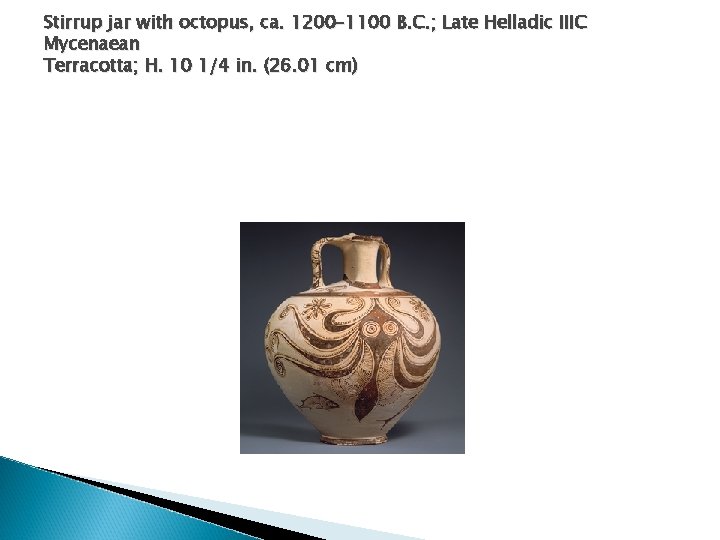
Stirrup jar with octopus, ca. 1200– 1100 B. C. ; Late Helladic IIIC Mycenaean Terracotta; H. 10 1/4 in. (26. 01 cm)
Lion’s Gate & Building @ Atreus