
CYCAS Super division Spermatophyta Seed plant Division Cycadophyta
- Slides: 29
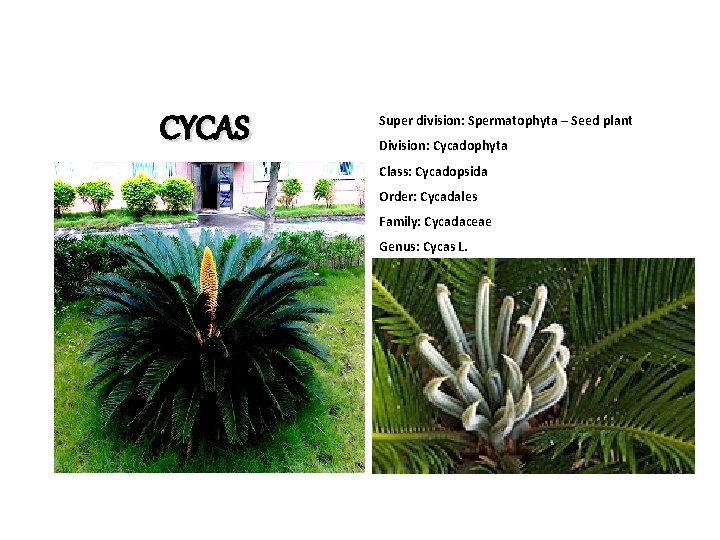
CYCAS Super division: Spermatophyta – Seed plant Division: Cycadophyta Class: Cycadopsida Order: Cycadales Family: Cycadaceae Genus: Cycas L.
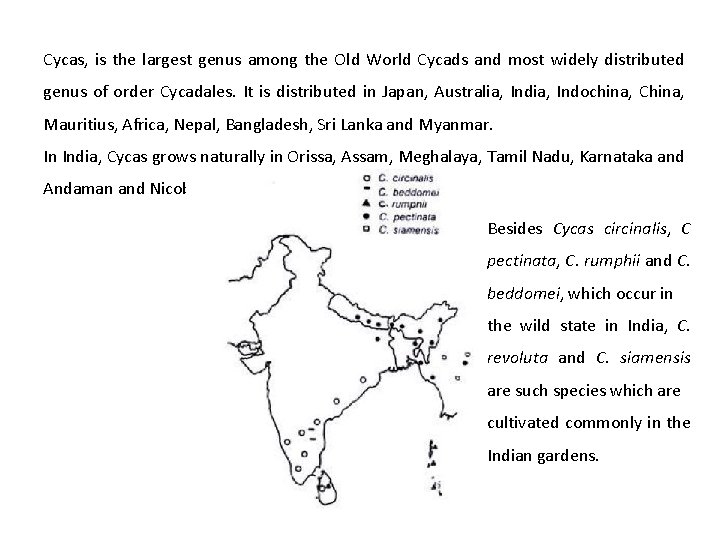
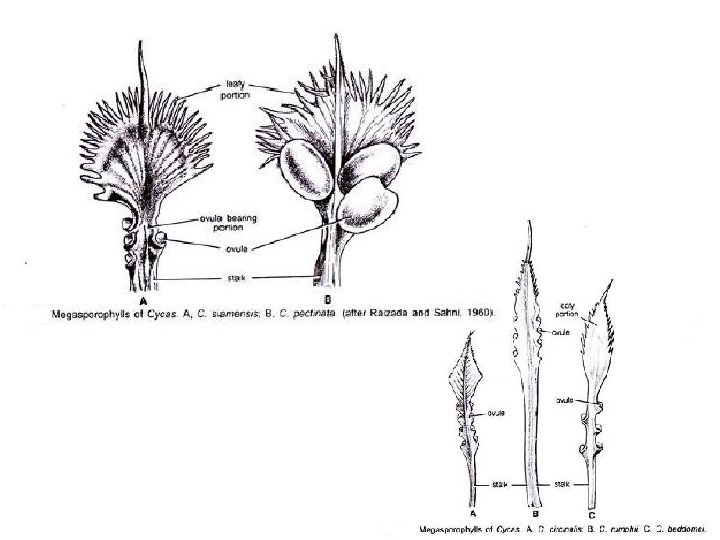
Cycas, is the largest genus among the Old World Cycads and most widely distributed genus of order Cycadales. It is distributed in Japan, Australia, Indochina, China, Mauritius, Africa, Nepal, Bangladesh, Sri Lanka and Myanmar. In India, Cycas grows naturally in Orissa, Assam, Meghalaya, Tamil Nadu, Karnataka and Andaman and Nicobar Islands Besides Cycas circinalis, C pectinata, C. rumphii and C. beddomei, which occur in the wild state in India, C. revoluta and C. siamensis are such species which are cultivated commonly in the Indian gardens.
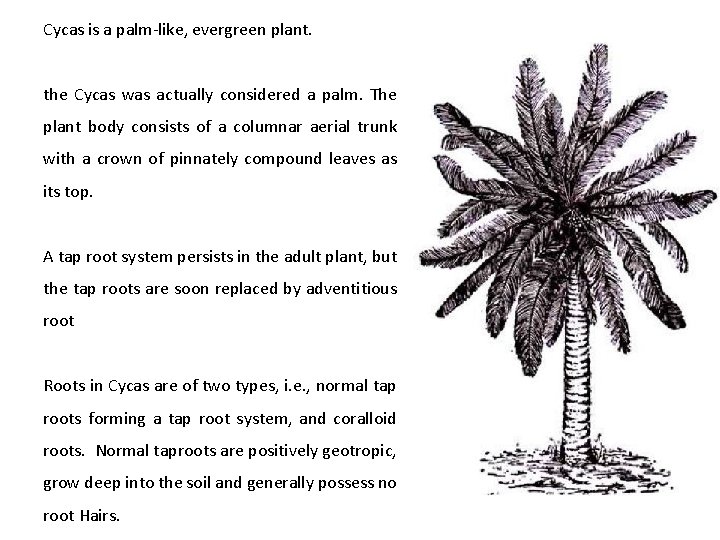
Cycas is a palm-like, evergreen plant. the Cycas was actually considered a palm. The plant body consists of a columnar aerial trunk with a crown of pinnately compound leaves as its top. A tap root system persists in the adult plant, but the tap roots are soon replaced by adventitious root Roots in Cycas are of two types, i. e. , normal tap roots forming a tap root system, and coralloid roots. Normal taproots are positively geotropic, grow deep into the soil and generally possess no root Hairs.
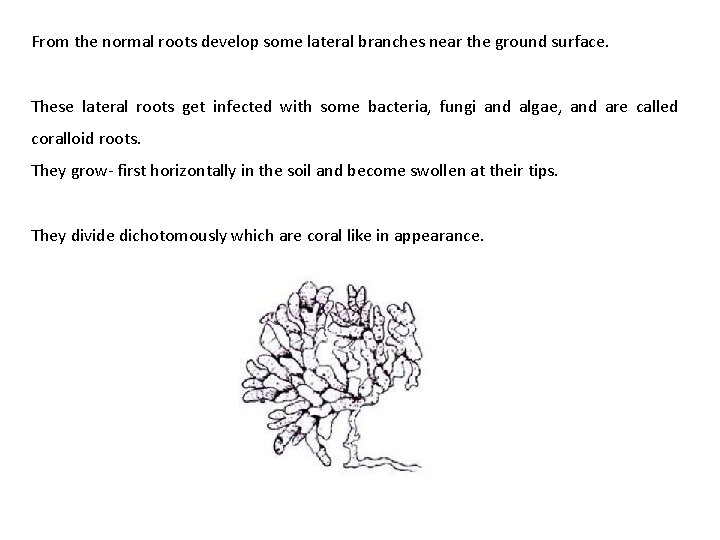
From the normal roots develop some lateral branches near the ground surface. These lateral roots get infected with some bacteria, fungi and algae, and are called coralloid roots. They grow- first horizontally in the soil and become swollen at their tips. They divide dichotomously which are coral like in appearance.
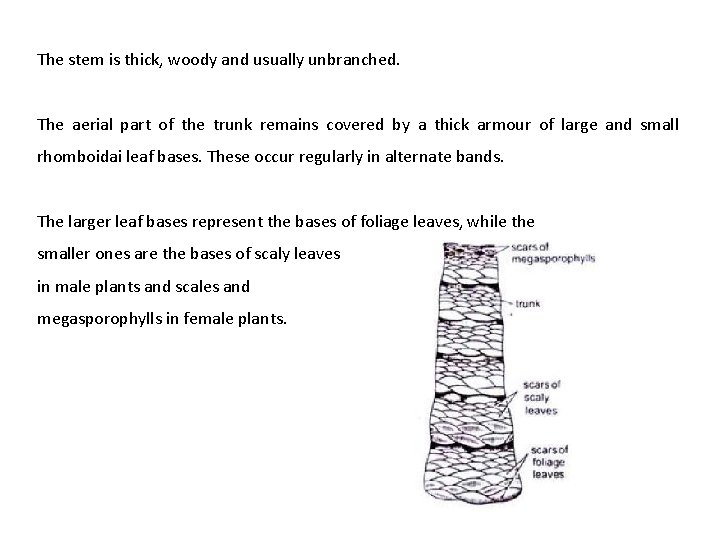
The stem is thick, woody and usually unbranched. The aerial part of the trunk remains covered by a thick armour of large and small rhomboidai leaf bases. These occur regularly in alternate bands. The larger leaf bases represent the bases of foliage leaves, while the smaller ones are the bases of scaly leaves in male plants and scales and megasporophylls in female plants.
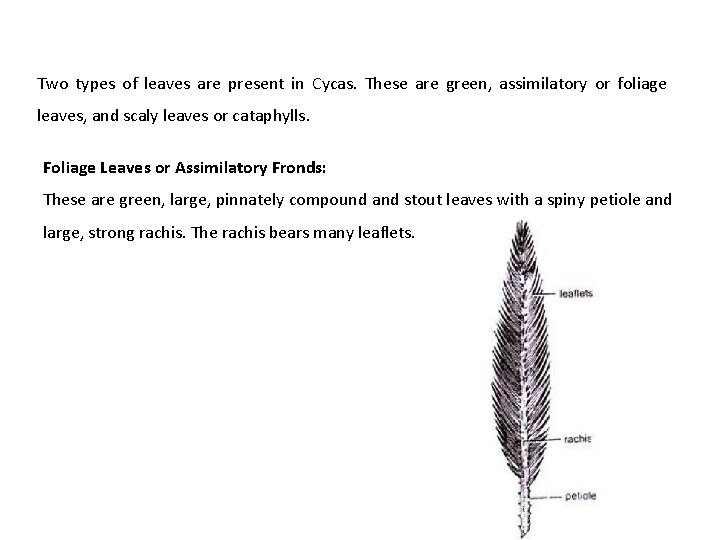
Two types of leaves are present in Cycas. These are green, assimilatory or foliage leaves, and scaly leaves or cataphylls. Foliage Leaves or Assimilatory Fronds: These are green, large, pinnately compound and stout leaves with a spiny petiole and large, strong rachis. The rachis bears many leaflets.
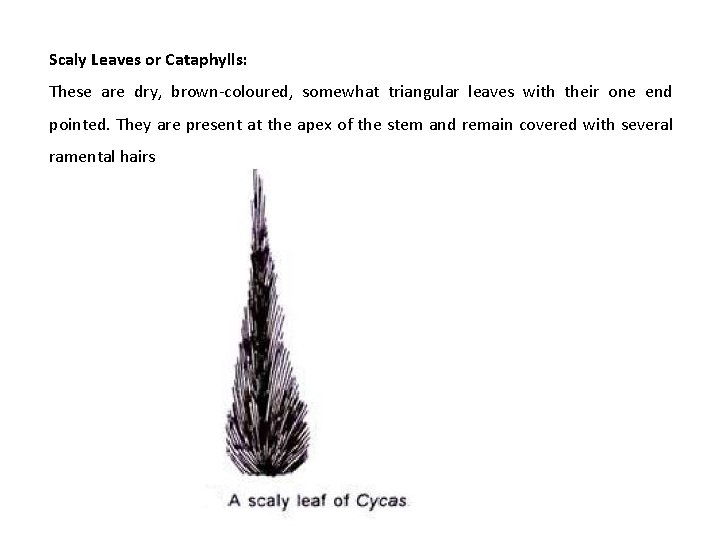
Scaly Leaves or Cataphylls: These are dry, brown-coloured, somewhat triangular leaves with their one end pointed. They are present at the apex of the stem and remain covered with several ramental hairs
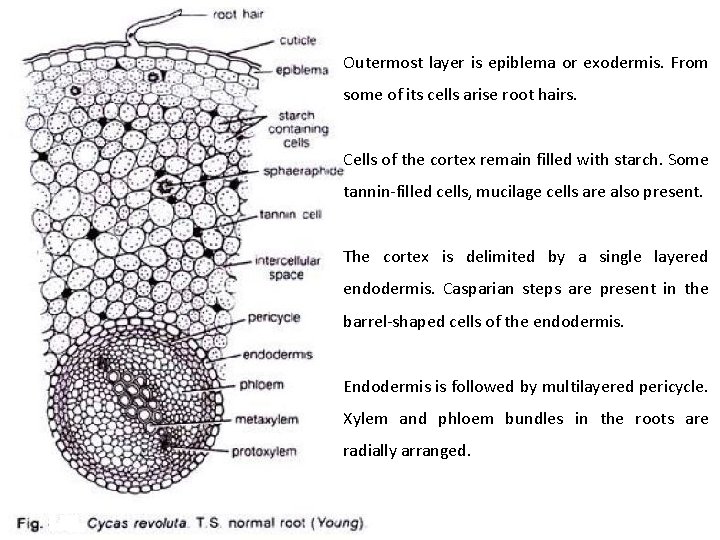
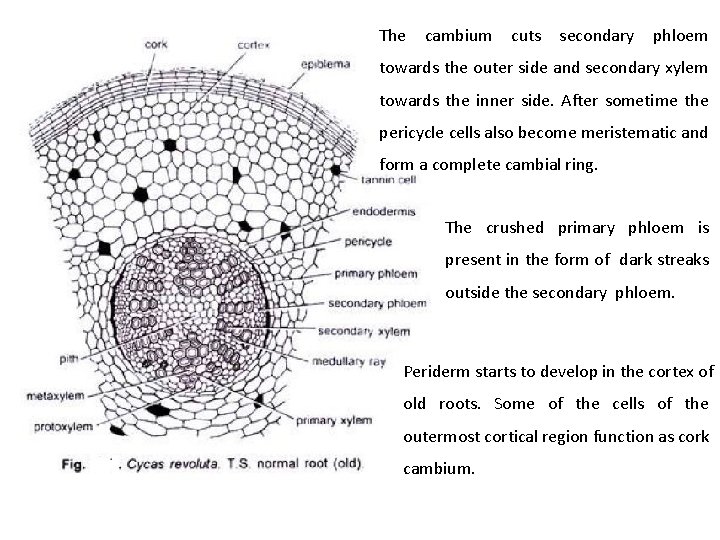
Outermost layer is epiblema or exodermis. From some of its cells arise root hairs. Cells of the cortex remain filled with starch. Some tannin-filled cells, mucilage cells are also present. The cortex is delimited by a single layered endodermis. Casparian steps are present in the barrel-shaped cells of the endodermis. Endodermis is followed by multilayered pericycle. Xylem and phloem bundles in the roots are radially arranged.
The cambium cuts secondary phloem towards the outer side and secondary xylem towards the inner side. After sometime the pericycle cells also become meristematic and form a complete cambial ring. The crushed primary phloem is present in the form of dark streaks outside the secondary phloem. Periderm starts to develop in the cortex of old roots. Some of the cells of the outermost cortical region function as cork cambium.
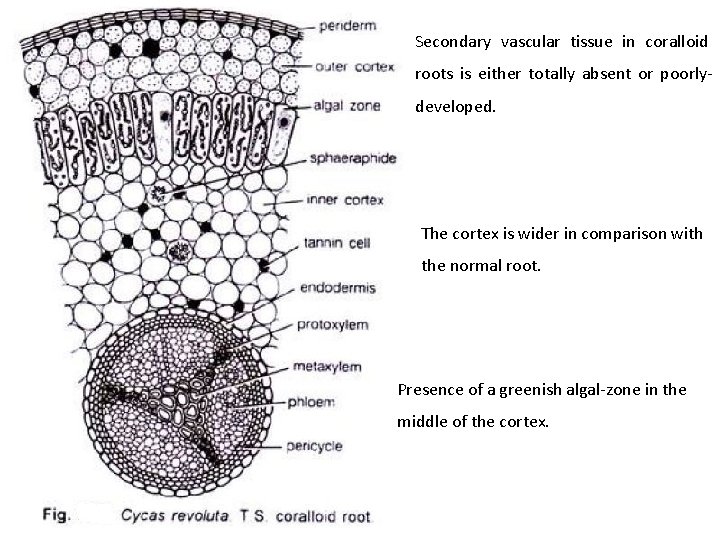
Secondary vascular tissue in coralloid roots is either totally absent or poorlydeveloped. The cortex is wider in comparison with the normal root. Presence of a greenish algal-zone in the middle of the cortex.
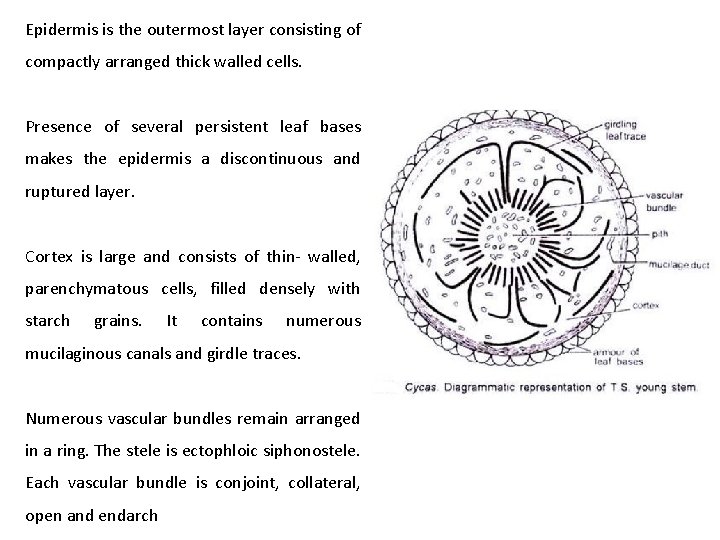
Epidermis is the outermost layer consisting of compactly arranged thick walled cells. Presence of several persistent leaf bases makes the epidermis a discontinuous and ruptured layer. Cortex is large and consists of thin- walled, parenchymatous cells, filled densely with starch grains. It contains numerous mucilaginous canals and girdle traces. Numerous vascular bundles remain arranged in a ring. The stele is ectophloic siphonostele. Each vascular bundle is conjoint, collateral, open and endarch
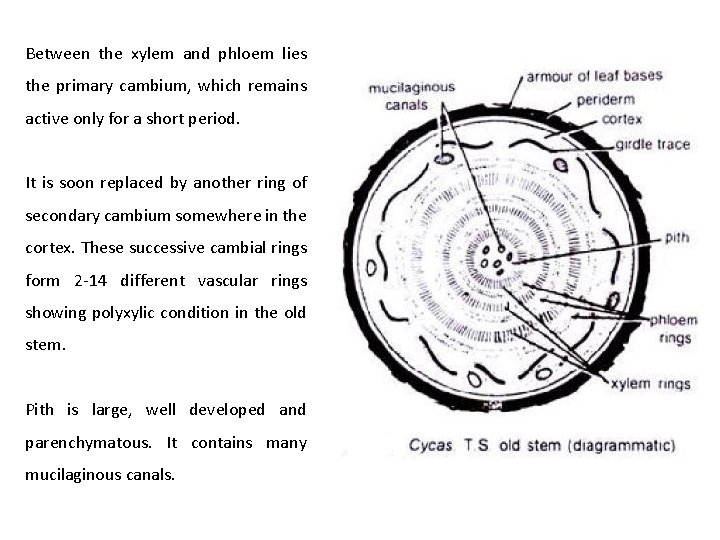
Between the xylem and phloem lies the primary cambium, which remains active only for a short period. It is soon replaced by another ring of secondary cambium somewhere in the cortex. These successive cambial rings form 2 -14 different vascular rings showing polyxylic condition in the old stem. Pith is large, well developed and parenchymatous. It contains many mucilaginous canals.
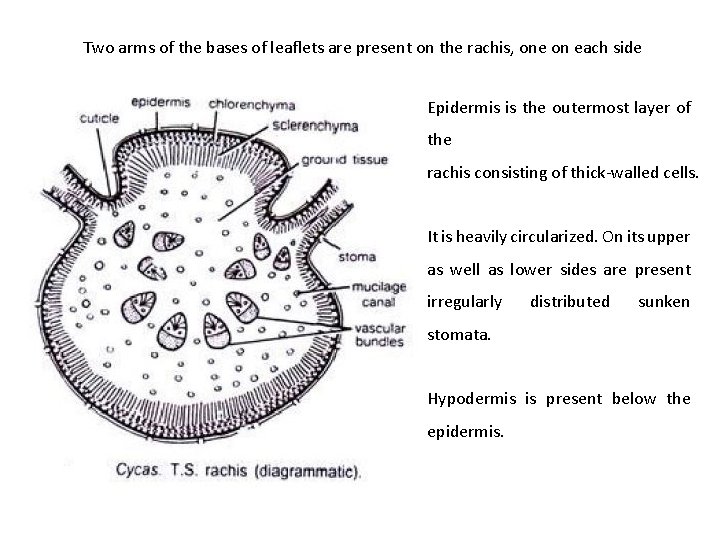
Two arms of the bases of leaflets are present on the rachis, one on each side Epidermis is the outermost layer of the rachis consisting of thick-walled cells. It is heavily circularized. On its upper as well as lower sides are present irregularly distributed sunken stomata. Hypodermis is present below the epidermis.
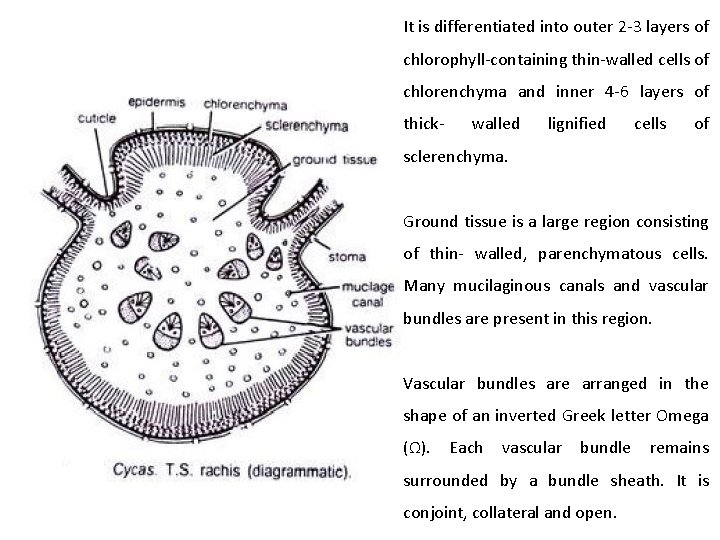
It is differentiated into outer 2 -3 layers of chlorophyll-containing thin-walled cells of chlorenchyma and inner 4 -6 layers of thick- walled lignified cells of sclerenchyma. Ground tissue is a large region consisting of thin- walled, parenchymatous cells. Many mucilaginous canals and vascular bundles are present in this region. Vascular bundles are arranged in the shape of an inverted Greek letter Omega (Ω). Each vascular bundle remains surrounded by a bundle sheath. It is conjoint, collateral and open.
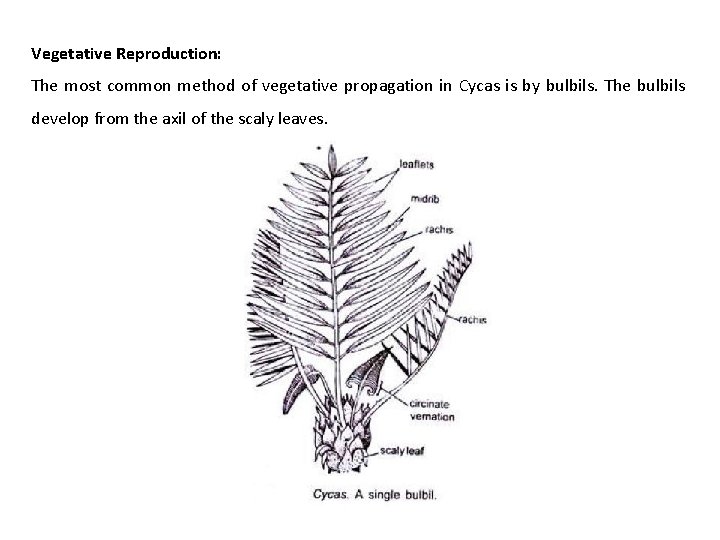
Vegetative Reproduction: The most common method of vegetative propagation in Cycas is by bulbils. The bulbils develop from the axil of the scaly leaves.
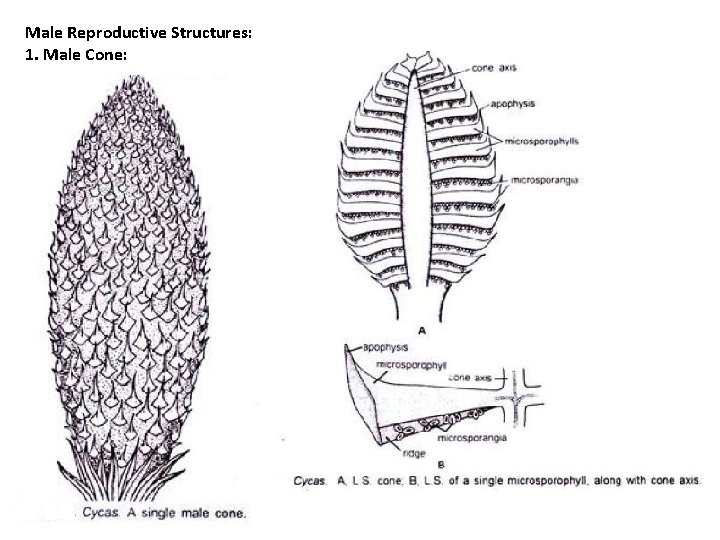
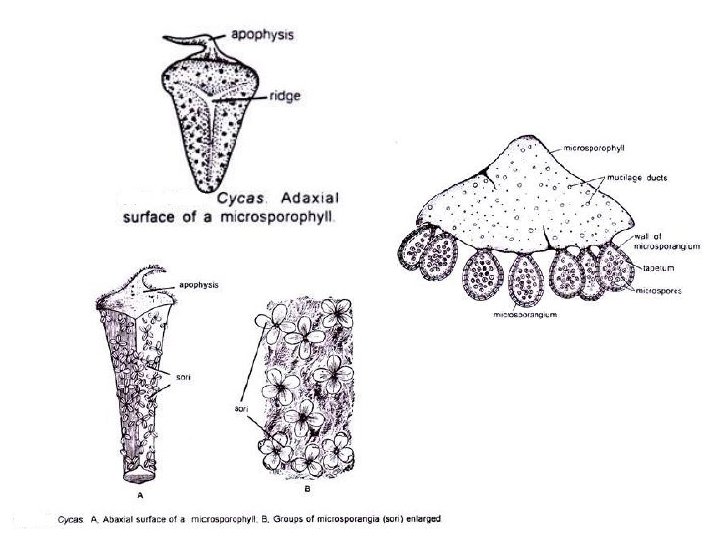
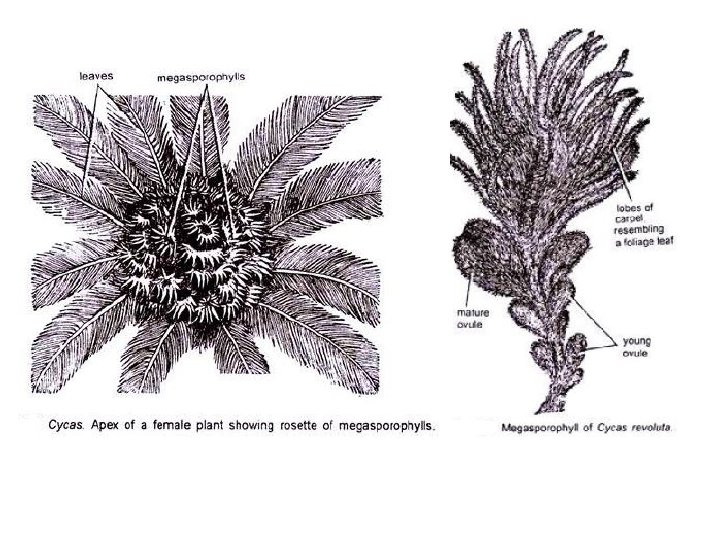
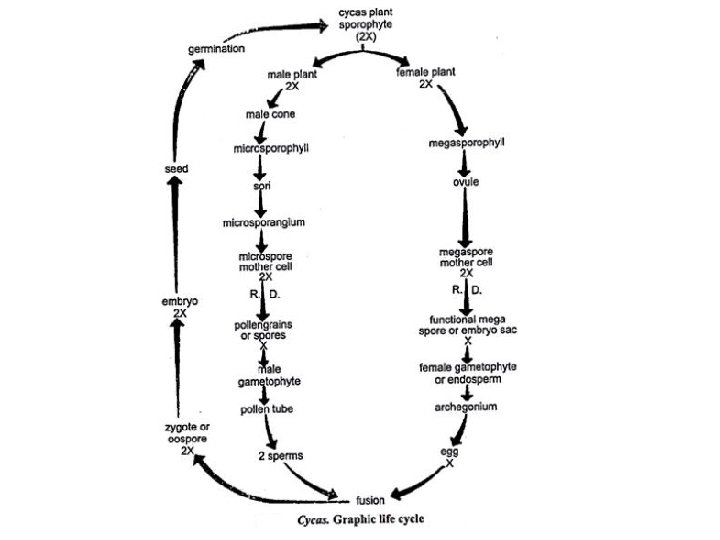
Sexual Reproduction: Cycas is strictly dioecious, i. e. male and female sex organs are borne on separate plants. After several years of vegetative growth the plants start to form sex organs. Generally, Cycads of more than 10 years of age produce the sex organs. The male plants develop male cones or male strobili bearing microsporophyll’s, while the female plants produce a loose collection of megasporophylls. The male cone is terminal while the megasporophylls are produced in succession with the leaves at the top of the stem.
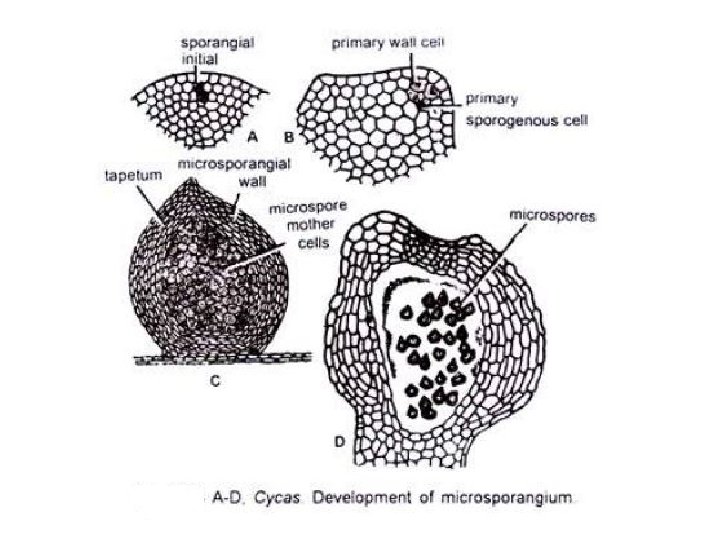
Male Reproductive Structures: 1. Male Cone:
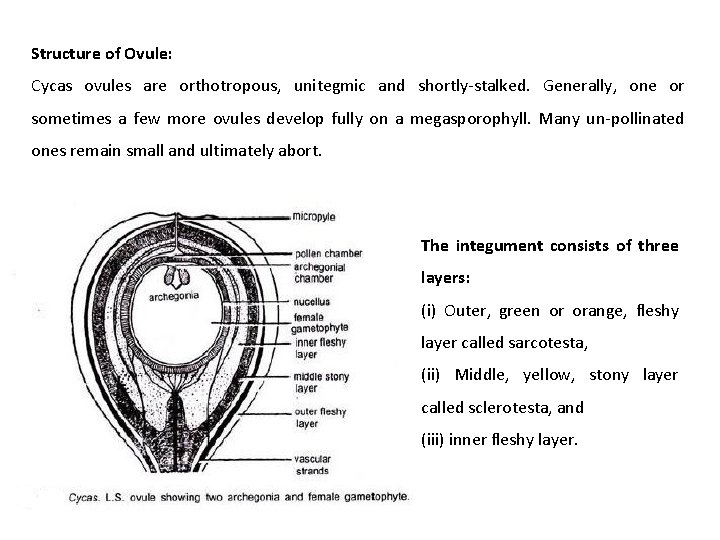
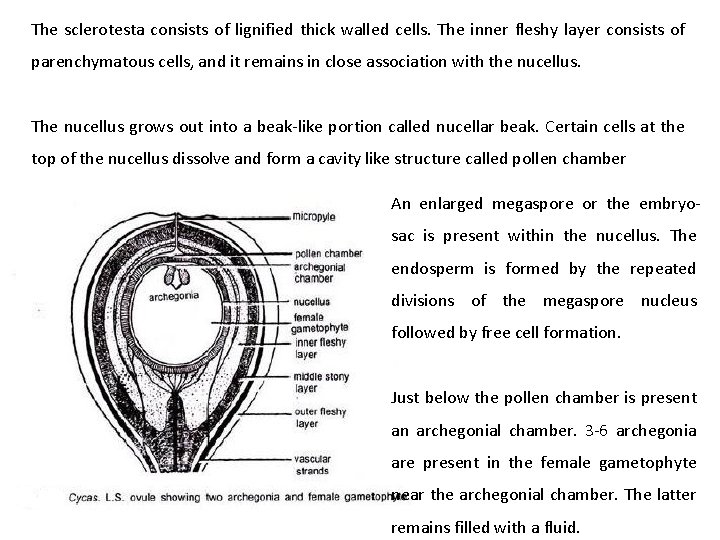
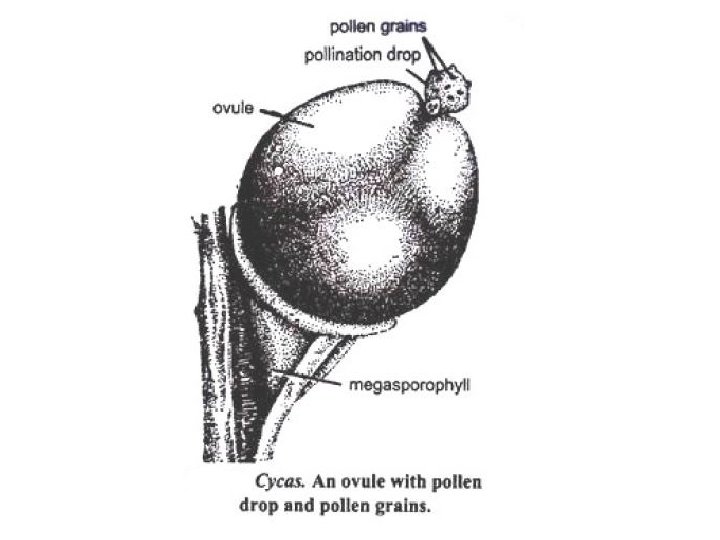
Structure of Ovule: Cycas ovules are orthotropous, unitegmic and shortly-stalked. Generally, one or sometimes a few more ovules develop fully on a megasporophyll. Many un-pollinated ones remain small and ultimately abort. The integument consists of three layers: (i) Outer, green or orange, fleshy layer called sarcotesta, (ii) Middle, yellow, stony layer called sclerotesta, and (iii) inner fleshy layer.
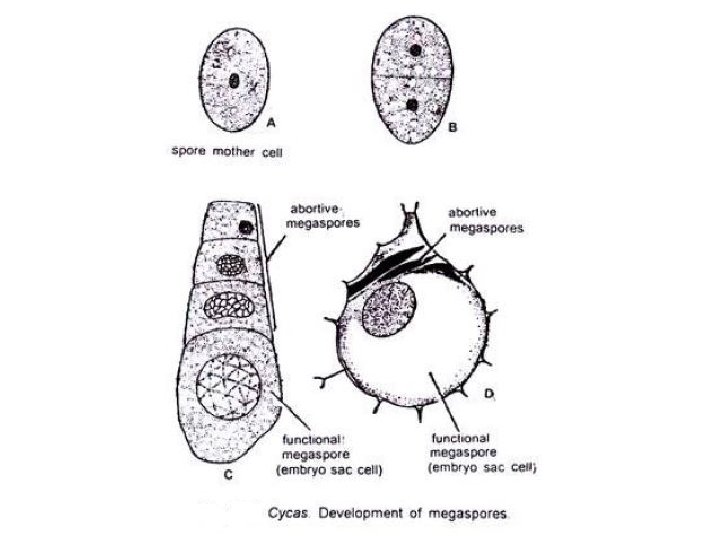
The sclerotesta consists of lignified thick walled cells. The inner fleshy layer consists of parenchymatous cells, and it remains in close association with the nucellus. The nucellus grows out into a beak-like portion called nucellar beak. Certain cells at the top of the nucellus dissolve and form a cavity like structure called pollen chamber An enlarged megaspore or the embryosac is present within the nucellus. The endosperm is formed by the repeated divisions of the megaspore nucleus followed by free cell formation. Just below the pollen chamber is present an archegonial chamber. 3 -6 archegonia are present in the female gametophyte near the archegonial chamber. The latter remains filled with a fluid.
Economic Importance of Cycas: 1. Several species of Cycas of e. g. , C. revoluta, C. circinalis C. bedomei are grown in the gardens as ornamental plants. 2. From the stem ‘sago’ a kind of starch, is obtained. Hence, it is also called sago palm (C. revoluta) 3. Leaves of C. circinalis are used to prepare hats, baskets and mats. The leaves of Cycas are extensively used for decorative purposes and floral decoration. 4. The resin obtained from C. rumphii is applied to malignant ulcers. 5. Pollens of C. circivalis are narcotic. Its seeds ground to paste with coconut oil are useful for swellings. 6. Seeds of Cycas are roasted and are used as food in Assam and certain islands. 7. The seeds and stem of C. revoluta are used in making wire in Japan. 8. The young succulent leaves of Cycas are also cooked as vegetables