
Cyberspace Humans Psychological Effects By Karyn Krawford 100712
Cyberspace & Humans Psychological Effects By Karyn Krawford 10/07/12


INTRODUCTION – Cyber Psychology Your presenter Historical technology effects and consequences Claude Steiner’s view of Psychological effects Television Effects on Mental Health Memory & Brain Cyber Bullying Empathy Internet Addiction Passive/Active Ratio Next presentation – sociological effects Group reflection
The Presenter • • • Interest academically – academic research & social sciences Interest personally - experience Interest professionally – work Media appearance – radio interviews – cyber bullying & cyber agression Daily Telegraph – Technology – Online Trolls SMH – Trolling Australian Youth Studies Organisation – cyber bullying on young people – to come this month Co-authoring – Cyber Psychology book with Dr Claude Steiner www. cyborgltd. org – for customised cyber research solutions for commercial and individuals

THERE ARE BENEFITS & NEGATIVE AFFECTS

• “You know what’s really exciting about video games is you don’t just interact with the game physically—you’re not just moving your hand on a joystick, but you’re asked to interact with the game psychologically and emotionally as well. You’re not just watching the characters on screen; you’re becoming those characters” —Nina Huntemann, Game Over (2010 American Psychological Association, 2010).
Video/Computer Games • Increasing controversy surrounds the concept of video games being mostly good or mostly bad for people especially where children are concerned according to the Entertainment Software Association (ESA) (ESA, 2011). ESA is an organisation created to support businesses that produce games and provides two reports on its website for the general public, appealing especially to concerned parents in order to reassure them about the benefits to them and their families as listed below; • The games industry has a positive impact on the US economy generating $25. 1 billion in 2010 including thousands of jobs. 72% of American households play computer or video games of which the average is 37 yrs old and 29% of the total is over 50 yrs. Of these 58% are male and 42% female of which a larger number of adolescent females under 18 yrs (37%) than males (13%)
Games cont • 59% of parents believe games provide mental stimulation or education and most parents give their permission when games are purchased from which 45% play with their children and family weekly • These statistics are important because top selling computer game is Starcraft and top selling video game is Call of duty. • According to descriptions on Wikipedia, Starcraft is a futuristic real time strategy game of aliens fighting for dominance (Wikipeda, 2011). And Call of Duty is a wartime shooting game where players create strategies to overcome and kill their opponents and is Rated M+ (for mature audiences). • according to a recent news report in The Age producers of one video game Company are being sued for millions after some adolescents killed a couple of people and said the game had inspired them to do it. • The video game teaches players how to commit crimes and kill people. The president of ESA said there is no evidence to link violence to games and people are responsible for their own actions as stated in his report from the ESA above. They refuse to speak negatively about it.
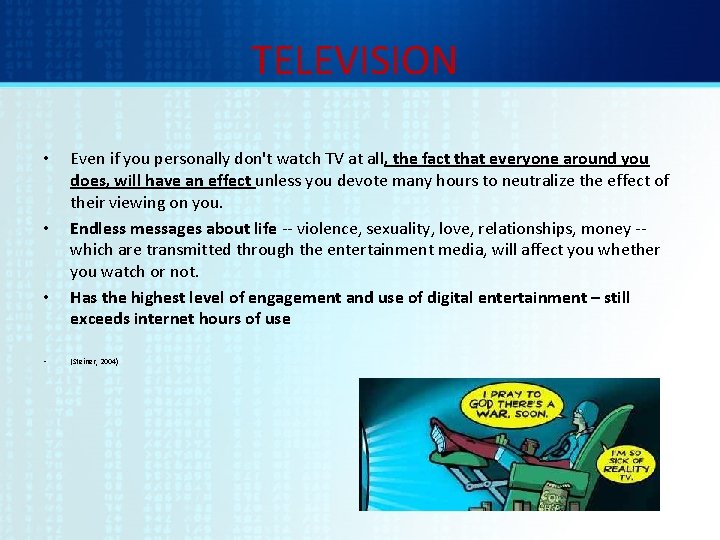
TELEVISION • • Even if you personally don't watch TV at all, the fact that everyone around you does, will have an effect unless you devote many hours to neutralize the effect of their viewing on you. Endless messages about life -- violence, sexuality, love, relationships, money -which are transmitted through the entertainment media, will affect you whether you watch or not. Has the highest level of engagement and use of digital entertainment – still exceeds internet hours of use (Steiner, 2004)
Effects on mental health Computers The average 8 -18 yr. old is said to spend an average of 11. 5 hours per day using digital technologies (Rosen, 2007) Depending on what reason the technologies are used for, children who use the internet for communication purposes is associated to lower psychological wellbeing after only 1 hour (Jackson et al, 2008, APA , 2011), correlates to depression, narcissist and anti – social behaviours (Gore, 2010, Ed, 2011) Strong caution for children under the age of eight years on high internet use is advised in Dr Small’s recent book called i. Brain which furthers the studies and experiments in brain alteration and cites several studies on both children and adults that correlate strongly with frequent technology use to mental health conditions such as ADD, ADHD, Autism, depression, anxiety, and even sociopathic behaviour (Small, 2008). Plus a range of sleep disorders (Weinstein, 2010). children under 2 years old should avoid watching TV completely (Gutnick, 2010) as they are more likely to suffer from psychological difficulties, regardless of their physical activity level, according to Dr Page who studied over 1000 children between 10 -11 yrs old (Page, 2010),
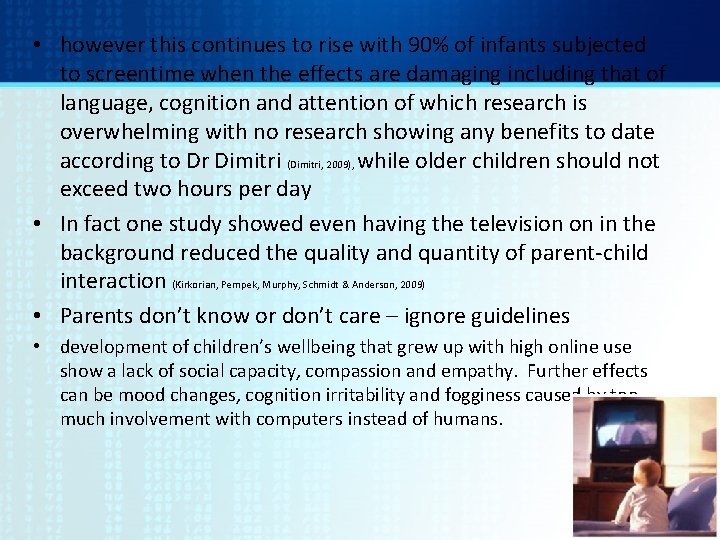
• however this continues to rise with 90% of infants subjected to screentime when the effects are damaging including that of language, cognition and attention of which research is overwhelming with no research showing any benefits to date according to Dr Dimitri (Dimitri, 2009), while older children should not exceed two hours per day • In fact one study showed even having the television on in the background reduced the quality and quantity of parent-child interaction (Kirkorian, Pempek, Murphy, Schmidt & Anderson, 2009) • Parents don’t know or don’t care – ignore guidelines • development of children’s wellbeing that grew up with high online use show a lack of social capacity, compassion and empathy. Further effects can be mood changes, cognition irritability and fogginess caused by too much involvement with computers instead of humans.
Brain Neurological studies show more negative than positive effects on the brain (Small, 2009, Carr, 2010, Rosen, 2007) Other negative Psychological effects – distractedness, decision making, processing information, focus (Del Boccio, 2009, Small, 2009, Carr, 2010, Rosen, 2007) Rise in ADHD & Autism (Small, 2009) • For example both Small (2009) and Carr (2010) write extensively on the subject in great scientific details about how the brain has changed through the use of these digital devices and they find only one hour per day is enough to cause significant change particularly with the quality of reading which has declined. • This is important because as Rosen (2007) explains, media use for adolescents is now at 6. 21 hours per day or 45 hours per week on TV, Internet and computer use that is non-school related, music and video games.
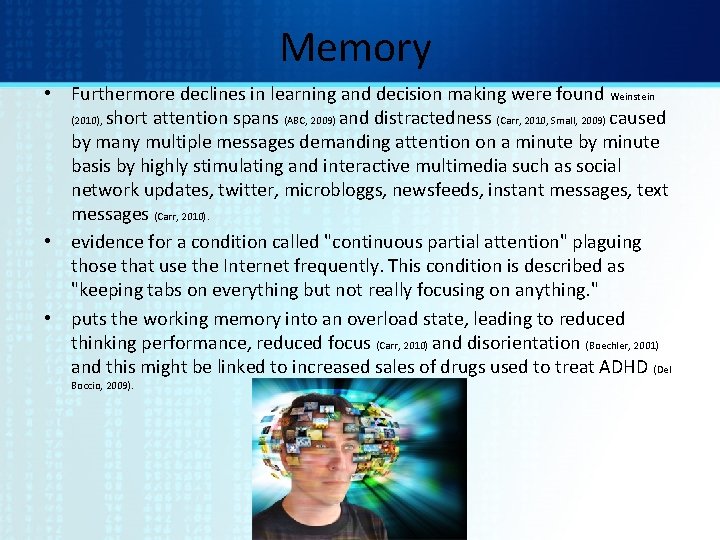
Memory • Furthermore declines in learning and decision making were found Weinstein (2010), short attention spans (ABC, 2009) and distractedness (Carr, 2010, Small, 2009) caused by many multiple messages demanding attention on a minute by minute basis by highly stimulating and interactive multimedia such as social network updates, twitter, microbloggs, newsfeeds, instant messages, text messages (Carr, 2010). • evidence for a condition called "continuous partial attention" plaguing those that use the Internet frequently. This condition is described as "keeping tabs on everything but not really focusing on anything. " • puts the working memory into an overload state, leading to reduced thinking performance, reduced focus (Carr, 2010) and disorientation (Boechler, 2001) and this might be linked to increased sales of drugs used to treat ADHD (Del Boccio, 2009).
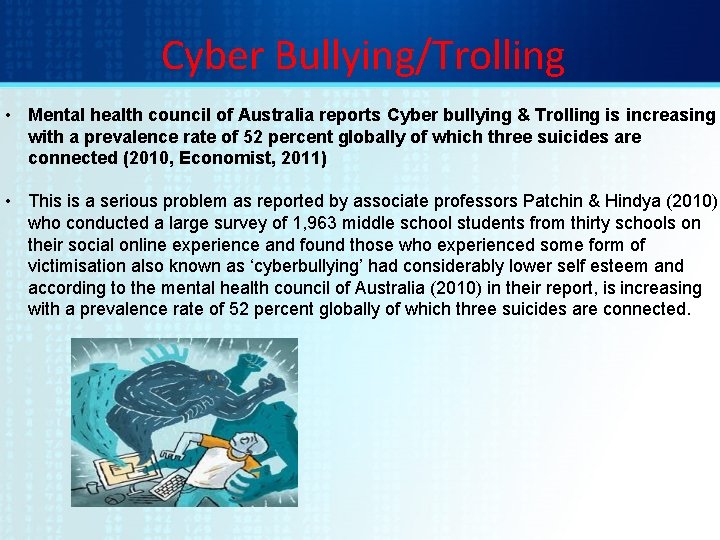
Cyber Bullying/Trolling • Mental health council of Australia reports Cyber bullying & Trolling is increasing with a prevalence rate of 52 percent globally of which three suicides are connected (2010, Economist, 2011) • This is a serious problem as reported by associate professors Patchin & Hindya (2010) who conducted a large survey of 1, 963 middle school students from thirty schools on their social online experience and found those who experienced some form of victimisation also known as ‘cyberbullying’ had considerably lower self esteem and according to the mental health council of Australia (2010) in their report, is increasing with a prevalence rate of 52 percent globally of which three suicides are connected.
Empathy • Detachment from feelings & desensitisation. Unable to detect emotions in others, unable recognise non verbal (Small, 2010, Ritchell, 2010, ABC, 2009) • Meta-analysis on effects of violent video games and emphasised the use of quality ethnographical methodologies in their research. • found violent games increased aggression of actions, cognition and affect while decreased empathy and prosocial behaviours. • results intensified with the quality of research, for example they seemed real. • criticise Meta analyses provided by Ferguson, Ferguson & Kilbum due to insufficient control of publication bias as quoted in ESA’s factsheets. • People are distanced from each other when online • Online social use is self centered, self focused, designed to give maximum user satisfation by controlling website platforms
Internet Addiction Disorder Strong co-relations found between people who use the internet excessively and depression. This research used one of the more reliable depression questionnaires Beck Depression Inventory (BDI). Soft protocol was developed similar to DSM-1 V for pathological gambling to determine what excessive internet users look like. Findings concluded addict would spend average 38 hours per week for non employment and non academic purposes, mostly of which is in chatrooms or playing games. Likely to be high-tech white collar workers than blue collar workers, withdrawal from significant real-life relationships resulting in social isolation and often depression. Similarly depressed people are drawn to internet addiction as they can avoid the confronting awarkedness of meeting and speaking with people, avoid eye contact and have control over their communication and responses using the internet to connect.
PASSIVE/ACTIVE RATIO (PAR) • A politician making a TV speech is making use of cyberspace and could be viewed as acively affecting millions of people • Person watching TV is plugged into cyberspace – passively, as an end-user • If the TV program prompted a telephone call or email and vote, the person is becoming more active • PAR depends on feedback parcitpation of information received – passive if watching anything appearing on screen day after day and increasingly active if comments to self and others, makes phones calls, letters, proceeds to watch or refuses to watch etc. Behaviour is modified.
WHAT CAN WE DO? Catastrophe we need to grasp is ecological rather than just nuclear; 1. Be informed of Cybernetic Age and it’s tools and how it benefits or manipulates and harms people 2. Understand profound changes from evolution of information technologies 3. Make Information about technology evolving to keep pace 4. Become info literate 5. Must learn to detect info-junk, toxic brew of lies and misinformation which like drugs, poisons us
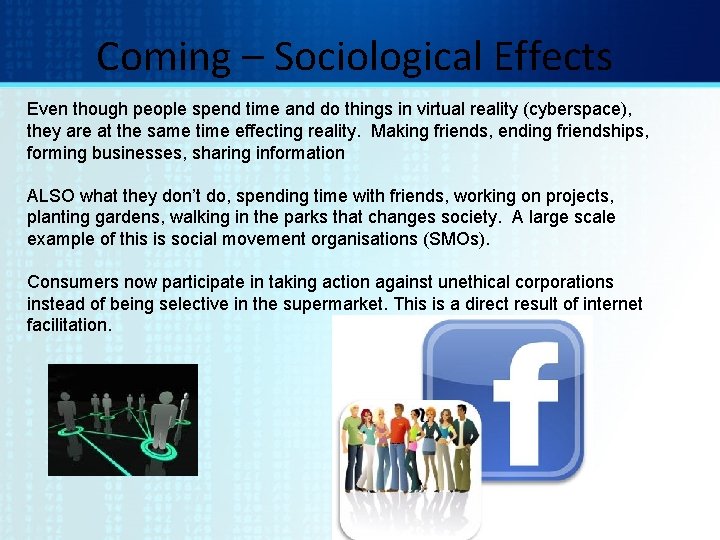
Coming – Sociological Effects Even though people spend time and do things in virtual reality (cyberspace), they are at the same time effecting reality. Making friends, ending friendships, forming businesses, sharing information ALSO what they don’t do, spending time with friends, working on projects, planting gardens, walking in the parks that changes society. A large scale example of this is social movement organisations (SMOs). Consumers now participate in taking action against unethical corporations instead of being selective in the supermarket. This is a direct result of internet facilitation.
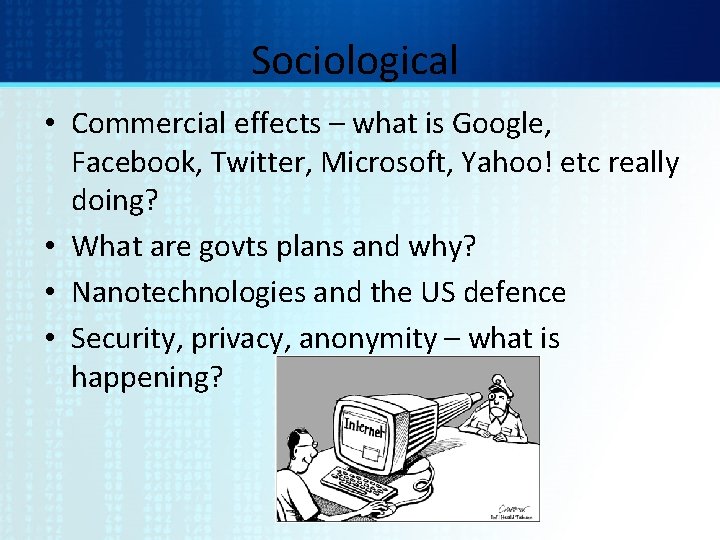
Sociological • Commercial effects – what is Google, Facebook, Twitter, Microsoft, Yahoo! etc really doing? • What are govts plans and why? • Nanotechnologies and the US defence • Security, privacy, anonymity – what is happening?
• • • • • REFERENCE LIST Anderson, C. A. , Shibuya, A. , Ihori, N. , Swing, E. L. , Bushman, B. J. , Sakamoto, A. , &. . . Saleem, M. (2010). Violent video game effects on aggression, empathy, and prosocial behavior in Eastern and Western countries: A meta-analytic review. Psychological Bulletin, 136(2), 151 -173. doi: 10. 1037/a 0018251 2010 American Psychological Association. (2010). Violent Video Game Effects on Aggression, Empathy, and Prosocial. Psychological Bulletin Vol. 136, No. 2 , Pgs 151– 173. Aoki, H. (2008). Learning to interact with a computer by gaze. Behaviour & Information Technology, 27(4), 339 -344. Retrieved from EBSCOhost Arnold, S. E. (2010). Is a search revolution brewing? Information Today , 20. Arnold, S. E. (2010 ). Is a search revolution brewing? (Redefining Search)(Facebook Inc. ). Information Today , p. 20(2). Australian Broadcasting Corporation. (2009, 3 19). Screen culture may be changing our brains. Retrieved 10 3, 2011, from The 7. 30 Report : http: //www. abc. net. au/7. 30/content/2009/s 2521139. htm Banaji, M. R. (2008, August 1). The Science of Satire. Retrieved October 2, 2011, from Chronicle. Review. com: http: //www. fas. harvard. edu/~mrbworks/articles/commentaries/2008_Op-Ed_Chron. Rev. pdf Berne, E. (1971). A Layman's Guide to Psychiatry & Psychoanalysis. Middlesex, England: Penguin Books Ltd. Boechler, P. M. (2001). How Spatial Is Hyperspace? Interacting with Hypertext Documents: Cognitive Processes and Concepts. Cyber. Psychology & Behavior, 4(1) , 23 -46. Brand, M. (2011). Watching Pornographic Pictures on the Internet: Role of Sexual Arousal Ratings and Psychological-Psychiatric Symptoms for Using Internet Sex Sites Excessively. Cyber. Psychology, Behavior & Social Networking, 14(6), 371 -377. Retrieved from EBSCOhost. Brodkin, J. (2011, 9 19). Only enterprise and developers can bypass Windows Store for Metro apps. Retrieved 10 16, 2011, from Ars Technica : http: //arstechnica. com/business/news/2011/09/only-enterprise-and-developers-can-bypass-windows-store-for-metro-apps. ars Byun, S. (2009). Internet Addiction: Metasynthesis of 1996– 2006 Quantitative Research. Cyber. Psychology & Behavior, 12(2), 203 -207. Retrieved from EBSCOhost. Carr, N. (2010). The Shallows. New York: W. W. Norton & Co. Chen, S. (2009). Internet Use & Academic Acheivement: Gender Differences In Early Adoesence. Adolescence 44 (176) , 797 -812. Chen, S. -Y. &. -C. (2009). Internet use and academic achievement: gender differences in early adolescence. Adolescence, 44, 176 , p. 797(16). Retrieved October 05, 2011, from Custom Journal 250 via Gale: . Dutton, W. H. (2008, September 30). Mate Selection in the Network Society: The Role of the Internet in Reconfiguring Marriages in Australia, the United Kingdom and United States. Retrieved October 3, 2011, from Social Science Research Network: Available at SSRN: http: //ssrn. com/abstract=1275810 Economist Intelligence Unit N. A. Incorporated. (2010). The web's new walls. The Economist (US) , 11. Editor, R. N. (2011, 8 8). Social Media’s Impact on Kids A Mixed Bag. Retrieved 10 5, 2011, from www. psychcentral. com: http: //psychcentral. com/news/2011/08/08/social-medias-impact-on-kids-a-mixed-bag/28425. html
• • • • • • Elon University/Pew Internet. (n. d. ). Predictions. Retrieved 10 14, 2011, from Imagining the Internet: http: //www. elon. edu/eweb/predictions/publications. xhtml Emmers-Sommer, T. & Burns, R. (2005) The relationship between exposure to Internet pornography and sexual attitudes toward women. Journal of Online Behavior, 1 (4). Retrieved from http: \www. beavior. netJOBv 1 n 4]emmers-sommer. html Flowers for a funeral; Google and China. (Jan 16, 2010). The Economist (US), 394, 8665. p. 50 EU. Retrieved October 02, 2011, from Custom Journal 250 via Gale: http: //find. galegroup. com. elibrary. acap. edu. au/gps/start. do? prod. Id=IPS&user. Group. Name=61 acap Gary W. Small, M. T. (2009, 02 17). Your Brain on Google: Pattens of Cerebral Activation during Internet searching. American Association fro geriatric Psychiatry , pp. 116 -126. Gillmor, D. (2011, 10 4). The i. Phone 4 S: Apple grows its walled garden. Retrieved 10 10, 2011, from Guardian News and Media Limited : http: //www. guardian. co. uk/commentisfree/cifamerica/2011/oct/04/iphone-apple-launch Gruzd, A. B. (2011, 10). Imagining Twitter as an imagined community. American Behavioral Scientist Greitemeyer, T. , Osswald, S. , & Brauer, M. (2010). Playing prosocial video games increases empathy and decreases schadenfreude. Emotion, 10(6), 796802. doi: 10. 1037/a 0020194 55 , pp. 1294 -1318. Gutnick, A. R. (2010). Always connected: The new digfital media habits of young children. New York: The Joan Ganz Cooney Centre at Sesame Workshop. Han, D. F. (2010). Changes in Cue-Induced, Prefrontal Cortex Activity with Video-Game Play. Cyber. Psychology, Behavior & Social Networking, 13(6), 655661. Han, D. , Hwang, J. , & Renshaw, P. F. (2011). Bupropion sustained release treatment decreases craving for video games and cue-induced brain activity in patients with internet video game addiction. Psychology of Popular Media Culture, 1108 -117. doi: 10. 1037/2160 -4134. 1. S. 108 Harkin, J. (2010, 12 2). Cyber-Con Vol. 32 No. 23. Retrieved 10 7, 2011, from London Review of Books: http: //www. lrb. co. uk/v 32/n 23/james-harkin/cybercon Helper, A. N. (2009, 6 26). i. Brain (book review). Psychiatric Times 35 , p. 35. Herther, N. K. (2009). Digital natives and immigrants: what brain research tells us. Health Reference Center Academic , 15. Holmes, D. H. (2007). Australian Sociology, A Changing Society. French's Forrest, NSW: Pearson Education Australia. Hutton, E. (2010). Can Video Games Enhance Creativity? Effects of Emotion Generated by Dance Revolution. Creativity Research Journal, 22(3), 294303. Retrieved from EBSCOhost Jackson, L. A. , von Eye, A. Witt, E. A. , Zhao, Y, & Fitzgerald, H. E. (2011). A longitudinal study of the effects of Internet use and videogame playing on academic performance and the roles of gender, race and income in these relationships. Computers in Human Behavior, 27, 228 -239. Jackson, L. A. , Witt, E. A. , & Games, I. A. (submitted January 2, 2011). Videogame playing and creativity. International Journal of Human-Computer Studies, Jackson, L. A. , Fitzgerald, H. E. , Zhao, Y. , Kolenic, A. , & von Eye, A. (2008). Information Technology (IT) use and children's psychological well-being. Cyber. Psychology & Behavior, December, 755 -757 Jiang, L. C. (2011). The Disclosure–Intimacy Link in Computer-Mediated Communication: An Attributional Extension of the Hyperpersonal Model. Human Communication Research, 37 , 58– 77. doi: 10. 1111/j. 1468 -2958. 2010. 01393. x. John M. Grohol, P. (2009, 11 4). The Psychology of Twitter. Retrieved 10 8, 2011, from Psych. Central: http: //psychcentral. com/blog/archives/2009/02/23/the-psychology-of-twitter/ Johnson, C. Y. (2011, 7 14). People outsource memory to the Internet. Retrieved 10 18, 2011, from The Boston Globe: http: //www. boston. com/Boston/whitecoatnotes/2011/07/people-outsource-memory-the-internet/Qhh 8 x 2 LODird 5 MHq. Oef. Zl. N/index. html
• • • • • • • Joost, A. S. (Director). (2010). Catfish [Motion Picture]. Just, M. (2010). Watching the Human Brain Process Information. Retrieved 10 9, 2011, from Nieman Reports: Nieman Foundation for Journalism at Harvard: www. nieman. harvard. edu/reportsitemprint. aspx? id=102399 LEE, R. (2007, July 5). Sympathy Through Technology. Retrieved 10 2, 2011, from ABC World News: http: //abcnews. go. com/WN/story? id=3348856&page=1 Lyons, D. (2010). Fortress Apple. Newsweek , 20. Lyons, D. (2010). Fortress Apple. (The Take)(Apple Inc. ). Newsweek , p. 20. Minwatts Marketing Group. (2011, 2 31). Useage & population statistics. Retrieved September 28 th, 2011, from Internet World stats: http: //www. internetworldstats. com/stats. htm Morozov, E. (2010, 1 8). A Walled Wide Web for Nervous Autocrats. Retrieved 10 07, 2011, from The Wall St Journal: http: //online. wsj. com/article/SB 10001424052748704415104576065641376054226. html Page, A. D. (2010, 10 11). Screen time linked to psychological problems in children. Retrieved 10 14, 2011, from University of Bristol News: http: //www. bris. ac. uk/news/2010/7235. html Palvus, J. (2010). Walled Gardens. Scientific American Vol 303 (3) , 71. Pavlus, J. (Sep 2010). WALLED GARDENS. Scientific American , Vol. 303, Issue 3. Pew. Rsearch. Center. (2010). The Future of the Internet. Washington D. C. : Pew Research Center. pilkington, e. (2011, 01 13). Evgeny Morozov: How democracy slipped through the net. Retrieved 10 01, 2011, from The Guardian: http: //www. guardian. co. uk/technology/2011/jan/13/evgeny-morozov-the-net-delusion Ravaja, N. , Turpeinen, M. , Saari, T. , Puttonen, S. , & Keltikangas-Järvinen, L. (2008). The psychophysiology of James Bond: Phasic emotional responses to violent video game events. Emotion, 8(1), 114 -120. doi: 10. 1037/1528 -3542. 8. 1. 114 Rosen, L. K. (2007). Me, My. Space, and I. New York: Palgrave Macmillan. Salimkhan, G. , Manago, A. , & Greenfield, P. (2010). The Construction of the Virtual Self on My. Space. Cyberpsychology: Journal of Psychosocial Research on Cyberspace, 4(1), article 1. http: //cyberpsychology. eu/view. php? cisloclanku=2010050203&article=1 Science Daily. (2011, 10 13). Violent Games Emotionally Desensitizing, Research Suggests. Retrieved 10 18, 2011, from Science Daily: http: //www. sciencedaily. com/releases/2011/10/111012124019. htm Sigelman, C. K. (2009). Life-Span Human Development Sixth Edition. Belmont, CA: Wadsworth, Cengage Learning. Small, G. V. (2008). IBRAIN: Surviving the Technological Alteration of the Modern Mind. Scientific American Mind, Vol. 19 Issue 5 , 42 -49. (Gary W. Small, 2009) Stout, H. (2010, 04 30). Antisocial Networking? Retrieved 9 18, 2011, from The New York Times: www. nytimes. com/2010/05/02/fashion/02 BEST. html? ref=fashion&pagewanted The Economist (US). (2010). The web's new walls. The Economist (US) , p. 11(US). The Entertainment Software Association. (2011). Video Games in the 21 st Century: The 2010 Report. Retrieved September 29, 2011, from www. the. ESA. com: http: //www. theesa. com/facts/pdfs/ESA_EF_2011. pdf Tom Simonite, o. t. (2007, October 5). Neurotic software has a winning personality. Retrieved October 2 nd, 2011, from New Scientist Magazine: http: //www. newscientist. com/blog/technology/2007/10/neurotic-software-is-top-gamer. html van de Donk, W. L. (2004). Cyberprotest: New media, ctizizens and social movements. London: Routledge. Vorgan, G. S. (2011, 2 18). Is the Internet killing empathy? Retrieved 10 4, 2011, from CNN Opinion: http: //articles. cnn. com/2011 -02 -

SOCIOLOGICAL EFFECTS OF CYBERSPACE By Karyn Krawford Sept 2012
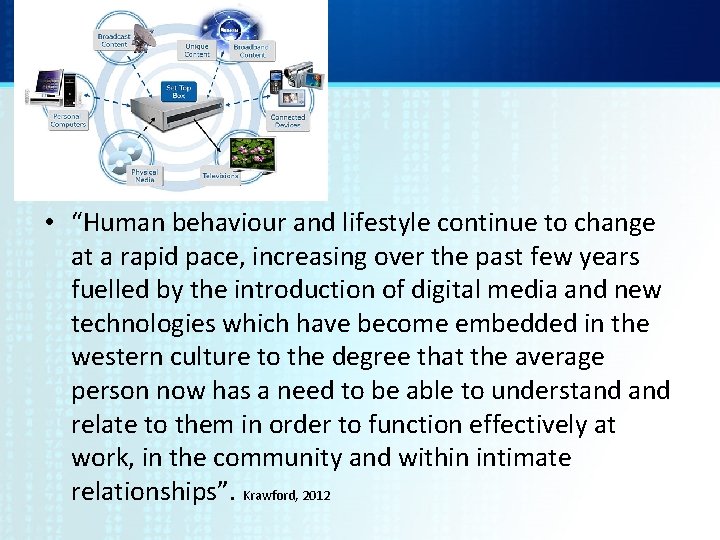
• “Human behaviour and lifestyle continue to change at a rapid pace, increasing over the past few years fuelled by the introduction of digital media and new technologies which have become embedded in the western culture to the degree that the average person now has a need to be able to understand relate to them in order to function effectively at work, in the community and within intimate relationships”. Krawford, 2012
The Presenter • • • Interest academically – academic research & social sciences Interest personally - experience Interest professionally – work Media appearance – radio interviews – cyber bullying & cyber agression Daily Telegraph – Technology – Online Trolls SMH – Trolling Australian Youth Studies Organisation – cyber bullying on young people – to come this month Co-authoring – Cyber Psychology book with Dr Claude Steiner www. cyborgltd. org – for customised cyber research solutions for commercial and individuals
INTRODUCTION • The way people communicate and how has changed since the introduction of communicative digital technologies. Research provides here on evidence for the global effect these technologies have on societies that is evidently both positive and negative. • Some effects are more significant and obvious than others • changes to industries, government policies and working careers • 1. Social movements & groups • 2. Commercial & political changes • 3. Control by organisations, governments and the ‘Net Neutrality’ concept • 4. Political & Corporate Collaboration for control • 5. Security & privacy issues- Internet regulation • 6. Technology developments & impact on society
Agenda tonight • • • • • • Historical Social Movements Twitter Walling off the Internet Organisations Apple Power Facebook Net Neutrality Politial control Free speech Website attacks China Web Filtering Future of the Internet Security Transperancy Virtual Reality Nanotechnology Nano ethics Debates Future Plans Gamification
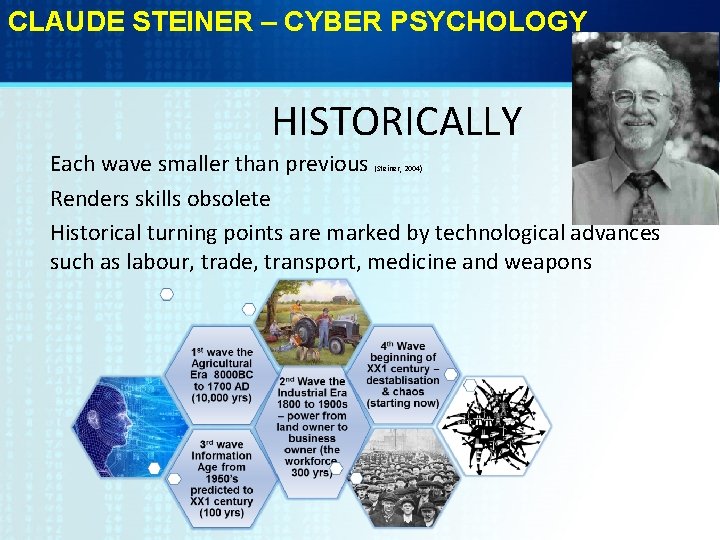
CLAUDE STEINER – CYBER PSYCHOLOGY HISTORICALLY Each wave smaller than previous Renders skills obsolete Historical turning points are marked by technological advances such as labour, trade, transport, medicine and weapons (Steiner, 2004)
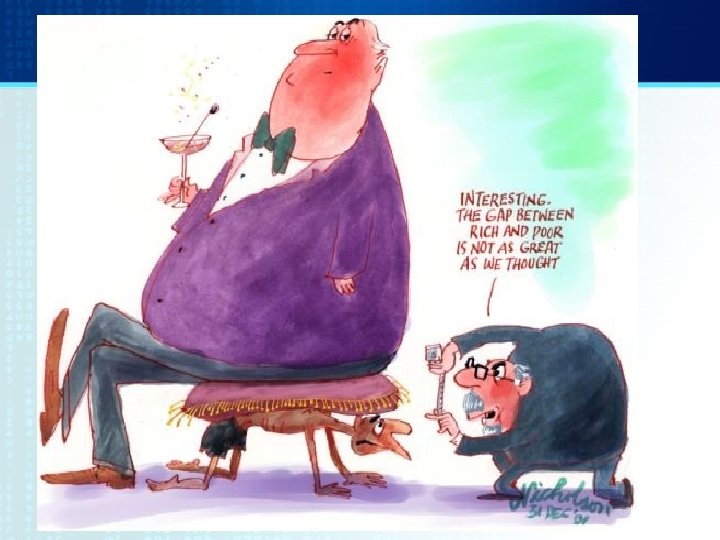
Traditional values & life styles rendered obsolete, entire industries gone -Struggle and desperation to preserve and reverse changes and technological driven course -Desperate sometimes turn to global terrorism, migration of workers to reduced wages -Refugees increasing What will it be like in this new wave? ? ? OUR CURRENT SITUATION: - Widening gap between rich and poor globally - Emergence of global terrorism - Brutal, genocidal, ethnic an nationalistic wars - Serious ecological crises - Famines, population explosion - AIDS and other scary diseases (Steiner, 2004, Holmes, 2007, Carr, 2010)
Young people having problems with decision making in the tangle of change and chaos Turning instead to psychic telephone help to tell you what to do for a small amount – now an industry of growth! Smaller highly paid group of younger people enjoying high tech cutting edge but low touch consequences…. . Busy, highly strung, intoxicated and electrified with success – there is an emotional disconnection and deterioration of relatedness to loved ones Huge salaries still not making ends meet…loss of capacity to interact successfully with other humans While others are lost without a clue…. .

ON THE HOME FRONT – HAPPENING NOW! Racial conflict, terrorist threat, drug abuse domestic violence homelessness, white collar and government crime, political corruption, debt crisis Response – lingering uncertainty, fear, paralysis, frantic activity and majority with uneasy denial INFORMATION ILLITERATE – Need to get clear, truthful information and not ‘info junk’ What guidelines do we live by? What happened to house with garages and backyard? Confusion and uncertainty for some (Steiner, 2004)
Hypothesis • There are both positive & negative effects of both digital technologies & open Internet • The higher level of authority in a group or government, the more likely regulation of the Internet will occur • The more negative effects produced especially in the media, move authoritarian governments closer to justifying Internet regulation • Psychological effects of digital technologies can be harmful, especially to children developmentally • Large technology companies and people working the field most often refuse to speak of negative effects • More research is carried out for positive effects than negative • Technology advancement has increased significantly over the past few decades and is responsible for increased pace of social
Digital consumption • While these technologies give people more choices, broadcast media currently still remains dominant in it’s one way communications i. e. television and radio. • The central point is no matter which kind of technology is consumed, it still has to be paid for, a commodification of the processes of communication which is sold more cost effectively through the digital technologies • Virtual economy doing well - over 2. 1 billion spent in 2009 on virtual products, those that exist only in cyberspace (Holmes, 2007), (Carr, 2010) (Bostrom & Sandberg, 2011)
Social Movements • The Internet facilitates online groups which affect political democracy processes and is used to support offline activism ie. the effect ICTs has on SMOs in book called "Cyber Protest". • The internet useful for facilitating traditional forms of protest activities, previously suppressed by mainstream media, promoting freedom of speech. (Palfrey, 2010). Donk, Loader, Nixon & Dieter (2004)
Twitter • EG. Twitter is a social media tool strategically used by people to organise protests and demonstrations and is certainly growing in Iran however due to Twitter being blocked by authoritarian governments in these countries and the Internet being very slow, most demonstrations are organised through word of mouth and text messages. • hard to monitor and reporting on these events to work out where the people who make the tweets are located and gain clear picture of what exactly is happening with government intervening and false information is everywhere.
• “The internet is not a philosophy it is a distribution mechanism. The laws of physics did not change when the airplane was invented, nor have the laws of economics changed because the internet exists. You make money on the Internet the same way you do everywhere else – by having something that people want and forcing them to pay for it”
Walling off the Internet • Pew Research Centre in Washington D. C. called “The Future of the Internet” (2011) annual reports. • Internet is at risk for being controlled by corporations and governments’, no longer operating as the current ‘free open system platform’ that it is. • Companies, countries and network operators want to wall off bits of the Internet or make parts of it work in a different way in order to promote their political or commercial agendas. • This walled wide web has already three sets of walls being built now.
Organisations – The Walled Garden • can be observed by Apple Corporation which provides hardware that can access online services only through its closed operating system called i. OS. This system is provided on all its i. Phones, ipads and other popular devices and considered the widest reaching walled garden in history yet. • The individual accesses news, videos, music etc. through applications approved by Apple and of which Apple keeps 30% profit from • forces developers to write applications which are distributed through Apple’s store if they want to be used on their highly popular hardware devices
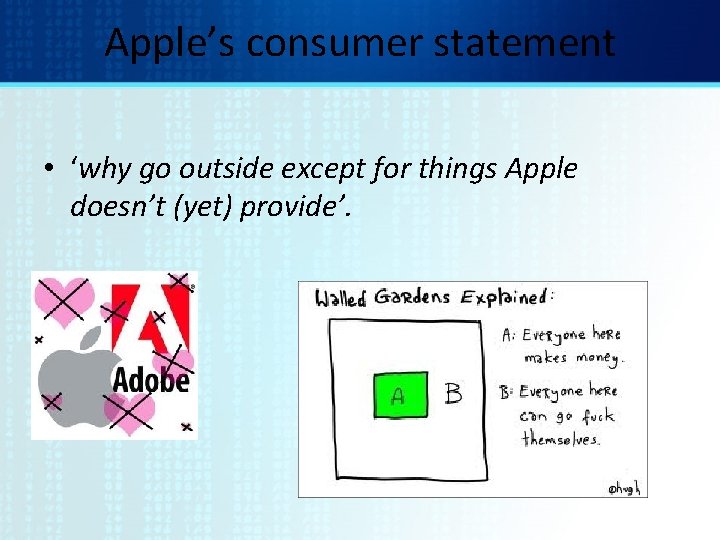
Apple’s consumer statement • ‘why go outside except for things Apple doesn’t (yet) provide’.
Power • more hardware companies are creating new distribution systems that give enormous power to a small number of distributors. • In future they expect customers will not actually own anything but will instead rent, of which these downloaded files such as music files, movies and software will be available for content providers to change or remove • some people think companies using walled gardens will benefit society from the profit they make to use for making new improved technologies and exciting innovations as Apple is doing (Gillmor, 2011). (Arnold S. E. , 2010).
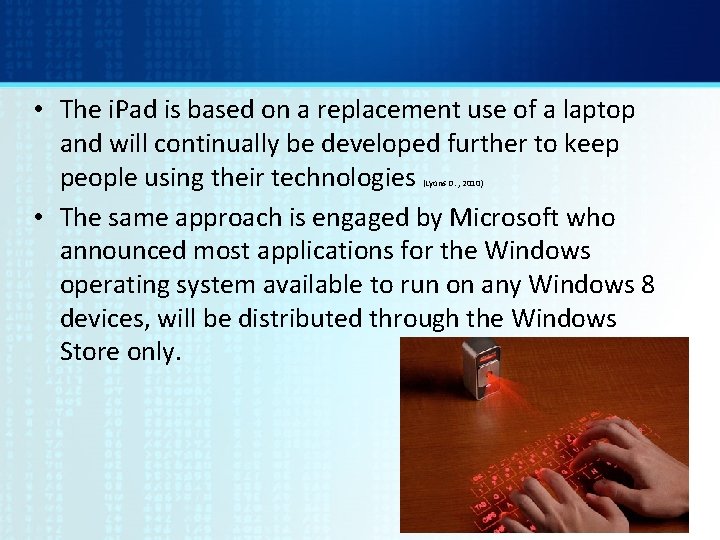
• The i. Pad is based on a replacement use of a laptop and will continually be developed further to keep people using their technologies • The same approach is engaged by Microsoft who announced most applications for the Windows operating system available to run on any Windows 8 devices, will be distributed through the Windows Store only. (Lyons D. , 2010)
Facebook • Another walled garden is Facebook who according to is providing an alternative search function with a wiser data base of personal information about its members than Google could ever get • able to transform how people locate information by integrating the algorithmic methods used by search engines. • may overtake all other web search systems if it continues growing. (Arnold S. E. , 2010)
Net Neutrality • Network operators and Internet service providers who favour content providers and their affiliate companies in order to gain more profit is a threat to the open Internet
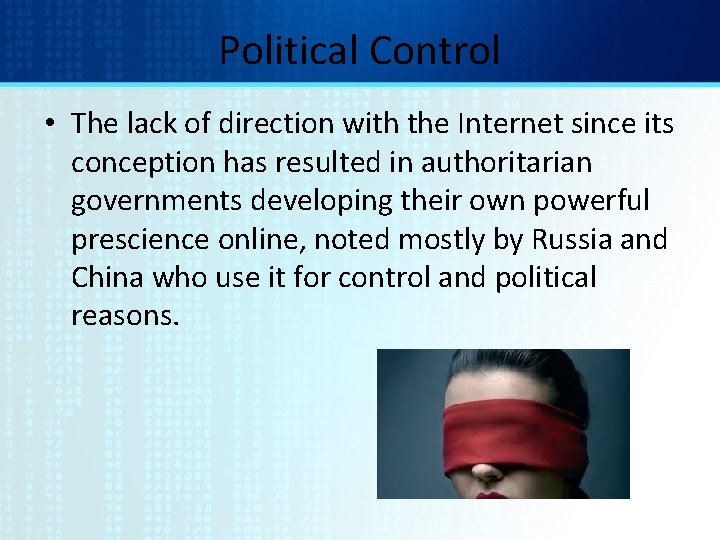
Political Control • The lack of direction with the Internet since its conception has resulted in authoritarian governments developing their own powerful prescience online, noted mostly by Russia and China who use it for control and political reasons.
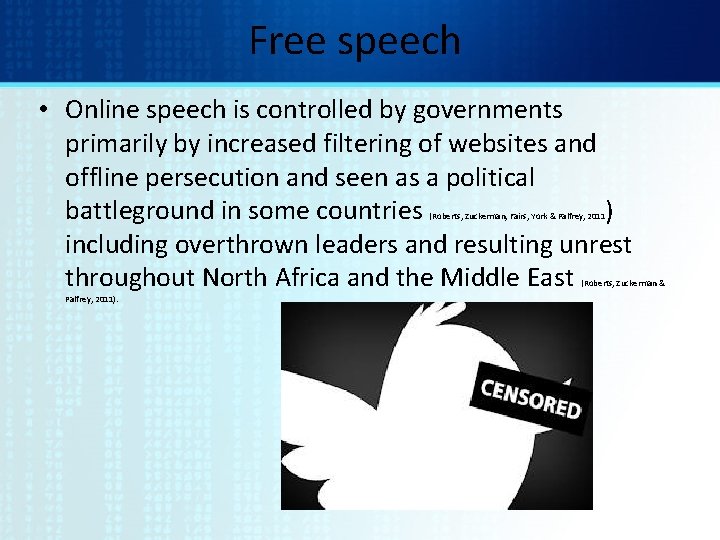
Free speech • Online speech is controlled by governments primarily by increased filtering of websites and offline persecution and seen as a political battleground in some countries ) including overthrown leaders and resulting unrest throughout North Africa and the Middle East (Roberts, Zuckerman, Fairs, York & Palfrey, 2011 (Roberts, Zuckerman & Palfrey, 2011).
Website attacks • EG. total and partial Internet shutdowns occurred in China, Iran, Egypt, Libya and Syria and in another instance a political website in Malaysia was denied service at election time. • “Media research found reports of 140 politically motivated attacks against 280 sites and thought strongly under-estimates the number of attacks taking place because we focused on English language media and because most attacks are not reported in the media ”(Roberts et al, 2011, pg 7).
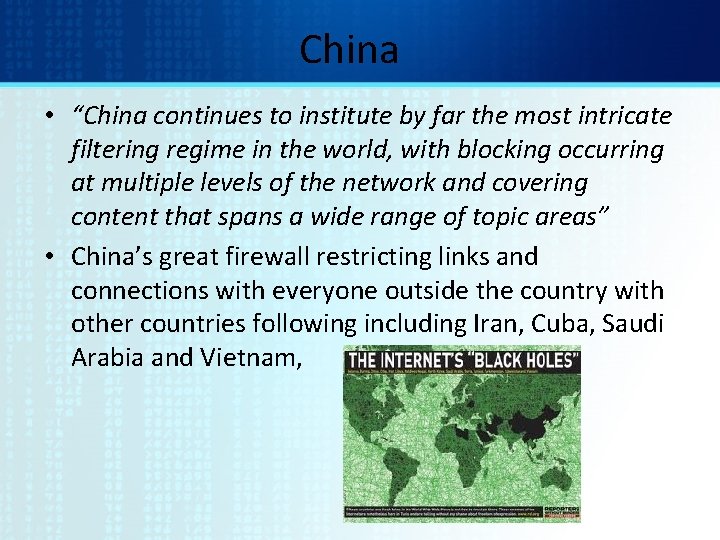
China • “China continues to institute by far the most intricate filtering regime in the world, with blocking occurring at multiple levels of the network and covering content that spans a wide range of topic areas” • China’s great firewall restricting links and connections with everyone outside the country with other countries following including Iran, Cuba, Saudi Arabia and Vietnam,
Web Filtering • In repressive countries political activists commonly use social media website such as Facebook, Twitter and You. Tube as tools however they commonly use anonymous online identities out of fear • Citizens of these countries use what is called ‘circumvention tools’ developed by free speech advocates, to get around the filtering of websites but often ineffective as blocked by govts
• EG. creation of Internet firewall in Australia to block child pornography and bomb making instructions which would prove unnecessarily excessive and ineffective and should be handled by law enforcement • a geopolitical future could occur with IT due to security leak fears. For example some governments are demanding data server’s base operations to be situated in their control.
• Pew Research = challenge will be who owns and controls the networks in future – governments or corporations, but changes will be small and the Internet will remain relatively free OR • too many forces from governments and organisations are already in force creating a realistic locked-down future. • Regional differences will be more obvious while business will shape online experiences with their pay -to-play business models, in turn affecting the information flows.
Security • recent growing concept of ‘life blogging’ - individual uploads and shares their life history in text and pictures. • increased popularity of personal ownership of data and media is causing a new industry to emerge called Identity management which governments perceive necessary for what they anticipate will become a completely identifiable society • can be observed by India’s plans to issue all 1. 2 billion citizens with biometric IDs (a multipurpose national identity card) valid for use online
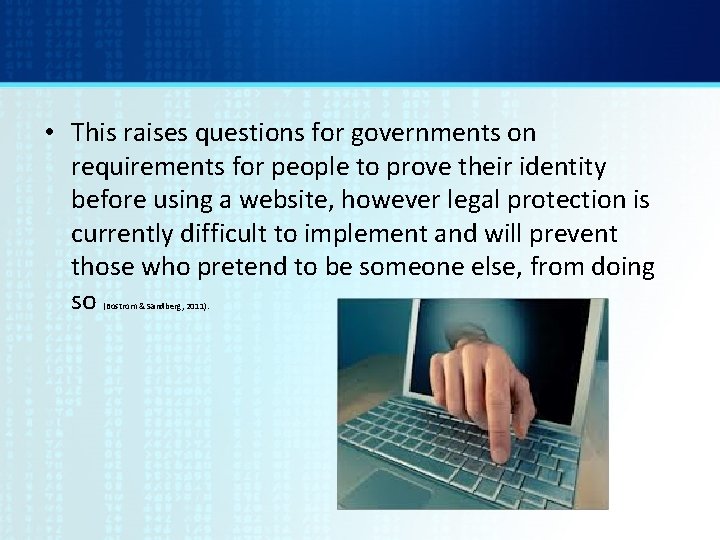
• This raises questions for governments on requirements for people to prove their identity before using a website, however legal protection is currently difficult to implement and will prevent those who pretend to be someone else, from doing so (Bostrom & Sandberg, 2011).
Transperancy • The progressing need to move towards a transparent society with surveillance systems implemented on a mass scale is very likely by both governments and corporations • must enable both top and bottom views, in other words governments can be as transparent as its citizens (Bostrom & Sandberg, 2011), (Sparrow, 2009), (Bostrom & Sandberg, 2011).
• An example is tracking of people through their purchased of anything that is manufactured through radiofrequency. • Privacy issues became a pressing issue as more people use file sharing networks for music, videos and other files that would normally be purchased. • The companies losing profit from this activity formed lobbying groups for governments to block file sharing websites from operating. Sparrow (2009)
• Simstims are "virtual reality" machines which stimulate all the senses not through earphones and screens but directly, at brain level, through “nerve chips” in which the person experiences the "movie" as if they were inhabiting it themselves. • Possible for one person to plug into another's experience as it occurs, or for that experience to be "downloaded" into a huge computer memory and to be viewed or used at a later time. And by the implantation, behind the ear, of "microsofts" -read-only microchips -- the brain can be constantly supplied with whatever recreational input a person can afford to buy. • Fully realistic sexual robots which perform their safe-sex tasks while connected to a mind-slave who generates the robot's behavior at a remote location
• It would be arduous in determining the extent of development in technologies will occur as legal and ethical issues surround each new development. • technology breakthroughs known as ‘wildcards’ that look likely are deception detection, life extension and human-level artificial general intelligence which are already well in progress now. • Much of this speculative technological advancement is shaped and driven by nanotechnologies which speed the pace and power of other technologies and engineer matter at a Nano scale level.

Technology Ethics • developments of nanotechnologies are false because they need legislations which requires regulating goods on an International level with historical past failures in this previously, making funding unlikely due to the high risk involved • Legal, moral and ethical grounds
Debates against NT development • Debates on the subject of society facing revolutionary technology explosions are; • 1. Most funding currently comes from the military and their developments are unlikely to make changes to terrorist movements as they won’t be more mobile or concealable and prone to aggravate the current situation further in terms of governments and criminal powers.
• 2. Additional military debates surround unmanned weapon systems which raise ethical questions such as the consequences of handing over war dictions to robots. Firstly there is to be expected increased war ‘accidents’ and second, the reduction in conflict thresholds before deciding to attack and psychological distance of killing people produces many protests on the development of further unmanned weapons.
• 3. Social power shifts the technologies would cause such as their development to benefit the wealthy rather than the poor and how this would benefit society. • 4. A revolution requires a democratic process and collective decision on who and what is to shape our future. Planning by lobbying groups and governments are currently the ones who decide on which technologies to pursue and which to reject or abandon
Future Plans • Future technologies that are predicted to happen such as designer foods, artificial intelligence, emotional charged devices, teleportation developing now, genetic profiling, autopilot vehicles, human cloning, smart materials, computer enhanced dreaming, virtual worlds, robots, brain downloading. • Dead people’s history to be projected into a technology facilitated communication tool so more conversations can be had with the deceased
Games (Gamification) • According to Ph. D owner of mindshuffle – consults with NY Times, major newspapers, builds games • Games infiltrate all of our lives now. Really? • How? • First – how it is done – how is it sold – target people • Males – compete, Females Collaborate • Social styles to appeal to – achiever types mainly • Social engagement – competing, cooperating, exploring, self expression – biggest drivers • Life cycle
- Slides: 69