
Cybersickness Seeking Human Factors from Causes to Cures
Cybersickness – Seeking Human Factors from Causes to Cures Hyun Taek Kim Ph. D. Department of Psychology, Korea University www. brainbehavior. net

Compliance with IEEE Standards Policies and Procedures Subclause 5. 2. 1 of the IEEE-SA Standards Board Bylaws states, "While participating in IEEE standards development activities, all participants. . . shall act in accordance with all applicable laws (nation-based and international), the IEEE Code of Ethics, and with IEEE Standards policies and procedures. " The contributor acknowledges and accepts that this contribution is subject to: • The IEEE Standards copyright policy as stated in the IEEE-SA Standards Board Bylaws, section 7, http: //standards. ieee. org/develop/policies/bylaws/sect 6 -7. html#7, and the IEEESA Standards Board Operations Manual, section 6. 1, http: //standards. ieee. org/develop/policies/opman/sect 6. html • The IEEE Standards patent policy as stated in the IEEE-SA Standards Board Bylaws, section 6, http: //standards. ieee. org/guides/bylaws/sect 6 -7. html#6, and the IEEE-SA Standards Board Operations Manual, section 6. 3, http: //standards. ieee. org/develop/policies/opman/sect 6. html 2
![IEEE [WG Project #] [WG Name] [WG Chair Name and Email] Cybersickness – Seeking](http://slidetodoc.com/presentation_image_h/254b06c52215b9317822ebf629643421/image-3.jpg "IEEE [WG Project #] [WG Name] [WG Chair Name and Email] Cybersickness – Seeking")
IEEE [WG Project #] [WG Name] [WG Chair Name and Email] Cybersickness – Seeking Human Factors from Causes to Cures Date: 2017 -07 -25 Author(s): Hyun Taek Kim Name Hyun Taek Kim Affiliation Korea University Phone [optional] +(82) 2 -3290 -2065 Email [optional] neurolab@korea. ac. kr

Virtual Reality Cybersickness – Seeking Human factors from causes to Cures July 25, 2017 4
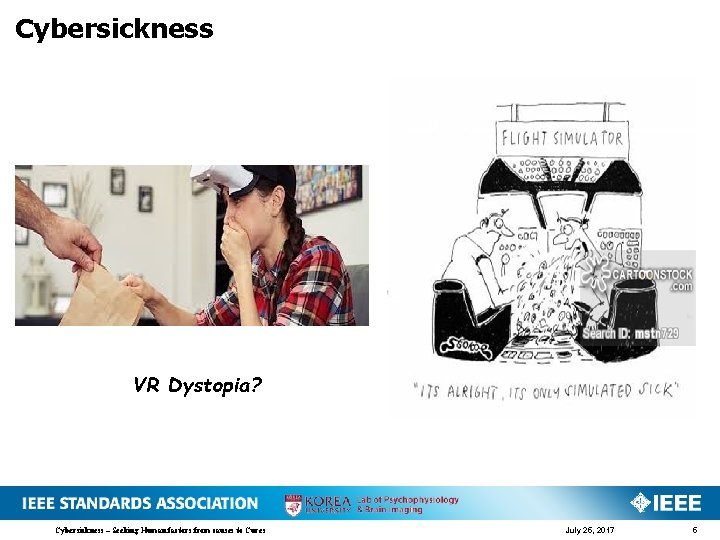
Cybersickness VR Dystopia? Cybersickness – Seeking Human factors from causes to Cures July 25, 2017 5
Discussion Points • Cybersickness theories and proposed causes • Behavioral correlates of cybersickness • Physiological correlates of cybersickness • Identifying human factors • Examining validity of questionnaires (eg. SSQ -> SCQ etc. ) • Standardization of terms • Scientific criteria for preventing hazardous symptoms • Establishing standard & users’ guide Cybersickness – Seeking Human factors from causes to Cures July 25, 2017
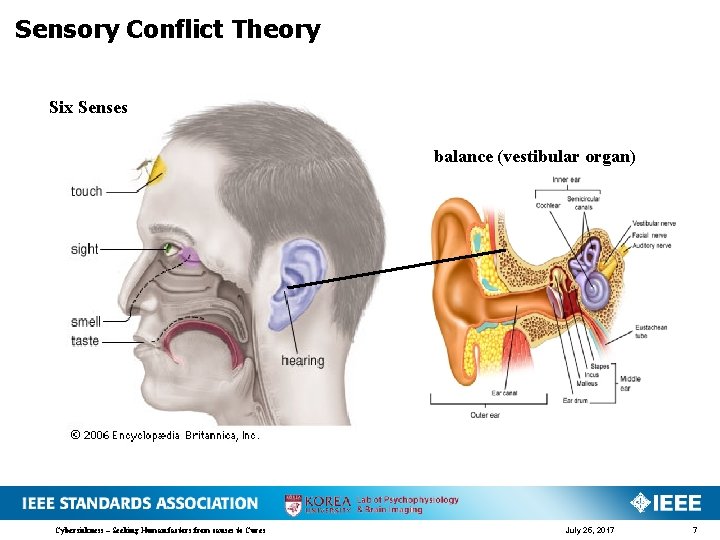
Sensory Conflict Theory Six Senses balance (vestibular organ) Cybersickness – Seeking Human factors from causes to Cures July 25, 2017 7
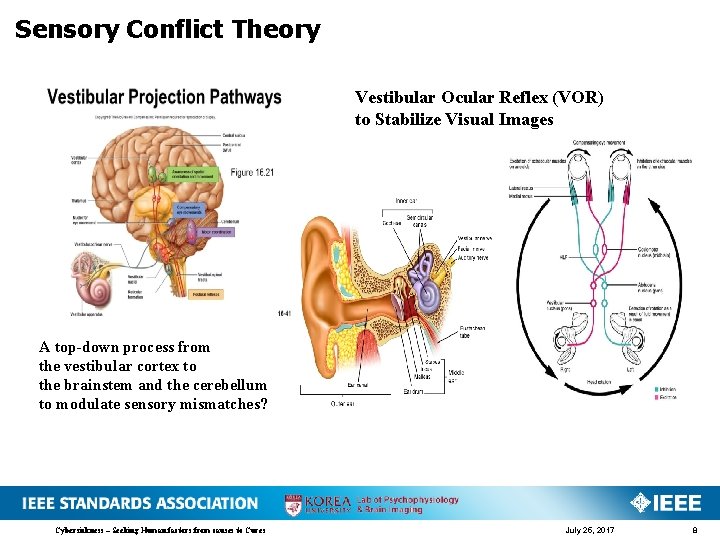
Sensory Conflict Theory Vestibular Ocular Reflex (VOR) to Stabilize Visual Images A top-down process from the vestibular cortex to the brainstem and the cerebellum to modulate sensory mismatches? Cybersickness – Seeking Human factors from causes to Cures July 25, 2017 8
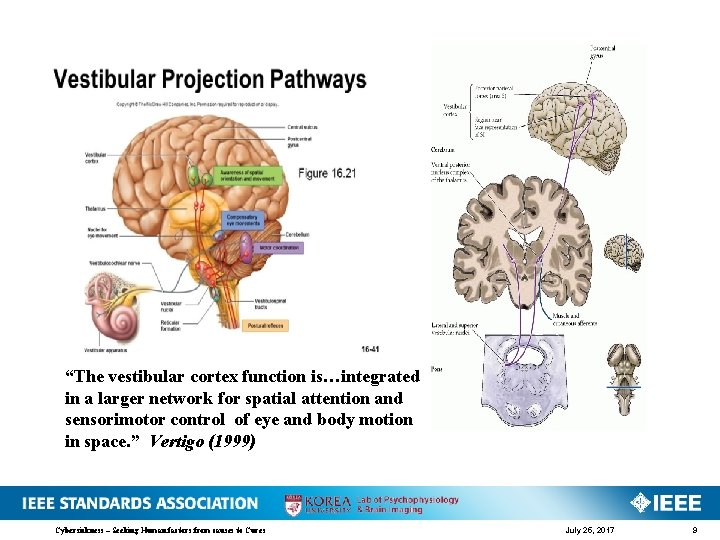
“The vestibular cortex function is…integrated in a larger network for spatial attention and sensorimotor control of eye and body motion in space. ” Vertigo (1999) Cybersickness – Seeking Human factors from causes to Cures July 25, 2017 9
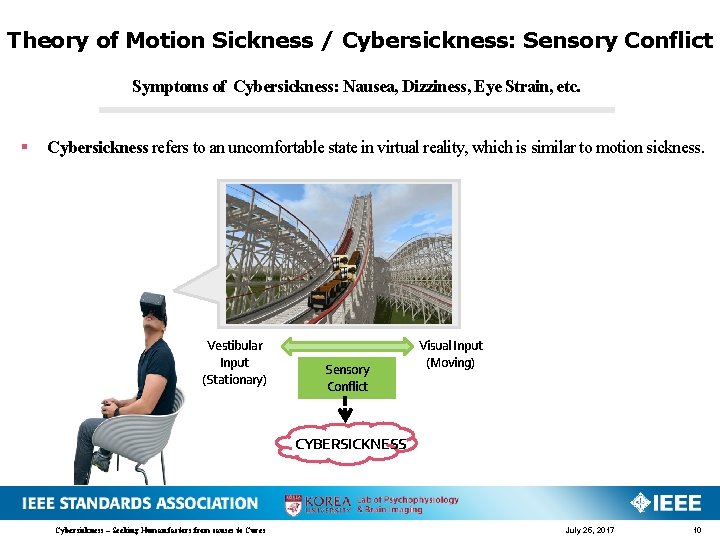
Theory of Motion Sickness / Cybersickness: Sensory Conflict Symptoms of Cybersickness: Nausea, Dizziness, Eye Strain, etc. § Cybersickness refers to an uncomfortable state in virtual reality, which is similar to motion sickness. Vestibular Input (Stationary) Sensory Conflict Visual Input (Moving) CYBERSICKNESS Cybersickness – Seeking Human factors from causes to Cures July 25, 2017 10
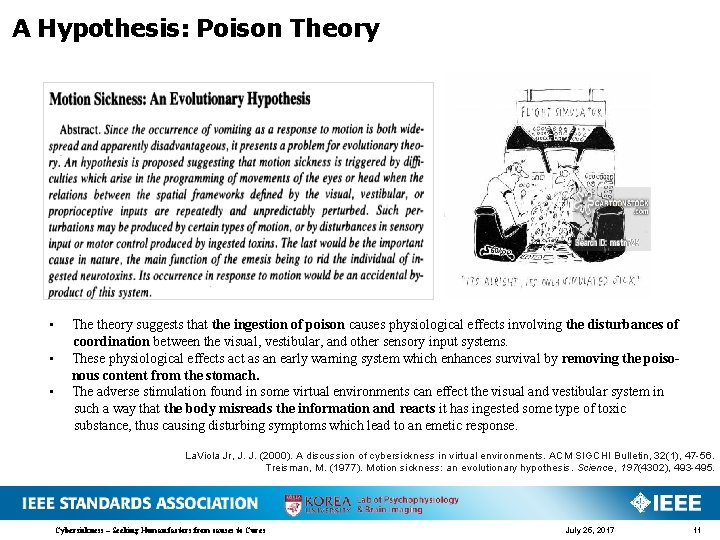
A Hypothesis: Poison Theory • • • The theory suggests that the ingestion of poison causes physiological effects involving the disturbances of coordination between the visual, vestibular, and other sensory input systems. These physiological effects act as an early warning system which enhances survival by removing the poisonous content from the stomach. The adverse stimulation found in some virtual environments can effect the visual and vestibular system in such a way that the body misreads the information and reacts it has ingested some type of toxic substance, thus causing disturbing symptoms which lead to an emetic response. La. Viola Jr, J. J. (2000). A discussion of cybersickness in virtual environments. ACM SIGCHI Bulletin, 32(1), 47 -56. Treisman, M. (1977). Motion sickness: an evolutionary hypothesis. Science, 197(4302), 493 -495. Cybersickness – Seeking Human factors from causes to Cures July 25, 2017 11
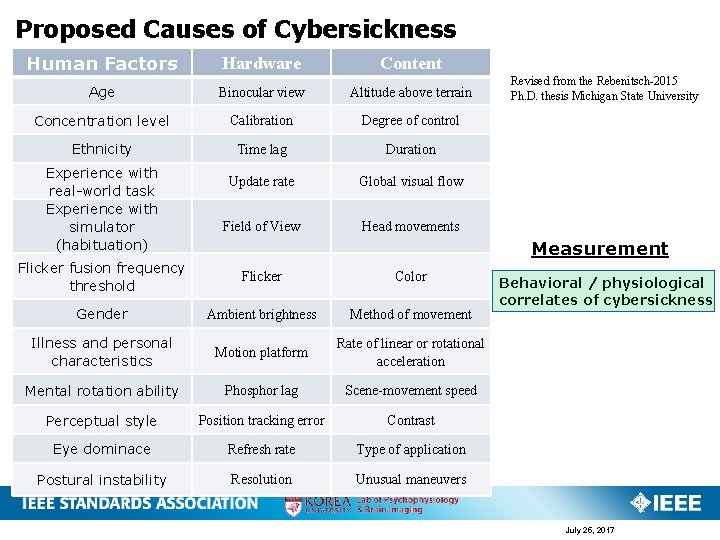
Proposed Causes of Cybersickness Human Factors Hardware Content Age Binocular view Altitude above terrain Concentration level Calibration Degree of control Ethnicity Time lag Duration Update rate Global visual flow Field of View Head movements Experience with real-world task Experience with simulator (habituation) Revised from the Rebenitsch-2015 Ph. D. thesis Michigan State University Measurement Flicker fusion frequency threshold Flicker Color Gender Ambient brightness Method of movement Illness and personal characteristics Motion platform Rate of linear or rotational acceleration Mental rotation ability Phosphor lag Scene-movement speed Perceptual style Position tracking error Contrast Eye dominace Refresh rate Type of application Postural instability Resolution Unusual maneuvers Behavioral / physiological correlates of cybersickness July 25, 2017
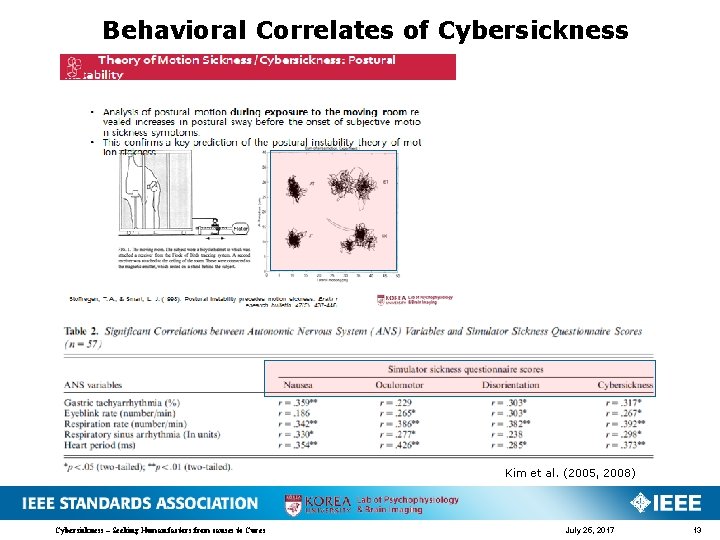
Behavioral Correlates of Cybersickness Kim et al. (2005, 2008) Cybersickness – Seeking Human factors from causes to Cures July 25, 2017 13
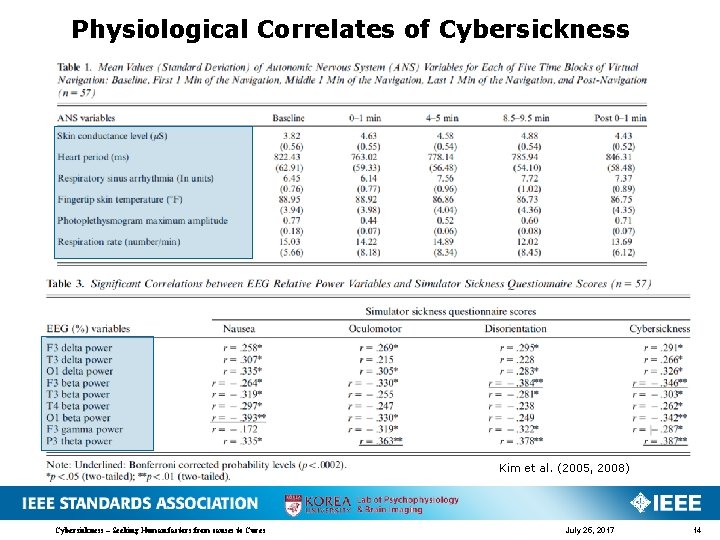
Physiological Correlates of Cybersickness Kim et al. (2005, 2008) Cybersickness – Seeking Human factors from causes to Cures July 25, 2017 14
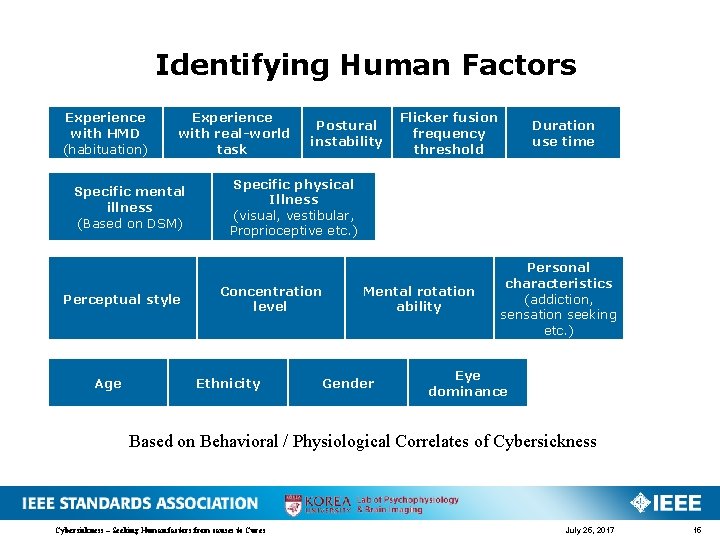
Identifying Human Factors Experience with HMD (habituation) Experience with real-world task Specific mental illness (Based on DSM) Perceptual style Age Postural instability Flicker fusion frequency threshold Duration use time Specific physical Illness (visual, vestibular, Proprioceptive etc. ) Concentration level Ethnicity Mental rotation ability Gender Personal characteristics (addiction, sensation seeking etc. ) Eye dominance Based on Behavioral / Physiological Correlates of Cybersickness – Seeking Human factors from causes to Cures July 25, 2017 15
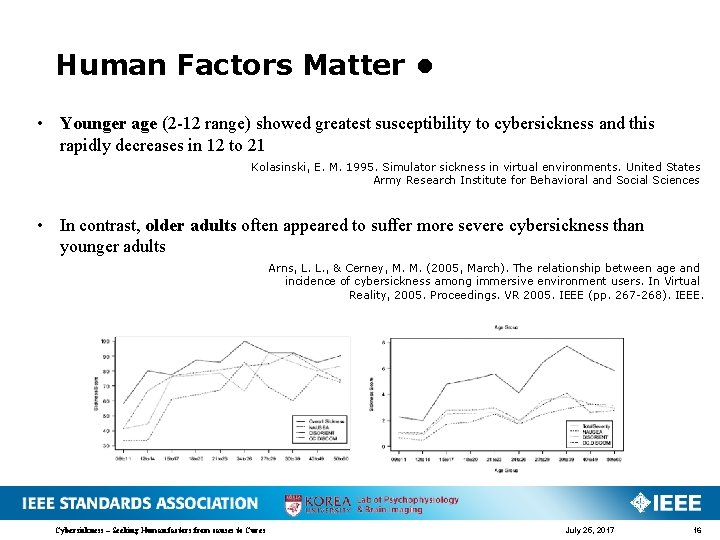
Human Factors Matter • • Younger age (2 -12 range) showed greatest susceptibility to cybersickness and this rapidly decreases in 12 to 21 Kolasinski, E. M. 1995. Simulator sickness in virtual environments. United States Army Research Institute for Behavioral and Social Sciences • In contrast, older adults often appeared to suffer more severe cybersickness than younger adults Arns, L. L. , & Cerney, M. M. (2005, March). The relationship between age and incidence of cybersickness among immersive environment users. In Virtual Reality, 2005. Proceedings. VR 2005. IEEE (pp. 267 -268). IEEE. Cybersickness – Seeking Human factors from causes to Cures July 25, 2017 16
Human Factors Matter • • • The MSSQ score was significantly lower in Caucasians than Chinese volunteers. • Rotation tolerance time was significantly higher in Caucasian than Chinese subjects Klosterhalfen, S. , Kellermann, S. , Pan, F. , STOc. KHORST, U. , Hall, G. , & ENc. K, P. (2005). Effects of ethnicity and gender on motion sickness susceptibility. Aviation, space, and environmental medicine, 76(11), 1051 -1057. • Women have a wider FOV, higher flicker perception. And this in turn increases susceptibility to cybersickness La. Viola Jr, J. 2000. A discussion of cybersickness in virtual environments. ACM SIGCHI Bulletin, 32(1): 47 -56. • No correlation between cybersickness and eye dominance Ling, Y. , Nefs, H. T. , Brinkman, W. P. , Qu, C. , & Heynderickx, I. (2013). The relationship between individual characteristics and experienced presence. Computers in Human Behavior, 29(4), 1519 -1530. • Nichols et al. found a negative correlation between ‘interface (concentration level)’ and cybersickness. Nichols S, Haldane C, Wilson JR. Measurement of presence and its consequences in virtual environments. International Journal of Human. Computer Studies. 2000 March; 52(3): 471 -491. Cybersickness – Seeking Human factors from causes to Cures July 25, 2017 17
Human Factors Matter • • The visual system of field-dependent subjects may be peripheral-dominant whereas the visual system of filed-independent subjects may be foveal-domiant. In other words, field-dependent individuals should be more susceptible to simulator sickenss. Ebenholtz, S. M. , & Benzschawel, T. L. (1977). The rod and frame effect and induced head tilt as a function of observation distance. Perception & Psychophysics, 22(5), 491 -496. • Improved mental rotation ability increased cybersickness in female, but it was reversed in male. But this effect is uncertain. Kolasinski, E. M. 1995. Simulator sickness in virtual environments. United States Army Research Institute for Behavioral and Social Sciences • Biocca suggested that personal characteristics like neuroticism, anxiety and introversion may be related to sickness susceptibility. But the effect requires further research. Biocca, F. (1992). Virtual reality technology: A tutorial. Journal of Communication, 42(4), 23 -72. Cybersickness – Seeking Human factors from causes to Cures July 25, 2017 18
Human Factors Matter • • • People who are not at usual health level, cybersickness susceptibility appears to increase. Kennedy, R. S. , Berbaum, K. S. , Lilienthal, M. G. , Dunlap, W. P. , & Mulligan, B. E. (1987). Guidelines for alleviation of simulator sickness symptomatology (No. NAVTRASYSCEN-TR-87 -007). NAVAL TRAINING SYSTEMS CENTER ORLANDO FL. • Exposure duration is critical factors in simulator-sickness outcome. Loger exposure produce more symptoms and totla sickness score. Kennedy, R. S. , Stanney, K. M. , & Dunlap, W. P. (2000). Duration and exposure to virtual environments: sickness curves during and across sessions. Presence: Teleoperators and virtual environments, 9(5), 463 -472. • Habituation to the side effects of immersion in a virtual reality was studied in some research groups (Hill & Howarth, 2000; Stanney, Kennedy, Drexler, & Harm, 1999). They reported that habituation did occur when virtual reality was repeatedly presented. Kim, Y. Y. , Kim, H. J. , Kim, E. N. , Ko, H. D. , & Kim, H. T. (2005). Characteristic changes in the physiological components of cybersickness. Psychophysiology, 42(5), 616 -625. Cybersickness – Seeking Human factors from causes to Cures July 25, 2017 19
Human Factors Matter • • • Past history of motion sickness and video game (real-world task) have the best predictive power of cybersickness Rebenitsch, L. , & Owen, C. (2014, October). Individual variation in susceptibility to cybersickness. In Proceedings of the 27 th annual ACM symposium on User interface software and technology (pp. 309 -317). ACM. • “The postural instability theory states that the cause of motion sickness and cybersickness is prolonged postural instability. ” In numerous studies, postural instability is correlated with cybersickness La. Viola Jr, J. J. (2000). A discussion of cybersickness in virtual environments. ACM SIGCHI Bulletin, 32(1), 47 -56. • Flicker can cause eye fatigue, and it is related to cybersickness in FOV aspects. K. Harwood and P. Foley. Temporal Resolution: An Insight into the Video Display Terminal (VDT) "Problem". Human Factors, 29(4): 447 -452, 1987. And more human factors… Cybersickness – Seeking Human factors from causes to Cures July 25, 2017 20
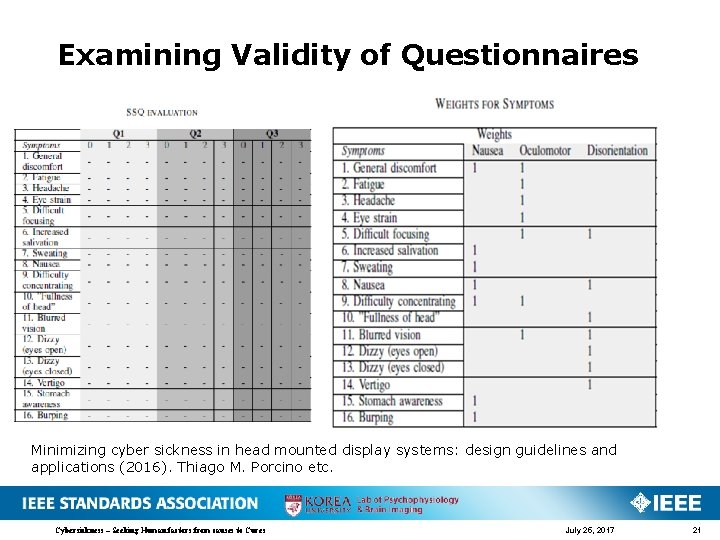
Examining Validity of Questionnaires Minimizing cyber sickness in head mounted display systems: design guidelines and applications (2016). Thiago M. Porcino etc. Cybersickness – Seeking Human factors from causes to Cures July 25, 2017 21
Standardization of Terms • VR motion sickness • Simulation sickness • Stimulator sickness • Cybersickness • Visually induced motion sickness (VIMS) • Motion sickness has been shown to be different from cybersickness or simulator sickness as regards symptoms, both behaviorally and physiologically. Cybersickness – Seeking Human factors from causes to Cures July 25, 2017 22
Scientific Criteria for Preventing Hazardous Symptoms • Reducing cybersickness is feasible, however eradicating all symptoms seems improbable. • Not all cybersickness is harmful, such as motion sickness from rides at amusement parks. • How can we establish scientific criteria for hazardous symptoms of cybersickness which are harmful for users’ health based on different human factors? Cybersickness – Seeking Human factors from causes to Cures July 25, 2017 23
Establishing Standards & Users’ Guide • Connecting dots of human factors with various hardware and content factors to establish a standard to reduce cybersickness based on understand of physiological mechanisms of cybersickness. • Cooperation with other working groups regarding the timetable, work schedules with results of discussion. • Referring to existing user’s guides (for example, Oculus VR Best Practices Guide) to issue better standards and users’ guide. Cybersickness – Seeking Human factors from causes to Cures July 25, 2017 24

Q&A Cybersickness – Seeking Human factors from causes to Cures July 25, 2017 25
- Slides: 25