
Cybersecurity Overview Chapter One The art of war
Cybersecurity Overview Chapter One
The art of war teaches us to rely not on the likelihood of the enemy's not coming, but on our own readiness to receive him; not on the chance of his not attacking, but rather on the fact that we have made our position unassailable. —The Art of War, Sun Tzu
The combination of space, time, and strength that must be considered as the basic elements of this theory of defense makes this a fairly complicated matter. Consequently, it is not easy to find a fixed point of departure. — On War, Carl Von Clausewitz
Introduction �Information security is a topic of extreme importance �the ubiquitous nature of today’s Internet has accelerated the importance of this area to a new and critical level. �It is vital, that in today’s world, one must have confidence information their information remain secret as they pass through elements encountered along the communication path from source to destination
A Definition of Computer Security �security is “the quality or state of being secure— to be free from danger. �The protection of information and its critical elements, including the systems and hardware that use, store, and transmit that information �The protection afforded to an automated information system in order to attain the applicable objectives of preserving the integrity, availability and confidentiality of information system resources (includes hardware, software, firmware, information/data, and telecommunications) �Organizations must enforce multiple layers of security ◦ Physical, personnel, operational, network, and information security communication,
A Definition of Computer Security … � This definition introduces three key objectives that are at the heart of computer security. � Confidentiality � Data confidentiality : Assures that private or confidential information is not made available or disclosed to unauthorized individuals � Privacy : Assures that individuals control what information to be collected and stored and by whom and to whom about them � Integrity � Data integrity: Assures that information are changed only in authorized manner � System integrity: Assures that a system performs its intended function in an unimpaired manner, � Availability : Assures that systems work promptly and service is not denied to authorized users
Cybersecurity � Cybersecurity is a collection of defensive technologies (hardware/software), processes and practices designed to protect networks, computers, programs and information from attack, damage or unauthorized access in order to secure systems that are connected to the Internet. � Cybersecurity protects against threats using defensive measures, including o o o information assurance, computer systems, and applications hardening, malware protection, access control, information infrastructure protection, and Network security
Key Objectives of Security Confidentiality: Preserving authorized restrictions on information access and disclosure, including means for protecting personal privacy and proprietary information. A loss of confidentiality is the unauthorized disclosure of information. Integrity: Guarding against improper information modification or destruction, including ensuring information nonrepudiation and authenticity. A loss of integrity is the unauthorized modification or destruction of information. Availability: Ensuring timely and reliable access to and use of information.
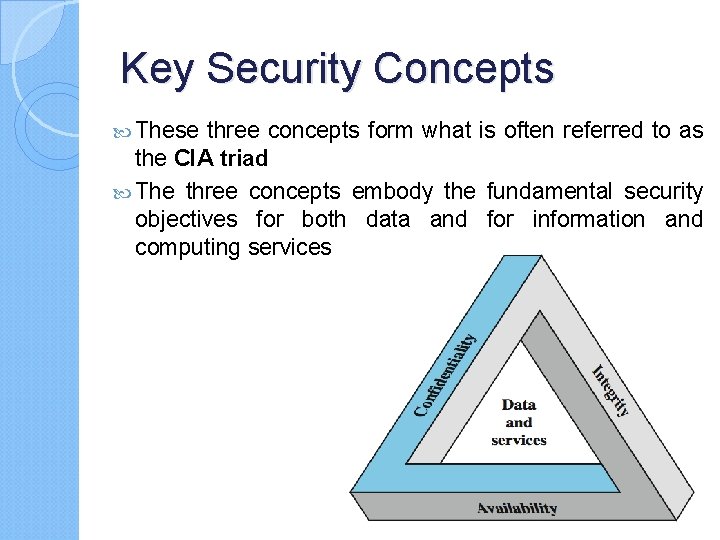
Key Security Concepts These three concepts form what is often referred to as the CIA triad The three concepts embody the fundamental security objectives for both data and for information and computing services
Key Objectives of Security … Additional Goals of security are Authenticity : The property of being genuine and being able to be verified and trusted; confidence in the validity of a transmission, a message, or message originator. This means verifying that users are who they say they are and that each input arriving at the system came from a trusted source. Authorization: a security measure that verifies whether you have permission to access the specific resources Access control: A security measure that permits access to the various resources by the user or process.
Key Objectives of Security … Accountability and non-repudiation : The security goal that generates the requirement for actions of an entity to be traced uniquely to that entity. This supports nonrepudiation, deterrence, fault isolation, intrusion detection and prevention, and after -action recovery and legal action Since truly secure systems are not yet an achievable goal, we must be able to trace a security breach to a responsible party. Systems must keep records of their activities to permit later forensic analysis to trace security breaches or to aid in transaction disputes.
Levels of Impact � 3 levels of impact from a security breach �Low - The loss could be expected to have a limited adverse effect on organizational operations, organizational assets, or individuals (mission, minor damage, financial loss, harm to individuals…) �Moderate - The loss could be expected to have a serious adverse effect on organizational operations, organizational assets, or individuals (mission, huge damage, financial loss, harm to individuals…) �High - The loss could be expected to have a severe or catastrophic adverse effect on organizational operations, organizational assets, or individuals (severe mission , major damage , financial loss, individual (catastrophic ) …)
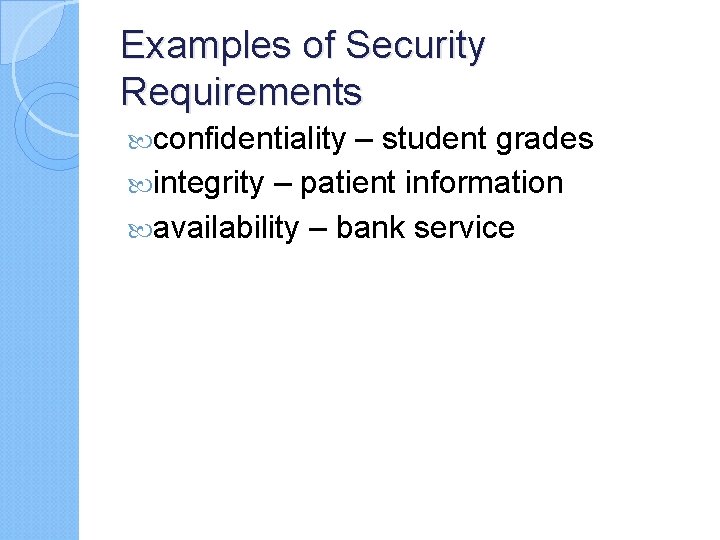
Examples of Security Requirements confidentiality – student grades integrity – patient information availability – bank service
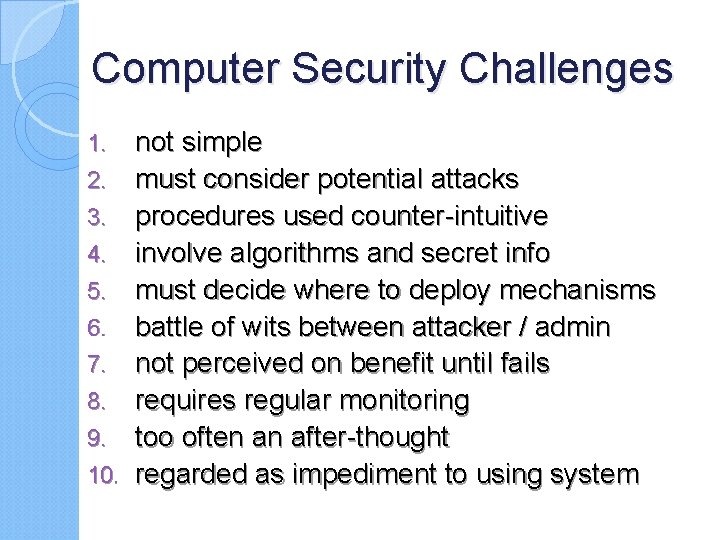
Computer Security Challenges 1. 2. 3. 4. 5. 6. 7. 8. 9. 10. not simple must consider potential attacks procedures used counter-intuitive involve algorithms and secret info must decide where to deploy mechanisms battle of wits between attacker / admin not perceived on benefit until fails requires regular monitoring too often an after-thought regarded as impediment to using system
OSI Security Architecture ITU-T X. 800 “Security Architecture for OSI” defines a systematic way of defining and providing security requirements for us it provides a useful, if abstract, overview of concepts we will study
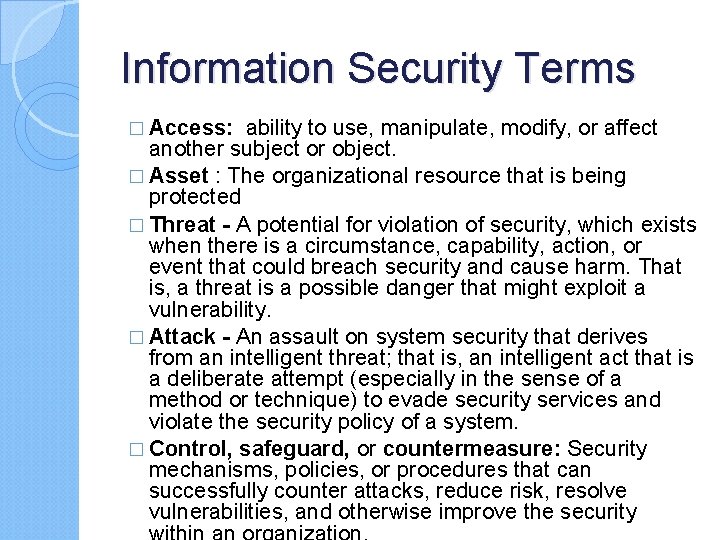
Information Security Terms ability to use, manipulate, modify, or affect another subject or object. � Asset : The organizational resource that is being protected � Threat - A potential for violation of security, which exists when there is a circumstance, capability, action, or event that could breach security and cause harm. That is, a threat is a possible danger that might exploit a vulnerability. � Attack - An assault on system security that derives from an intelligent threat; that is, an intelligent act that is a deliberate attempt (especially in the sense of a method or technique) to evade security services and violate the security policy of a system. � Control, safeguard, or countermeasure: Security mechanisms, policies, or procedures that can successfully counter attacks, reduce risk, resolve vulnerabilities, and otherwise improve the security � Access:
Information Security Terms … � Exploit: A technique used to compromise a system. � Exposure: A condition or state of being exposed. In information security, exposure exists when a vulnerability known to an attacker is present. � Loss: A single instance of an information asset suffering damage or unintended or unauthorized modification or disclosure. When an organization’s information is stolen, it has suffered a loss. � Risk: The probability that something unwanted will happen. � Vulnerability: A weaknesses or fault in a system or protection mechanism that opens it to attack or damage.
Aspects of Security 3 aspects of information security: security attack - Any action that compromises the security of information owned by an organization. security mechanism- A process (or a device incorporating such a process) that is designed to detect, prevent, or recover from a security attack. security service- A processing or communication service that enhances the security of the data processing systems and the information transfers of an organization. The services are intended to counter security attacks, and they make use of one or more security mechanisms to provide the service.
Security Attacks and Malware Attacks on the Internet information infrastructure originate from the four corners of the world and can be absolutely devastating. � The attacks on hosts are generated through malware and can easily gain unauthorized access to critical information. � � Malware comes in five distinct categories/capabilities: o o Spyware, Viruses, Worms Trojans and Rootkits Another form of attack is the denial of service (Do. S) attack in which legitimate users are denied access to resources. � These Do. S attacks will typically exhaust the server’s memory and processing capacity and/or exhaust the link bandwidth. � For the attack to work its purpose their should be vulnerability to computer system �
Security Attacks and Malware … � Based on X. 800 and RFC 2828, � passive attacks and active attacks. � Passive attack : attempts to learn or make use of information from the system but does not affect system resources. � Passive attacks are in the nature of eavesdropping on, or monitoring of, transmissions. The goal of the opponent is to obtain information that is being transmitted. Two types of passive attacks are: release of message contents , traffic analysis � Active attacks : attempts to alter system resources or affect their operation and can be subdivided into four categories: masquerade,
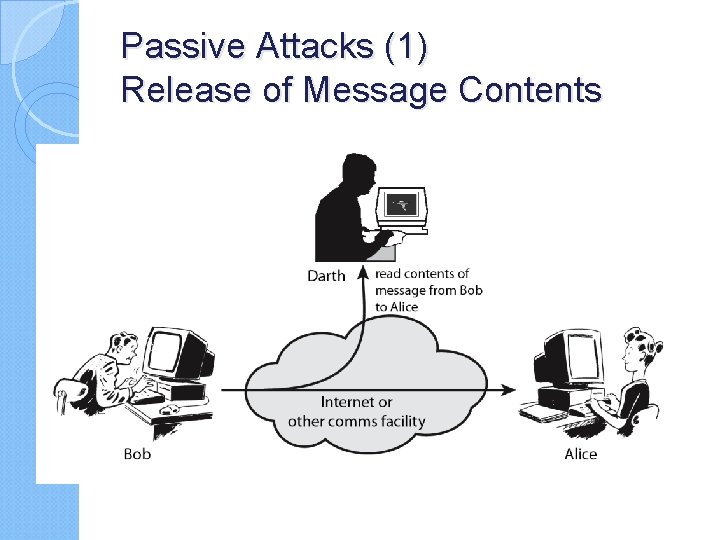
Passive Attacks (1) Release of Message Contents
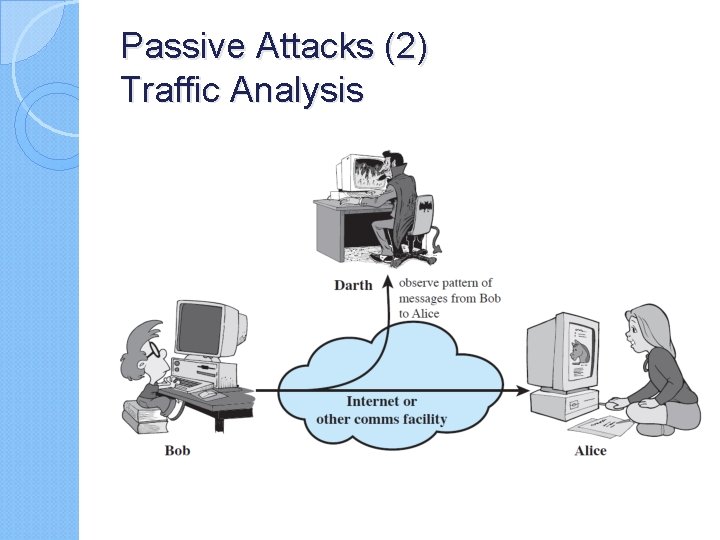
Passive Attacks (2) Traffic Analysis
Passive attacks do not affect system resources ◦ Eavesdropping, monitoring Two types of passive attacks ◦ Release of message contents ◦ Traffic analysis Passive attacks are very difficult to detect ◦ Message transmission apparently normal No alteration of the data ◦ Emphasis on prevention rather than detection By means of encryption
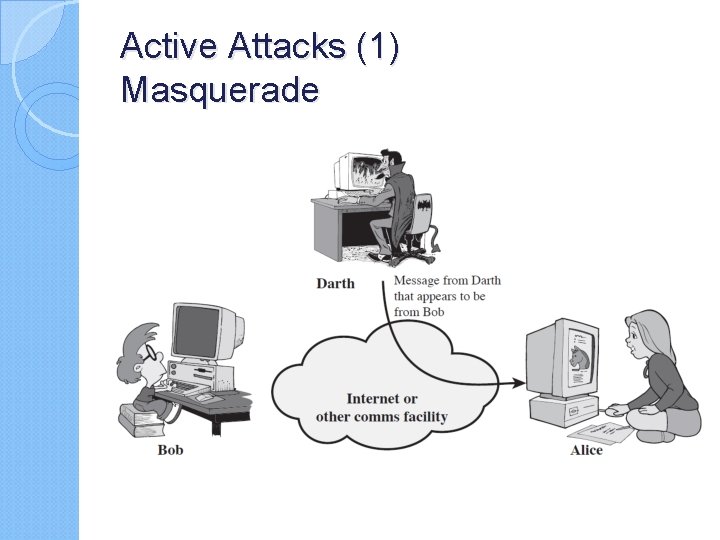
Active Attacks (1) Masquerade
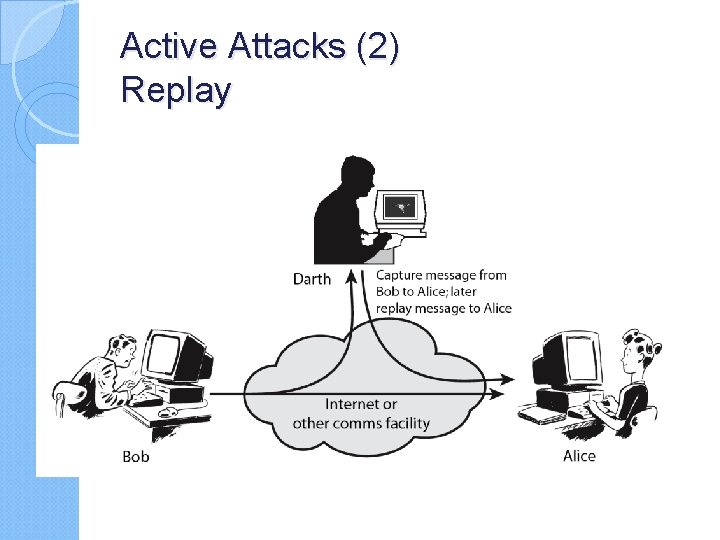
Active Attacks (2) Replay
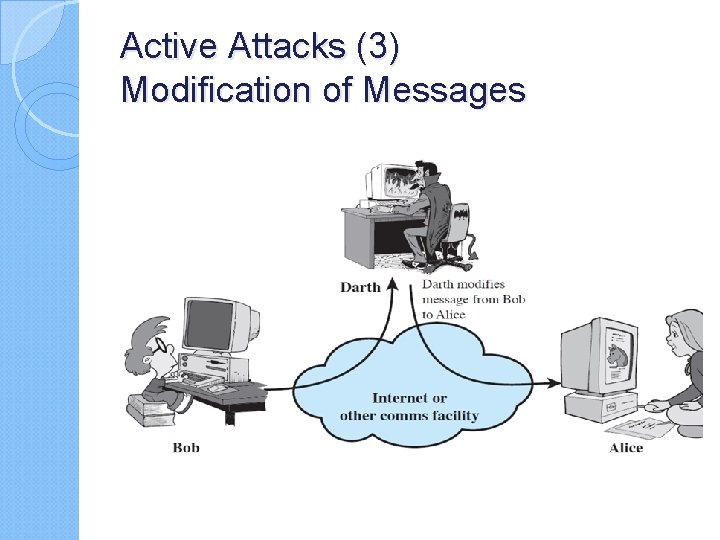
Active Attacks (3) Modification of Messages
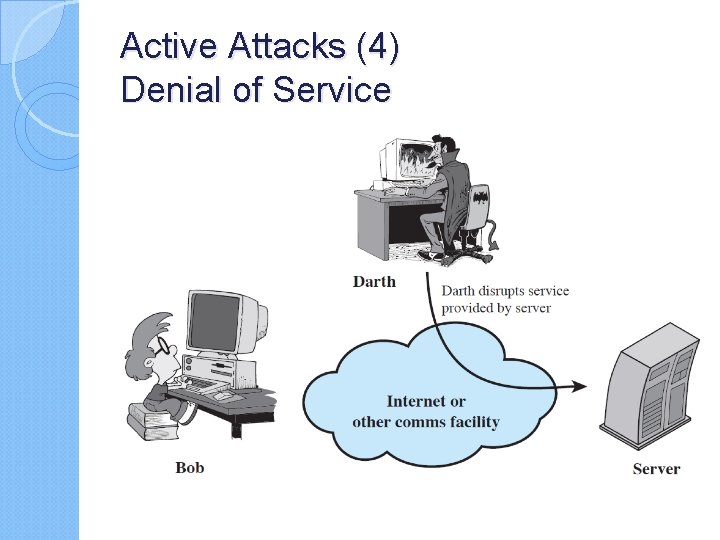
Active Attacks (4) Denial of Service
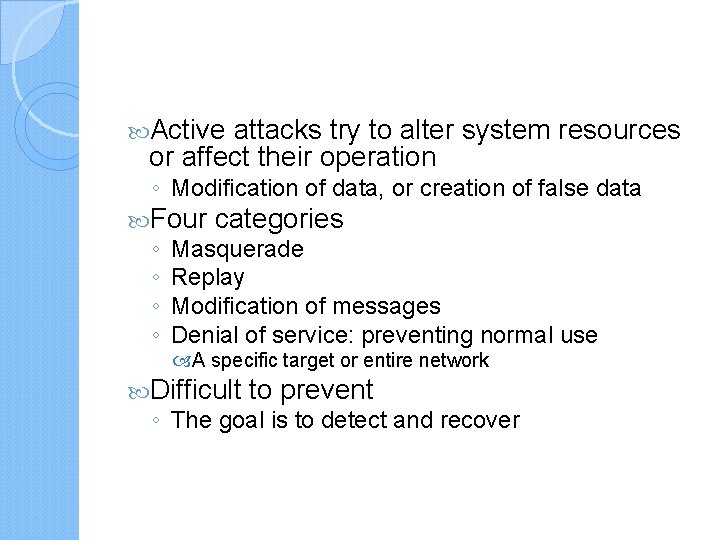
Active attacks try to alter system resources or affect their operation ◦ Modification of data, or creation of false data Four categories ◦ Masquerade ◦ Replay ◦ Modification of messages ◦ Denial of service: preventing normal use A specific target or entire network Difficult to prevent ◦ The goal is to detect and recover
Security Service • enhance security of data processing systems and information transfers of an organization • intended to counter security attacks • using one or more security mechanisms • often replicates functions normally associated with physical documents o which, for example, have signatures, dates; need protection from disclosure, tampering, or destruction; be notarized or witnessed; be recorded or licensed
Security Services X. 800: “a service provided by a protocol layer of communicating open systems, which ensures adequate security of the systems or of data transfers” RFC 2828: “a processing or communication service provided by a system to give a specific kind of protection to system resources”
Security Services (X. 800) �Authentication - assurance that communicating entity is the one claimed ◦ have both peer-entity & data origin authentication �Access Control - prevention of the unauthorized use of a resource �Data Confidentiality –protection of data from unauthorized disclosure �Data Integrity - assurance that data received is as sent by an authorized entity �Non-Repudiation - protection against denial by one of the parties in a communication �Availability – resource accessible/usable
Security Mechanism feature designed to detect, prevent, or recover from a security attack no single mechanism that will support all services required however one particular element underlies many of the security mechanisms in use: ◦ cryptographic techniques
Security Mechanisms (X. 800) specific security mechanisms: ◦ encipherment, digital signatures, access controls, data integrity, authentication exchange, traffic padding, routing control, notarization pervasive security mechanisms: ◦ trusted functionality, security labels, event detection, security audit trails, security recovery
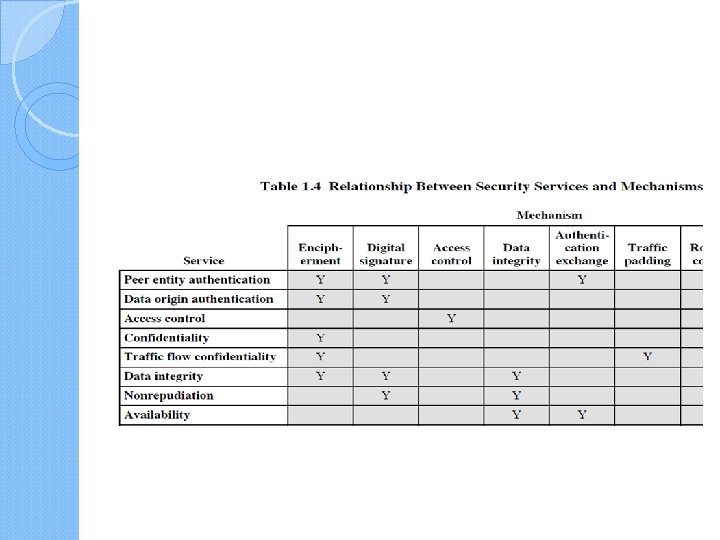
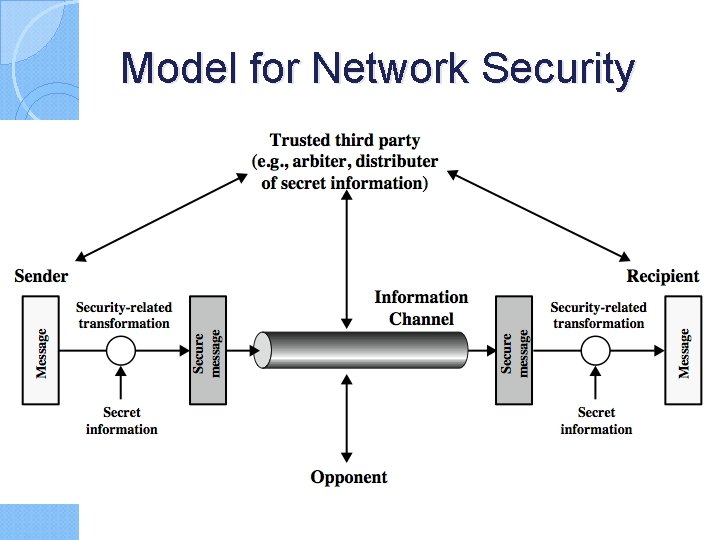
Model for Network Security
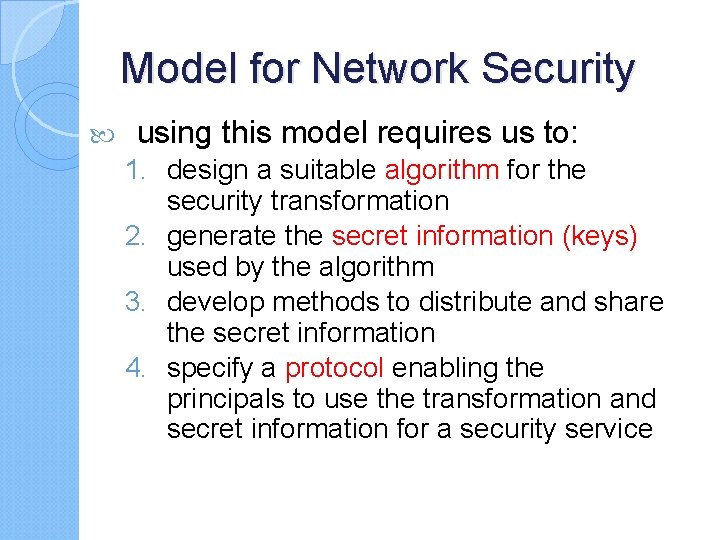
Model for Network Security using this model requires us to: 1. design a suitable algorithm for the security transformation 2. generate the secret information (keys) used by the algorithm 3. develop methods to distribute and share the secret information 4. specify a protocol enabling the principals to use the transformation and secret information for a security service
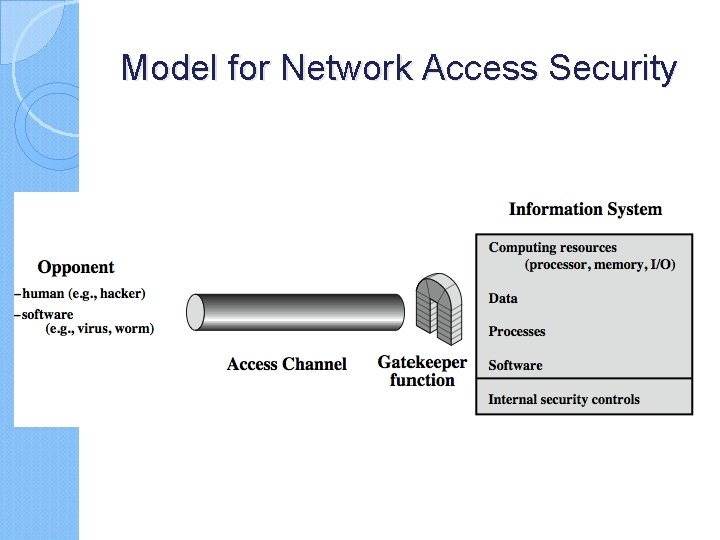
Model for Network Access Security
Model for Network Access Security using this model requires us to: 1. select appropriate gatekeeper functions to identify users 2. implement security controls to ensure only authorised users access designated information or resources
Standards NIST: National Institute of Standards and Technology ◦ FIPS: Federal Information Processing Standards ◦ SP: Special Publications ISOC: Internet Society ◦ Home for IETF (Internet Engineering Task Force) and IAB (Internet Architecture Board) ◦ RFCs: Requests for Comments
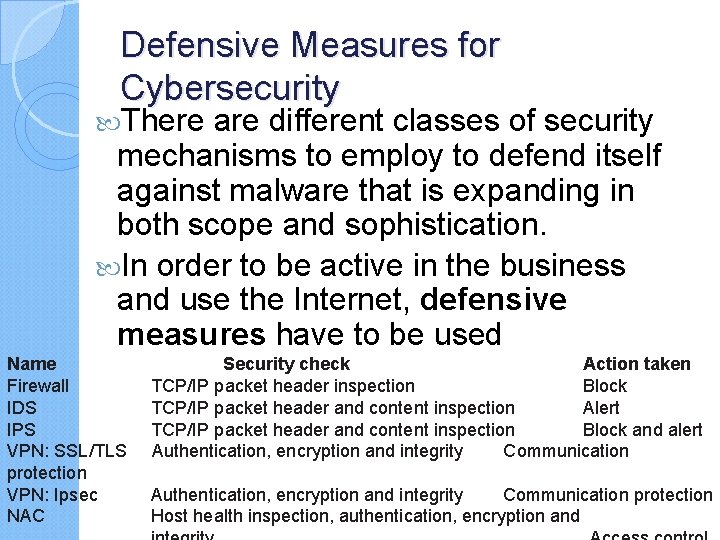
Defensive Measures for Cybersecurity There are different classes of security mechanisms to employ to defend itself against malware that is expanding in both scope and sophistication. In order to be active in the business and use the Internet, defensive measures have to be used Name Firewall IDS IPS VPN: SSL/TLS protection VPN: Ipsec NAC Security check Action taken TCP/IP packet header inspection Block TCP/IP packet header and content inspection Alert TCP/IP packet header and content inspection Block and alert Authentication, encryption and integrity Communication protection Host health inspection, authentication, encryption and
The Firewall, the Intrusion Detection System (IDS) and the Intrusion Prevention System (IPS) malware is capable of destroying the Internet and everyone attached to it, Three of the methods that are employed to protect systems are the Firewall, the Intrusion Detection System (IDS) and the Intrusion Prevention System (IPS These elements are typically placed at critical entry and exit points to protect vital assets, such as a server farm, a financial database, or something else of significant value.
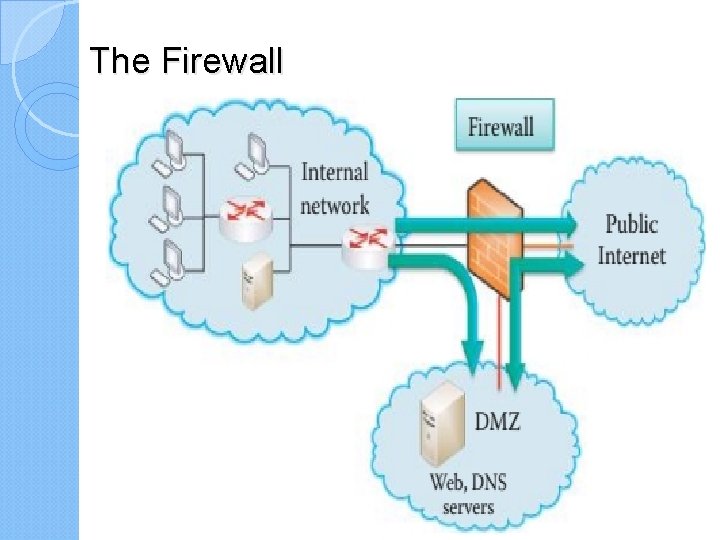
The Firewall Host firewalls are used in a computer’s OS/application to protect the host. Network firewalls are used to protect the entrance to a network and block packets based on the IP address and port number in the header. In addition, a stateful inspection is performed in order to maintain a state transition table for a connection. Its purpose is to isolate an organization’s internal network. The firewall permits transmission from the organization to either the public Internet or the Demilitarized Zone (DMZ), as well as transmission from the DMZ to the Internet. However, it blocks traffic into the organization from
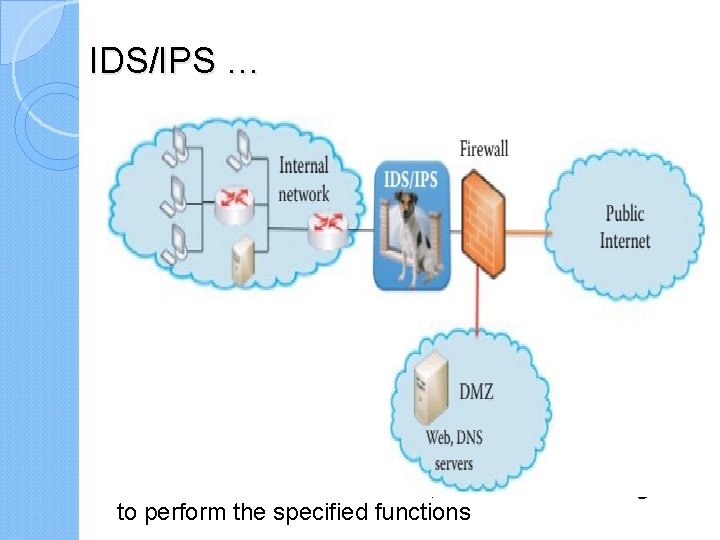
IDS/IPS Both IDS and IPS are used to monitor potentially malicious traffic by inspecting the entire packet IDS will let the packet pass, but sends an alert to the network administrator, while IPS will block a malicious packet and send a message to the network administrator IDS/IPS is strategically placed at the entrance to an organization. From this point it can detect a wide range of attacks. Attackers typically perform network mapping, in the form of reconnaissance, port scans and TCP stack scans that can be detected/blocked by the IDS/IPS. It can also detect denial of service bandwidth-flooding attacks, worms and viruses, as well as both OS and application vulnerability attacks.
IDS/IPS … Signature-based detection methods used in IDS/IPS and anti-virus software ineffective against any zeroday or mutated malware. The IDS generates too many false positive alarms, which make it difficult for administrators to identify meaningful attacks. On the other end, the IPS only blocks the packets that are definitely malicious while other malicious packets pass through. It is the responsibility of every user to take precautionary measures, by employing the help of currently available defense products, when surfing the Internet. Today’s fully featured routers contain within them the firewall and IDS/IPS functions, which can be configured to perform the specified functions
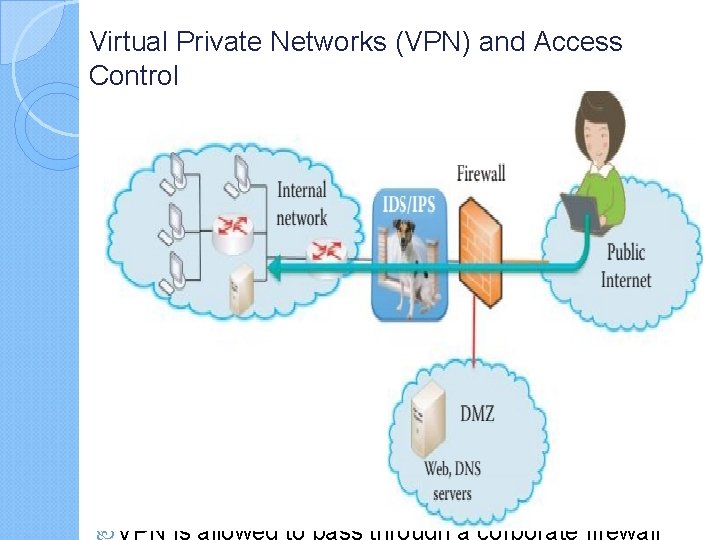
Virtual Private Networks (VPN) and Access Control While it is clear that defensive measures must be applied at every possible location, The communication, which often carries sensitive information, must also be protected. There are several methods that can be employed with information transmission. Among them are encryption, authentication and authorization. For example, Secure Socket Layer/Transport Layer Security (SSL/TLS) is used between the session and transport layers for such things as Internet shopping and web mail. The Internet Protocol Security (IPsec) is used in the network layer for such things as a virtual private network (VPN)
Virtual Private Networks (VPN) and Access Control… Organizational network access control (NAC) is agentbased NAC deployed at each host and central control server. Only healthy hosts that are certified by their agents can have network access, and security policy enforcement is a main feature of NAC in an enterprise network. 802. 11 i is used in the data link layer for Wi. Fi or 802. 11 WLAN; organizational access control using Active Directory based on Kerberos is used for user access control, RADIUS/AAA protocol is employed for authentication and 802. 1 x is placed in layer 2 for Wi. Fi and LAN authentication. Today’s routers, have IPsec or SSL/TLS VPN functions built right into the unit.
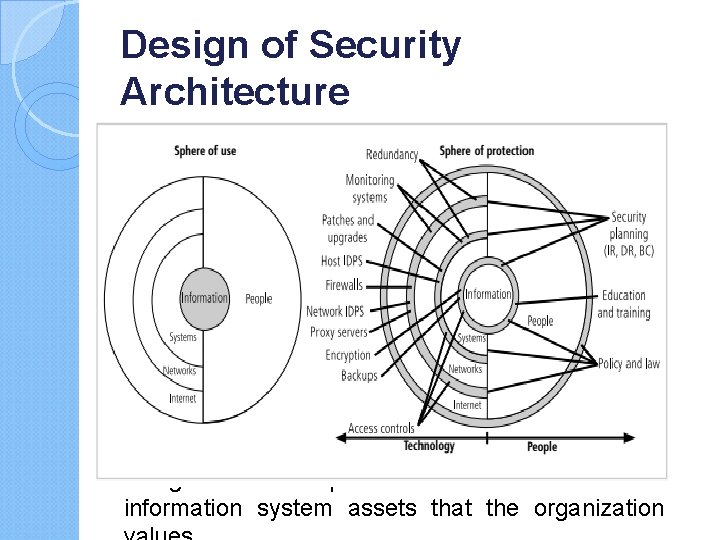
Design of Security Architecture Spheres of Security the foundation of the security framework. Generally speaking, the spheres of security illustrate how information is under attack from a variety of sources. Information security is designed and implemented in three layers: policies, people (education, training, and awareness programs), and technology, commonly referred to as PPT. Each of the layers contains controls and safeguards that protect the information and information system assets that the organization
Design of Security Architecture … Levels of Controls Information security safeguards provide three levels of control: managerial, operational, and technical. Managerial controls are security processes that are designed by strategic planners and implemented by the security administration of the organization. Management controls set the direction and scope of the security process and provide detailed instructions for its conduct, It also describe the necessity and scope of legal compliance, and set guidelines for the maintenance of the entire security life cycle.
Design of Security Architecture … Operational controls are management and lowerlevel planning functions that deal with the operational functionality of security in the organization, such as disaster recovery and incident response planning. Operational controls address personnel security, physical security, and the protection of production inputs and outputs. In addition, operational controls guide the development of education, training, and awareness programs for users, administrators, and management. Finally, they address hardware and software systems maintenance and the integrity of data.
Design of Security Architecture … Technical controls are the tactical and technical implementations of security in the organization. Technical controls are the components put in place to protect an organization’s information assets. They include logical access controls, such as identification, authentication, authorization, accountability (including audit trails), cryptography, and the classification of assets and users.
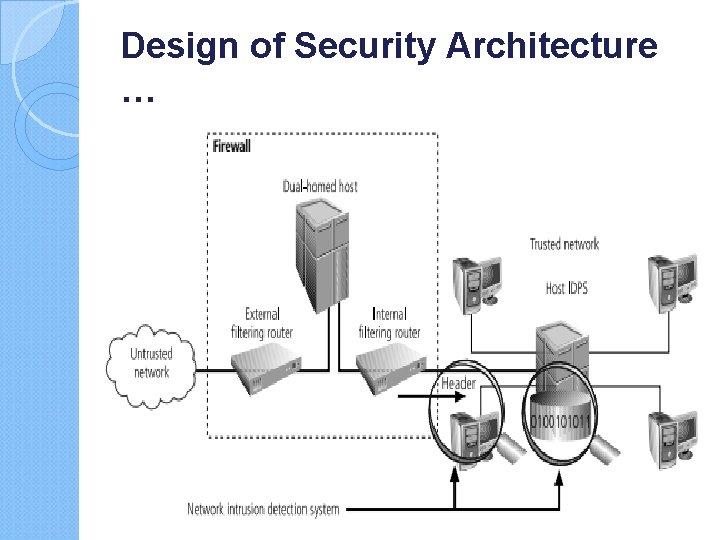
Design of Security Architecture … Defense in Depth One of the basic tenets of security architectures is the layered implementation of security. This layered approach is called defense in depth. To achieve defense in depth, an organization must establish multiple layers of security controls and safeguards, which can be organized into policy, training and education, and technology, Implementing multiple types of technology and thereby precluding that the failure of one system will compromise the security of information is referred to as redundancy. Redundancy can be implemented at a number of points throughout the security architecture, such as in firewalls, proxy servers, and access controls.
Integrated Defense in Depth can be implemented using an integrated defense for an enterprise network using the following formula Integrated defense = endpoint security software + cloud + NAC + IDS/IPS + Firewall ◦ ◦ ◦ Endpoint security software contains a lot of protection such as Malware signatures Real-time code emulation Advanced heuristics A cloud-centric feedback loop from actual users, such as reputation services that blocks bad IP addresses, URLs, and files ◦ Application controls that are effective in decreasing the endpoint attack surface ◦ Tools provide kernel level, hypervisor level, or CPU level protection to protect against rootkits The NAC uses centralized policy enforcement for endpoint security, that can be configured in accordance with the role of the user and associated devices and employed by the user
Attacks on the Power Grid and Utility Networks In addition to the security issues associated with financial entities, such as credit cards and bank accounts, there attacks on portions of the critical infrastructure such as utilities. These industrial-control systems (ICS) and their networks are used to control water, chemical and energy systems. Only about half a dozen major manufacturers, such as Siemens and GE, make these systems. Most ICS’s employ either Microsoft Windows or Linux OS.
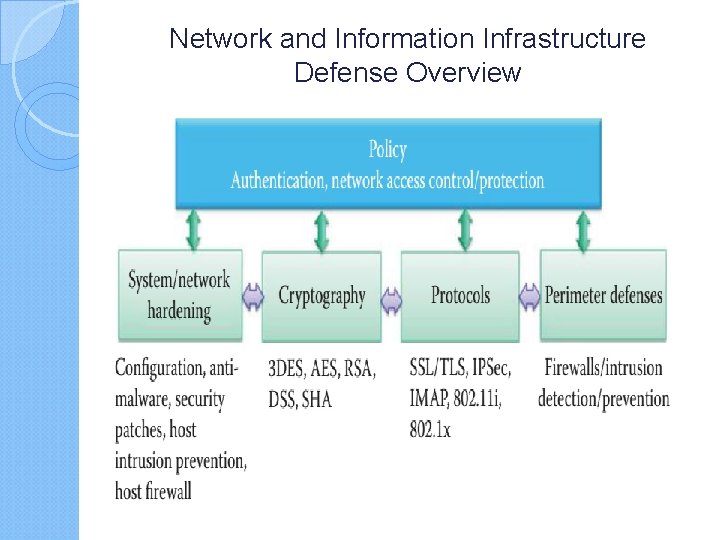
Network and Information Infrastructure Defense Overview In general, many feature-rich systems are not developed with security in mind e. g. , ◦ web 2. 0/AJAX has too many weaknesses. ◦ It is almost impossible for implementations to consider all security issues, and buffer overflows become the “IEDs” of these systems. ◦ In addition, there are weaknesses in protocol implementations, e. g. , DNS and older versions of SSL, SSH, FTP, and the like. ◦ Furthermore, many attacks are not even technical in nature, such as phishing, impersonation, social engineering, etc. It is imperative that mechanisms be established and used extensively to counter and eliminate them A security policy dictates the security measures that are deployed for protecting the infrastructure.
Network and Information Infrastructure Defense Overview … Overall security is clearly a cooperative effort, with centralized management, that involves all hosts and network/security equipment. Security mechanisms range from soup to nuts and include hardware and software-based methods. OS and applications must be hardened in hardware devices such as smartphones, computers, servers, switches, routers, and regularly patched with security updates For example, ◦ unnecessary applications must be uninstalled and unused TCP/UDP ports must not be left open. ◦ In addition, there must security policy for these devices and their access to the information infrastructure.
Network and Information Infrastructure Defense Overview. . . Cryptography also plays a critical role in protecting an infrastructure. cryptographic hash functions for authentication, Symmetric key encryption, public-key infrastructure and certificates for authentication, and pseudo-random generators to ensure freshness and eliminate replays. Another important technique is the use of authentication and key establishment within a domain. Kerberos is an excellent authentication method supported by every OS
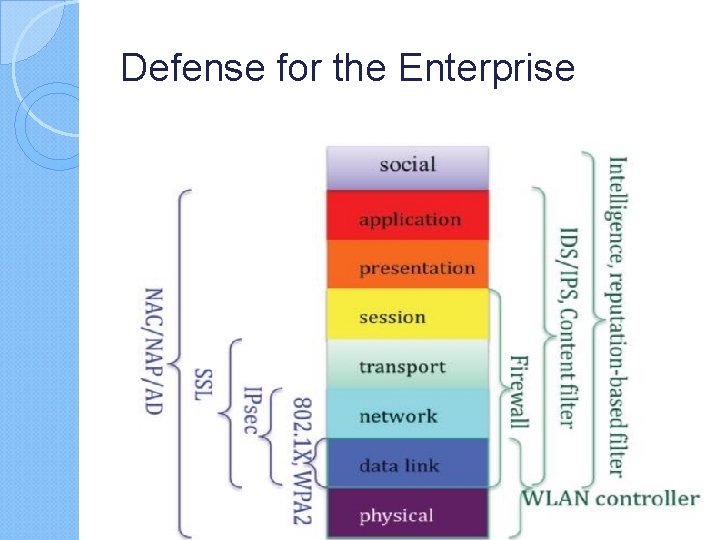
Defense for the Enterprise Intelligence and a reputation-based filter can be deployed to protect web and email access, and is especially important in countering the rapidly changing nature of the malware. IDS/IPS and a content filter can be used to perform deep packet inspection based on the knowledge of applications. Firewalls can be useful in filtering
Defense for the Enterprise WLAN controllers can be deployed to monitor the spectrum and detect rogue access points. 802. 1 X and WPA 2 can be used to protect data link layer communications. IPsec is a VPN protocol that protects network layer communications. SSL/TLS is widely used for protecting transport layer communications Network access control/protection (NAC/NAP) and AD can be used to protect an information infrastructure by monitoring the health of every host based on all available defense hardware and software.
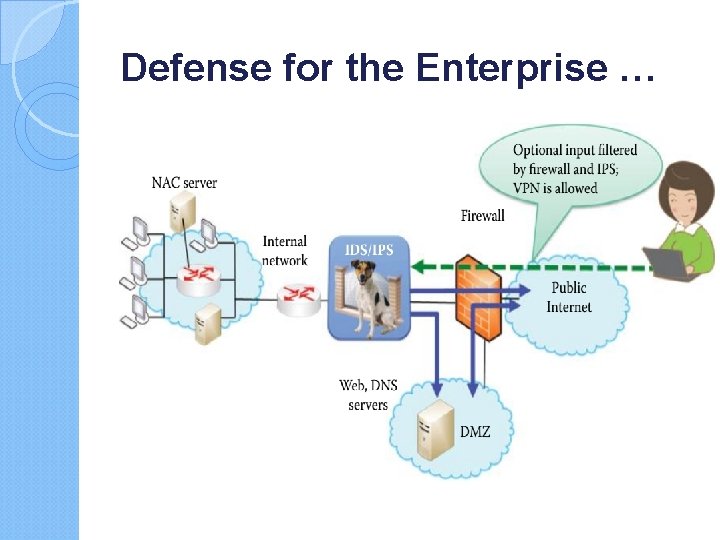
Defense for the Enterprise … A firewall and IDS/IPS are used for guarding the entrance of the enterprise network. VPN is typically used for remote access to the enterprise network and is allowed by the firewall. A Demilitarized Zone (DMZ) is established in order to permit the outside Internet to access public information of the enterprise network, such as DNS, web and email servers. Internal hosts can also access the servers in the DMZ and the Internet. However, the hosts in the Internet are blocked by the firewall from accessing the internal network, and these external hosts can access the internal network only through VPN.
Defense for the Enterprise … Protection via cryptography and protocols includes 1. symmetric key crypto, which involves encryption for confidentiality and hash for authentication. 2. public key crypto, which consists of public key encryption, signatures and public key certificates for authentication, and 3. Protocols based upon crypto, that include VPN and SSL using public key crypto for authentication as well as symmetric key establishment, and symmetric key crypto for encryption.
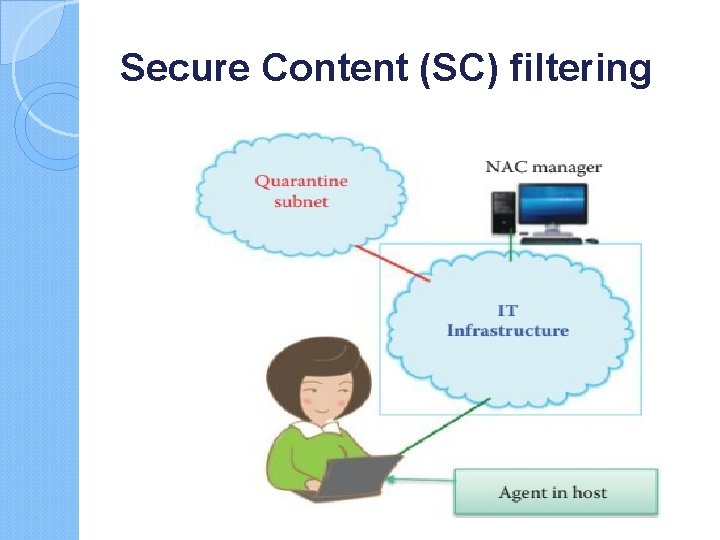
Secure Content (SC) filtering includes antimalware, anti-spam, url filtering, and packet content filtering and is referred to as a deep packet inspection of packet payload content SC filtering is usually provided by a dedicated appliance, or an integrated appliance that may contain a firewall, IDS/ IPS, VPN, etc. The integrated security appliance is widely deployed at the entrance of important subnets in an organization as a compliment to host-based defense software
penetration test A penetration test is used for evaluating the security of an enterprise network and hosts by simulating attacks from potential attackers using active exploitation of vulnerabilities. The purpose of the test is to discover the vulnerabilities that may result from improper configurations, hardware and software, or policy violations. The discovered vulnerabilities are
Contingency planning NIST provides a guide for viable contingency planning that an organization may adopt for their information systems. Contingency planning refers to interim measures used to recover information system services after a disruption. Interim measures may include relocation of information systems and operations to an alternate site, recovery of information system functions using alternate equipment, or information system functions using manual methods.
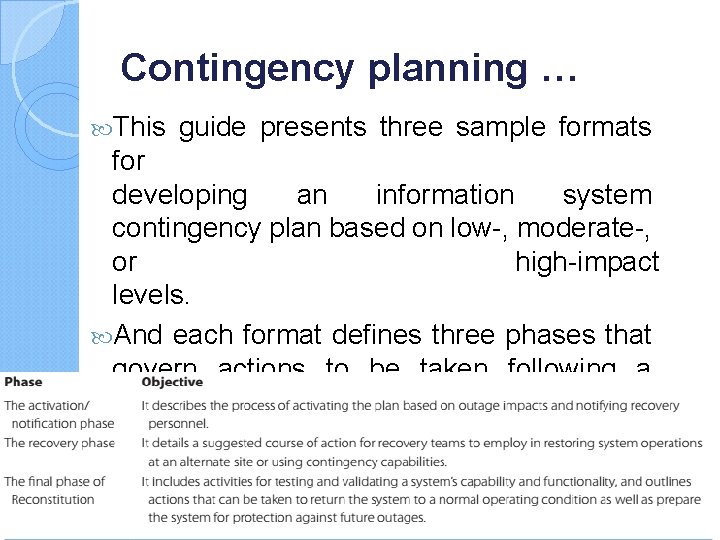
Contingency planning … This guide presents three sample formats for developing an information system contingency plan based on low-, moderate-, or high-impact levels. And each format defines three phases that govern actions to be taken following a system disruption
Contingency planning … The cyber incident response plan establishes procedures to address cyber attacks that occur against an organization’s information system(s). The procedures are designed to enable security personnel to identify, mitigate, and recover from malicious computer incidents, such as unauthorized access to a system or data, denial of service, or unauthorized changes to system hardware, software, or data,
The Critical Infrastructure Protection (CIP) Plan Critical infrastructure and key resources (CIKR) are those components of the national infrastructure that are deemed so vital that their loss would have a debilitating effect on the safety, security, economy, and/or health of a country A CIP plan is a set of policies and procedures that serve to protect and recover these national assets as well as mitigate risks and vulnerabilities. CIP plans define the roles and responsibilities for protection, develop partnerships and information sharing relationships, implement the risk management framework defined in the National Infrastructure Protection Plan (NIPP)
- Slides: 66