
CyberSecurity and Privacy Challenges in the Electrical Power
Cyber-Security and Privacy Challenges in the Electrical Power System Lalitha Sankar School of Electrical, Computer, and Energy Engineering Arizona State University November 30, 2020 1
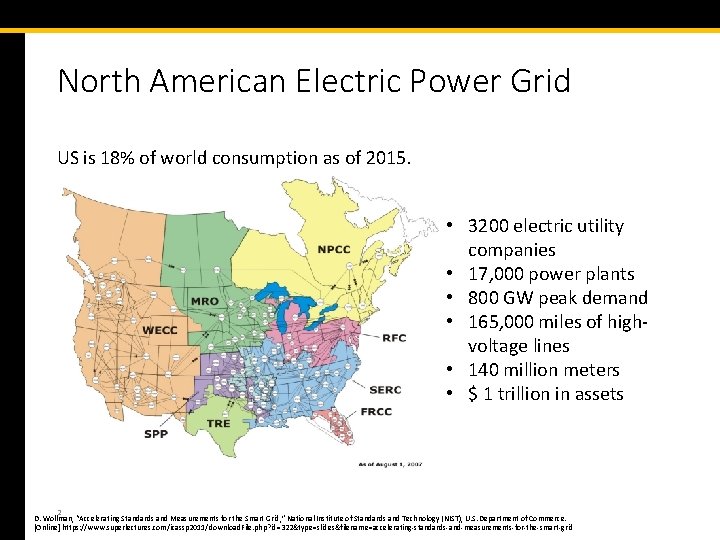
North American Electric Power Grid US is 18% of world consumption as of 2015. • 3200 electric utility companies • 17, 000 power plants • 800 GW peak demand • 165, 000 miles of highvoltage lines • 140 million meters • $ 1 trillion in assets 2 D. Wollman, “Accelerating Standards and Measurements for the Smart Grid, ” National Institute of Standards and Technology (NIST), U. S. Department of Commerce. [Online] https: //www. superlectures. com/icassp 2011/download. File. php? id=322&type=slides&filename=accelerating-standards-and-measurements-for-the-smart-grid
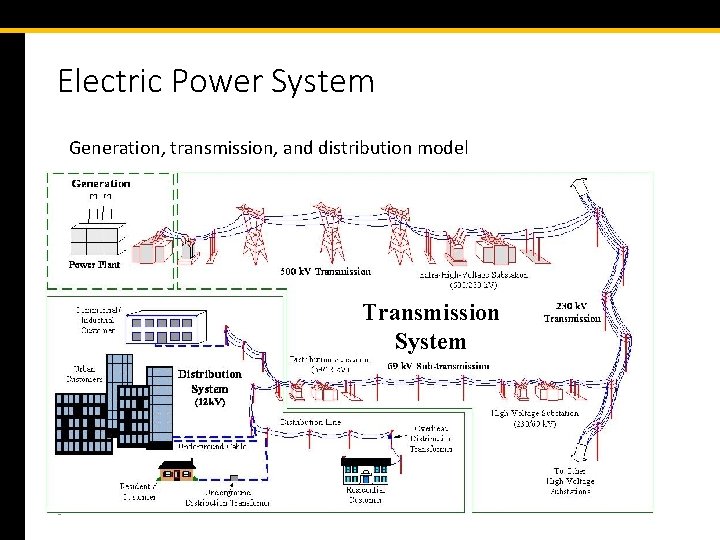
Electric Power System Generation, transmission, and distribution model Transmission System 3
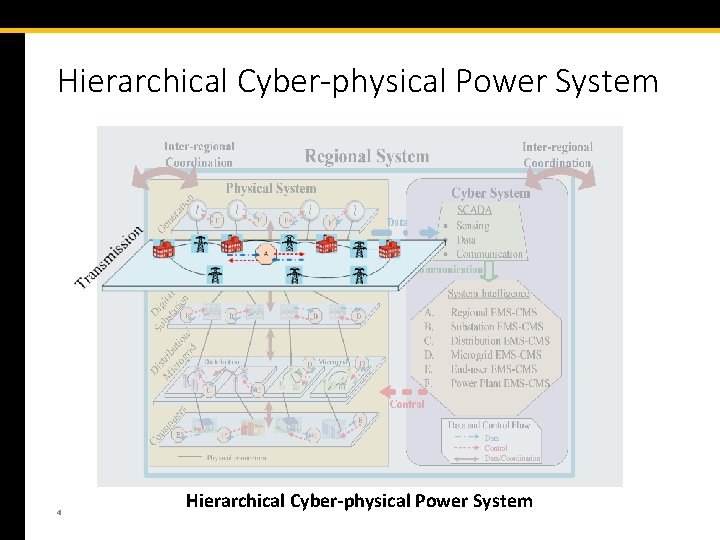
Hierarchical Cyber-physical Power System 4 Hierarchical Cyber-physical Power System
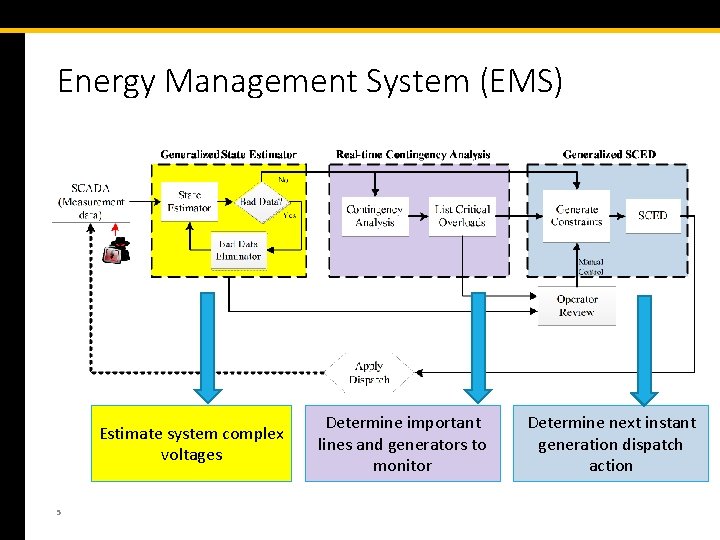
Energy Management System (EMS) Estimate system complex voltages 5 Determine important lines and generators to monitor Determine next instant generation dispatch action
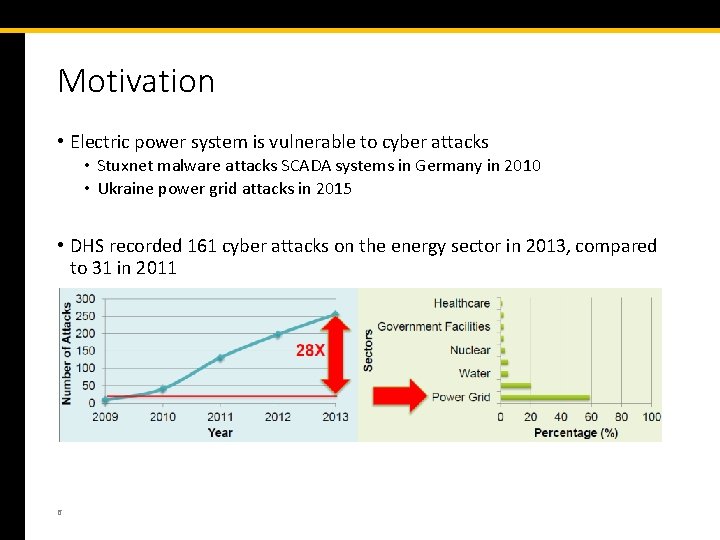
Motivation • Electric power system is vulnerable to cyber attacks • Stuxnet malware attacks SCADA systems in Germany in 2010 • Ukraine power grid attacks in 2015 • DHS recorded 161 cyber attacks on the energy sector in 2013, compared to 31 in 2011 6

Ukraine Cyber Attack • Cyber attack against Ukraine power grid illuminated the urgency of prognosis of cyber attacks on open-source EMS platform Can cascading outages and failures be achieved by intelligent attacks on the cyber-infrastructure of electric power systems? Antiy Labs, “Comprehensive analysis report on Ukraine power system attacks, ” March 2016. [Online]. Available: http: //www. antiy. net/p/comprehensive-analysis-report-on-ukraine-power-system-attacks/ 7
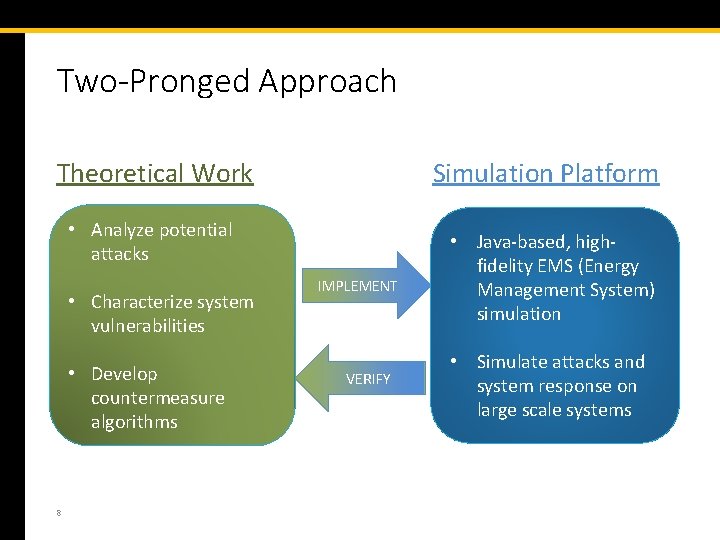
Two-Pronged Approach Simulation Platform Theoretical Work • Analyze potential attacks • Characterize system vulnerabilities • Develop countermeasure algorithms 8 IMPLEMENT VERIFY • Java-based, highfidelity EMS (Energy Management System) simulation • Simulate attacks and system response on large scale systems
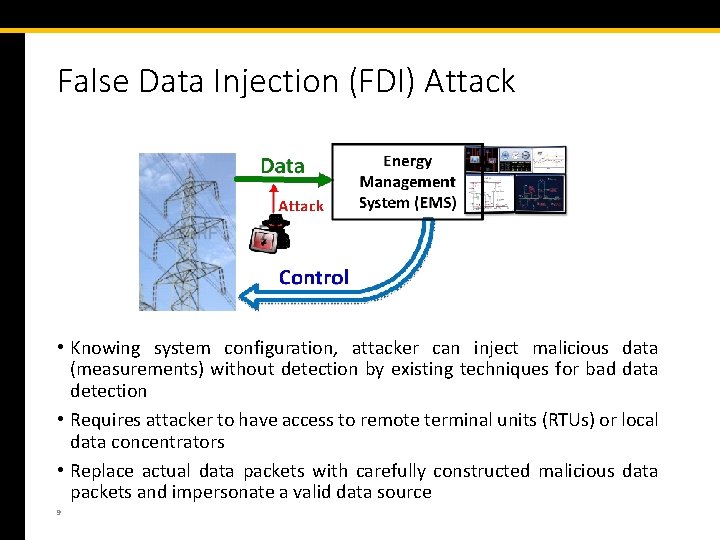
False Data Injection (FDI) Attack • Knowing system configuration, attacker can inject malicious data (measurements) without detection by existing techniques for bad data detection • Requires attacker to have access to remote terminal units (RTUs) or local data concentrators • Replace actual data packets with carefully constructed malicious data packets and impersonate a valid data source 9
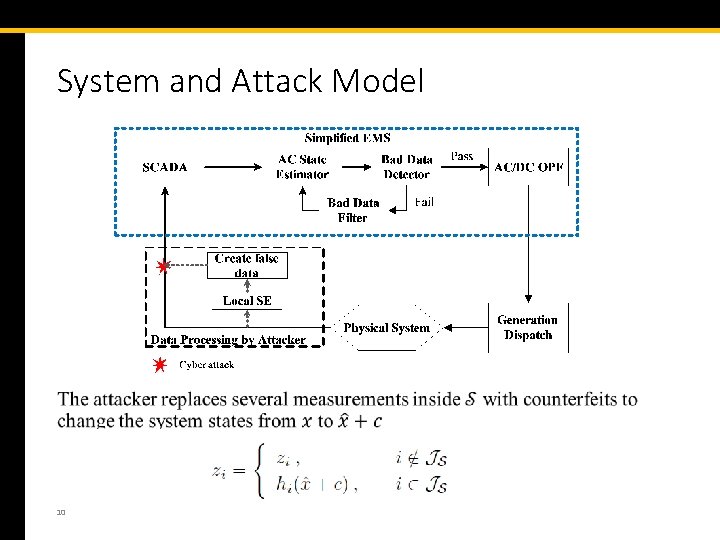
System and Attack Model 10
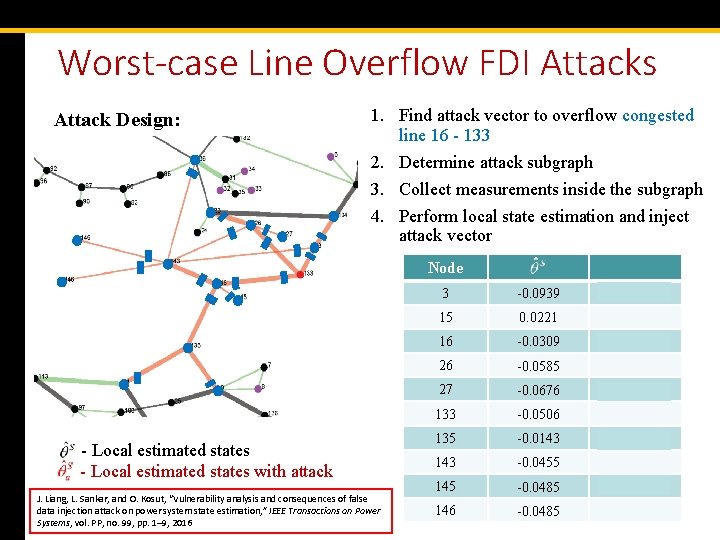
Worst-case Line Overflow FDI Attacks Attack Design: 1. Find attack vector to overflow congested line 16 - 133 2. Determine attack subgraph 3. Collect measurements inside the subgraph 4. Perform local state estimation and inject attack vector Node - Local estimated states with attack J. Liang, L. Sankar, and O. Kosut, “Vulnerability analysis and consequences of false data injection attack on power system state estimation, ” IEEE Transactions on Power Systems, vol. PP, no. 99, pp. 1– 9, 2016 3 -0. 0939 -0. 0930 15 0. 0221 0. 0211 16 -0. 0309 -0. 0318 26 -0. 0585 -0. 0580 27 -0. 0676 -0. 0652 133 -0. 0506 -0. 0508 135 -0. 0143 -0. 0150 143 -0. 0455 -0. 0470 145 -0. 0485 -0. 0506 146 -0. 0485 -0. 0506

Worst-case Line Overflow FDI Attacks Attack Design: 6. 12 Calculate and inject false measurements - Actual from side line flow measurements - False from side line flow measurements Line (MW) 135 – 1 -361. 41 -365. 96 3 – 133 -312. 65 -304. 98 134 – 3 264. 05 259. 85 3 – 143 -346. 65 -329. 89 9 – 135 -126. 72 -122. 63 16 – 15 -536. 97 -535. 92 133 – 16 -359. 15 -346. 74 16 – 135 -199. 93 -203. 06 143 – 16 -270. 76 -281. 56 23 – 26 64. 40 59. 29 26 – 27 89. 79 72. 00 26 – 133 -45. 05 -40. 38 26 – 143 -74. 23 -61. 87 36 – 143 150. 43 151. 78 143 – 145 4. 89 5. 87 143 – 146 4. 89 5. 87
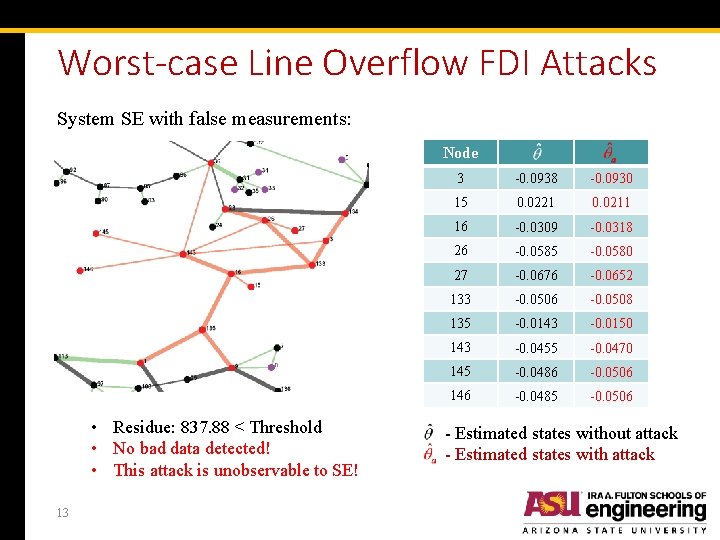
Worst-case Line Overflow FDI Attacks System SE with false measurements: Node • Residue: 837. 88 < Threshold • No bad data detected! • This attack is unobservable to SE! 13 3 -0. 0938 -0. 0930 15 0. 0221 0. 0211 16 -0. 0309 -0. 0318 26 -0. 0585 -0. 0580 27 -0. 0676 -0. 0652 133 -0. 0506 -0. 0508 135 -0. 0143 -0. 0150 143 -0. 0455 -0. 0470 145 -0. 0486 -0. 0506 146 -0. 0485 -0. 0506 - Estimated states without attack - Estimated states with attack
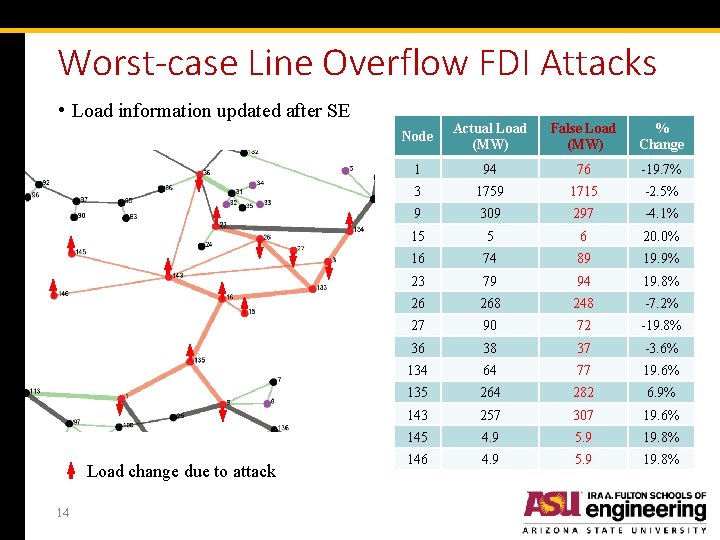
Worst-case Line Overflow FDI Attacks • Load information updated after SE Load change due to attack 14 Node Actual Load (MW) False Load (MW) % Change 1 94 76 -19. 7% 3 1759 1715 -2. 5% 9 309 297 -4. 1% 15 5 6 20. 0% 16 74 89 19. 9% 23 79 94 19. 8% 26 268 248 -7. 2% 27 90 72 -19. 8% 36 38 37 -3. 6% 134 64 77 19. 6% 135 264 282 6. 9% 143 257 307 19. 6% 145 4. 9 5. 9 19. 8% 146 4. 9 5. 9 19. 8%
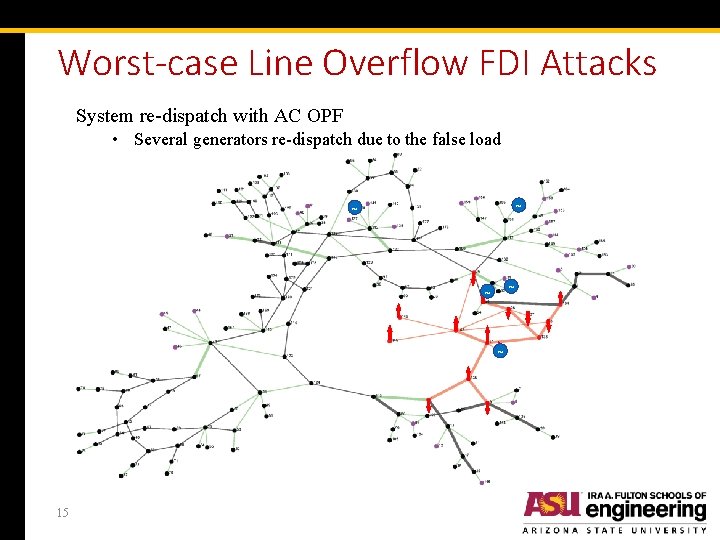
Worst-case Line Overflow FDI Attacks System re-dispatch with AC OPF • Several generators re-dispatch due to the false load ~ ~ ~ 15
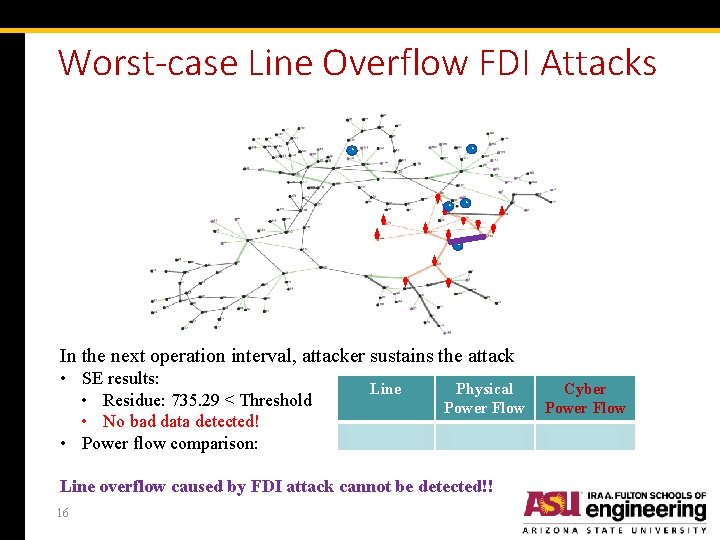
Worst-case Line Overflow FDI Attacks ~ ~ ~ In the next operation interval, attacker sustains the attack • SE results: • Residue: 735. 29 < Threshold • No bad data detected! • Power flow comparison: Line Physical Power Flow Cyber Power Flow 171 & 172 103. 62% 100% Line overflow caused by FDI attack cannot be detected!! 16
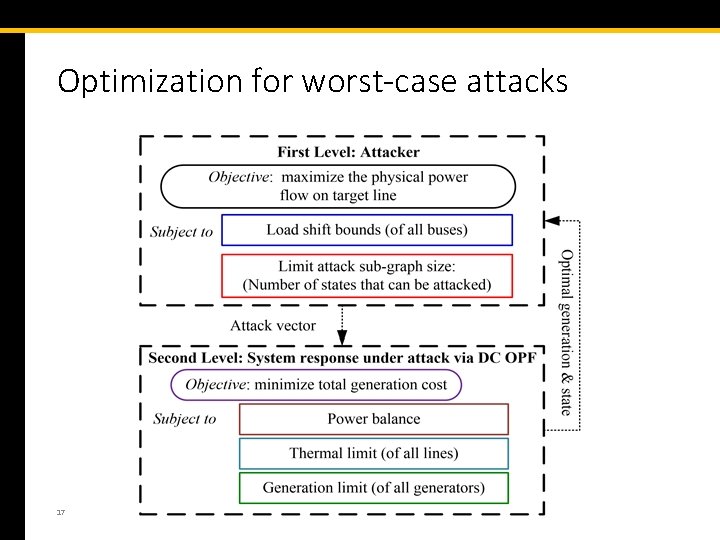
Optimization for worst-case attacks 17
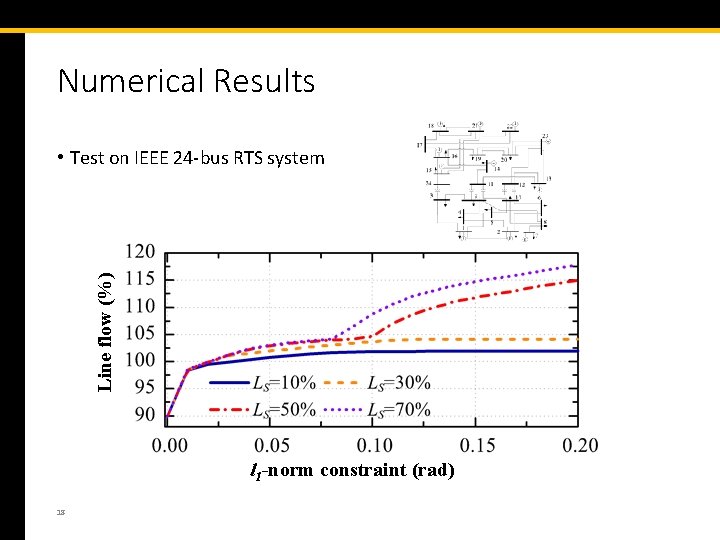
Numerical Results Line flow (%) • Test on IEEE 24 -bus RTS system l 1 -norm constraint (rad) 18
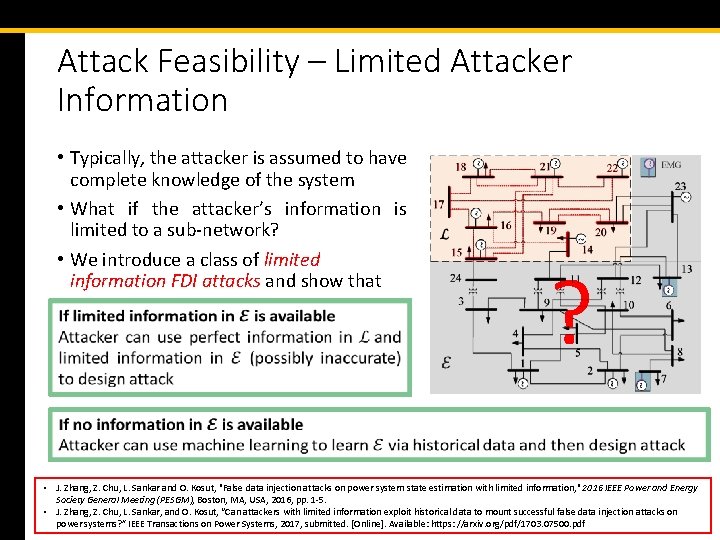
Attack Feasibility – Limited Attacker Information • Typically, the attacker is assumed to have complete knowledge of the system • What if the attacker’s information is limited to a sub-network? • We introduce a class of limited information FDI attacks and show that ? • J. Zhang, Z. Chu, L. Sankar and O. Kosut, "False data injection attacks on power system state estimation with limited information, " 2016 IEEE Power and Energy Society General Meeting (PESGM), Boston, MA, USA, 2016, pp. 1 -5. • J. Zhang, Z. Chu, L. Sankar, and O. Kosut, “Can attackers with limited information exploit historical data to mount successful false data injection attacks on power systems? ” IEEE Transactions on Power Systems, 2017, submitted. [Online]. Available: https: //arxiv. org/pdf/1703. 07500. pdf
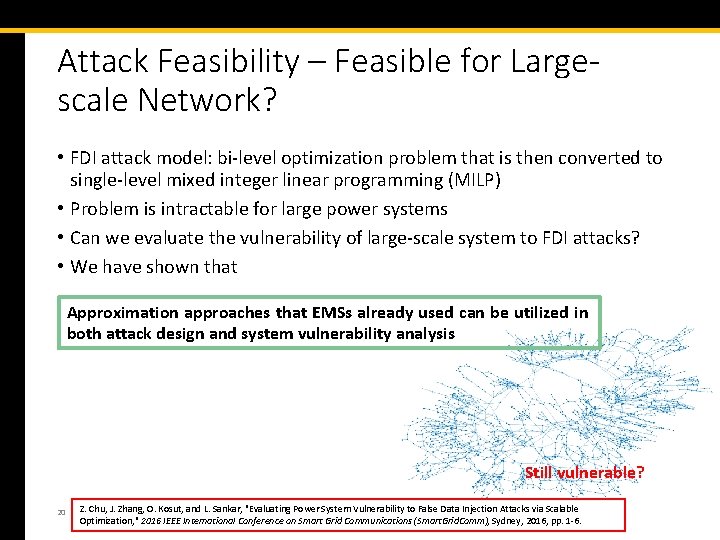
Attack Feasibility – Feasible for Largescale Network? • FDI attack model: bi-level optimization problem that is then converted to single-level mixed integer linear programming (MILP) • Problem is intractable for large power systems • Can we evaluate the vulnerability of large-scale system to FDI attacks? • We have shown that Approximation approaches that EMSs already used can be utilized in both attack design and system vulnerability analysis Still vulnerable? 20 Z. Chu, J. Zhang, O. Kosut, and L. Sankar, "Evaluating Power System Vulnerability to False Data Injection Attacks via Scalable Optimization, " 2016 IEEE International Conference on Smart Grid Communications (Smart. Grid. Comm), Sydney, 2016, pp. 1 -6.
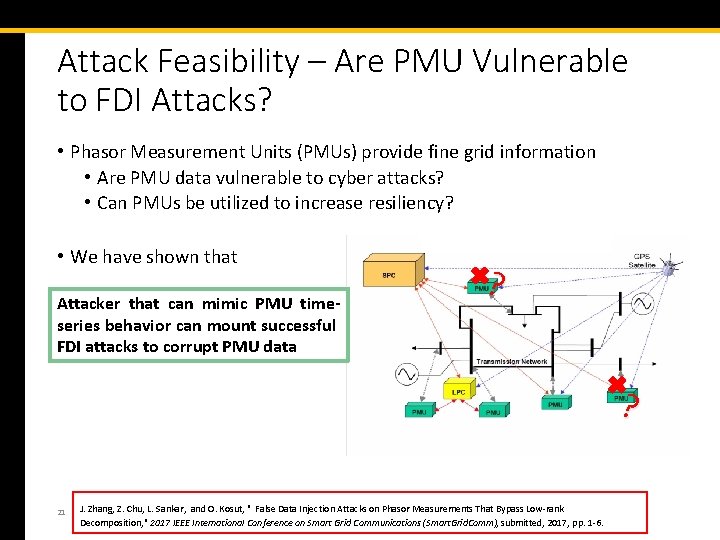
Attack Feasibility – Are PMU Vulnerable to FDI Attacks? • Phasor Measurement Units (PMUs) provide fine grid information • Are PMU data vulnerable to cyber attacks? • Can PMUs be utilized to increase resiliency? • We have shown that Attacker that can mimic PMU timeseries behavior can mount successful FDI attacks to corrupt PMU data ? ? 21 J. Zhang, Z. Chu, L. Sankar, and O. Kosut, " False Data Injection Attacks on Phasor Measurements That Bypass Low-rank Decomposition, " 2017 IEEE International Conference on Smart Grid Communications (Smart. Grid. Comm), submitted, 2017, pp. 1 -6.
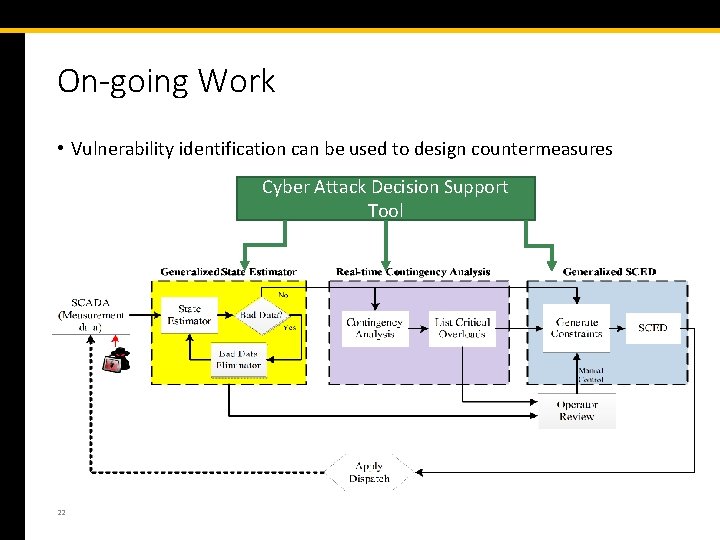
On-going Work • Vulnerability identification can be used to design countermeasures Cyber Attack Decision Support Tool 22
Publications • J. Liang, O. Kosut, and L. Sankar, “Cyber-attacks on ac state estimation: Unobservability and physical consequences, ” in IEEE PES General Meeting, Washington, DC, July 2014. • J. Zhang and L. Sankar, “Implementation of unobservable state-preserving topology attacks, ” in North American Power Symposium (NAPS), 2015, pp. 1 -6, Oct 2015. • J. Liang, L. Sankar, and O. Kosut, “Vulnerability analysis and consequences of false data injection attack on power system state estimation, ” IEEE Transactions on Power Systems, vol. 31, no. 5, pp. 3864– 3872, Sept 2016. • J. Zhang and L. Sankar, "Physical System Consequences of Unobservable State-and-Topology Cyber-Physical Attacks, " in IEEE Transactions on Smart Grid, vol. 7, no. 4, pp. 2016 -2025, July 2016. • J. Zhang, Z. Chu, L. Sankar and O. Kosut, "False data injection attacks on power system state estimation with limited information, " 2016 IEEE Power and Energy Society General Meeting (PESGM), Boston, MA, USA, 2016, pp. 1 -5. • Z. Chu, J. Zhang, O. Kosut, and L. Sankar, "Evaluating Power System Vulnerability to False Data Injection Attacks via Scalable Optimization, " 2016 IEEE International Conference on Smart Grid Communications (Smart. Grid. Comm), Sydney, 2016, pp. 1 -6. • J. Zhang, Z. Chu, L. Sankar, and O. Kosut, “Can attackers with limited information exploit historical data to mount successful false data injection attacks on power systems? ” IEEE Transactions on Power Systems, 2017, submitted. [Online]. Available: https: //arxiv. org/pdf/1703. 07500. pdf • J. Zhang, Z. Chu, L. Sankar, and O. Kosut, " False Data Injection Attacks on Phasor Measurements That Bypass Low-rank Decomposition, " 2017 IEEE International Conference on Smart Grid Communications (Smart. Grid. Comm), submitted, 2017, pp. 1 -6. 23
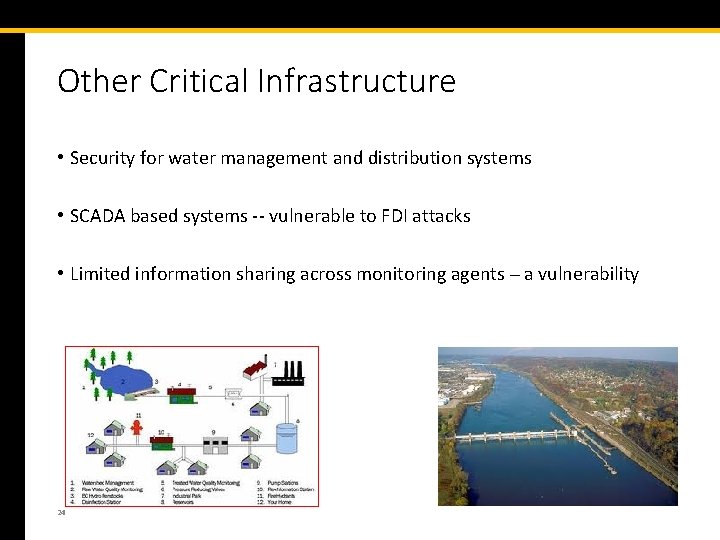
Other Critical Infrastructure • Security for water management and distribution systems • SCADA based systems -- vulnerable to FDI attacks • Limited information sharing across monitoring agents – a vulnerability 24
Privacy Challenges in the Smart Grid 25
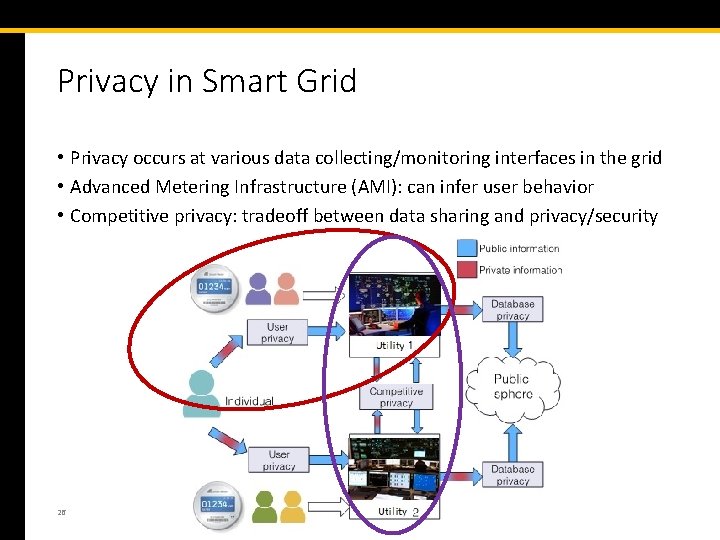
Privacy in Smart Grid • Privacy occurs at various data collecting/monitoring interfaces in the grid • Advanced Metering Infrastructure (AMI): can infer user behavior • Competitive privacy: tradeoff between data sharing and privacy/security 26
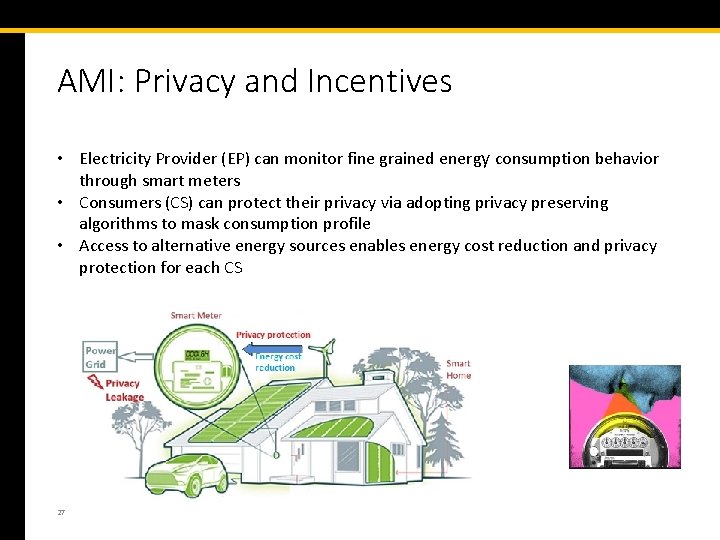
AMI: Privacy and Incentives • Electricity Provider (EP) can monitor fine grained energy consumption behavior through smart meters • Consumers (CS) can protect their privacy via adopting privacy preserving algorithms to mask consumption profile • Access to alternative energy sources enables energy cost reduction and privacy protection for each CS 27
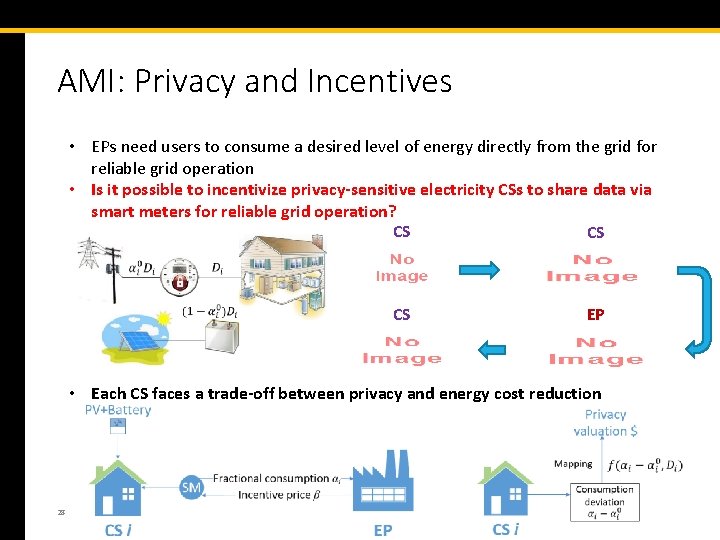
AMI: Privacy and Incentives • EPs need users to consume a desired level of energy directly from the grid for reliable grid operation • Is it possible to incentivize privacy-sensitive electricity CSs to share data via smart meters for reliable grid operation? CS CS CS EP • Each CS faces a trade-off between privacy and energy cost reduction 28
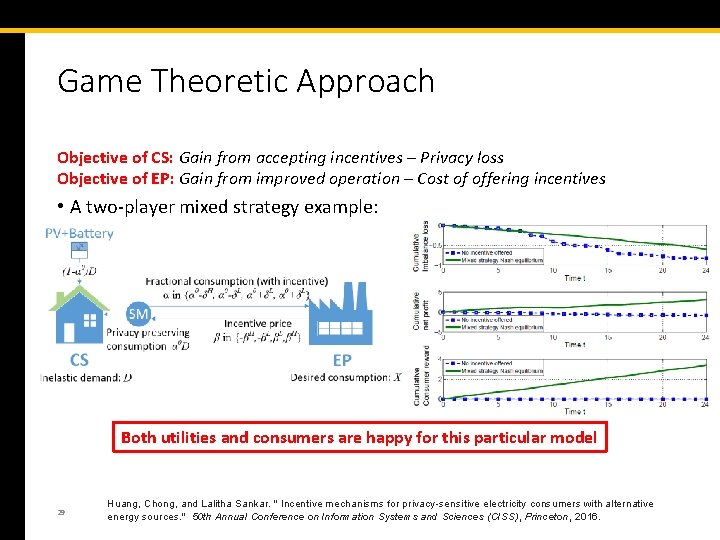
Game Theoretic Approach Objective of CS: Gain from accepting incentives – Privacy loss Objective of EP: Gain from improved operation – Cost of offering incentives • A two-player mixed strategy example: Both utilities and consumers are happy for this particular model 29 Huang, Chong, and Lalitha Sankar. " Incentive mechanisms for privacy-sensitive electricity consumers with alternative energy sources. " 50 th Annual Conference on Information Systems and Sciences (CISS), Princeton, 2016.
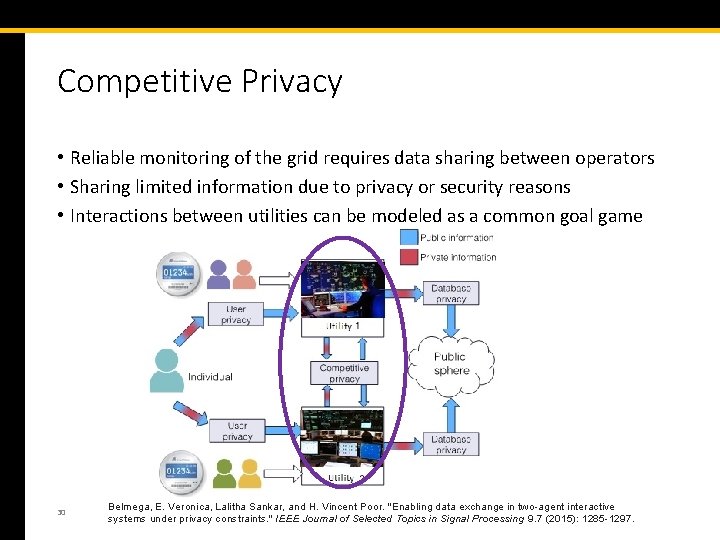
Competitive Privacy • Reliable monitoring of the grid requires data sharing between operators • Sharing limited information due to privacy or security reasons • Interactions between utilities can be modeled as a common goal game 30 Belmega, E. Veronica, Lalitha Sankar, and H. Vincent Poor. "Enabling data exchange in two-agent interactive systems under privacy constraints. " IEEE Journal of Selected Topics in Signal Processing 9. 7 (2015): 1285 -1297.
Thank you! http: //sankar. engineering. asu. edu/ ? 31

State of Art False data injection attack (FDI) on state estimator: Ø Y. Liu, M. K. Reiter, and P. Ning, “False data injection attacks against state estimation in electric power grids, ” Proceedings of the 16 th ACM Conference on Computer and Communications Security, 2009. Ø Y. Mo and B. Sinopoli. False data injection attacks in cyber physical systems. In First Workshop on Secure Control Systems, Stockholm, Sweden, April 2010. Ø Kosut, L. Jia, R. J. Thomas, and L. Tong, “Malicious data attacks on the smart grid, ” IEEE Transactions on Smart Grid, vol. 2, no. 4, pp. 645– 658, 2011. Ø G. Hug and J. A. Giampapa, “Vulnerability assessment of AC state estimation with respect to false data injection cyber-attacks, ” IEEE Trans. Smart Grid, vol. 3, no. 3, pp. 1362– 1370, 2012. 32
State of Art Mi. M attack on generation control: Ø S. Sridhar and M. Govindarasu, “Model-based attack detection and mitigation for automatic generation control, ” IEEE Transactions on Smart Grid, vol. 5, no. 2, pp. 580– 591, 2014. Ø J. Wei, D. Kundur, T. Zourntos, and K. Butler-Purry, “A flocking-based dynamical systems paradigm for smart power system analysis, ” in Power and Energy Society General Meeting, 2012 IEEE, 2012, pp. 1– 8. Mi. M attack on electric market: Ø L. Xie, Y. Mo, and B. Sinopoli, “Integrity data attacks in power market operations, ” IEEE Transactions on Smart Grid, vol. 2, no. 4, pp. 659– 666, 2011. Ø D. -H. Choi and L. Xie, "Impact analysis of locational marginal price subject to power system topology errors, " in Smart Grid Communications (Smart. Grid. Comm), 2013 IEEE International Conference on, 2013. Ø L. Jia, J. Kim, R. J. Thomas, and L. Tong, “Impact of data quality on real-time locational marginal price, ” IEEE Trans. Power Systems, vol. 29, no. 2, pp. 627– 636, 2014. 33
State of Art Mi. M attack on power system topology: Ø J. Kim and L. Tong, “On topology attack of a smart grid: Undetectable attacks and countermeasures, ” IEEE Transactions on Smart Grid, vol. 31, no. 7, pp. 1294– 1305, 2013. Ø M. A. Rahman, E. Al-Shaer, “Impact Analysis of Topology Poisoning Attacks on Economic Operation of the Smart Power Grid, ” in Proceedings of IEEE Distributed Computing Systems (ICDCS), Madrid, Spain, July, 2014. Ø A. Ashok and M. Govindarasu, “Cyber Attacks on Power System State Estimation through Topology Errors, ” in Proceedings of IEEE PES General Meeting, San Diego, CA, USA, July, 2012. Implication Analysis for Cyber attack in power system: Ø J. Liang, O. Kosut, and L. Sankar, “Cyber-attacks on ac state estimation: Unobservability and physical consequences, ” in IEEE PES General Meeting, Washington, DC, July 2014. Ø A. Teixeira, S. Amin, H. Sandberg, K. Johansson, and S. Sastry, “Cyber security analysis of state estimators in electric power systems, ” in 2010 49 th IEEE Conference on Decision and Control (CDC), 2010, pp. 5991– 5998. Ø J. Zhang, L. Sankar and K. W. Hedman, "Implications of Cyber Attacks on Distributed Power System Operations, " in CIGRE Grid of the Future Symposium, 2014. 34
- Slides: 34