
Cybernetics and Robotics Dr Richard Mitchell Senior Lecturer
Cybernetics and Robotics Dr Richard Mitchell Senior Lecturer in Cybernetics Director of Teaching & Learning for the School of Systems Engineering University of Reading, UK © Dr Richard Mitchell 2009
Cybernetics and Robotics Cybernetics is the study of systems - technological, animal, economic or environmental –interdisciplinary. 60 years since Wiener’s book was published, it is even more appropriate and applicable The aim of this talk is to give an overview of the subject, show some recent / current work here, and to consider briefly where the subject is going. Various concepts and applications are considered, including Robotics, but also the use of technology to help in medicine, intelligence and Gaia hypothesis. © Dr Richard Mitchell 2009
Cybernetics ‘Cybernetics’ is derived from the Greek word kybernetes meaning steersman, a person in control Ampere used the term for science of government It arose from discussions between researchers from various disciplines with common interests As the science of systems it is as relevant to the study of our effect on natural systems as to the design of complex technological systems Cybernetics encompasses related subjects Cyberneticists (eg Mc. Culloch) pioneered Control, AI. . . © Dr Richard Mitchell 2009
Definitions + Areas of Cybernetics Control & Communication in the animal & the machine “First Order” Cybernetics – for control Advanced systems – learn to control, act, etc – Cybernetics includes learning and intelligence Interacting Systems – In particular Human-Machine interactions, VR Environmental Cybernetics Gaia hypothesis These all involve feedback … © Dr Richard Mitchell 2009

Cybernetics - a Different Perspective Fundamental principles, such as feedback, applicable to a great variety of diverse systems, technological, environmental, biological, or a mixture © Dr Richard Mitchell 2009
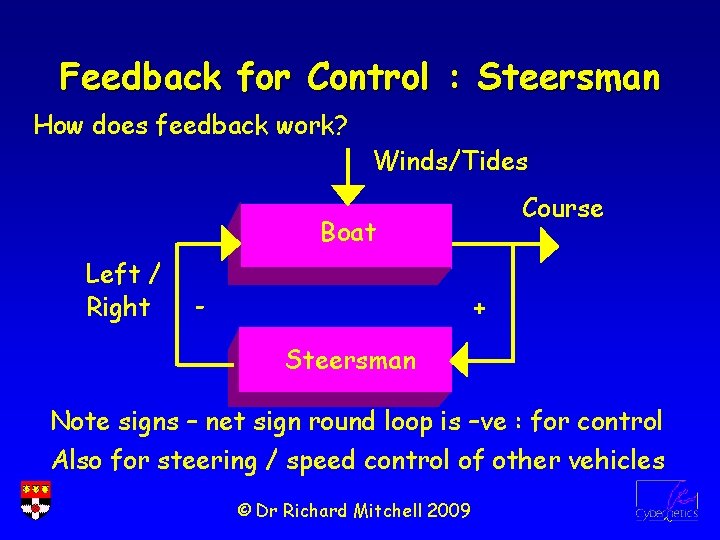
Feedback for Control : Steersman How does feedback work? Winds/Tides Course Boat Left / Right - + Steersman Note signs – net sign round loop is –ve : for control Also for steering / speed control of other vehicles © Dr Richard Mitchell 2009
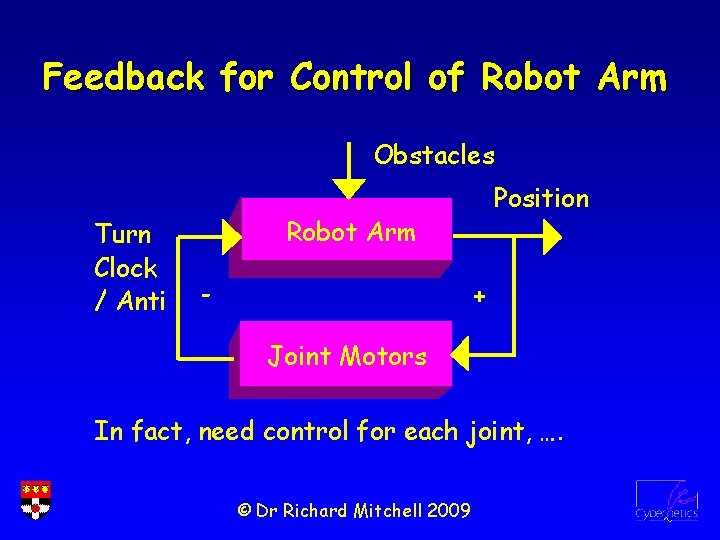
Feedback for Control of Robot Arm Obstacles Turn Clock / Anti Position Robot Arm - + Joint Motors In fact, need control for each joint, …. © Dr Richard Mitchell 2009
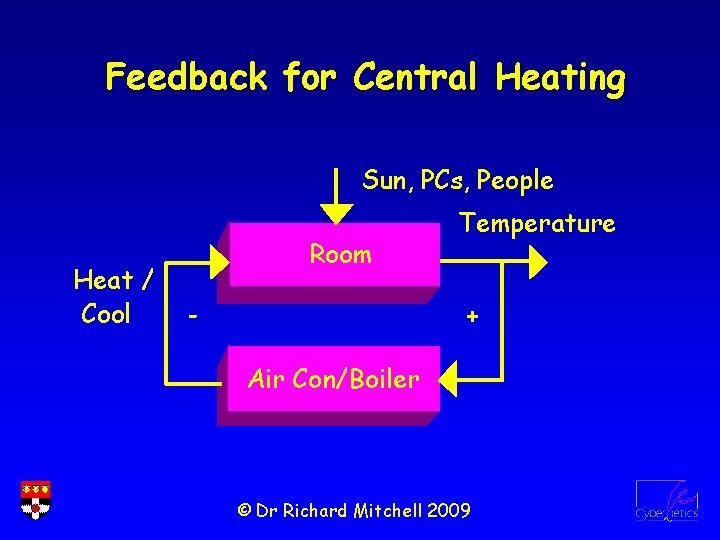
Feedback for Central Heating Sun, PCs, People Heat / Cool Room - Temperature + Air Con/Boiler © Dr Richard Mitchell 2009
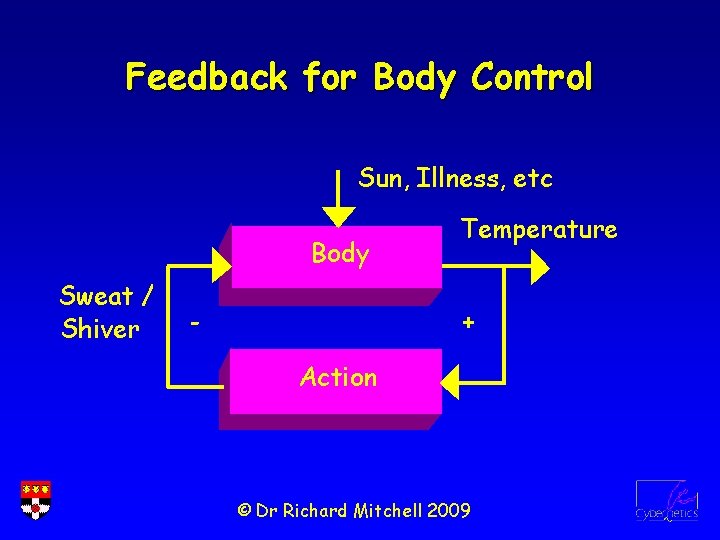
Feedback for Body Control Sun, Illness, etc Body Sweat / Shiver - Temperature + Action © Dr Richard Mitchell 2009
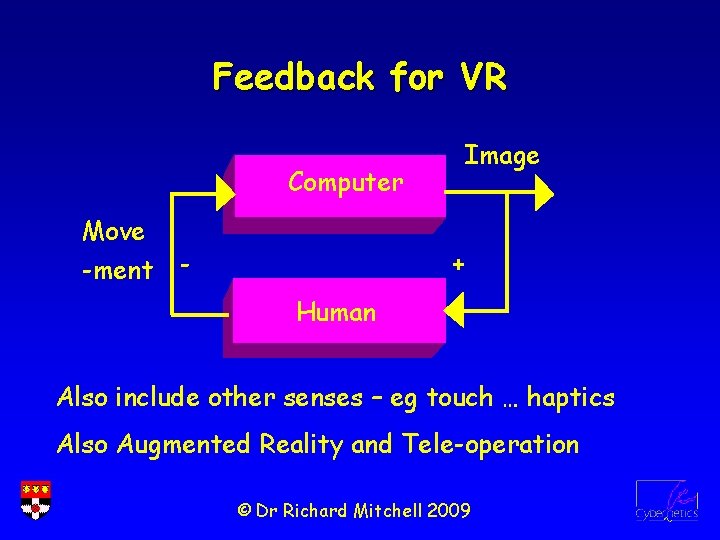
Feedback for VR Image Computer Move -ment - + Human Also include other senses – eg touch … haptics Also Augmented Reality and Tele-operation © Dr Richard Mitchell 2009
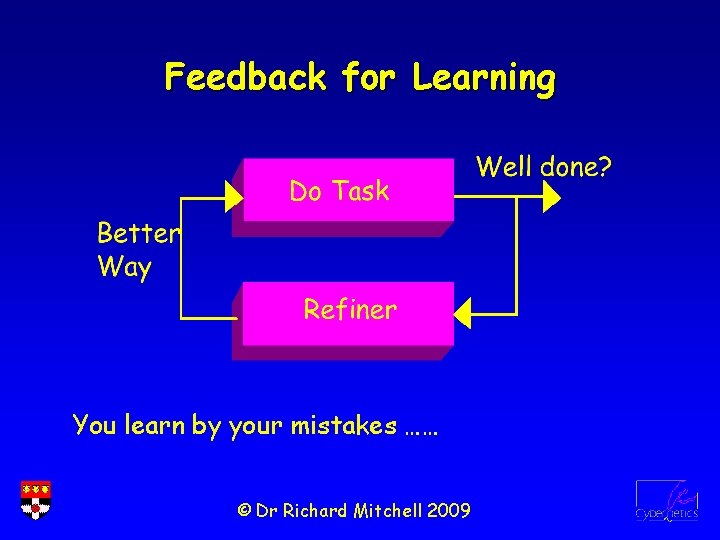
Feedback for Learning You learn by your mistakes …… © Dr Richard Mitchell 2009
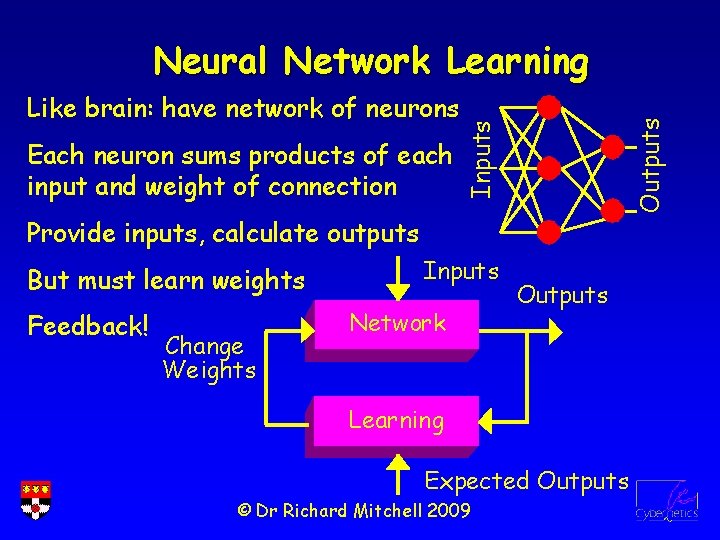
Each neuron sums products of each input and weight of connection Inputs Like brain: have network of neurons Outputs Neural Network Learning Provide inputs, calculate outputs But must learn weights Feedback! Change Weights Inputs Network Outputs Learning Expected Outputs © Dr Richard Mitchell 2009
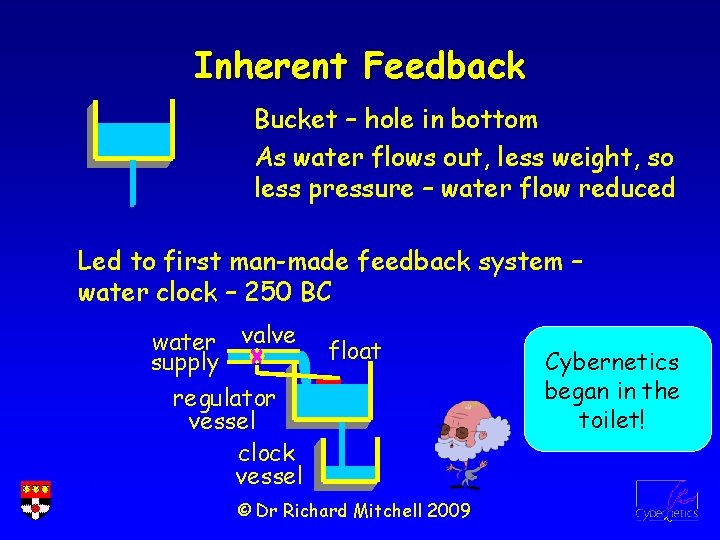
Inherent Feedback Bucket – hole in bottom As water flows out, less weight, so less pressure – water flow reduced Led to first man-made feedback system – water clock – 250 BC water valve supply float regulator vessel clock vessel © Dr Richard Mitchell 2009 Cybernetics began in the toilet!
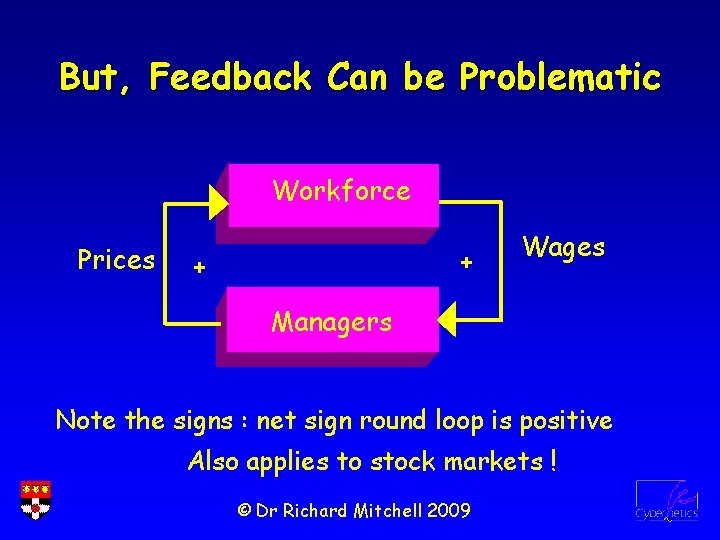
But, Feedback Can be Problematic Workforce Prices + + Wages Managers Note the signs : net sign round loop is positive Also applies to stock markets ! © Dr Richard Mitchell 2009
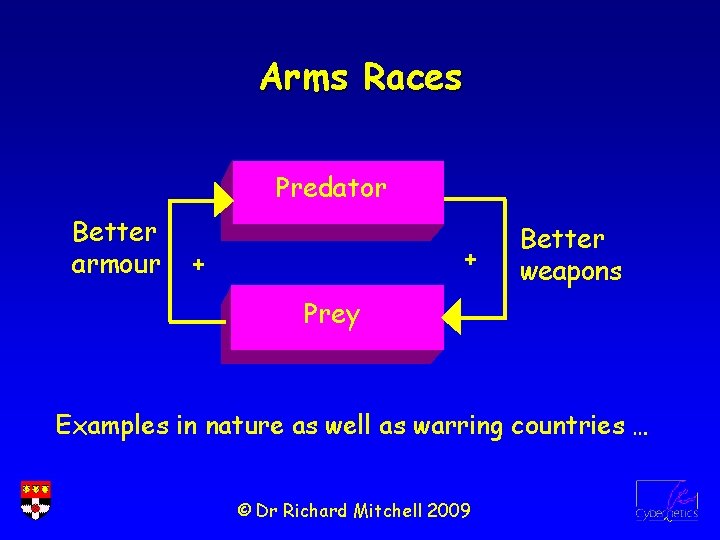
Arms Races Predator Better armour + + Better weapons Prey Examples in nature as well as warring countries … © Dr Richard Mitchell 2009
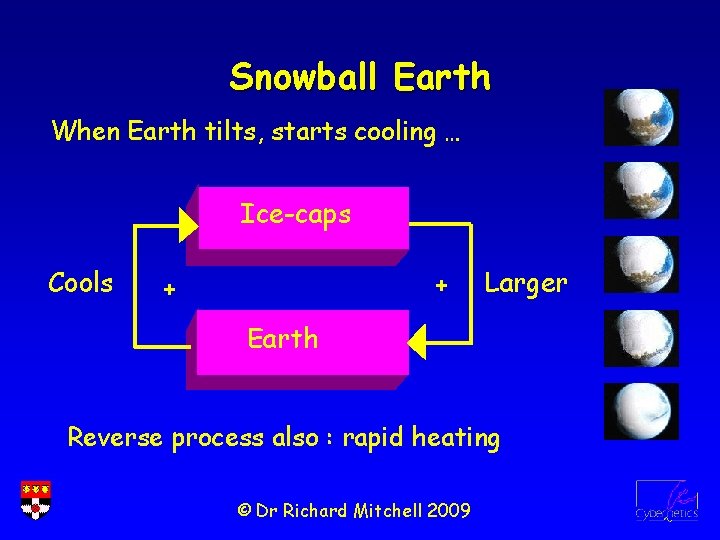
Snowball Earth When Earth tilts, starts cooling … Ice-caps Cools + + Larger Earth Reverse process also : rapid heating © Dr Richard Mitchell 2009
Positive and Negative Feedback So feedback can control – reduce disturbances Sometimes it can cause problems In fact there are two types of feedback Negative Feedback – for control Positive Feedback – for change Positive not necessarily bad if Negative also In fact, it can be used to move towards a new state and held there using negative feedback Not really done in man-made systems … © Dr Richard Mitchell 2009
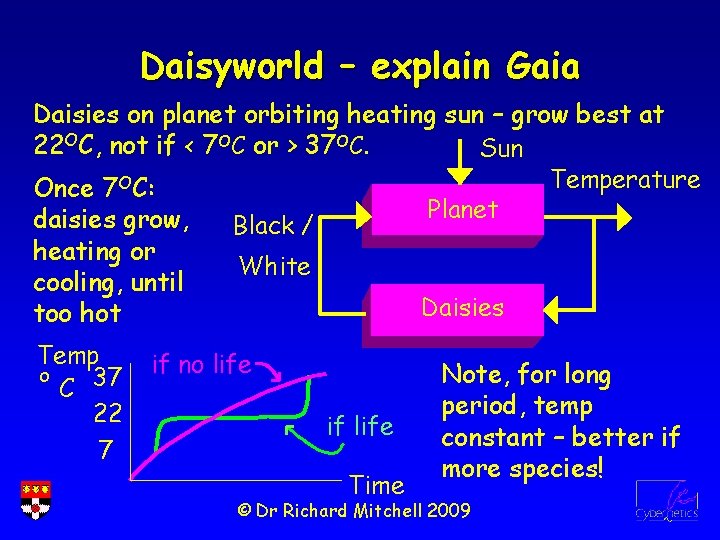
Daisyworld – explain Gaia Daisies on planet orbiting heating sun – grow best at 22 OC, not if < 7 OC or > 37 OC. Sun Temperature Once 7 OC: Planet daisies grow, Black / heating or White cooling, until Daisies too hot Temp o C 37 22 7 if no life if life Time Note, for long period, temp constant – better if more species! © Dr Richard Mitchell 2009
Some Applications There are numerous applications of Cybernetics The next three slides introduces these Then there are detailed slides with some videos etc of some work done. Some of this is at the undergraduate project level Some at staff/research level My thanks to all students/staff involved. Apologies to colleagues whose work is not there © Dr Richard Mitchell 2009
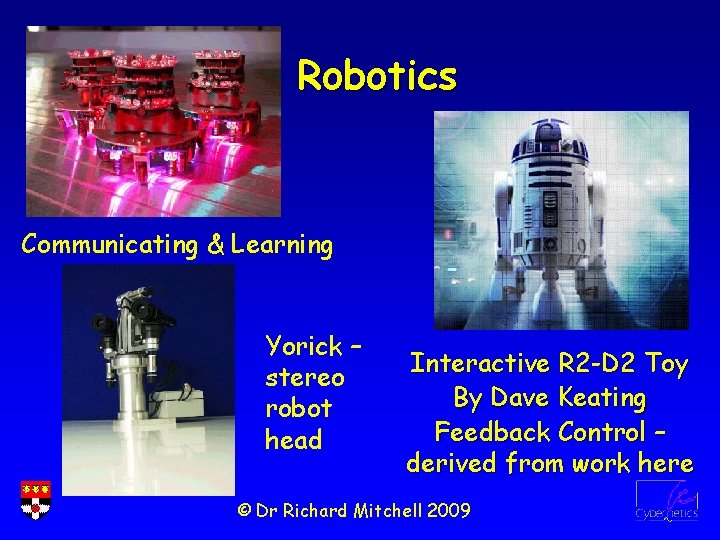
Robotics Communicating & Learning Yorick – stereo robot head Interactive R 2 -D 2 Toy By Dave Keating Feedback Control – derived from work here © Dr Richard Mitchell 2009
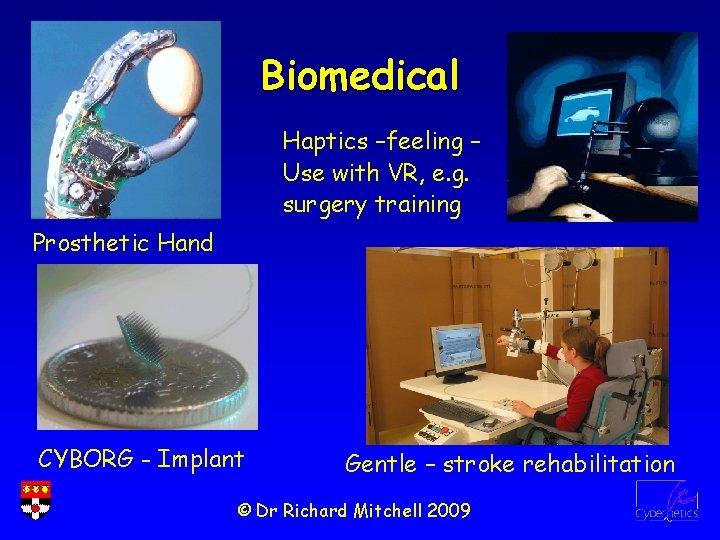
Biomedical Haptics –feeling – Use with VR, e. g. surgery training Prosthetic Hand CYBORG - Implant Gentle – stroke rehabilitation © Dr Richard Mitchell 2009
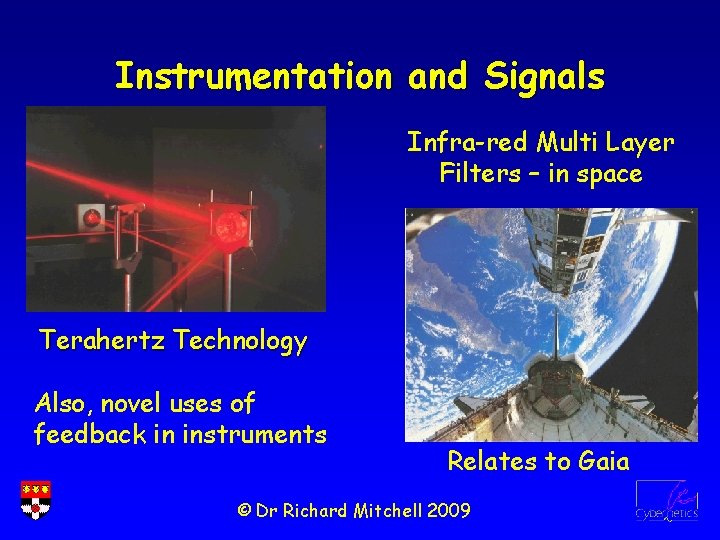
Instrumentation and Signals Infra-red Multi Layer Filters – in space Terahertz Technology Also, novel uses of feedback in instruments Relates to Gaia © Dr Richard Mitchell 2009
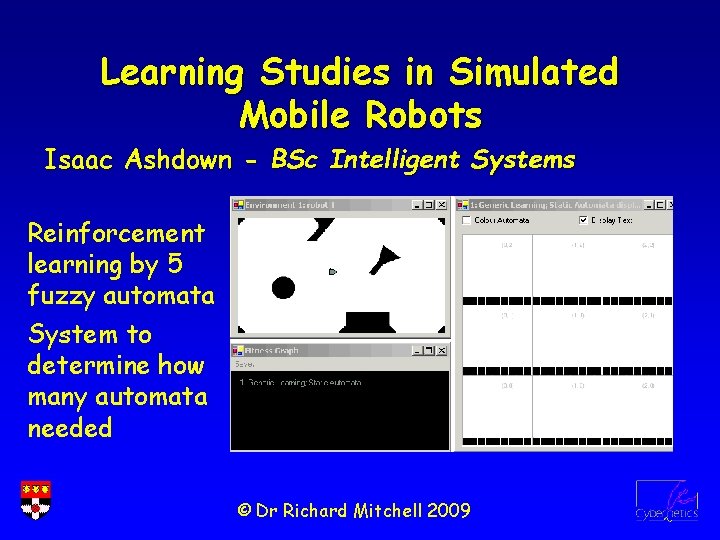
Learning Studies in Simulated Mobile Robots Isaac Ashdown - BSc Intelligent Systems Reinforcement learning by 5 fuzzy automata System to determine how many automata needed © Dr Richard Mitchell 2009
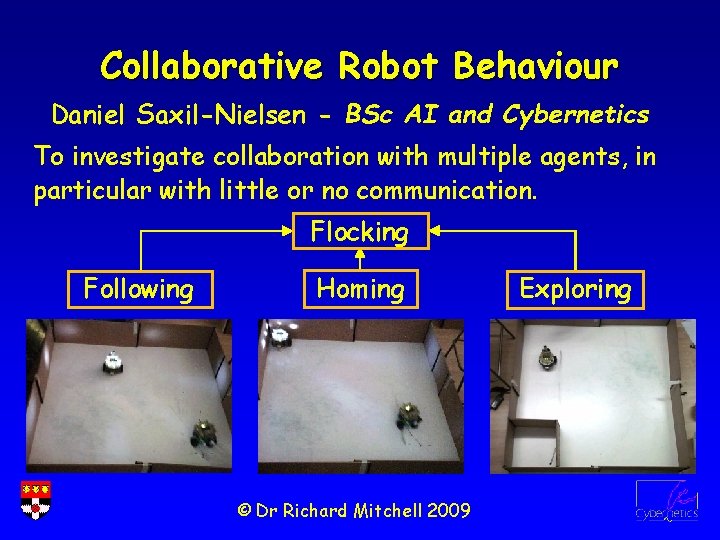
Collaborative Robot Behaviour Daniel Saxil-Nielsen - BSc AI and Cybernetics To investigate collaboration with multiple agents, in particular with little or no communication. Flocking Following Homing © Dr Richard Mitchell 2009 Exploring
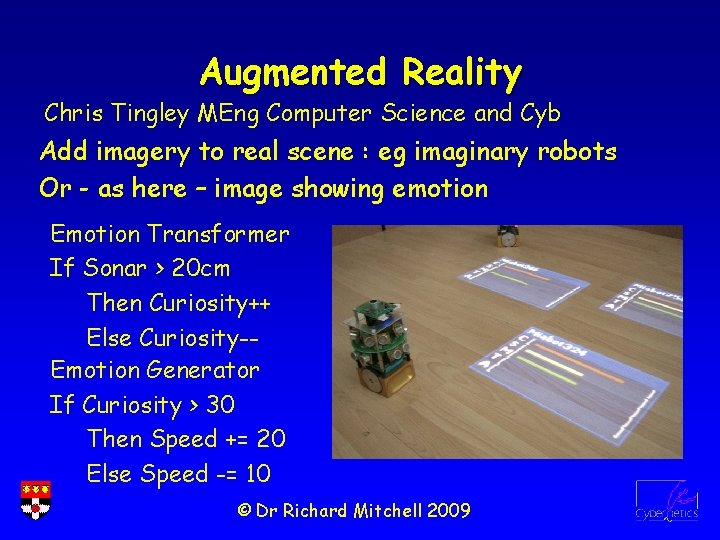
Augmented Reality Chris Tingley MEng Computer Science and Cyb Add imagery to real scene : eg imaginary robots Or - as here – image showing emotion Emotion Transformer If Sonar > 20 cm Then Curiosity++ Else Curiosity-Emotion Generator If Curiosity > 30 Then Speed += 20 Else Speed -= 10 © Dr Richard Mitchell 2009
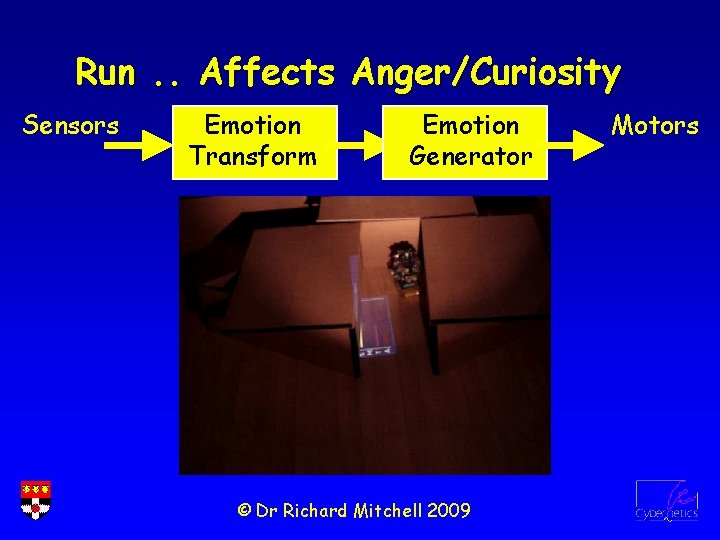
Run. . Affects Anger/Curiosity Sensors Emotion Transform Emotion Generator © Dr Richard Mitchell 2009 Motors
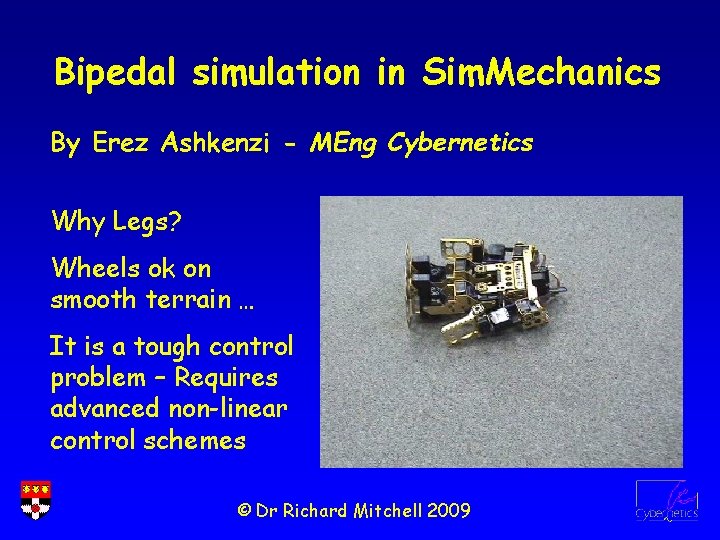
Bipedal simulation in Sim. Mechanics By Erez Ashkenzi - MEng Cybernetics Why Legs? Wheels ok on smooth terrain … It is a tough control problem – Requires advanced non-linear control schemes © Dr Richard Mitchell 2009
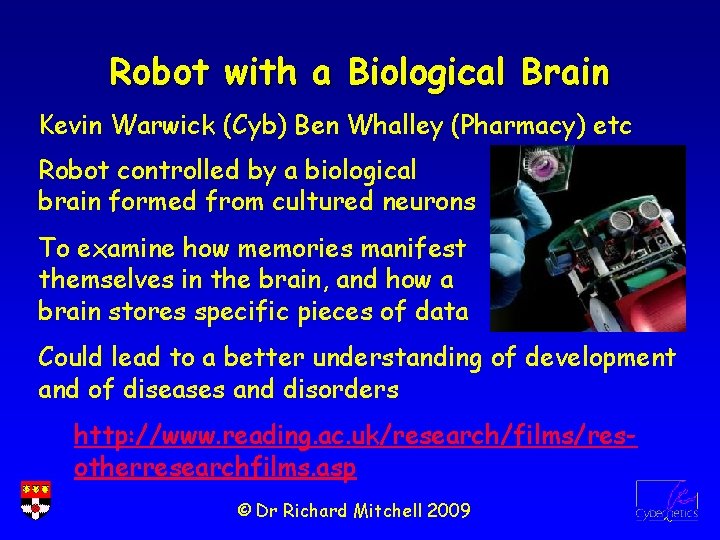
Robot with a Biological Brain Kevin Warwick (Cyb) Ben Whalley (Pharmacy) etc Robot controlled by a biological brain formed from cultured neurons To examine how memories manifest themselves in the brain, and how a brain stores specific pieces of data Could lead to a better understanding of development and of diseases and disorders http: //www. reading. ac. uk/research/films/resotherresearchfilms. asp © Dr Richard Mitchell 2009
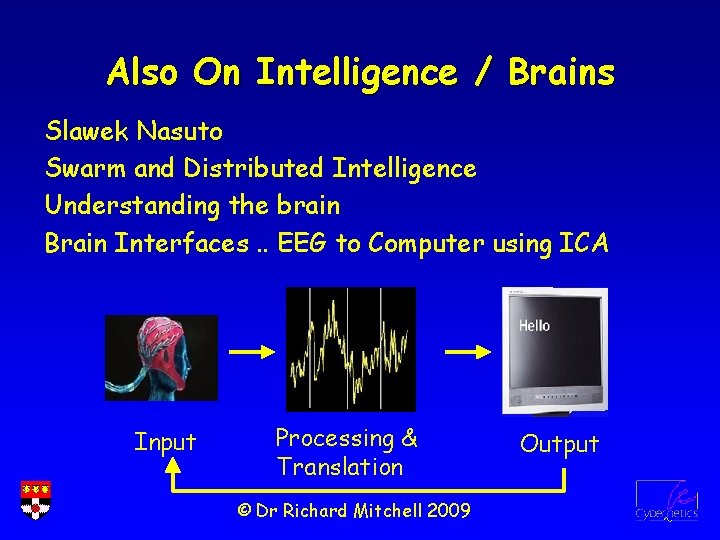
Also On Intelligence / Brains Slawek Nasuto Swarm and Distributed Intelligence Understanding the brain Brain Interfaces. . EEG to Computer using ICA Input Processing & Translation © Dr Richard Mitchell 2009 Output
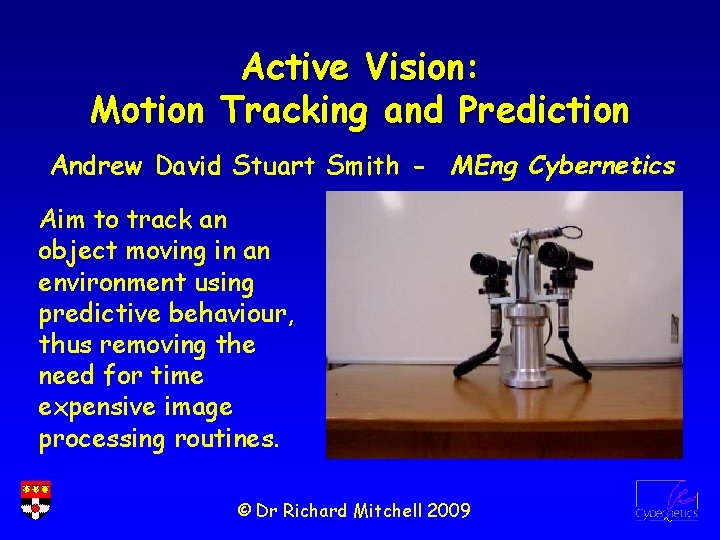
Active Vision: Motion Tracking and Prediction Andrew David Stuart Smith - MEng Cybernetics Aim to track an object moving in an environment using predictive behaviour, thus removing the need for time expensive image processing routines. © Dr Richard Mitchell 2009
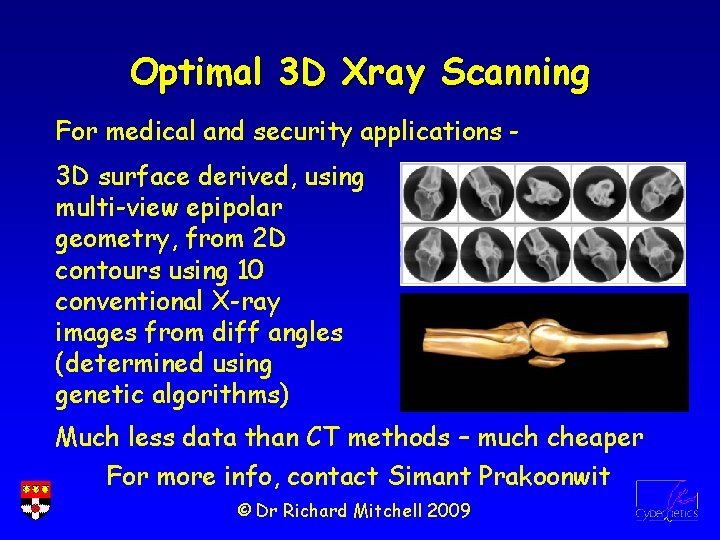
Optimal 3 D Xray Scanning For medical and security applications 3 D surface derived, using multi-view epipolar geometry, from 2 D contours using 10 conventional X-ray images from diff angles (determined using genetic algorithms) Much less data than CT methods – much cheaper For more info, contact Simant Prakoonwit © Dr Richard Mitchell 2009
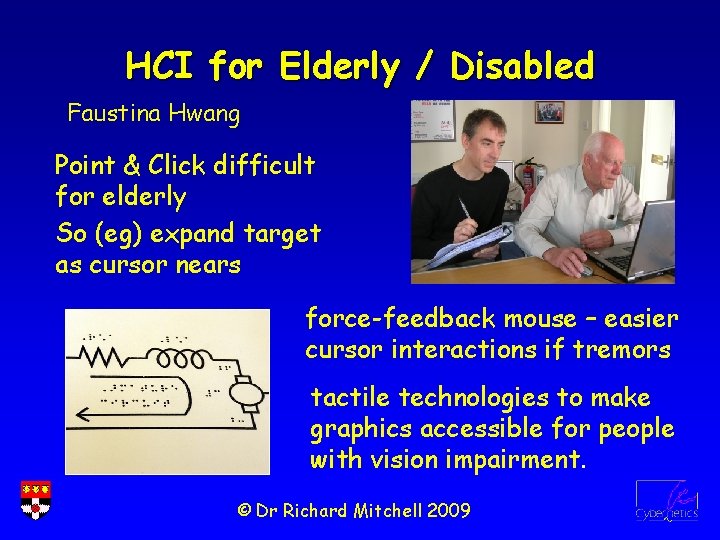
HCI for Elderly / Disabled Faustina Hwang Point & Click difficult for elderly So (eg) expand target as cursor nears force-feedback mouse – easier cursor interactions if tremors tactile technologies to make graphics accessible for people with vision impairment. © Dr Richard Mitchell 2009
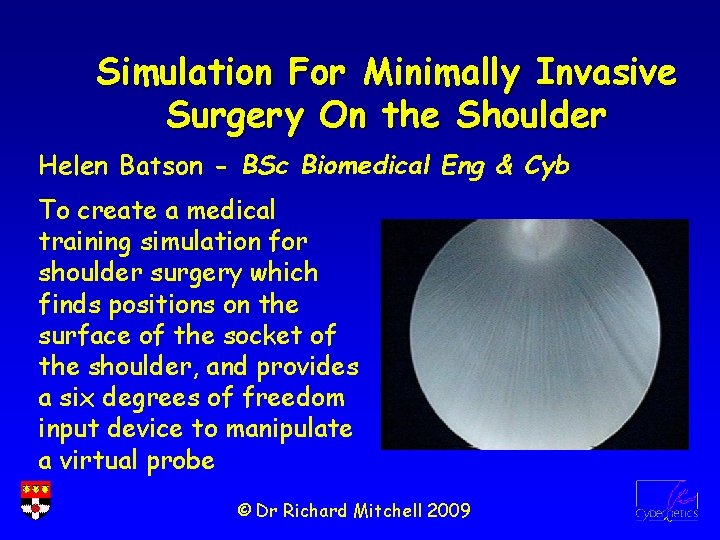
Simulation For Minimally Invasive Surgery On the Shoulder Helen Batson - BSc Biomedical Eng & Cyb To create a medical training simulation for shoulder surgery which finds positions on the surface of the socket of the shoulder, and provides a six degrees of freedom input device to manipulate a virtual probe © Dr Richard Mitchell 2009
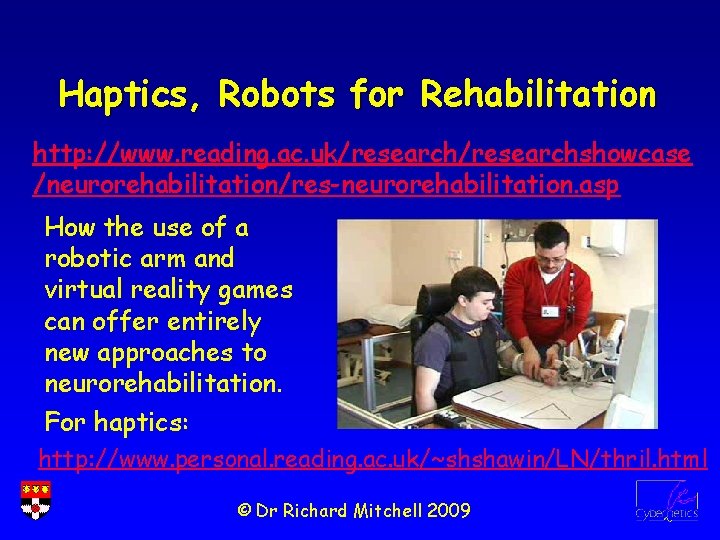
Haptics, Robots for Rehabilitation http: //www. reading. ac. uk/researchshowcase /neurorehabilitation/res-neurorehabilitation. asp How the use of a robotic arm and virtual reality games can offer entirely new approaches to neurorehabilitation. For haptics: http: //www. personal. reading. ac. uk/~shshawin/LN/thril. html © Dr Richard Mitchell 2009
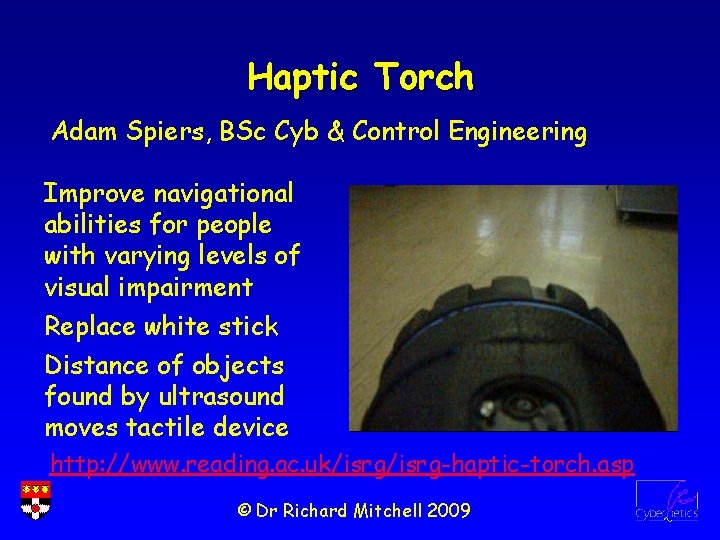
Haptic Torch Adam Spiers, BSc Cyb & Control Engineering Improve navigational abilities for people with varying levels of visual impairment Replace white stick Distance of objects found by ultrasound moves tactile device http: //www. reading. ac. uk/isrg-haptic-torch. asp © Dr Richard Mitchell 2009
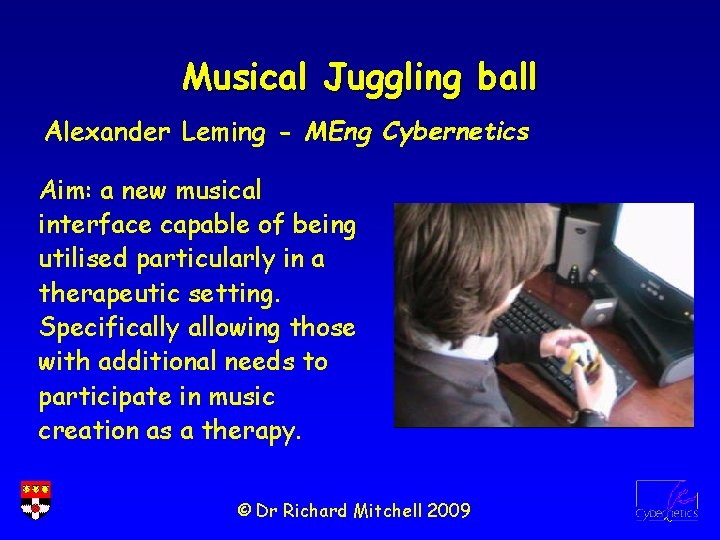
Musical Juggling ball Alexander Leming - MEng Cybernetics Aim: a new musical interface capable of being utilised particularly in a therapeutic setting. Specifically allowing those with additional needs to participate in music creation as a therapy. © Dr Richard Mitchell 2009
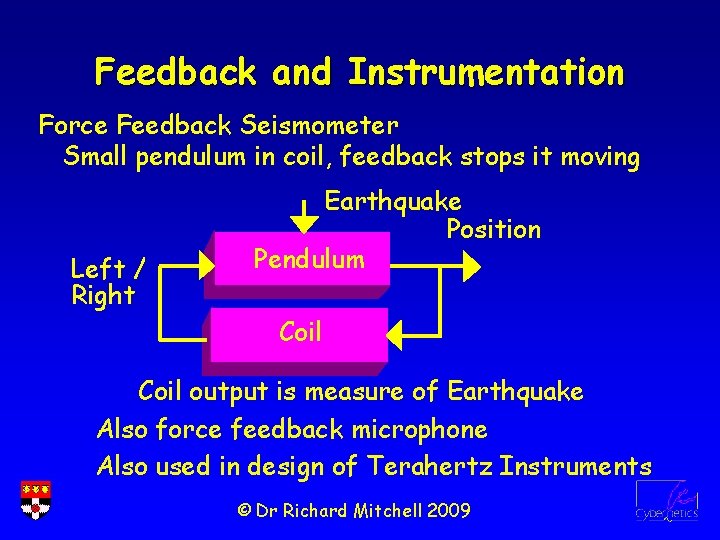
Feedback and Instrumentation Force Feedback Seismometer Small pendulum in coil, feedback stops it moving Left / Right Earthquake Position Pendulum Coil output is measure of Earthquake Also force feedback microphone Also used in design of Terahertz Instruments © Dr Richard Mitchell 2009
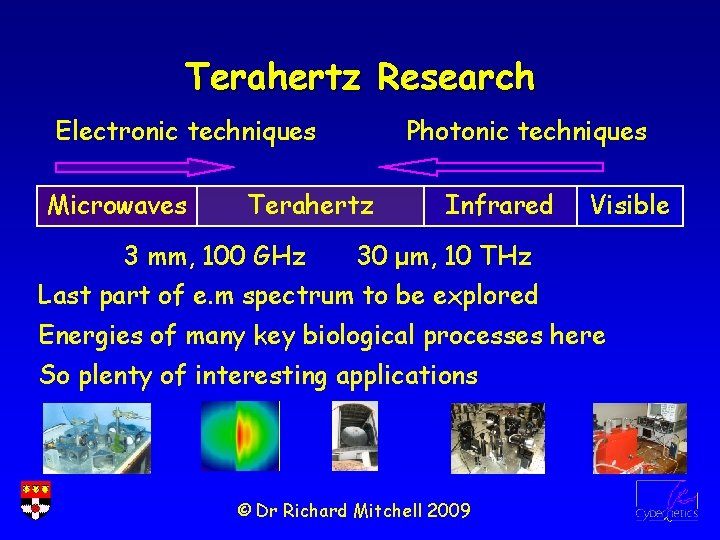
Terahertz Research Electronic techniques Microwaves Terahertz Photonic techniques Infrared Visible 3 mm, 100 GHz 30 μm, 10 THz Last part of e. m spectrum to be explored Energies of many key biological processes here So plenty of interesting applications © Dr Richard Mitchell 2009
Terahertz Applications Medical imaging – non-invasive biopsy of skin cancer Security screening –detection of concealed weapons Non-destructive testing – e. g. pharmaceuticals Plasma diagnostics Label-free DNA sequencing Radar Communications Meteorology, climatology, atmospheric chemistry Infra-Red Multi Layer Filters also allow gases in atmosphere to be determined … and this relates to Gaia hypothesis and Environmental Cybernetics © Dr Richard Mitchell 2009
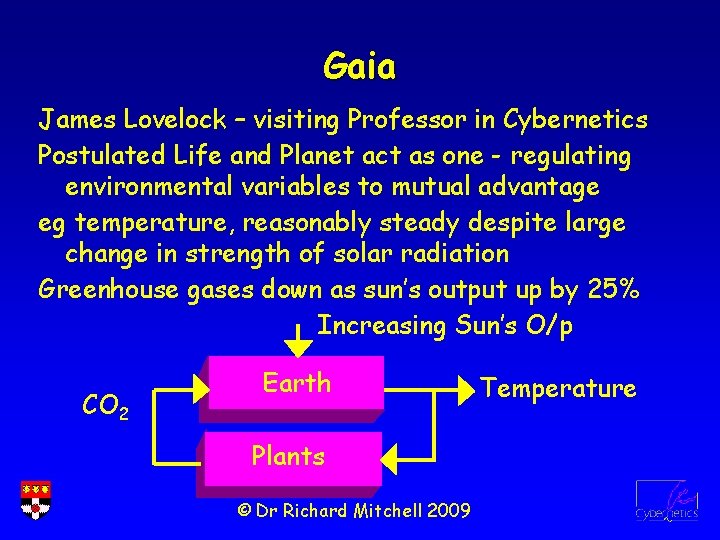
Gaia James Lovelock – visiting Professor in Cybernetics Postulated Life and Planet act as one - regulating environmental variables to mutual advantage eg temperature, reasonably steady despite large change in strength of solar radiation Greenhouse gases down as sun’s output up by 25% Increasing Sun’s O/p CO 2 Earth Plants © Dr Richard Mitchell 2009 Temperature
Climate Change and Gaia Life existed continually since began Have been major extinctions – eg snowball earth when life started – rapid drop of CO 2 + meteors So –ve feedbacks meant temp controlled well enough Now suggested that the CO 2 temp loop changed to a net positive loop … could lead to major change. Or, in 100 million years, sun so hot - no CO 2 needed – so no plants – or +ve fb move Gaia to new temp, say 25 OC, where CO 2 needed – good for plants Better Climate models now need – must include life © Dr Richard Mitchell 2009
Systems Engineering at Reading School of Systems Engineering comprises Computer Science, Informatics, Cybernetics and Electronic Engineering We offer BSc/BEng and MEng degrees in the above plus Joint degrees between subjects eg Robotics There also degrees with Business and Maths Entry Points vary … typically 320 points for MEng 280 for BSc The next Open Day is in September. © Dr Richard Mitchell 2009
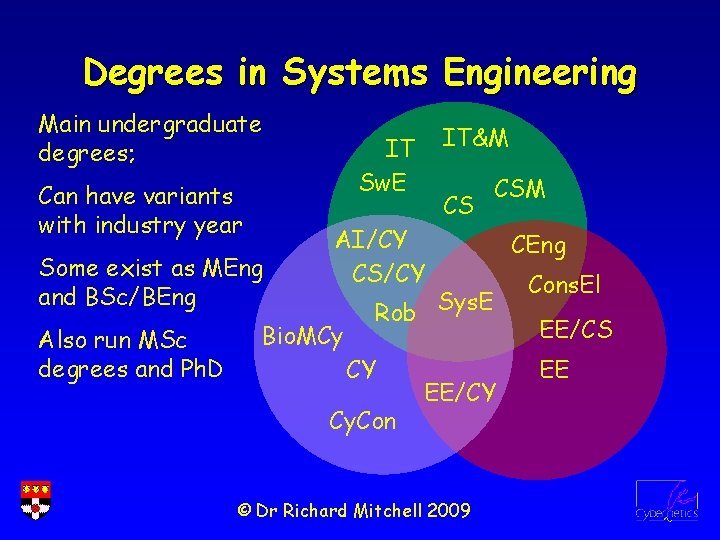
Degrees in Systems Engineering Main undergraduate degrees; Can have variants with industry year Some exist as MEng and BSc/BEng Also run MSc degrees and Ph. D IT&M IT Sw. E CS CSM AI/CY CS/CY Bio. MCy Rob Sys. E CY Cy. Con EE/CY © Dr Richard Mitchell 2009 CEng Cons. El EE/CS EE
Summary Cybernetics is a broad subject – a systems subject It is appropriate in many applications Robotics is one area But there are many more, technological and non. . You can study Cybernetics, Robotics and many more subjects at the University of Reading Any questions? © Dr Richard Mitchell 2009
- Slides: 44