
CYBER SECURITYHACKING PRESENTED BYSHITAL BANDGAR CLASS D ROLL
CYBER SECURITYHACKING PRESENTED BYSHITAL BANDGAR CLASS: D ROLL NO. : 24
Introduction The term of cyber security is used to refer to the security offered through online services to protect your online information. 2. In computers and computer networks an attack is any attempt to expose, alter, disable, destroy, steal or gain unauthorized access to or make unauthorized use of an asset. 3. A cyberattack is any type of offensive maneuver that targets computer information systems, infrastructures, computer networks, or personal computer devices. An attacker is a person or process that attempts to access data, functions or other restricted areas of the system without authorization, potentially with malicious intent. [ 1.
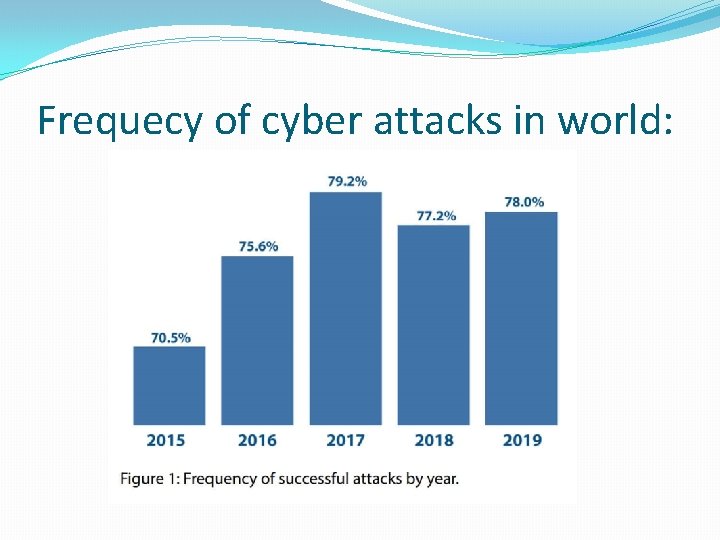
Frequecy of cyber attacks in world:
What is HACKING? �Exmine something minutely. �The rapid crafting of new program or making of changes to existing, usually complicated software. �Hacking can also refer to non-malicious activities, usually involving unusual or improvised alterations to equipment or processes.
TYPES OF HACKER WHITE HAT HACKER BLACK HAT HACKER �GOOD GUYES �USE THEIR SKILLS FOR SECURITY �DON’T USE THEIR SKILLS FOR ILLEGAL PURPOSE �BAD GUYES �USE THEIR SKILLS MILLICIOUSLY FOR PERSONAL GAIN
WHAT SHOULD DO AFTER HACKING? �Isolate Your Computer �Shutdown and Remove the Hard Drive �Scan Your Drive for Infection and Malware �Backup Your Important Files From the Previously Infected Drive �Move Your Drive Back to Your PC �Completely Wipe Your Old Hard Drive �Reload the Operating System From Trusted Media and Install Updates
WHAT SHOULD DO AFTER HACKING? �Reinstall Anti-Virus, Anti-Spyware, and Other Security Software �Scan Your Data Backup Disks for Viruses �Make a Complete Backup of Your System
HOW TO SECURE YOUR DATA? #1: Back up early and often #2: Use file-level and share-level security #3: Password-protect documents #4: Use EFS encryption #5: Use disk encryption
HOW TO SECURE YOUR DATA? #6: Make use of a public key infrastructure #7: Hide data with steganography #8: Protect data in transit with IP security #9: Secure wireless transmissions #10: Use rights management to retain control
Legal Protection: • In India Information and Technology Act 2000 was enacted and amended in 2008 covering different types of crimes under cyber law. • Article 66 A. Hacking is an offence. • Penulty : Shall be punished with imprisonment upto 3 year or fine which may extends up to 2 lakh rupees or with both.
Conclusion: Cybercrime: Yes or No? In my opinion, any sort of crime (online or offline) should never be tolerated. The safety and well-being of citizens should be safeguarded. Everyone deserves a right to live in a secure environment, no matter in real-life or on the Internet.
Cyber-criminals come up with more effective hacking methods day-by-day Companies have to make sure their security measures are kept updated and consistent To conclude, I hope that with the combined efforts of companies, banks and the authorities, we can see a drop in cyber-crime rates in 2019!

- Slides: 14